
Transitional Romantic Music Ludwig von Beethoven Ludwig von
Transitional Romantic Music Ludwig von Beethoven
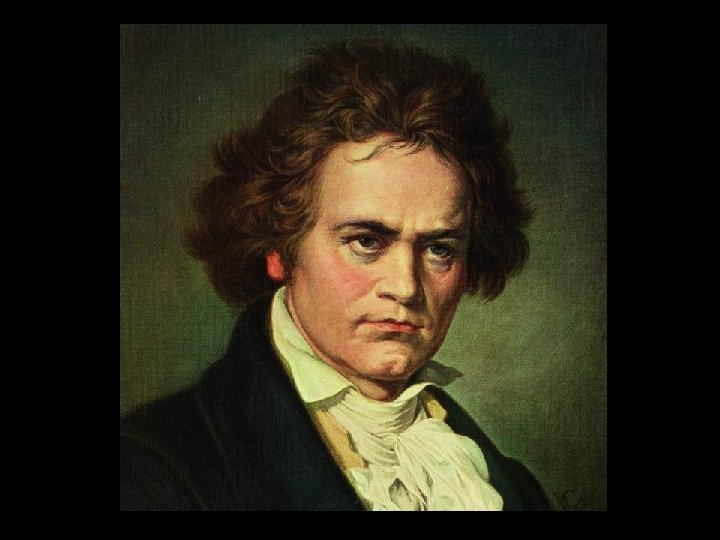
Ludwig von Beethoven • Born in Bonn, Germany on the Rhine River. • Beethoven’s father tried to make his son a child prodigy, but he failed. • He had a horrifying childhood. – Father was a raging alcoholic who beat Beethoven & his brothers. – As the oldest, Beethoven often felt he had to protect his younger siblings. – Mother died when he was young, so the boys were left with their father.
• He studied with Haydn in Vienna. – He was a regular performer for the Viennese aristocracy & nobility (but he doesn’t particularly like the nobles. ) – Works within the system. • VON: German aristocracy. • Beethoven was not a German aristocrat, but he added this to his name to enhance his standing with the noble classes of Europe.
• Beethoven was not a very good-looking guy: – Short – Bad complexion – Wild hair – Fierce look • BUT, women threw themselves at him because he was passionate about his music. • For Beethoven, composing was tedious & difficult; his music tends to be profound & sometimes disturbing for the average listener.
• He was always popular with the general public & was considered the common man’s composer. • Beethoven was not part of the patronage system; he relied on wealthy friends to help him get by; he had the freedom to compose with no deadline pressures. • He was one of the first composers to make a small profit from his music. – People commissioned him for pieces of music. • By the age of 31, he could no longer hide his hearing loss.
– No one is sure of the cause of his hearing loss. – He communicated by using little notebooks. – His hearing loss ended his career as a performer. – He withdrew from society & became a loner & very reclusive. • During this period his personal troubles & abandons composing. – His brother Caspar dies & Beethoven sues his sister -in-law for custody of his nephew, Karl. – Beethoven wins the suit & gets custody (women had little rights in this time. ) – He tries to turn Karl into a child prodigy, much like his father tried with him (same techniques, same bullying, etc. )
– Around the age 17/18, Karl attempts suicide; Beethoven’s treatment of Karl becomes known & people turn from him. – The nephew cuts off all contact with Beethoven & lives with his mother; Beethoven is rejected by the public. – For a number of years, Beethoven composes a few things but his reputation is not restored until the premiere his 9 th Symphony.
3 Periods of Beethoven’s Life 1. Young man (beginning composer, until 1802) 2. Vienna Years (1802 -1814) 3. Loss of hearing & reputation (1814 -to death)
Youth • Beethoven’s early compositions are Classical in nature & reflect the teachings of Haydn. • His music in this period is very much like what was being written by Mozart & other Classical composers. • During this period he writes the following compositions: – String quartets to opus 18 (1798 -1802) – 1 st Symphony (1799) – Piano Sonatas 1 -3
The Vienna Years • 1802 -1814 • Beethoven goes beyond the boundaries of the Classical period. • He starts laying the groundwork for Romantic music. • He writes 3 of his most famous symphonies during this period – 3 rd Symphony (“Eroica”) – 5 th Symphony (first to use trombones) – 6 th Symphony (no clear divisions)
• The 3 rd Symphony was originally a tribute to Napoleon, whom Beethoven greatly admired. • But when Napoleon showed himself to be nothing more than a dictator, he changed the title to “Eroica, ” a tribute to heroism. • The 5 th Symphony was built off a seed motive of 3 notes; a seed motive is a small group of notes that leads to a melody. • The 6 th Symphony is a tribute to nature which is why it is called “Pastorale; ” there are no clear divisions in this symphony. • Beethoven wrote a total of 7 symphonies during this period.
• He also wrote two very important piano sonatas during this period. – Waldstein – Appasionata
Late Years • 1814 to death • By this time he is totally deaf & in his own musical world. • Period of great personal troubles. • He writes some of his most profound music during this period, most notably the 9 th Symphony (his most important piece. ) • He wrote the “Missa Solemnis” or “Solemn Mass”
• He also wrote some rather abstract sounding string quartets. • Some piano sonatas written during this time. • Total works include – 9 symphonies – 32 piano sonatas – 16 string quartets – 1 opera (Fidelo—very successful) – 5 piano concertos – 1 violin concerto – Numerous piano pieces, like “Fur Elise”

Elements of Beethoven’s style 1. Self-contained movements (except for the 5 th & 6 th Symphonies) 2. Changed the minuet (3 rd movement) to the scherzo (faster tempo) 3. Fluctuating dynamics (loud to soft) 4. Ingenious use of silence (rest) 5. Suspense building techniques Beethoven was hampered by the limitations of the instruments of the time period (music sounds better today. )
Beethoven’s Orchestrations 1. More powerful & intense than those of Mozart & Haydn (& other composers) 2. Added more instruments (in each family) to the orchestra to get a more powerful sound. 3. Increased dimensions 4. Development of themes (musical ideas) 5. Exploitation of dynamics
Romantic Period Historical background
1825 -1900 • Romanticism is a reaction against Rationalism • People were tired of the cold scientific nature of the Age of Reason. • The Romantic age would be a period where “feelings” would prevail. • The Romantic period begins in Germany with the transcendentalist movement. • Johann von Goethe is credited with beginning this period with one of his books.
• Goethe’s book “The Sorrows of Young Werther” is the story of two lovers who cannot be together because of social circumstances. • Since they can’t be together, they decide to die for love in a suicide pact. • All over Europe, young lovers who can’t be together make their own suicide pacts. • Goethe is forced to put ads in the major newspapers saying that his book is a work of fiction; stop killing yourselves
Romanticism is…. . • • • The way the world SHOULD be. Feelings, emotions Irrational part of the mind Individualism Emphasis on God, spirituality, nature Mistrust of the Industrial Revolution (science & technology) • Transcendentalism: go beyond the ordinary existence by contemplating or meditating on the beauties of nature & the world.
Inspirations • • • Shakespeare Nature Supernatural Love & Hate Folklore & folktales Greco-Roman ideas
Celebrities Byron Keats Shelley Wordsworth Goethe Austen Bronte Sisters Poe Dickinson Walt Whitman Dickens Victor Hugo Schiller Brothers Grimm Coleridge
Romantic Music • Builds on the principles of Classical music but then departs from those principles • Less emphasis on formal balance & structure • More emphasis on emotional depth, richness of sound, & feelings of spontaneity • The flow of the music is more important than its structure. • Harmony & tone color become the most emphasized elements
• Tone color: sound quality of the instrument. • Changes in the instruments improve the sound that they make (technical improvements; result of the Industrial Revolution. ) • Orchestra grows in the 19 th century • Less percussion & brasses; more string, piano, & woodwinds. • Order of importance of elements: – Tone color – Harmony – Melody – Rhythm
Types of Compositions • Symphonic style becomes the most important type of composition. • Piano pieces (short & long) – Piano becomes the most important musical instrument in late 19 th century • • Chamber ensembles (quartets & quintets) Concertos & sonatas Operas Some church music
Piano Music 3 Important types of piano music written in the Romantic period • Art song • Short piano piece • Long exhibition pieces.
Art Song • Developed in Germany from the lied; lieder is plural. • Became popular in the 19 th century (started in the 18 th century. ) • Pianos become the home entertainment center in the 19 th century. • Art songs use the strophic organization (AKA strophic form. ) – Same melody for each stanza (strophe. )
• The piano is used only as support for the singer & help paint a picture of the scene. • One art song that uses the supernatural as its inspiration is “Erlkonig. ” • Erlkonig means “King of the Elves. ” • It is based on a poem from Goethe • One voice sings all four characters. – Father – Son – King of the Elves – Narrator
• Story goes like this…. • A father is riding on horseback through a storm holding his sick son (the boy is delirious from fever. ) • The son believes he hears & sees the Elf King; the Elf King is speaking to him, trying to get the son to go with him & leave the father. • The father rides faster & faster to reach home, pleading with his son to hold on & stay with him. • When the father reaches home, he finds the son has died; he has gone with the Elf King.
Other piano pieces • Short piano piece: usually from 3 -5 minutes or 10 -12 minutes. • Played at home (usually) in small intimate settings. • Performed by pianist (soloist. ) • Long piano piece (AKA exhibition piece) for the virtuoso pianist • Solo pianist or solo piano & symphony. • Can last from 10 to 30 minutes.
Piano Composers • 3 main composers for the piano in the 19 th century are Franz Liszt, Robert Schumann, & Frederic Chopin.
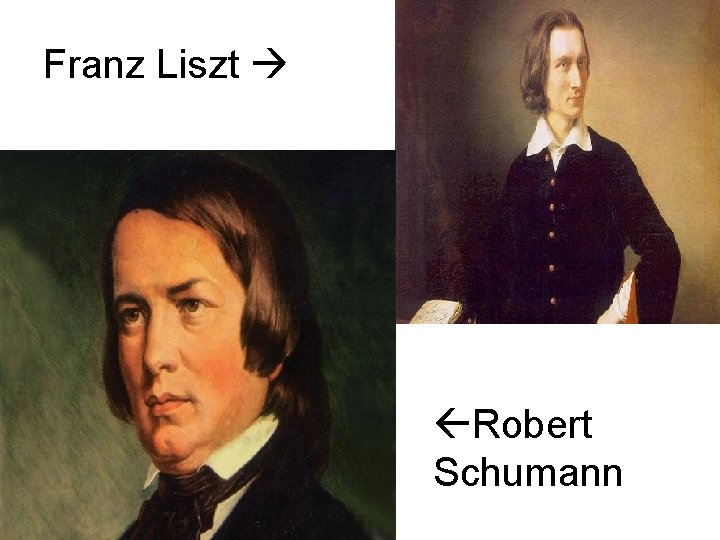
Franz Liszt Robert Schumann
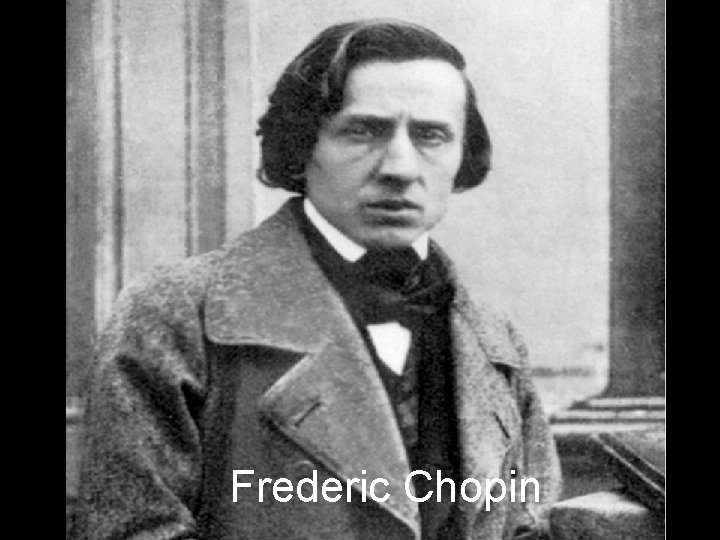
Frederic Chopin
Frederic Chopin (1810 -1849) • Born in Warsaw, Poland while under the control of Napoleon. • His father was a French attache; his mother was Polish. • Chopin showed talent at a very early age (7); by this time the piano is better developed. • 96% of his compositions are for the piano. • He is one of the first composers to make a living off his compositions.
• He goes to study in Vienna (still the cultural capital of Europe at this time. ) • When Russia invades Poland, he declares that he is a Polish national in exile. He is fiercely patriotic. • Moved to Paris in 1830 which is starting to outshine Vienna in terms of culture. • Chopin is shy about performing; he only performs to small groups of people; soon he becomes of the city’s celebrities. • He is known for his virtuoso performances. • Chopin is widely acclaimed during his lifetime.
• He meets Mme. Aurore Dudevant who is a novelist living in Paris away from her husband. • Her pen-name is George Sand; she is notoriously unconventional. • They begin a very public affair; from all indications they were very passionate. • It ends bitterly (she continuously criticizes his Catholic beliefs. ) • When Chopin died, she refused to attend his funeral (big snub. ) • Chopin died of tuberculosis (consumption. ) • His body is buried in Paris but his heart in Warsaw.

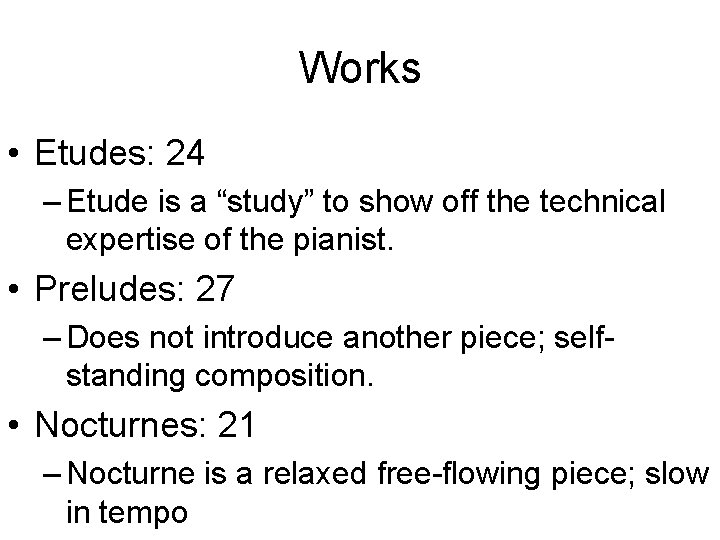
Works • Etudes: 24 – Etude is a “study” to show off the technical expertise of the pianist. • Preludes: 27 – Does not introduce another piece; selfstanding composition. • Nocturnes: 21 – Nocturne is a relaxed free-flowing piece; slow in tempo
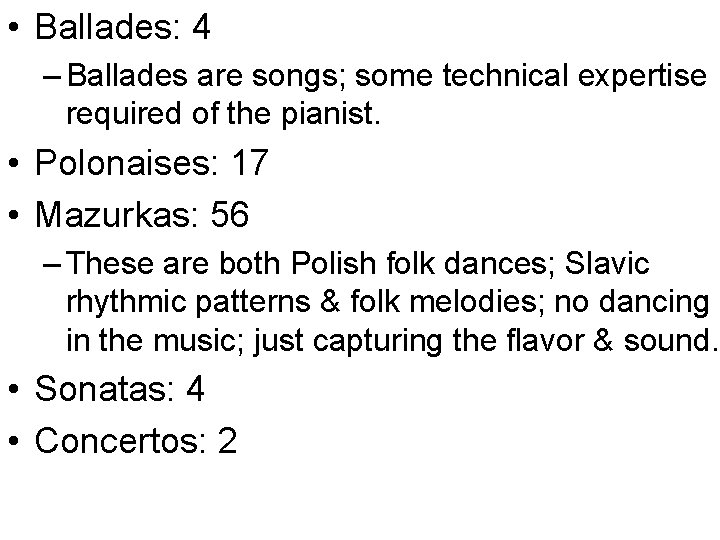
• Ballades: 4 – Ballades are songs; some technical expertise required of the pianist. • Polonaises: 17 • Mazurkas: 56 – These are both Polish folk dances; Slavic rhythmic patterns & folk melodies; no dancing in the music; just capturing the flavor & sound. • Sonatas: 4 • Concertos: 2
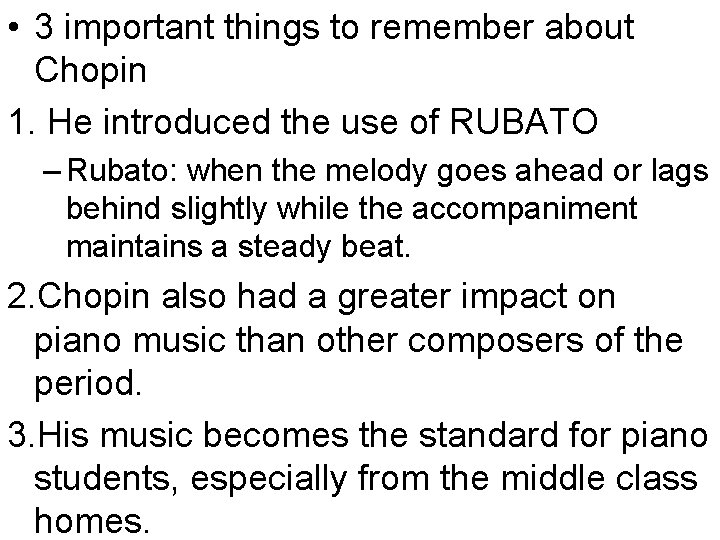
• 3 important things to remember about Chopin 1. He introduced the use of RUBATO – Rubato: when the melody goes ahead or lags behind slightly while the accompaniment maintains a steady beat. 2. Chopin also had a greater impact on piano music than other composers of the period. 3. His music becomes the standard for piano students, especially from the middle class homes.

Test Information
Part I Match the biographical characteristic with the composer.
Part II True/False: Background information on the Romantic period & Romantic music
Part III: Identify the significance of each of the following Scherzo Mme. Aurore Dudevant Eroica, Pastoral, Chorale Vienna Rubato Lied or Lieder Erlkonig Liszt, Schumann, Chopin Etude Polonaises & Mazurkas
Part IV: Discussion 1. Explain changes in thought brought on by the Romantic period (10 points. ) 2. List & explain the 3 periods of B’veen’s life, including major compositions written in each period (10 points. ) 3. Which composer (B or C) had more influence on music in the 1800 s? Defend your answer with information you have learned about each composer (5 points. )
- Slides: 46