
Transitional Justice and Reconciliation Jared O Bell Ph
Transitional Justice and Reconciliation Jared O. Bell, Ph. D Visiting Scholar, The University of The Gambia
Defining Reconciliation �How can we define reconciliation? �What does reconciliation entail?
Reconciliation �Reconciliation is the point where those who once viewed each other was enemies now begin restoring relationships. �Reconciliation can also meaning building relationships that didn’t exist before. �The concept of reconciliation is futuristic in nature. It’s an attempt to move beyond the past so that all those who were once involved in a conflict can live in positive peace.
Thin and Thick Reconciliation �Relationships can be built or rebuilt in different ways and to different degrees. This is often discussed in terms of “thin” or “thick” reconciliation, although the distinction is not always clear cut (Seils, 2017)
Thin Reconciliation �Thin or minimal understandings of reconciliation, at one end of the spectrum, involve individuals, groups, and institutions peacefully coexisting but with little or no trust, respect, restoration of dignity or shared values between them.
Thick Reconciliation �Thicker versions of reconciliation, on the other end, involve relationships built on trust, respect, and shared values, which may all contribute to the restoration of dignity that may have been lost as a result of violations. (Seils, 2017)
Connecting Transitional Justice and Reconciliation �How is the notion of transitional Justice and Reconciliation connected? �How might Justice lead to reconciliation?
Reconciliation and Transitional Justice �Reconciliation has will differ from society to society, group, and individual. �Transitional justice processes aim to give societies and individuals closure from the past so they maybe able to move on. �Transitional justice processes cannot be the only sole tool towards reconciliation. They are tools for reconciliation and not it’s entire achievement.
Does Reconciliation always mean forgiveness? �Can we assume that reconciliation and forgiveness mean the same thing? Yes or no?
Forgiveness is… �Erguner Tekinalp (2009) notes that forgiveness is a transformation of perception of the transgression, transgressor, and consequences, of the transgression from negative to positive.
Forgiveness. . (Cont. ) �The purpose is to restore damaged relationships, to reduce negative feelings between the offended and the offender, and to provide opportunity for both to give up their perspective roles. �Do you agree with the above definition?
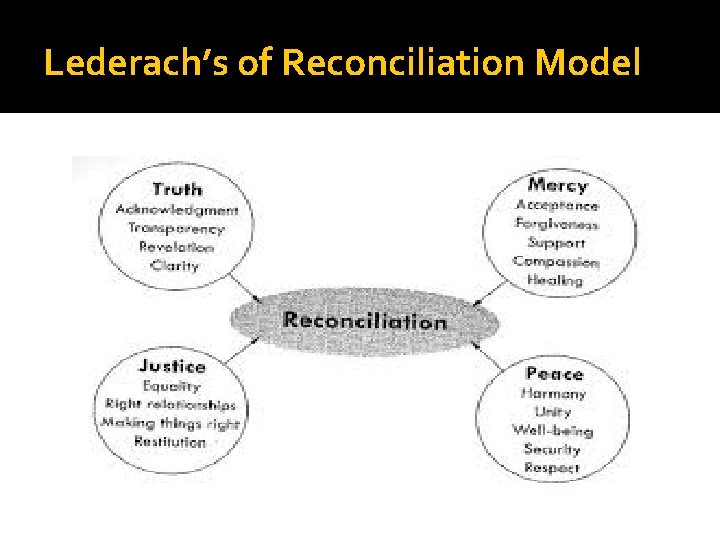
Lederach’s of Reconciliation Model
Contextual Factors that contribute to reconciliation �Personal Security �How time has elapsed since a conflict �Past and Present roles �Sense of common nationality �Effectiveness of political institutions (Chapman, 2009) �Economic growth and sustainability
Reconciliation, Divided Societies, and Transitional Justice �Deeply divided societies are those that have existing ethnic political, cultural, or religious cleavages that shape and impact the public sphere heavily. �Achieving reconciliation around these particular cleavages can be extremely difficult. �In some cases transitional justice process can sometimes aggravate and widen these cleavages.
Different Layers of Reconciliation �Individual �Inter-personal �Socio-political �Institutional
Individual �In order to rebuild their lives and their relationships with others, victims may have to reconcile themselves with their past experiences, including the harms, suffering, and damage that have resulted from human rights violations. (Seils, 2017)
Inter-personal �Often focusing on the relationship between victims, perpetrators, or beneficiaries of rights violations, interpersonal reconciliation can involve processes based on acknowledgement of past wrongs, reform, and forgiveness between individuals. (Seils, 2017)
Socio-political �Socio-political reconciliation focuses on relations between groups—social, political, ethnic, religious, or other—in divided societies. � In contexts where existing parliamentary and other structures may be relatively strong, processes may lead to respect for others who hold different beliefs and to a commitment to resolve differences through agreed-on, nonviolent means. (Seils, 2017)
Institutional �Institutional reconciliation is premised on processes whereby institutions charged with protecting fundamental freedoms and individual and collective rights win back the trust of alienated parts of society. � It is often focused on justice and security institutions but can also affect institutions such as education and the media. (Seils, 2017)
What’s more important? �Which of these levels do you think it’s particularly important to address in terms of moving on? �What should states put more attention on?
How can we measure transitional justice and its impact on reconciliation? �Reconciliation isn’t something that can be necessarily seen or tangible. Reconciliation can’t be touched. But, it can be witnessed. �Reconciliation and transitional justice’s impact on it can be measured through perspective, opinions, and attitudes. �Reconciliation can be measured through behavior.
Strategies for Reconciliation �Public Education �Community Level Initiatives �Use of rituals � Transforming the attitudes of victims and perpetrators �Development of new symbols and images �Recommendations about future activities (Chapman, 2009)
Public Education � Transitional justice mechanism often have varying strategies to reach out to the public and keep them informed about the process taking place. �There is often also aims to educate the public about the need for reconciliation.
Community Level Initiatives �Several transitional justice mechanisms under take community level activities to bring. �Various community activities bring people together to talk, find common ground, address the past, and lay the blue print for the future.
Use of rituals �Many societies have traditional cultural practices and customs that seek to bring enemies together and heal rifts. �Some transitional justice mechanism have been used these as a tool to foster reconciliation.
Transforming the attitudes of victims and perpetrators �Reconciliation requires a change from all sides of a conflict. �Victims and perpetrators alike have to be willing to shift attitudes and transform behavior. �Often times in post-conflict settings victims are more open to over coming the past tan the perpetraitors (Chapman, 2009).
Development of new symbols and images �Cultural images can constitute important filers though which people see and relate to other groups and the wider world. �Transitional justice mechanisms can offer a new way of processing and filtering the past and creating a different narrative for society.
Recommendations about future activities �Some transitional justice mechanisms like truth commissions make recommendations about promoting reconciliation in the posttransitional justice period. �This could mean recommending more longer term community engagement, research studies, outreach, reparations plans, etc.
What do you think are the best strategies? �Out of these six strategies what might be the best programs for fostering reconciliation? �Which do you think might not be effective at all?
- Slides: 29