
Transition to Immanuel Kant Rationalism and Empiricism Historical
- Slides: 15
Transition to Immanuel Kant Rationalism and Empiricism
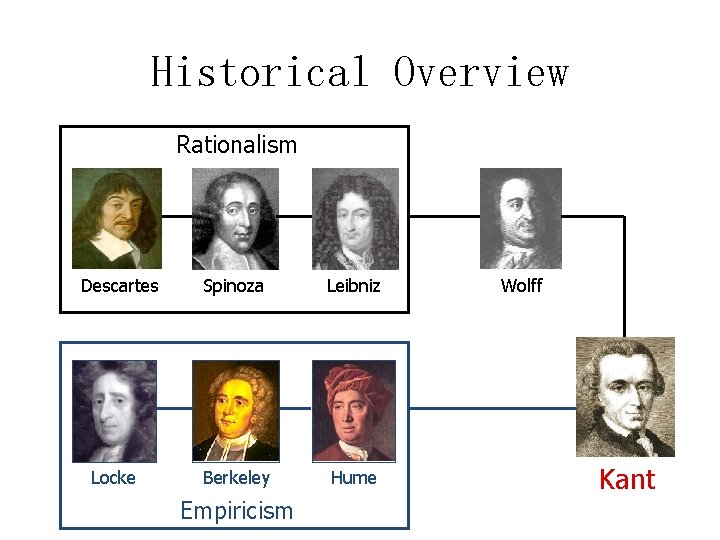
Historical Overview Rationalism Descartes Locke Spinoza Leibniz Berkeley Hume Empiricism Wolff Kant
Empiricism • Basic tenets of Empiricism – All knowledge comes from experience – The mind is a blank slate (tabula rasa) – The mind is passive, merely a receptor of sense impressions • Hume’s radicalizes these, ending in Skepticism – Unbridgeable gap between sense impressions and objects in the world – All we know are ‘sensations’ playing in our minds – The necessary ‘connectedness’ of experience is problematic Causality is merely superstition, born of habit
Rationalism • Basic tenets of Rationalism – Reason has access to reality as it really is – Reason can go beyond what is given to us in experience – Reason can then grasp things, not as they appear, but as they really are • The Leibniz-Wolffian School – Reason (without experience) can know about God, immortality of the soul, and human freedom • Reason has direct access to “meta-physical” knowledge
Part 2 • • John Locke David Hume Immanuel Kant Thomas Bayes Karl Popper Thomas Kuhn Imre Lakatos
John Locke (1632 -1704) Introduction
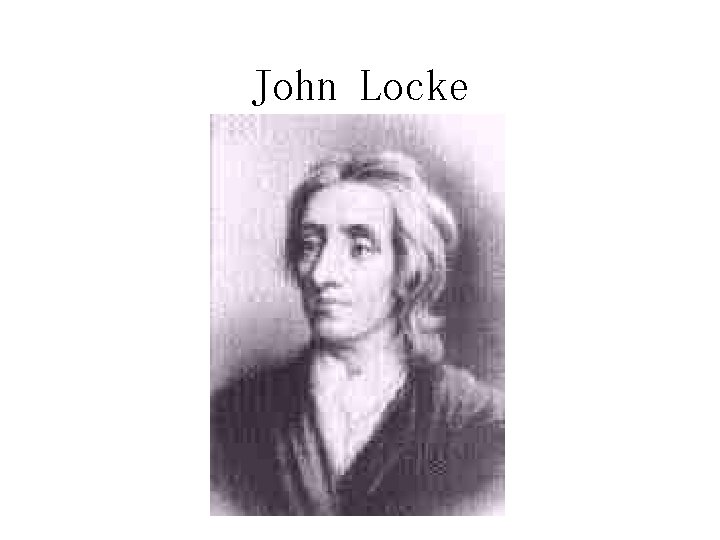
John Locke
Biography • B. 1632, son of a small property-owner and lawyer • Oxford, 1652 -67 • Studied church-state issues, chemistry and medicine, new mechanical philosophy • Involvement in politics through Lord Ashley, whom he treated for a liver abscess • Plotted to assassinate King Charles II and his Catholic brother, later James II • Exile in Holland, 1683 -89 • 1689: 3 major works published
Major works and themes: A Letter Concerning Toleration (1689) - Argues for religious toleration; - Except for atheists, “who deny the Being of a God” and thus cannot be trusted to keep their promises (e. g. in contracts). Context: - Religious wars and persecution in England on the Continent.
Works, cont. Essay Concerning Human Understanding (1689) • Argues against innate ideas • For the acquisition of knowledge through the senses: “Intuitionism” • Anti-Cartesian (Descartes) • Re-opens debate about essentialism vs conventionalism with his views on identity, comparison, classification and natural kinds.
Works, cont. Two Treatises on Government (written 1679/80; published 1689/90) • First: Argues against traditional basis for political authority expressed in Filmer’s Patriarcha, divine right of kings; • Second: protection of private property, life and liberty = basis for civil government.
Locke’s Basic Epistemology • • • Human being = tabula rasa (blank slate) receives sense-impressions some of these transformed by Mind into Ideas represented in language by words However, no Ideas are innate Mind operates (through gradual learning process) w/out reference to any received authority (of Church, State or others)
Complex Ideas • Sense-data of primary qualities (PQs) and secondary qualities (SQs), produce ideas in the mind: • Ideas are mental results of sense-data • -Sense-perceptions • -Bodily sensations • -Mental images • -Thoughts and concepts
Primary(PQ) and Secondary Qualities(SQ) Distinction between perceived aspects of things. The primary qualities are intrinsic features of the thing itself (its size, shape, internal structure, mass, and momentum, for example), while the secondary qualities are merely its powers to produce sensations in us (its color, odor, sound, and taste, for example). This distinction was carefully drawn by Galileo, Descartes, Boyle, and Locke, whose statement of the distinction set the tone for future scientific inquiry. But Foucher, Bayle, and Berkeley argued that the distinction is groundless, so that all sensible qualities exist only in the mind of the perceiver.
Attacks Innatism (Descartes) Locke’s objections to innate ideas (“II’s”) • Lack of universal assent: II’s not known to idiots, children, illiterates • Dependence on authority: • “…a Man is not permitted without Censure to follow his own Thoughts in the search of Truth, when they lead him…out of the common Road”. • Epistemological and political commitment to the individual (who is the foundation of Locke’s political liberalism).