
TRANSITION TO COLLEGE FOR STUDENTS WITH A DISABILITY
TRANSITION TO COLLEGE FOR STUDENTS WITH A DISABILITY KATHLEEN JOHNSON, MS DIRECTOR, DISABILITY RESOURCE CENTER (DRC)
AGENDA • Learn about the law: • Legal Rights: High School vs. College • College accommodations and disability services • Challenges of transitioning to College • Expectations • What can students/parents do now? • Q&A
THE MISSION OF COLLEGE DISABILITY/ACCESSIBILITY OFFICES • committed to providing accommodations and services to students with disabilities • to ensure equal access for students with disabilities to all campus programs, opportunities and activities.
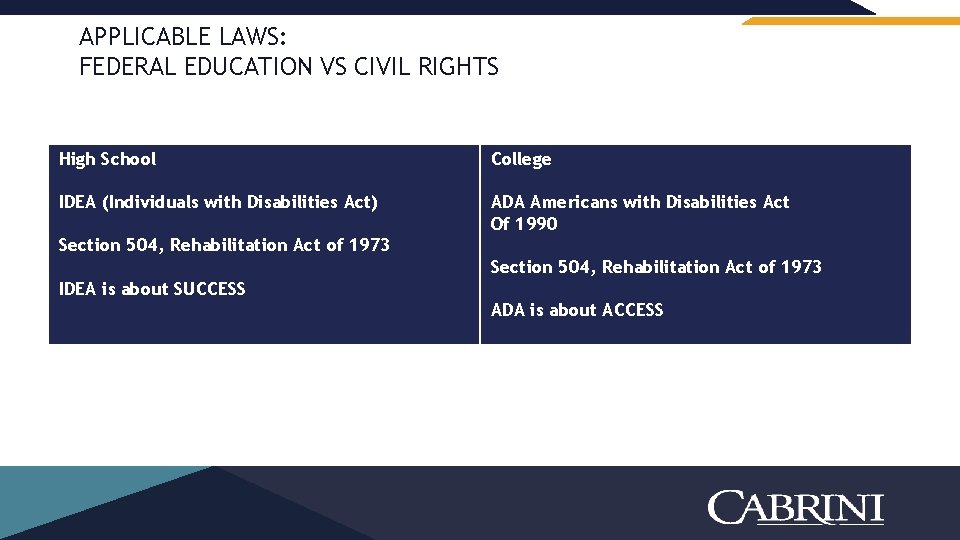
APPLICABLE LAWS: FEDERAL EDUCATION VS CIVIL RIGHTS High School College IDEA (Individuals with Disabilities Act) ADA Americans with Disabilities Act Of 1990 Section 504, Rehabilitation Act of 1973 IDEA is about SUCCESS ADA is about ACCESS
WHAT IS THE DEFINITION OF DISABILITY UNDER THE ADA? • The context of the ADA, “disability” is a legal term rather than a medical one. Because it has a legal definition, the ADA’s definition of disability is different from how disability is defined under some other laws. • The ADA defines a person with a disability as a person who has a physical or mental impairment that substantially limits one or more major life activity. • Source URL: https: //adata. org/faq/what-definition-disability-under-ada
PROTECTION AGAINST DISCRIMINATION • The ADA states: "No otherwise qualified individual with a disability shall, solely by reason of such disability, be excluded from participation in or be denied the benefits of the services, programs, or activities of a public entity, or be subjected to discrimination by any such entity. " • In other words, a disability cannot be grounds for excluding a person from a college, an academic program, a class, a residence hall, or a college activity, if the person is qualified.
WHO DO DISABILITY OFFICES SERVE? • • • Students with Physical, Psychological and Learning disabilities such as: Physical impairments Hearing and Visual impairments Dyslexia, Dyscalculia, Dysgraphia Attention Deficit/Hyperactivity Disorder ADHD Anxiety disorder Autism Spectrum Traumatic Brain injury …and more
“TIERED” LEVEL OF DISABILITY SERVICES AT COLLEGES • Tier 1 : Provision of accommodation letter and ADA mandated services • Tier 2: Provision of accommodation letter, ADA services and disability related learning support (no additional fee) • Tier 3: Provision of accommodation letter, services and disability related support – Fee for Service • Tier 4: College/University that accepts only students with a particular disability • E. g. Landmark College in Vermont- Students with LD and/or ASD
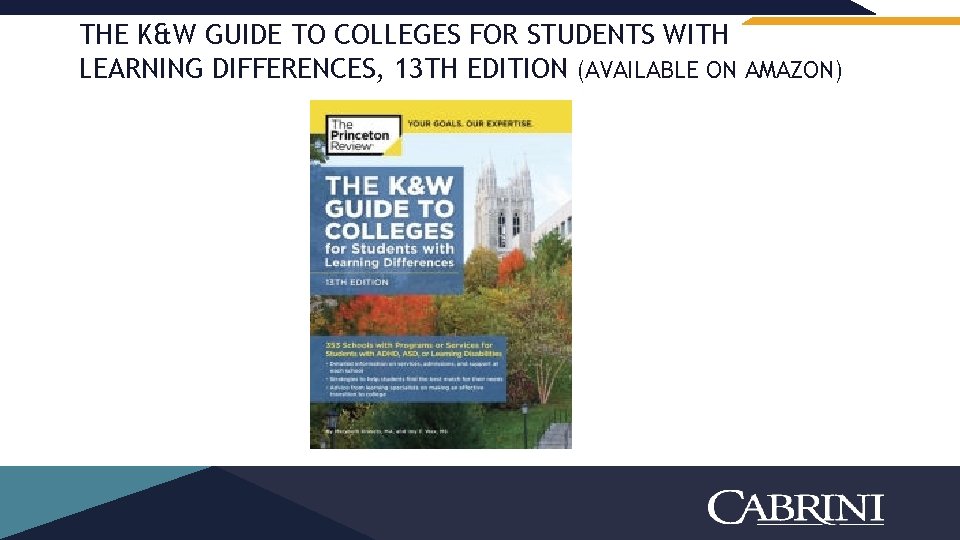
THE K&W GUIDE TO COLLEGES FOR STUDENTS WITH LEARNING DIFFERENCES, 13 TH EDITION (AVAILABLE ON AMAZON)
WHAT SERVICES MAY BE PROVIDED BY A DISABILITY OFFICE? • Pre-admission services • Parents and students can make an appointment to meet and discuss DRC program and review of documentation for possible accommodations
CAN A STUDENT’S DISABILITY BE USED IN THE DETERMINATION OF COLLEGE ADMISSION? • NO- federal laws protect qualified student from being denied admission on the basis of disability • Student must meet the essential requirements for admission • The student may choose to disclose if they feel it may have an impact on the college decision/explain variations in scores • Student is accepted as an otherwise qualified student

ONCE ACCEPTED, IS MY STUDENT REQUIRED TO DISCLOSE THEIR DISABILITY? • NO- however if academic accommodations are needed, the student must identify as having a disability. Disclosure of a disability is always voluntary. • However, the school should be notified to be assigned to accessible facilities
LEARNING SUPPORT IN COLLEGE • Professor office hours • Classroom Coaches • Academic Enrichment Center • Peer tutors • Writing tutors • Math tutors • Academic Advisors • Requests for paid tutors • Counseling and Psychological Services - Ca. PS
INDIVIDUALIZED LEARNING SUPPORT AT CABRINI • Standing weekly, bi-weekly or monthly appointments • Learning support strategies related to disability need • Reading, writing, math support • Transition support • Executive function support- time management, organization, planning, memory/retrieval
SECONDARY ACADEMIC ADVISING • While students are encouraged to meet with their appropriate academic advisors, the DRC can assist in the academic advising process to suggest appropriate classroom accommodations. • Advising is individualized to take into account the impact of an individual’s disability on the recommended course selection, including recommendations of an instructor/professor whose teaching style may be a better match for a student’s learning style.
WHY SHOULD MY STUDENT REGISTER WITH THE DISABILITY OFFICE AT THEIR COLLEGE? • Frequently heard statements from students and parents: • Student: “ I don’t need accommodations any more…I get this” • Student (when asked what their learning challenge is), ” I don’t know. I just get extra testing time…” • Parent: “ Their disability is not that bad. ” OR “My son/daughter MUST register with your office! Can you make them meet with you? ” • Registration should happen sooner than later for timeliness of provision of needed accommodations- not retroactive… • Receiving an accommodation letter allows a student to use accommodations as needed. Learning at the college level may require using accommodations not previously used as a junior/senior in high school
WHAT DOES THE REGISTRATION PROCESS FOR DISABILITY ACCOMMODATIONS/SERVICES LOOK LIKE? • We request that the student submit current documentation/psychoeducational evaluation • We engage in an interactive process with each student and review requests for accommodations on a case-by-case basis. • Other information may be requested in order to establish a disability and the impact it has on living and/or learning in a postsecondary environment.
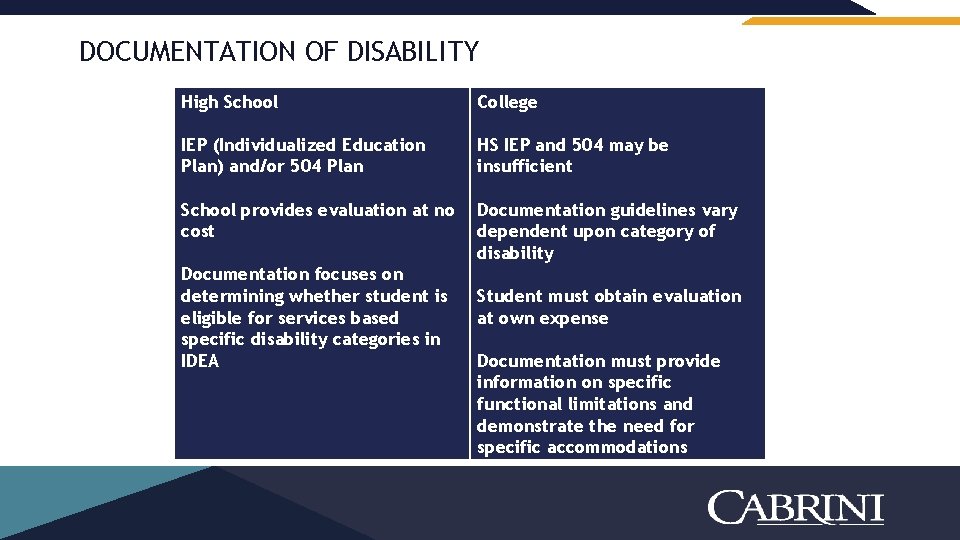
DOCUMENTATION OF DISABILITY High School College IEP (Individualized Education Plan) and/or 504 Plan HS IEP and 504 may be insufficient School provides evaluation at no cost Documentation guidelines vary dependent upon category of disability Documentation focuses on determining whether student is eligible for services based specific disability categories in IDEA Student must obtain evaluation at own expense Documentation must provide information on specific functional limitations and demonstrate the need for specific accommodations
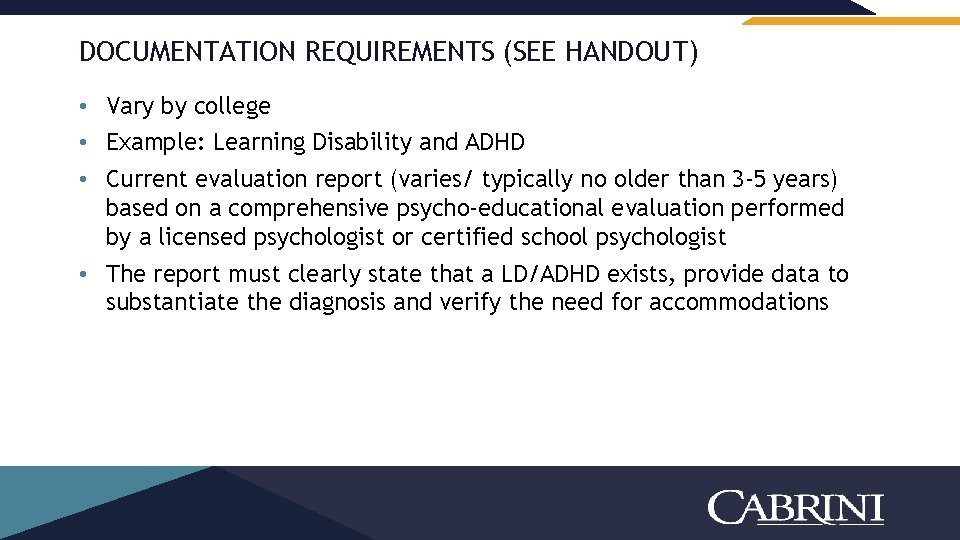
DOCUMENTATION REQUIREMENTS (SEE HANDOUT) • Vary by college • Example: Learning Disability and ADHD • Current evaluation report (varies/ typically no older than 3 -5 years) based on a comprehensive psycho-educational evaluation performed by a licensed psychologist or certified school psychologist • The report must clearly state that a LD/ADHD exists, provide data to substantiate the diagnosis and verify the need for accommodations
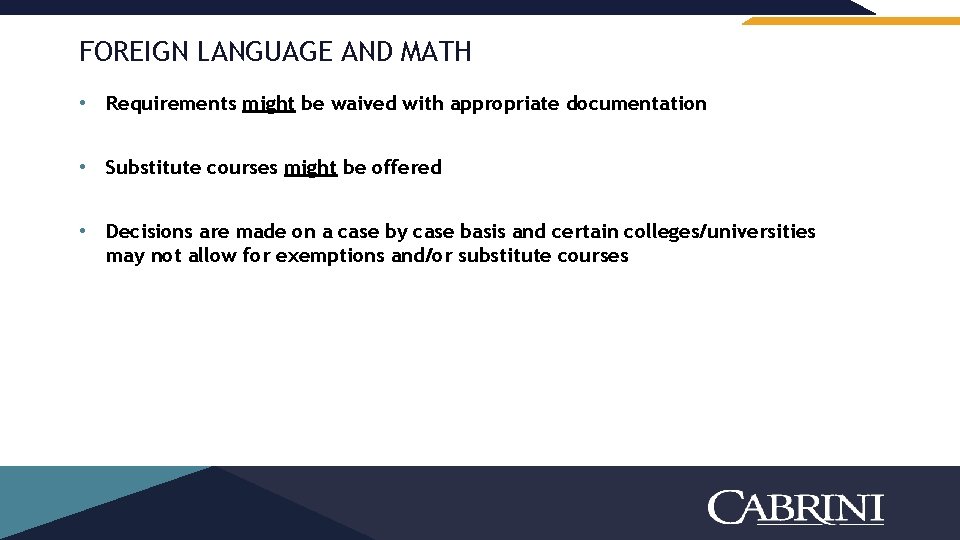
FOREIGN LANGUAGE AND MATH • Requirements might be waived with appropriate documentation • Substitute courses might be offered • Decisions are made on a case by case basis and certain colleges/universities may not allow for exemptions and/or substitute courses
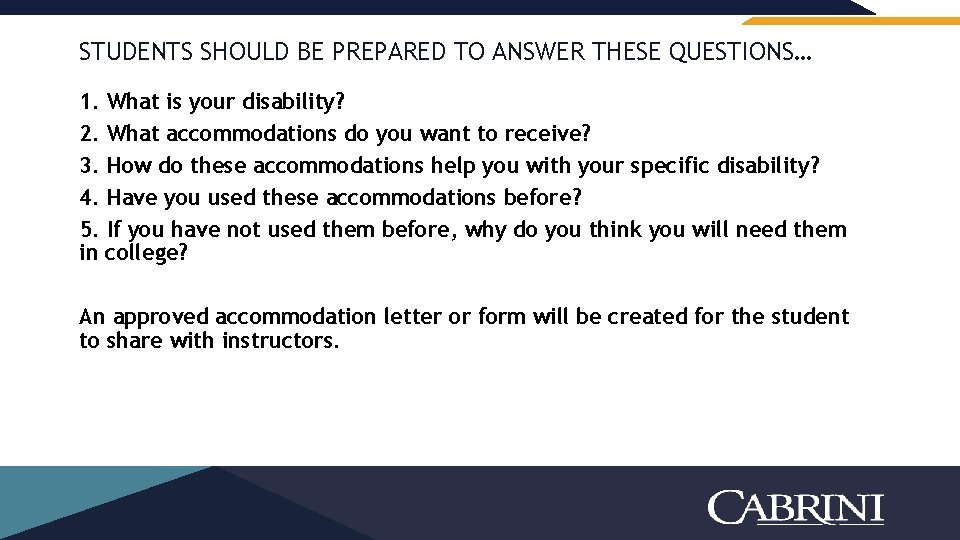
STUDENTS SHOULD BE PREPARED TO ANSWER THESE QUESTIONS… 1. What is your disability? 2. What accommodations do you want to receive? 3. How do these accommodations help you with your specific disability? 4. Have you used these accommodations before? 5. If you have not used them before, why do you think you will need them in college? An approved accommodation letter or form will be created for the student to share with instructors.
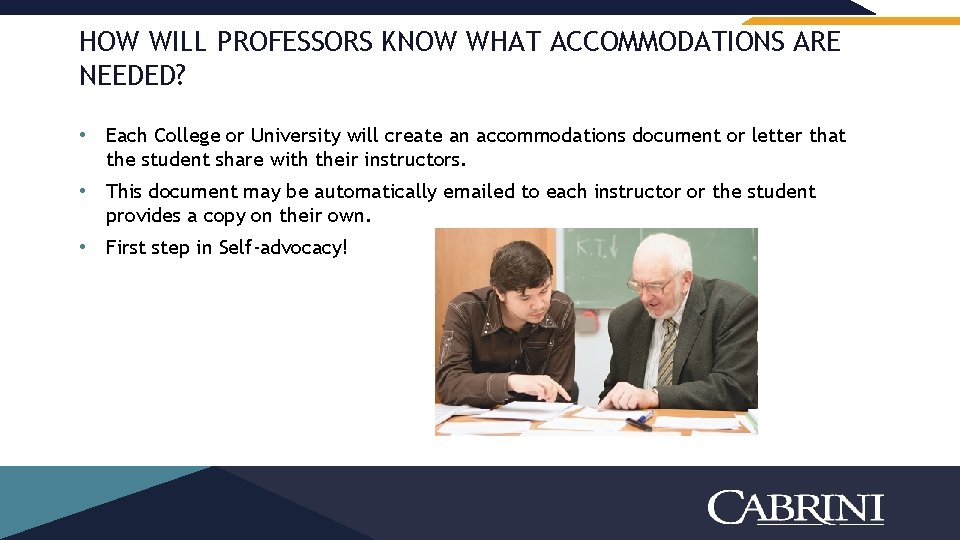
HOW WILL PROFESSORS KNOW WHAT ACCOMMODATIONS ARE NEEDED? • Each College or University will create an accommodations document or letter that the student share with their instructors. • This document may be automatically emailed to each instructor or the student provides a copy on their own. • First step in Self-advocacy!
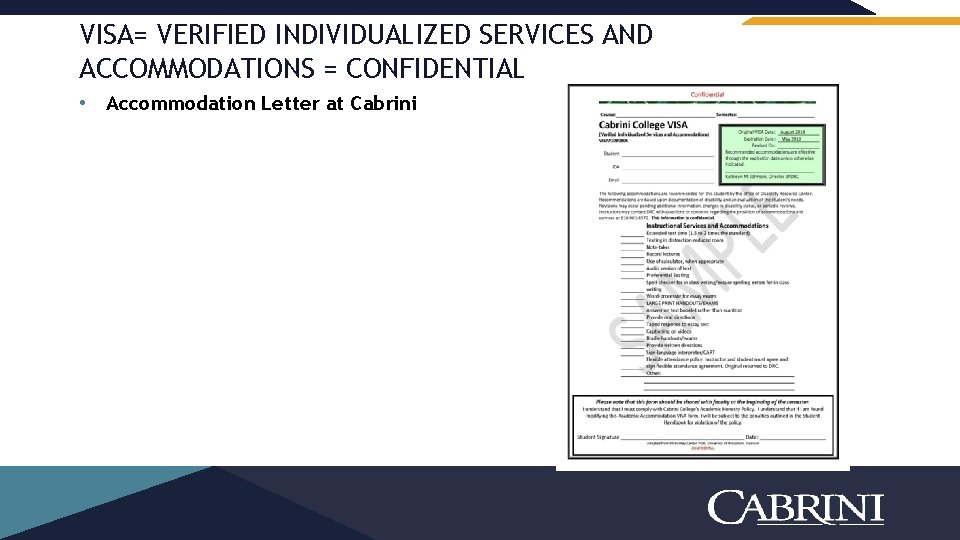
VISA= VERIFIED INDIVIDUALIZED SERVICES AND ACCOMMODATIONS = CONFIDENTIAL • Accommodation Letter at Cabrini
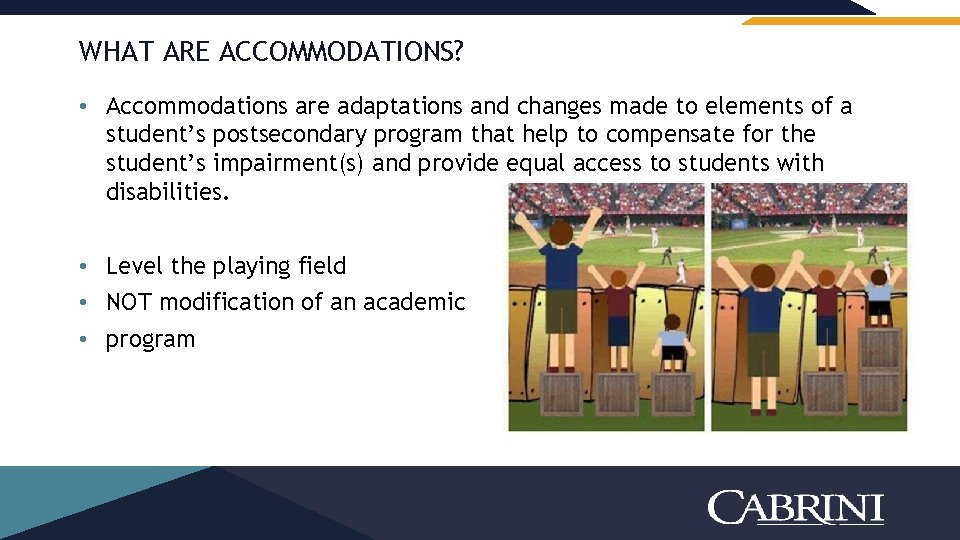
WHAT ARE ACCOMMODATIONS? • Accommodations are adaptations and changes made to elements of a student’s postsecondary program that help to compensate for the student’s impairment(s) and provide equal access to students with disabilities. • Level the playing field • NOT modification of an academic • program
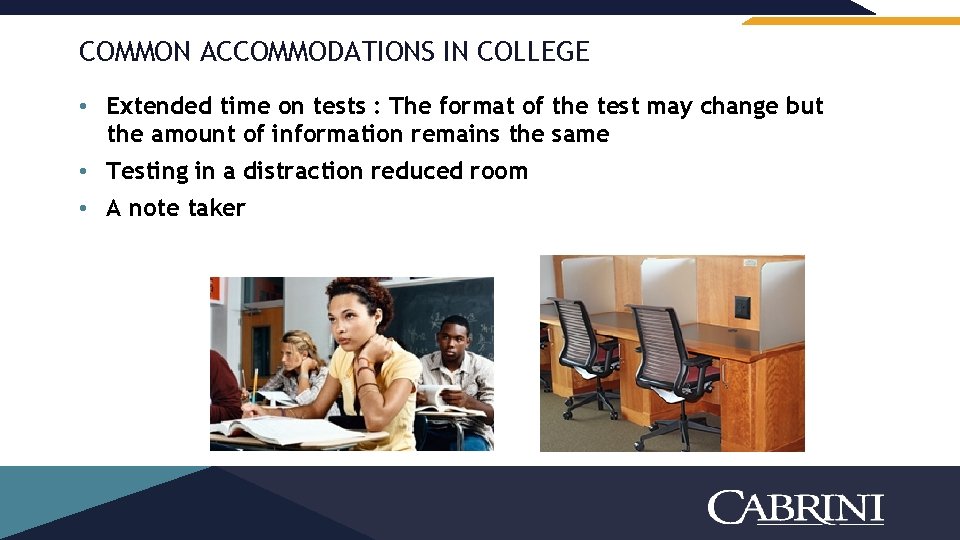
COMMON ACCOMMODATIONS IN COLLEGE • Extended time on tests : The format of the test may change but the amount of information remains the same • Testing in a distraction reduced room • A note taker
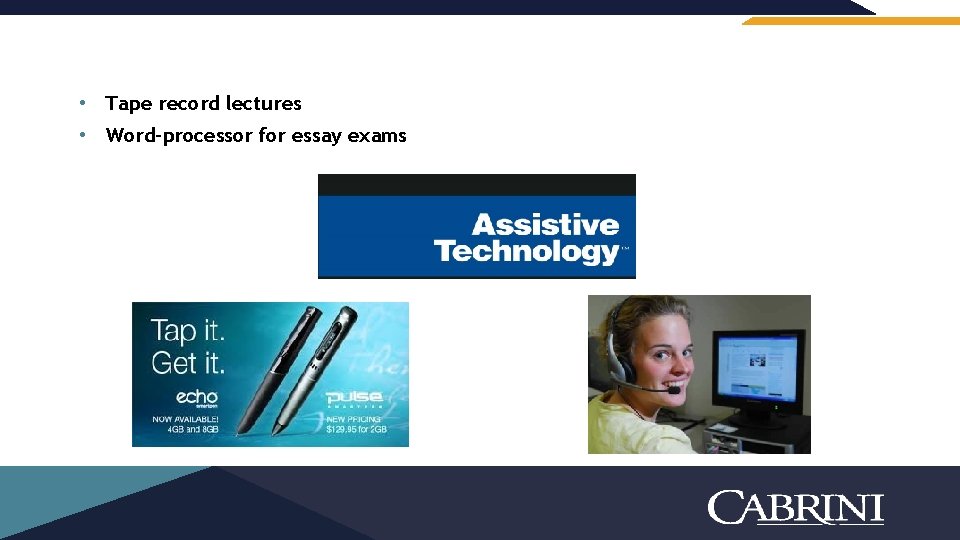
• Tape record lectures • Word-processor for essay exams
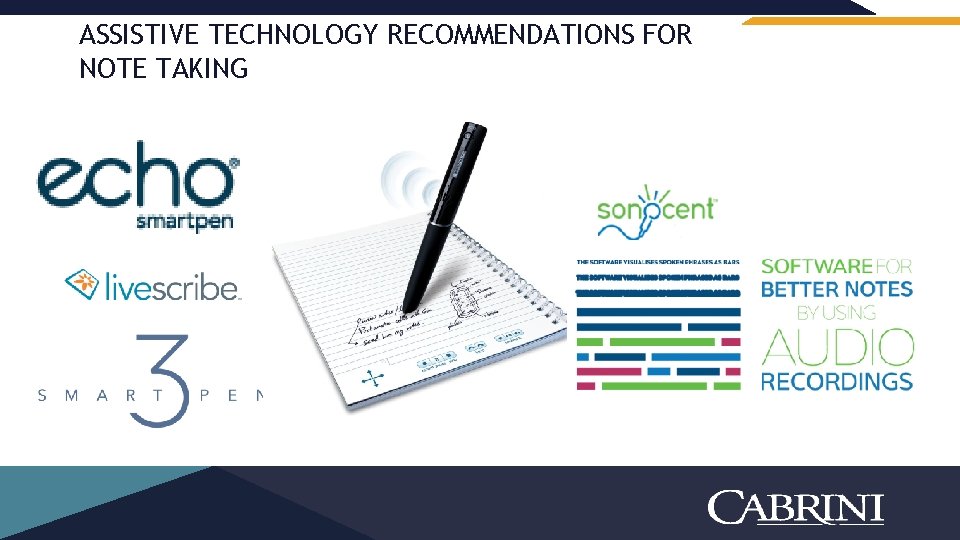
ASSISTIVE TECHNOLOGY RECOMMENDATIONS FOR NOTE TAKING
READING, WRITING AND STUDY SOFTWARE • Read & Write Gold • Literacy software that helps with reading and independent study.
LEARNING ALLY - AUDIOBOOKS • Student receives an account at no cost • Audio books support comprehension
EXPECTATIONS IN COLLEGE • Student manages own time, makes own decisions, responsible for consequences of their decisions • Classes in college: • Allow 2 to 3 hours outside study time per class • Substantial amounts of reading and writing • Learning- formulating thoughts and critical thinking is required • Students take responsibility for learning
COLLEGE PROFESSORS VS. HS TEACHERS: • Expectations- completion of homework and reading assignments, may not provide reminders, expect attendance, consult syllabus Testing in College: • less frequent and may be cumulative • Test preparation is the student’s responsibility • Makeup tests- seldom an option • May have multiple exams on the same day • Review sessions may or may not be offered • Test content is not modified
GRADES IN COLLEGE • May not be provided immediately • Extra credit may not be an option • Each department (major) has a minimum average needed to be in that major (typically a 2. 0 or C) • A student with a disability can be academically dismissed from a college and success is not guaranteed
TEST AND GRADES • May be less frequent assessments • Extra credit work not always an option • Grades may or may not be posted on a class management systeme. g. Blackboard “Cabrini Learn” • Tests are NOT modified • Students need to actively seek out professors via email/office hours for information
ADVOCACY TRAINING • Awareness of disability • Advocate with instructors • Preparation for internships and employment • Collaboration with Center for Career and Professional Development
DELTA ALPHA PI HONOR SOCIETY • Beta Omega Chapter • Disability awareness events • Peer mentors • Honor Cord at graduation • Qualification: 3. 1 GPA after earning • 24 credits
SUMMER TRANSITION PROGRAM • Some colleges/universities offer summer transition programs • Accepted students who have self identified • Workshop opportunity for parents • Access Prep Program (APP) offered at Cabrini for first year students registered with the Disability Resource Center at Cabrini
WHAT CAN STUDENTS AND PARENTS DO NOW FOR THE TRANSITION? • Step 1: Know the law and research preparing for success in college • Step 2: Student understands their rights and their responsibilities
DOES YOUR CHILD KNOW ABOUT THEIR DISABILITY, STRENGTHS AND WEAKNESSES? • Be honest and support your child’s understanding of their learning challenges • Have the IEP team explain to you the reason why certain accommodations are provided to your student • Ask questions and be informed so that you can prepare your child to be his or her own self advocate in college and in life
DEVELOP SELF ADVOCACY SKILLS • Advocacy = “Being able to communicate one’s needs and rights” Communication skills are critical for success in college! • Learning to speak for themselves – parents practice this skill now • Role play scenarios- practicing eye contact, personal space issues, body language, tone of voice • Develop good email skills!
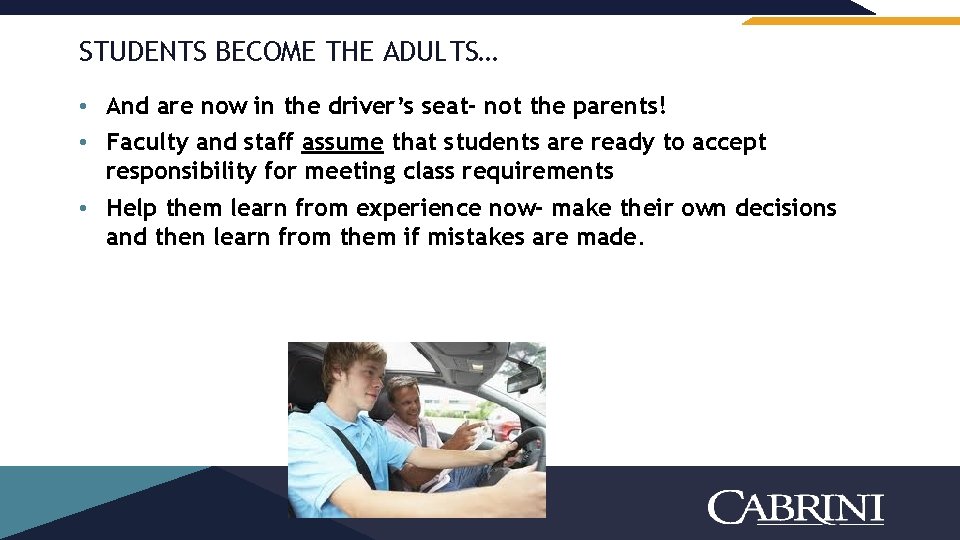
STUDENTS BECOME THE ADULTS… • And are now in the driver’s seat- not the parents! • Faculty and staff assume that students are ready to accept responsibility for meeting class requirements • Help them learn from experience now- make their own decisions and then learn from them if mistakes are made.
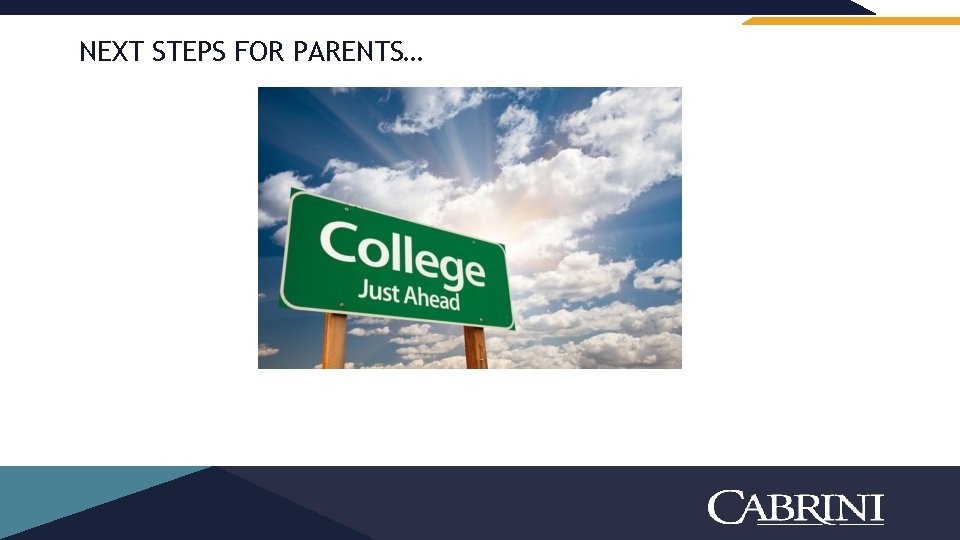
NEXT STEPS FOR PARENTS…
AS YOU BEGIN YOUR SEARCH FOR COLLEGE • Ask questions of the disability service office Begin the art of letting go- for both you and for your student by breaking the dependency • Books: • Letting Go A Parents’ Guide to understanding the College Years by Coburn and Treeger • 100 Things Every College Student with a Disability Ought to Know by K. Johnson and T. Hines
NEXT STEPS…. • • Help your son or daughter to understand their learning strengths and challenges Include them in decision making process for college Meet with disability offices at college/university of choice Begin the process of …. Letting Go…. . • Jane Jarrow, ” As parents, it is time for us to step back and allow/encourage/gently nudge our SWD’s (Students With Disabilities) to assume significant independent responsibility for their own lives, both academically and personally. ” • http: //drc. boisestate. edu/jane-jarrows-letter-to-parents/ • • http: //www. ed. gov/about/offices/list/ocr/transition. html http: //www. heath. gwu. edu/)
KNOW BEFORE YOU GO… • When college searching… • Ask to meet with the disability office to discuss their services and registration process • The disability office may have different names, such as: • Accessibility office • Student Success • Center for teaching and learning, etc. . • Type “DISABILITY” in the college home page search box to find the office
WEBSITES FOR RESOURCES • • National Center on Secondary Education and transition www. ncset. org Going to College www. going-to-college. org
COLLEGE SEARCH PROCESS • Listen and guide your child with their decisions about going to college, which college and if they will be a full time or part time student • Reduced course load should be considered
There are only two things a parent can give to a child… One is roots. The other is wings.
QUESTIONS? ? • Thank you for inviting me to your school today • Come and visit Cabrini!
- Slides: 48