
Transition Systems COURSE CS 60030 FORMAL SYSTEMS INDIAN
- Slides: 20
Transition Systems COURSE: CS 60030 FORMAL SYSTEMS INDIAN INSTITUTE OF TECHNOLOGY 1 Pallab Dasgupta Professor, Dept. of Computer Sc & Engg
Overview Lecture #1 ⇒ Transition systems 1 – Executions – Modeling data-dependent systems
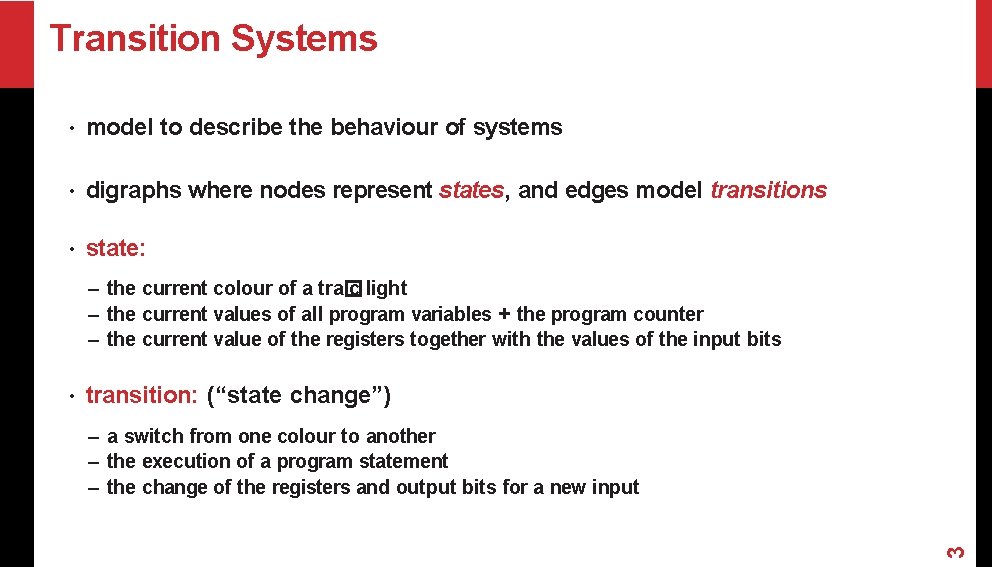
Transition Systems • model to describe the behaviour of systems • digraphs where nodes represent states, and edges model transitions • state: – the current colour of a tra� c light – the current values of all program variables + the program counter – the current value of the registers together with the values of the input bits • transition: (“state change”) 3 – a switch from one colour to another – the execution of a program statement – the change of the registers and output bits for a new input
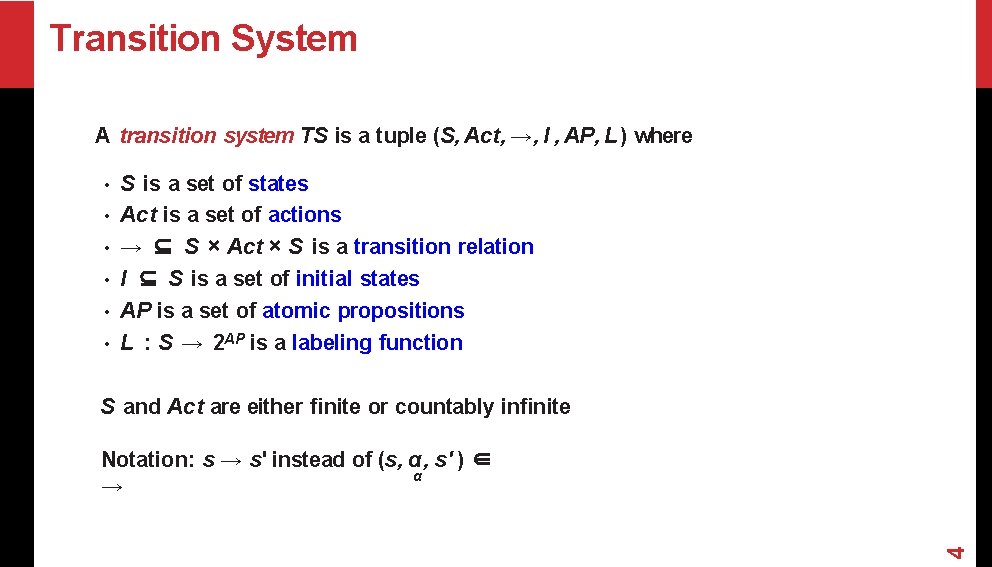
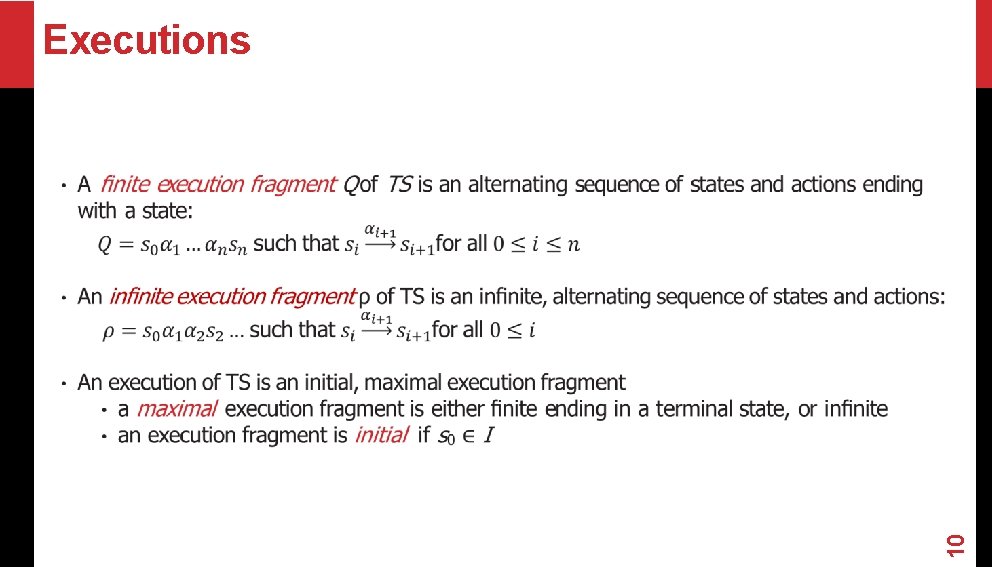
Transition System A transition system TS is a tuple (S, Act, →, I , AP, L ) where • S is a set of states • Act is a set of actions • → ⊆ S × Act × S is a transition relation • I ⊆ S is a set of initial states • AP is a set of atomic propositions • L : S → 2 AP is a labeling function S and Act are either finite or countably infinite 4 Notation: s → s' instead of (s, α, s' ) ∈ α →
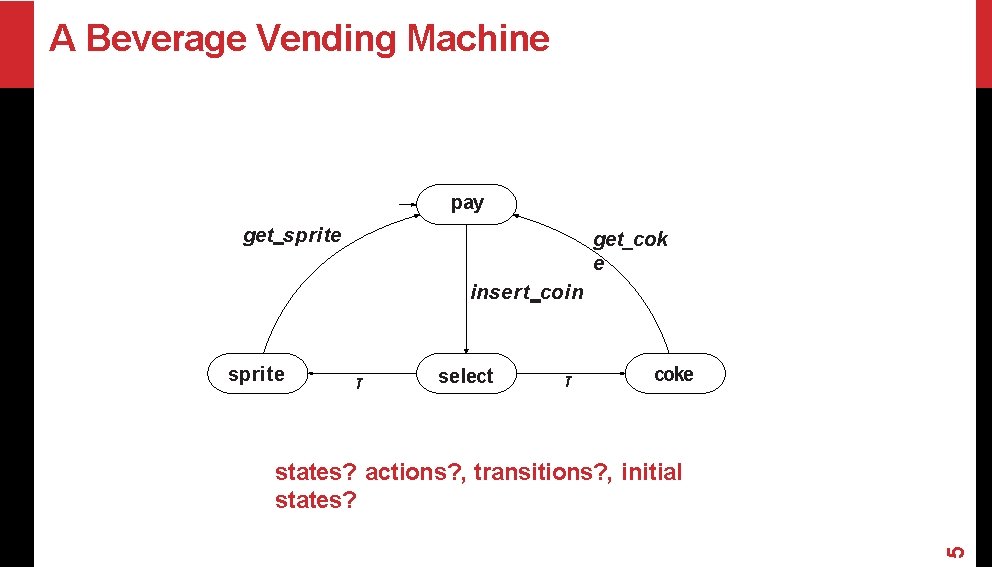
A Beverage Vending Machine pay get sprite get_cok e insert coin sprite τ select τ coke 5 states? actions? , transitions? , initial states?
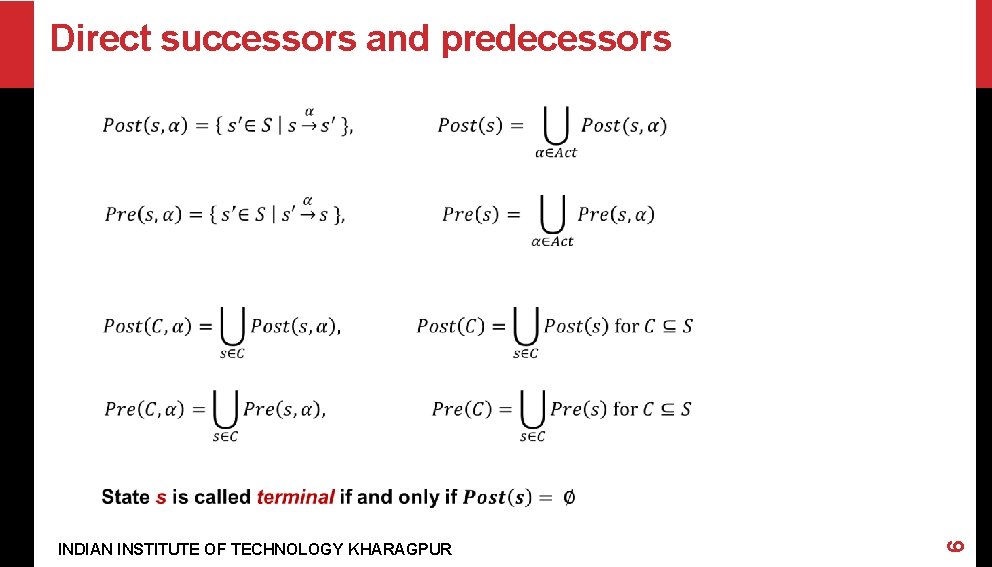
Direct successors and predecessors INDIAN INSTITUTE OF TECHNOLOGY KHARAGPUR 6
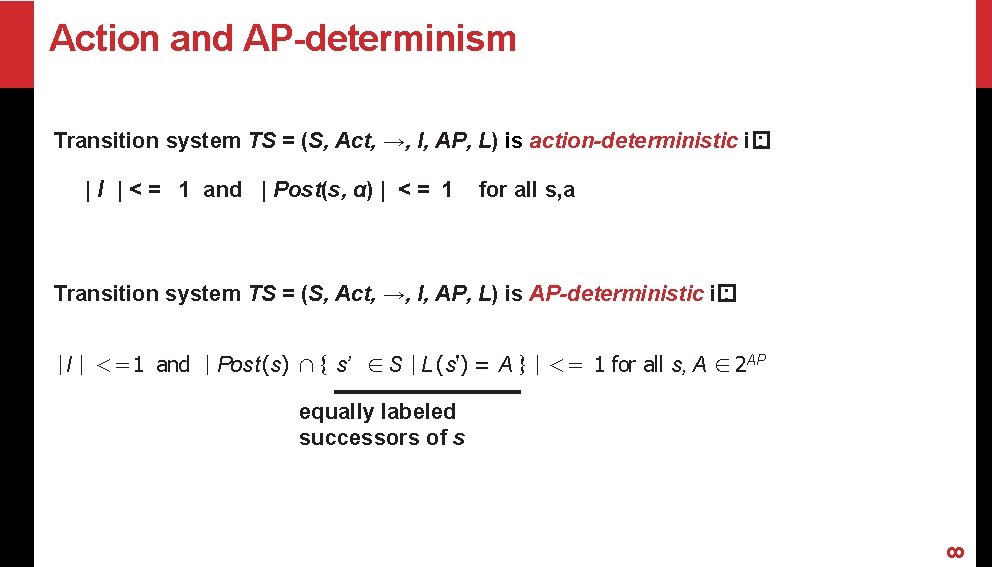
Action and AP-determinism Transition system TS = (S, Act, →, I, AP, L) is action-deterministic i� : | I | < = 1 and | Post(s, α) | < = 1 for all s, a Transition system TS = (S, Act, →, I, AP, L) is AP-deterministic i� : | I | <=1 and | Pos t(s) ∩ { s’ ∈ S | L (s') = A } | <= 1 for all s, A ∈ 2 AP equally labeled successors of s 8
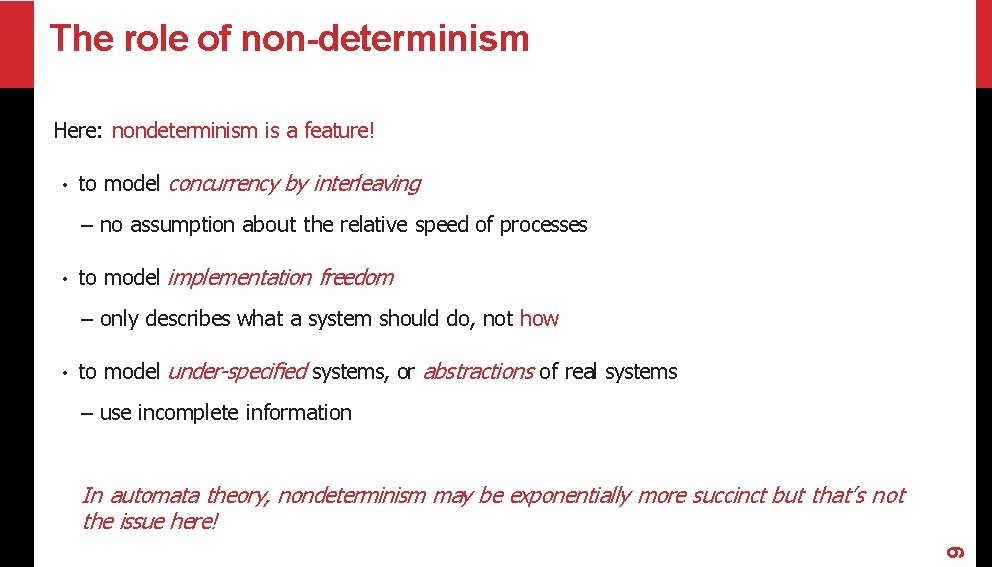
The role of non-determinism Here: nondeterminism is a feature! • to model concurrency by interleaving – no assumption about the relative speed of processes • to model implementation freedom – only describes what a system should do, not how • to model under-specified systems, or abstractions of real systems – use incomplete information 9 In automata theory, nondeterminism may be exponentially more succinct but that’s not the issue here!
Executions 10
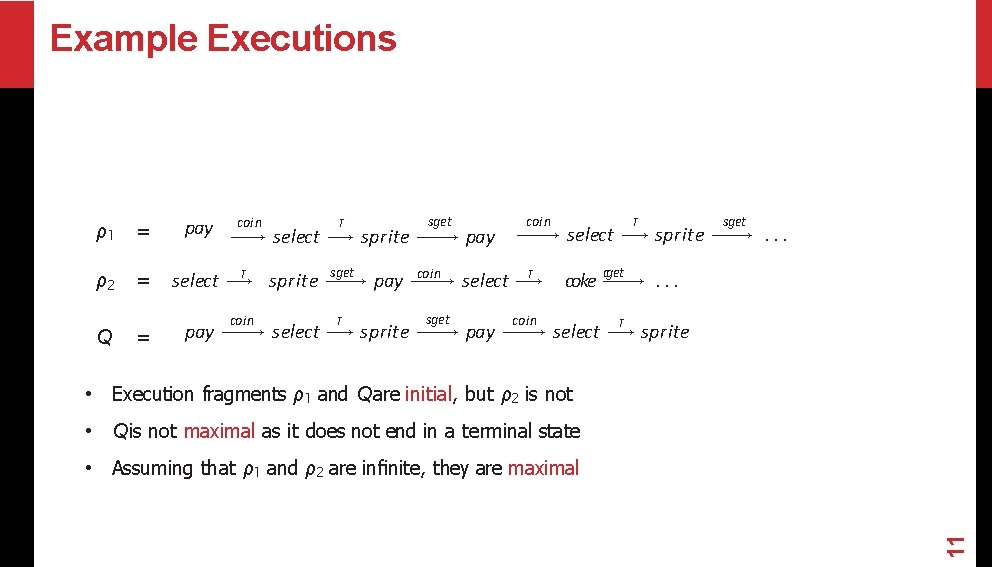
Example Executions ρ1 = ρ2 = Q = sget coin τ τ pay −coin −→ select −→ sprite −−−→ pay −−−→ select −→ sprite −−−→. . . cget τ τ coke − −−→. . . sprite −sget −−→ pay −coin −−→ select −→ coin τ sget coin τ pay −−−→ select −→ sprite −−−→ pay −−−→ select −→ sprite • Execution fragments ρ1 and Q are initial, but ρ2 is not • Q is not maximal as it does not end in a terminal state 11 • Assuming that ρ1 and ρ2 are infinite, they are maximal
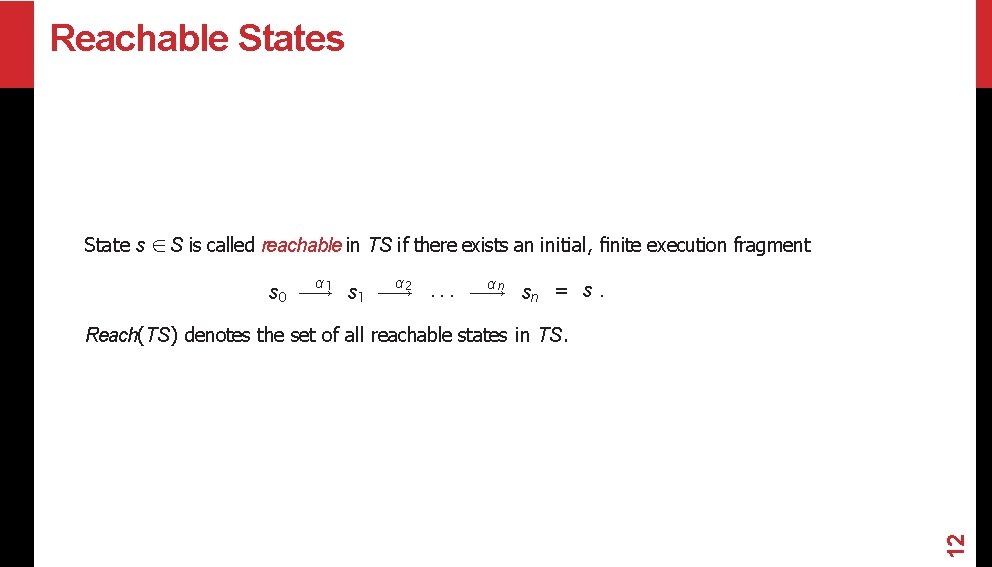
Reachable States State s ∈ S is called reachable in TS if there exists an initial, finite execution fragment α 1 α 2 n. . . −−α→ s 0 −−→ s 1 −−→ sn = s. 12 Reach(TS) denotes the set of all reachable states in TS.
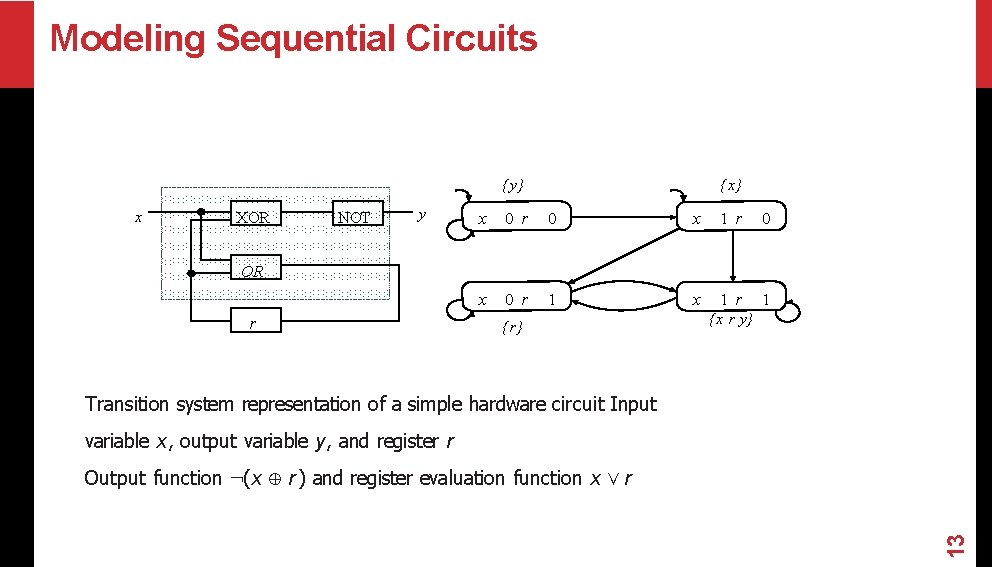
Modeling Sequential Circuits { y} x XOR NOT y { x} x 0 r 0 x x 0 r 1 x 1 r 0 OR r { r} 1 r 1 {x r y} Transition system representation of a simple hardware circuit Input variable x, output variable y, and register r 13 Output function ¬(x ⊕ r ) and register evaluation function x ∨ r
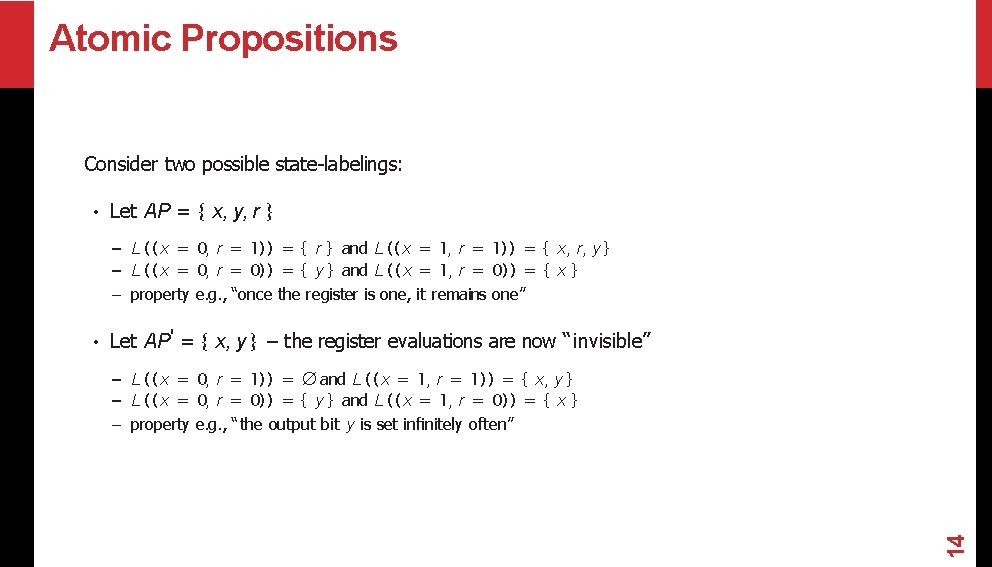
Atomic Propositions Consider two possible state-labelings: • Let AP = { x, y, r } – L ( ( x = 0, r = 1) ) = { r } and L ( ( x = 1, r = 1) ) = { x, r , y } – L ( ( x = 0, r = 0) ) = { y } and L ( ( x = 1, r = 0) ) = { x } – property e. g. , “once the register is one, it remains one” • Let AP' = { x, y } – the register evaluations are now “invisible” 14 – L ( ( x = 0, r = 1) ) = ∅ and L ( ( x = 1, r = 1) ) = { x, y } – L ( ( x = 0, r = 0) ) = { y } and L ( ( x = 1, r = 0) ) = { x } – property e. g. , “ the output bit y is set infinitely often”
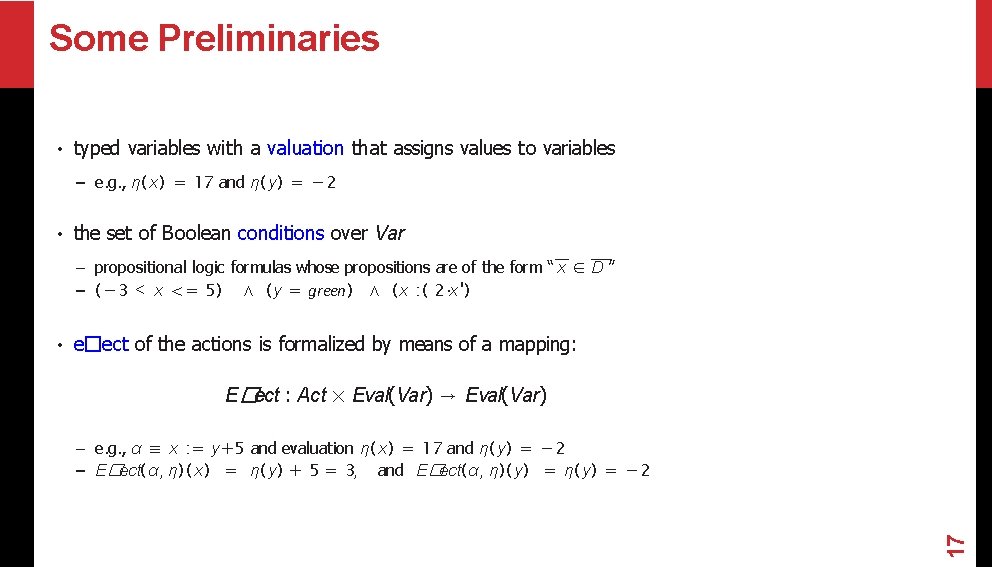
Some Preliminaries • typed variables with a valuation that assigns values to variables – e. g. , η( x ) = 17 and η( y) = − 2 • the set of Boolean conditions over Var – propositional logic formulas whose propositions are of the form “x ∈ D ” – ( − 3 < x <= 5) ∧ ( y = green) ∧ ( x : ( 2·x ') • e�ect of the actions is formalized by means of a mapping: E�ect : Act × Eval(Var) → Eval(Var) 17 – e. g. , α ≡ x : = y+5 and evaluation η( x ) = 17 and η( y) = − 2 – E�ect( α , η) ( x ) = η( y) + 5 = 3, and E�ect( α , η) ( y) = η( y) = − 2
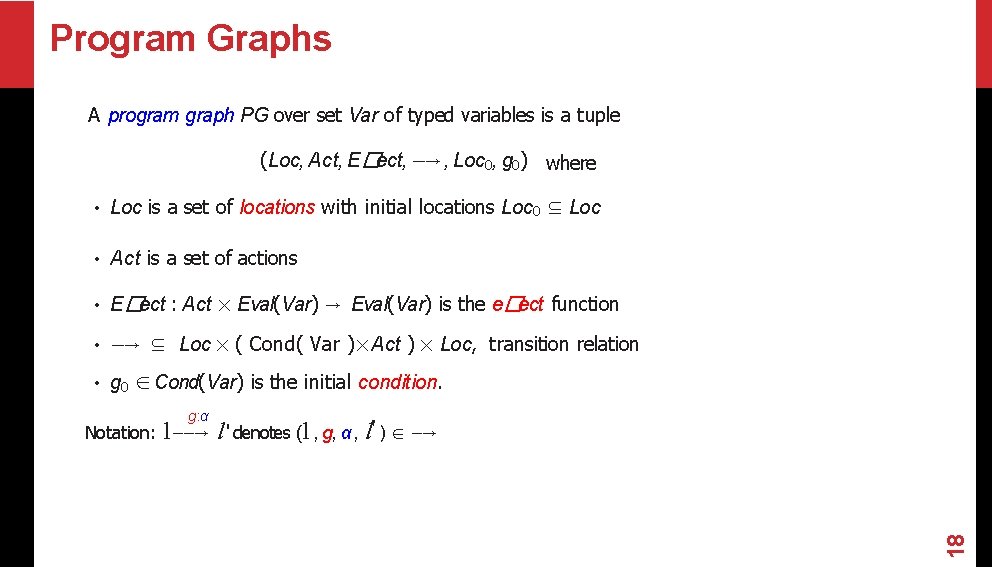
Program Graphs A program graph PG over set Var of typed variables is a tuple (Loc, Act, E�ect, −→, Loc 0, g 0) where • Loc is a set of locations with initial locations Loc 0 ⊆ Loc • Act is a set of actions • E�ect : Act × Eval(Var) → Eval(Var) is the e�ect function • −→ ⊆ Loc × ( Cond( Var )×Act ) × Loc, transition relation • g 0 ∈ Cond(Var) is the initial condition. Notation: l −−→ l ' denotes (l , g, α , l' ) ∈ −→ 18 g: α
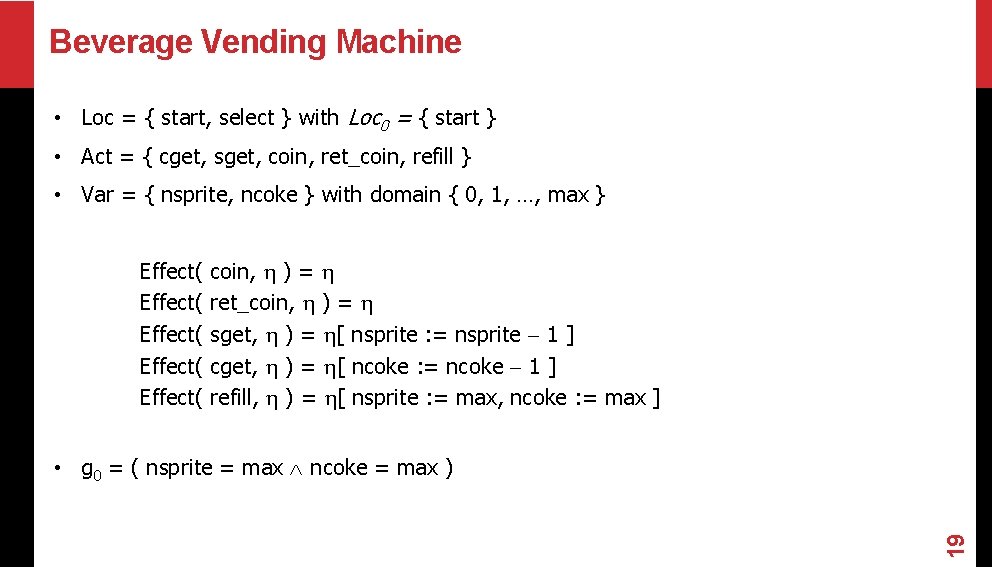
Beverage Vending Machine • Loc = { start, select } with Loc 0 = { start } • Act = { cget, sget, coin, ret_coin, refill } • Var = { nsprite, ncoke } with domain { 0, 1, …, max } Effect( Effect( coin, ) = ret_coin, ) = sget, ) = [ nsprite : = nsprite 1 ] cget, ) = [ ncoke : = ncoke 1 ] refill, ) = [ nsprite : = max, ncoke : = max ] 19 • g 0 = ( nsprite = max ncoke = max )
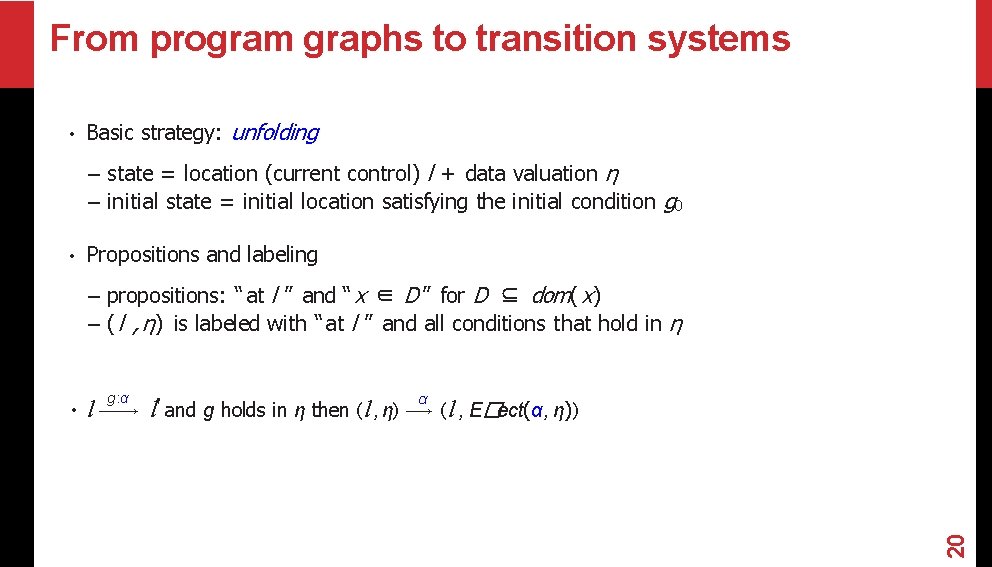
From program graphs to transition systems • Basic strategy: unfolding – state = location (current control) l + data valuation η – initial state = initial location satisfying the initial condition g 0 • Propositions and labeling – propositions: “at l ” and “ x ∈ D ” for D ⊆ dom( x ) – ( l , η ) is labeled with “at l ” and all conditions that hold in η • l −−−→ l' and g holds in η then ( l , η) −−→ ( l , E�ect(α, η)) α 20 g: α
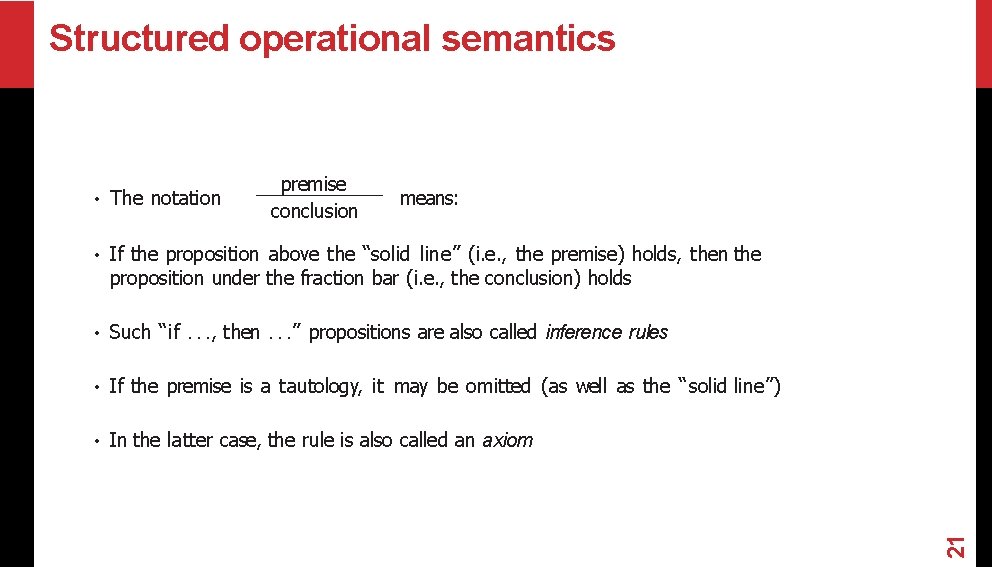
Structured operational semantics • The notation premise conclusion means: • If the proposition above the “solid line” (i. e. , the premise) holds, then the proposition under the fraction bar (i. e. , the conclusion) holds • Such “if. . . , then. . . ” propositions are also called inference rules • If the premise is a tautology, it may be omitted (as well as the “solid line”) 21 • In the latter case, the rule is also called an axiom
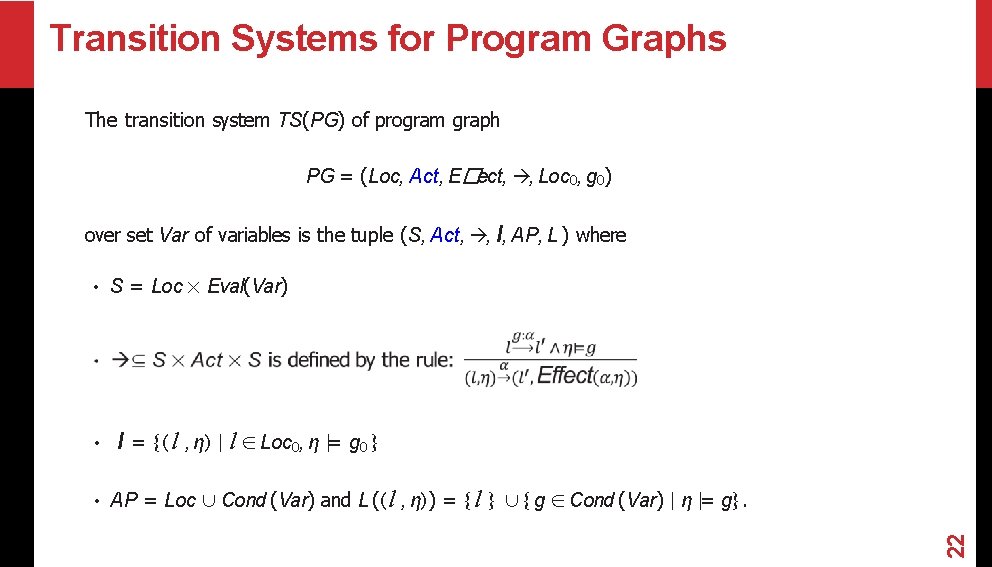
Transition Systems for Program Graphs The transition system TS(PG) of program graph PG = (Loc, Act, E�ect, , Loc 0, g 0) over set Var of variables is the tuple (S, Act, , I, AP, L ) where • S = Loc × Eval(Var) • I = { ( l , η) | l ∈ Loc 0, η |= g 0 } 22 • AP = Loc ∪ Cond (Var) and L (( l , η)) = { l } ∪ { g ∈ Cond (Var) | η |= g}.
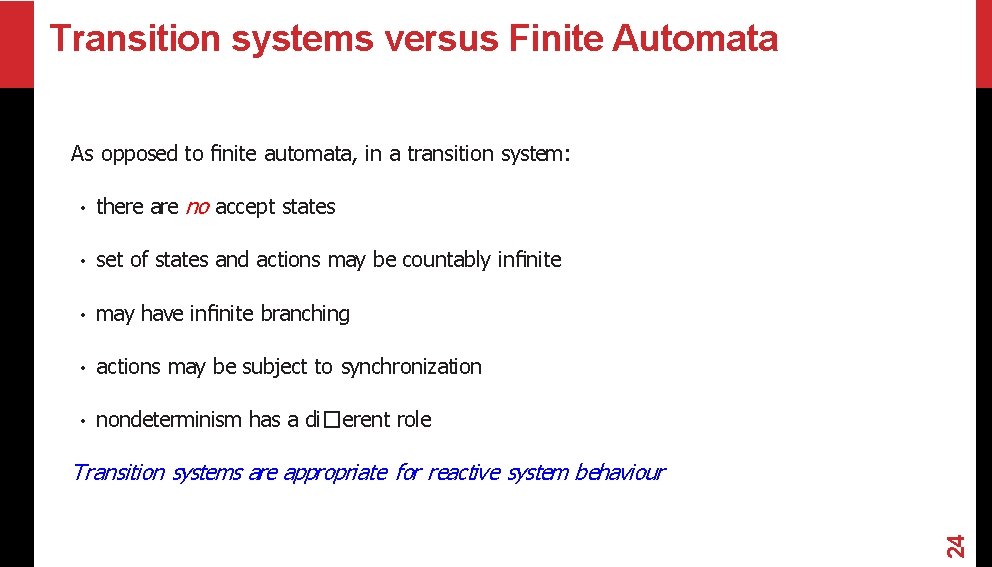
Transition systems versus Finite Automata As opposed to finite automata, in a transition system: • there are no accept states • set of states and actions may be countably infinite • may have infinite branching • actions may be subject to synchronization • nondeterminism has a di�erent role 24 Transition systems are appropriate for reactive system behaviour