
Transition Series Topics for the EMT TOPIC 32


- Slides: 26
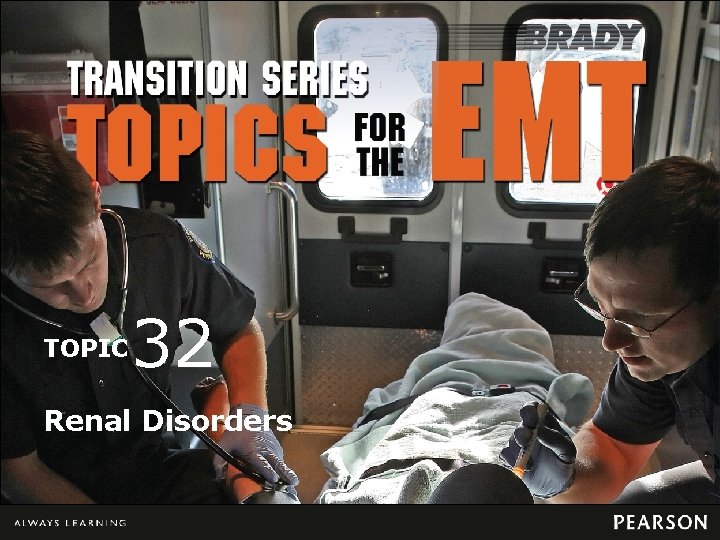
Transition Series Topics for the EMT TOPIC 32 Renal Disorders
Objectives • Discuss frequency rates for renal diseases in the U. S. • Review basic renal physiology. • Discuss pathophysiology of renal-related disorders. • Review basic assessment and management strategies. Transition Series: Topics for the EMT Joseph J. Mistovich • Daniel Limmer
Introduction • Renal disorders are those that pertain to the kidneys. • Potentially painful or fatal pathophysiologic changes can occur with renal diseases. Transition Series: Topics for the EMT Joseph J. Mistovich • Daniel Limmer
Epidemiology • Renal diseases affect about 20 million people in the United States. • 350, 000 Americans receive dialysis for end-stage renal disease. • 50, 000 people die each year from kidney disease. Transition Series: Topics for the EMT Joseph J. Mistovich • Daniel Limmer
Pathophysiology • Kidneys – Production and elimination of urine – Maintain electrolyte balance – Contribute to the body's p. H Transition Series: Topics for the EMT Joseph J. Mistovich • Daniel Limmer
Pathophysiology • Kidneys – Can be damaged by traumatic or nontraumatic etiologies § Inflammation § Infection § Obstruction § Hemorrhage Transition Series: Topics for the EMT Joseph J. Mistovich • Daniel Limmer
Pathophysiology • Renal conditions – Kidney stones – Kidney failure – Dialysis-related emergencies Transition Series: Topics for the EMT Joseph J. Mistovich • Daniel Limmer
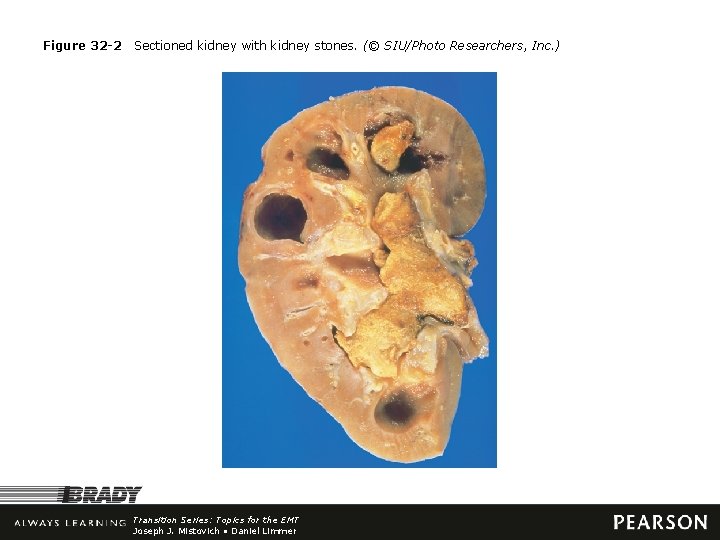
Pathophysiology • Renal conditions – kidney stones – Crystals that form in the kidneys that may obstruct urine flow or get trapped in the ureters or urethra Transition Series: Topics for the EMT Joseph J. Mistovich • Daniel Limmer
Figure 32 -2 Sectioned kidney with kidney stones. (© SIU/Photo Researchers, Inc. ) Transition Series: Topics for the EMT Joseph J. Mistovich • Daniel Limmer
Pathophysiology • Renal conditions – renal failure – Acute renal failure § Occurs over a period of days § Can result in serious metabolic derangements – Chronic renal failure § Occurs over a period of years § Permanent loss of nephrons § Waste products will accumulate Transition Series: Topics for the EMT Joseph J. Mistovich • Daniel Limmer
Pathophysiology • Renal conditions – dialysis – Artificial process used to remove water and waste from the body due to CRF or ARF – Two types § Hemodialysis § Peritoneal dialysis Transition Series: Topics for the EMT Joseph J. Mistovich • Daniel Limmer
Assessment Findings • General assessment considerations – Dialysis patients often on heparin; falls can result in serious bleeding – Ask patient about use of dialysis – Ask about changes to urine – Ask about shunt or graft placements – Ask about other medical problems Transition Series: Topics for the EMT Joseph J. Mistovich • Daniel Limmer
Assessment Findings • General assessment findings – Abnormal urination (odor, color) – Abdominal or flank pain – Fever, malaise, nausea, vomiting – Pain or burning during sex – Increased urge to urinate – Hematuria, oliguria – Anorexia, tachycardia Transition Series: Topics for the EMT Joseph J. Mistovich • Daniel Limmer
Assessment Considerations • Do not obtain a blood pressure in an arm with a dialysis shunt or fistula • Palpation of the abdomen commonly elicits pain Transition Series: Topics for the EMT Joseph J. Mistovich • Daniel Limmer
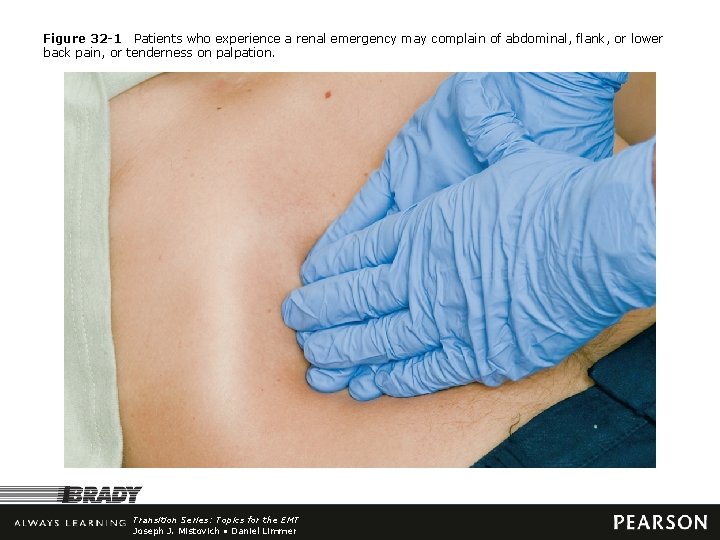
Figure 32 -1 Patients who experience a renal emergency may complain of abdominal, flank, or lower back pain, or tenderness on palpation. Transition Series: Topics for the EMT Joseph J. Mistovich • Daniel Limmer
Emergency Medical Care • Ensure airway adequacy • Provide oxygen based on need – Apply oxygen to keep Sp. O 2 >95% – NRB or PPV based on breathing adequacy • • Control external hemorrhage if present Place patient in position of comfort Calm and reassure the patient Initiate transport, consider ALS intercept Transition Series: Topics for the EMT Joseph J. Mistovich • Daniel Limmer
Case Study You are dispatched to a local construction site for someone abdominal pain. Upon your arrival, you are directed to a big burly man who is sitting on a chair, all hunched over. As you approach he stands up and starts walking, but then sits down again. He looks at you and says, “Help me man, I can't get comfortable – my belly is on fire!” Transition Series: Topics for the EMT Joseph J. Mistovich • Daniel Limmer
Case Study • Scene Size-Up – Scene is safe – Standard precautions taken – Patient is 32 years old, male, 240 lbs – Entry and egress from site is unobstructed – NOI appears to be back pain – No additional resources needed Transition Series: Topics for the EMT Joseph J. Mistovich • Daniel Limmer
Case Study • Primary Assessment Findings – Patient alert and well oriented – Airway patent – Breathing normally, talks in full sentences – Peripheral perfusion intact – Primary complaint is for severe abdominal pain Transition Series: Topics for the EMT Joseph J. Mistovich • Daniel Limmer
Case Study • What kind of differentials could you consider at this time? • What care should be provided at this time? Transition Series: Topics for the EMT Joseph J. Mistovich • Daniel Limmer
Case Study • Medical History – Patient has no medical history – Stated he was “going to pee” when the pain started in his back • Medications – None • Allergies – None Transition Series: Topics for the EMT Joseph J. Mistovich • Daniel Limmer
Case Study • Pertinent Secondary Assessment Findings – Pupils equal and reactive, membranes moist – Airway patent and breathing normal but fast – Perfusion intact and strong, pulse tachy – No history of trauma or similar incident – Back pain happened suddenly, rated as “ 10” Transition Series: Topics for the EMT Joseph J. Mistovich • Daniel Limmer
Case Study • Pertinent Secondary Assessment Findings – States pain has traveled to his groin; he also tells you he “peed blood twice today” – PMS present times 4, Sp. O 2 98% on room air – BGL normal, no other contributory findings Transition Series: Topics for the EMT Joseph J. Mistovich • Daniel Limmer
Case Study • What may be the cause of the back pain? • What would be three assessment findings that could confirm your suspicion? Transition Series: Topics for the EMT Joseph J. Mistovich • Daniel Limmer
Case Study • Care provided: – Patient placed on low-flow oxygen – Placed in the most comfortable position attainable on wheeled cot – Transport initiated to ED with ALS intercept planned en route Transition Series: Topics for the EMT Joseph J. Mistovich • Daniel Limmer
Summary • Renal disorders, although rare, can become life threatening in a short period of time. • The goal is to recognize the kidneys are failing (or have failed) based upon your assessment, and provide supportive treatment and expedient transport. Transition Series: Topics for the EMT Joseph J. Mistovich • Daniel Limmer