
TRANSITION SCHOOL TO WORK FOR STUDENTS WITH DISABILITIES
TRANSITION SCHOOL TO WORK FOR STUDENTS WITH DISABILITIES & OTHER BARRIERS CTAE SUMMER CONFERENCE JUNE 10 -11, 2015
OBJECTIVES • Workforce Investment Act (WIA) Youth Program, Department of Workforce Services (DWS) • • Program Overview Eligibility Requirements Upcoming changes Recommendations • Vocational Rehabilitation Program (VR), State Office of Rehabilitation (USOR) • • Program Overview Eligibility Requirements Upcoming changes Recommendations Utah


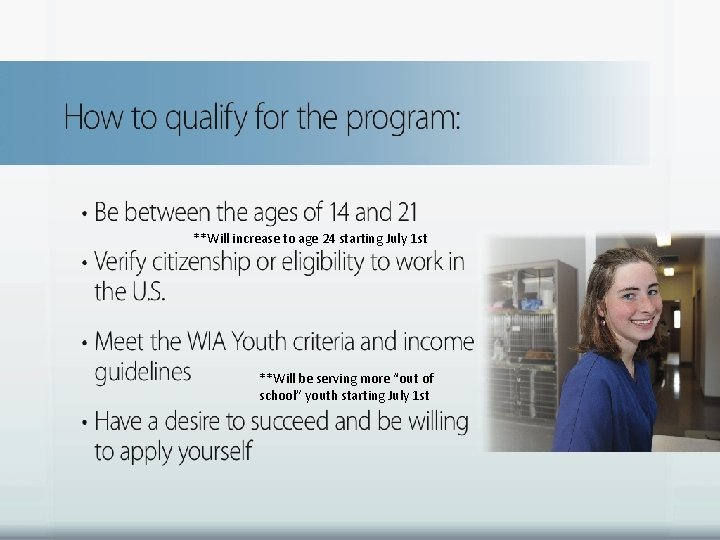
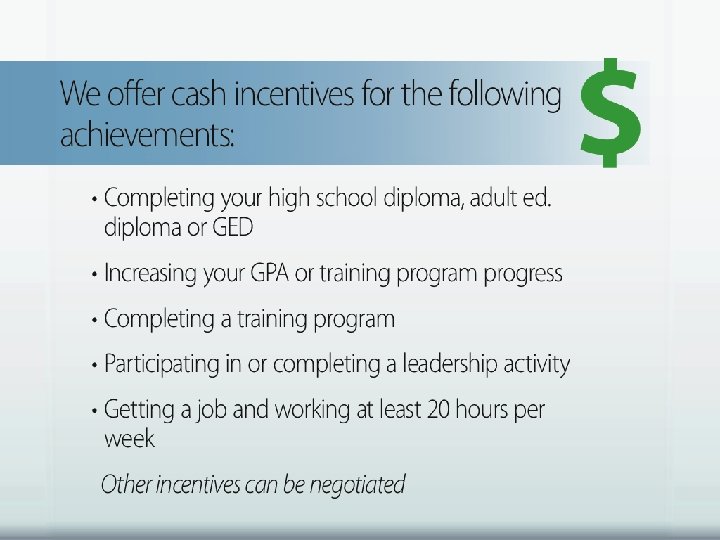
**Will increase to age 24 starting July 1 st **Will be serving more “out of school” youth starting July 1 st
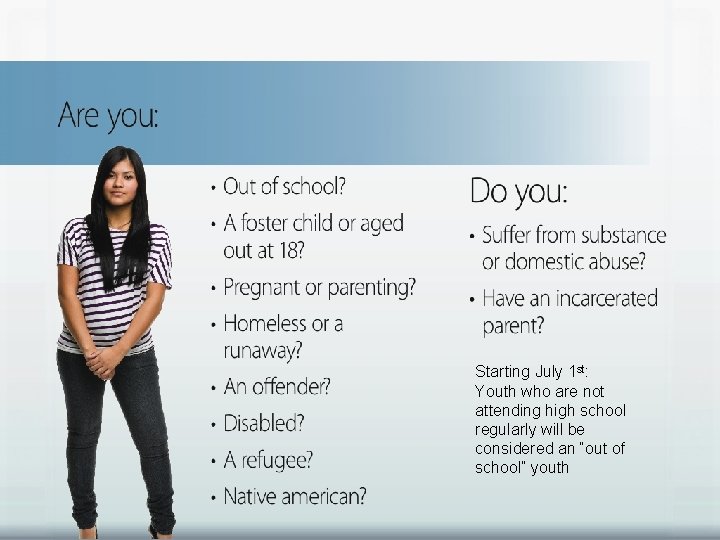
WIA SLIDES… Starting July 1 st: Youth who are not attending high school regularly will be considered an “out of school” youth
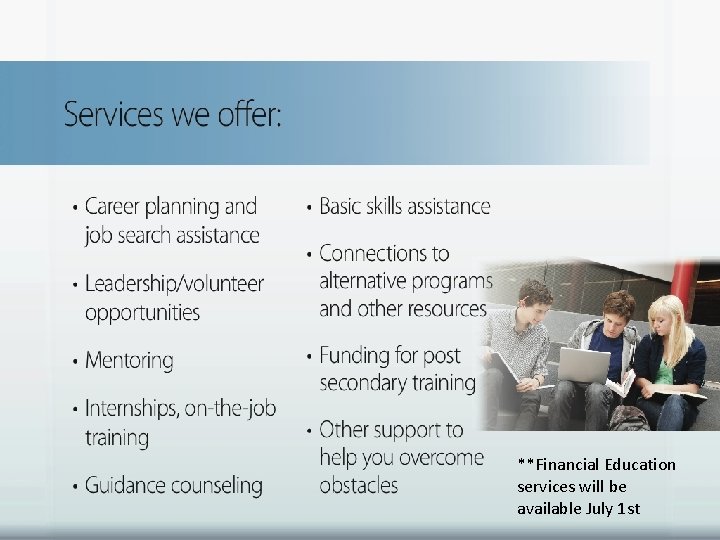
**Financial Education services will be available July 1 st
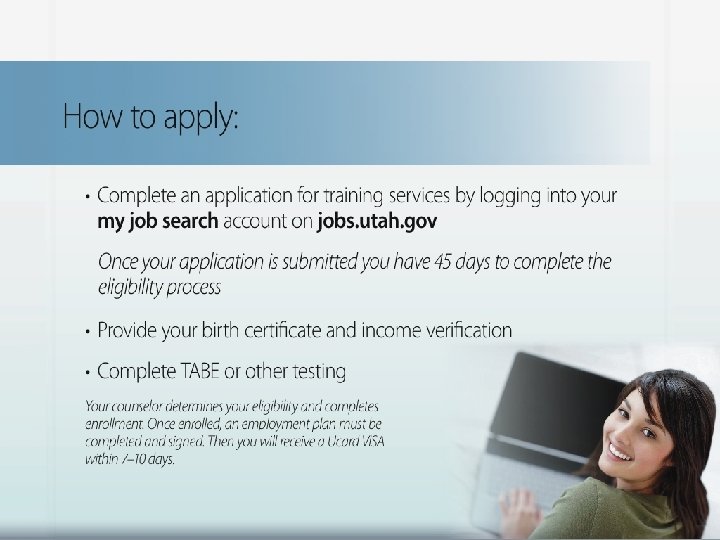
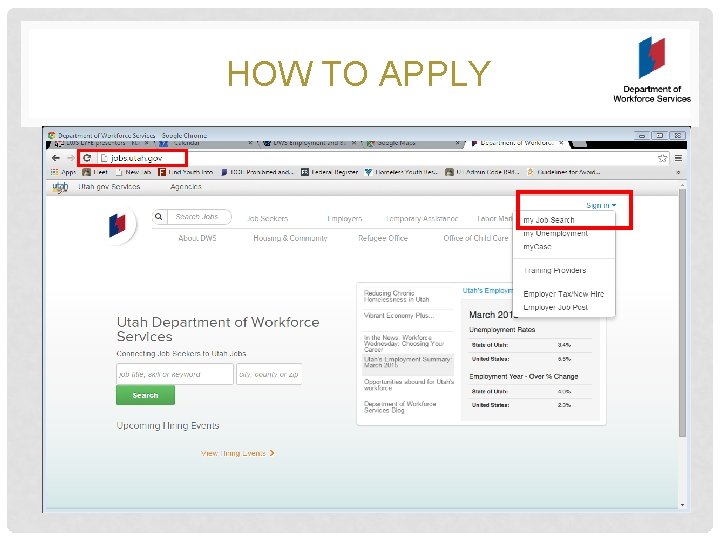
HOW TO APPLY
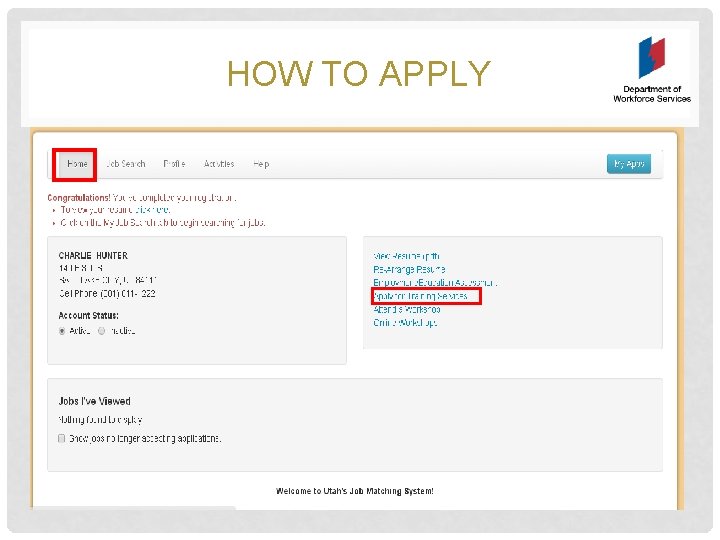
HOW TO APPLY
CONTACT INFORMATION • Kimber Burks, MS Statewide Program Specialist Workforce Investment Act (WIA) Youth Program Department of Workforce Services • kburks@utah. gov • 801 -814 -1222 • www. jobs. utah. gov
VOCATIONAL REHABILITATION Our Mission: To assist eligible individuals with disabilities to prepare for and obtain employment and increase their independence
WHAT IS VOCATIONAL REHABILITATION? • VR is not a one-size-fits-all menu of services. Instead its an individualized and customized set of rehabilitative activities. • Activities are designed to help individuals learn more about their disability, how to overcome barriers to getting and keeping a job, and ways to be more self-reliant. • VR’s Goal: Competitive, Integrated Employment!
WHO IS ELIGIBLE FOR VR? • VR Counselors determine whether individuals are eligible for the VR program based on these 4 criteria: 1. Does a significant physical or mental impairment exist? 2. Does the impairment result in a substantial impediment to employment? 3. Does the individual require VR services? 4. Will the individual benefit in terms of an employment outcome? • Transition services for youth/students with disabilities ages 14 -24, assist with transitioning eligible students from the education system to employment and adult service agencies.
VR TRANSITION SERVICES • VR services are individualized and based on need, resulting in a variety of possible services that student with a disability could access. Services may include but are not limited to: • Vocational Counseling & Guidance • Restoration & Disability Adjustment Services • IEP & 504 or School Counselor Team Meetings • Training & Education • Job Placement & Coaching • Assistive Technology • • • Job Readiness Workshops Assistive Technology Summer Work Programs Social Skills Training Individualized Work Experiences for Youth 14 -24 • Job Accommodations & Disability Disclosure Assistance • Other
WHO PAYS FOR VR SERVICES? • A financial needs assessment will be completed to determine if a student/client can afford to contribute toward payment for VR services. • Students under the age of 18 will have to include their parent/guardian information. • Eligibility is NOT based on financial need • There are many services with VR that are at no cost to the student/client. For example: • • VR Counseling & Guidance Job Placement Services Work Experiences Work Training Programs • VR also seeks out any comparable benefits for services, while determining what services will be covered by VR.
VR ORDER OF SELECTION • When a VR program does not have enough financial resources or staff to serve everyone who is eligible for services, they implement a waiting list, called an Order of Selection. • Any individual who is found eligible for VR services will be placed on a waiting list, based on disability categories. 1. 2. 3. Individuals with Most Significant Disabilities (MSD) Individuals with Significant Disabilities (SD) Individuals with Disabilities (D) • VR Counselors will assess individuals by the: • Limitations in functional capacities (due to their disabilities) • Number of services required by the individual • Length of time services are required • Information & Referral services will be offered to persons on the wait list & individuals will be notified when they come off the list.
TIMELINES & OUTCOMES • VR is a short term program, however, the length of time engaged in services is individualized. • For example, a student that was found eligible for VR services at age 16, will engage in services at least until they leave the school system. If further training or employment programs are necessary, the student could potentially be in VR services until the are 24 • Outcomes: A clients case will successfully close when they have completed their VR plan and have transitioned into permanent employment for at least 90 days. • Clients that are unsuccessful in complying with their VR plan and do not make progress toward remediation of a disability or towards a vocational goal with have their case closed.
CONTACT INFORMATION • Rachel Anderson, MS, CRC, LVRC Transition & Supported Employment Coordinator Utah State Office of Rehabilitation, Vocational Rehabilitation Program • rachelanderson@utah. gov • 801 -538 -7591 • www. usor. utah. gov/transition
- Slides: 20