
Transition Planning Parents Perspective to Quality Transition Plans
- Slides: 26
Transition Planning: Parent’s Perspective to Quality Transition Plans March 29, 2007 Henrico County Public Schools Dr. Mary E. Morningstar & Dana Lattin mmorningstar@ku. edu http: //www. transitioncoalition. org Examples University of Kansasfrom session: www. transitioncoalition. org Department of Special Education
www. transitioncoalition. org
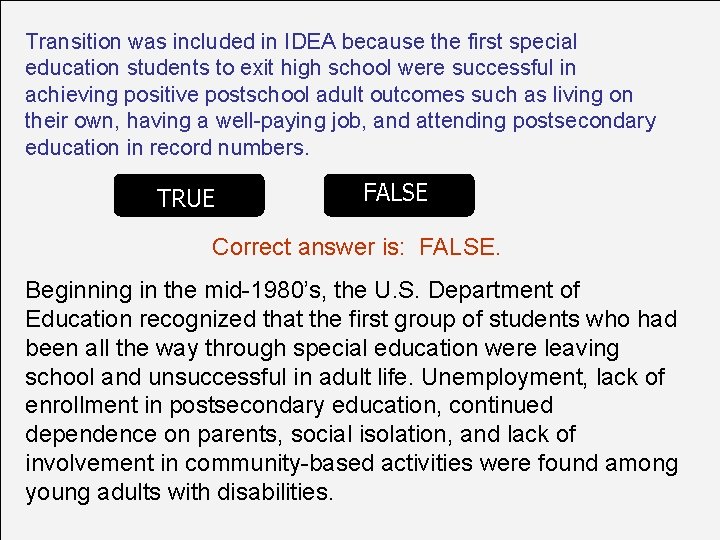
Transition was included in IDEA because the first special education students to exit high school were successful in achieving positive postschool adult outcomes such as living on their own, having a well-paying job, and attending postsecondary education in record numbers. TRUE FALSE Correct answer is: FALSE. Beginning in the mid-1980’s, the U. S. Department of Education recognized that the first group of students who had been all the way through special education were leaving school and unsuccessful in adult life. Unemployment, lack of enrollment in postsecondary education, continued dependence on parents, social isolation, and lack of involvement in community-based activities were found among young adults with disabilities.
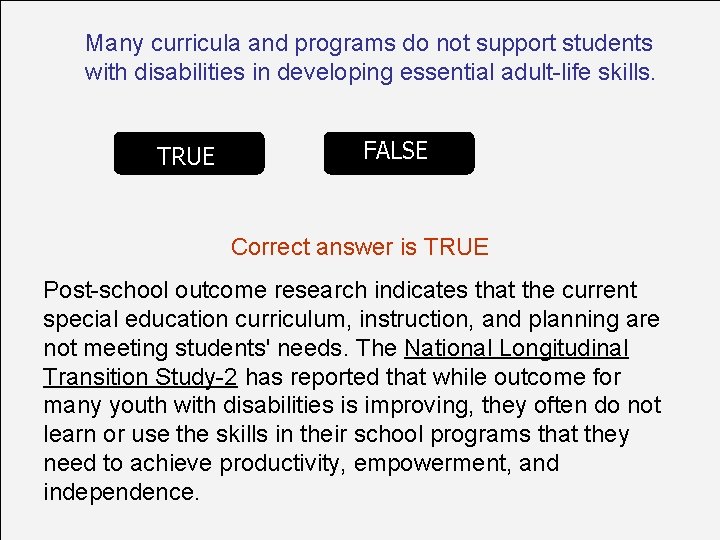
Many curricula and programs do not support students with disabilities in developing essential adult-life skills. TRUE FALSE Correct answer is TRUE Post-school outcome research indicates that the current special education curriculum, instruction, and planning are not meeting students' needs. The National Longitudinal Transition Study-2 has reported that while outcome for many youth with disabilities is improving, they often do not learn or use the skills in their school programs that they need to achieve productivity, empowerment, and independence.
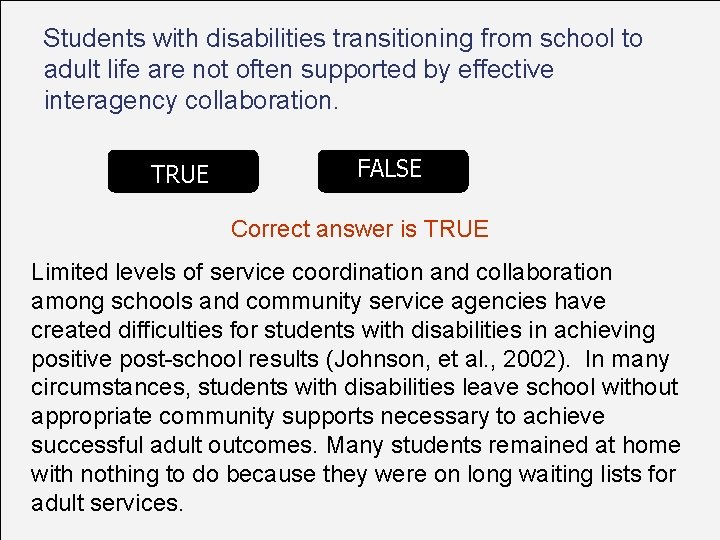
Students with disabilities transitioning from school to adult life are not often supported by effective interagency collaboration. TRUE FALSE Correct answer is TRUE Limited levels of service coordination and collaboration among schools and community service agencies have created difficulties for students with disabilities in achieving positive post-school results (Johnson, et al. , 2002). In many circumstances, students with disabilities leave school without appropriate community supports necessary to achieve successful adult outcomes. Many students remained at home with nothing to do because they were on long waiting lists for adult services.
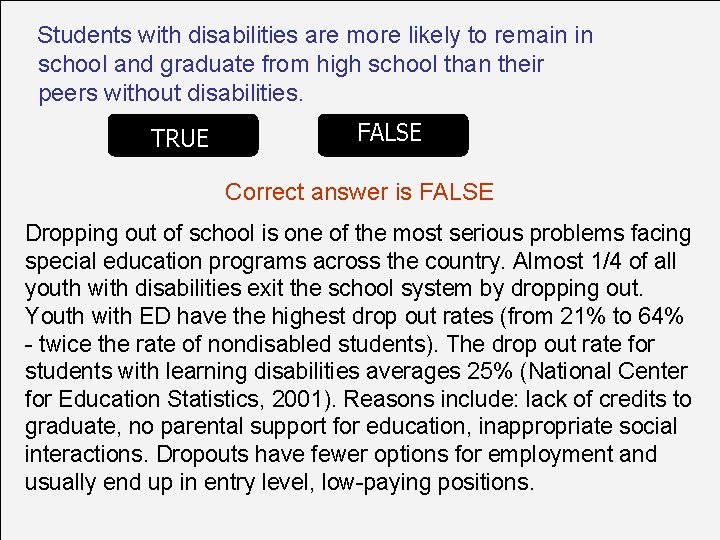
Students with disabilities are more likely to remain in school and graduate from high school than their peers without disabilities. TRUE FALSE Correct answer is FALSE Dropping out of school is one of the most serious problems facing special education programs across the country. Almost 1/4 of all youth with disabilities exit the school system by dropping out. Youth with ED have the highest drop out rates (from 21% to 64% - twice the rate of nondisabled students). The drop out rate for students with learning disabilities averages 25% (National Center for Education Statistics, 2001). Reasons include: lack of credits to graduate, no parental support for education, inappropriate social interactions. Dropouts have fewer options for employment and usually end up in entry level, low-paying positions.
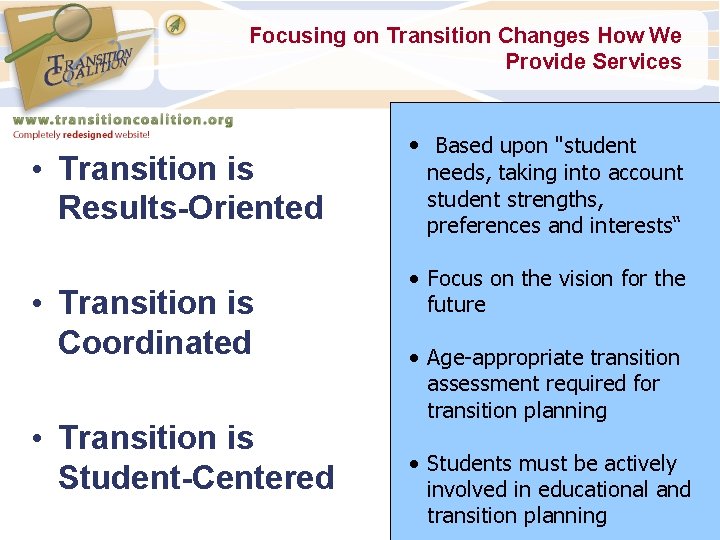
Focusing on Transition Changes How We Provide Services • All activities & services • Transition is Results-Oriented • Transition is Coordinated • Transition is Student-Centered • • Postecondary Based "student ed. , = living, within upon the school employment, needs, and intofull account coursetaking of study participation student strengths, in the community preferences interests“ • Link with and agencies and service providers • • Focus Accountable on the for vision programs for the providing transition leading future to successful services outcomes • Age-appropriate transition • Work with outside • assessment IEP reflects(including what required the for agencies student transition expected planning to invitingisto IEP meetings). know or be able to do • Students must be actively • Reauthorization of • involved IEP = transition in educational IEP and Rehab. Act transition planning
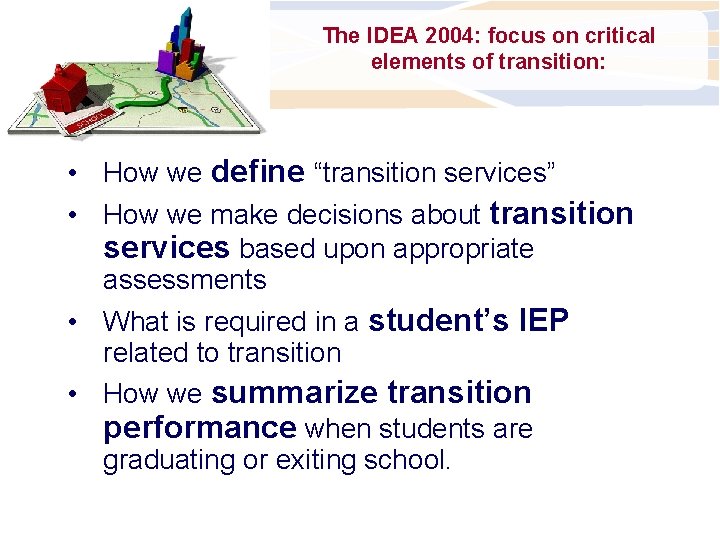
The IDEA 2004: focus on critical elements of transition: • How we define “transition services” • How we make decisions about transition services based upon appropriate assessments • What is required in a student’s IEP related to transition • How we summarize transition performance when students are graduating or exiting school.
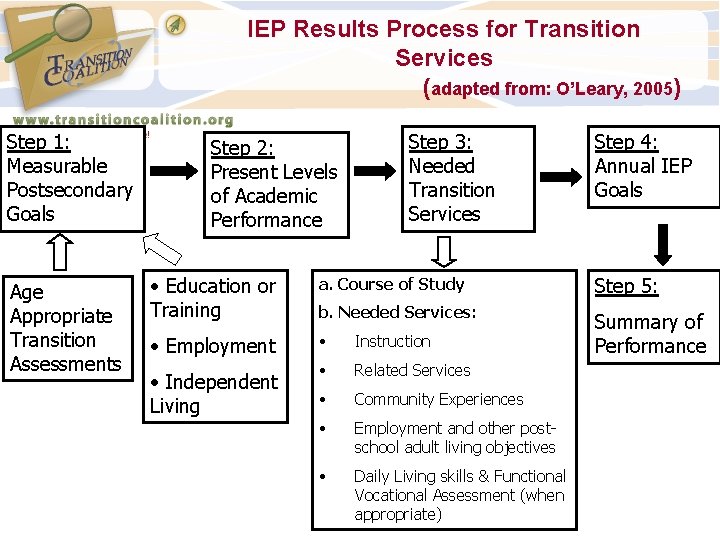
IEP Results Process for Transition Services (adapted from: O’Leary, 2005) Step 1: Measurable Postsecondary Goals Age Appropriate Transition Assessments Step 2: Present Levels of Academic Performance Step 3: Needed Transition Services Step 4: Annual IEP Goals • Education or Training a. Course of Study Step 5: b. Needed Services: • Employment • Instruction Summary of Performance • Related Services • Community Experiences • Employment and other postschool adult living objectives • Daily Living skills & Functional Vocational Assessment (when appropriate) • Independent Living
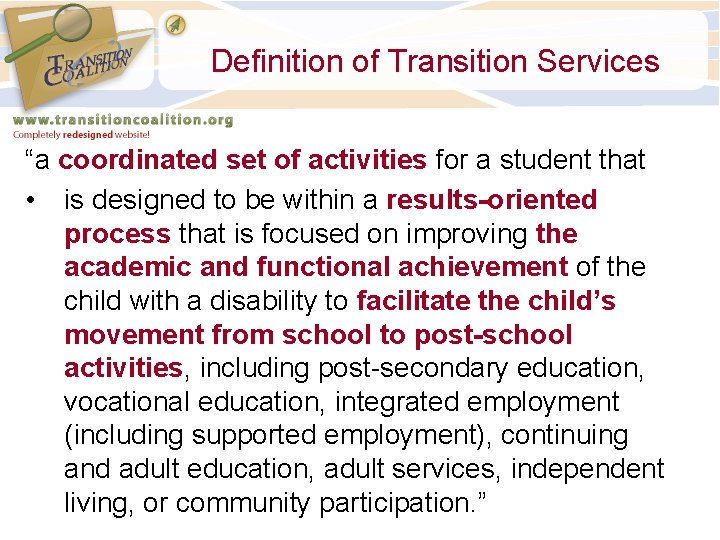
Definition of Transition Services “a coordinated set of activities for a student that • is designed to be within a results-oriented process that is focused on improving the academic and functional achievement of the child with a disability to facilitate the child’s movement from school to post-school activities, including post-secondary education, vocational education, integrated employment (including supported employment), continuing and adult education, adult services, independent living, or community participation. ”
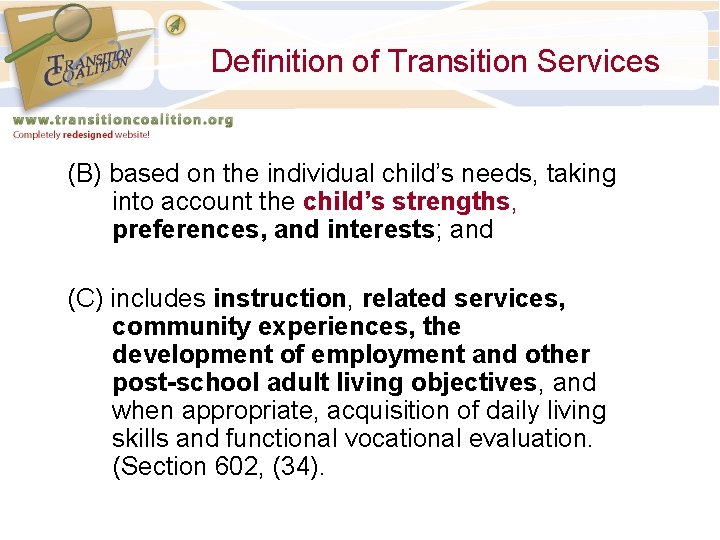
Definition of Transition Services (B) based on the individual child’s needs, taking into account the child’s strengths, preferences, and interests; and (C) includes instruction, related services, community experiences, the development of employment and other post-school adult living objectives, and when appropriate, acquisition of daily living skills and functional vocational evaluation. (Section 602, (34).
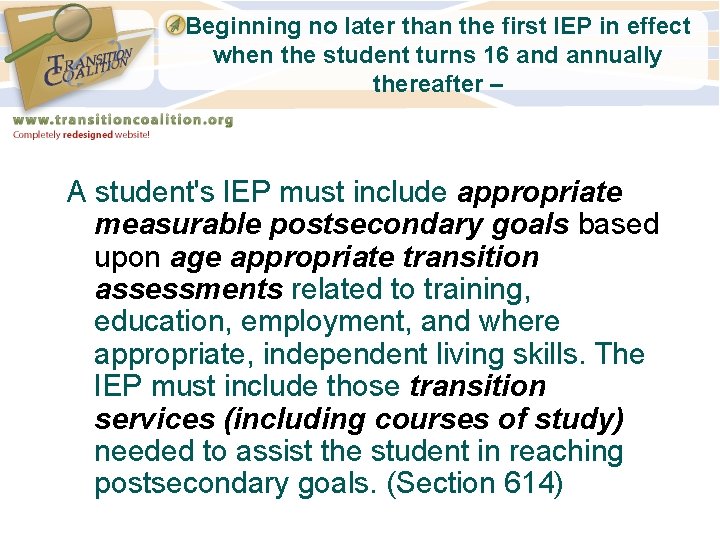
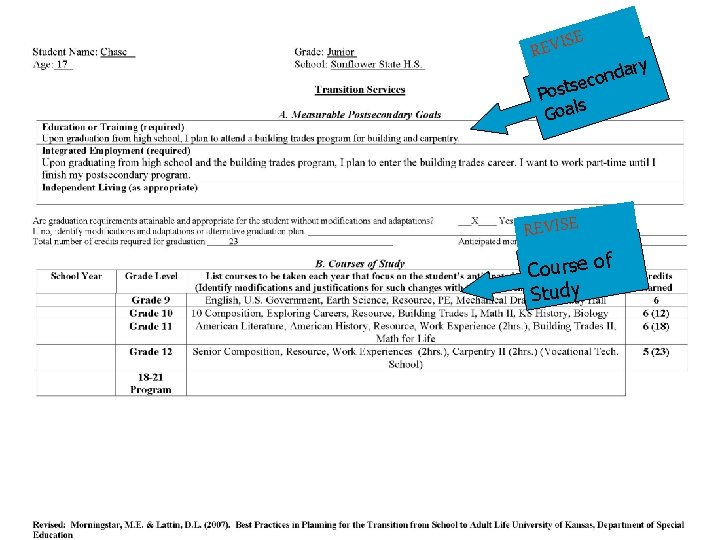
Beginning no later than the first IEP in effect when the student turns 16 and annually thereafter – A student's IEP must include appropriate measurable postsecondary goals based upon age appropriate transition assessments related to training, education, employment, and where appropriate, independent living skills. The IEP must include those transition services (including courses of study) needed to assist the student in reaching postsecondary goals. (Section 614)
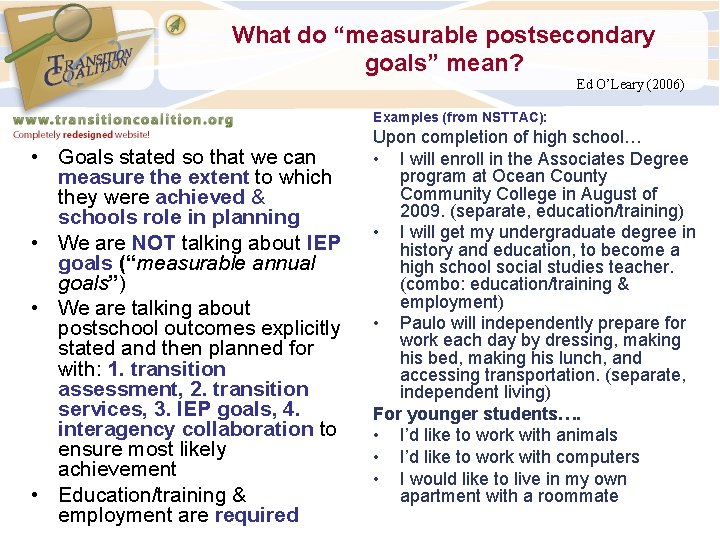
What do “measurable postsecondary goals” mean? Ed O’Leary (2006) Examples (from NSTTAC): • Goals stated so that we can measure the extent to which they were achieved & schools role in planning • We are NOT talking about IEP goals (“measurable annual goals”) • We are talking about postschool outcomes explicitly stated and then planned for with: 1. transition assessment, 2. transition services, 3. IEP goals, 4. interagency collaboration to ensure most likely achievement • Education/training & employment are required Upon completion of high school… • I will enroll in the Associates Degree program at Ocean County Community College in August of 2009. (separate, education/training) • I will get my undergraduate degree in history and education, to become a high school social studies teacher. (combo: education/training & employment) • Paulo will independently prepare for work each day by dressing, making his bed, making his lunch, and accessing transportation. (separate, independent living) For younger students…. • I’d like to work with animals • I’d like to work with computers • I would like to live in my own apartment with a roommate
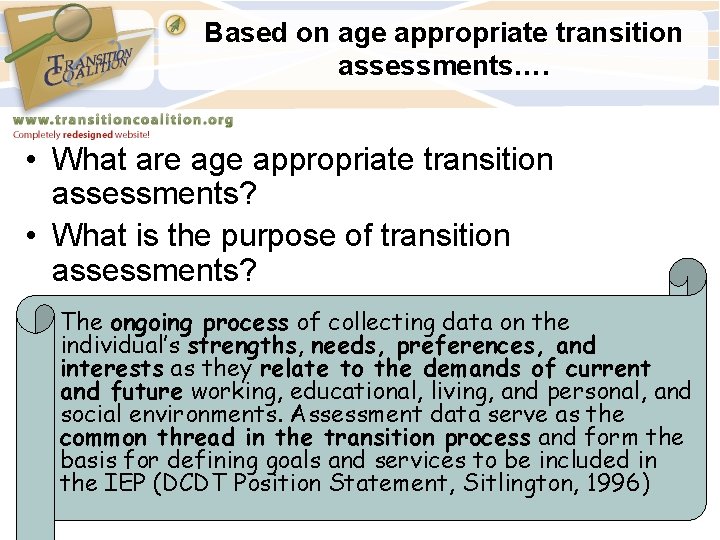
Based on age appropriate transition assessments…. • What are age appropriate transition assessments? • What is the purpose of transition assessments? The ongoing process of collecting data on the individual’s strengths, needs, preferences, and interests as they relate to the demands of current and future working, educational, living, and personal, and social environments. Assessment data serve as the common thread in the transition process and form the basis for defining goals and services to be included in the IEP (DCDT Position Statement, Sitlington, 1996)
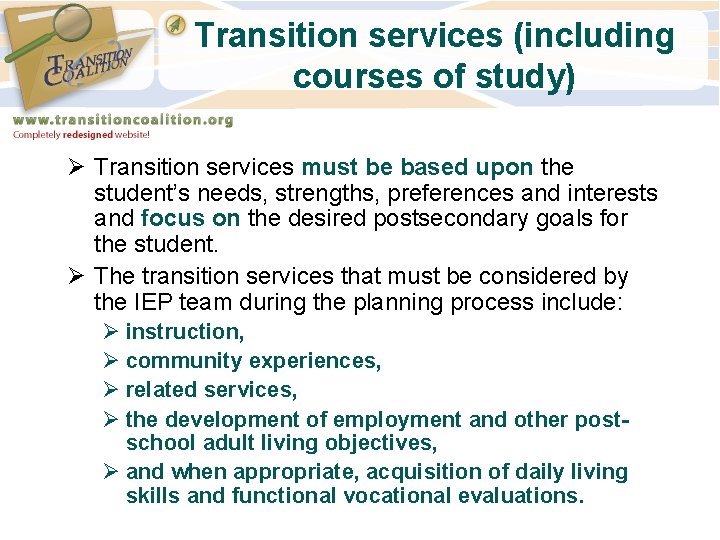
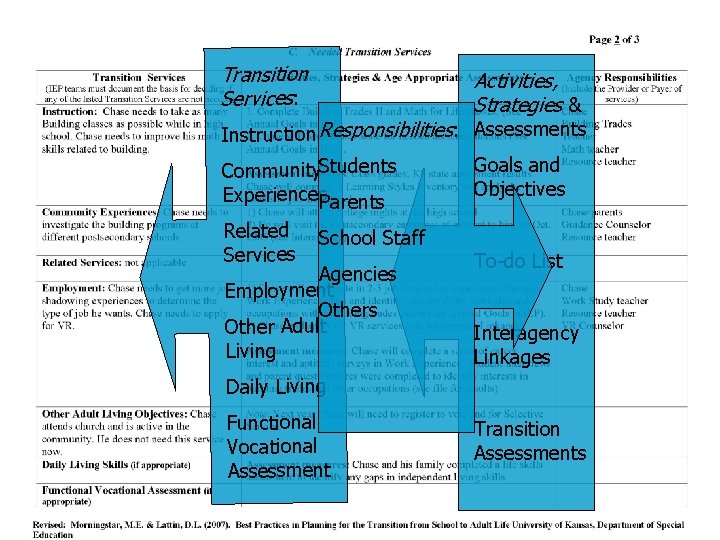
Transition services (including courses of study) Ø Transition services must be based upon the student’s needs, strengths, preferences and interests and focus on the desired postsecondary goals for the student. Ø The transition services that must be considered by the IEP team during the planning process include: Ø instruction, Ø community experiences, Ø related services, Ø the development of employment and other postschool adult living objectives, Ø and when appropriate, acquisition of daily living skills and functional vocational evaluations.
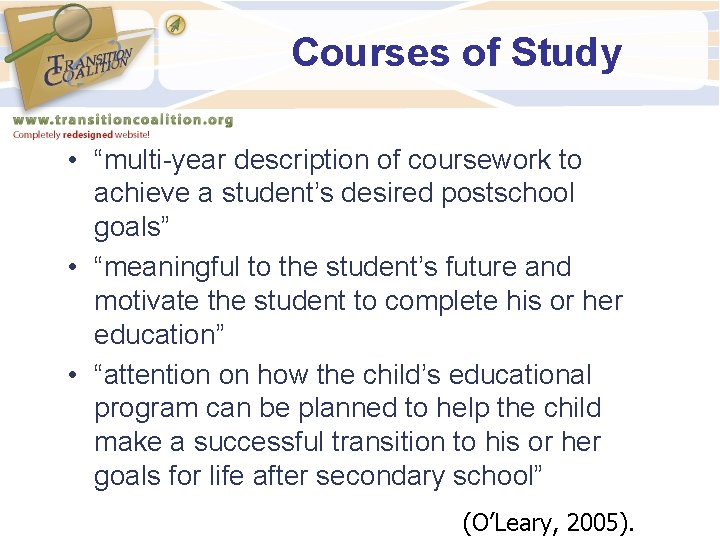
Courses of Study • “multi-year description of coursework to achieve a student’s desired postschool goals” • “meaningful to the student’s future and motivate the student to complete his or her education” • “attention on how the child’s educational program can be planned to help the child make a successful transition to his or her goals for life after secondary school” (O’Leary, 2005).
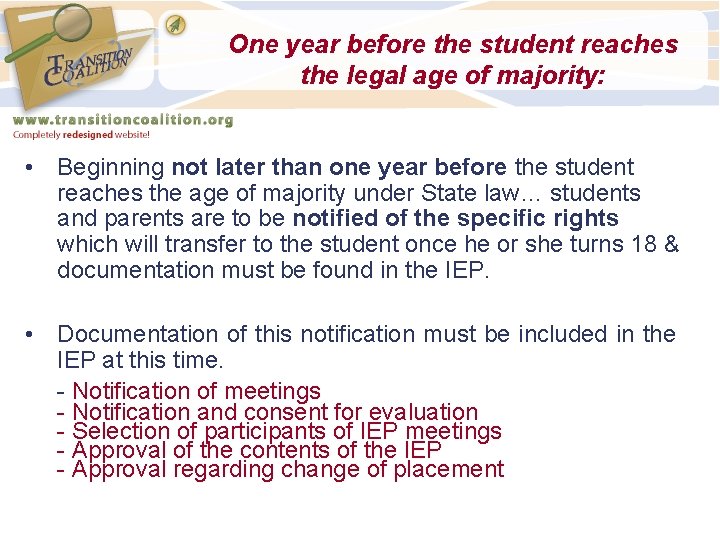
One year before the student reaches the legal age of majority: • Beginning not later than one year before the student reaches the age of majority under State law… students and parents are to be notified of the specific rights which will transfer to the student once he or she turns 18 & documentation must be found in the IEP. • Documentation of this notification must be included in the IEP at this time. - Notification of meetings - Notification and consent for evaluation - Selection of participants of IEP meetings - Approval of the contents of the IEP - Approval regarding change of placement
E S I V E R ry nda o c e s Post s Goal REVISE f Course o Study
Transition Services: Activities, Strategies & Instruction Responsibilities: Assessments Goals and Community. Students Objectives Experiences. Parents Related Services School Staff Agencies Employment Others Other Adult Living To-do List Interagency Linkages Daily Living Functional Vocational Assessment Transition Assessments
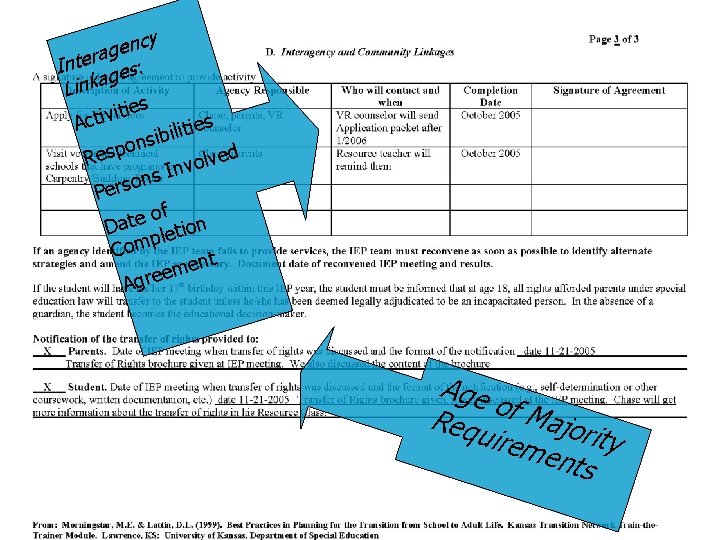
cy n e g a Inter ges: Linka es i t i v i Act ies t i l i b nsi o p s ed v Re l o Inv s n o Pers of e t a D on i t e l p Com nt e m e Agre Age o Requ f Major ity irem ents
Caught in Transition… A comprehensive evaluation. . “shall not be required before the termination of a child's eligibility under this part due to graduation from secondary school with a regular diploma. ” SUMMARY OF PERFORMANCE “… a local educational agency shall provide the child with a summary of the child's academic achievement and functional performance, which shall include recommendations on how to assist the child in meeting the child's postsecondary goals. ” IDEA 2004 Sec. 614 c (5)
Summary of Performance • For students who are graduating (exiting) high school (either with a regular diploma or due to exceeding the age eligibility for special education), schools are now required to provide the student and his or her family with a summary of academic achievement and functional performance, along with recommendations on how to assist the student to meet postschool goals. • These requirements do not require additional evaluations or reevaluations before the change in eligibility take place. • The IDEA does not specify what this performance summary should look like or what kinds of information need to be included. Schools should be planning creative ways to capture a students transition summary report.
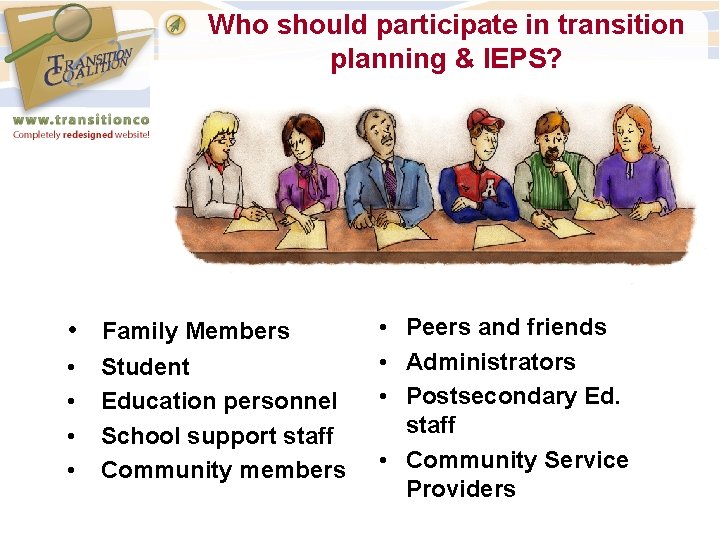
Who should participate in transition planning & IEPS? • Family Members • • Student Education personnel School support staff Community members • Peers and friends • Administrators • Postsecondary Ed. staff • Community Service Providers
Who is Responsible for Transition Outcomes? In the case where a participating agency, other than the educational agency, fails to provide agreed upon services, the educational agency shall reconvene the IEP team to identify alternative strategies to meet the transition objective.
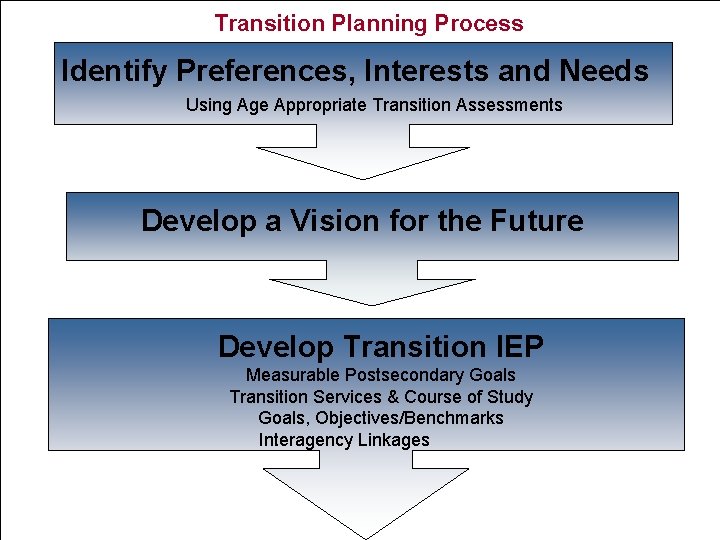
Transition Planning Process Identify Preferences, Interests and Needs Using Age Appropriate Transition Assessments Develop a Vision for the Future Develop Transition IEP Measurable Postsecondary Goals Transition Services & Course of Study Goals, Objectives/Benchmarks Interagency Linkages
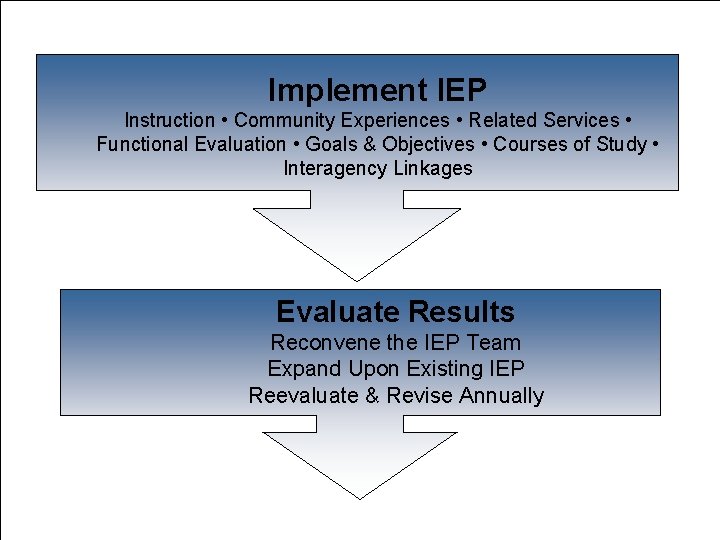
Implement IEP Instruction • Community Experiences • Related Services • Functional Evaluation • Goals & Objectives • Courses of Study • Interagency Linkages Evaluate Results Reconvene the IEP Team Expand Upon Existing IEP Reevaluate & Revise Annually