
Transition Plan Development Learning Purpose Understand the necessity

- Slides: 30
Transition Plan Development
Learning Purpose Understand the necessity of transition planning as well as its procedure Understand the tasks for developing a transition plan. 1
Contents 1. Transition Plan Development Overview 2. Transition Plan Tasks
1. Transition Plan Development Overview 2. Transition Plan Tasks
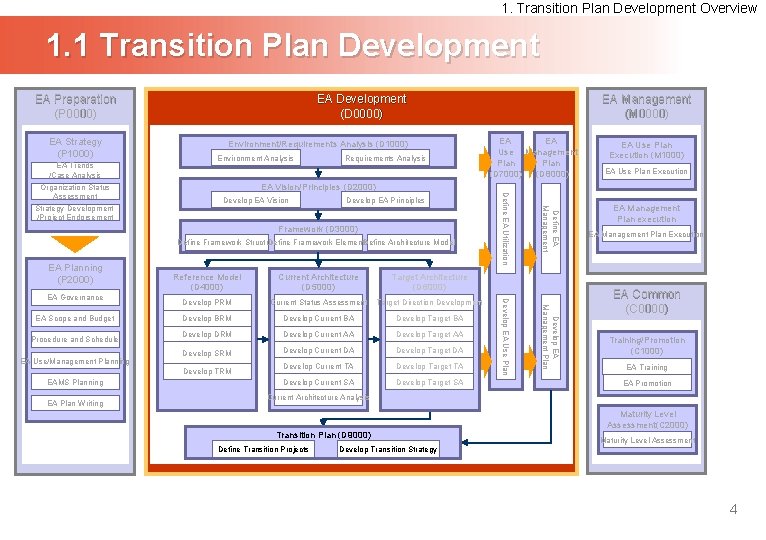
1. Transition Plan Development Overview 1. 1 Transition Plan Development EA Preparation (P 0000) EA Strategy (P 1000) Environment/Requirements Analysis (D 1000) Environment Analysis Requirements Analysis Develop EA Principles EA Use/Management Planning Target Architecture (D 6000) Develop PRM Current Status Assessment Target Direction Development Develop BRM Develop Current BA Develop Target BA Develop DRM Develop Current AA Develop Target AA Develop SRM Develop Current DA Develop Target DA Develop Current TA Develop Target TA Develop Current SA Develop Target SA Develop TRM EAMS Planning EA Plan Writing Develop EA Management Plan Procedure and Schedule Current Architecture (D 5000) Develop EA Use Plan EA Scope and Budget Reference Model (D 4000) Define EA Management Framework (D 3000) EA Governance EA Use Plan Execution (M 1000) EA Use Plan Execution EA Vision/Principles (D 2000) Develop EA Vision Define Framework Structure Define Architecture Model Define Framework Elements EA Planning (P 2000) EA EA Use Management Plan (D 7000) (D 8000) Define EA Utilization EA Trends /Case Analysis Organization Status Assessment Strategy Development /Project Endorsement EA Management (M 0000) EA Development (D 0000) EA Management Plan execution (M 2000) EA Management Plan Execution EA Common (C 0000) Training/Promotion (C 1000) EA Training EA Promotion Current Architecture Analysis Maturity Level Assessment(C 2000) Transition Plan (D 9000) Define Transition Projects Develop Transition Strategy Maturity Level Assessment 4
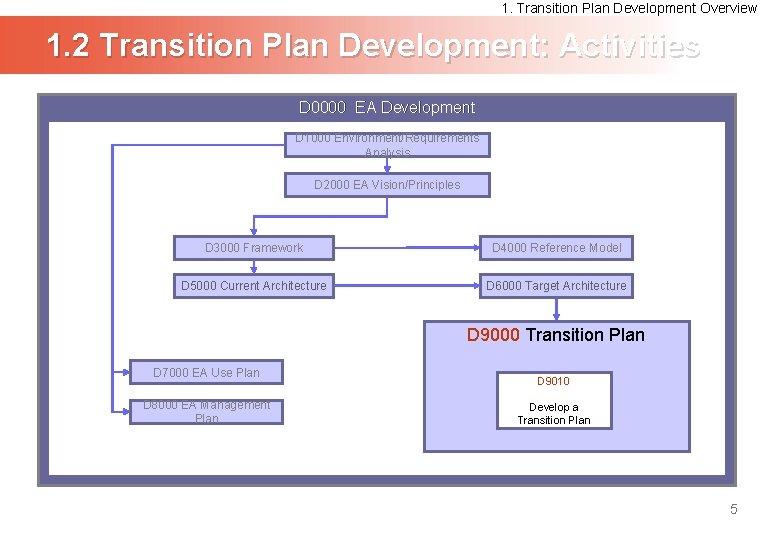
1. Transition Plan Development Overview 1. 2 Transition Plan Development: Activities D 0000 EA Development D 1000 Environment/Requirements Analysis D 2000 EA Vision/Principles D 3000 Framework D 4000 Reference Model D 5000 Current Architecture D 6000 Target Architecture D 9000 Transition Plan D 7000 EA Use Plan D 8000 EA Management Plan D 9010 Develop a Transition Plan 5
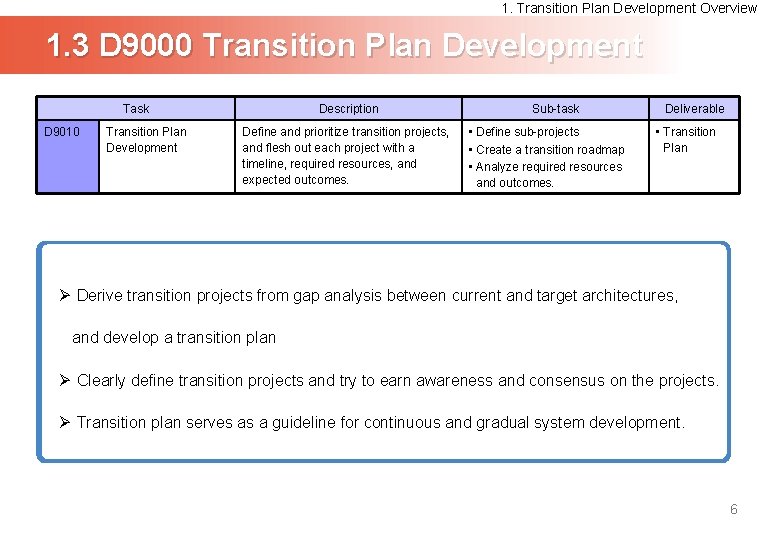
1. Transition Plan Development Overview 1. 3 D 9000 Transition Plan Development Task D 9010 Transition Plan Development Description Define and prioritize transition projects, and flesh out each project with a timeline, required resources, and expected outcomes. Sub-task • Define sub-projects • Create a transition roadmap • Analyze required resources and outcomes. Deliverable • Transition Plan Ø Derive transition projects from gap analysis between current and target architectures, and develop a transition plan Ø Clearly define transition projects and try to earn awareness and consensus on the projects. Ø Transition plan serves as a guideline for continuous and gradual system development. 6
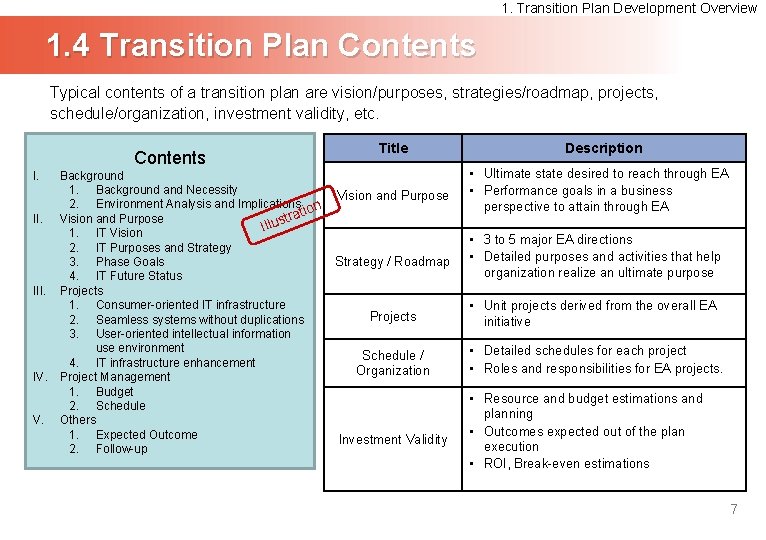
1. Transition Plan Development Overview 1. 4 Transition Plan Contents Typical contents of a transition plan are vision/purposes, strategies/roadmap, projects, schedule/organization, investment validity, etc. Contents Title Vision and Purpose • Ultimate state desired to reach through EA • Performance goals in a business perspective to attain through EA Strategy / Roadmap • 3 to 5 major EA directions • Detailed purposes and activities that help organization realize an ultimate purpose Projects • Unit projects derived from the overall EA initiative Schedule / Organization • Detailed schedules for each project • Roles and responsibilities for EA projects. I. Background 1. Background and Necessity 2. Environment Analysis and Implications on ati r t II. Vision and Purpose s Illu 1. IT Vision 2. IT Purposes and Strategy 3. Phase Goals 4. IT Future Status III. Projects 1. Consumer-oriented IT infrastructure 2. Seamless systems without duplications 3. User-oriented intellectual information use environment 4. IT infrastructure enhancement IV. Project Management 1. Budget 2. Schedule V. Others 1. Expected Outcome 2. Follow-up Description Investment Validity • Resource and budget estimations and planning • Outcomes expected out of the plan execution • ROI, Break-even estimations 7
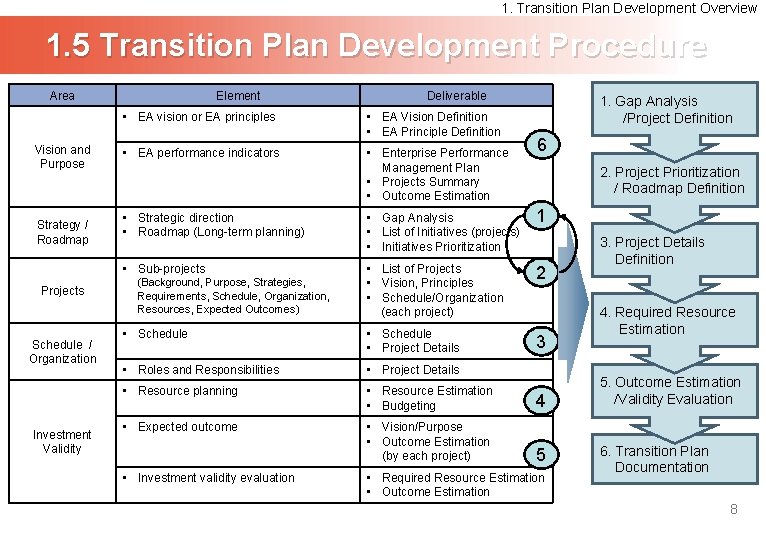
1. Transition Plan Development Overview 1. 5 Transition Plan Development Procedure Area Vision and Purpose Strategy / Roadmap Projects Schedule / Organization Investment Validity Element Deliverable • EA vision or EA principles • EA Vision Definition • EA Principle Definition • EA performance indicators • Enterprise Performance Management Plan • Projects Summary • Outcome Estimation 1. Gap Analysis /Project Definition 6 2. Project Prioritization / Roadmap Definition • Strategic direction • Roadmap (Long-term planning) • Gap Analysis • List of Initiatives (projects) • Initiatives Prioritization 1 • Sub-projects • List of Projects • Vision, Principles • Schedule/Organization (each project) 2 • Schedule • Project Details 3 • Roles and Responsibilities • Project Details • Resource planning • Resource Estimation • Budgeting 4 • Expected outcome • Vision/Purpose • Outcome Estimation (by each project) 5 (Background, Purpose, Strategies, Requirements, Schedule, Organization, Resources, Expected Outcomes) • Investment validity evaluation • Required Resource Estimation • Outcome Estimation 3. Project Details Definition 4. Required Resource Estimation 5. Outcome Estimation /Validity Evaluation 6. Transition Plan Documentation 8
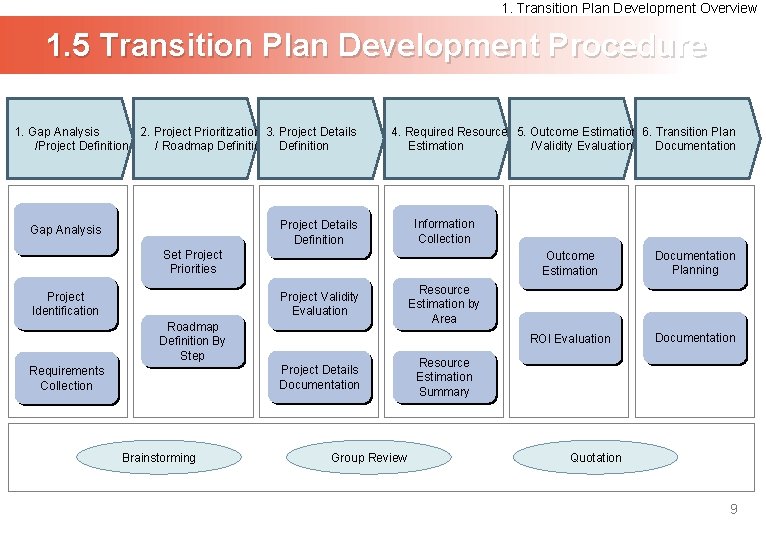
1. Transition Plan Development Overview 1. 5 Transition Plan Development Procedure 1. Gap Analysis 2. Project Prioritization 3. Project Details /Project Definition / Roadmap Definition 4. Required Resource 5. Outcome Estimation 6. Transition Plan Estimation /Validity Evaluation Documentation Project Details Definition Gap Analysis Information Collection Set Project Priorities Project Identification Project Validity Evaluation Roadmap Definition By Step Project Details Documentation Requirements Collection Brainstorming Group Review Outcome Estimation Documentation Planning ROI Evaluation Documentation Resource Estimation by Area Resource Estimation Summary Quotation 9
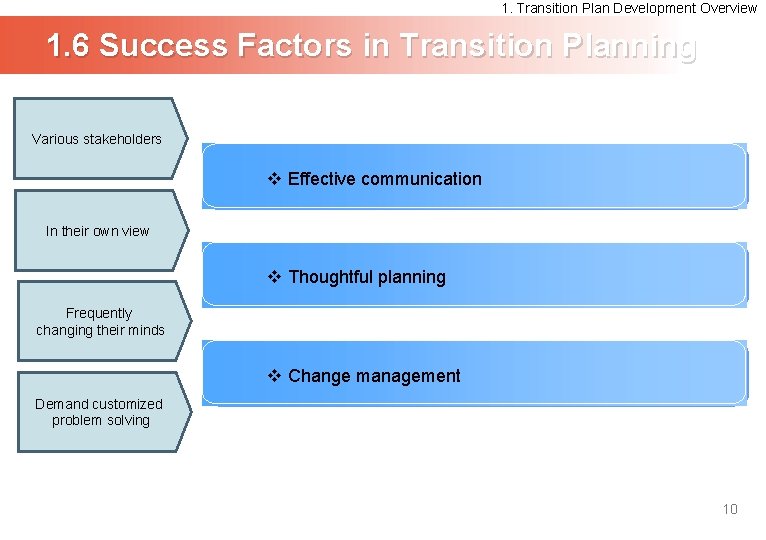
1. Transition Plan Development Overview 1. 6 Success Factors in Transition Planning Various stakeholders v Effective communication In their own view v Thoughtful planning Frequently changing their minds v Change management Demand customized problem solving 10
1. Transition Plan Development Overview 2. Transition Plan Tasks
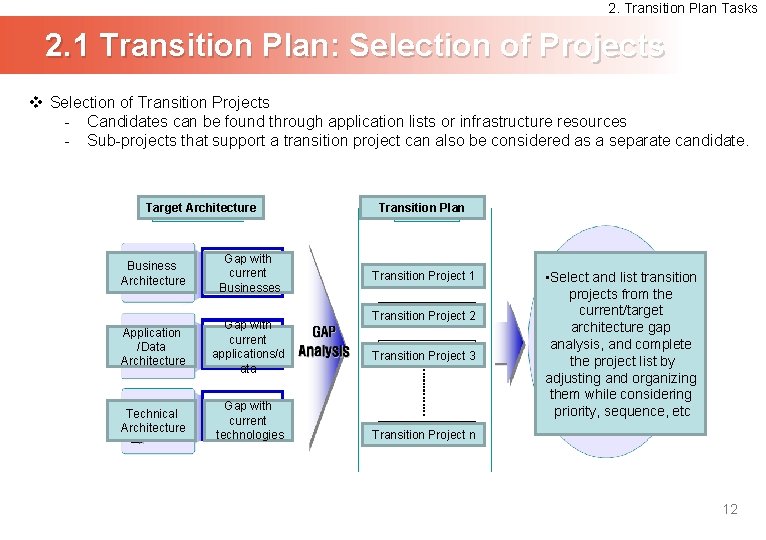
2. Transition Plan Tasks 2. 1 Transition Plan: Selection of Projects v Selection of Transition Projects - Candidates can be found through application lists or infrastructure resources - Sub-projects that support a transition project can also be considered as a separate candidate. Target Architecture Business Architecture Gap with current Businesses Application /Data Architecture Gap with current applications/d ata Technical Architecture Gap with current technologies Transition Plan Transition Project 1 Transition Project 2 Transition Project 3 • Select and list transition projects from the current/target architecture gap analysis, and complete the project list by adjusting and organizing them while considering priority, sequence, etc Transition Project n 12
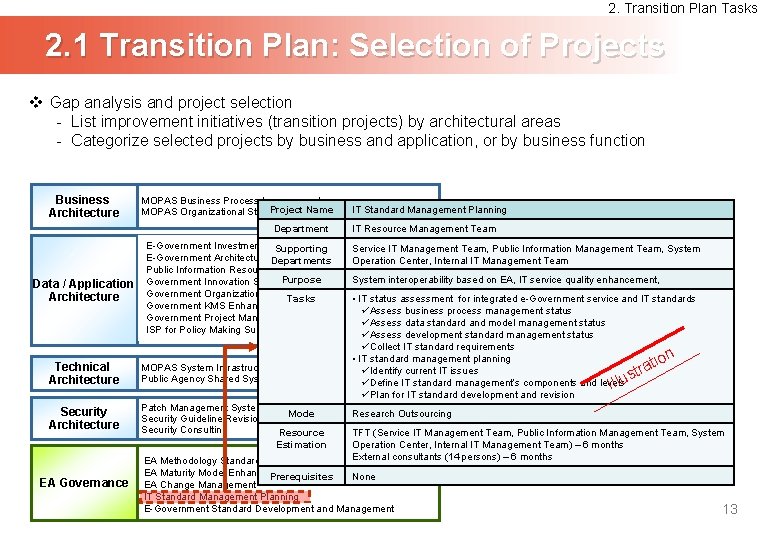
2. Transition Plan Tasks 2. 1 Transition Plan: Selection of Projects v Gap analysis and project selection - List improvement initiatives (transition projects) by architectural areas - Categorize selected projects by business and application, or by business function Business Architecture MOPAS Business Process Improvement Project Name IT Standard Management Planning MOPAS Organizational Structure Improvement Department Data / Application Architecture Technical Architecture Security Architecture EA Governance IT Resource Management Team E-Government Investment Mgmt System Development Supporting Service IT Management Team, Public Information Management Team, System E-Government Architecture Mgmt System Development Departments Operation Center, Internal IT Management Team Public Information Resource Mgmt System Enhancement Purpose System interoperability based on EA, IT service quality enhancement, Government Innovation Support System Development Government Organization Management Development Tasks System • IT status assessment for integrated e-Government service and IT standards Government KMS Enhancement üAssess business process management status Government Project Management System Development üAssess data standard and model management status ISP for Policy Making Support System üAssess development standard management status üCollect IT standard requirements • IT standard management planning tion MOPAS System Infrastructure Development a üIdentify current IT issues r st Public Agency Shared System Infrastructure Development üDefine IT standard management’s components and levels Illu üPlan for IT standard development and revision Patch Management System Application Mode Research Outsourcing Security Guideline Revision Security Consulting Resource TFT (Service IT Management Team, Public Information Management Team, System Estimation Operation Center, Internal IT Management Team) – 6 months External consultants (14 persons) – 6 months EA Methodology Standardization EA Maturity Model Enhancement Prerequisites None EA Change Management IT Standard Management Planning E-Government Standard Development and Management 13
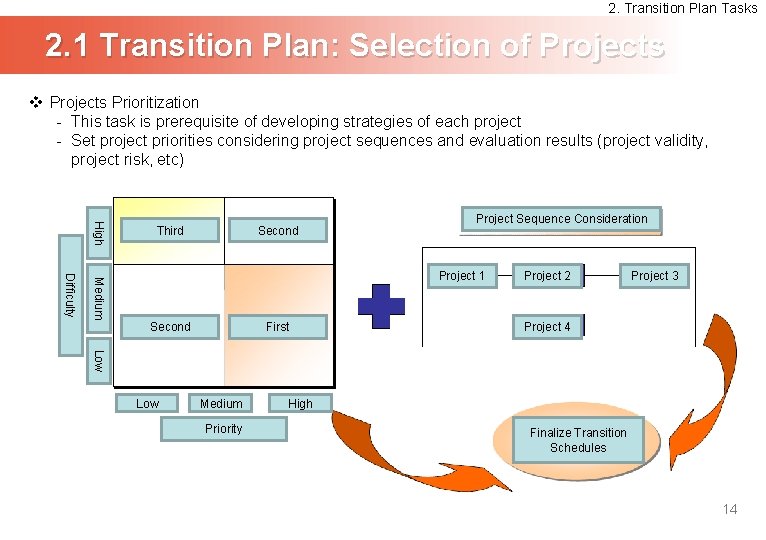
2. Transition Plan Tasks 2. 1 Transition Plan: Selection of Projects v Projects Prioritization - This task is prerequisite of developing strategies of each project - Set project priorities considering project sequences and evaluation results (project validity, project risk, etc) High Third Second Project Sequence Consideration Medium Difficulty Project 1 Second First Project 2 Project 3 Project 4 Low Medium Priority High Finalize Transition Schedules 14
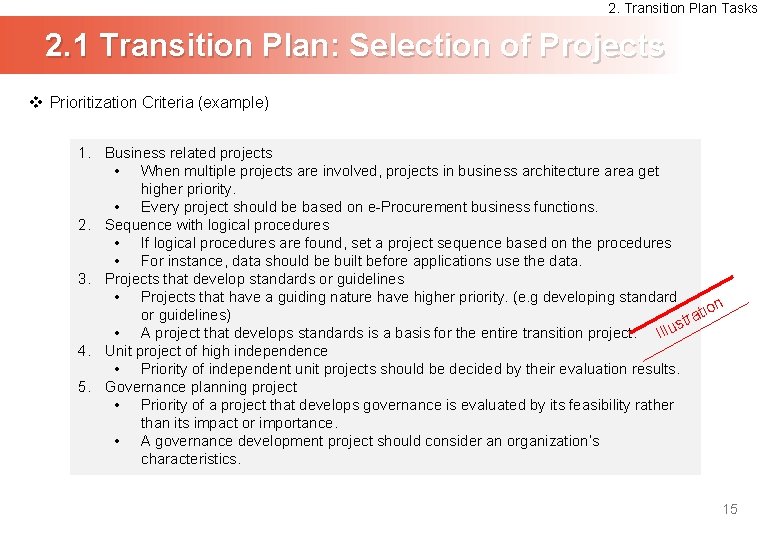
2. Transition Plan Tasks 2. 1 Transition Plan: Selection of Projects v Prioritization Criteria (example) 1. Business related projects • When multiple projects are involved, projects in business architecture area get higher priority. • Every project should be based on e-Procurement business functions. 2. Sequence with logical procedures • If logical procedures are found, set a project sequence based on the procedures • For instance, data should be built before applications use the data. 3. Projects that develop standards or guidelines • Projects that have a guiding nature have higher priority. (e. g developing standard ion t or guidelines) a str • A project that develops standards is a basis for the entire transition project. Illu 4. Unit project of high independence • Priority of independent unit projects should be decided by their evaluation results. 5. Governance planning project • Priority of a project that develops governance is evaluated by its feasibility rather than its impact or importance. • A governance development project should consider an organization’s characteristics. 15
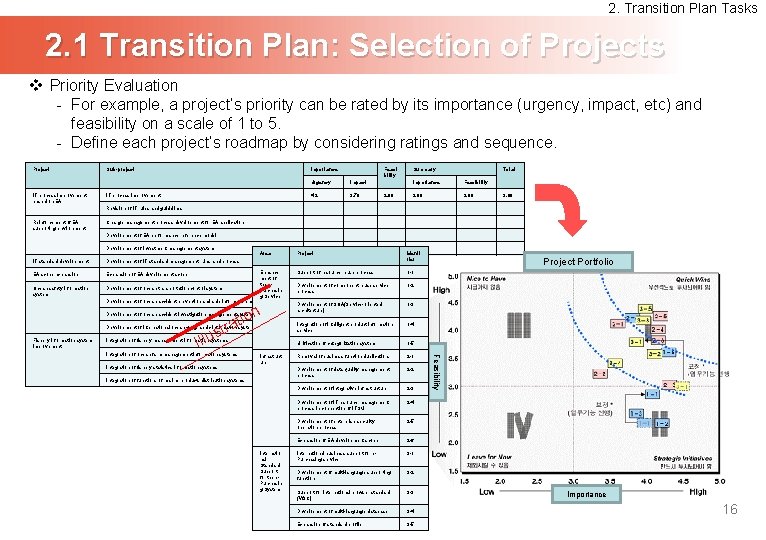
2. Transition Plan Tasks 2. 1 Transition Plan: Selection of Projects v Priority Evaluation - For example, a project’s priority can be rated by its importance (urgency, impact, etc) and feasibility on a scale of 1 to 5. - Define each project’s roadmap by considering ratings and sequence. Project IT process improvement based on EA Sub-project Importance IT process improvement Feasi bility Urgency Impact 4. 2 3. 70 2. 90 Summary Total Importance Feasibility 3. 90 2. 90 3. 60 Revision of IT rules and guidelines Reinforcement of EA supporting environment Change management process development for EA application Development of EA performance reference model Development of investment management system Area IT standard development Development of IT standard management rules and process EA scope expansion Expansion of EA development scope Ocean safety information system Enhance Support of resource reuse process ment of the e. Development of component reuse service Development of ocean transportation control system Purchasin process g Service Development of ocean accident prevention and ship information management system Development of SOA(Service-oriented architecture) Development of ocean accident investigation management system ion t a str Development of international ocean geographic information system Fishery information system improvement Project Illu Integration of fishery management information systems Integration of fishery statistics information systems Infrastruct ure Integration of functions of marine products distribution systems Internatio nal Standard Support for the e. Purchasin g System Project Portfolio 1 -1 1 -2 1 -3 Integration of intelligent product information service 1 -4 Unification of categorization system 1 -5 Removal of business function duplications 2 -1 Development of data quality management process 2 -2 Development of integrative infrastructure 2 -3 Development of IT resource management process in connection of ITSM 2 -4 Development of enterprise security operation process 2 -5 Expansion of EA development scope 2 -6 International business support for e. Purchasing service 3 -1 Development of multi-language supporting function 3 -2 Support for international browser standard (W 3 C) 3 -3 Development of multi-language database 3 -4 Expansion of standard profile 3 -5 Feasibility Integration of ocean farm management information systems Identi fier Importance 16
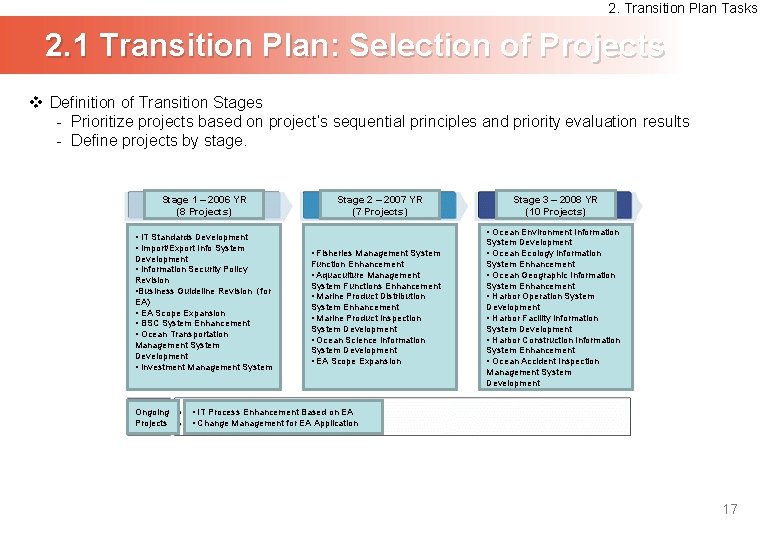
2. Transition Plan Tasks 2. 1 Transition Plan: Selection of Projects v Definition of Transition Stages - Prioritize projects based on project’s sequential principles and priority evaluation results - Define projects by stage. Stage 1 – 2006 YR (8 Projects) • IT Standards Development • Import/Export Info System Development • Information Security Policy Revision • Business Guideline Revision (for EA) • EA Scope Expansion • BSC System Enhancement • Ocean Transportation Management System Development • Investment Management System Ongoing Projects Stage 2 – 2007 YR (7 Projects) Stage 3 – 2008 YR (10 Projects) • Ocean Environment Information • Fisheries Management System Function Enhancement • Aquaculture Management System Functions Enhancement • Marine Product Distribution System Enhancement • Marine Product Inspection System Development • Ocean Science Information System Development • EA Scope Expansion System Development • Ocean Ecology Information System Enhancement • Ocean Geographic Information System Enhancement • Harbor Operation System Development • Harbor Facility Information System Development • Harbor Construction Information System Enhancement • Ocean Accident Inspection Management System Development • IT Process Enhancement Based on EA • Change Management for EA Application 17
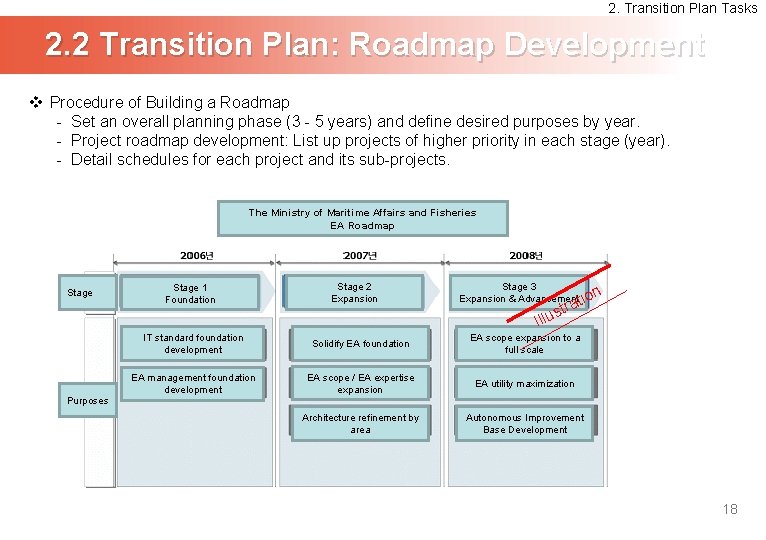
2. Transition Plan Tasks 2. 2 Transition Plan: Roadmap Development v Procedure of Building a Roadmap - Set an overall planning phase (3 - 5 years) and define desired purposes by year. - Project roadmap development: List up projects of higher priority in each stage (year). - Detail schedules for each project and its sub-projects. The Ministry of Maritime Affairs and Fisheries EA Roadmap Stage Purposes Stage 1 Foundation Stage 2 Expansion Stage 3 Expansion & Advancement tion tra s Illu IT standard foundation development Solidify EA foundation EA scope expansion to a full scale EA management foundation development EA scope / EA expertise expansion EA utility maximization Architecture refinement by area Autonomous Improvement Base Development 18
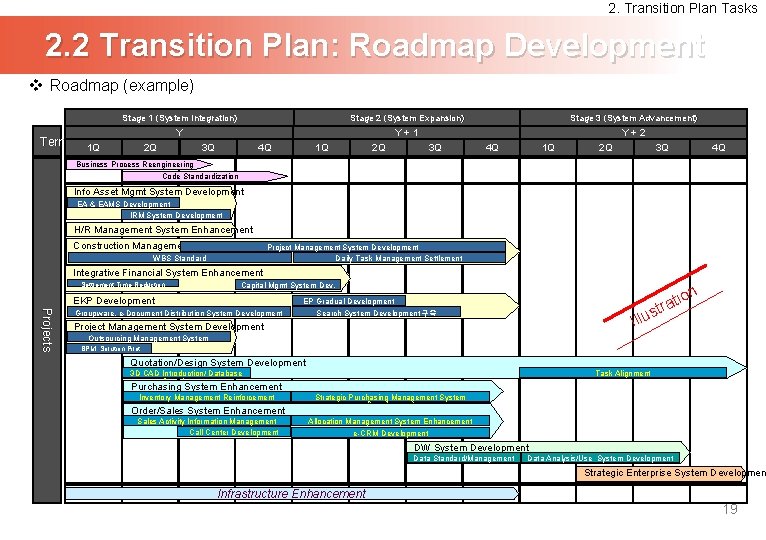
2. Transition Plan Tasks 2. 2 Transition Plan: Roadmap Development v Roadmap (example) Term Stage 1 (System Integration) Stage 2 (System Expansion) Stage 3 (System Advancement) Y Y+1 Y+2 1 Q 2 Q 3 Q 4 Q Business Process Reengineering Code Standardization Info Asset Mgmt System Development EA & EAMS Development IRM System Development H/R Management System Enhancement Construction Management System Development Project Management System Development WBS Standard Daily Task Management Settlement Integrative Financial System Enhancement Settlement Time Reduction Capital Mgmt System Dev. EKP Development Projects Groupware, e-Document Distribution System Development EP Gradual Development Search System Development구축 ion t a tr s Illu Project Management System Development Outsourcing Management System BPM Solution Pilot Quotation/Design System Development 3 D CAD Introduction/ Database Development Task Alignment Purchasing System Enhancement Inventory Management Reinforcement Order/Sales System Enhancement Sales Activity Information Management Call Center Development Strategic Purchasing Management System Development Allocation Management System Enhancement e-CRM Development DW System Development Data Standard/Management Data Analysis/Use System Development Strategic Enterprise System Developmen Infrastructure Enhancement 19
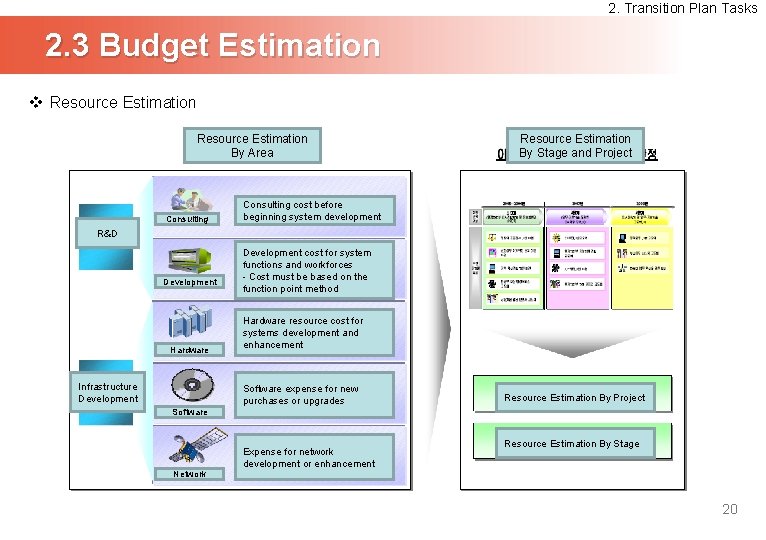
2. Transition Plan Tasks 2. 3 Budget Estimation v Resource Estimation By Area Consulting Resource Estimation By Stage and Project Consulting cost before beginning system development R&D Development Hardware Infrastructure Development cost for system functions and workforces - Cost must be based on the function point method Hardware resource cost for systems development and enhancement Software expense for new purchases or upgrades Resource Estimation By Project Software Expense for network development or enhancement Resource Estimation By Stage Network 20
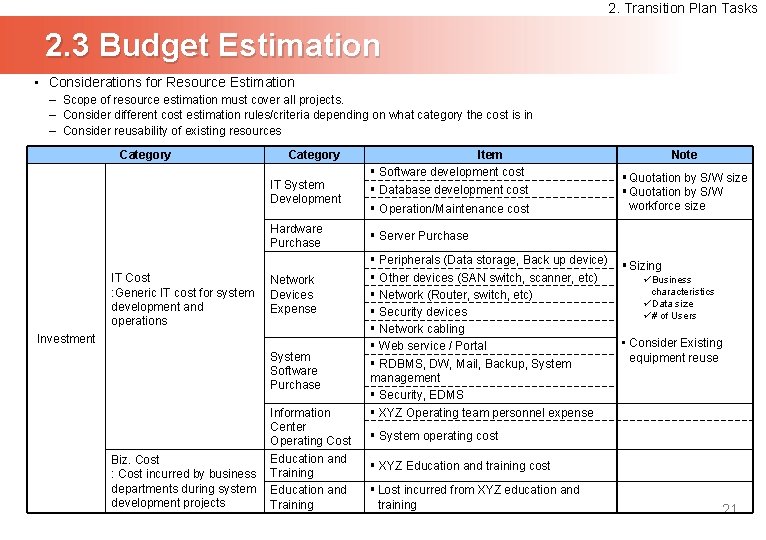
2. Transition Plan Tasks 2. 3 Budget Estimation • Considerations for Resource Estimation – Scope of resource estimation must cover all projects. – Consider different cost estimation rules/criteria depending on what category the cost is in – Consider reusability of existing resources Category IT System Development Hardware Purchase IT Cost : Generic IT cost for system development and operations Network Devices Expense Investment System Software Purchase Biz. Cost : Cost incurred by business departments during system development projects Information Center Operating Cost Education and Training Item § Software development cost § Database development cost § Operation/Maintenance cost Note § Quotation by S/W size § Quotation by S/W workforce size § Server Purchase § Peripherals (Data storage, Back up device) § Other devices (SAN switch, scanner, etc) § Network (Router, switch, etc) § Security devices § Network cabling § Web service / Portal § RDBMS, DW, Mail, Backup, System management § Security, EDMS § XYZ Operating team personnel expense § Sizing üBusiness characteristics üData size ü# of Users • Consider Existing equipment reuse § System operating cost § XYZ Education and training cost § Lost incurred from XYZ education and training 21
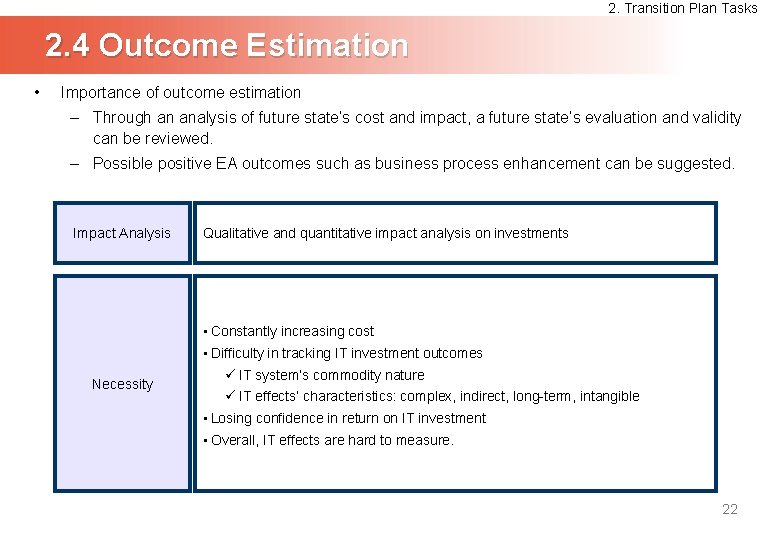
2. Transition Plan Tasks 2. 4 Outcome Estimation • Importance of outcome estimation – Through an analysis of future state’s cost and impact, a future state’s evaluation and validity can be reviewed. – Possible positive EA outcomes such as business process enhancement can be suggested. Impact Analysis Qualitative and quantitative impact analysis on investments • Constantly increasing cost • Difficulty in tracking IT investment outcomes Necessity ü IT system’s commodity nature ü IT effects’ characteristics: complex, indirect, long-term, intangible • Losing confidence in return on IT investment • Overall, IT effects are hard to measure. 22
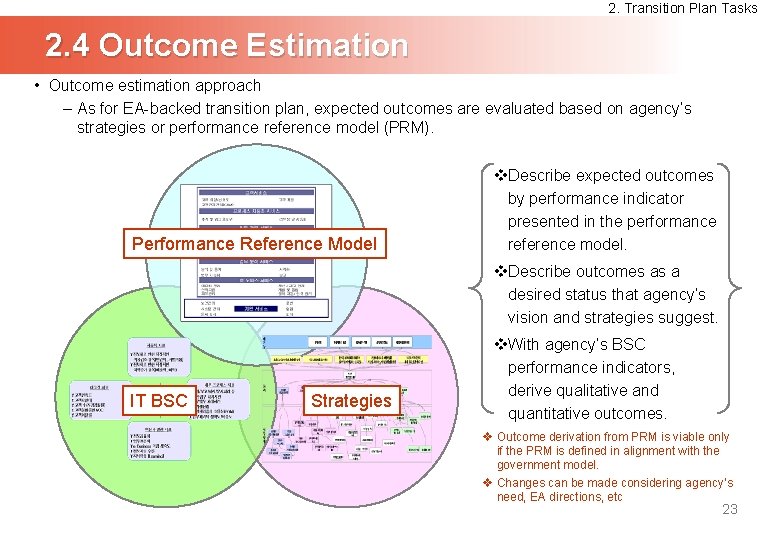
2. Transition Plan Tasks 2. 4 Outcome Estimation • Outcome estimation approach – As for EA-backed transition plan, expected outcomes are evaluated based on agency’s strategies or performance reference model (PRM). Performance Reference Model v. Describe expected outcomes by performance indicator presented in the performance reference model. v. Describe outcomes as a desired status that agency’s vision and strategies suggest. IT BSC Strategies v. With agency’s BSC performance indicators, derive qualitative and quantitative outcomes. v Outcome derivation from PRM is viable only if the PRM is defined in alignment with the government model. v Changes can be made considering agency’s need, EA directions, etc 23
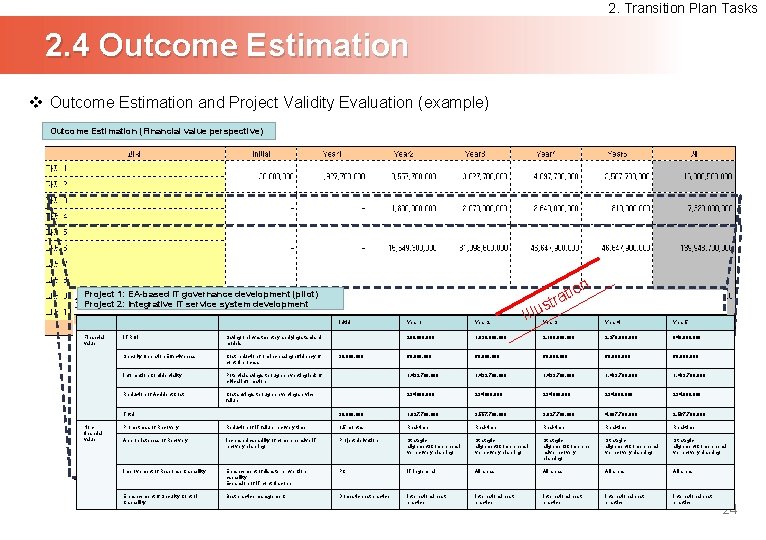
2. Transition Plan Tasks 2. 4 Outcome Estimation v Outcome Estimation and Project Validity Evaluation (example) Outcome Estimation (Financial value perspective) • 정보화 성과지표 기반의 기대효과 추정(2/2) – 정량적, 정성적 관점에 기대효과 추정예시 Project 1: EA-based IT governance development (pilot) Project 2: Integrative IT service system development s Initial Financial value Year 1 Year 2 200, 000 Illu Year 3 Year 4 Year 5 1, 830, 000 2, 100, 000 2, 370, 000 840, 000, 000 60, 000 60, 000 IT ROI Saving on investment by applying standard models Security Operation Effectiveness Cost reduction from increasing efficiency of control process Information Confidentiality Potential savings through preventing leak of critical information 1, 433, 700, 000 1, 433, 700, 000 Reduction of Accident Cost savings through preventing service failure 234, 000, 000 234, 000 30, 000 1, 927, 700, 000 3, 557, 700, 000 3, 827, 700, 000 4, 097, 700, 000 2, 567, 700, 000 Total Nonfinancial value ion t a tr 30, 000 Promptness of Recovery Reduction of IT failure recovery time 1. 5 months Real-time Real-time Appropriateness of Recovery Increased capability of comprehensive IT recovery planning Project derivation Strategic alignment/Comprehensi ve recovery planning Strategic alignment/Comprehe nsive recovery planning Strategic alignment/Comprehensi ve recovery planning Improvement of Response Capability Enhancement of disaster prevention capability Expansion of IT control scope PC IT in general All areas Enhancement of Security Control Capability Best practice management Domestic best practice International best practice International best practice 24
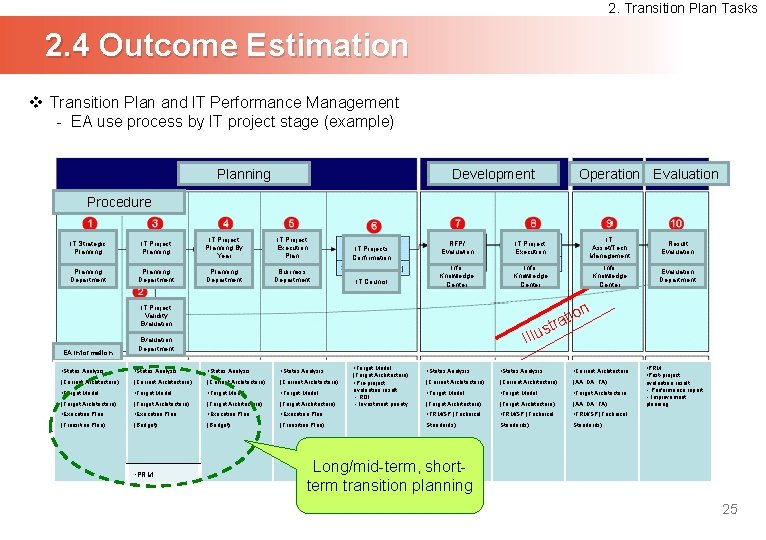
2. Transition Plan Tasks 2. 4 Outcome Estimation v Transition Plan and IT Performance Management - EA use process by IT project stage (example) Planning Development Operation Evaluation Procedure IT Strategic Planning IT Project Planning By Year IT Project Execution Plan IT Projects Confirmation Planning Department Business Department IT Council RFP/ Evaluation IT Project Execution IT Asset/Tech Management Result Evaluation Info Knowledge Center Evaluation Department n IT Project Validity Evaluation EA Information atio r t llus I Evaluation Department • Status Analysis (Current Architecture) • Target Model (Target Architecture) • Execution Plan (Transition Plan) (Budget) (Transition Plan) • PRM • Target Model (Target Architecture) • Pre-project evaluation result - ROI - Investment priority • Status Analysis • Current Architecture (Current Architecture) (AA, DA, TA) • Target Model • Target Architecture (Target Architecture) (AA, DA, TA) • TRM/SP (Technical Standards) • PRM • Post-project evaluation result - Performance report - Improvement planning Long/mid-term, shortterm transition planning 25
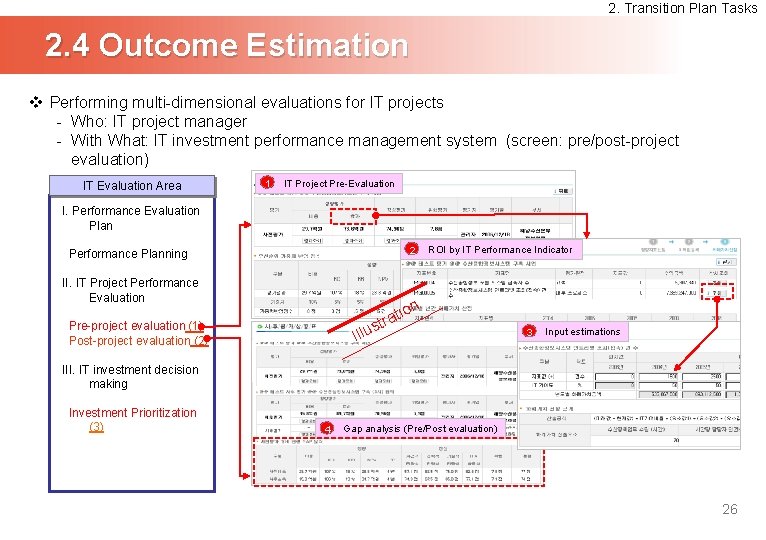
2. Transition Plan Tasks 2. 4 Outcome Estimation v Performing multi-dimensional evaluations for IT projects - Who: IT project manager - With What: IT investment performance management system (screen: pre/post-project evaluation) IT Evaluation Area 1 IT Project Pre-Evaluation I. Performance Evaluation Plan 2 Performance Planning II. IT Project Performance Evaluation ROI by IT Performance Indicator tion a r st Pre-project evaluation (1) Post-project evaluation (2) Illu 3 Input estimations III. IT investment decision making Investment Prioritization (3) 4 Gap analysis (Pre/Post evaluation) 26
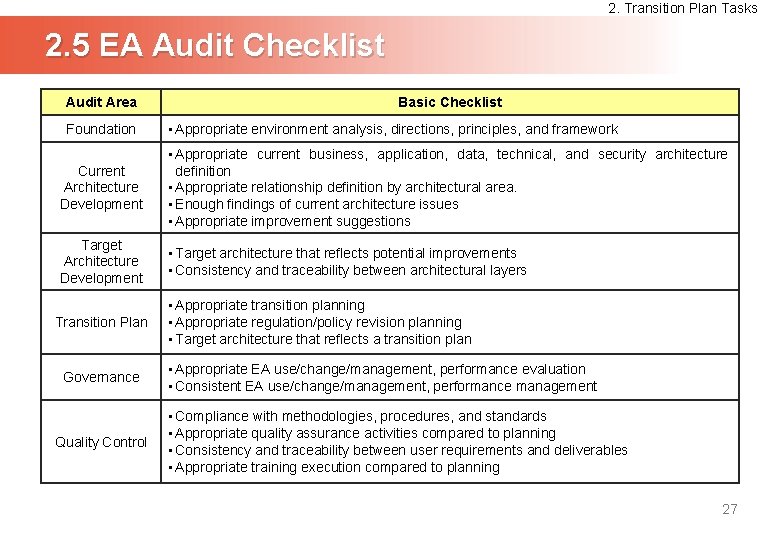
2. Transition Plan Tasks 2. 5 EA Audit Checklist Audit Area Foundation Basic Checklist • Appropriate environment analysis, directions, principles, and framework Current Architecture Development • Appropriate current business, application, data, technical, and security architecture definition • Appropriate relationship definition by architectural area. • Enough findings of current architecture issues • Appropriate improvement suggestions Target Architecture Development • Target architecture that reflects potential improvements • Consistency and traceability between architectural layers Transition Plan Governance Quality Control • Appropriate transition planning • Appropriate regulation/policy revision planning • Target architecture that reflects a transition plan • Appropriate EA use/change/management, performance evaluation • Consistent EA use/change/management, performance management • Compliance with methodologies, procedures, and standards • Appropriate quality assurance activities compared to planning • Consistency and traceability between user requirements and deliverables • Appropriate training execution compared to planning 27
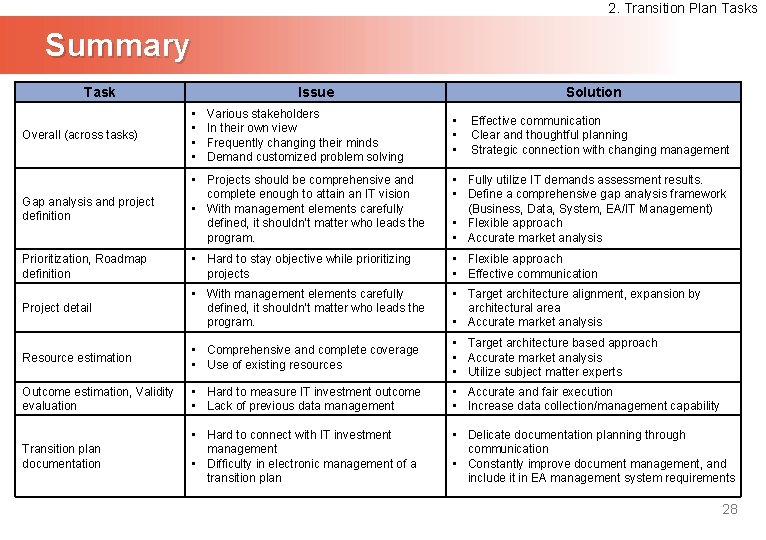
2. Transition Plan Tasks Summary Task Issue Solution Overall (across tasks) • • Gap analysis and project definition • Projects should be comprehensive and complete enough to attain an IT vision • With management elements carefully defined, it shouldn’t matter who leads the program. • Fully utilize IT demands assessment results. • Define a comprehensive gap analysis framework (Business, Data, System, EA/IT Management) • Flexible approach • Accurate market analysis Prioritization, Roadmap definition • Hard to stay objective while prioritizing projects • Flexible approach • Effective communication Project detail • With management elements carefully defined, it shouldn’t matter who leads the program. • Target architecture alignment, expansion by architectural area • Accurate market analysis Resource estimation • Comprehensive and complete coverage • Use of existing resources • Target architecture based approach • Accurate market analysis • Utilize subject matter experts Outcome estimation, Validity evaluation • Hard to measure IT investment outcome • Lack of previous data management • Accurate and fair execution • Increase data collection/management capability Transition plan documentation • Hard to connect with IT investment management • Difficulty in electronic management of a transition plan • Delicate documentation planning through communication • Constantly improve document management, and include it in EA management system requirements Various stakeholders In their own view Frequently changing their minds Demand customized problem solving • • • Effective communication Clear and thoughtful planning Strategic connection with changing management 28
Q&A Thank You! 29