
Transition Pack for A Level Physics Get ready
- Slides: 14
Transition Pack for A Level Physics Get ready for A-level! A guide to help you get ready for A-level Physics, including everything from topic guides to days out and online learning courses. Commissioned by The Pi. XL Club Ltd. June 2018 © Copyright The Pi. XL Club Ltd, 2018 Please note: these resources are non-board specific. Please direct your students to the specifics of where this knowledge and skills most apply. This resource is strictly for the use of member schools for as long as they remain members of The Pi. XL Club. It may not be copied, sold nor transferred to a third party or used by the school after membership ceases. Until such time it may be freely used within the member school. All opinions and contributions are those of the authors. The contents of this resource are not connected with nor endorsed by any other company, organisation or institution. www. pixl. org. uk The Pi. XL Club Ltd, Company number 07321607
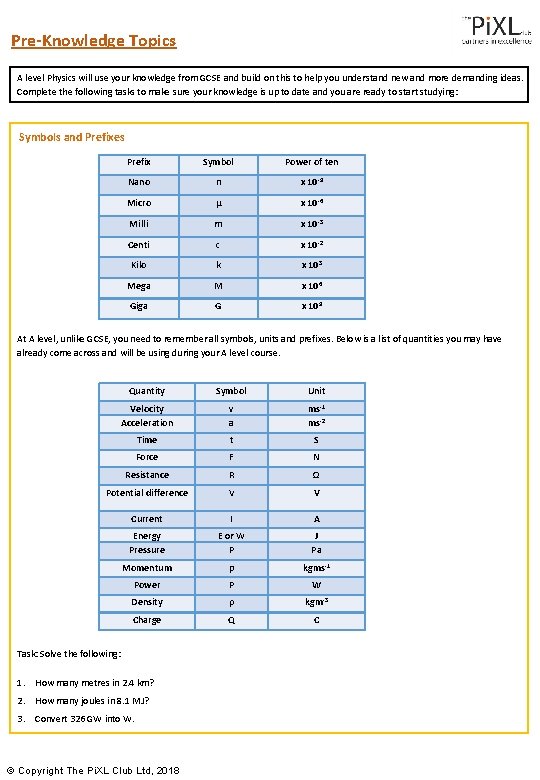
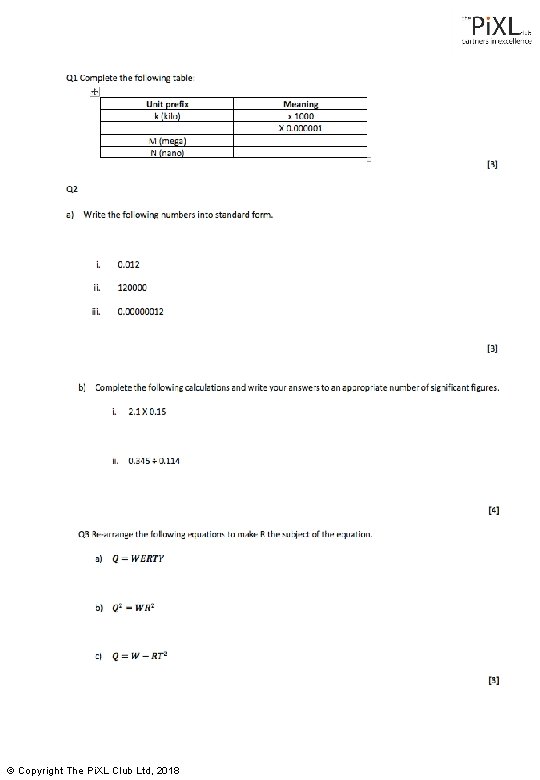
Pre-Knowledge Topics A level Physics will use your knowledge from GCSE and build on this to help you understand new and more demanding ideas. Complete the following tasks to make sure your knowledge is up to date and you are ready to start studying: Symbols and Prefixes Prefix Symbol Power of ten Nano n x 10 -9 Micro μ x 10 -6 Milli m x 10 -3 Centi c x 10 -2 Kilo k x 103 Mega M x 106 Giga G x 109 At A level, unlike GCSE, you need to remember all symbols, units and prefixes. Below is a list of quantities you may have already come across and will be using during your A level course. Quantity Symbol Unit Velocity Acceleration v a ms-1 ms-2 Time t S Force F N Resistance R Ω Potential difference V V Current I A Energy Pressure E or W P J Pa Momentum p kgms-1 Power P W Density ρ kgm-3 Charge Q C Task: Solve the following: 1. How many metres in 2. 4 km? 2. How many joules in 8. 1 MJ? 3. Convert 326 GW into W. © Copyright The Pi. XL Club Ltd, 2018
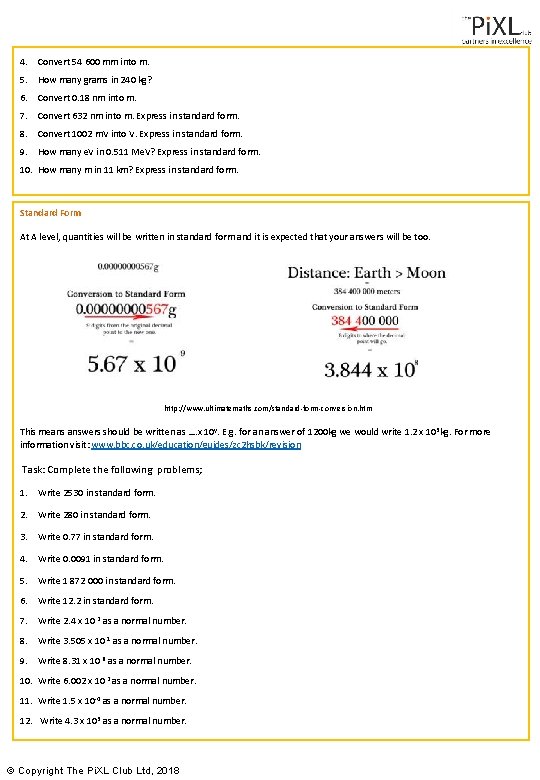
4. Convert 54 600 mm into m. 5. How many grams in 240 kg? 6. Convert 0. 18 nm into m. 7. Convert 632 nm into m. Express in standard form. 8. Convert 1002 m. V into V. Express in standard form. 9. How many e. V in 0. 511 Me. V? Express in standard form. 10. How many m in 11 km? Express in standard form. Standard Form At A level, quantities will be written in standard form and it is expected that your answers will be too. http: //www. ultimatemaths. com/standard-form-conversion. htm This means answers should be written as …. x 10 y. E. g. for an answer of 1200 kg we would write 1. 2 x 10³ kg. For more information visit: www. bbc. co. uk/education/guides/zc 2 hsbk/revision Task: Complete the following problems; 1. Write 2530 in standard form. 2. Write 280 in standard form. 3. Write 0. 77 in standard form. 4. Write 0. 0091 in standard form. 5. Write 1 872 000 in standard form. 6. Write 12. 2 in standard form. 7. Write 2. 4 x 10 2 as a normal number. 8. Write 3. 505 x 10 1 as a normal number. 9. Write 8. 31 x 10 6 as a normal number. 10. Write 6. 002 x 10 2 as a normal number. 11. Write 1. 5 x 10 -4 as a normal number. 12. Write 4. 3 x 10³ as a normal number. © Copyright The Pi. XL Club Ltd, 2018
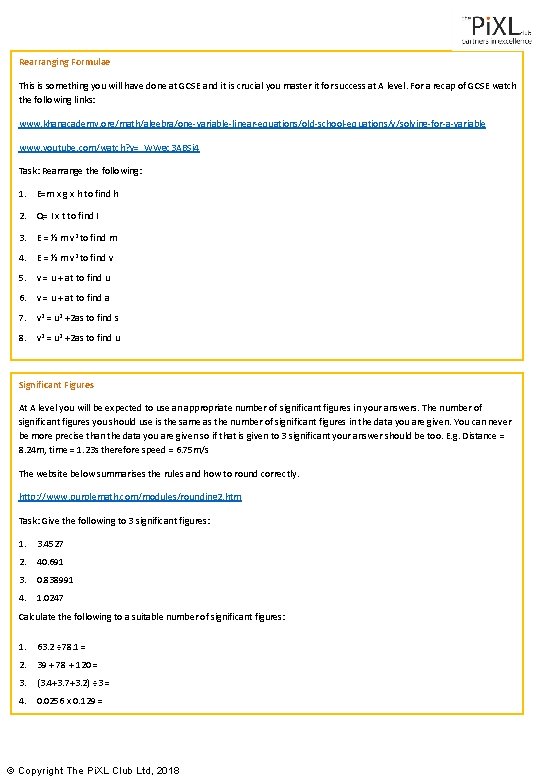
Rearranging Formulae This is something you will have done at GCSE and it is crucial you master it for success at A level. For a recap of GCSE watch the following links: www. khanacademy. org/math/algebra/one-variable-linear-equations/old-school-equations/v/solving-for-a-variable www. youtube. com/watch? v=_WWgc 3 ABSj 4 Task: Rearrange the following: 1. E=m x g x h to find h 2. Q= I x t to find I 3. E = ½ m v 2 to find m 4. E = ½ m v 2 to find v 5. v = u + at to find u 6. v = u + at to find a 7. v 2 = u 2 +2 as to find s 8. v 2 = u 2 +2 as to find u Significant Figures At A level you will be expected to use an appropriate number of significant figures in your answers. The number of significant figures you should use is the same as the number of significant figures in the data you are given. You can never be more precise than the data you are given so if that is given to 3 significant your answer should be too. E. g. Distance = 8. 24 m, time = 1. 23 s therefore speed = 6. 75 m/s The website below summarises the rules and how to round correctly. http: //www. purplemath. com/modules/rounding 2. htm Task: Give the following to 3 significant figures: 1. 3. 4527 2. 40. 691 3. 0. 838991 4. 1. 0247 Calculate the following to a suitable number of significant figures: 1. 63. 2 ÷ 78. 1 = 2. 39 + 78 + 120 = 3. (3. 4+3. 7+3. 2) ÷ 3 = 4. 0. 0256 x 0. 129 = © Copyright The Pi. XL Club Ltd, 2018
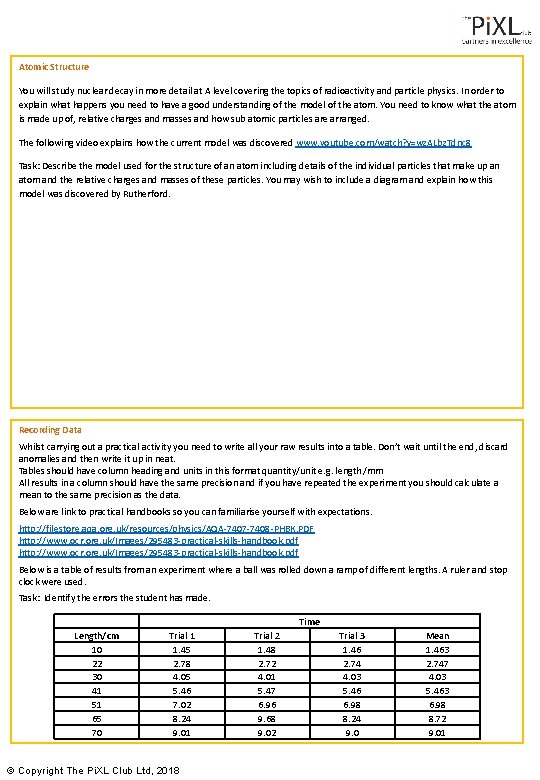
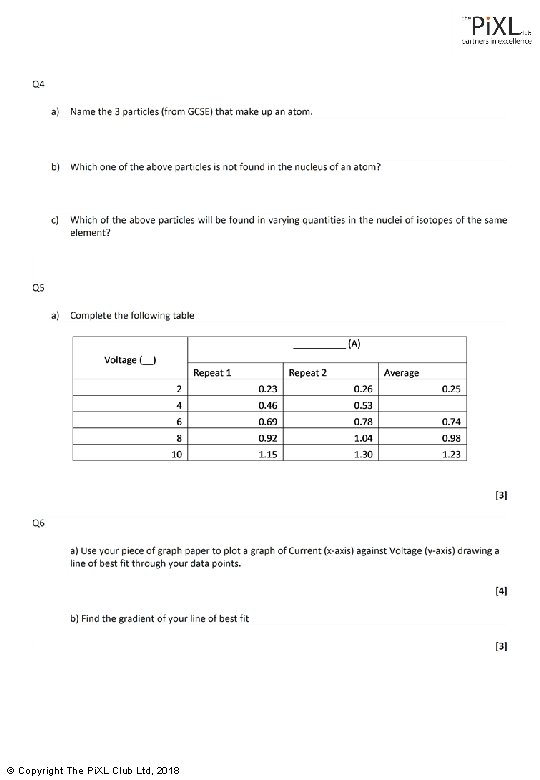
Atomic Structure You will study nuclear decay in more detail at A level covering the topics of radioactivity and particle physics. In order to explain what happens you need to have a good understanding of the model of the atom. You need to know what the atom is made up of, relative charges and masses and how sub atomic particles are arranged. The following video explains how the current model was discovered www. youtube. com/watch? v=wz. ALbz. Tdnc 8 Task: Describe the model used for the structure of an atom including details of the individual particles that make up an atom and the relative charges and masses of these particles. You may wish to include a diagram and explain how this model was discovered by Rutherford. Recording Data Whilst carrying out a practical activity you need to write all your raw results into a table. Don’t wait until the end, discard anomalies and then write it up in neat. Tables should have column heading and units in this format quantity/unit e. g. length /mm All results in a column should have the same precision and if you have repeated the experiment you should calculate a mean to the same precision as the data. Below are link to practical handbooks so you can familiarise yourself with expectations. http: //filestore. aqa. org. uk/resources/physics/AQA-7407 -7408 -PHBK. PDF http: //www. ocr. org. uk/Images/295483 -practical-skills-handbook. pdf Below is a table of results from an experiment where a ball was rolled down a ramp of different lengths. A ruler and stop clock were used. Task: Identify the errors the student has made. Time Length/cm 10 22 30 41 51 65 70 Trial 1 1. 45 2. 78 4. 05 5. 46 7. 02 8. 24 9. 01 © Copyright The Pi. XL Club Ltd, 2018 Trial 2 1. 48 2. 72 4. 01 5. 47 6. 96 9. 68 9. 02 Trial 3 1. 46 2. 74 4. 03 5. 46 6. 98 8. 24 9. 0 Mean 1. 463 2. 747 4. 03 5. 463 6. 98 8. 72 9. 01
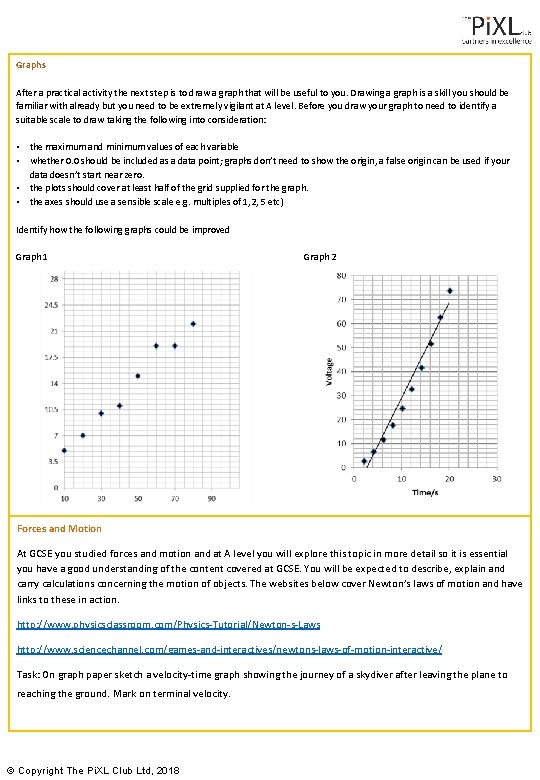
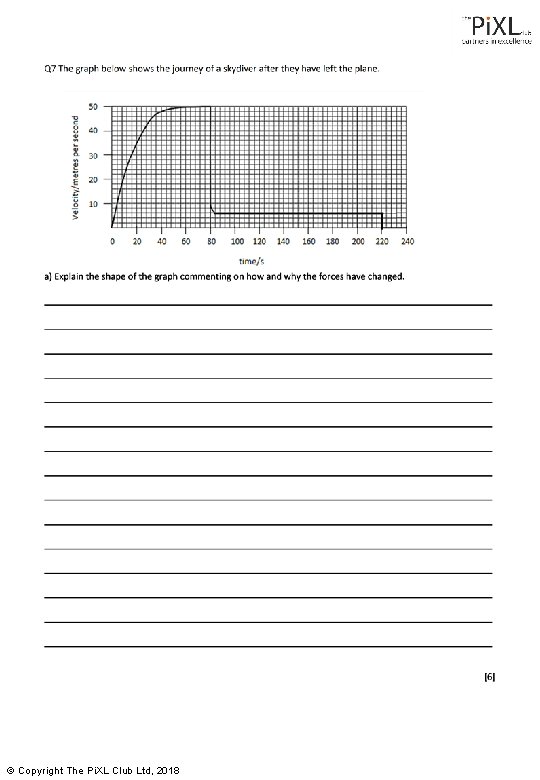
Graphs After a practical activity the next step is to draw a graph that will be useful to you. Drawing a graph is a skill you should be familiar with already but you need to be extremely vigilant at A level. Before you draw your graph to need to identify a suitable scale to draw taking the following into consideration: • the maximum and minimum values of each variable • whether 0. 0 should be included as a data point; graphs don’t need to show the origin, a false origin can be used if your data doesn’t start near zero. • the plots should cover at least half of the grid supplied for the graph. • the axes should use a sensible scale e. g. multiples of 1, 2, 5 etc) Identify how the following graphs could be improved Graph 1 Graph 2 Forces and Motion At GCSE you studied forces and motion and at A level you will explore this topic in more detail so it is essential you have a good understanding of the content covered at GCSE. You will be expected to describe, explain and carry calculations concerning the motion of objects. The websites below cover Newton’s laws of motion and have links to these in action. http: //www. physicsclassroom. com/Physics-Tutorial/Newton-s-Laws http: //www. sciencechannel. com/games-and-interactives/newtons-laws-of-motion-interactive/ Task: On graph paper sketch a velocity-time graph showing the journey of a skydiver after leaving the plane to reaching the ground. Mark on terminal velocity. © Copyright The Pi. XL Club Ltd, 2018
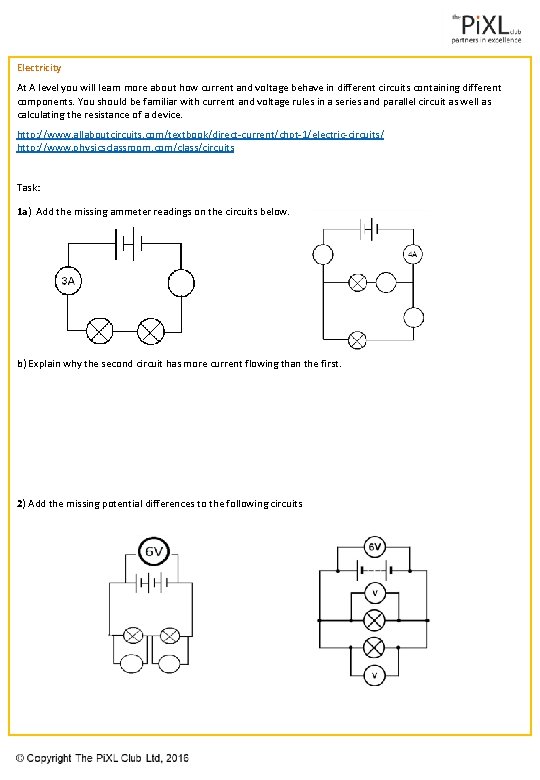
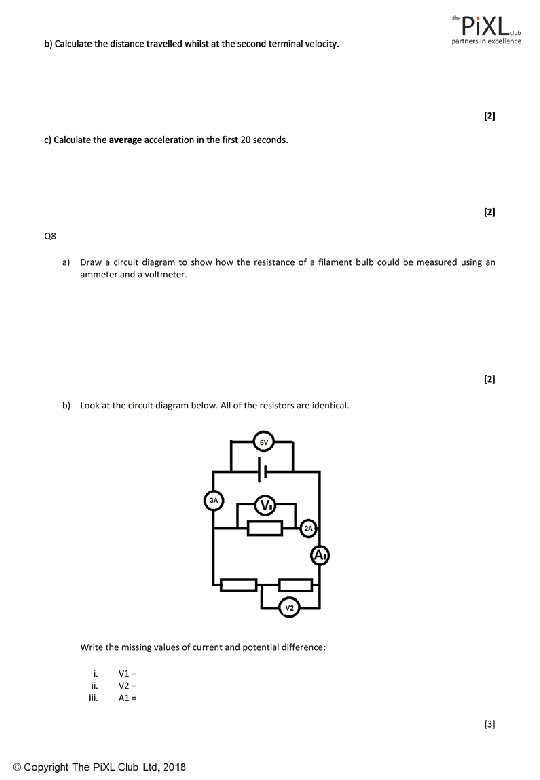
Electricity At A level you will learn more about how current and voltage behave in different circuits containing different components. You should be familiar with current and voltage rules in a series and parallel circuit as well as calculating the resistance of a device. http: //www. allaboutcircuits. com/textbook/direct-current/chpt-1/electric-circuits/ http: //www. physicsclassroom. com/class/circuits Task: 1 a) Add the missing ammeter readings on the circuits below. b) Explain why the second circuit has more current flowing than the first. 2) Add the missing potential differences to the following circuits
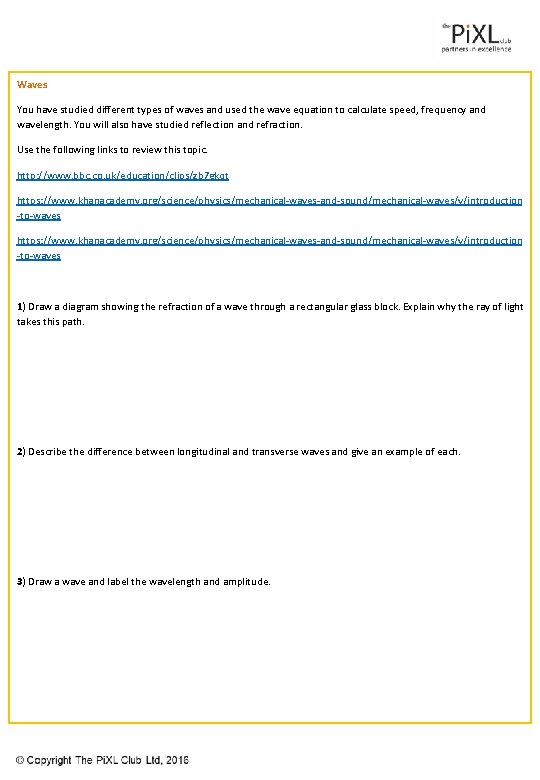
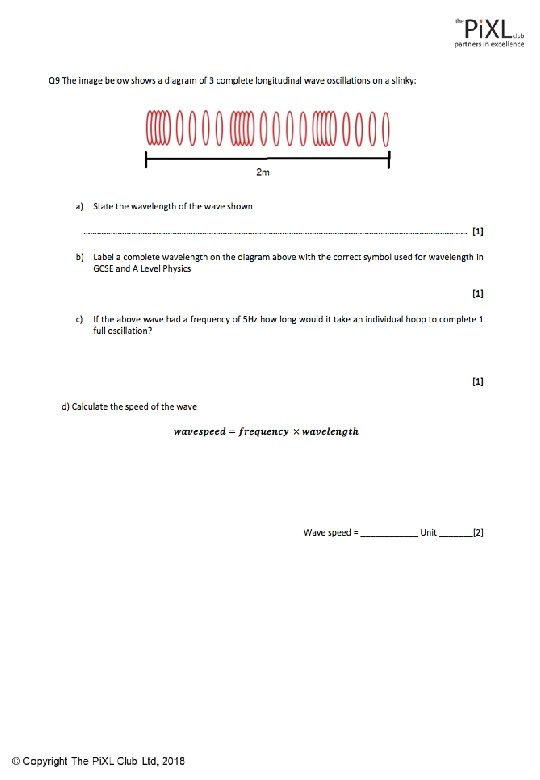
Waves You have studied different types of waves and used the wave equation to calculate speed, frequency and wavelength. You will also have studied reflection and refraction. Use the following links to review this topic. http: //www. bbc. co. uk/education/clips/zb 7 gkqt https: //www. khanacademy. org/science/physics/mechanical-waves-and-sound/mechanical-waves/v/introduction -to-waves 1) Draw a diagram showing the refraction of a wave through a rectangular glass block. Explain why the ray of light takes this path. 2) Describe the difference between longitudinal and transverse waves and give an example of each. 3) Draw a wave and label the wavelength and amplitude.
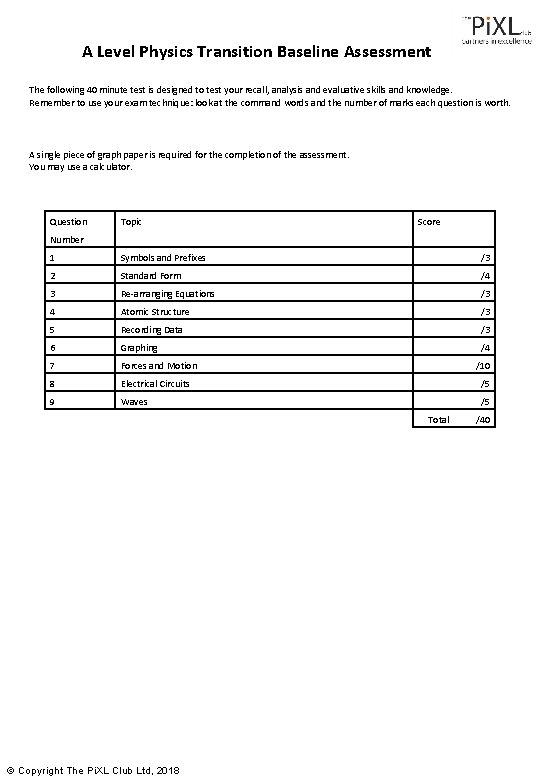
A Level Physics Transition Baseline Assessment The following 40 minute test is designed to test your recall, analysis and evaluative skills and knowledge. Remember to use your exam technique: look at the command words and the number of marks each question is worth. A single piece of graph paper is required for the completion of the assessment. You may use a calculator. Question Topic Score Number 1 Symbols and Prefixes /3 2 Standard Form /4 3 Re-arranging Equations /3 4 Atomic Structure /3 5 Recording Data /3 6 Graphing /4 7 Forces and Motion 8 Electrical Circuits /5 9 Waves /5 /10 Total © Copyright The Pi. XL Club Ltd, 2018 /40
© Copyright The Pi. XL Club Ltd, 2018
© Copyright The Pi. XL Club Ltd, 2018
© Copyright The Pi. XL Club Ltd, 2018