
TRANSITION METALS Transition metal characteristics of elements Sc


 Few drops Na. OH Colourless](https://slidetodoc.com/presentation_image_h2/3f81312ec68b6691e3b686e5658bc85e/image-65.jpg "EXCESS Na. OH [Zn(H 2 O)6]2+(aq) [Zn(H 2 O)3(OH)3](s) Few drops Na. OH Colourless")

 [Fe(H 2 O)4(OH)2] – Dark green ppte](https://slidetodoc.com/presentation_image_h2/3f81312ec68b6691e3b686e5658bc85e/image-69.jpg "SUMMARY SO FAR – [M(H 2 O)4(OH)2](s) [Fe(H 2 O)4(OH)2] – Dark green ppte")

- Slides: 96
TRANSITION METALS
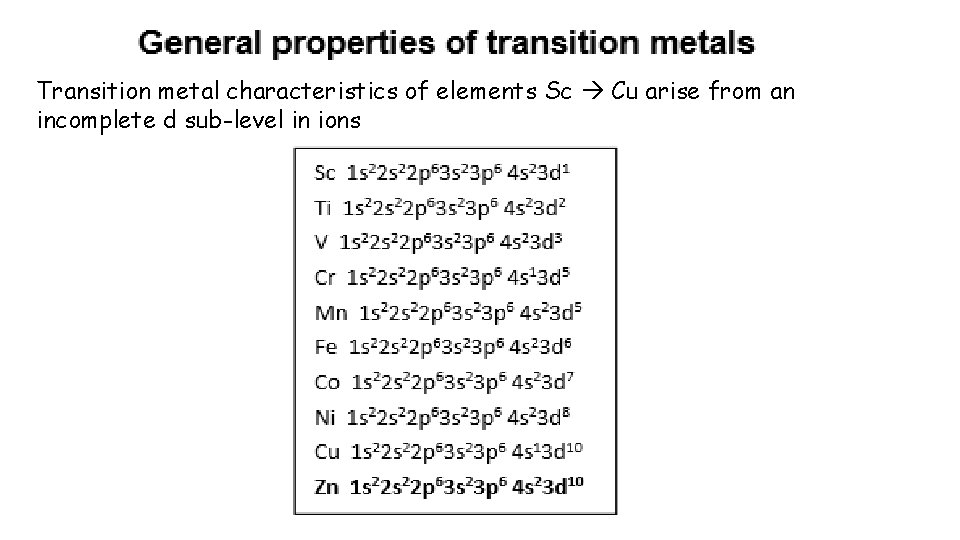
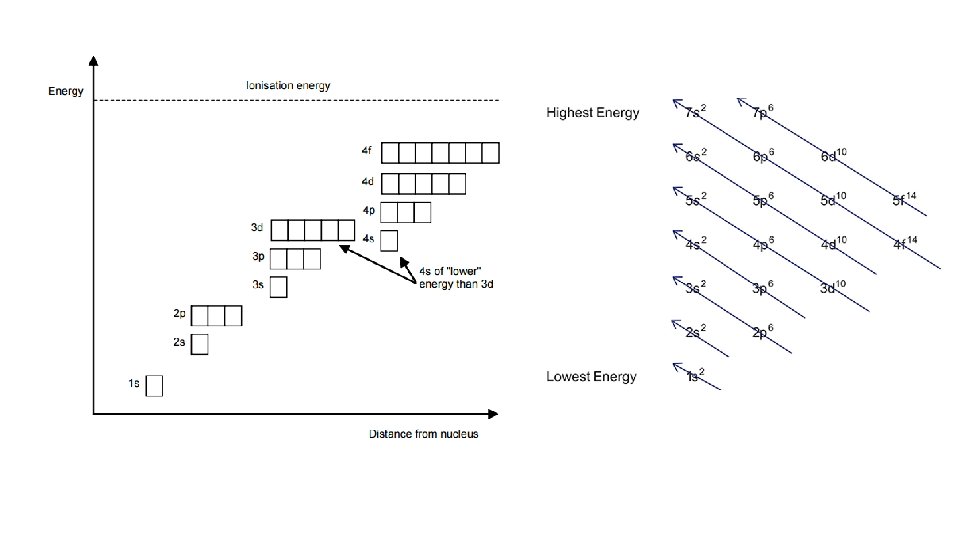
Transition metal characteristics of elements Sc Cu arise from an incomplete d sub-level in ions
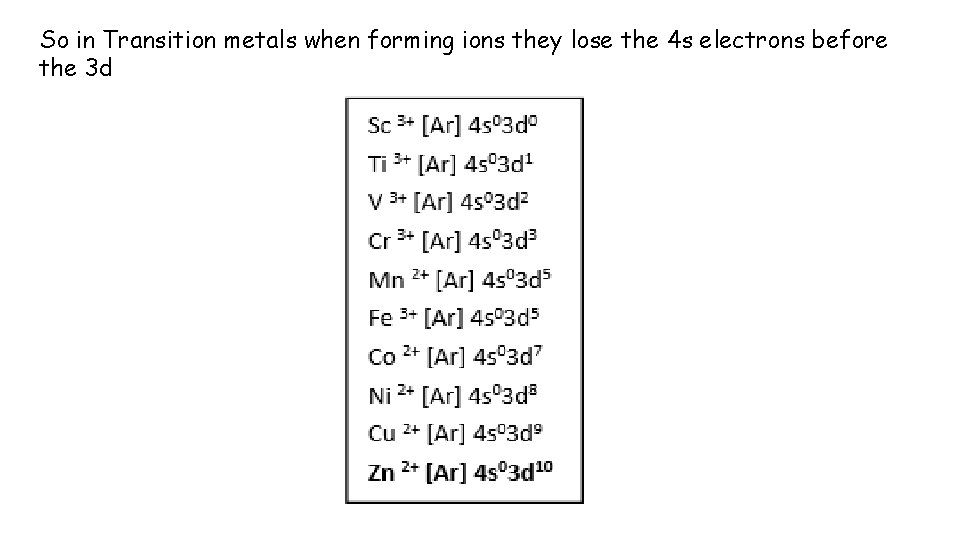
So in Transition metals when forming ions they lose the 4 s electrons before the 3 d
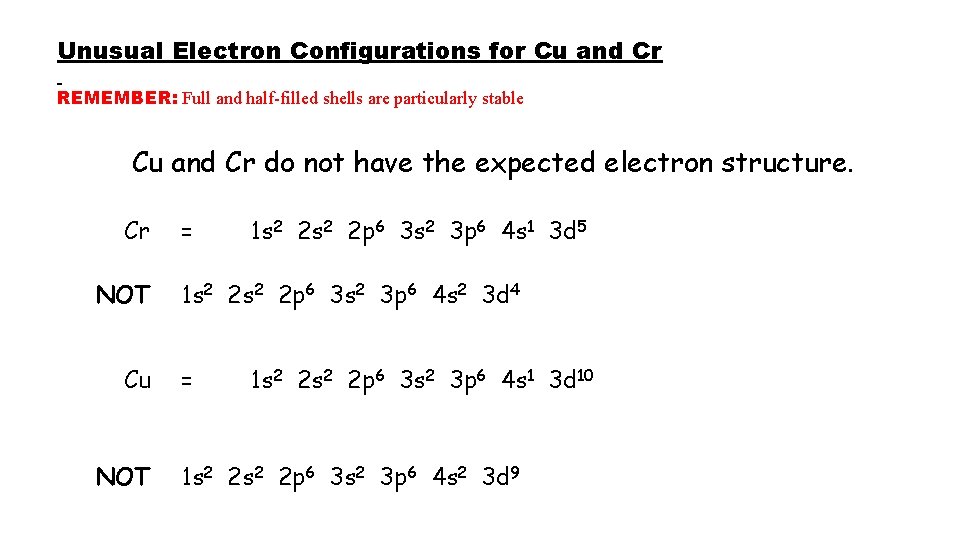
Unusual Electron Configurations for Cu and Cr REMEMBER: Full and half-filled shells are particularly stable Cu and Cr do not have the expected electron structure. Cr NOT Cu NOT = 1 s 2 2 p 6 3 s 2 3 p 6 4 s 1 3 d 5 1 s 2 2 p 6 3 s 2 3 p 6 4 s 2 3 d 4 = 1 s 2 2 p 6 3 s 2 3 p 6 4 s 1 3 d 10 1 s 2 2 p 6 3 s 2 3 p 6 4 s 2 3 d 9
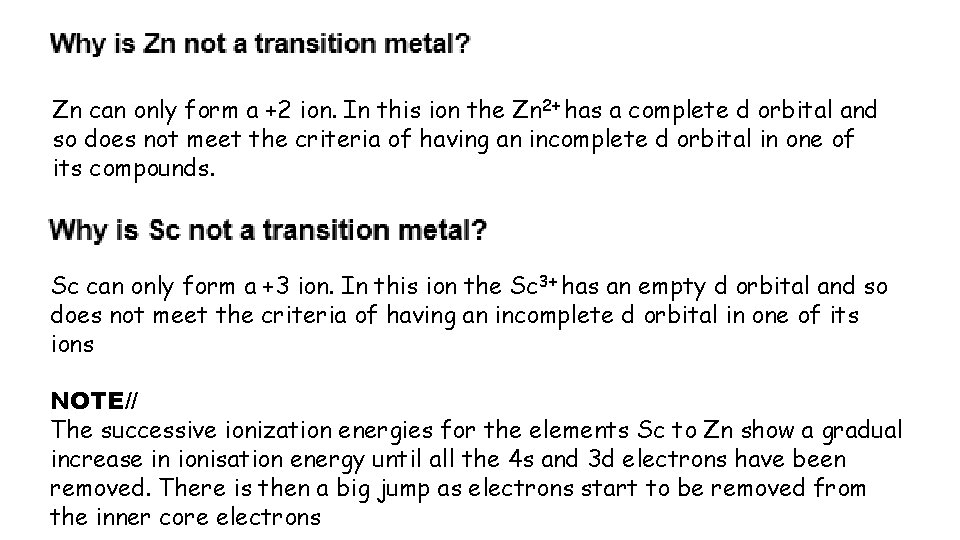
Zn can only form a +2 ion. In this ion the Zn 2+ has a complete d orbital and so does not meet the criteria of having an incomplete d orbital in one of its compounds. Sc can only form a +3 ion. In this ion the Sc 3+ has an empty d orbital and so does not meet the criteria of having an incomplete d orbital in one of its ions NOTE// The successive ionization energies for the elements Sc to Zn show a gradual increase in ionisation energy until all the 4 s and 3 d electrons have been removed. There is then a big jump as electrons start to be removed from the inner core electrons
CHARACTERISTICS OF TRANSITION METALS Since transition metals OR at least one of its stable ions has an incomplete d-orbital it gives rise to these characteristics of transition metals: Ø Ø complex formation, formation of coloured ions, variable oxidation state catalytic activity.
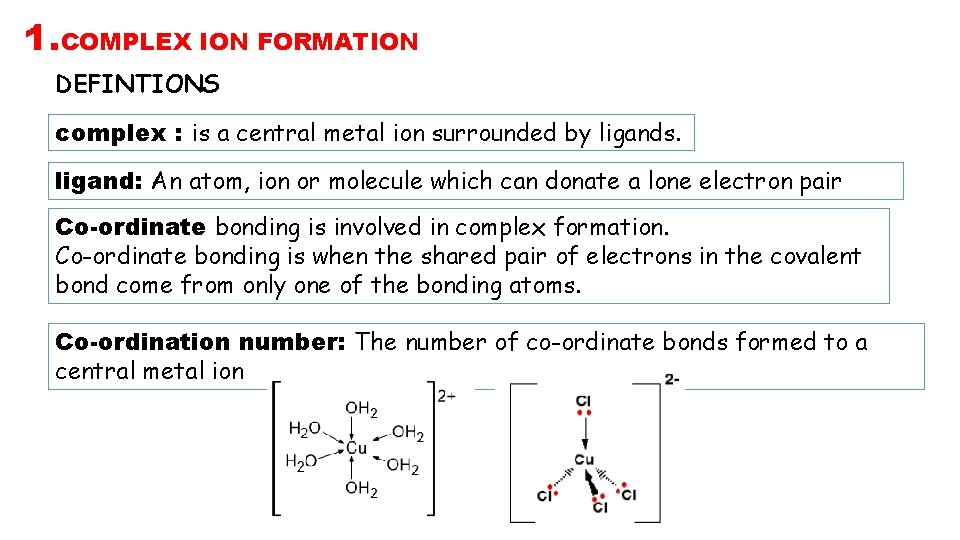
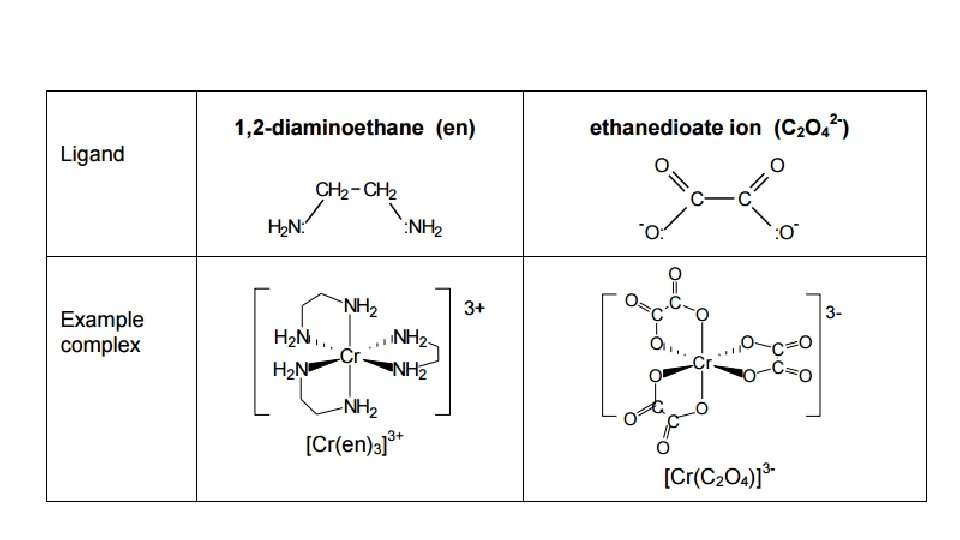
1. COMPLEX ION FORMATION DEFINTIONS complex : is a central metal ion surrounded by ligands. ligand: An atom, ion or molecule which can donate a lone electron pair Co-ordinate bonding is involved in complex formation. Co-ordinate bonding is when the shared pair of electrons in the covalent bond come from only one of the bonding atoms. Co-ordination number: The number of co-ordinate bonds formed to a central metal ion
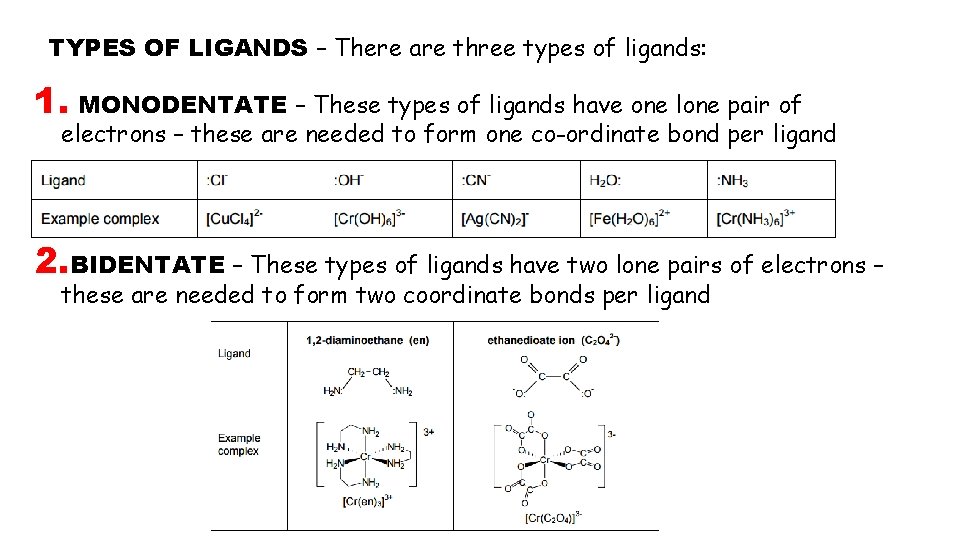
TYPES OF LIGANDS – There are three types of ligands: 1. MONODENTATE – These types of ligands have one lone pair of electrons – these are needed to form one co-ordinate bond per ligand 2. BIDENTATE – These types of ligands have two lone pairs of electrons – these are needed to form two coordinate bonds per ligand
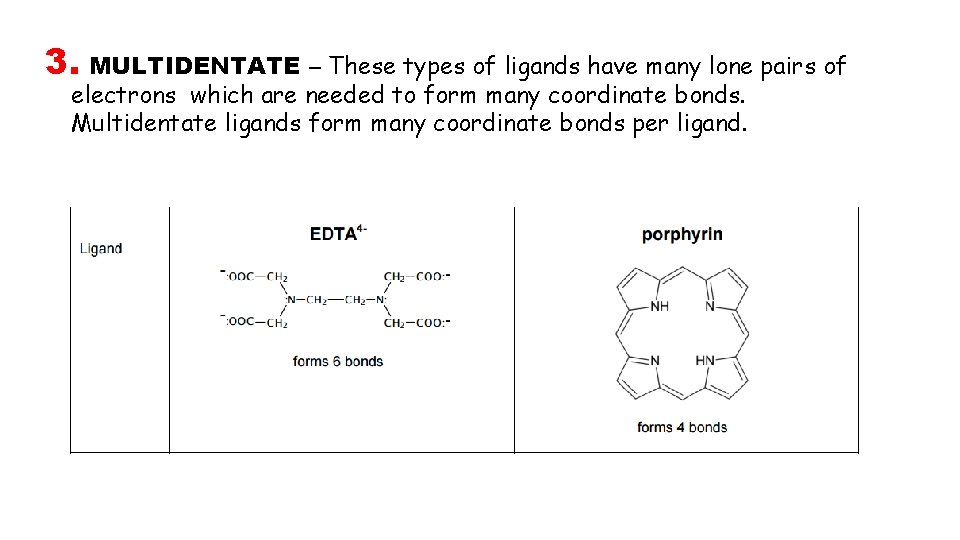
3. MULTIDENTATE – These types of ligands have many lone pairs of electrons which are needed to form many coordinate bonds. Multidentate ligands form many coordinate bonds per ligand.
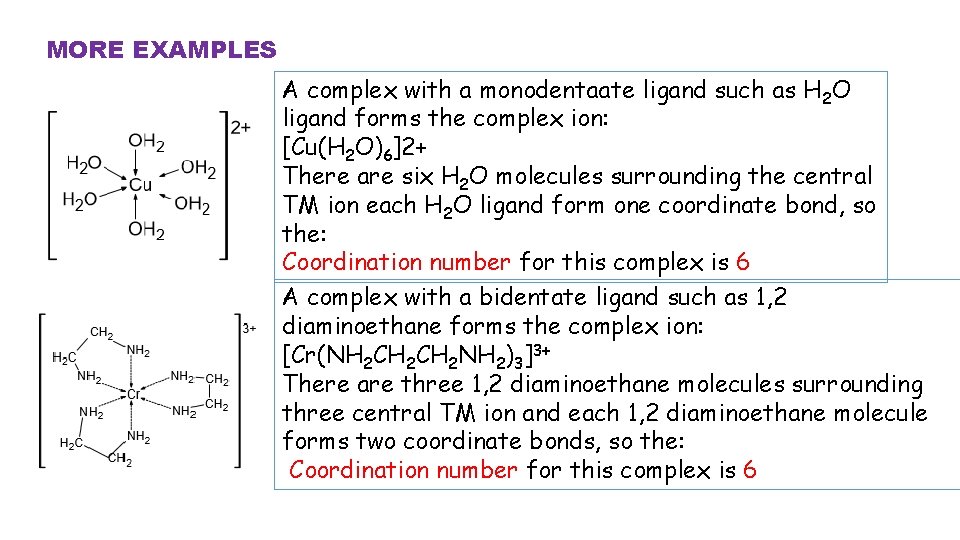
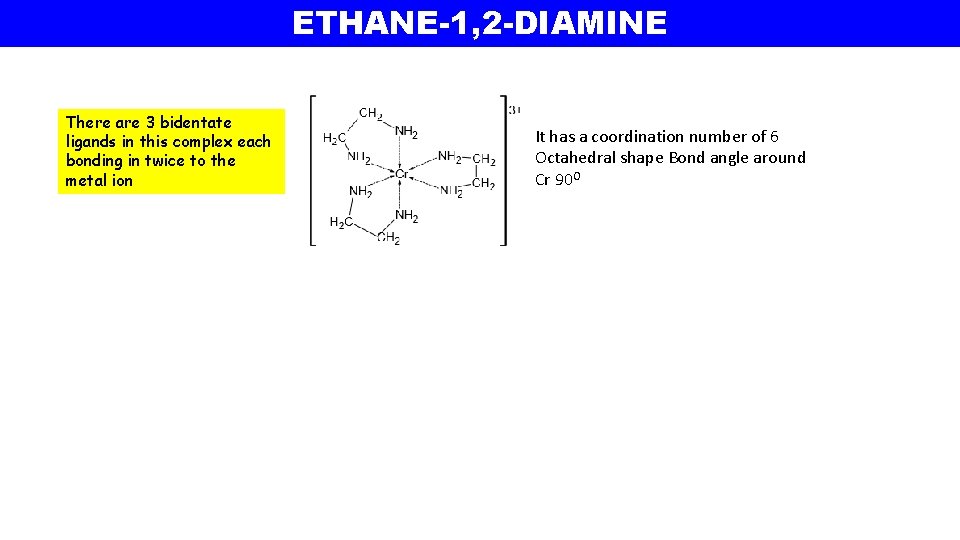
MORE EXAMPLES A complex with a monodentaate ligand such as H 2 O ligand forms the complex ion: [Cu(H 2 O)6]2+ There are six H 2 O molecules surrounding the central TM ion each H 2 O ligand form one coordinate bond, so the: Coordination number for this complex is 6 A complex with a bidentate ligand such as 1, 2 diaminoethane forms the complex ion: [Cr(NH 2 CH 2 NH 2)3]3+ There are three 1, 2 diaminoethane molecules surrounding three central TM ion and each 1, 2 diaminoethane molecule forms two coordinate bonds, so the: Coordination number for this complex is 6
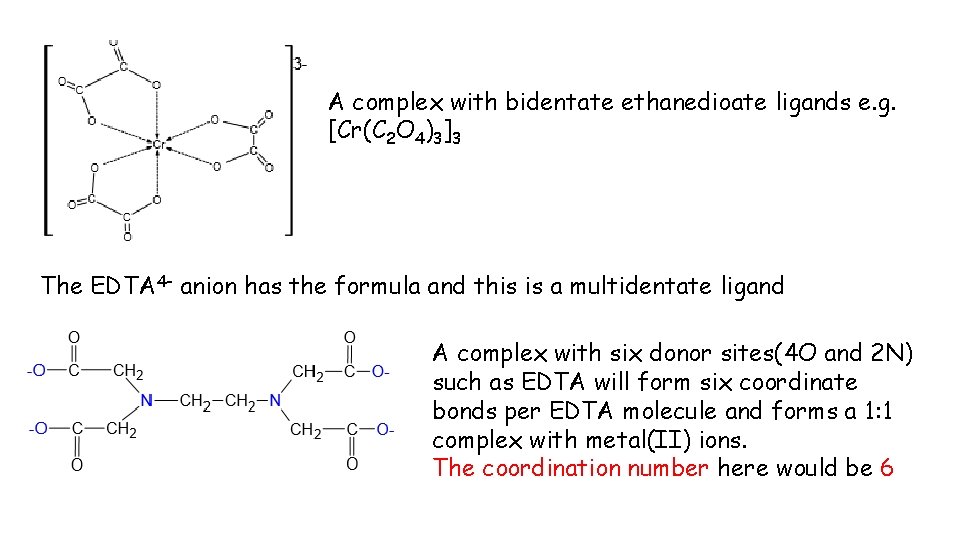
A complex with bidentate ethanedioate ligands e. g. [Cr(C 2 O 4)3]3 The EDTA 4 - anion has the formula and this is a multidentate ligand A complex with six donor sites(4 O and 2 N) such as EDTA will form six coordinate bonds per EDTA molecule and forms a 1: 1 complex with metal(II) ions. The coordination number here would be 6
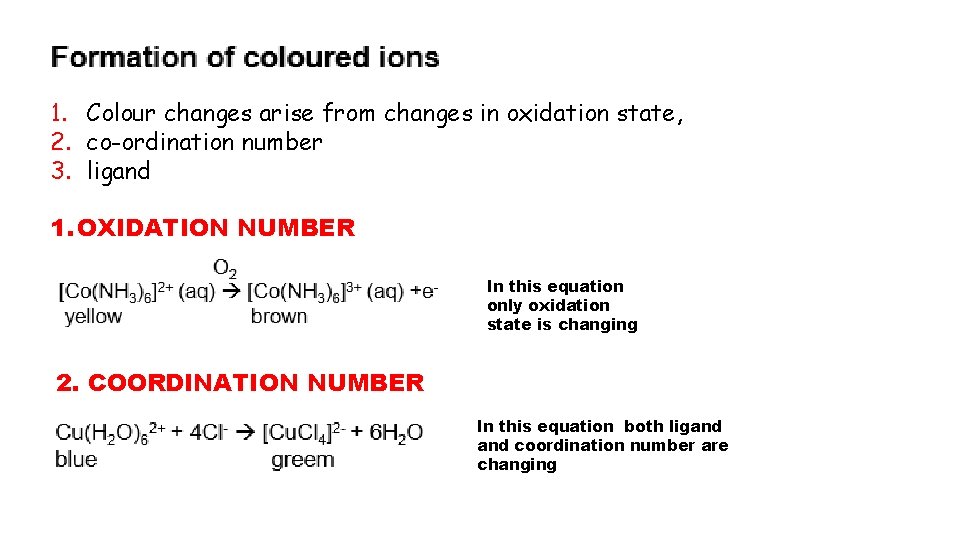
1. Colour changes arise from changes in oxidation state, 2. co-ordination number 3. ligand 1. OXIDATION NUMBER In this equation only oxidation state is changing 2. COORDINATION NUMBER In this equation both ligand coordination number are changing
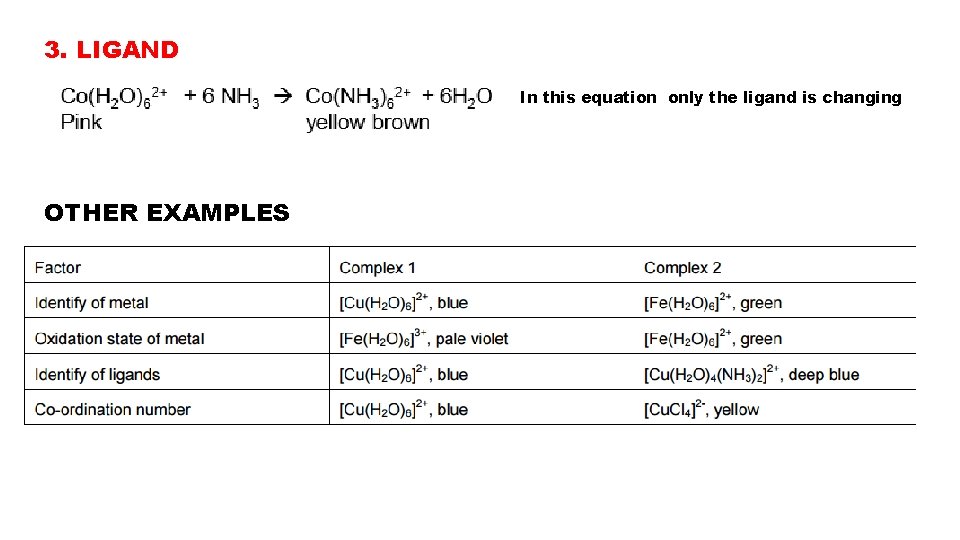
3. LIGAND In this equation only the ligand is changing OTHER EXAMPLES
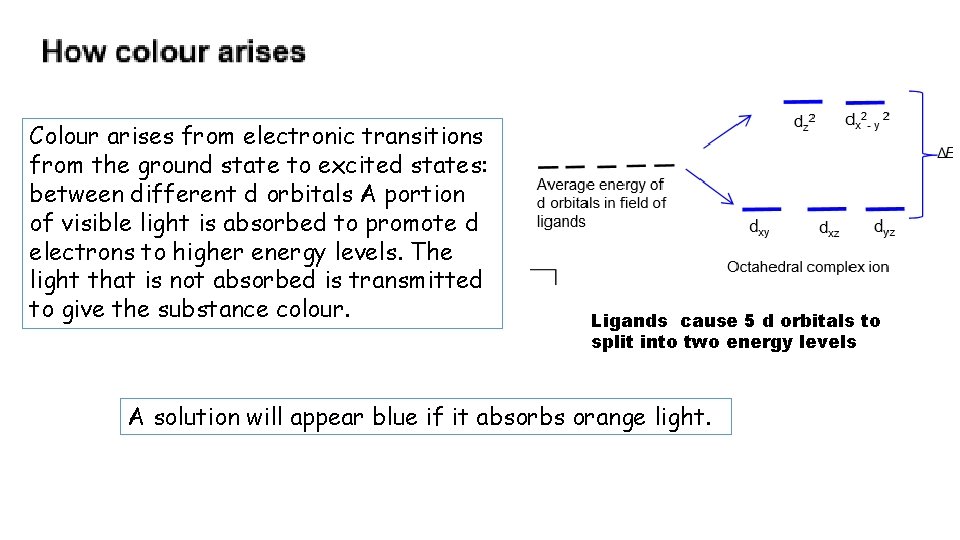
Colour arises from electronic transitions from the ground state to excited states: between different d orbitals A portion of visible light is absorbed to promote d electrons to higher energy levels. The light that is not absorbed is transmitted to give the substance colour. Ligands cause 5 d orbitals to split into two energy levels A solution will appear blue if it absorbs orange light.
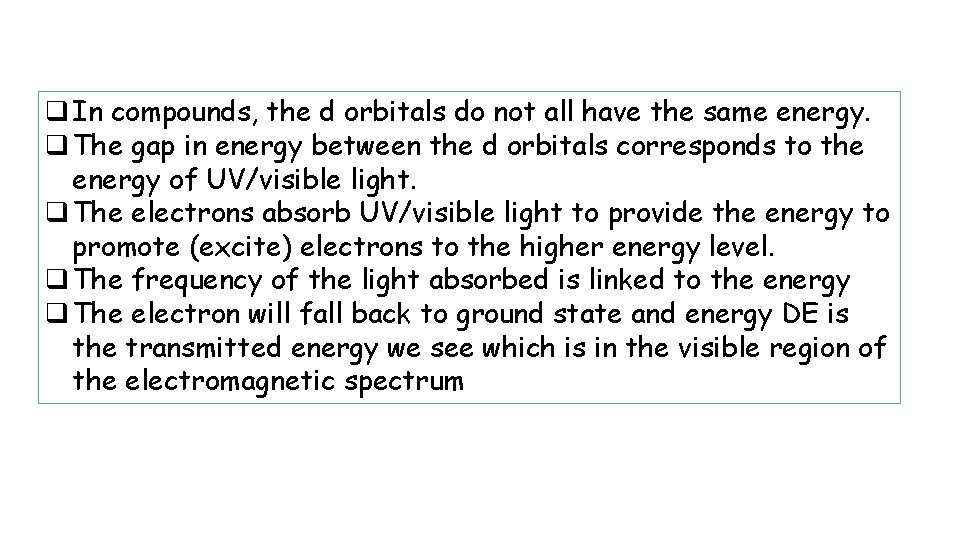
q In compounds, the d orbitals do not all have the same energy. q The gap in energy between the d orbitals corresponds to the energy of UV/visible light. q The electrons absorb UV/visible light to provide the energy to promote (excite) electrons to the higher energy level. q The frequency of the light absorbed is linked to the energy q The electron will fall back to ground state and energy DE is the transmitted energy we see which is in the visible region of the electromagnetic spectrum
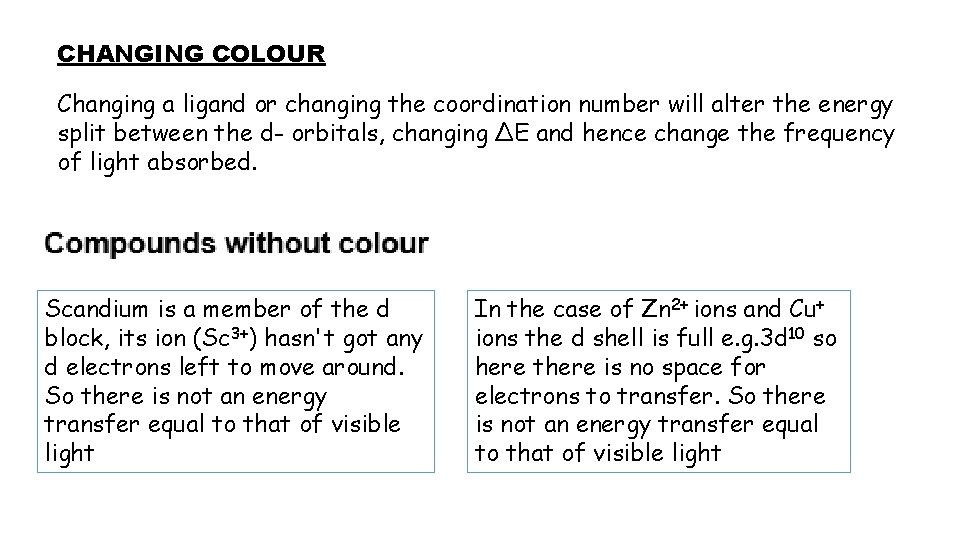
CHANGING COLOUR Changing a ligand or changing the coordination number will alter the energy split between the d- orbitals, changing ∆E and hence change the frequency of light absorbed. Scandium is a member of the d block, its ion (Sc 3+) hasn't got any d electrons left to move around. So there is not an energy transfer equal to that of visible light In the case of Zn 2+ ions and Cu+ ions the d shell is full e. g. 3 d 10 so here there is no space for electrons to transfer. So there is not an energy transfer equal to that of visible light
- Ultraviolet/visible spectroscopy Ø If visible light of increasing frequency is passed through a sample of a coloured complex ion, some of the light is absorbed. Ø The amount of light absorbed is proportional to the concentration of the absorbing species. Ø Some complexes have only pale colours and do not absorb light strongly. Ø In these cases a suitable ligand is added to intensify the colour. Absorption of visible light is used in spectrometry to determine the concentration of coloured ions
Ø The frequencies at which a complex absorbs uv/visible light can be measured with a uv/visible spectrometer. Ø UV/visible light is passed through the complex, and the frequencies of uv/vis light passing through detected – those that do not pass through are absorbed. Ø The more concentrated the solution the more light that is absorbed, so UV/VISIBLE can be used to measure the concentration of the solution.
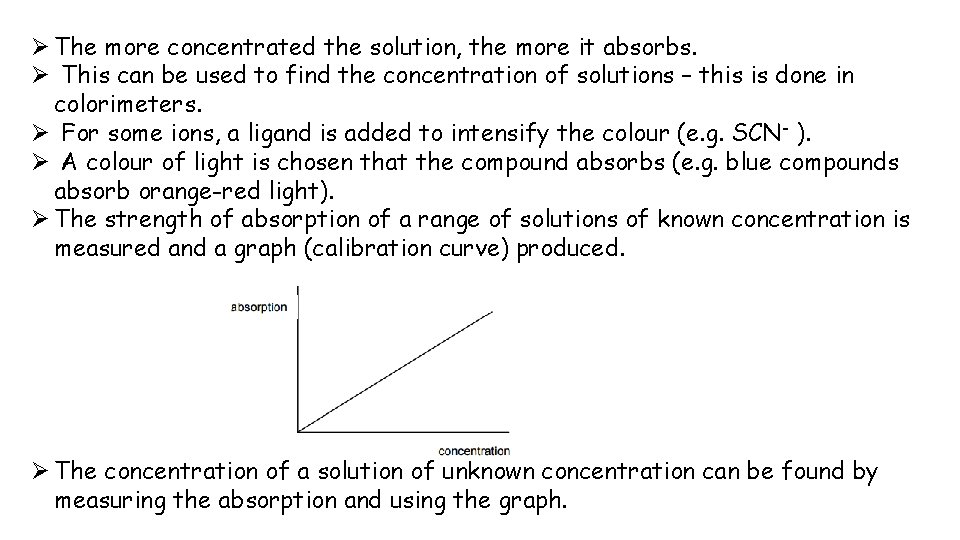
Ø The more concentrated the solution, the more it absorbs. Ø This can be used to find the concentration of solutions – this is done in colorimeters. Ø For some ions, a ligand is added to intensify the colour (e. g. SCN - ). Ø A colour of light is chosen that the compound absorbs (e. g. blue compounds absorb orange-red light). Ø The strength of absorption of a range of solutions of known concentration is measured and a graph (calibration curve) produced. Ø The concentration of a solution of unknown concentration can be found by measuring the absorption and using the graph.
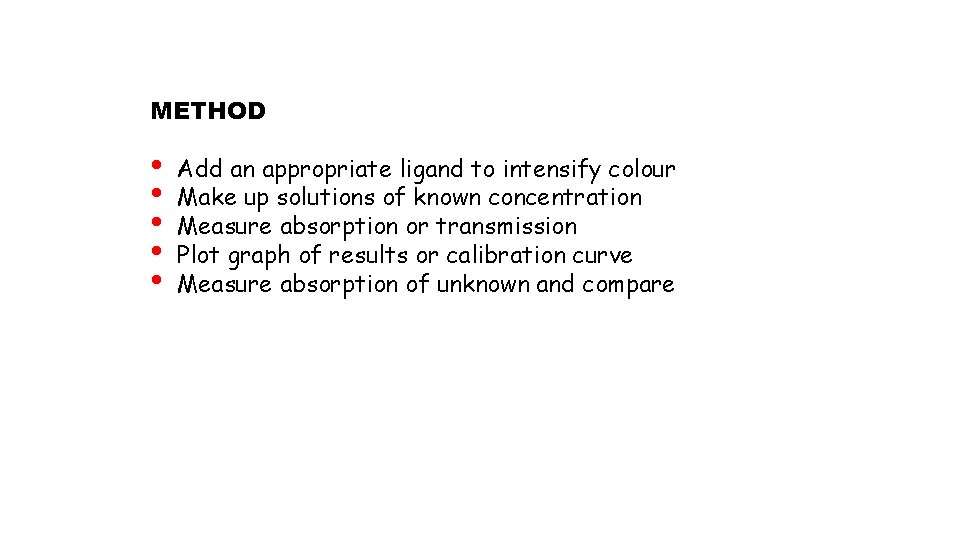
METHOD • • • Add an appropriate ligand to intensify colour Make up solutions of known concentration Measure absorption or transmission Plot graph of results or calibration curve Measure absorption of unknown and compare
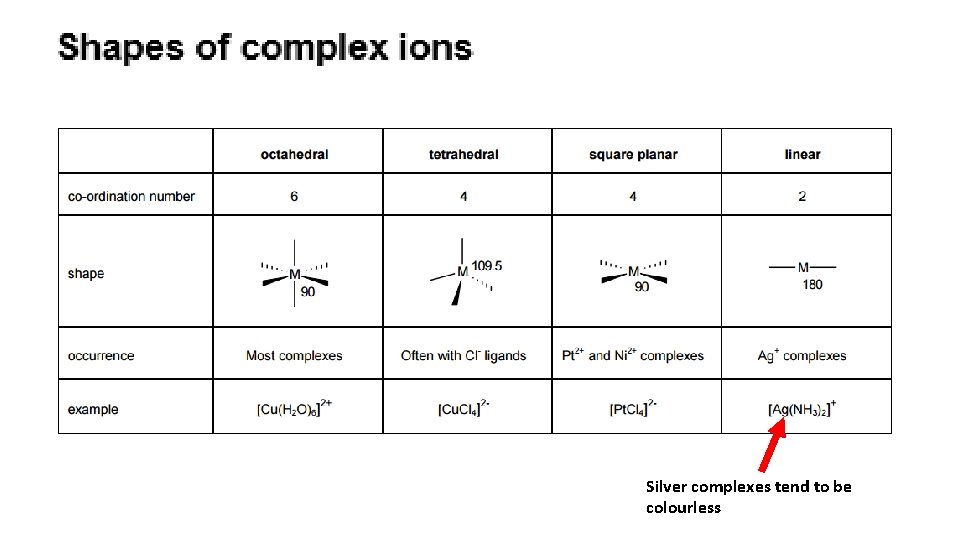
Silver complexes tend to be colourless
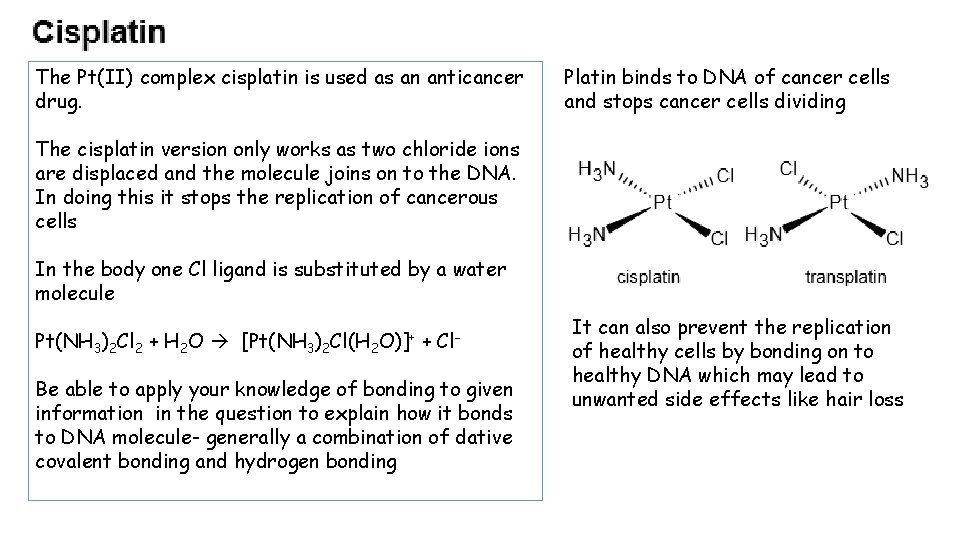
The Pt(II) complex cisplatin is used as an anticancer drug. Platin binds to DNA of cancer cells and stops cancer cells dividing The cisplatin version only works as two chloride ions are displaced and the molecule joins on to the DNA. In doing this it stops the replication of cancerous cells In the body one Cl ligand is substituted by a water molecule Pt(NH 3)2 Cl 2 + H 2 O [Pt(NH 3)2 Cl(H 2 O)]+ + Cl– Be able to apply your knowledge of bonding to given information in the question to explain how it bonds to DNA molecule- generally a combination of dative covalent bonding and hydrogen bonding It can also prevent the replication of healthy cells by bonding on to healthy DNA which may lead to unwanted side effects like hair loss
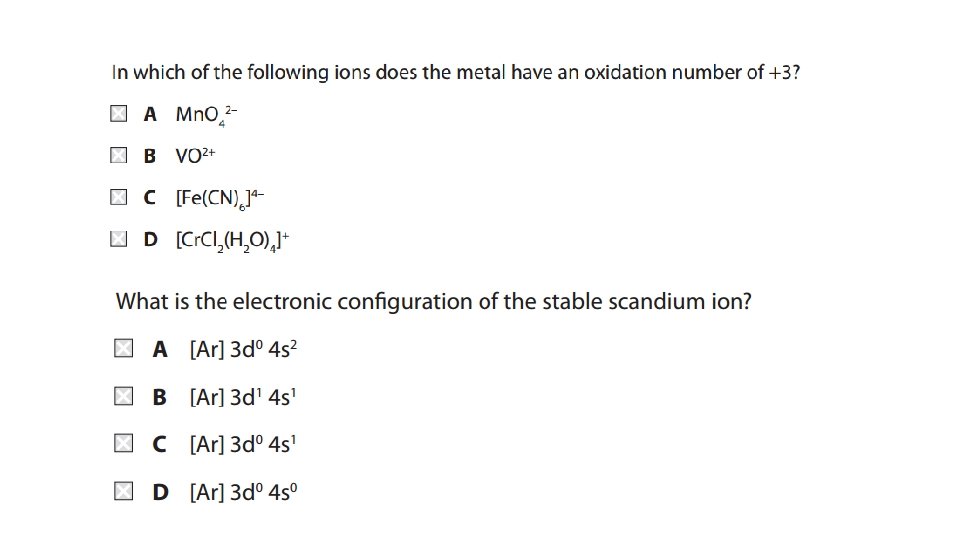
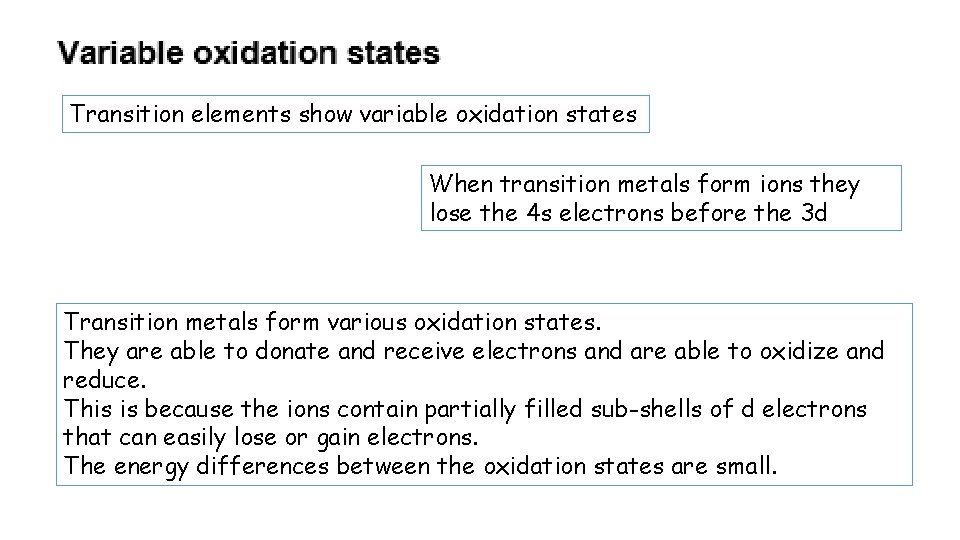
Transition elements show variable oxidation states When transition metals form ions they lose the 4 s electrons before the 3 d Transition metals form various oxidation states. They are able to donate and receive electrons and are able to oxidize and reduce. This is because the ions contain partially filled sub-shells of d electrons that can easily lose or gain electrons. The energy differences between the oxidation states are small.
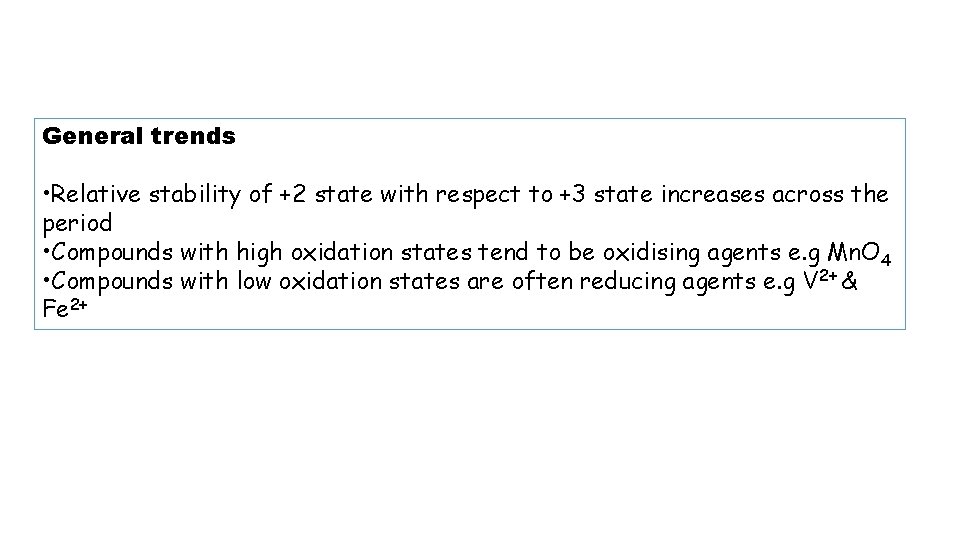
General trends • Relative stability of +2 state with respect to +3 state increases across the period • Compounds with high oxidation states tend to be oxidising agents e. g Mn. O 4 • Compounds with low oxidation states are often reducing agents e. g V 2+ & Fe 2+
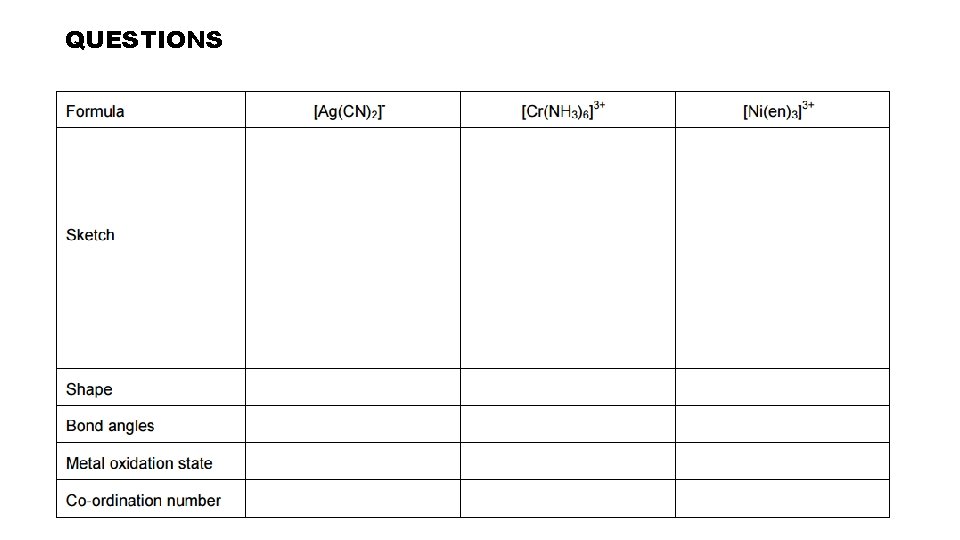
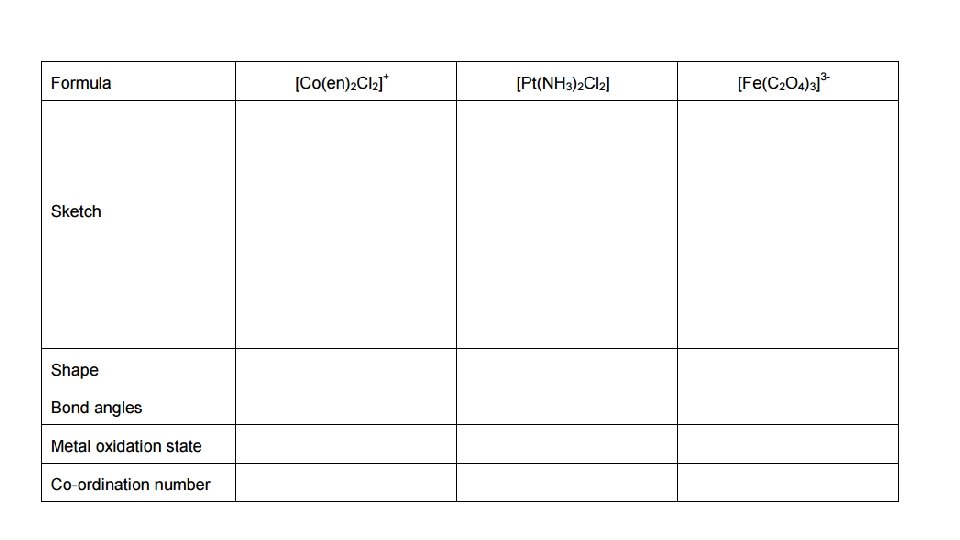
QUESTIONS
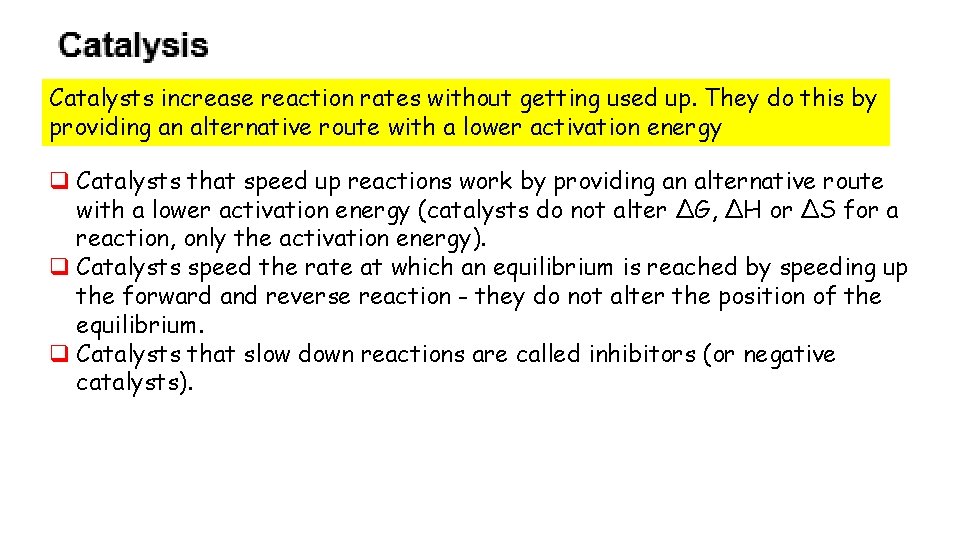
Catalysts increase reaction rates without getting used up. They do this by providing an alternative route with a lower activation energy q Catalysts that speed up reactions work by providing an alternative route with a lower activation energy (catalysts do not alter ∆G, ∆H or ∆S for a reaction, only the activation energy). q Catalysts speed the rate at which an equilibrium is reached by speeding up the forward and reverse reaction - they do not alter the position of the equilibrium. q Catalysts that slow down reactions are called inhibitors (or negative catalysts).
Transition metals and their compounds can act as heterogeneous and homogeneous catalysts. A heterogeneous catalyst is in a different phase from the reactants A homogeneous catalyst is in the same phase as the reactants
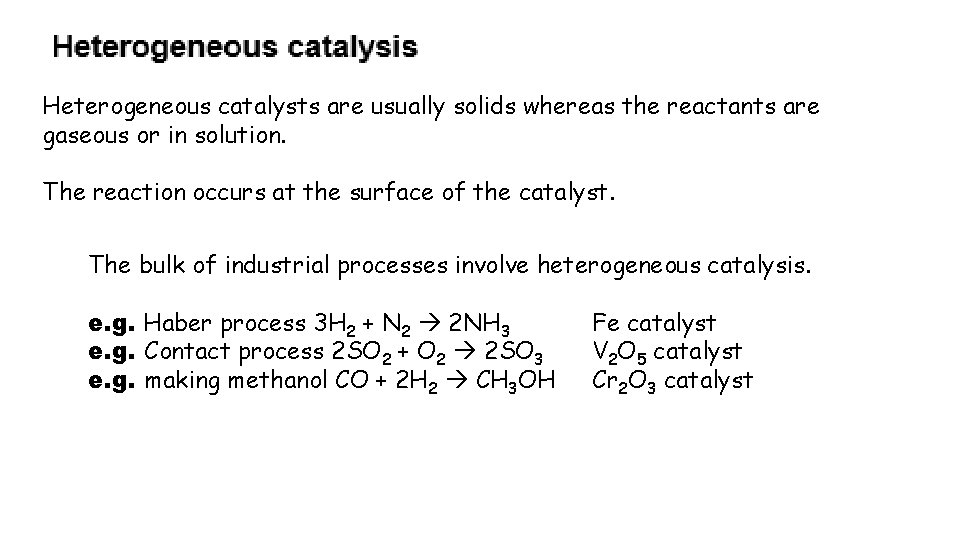
Heterogeneous catalysts are usually solids whereas the reactants are gaseous or in solution. The reaction occurs at the surface of the catalyst. The bulk of industrial processes involve heterogeneous catalysis. e. g. Haber process 3 H 2 + N 2 2 NH 3 e. g. Contact process 2 SO 2 + O 2 2 SO 3 e. g. making methanol CO + 2 H 2 CH 3 OH Fe catalyst V 2 O 5 catalyst Cr 2 O 3 catalyst
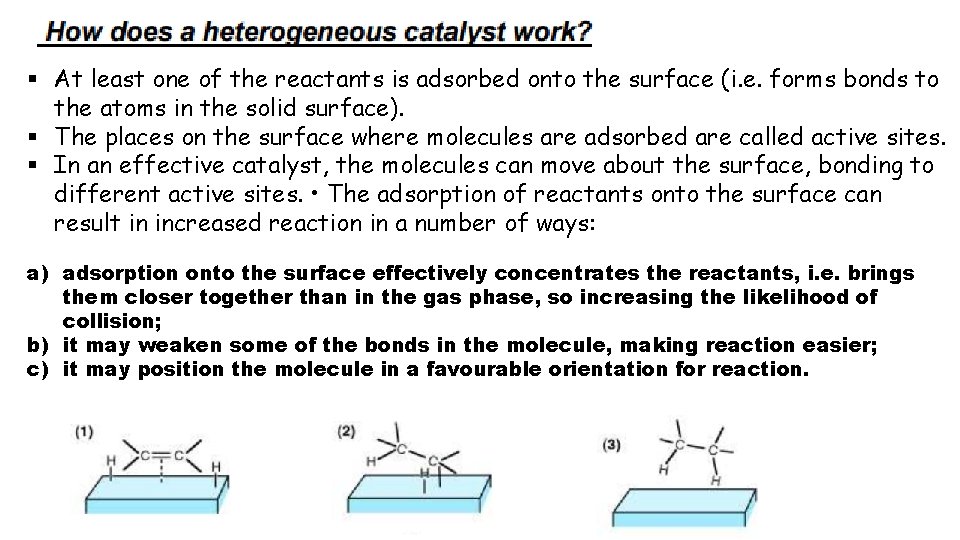
§ At least one of the reactants is adsorbed onto the surface (i. e. forms bonds to the atoms in the solid surface). § The places on the surface where molecules are adsorbed are called active sites. § In an effective catalyst, the molecules can move about the surface, bonding to different active sites. • The adsorption of reactants onto the surface can result in increased reaction in a number of ways: a) adsorption onto the surface effectively concentrates the reactants, i. e. brings them closer together than in the gas phase, so increasing the likelihood of collision; b) it may weaken some of the bonds in the molecule, making reaction easier; c) it may position the molecule in a favourable orientation for reaction.
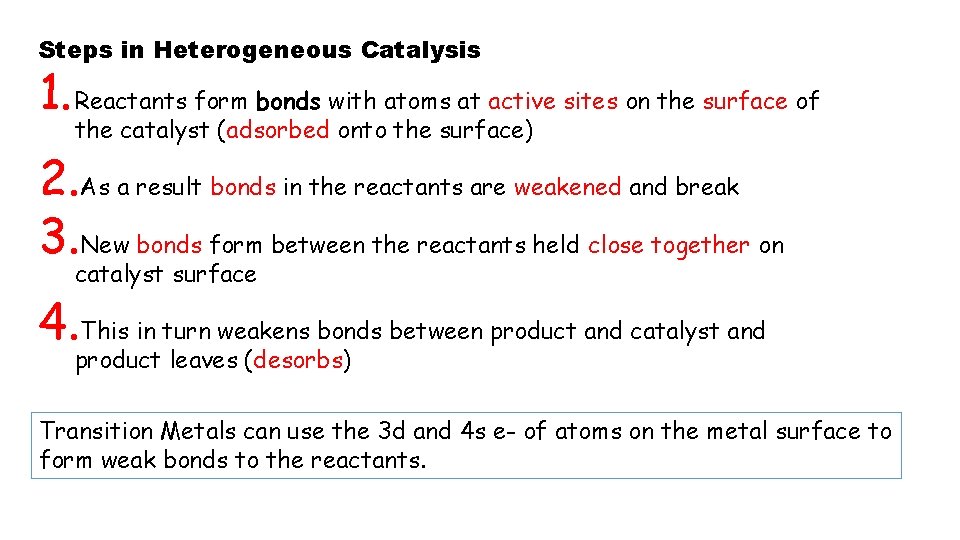
Steps in Heterogeneous Catalysis 1. Reactants form bonds with atoms at active sites on the surface of the catalyst (adsorbed onto the surface) 2. As a result bonds in the reactants are weakened and break 3. New bonds form between the reactants held close together on catalyst surface 4. This in turn weakens bonds between product and catalyst and product leaves (desorbs) Transition Metals can use the 3 d and 4 s e- of atoms on the metal surface to form weak bonds to the reactants.
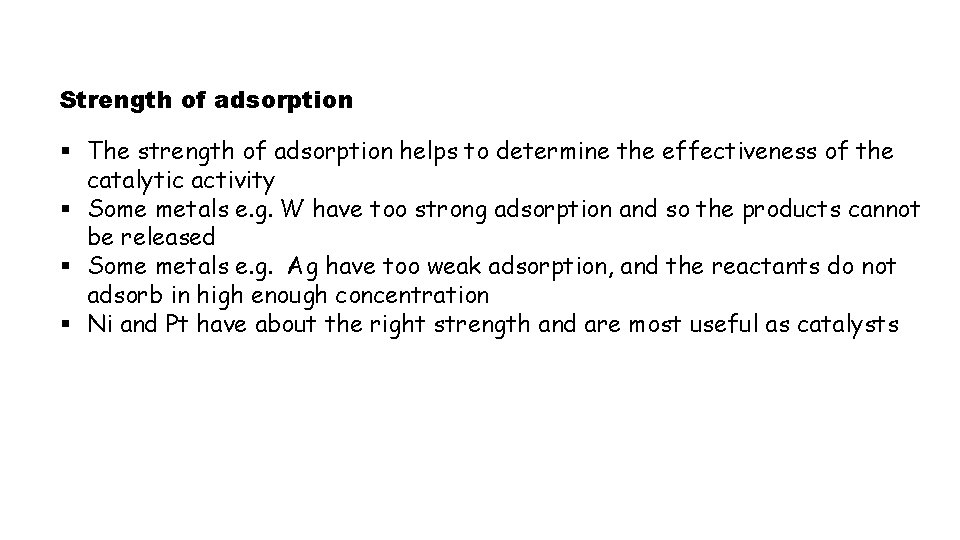
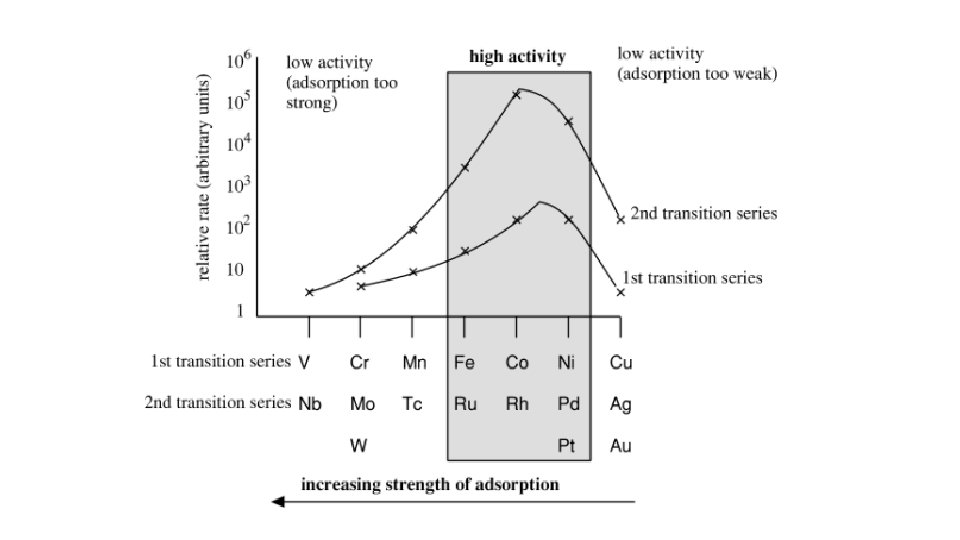
Strength of adsorption § The strength of adsorption helps to determine the effectiveness of the catalytic activity § Some metals e. g. W have too strong adsorption and so the products cannot be released § Some metals e. g. Ag have too weak adsorption, and the reactants do not adsorb in high enough concentration § Ni and Pt have about the right strength and are most useful as catalysts
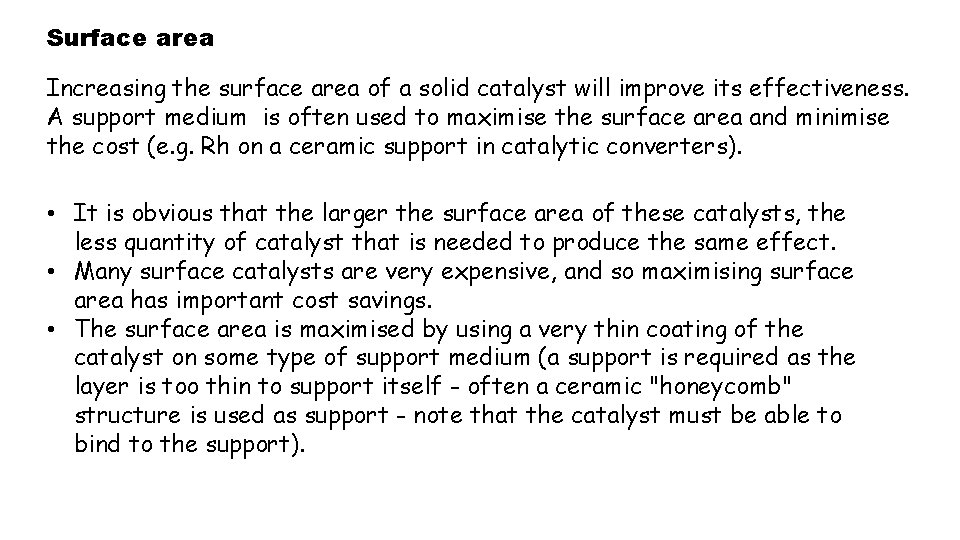
Surface area Increasing the surface area of a solid catalyst will improve its effectiveness. A support medium is often used to maximise the surface area and minimise the cost (e. g. Rh on a ceramic support in catalytic converters). • It is obvious that the larger the surface area of these catalysts, the less quantity of catalyst that is needed to produce the same effect. • Many surface catalysts are very expensive, and so maximising surface area has important cost savings. • The surface area is maximised by using a very thin coating of the catalyst on some type of support medium (a support is required as the layer is too thin to support itself - often a ceramic "honeycomb" structure is used as support - note that the catalyst must be able to bind to the support).
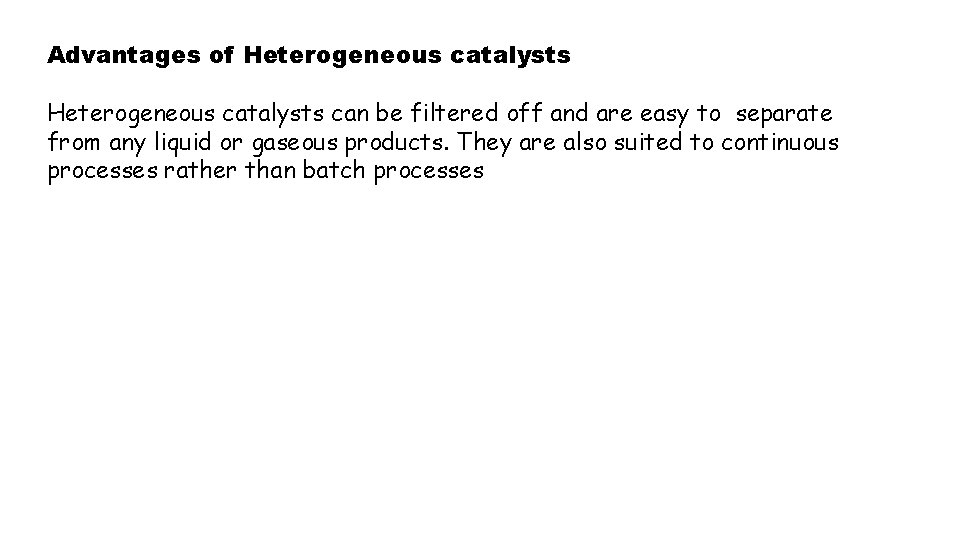
Advantages of Heterogeneous catalysts can be filtered off and are easy to separate from any liquid or gaseous products. They are also suited to continuous processes rather than batch processes
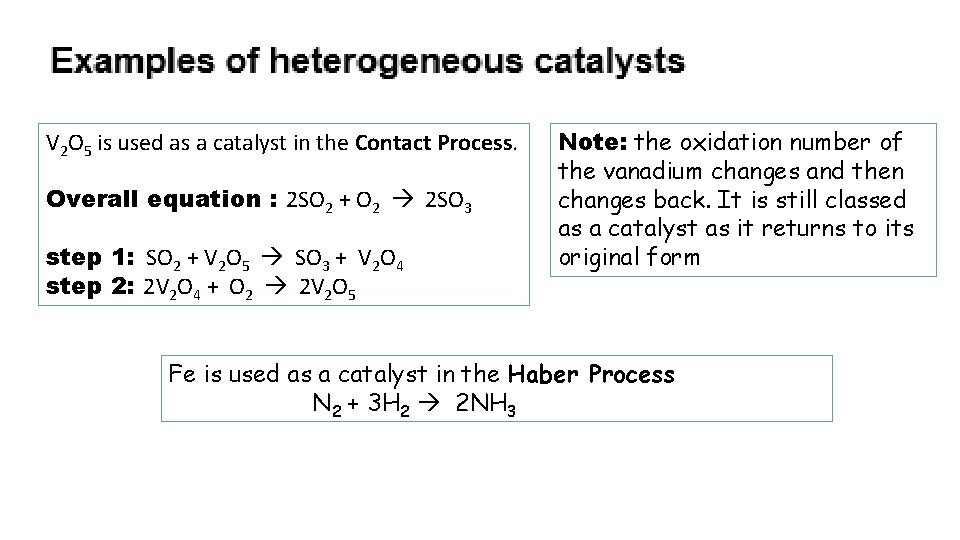
V 2 O 5 is used as a catalyst in the Contact Process. Overall equation : 2 SO 2 + O 2 2 SO 3 step 1: SO 2 + V 2 O 5 SO 3 + V 2 O 4 step 2: 2 V 2 O 4 + O 2 2 V 2 O 5 Note: the oxidation number of the vanadium changes and then changes back. It is still classed as a catalyst as it returns to its original form Fe is used as a catalyst in the Haber Process N 2 + 3 H 2 2 NH 3
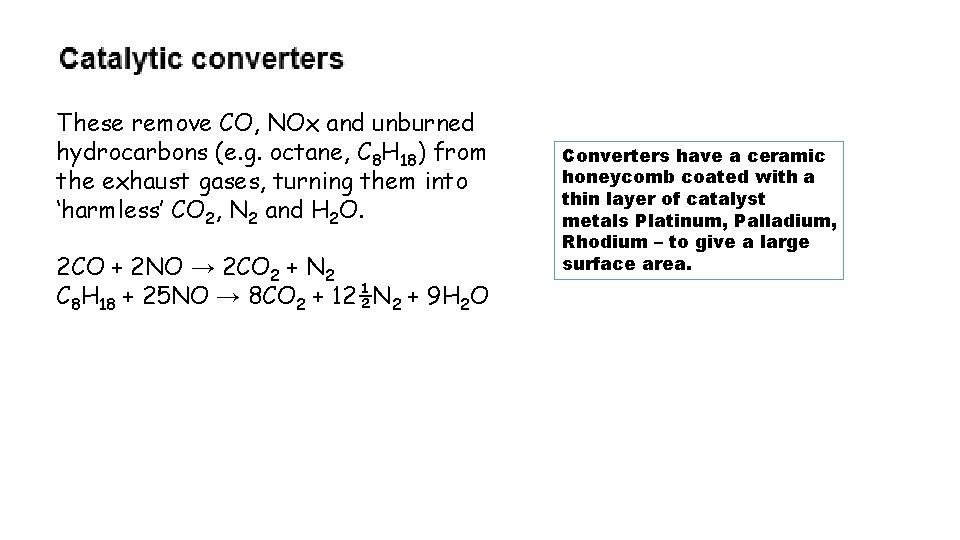
These remove CO, NOx and unburned hydrocarbons (e. g. octane, C 8 H 18) from the exhaust gases, turning them into ‘harmless’ CO 2, N 2 and H 2 O. 2 CO + 2 NO → 2 CO 2 + N 2 C 8 H 18 + 25 NO → 8 CO 2 + 12½N 2 + 9 H 2 O Converters have a ceramic honeycomb coated with a thin layer of catalyst metals Platinum, Palladium, Rhodium – to give a large surface area.
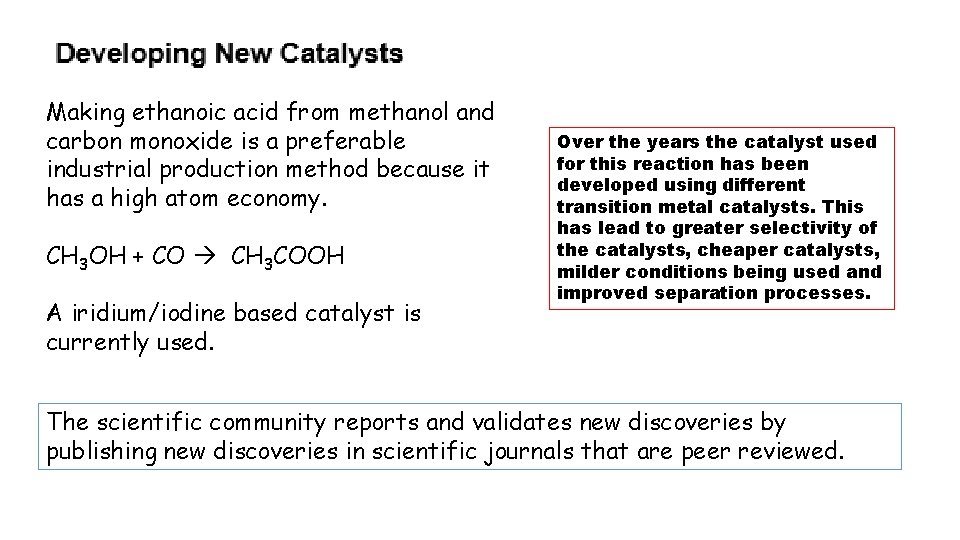
Making ethanoic acid from methanol and carbon monoxide is a preferable industrial production method because it has a high atom economy. CH 3 OH + CO CH 3 COOH A iridium/iodine based catalyst is currently used. Over the years the catalyst used for this reaction has been developed using different transition metal catalysts. This has lead to greater selectivity of the catalysts, cheaper catalysts, milder conditions being used and improved separation processes. The scientific community reports and validates new discoveries by publishing new discoveries in scientific journals that are peer reviewed.
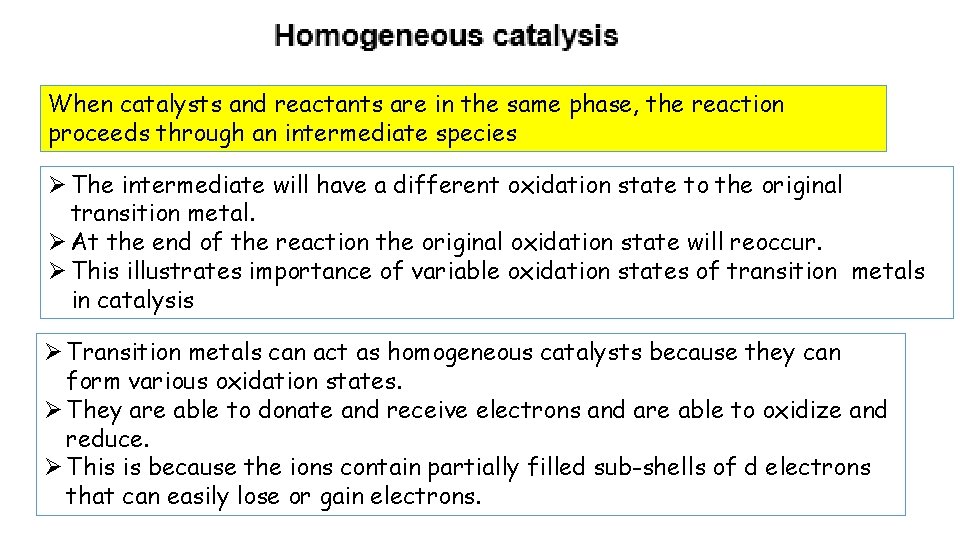
When catalysts and reactants are in the same phase, the reaction proceeds through an intermediate species Ø The intermediate will have a different oxidation state to the original transition metal. Ø At the end of the reaction the original oxidation state will reoccur. Ø This illustrates importance of variable oxidation states of transition metals in catalysis Ø Transition metals can act as homogeneous catalysts because they can form various oxidation states. Ø They are able to donate and receive electrons and are able to oxidize and reduce. Ø This is because the ions contain partially filled sub-shells of d electrons that can easily lose or gain electrons.
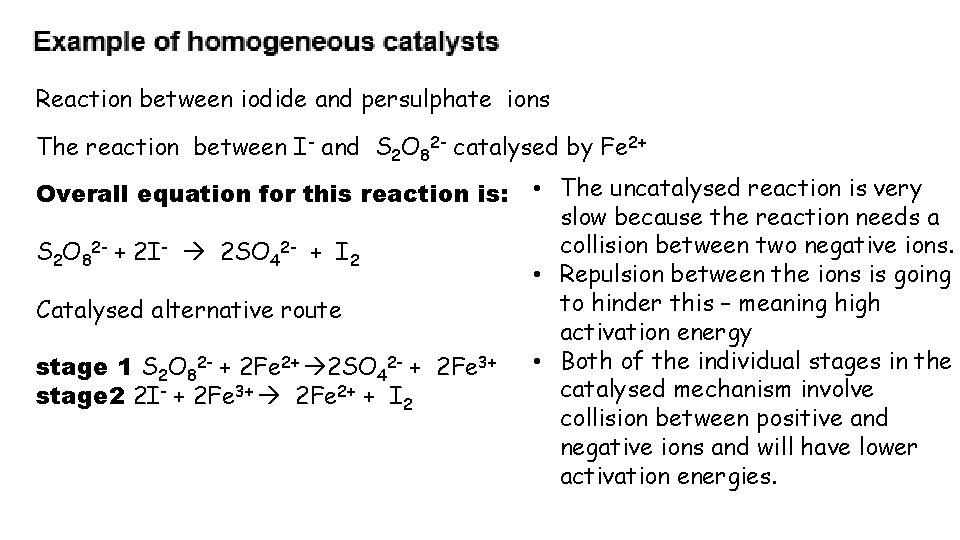
Reaction between iodide and persulphate ions The reaction between I- and S 2 O 82 - catalysed by Fe 2+ Overall equation for this reaction is: • The uncatalysed reaction is very slow because the reaction needs a collision between two negative ions. S 2 O 82 - + 2 I- 2 SO 42 - + I 2 • Repulsion between the ions is going to hinder this – meaning high Catalysed alternative route activation energy • Both of the individual stages in the stage 1 S 2 O 82 - + 2 Fe 2+ 2 SO 42 - + 2 Fe 3+ catalysed mechanism involve stage 2 2 I- + 2 Fe 3+ 2 Fe 2+ + I 2 collision between positive and negative ions and will have lower activation energies.
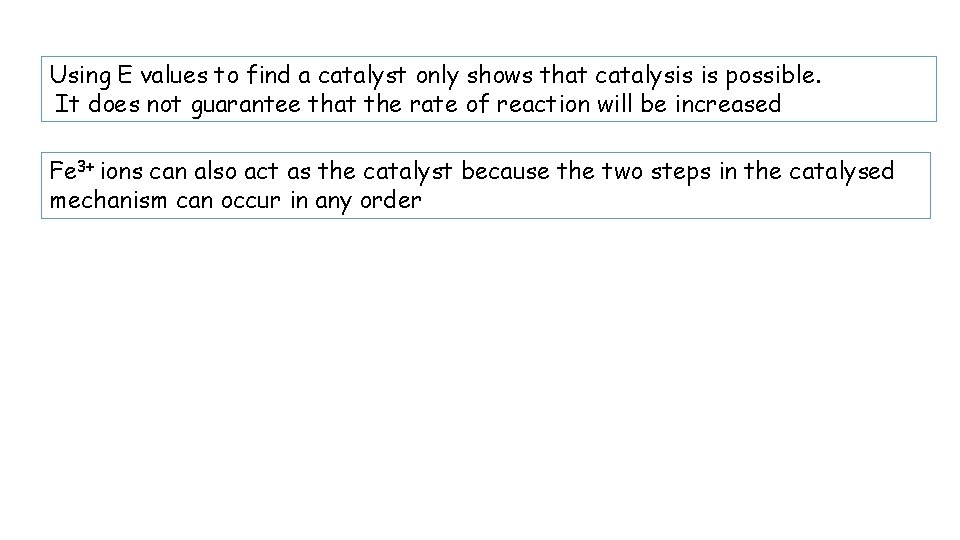
Using E values to find a catalyst only shows that catalysis is possible. It does not guarantee that the rate of reaction will be increased Fe 3+ ions can also act as the catalyst because the two steps in the catalysed mechanism can occur in any order
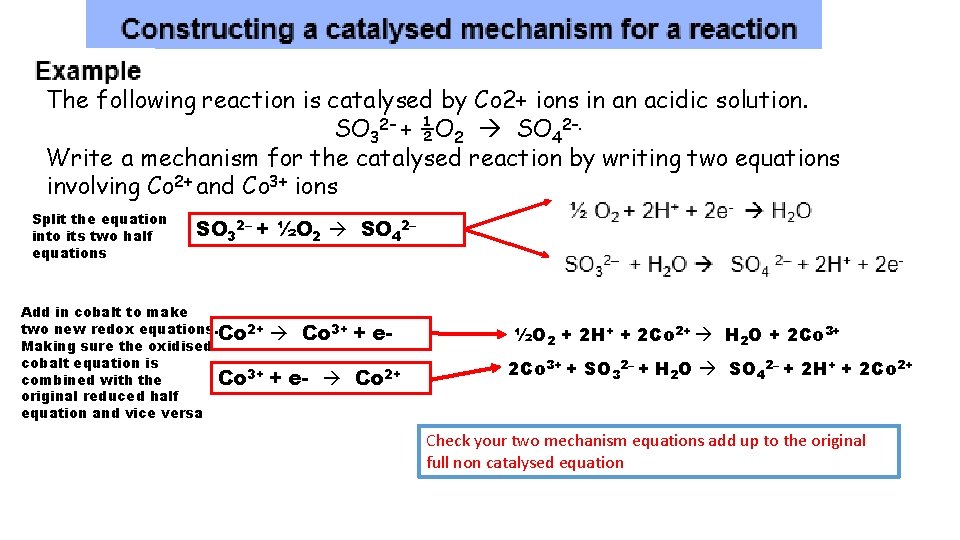
The following reaction is catalysed by Co 2+ ions in an acidic solution. SO 32– + ½O 2 SO 42–. Write a mechanism for the catalysed reaction by writing two equations involving Co 2+ and Co 3+ ions Split the equation into its two half equations SO 32– + ½O 2 SO 42– Add in cobalt to make two new redox equations. Co 2+ Making sure the oxidised cobalt equation is combined with the Co 3+ original reduced half equation and vice versa Co 3+ + e+ e- Co 2+ ½O 2 + 2 H+ + 2 Co 2+ H 2 O + 2 Co 3+ + SO 32– + H 2 O SO 42– + 2 H+ + 2 Co 2+ Check your two mechanism equations add up to the original full non catalysed equation
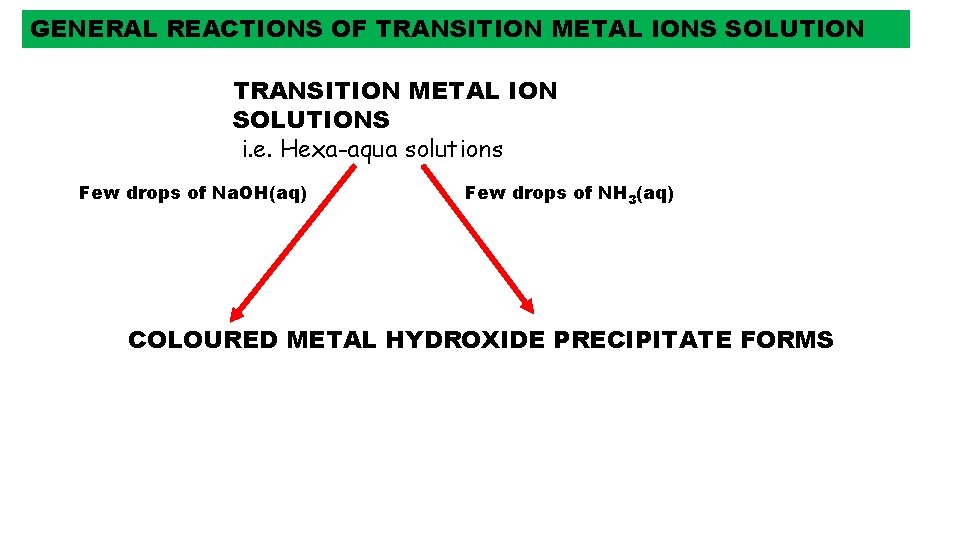
GENERAL REACTIONS OF TRANSITION METAL IONS SOLUTION TRANSITION METAL ION SOLUTIONS i. e. Hexa-aqua solutions Few drops of Na. OH(aq) Few drops of NH 3(aq) COLOURED METAL HYDROXIDE PRECIPITATE FORMS
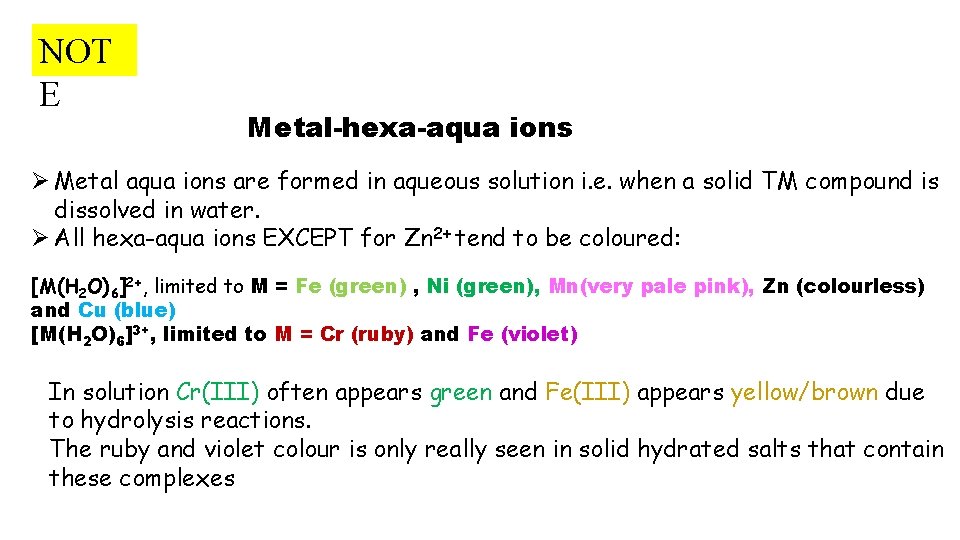
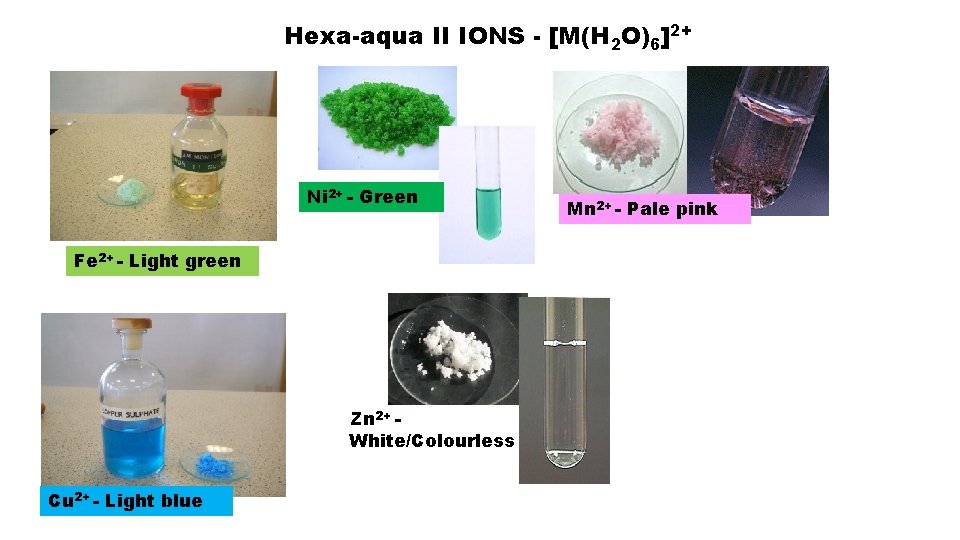
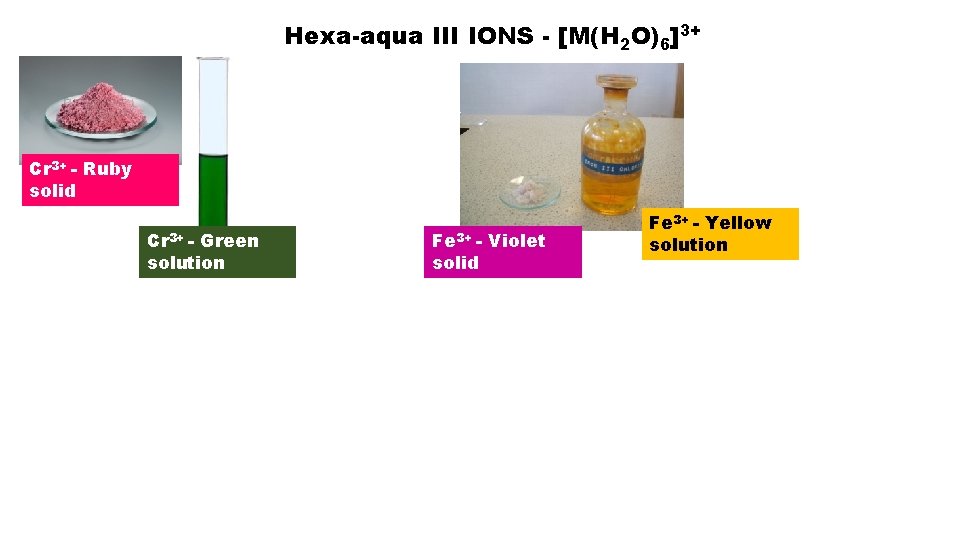
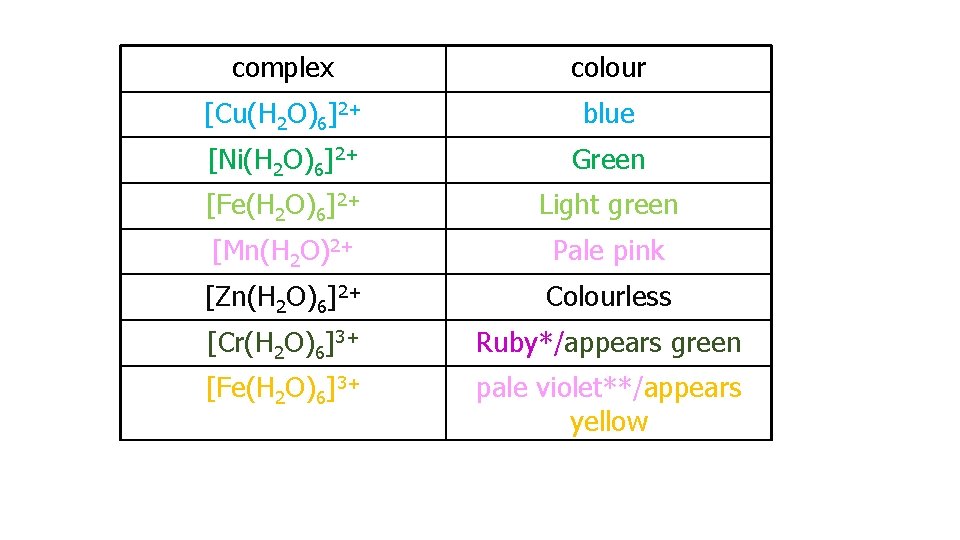
NOT E Metal-hexa-aqua ions Ø Metal aqua ions are formed in aqueous solution i. e. when a solid TM compound is dissolved in water. Ø All hexa-aqua ions EXCEPT for Zn 2+ tend to be coloured: [M(H 2 O)6]2+, limited to M = Fe (green) , Ni (green), Mn(very pale pink), Zn (colourless) and Cu (blue) [M(H 2 O)6]3+, limited to M = Cr (ruby) and Fe (violet) In solution Cr(III) often appears green and Fe(III) appears yellow/brown due to hydrolysis reactions. The ruby and violet colour is only really seen in solid hydrated salts that contain these complexes
Hexa-aqua II IONS - [M(H 2 O)6]2+ Ni 2+ - Green Fe 2+ - Light green Zn 2+ White/Colourless Cu 2+ - Light blue Mn 2+ - Pale pink
Hexa-aqua III IONS - [M(H 2 O)6]3+ Cr 3+ - Ruby solid Cr 3+ - Green solution Fe 3+ - Violet solid Fe 3+ - Yellow solution
complex colour [Cu(H 2 O)6]2+ blue [Ni(H 2 O)6]2+ Green [Fe(H 2 O)6]2+ Light green [Mn(H 2 O)2+ Pale pink [Zn(H 2 O)6]2+ Colourless [Cr(H 2 O)6]3+ Ruby*/appears green [Fe(H 2 O)6]3+ pale violet**/appears yellow
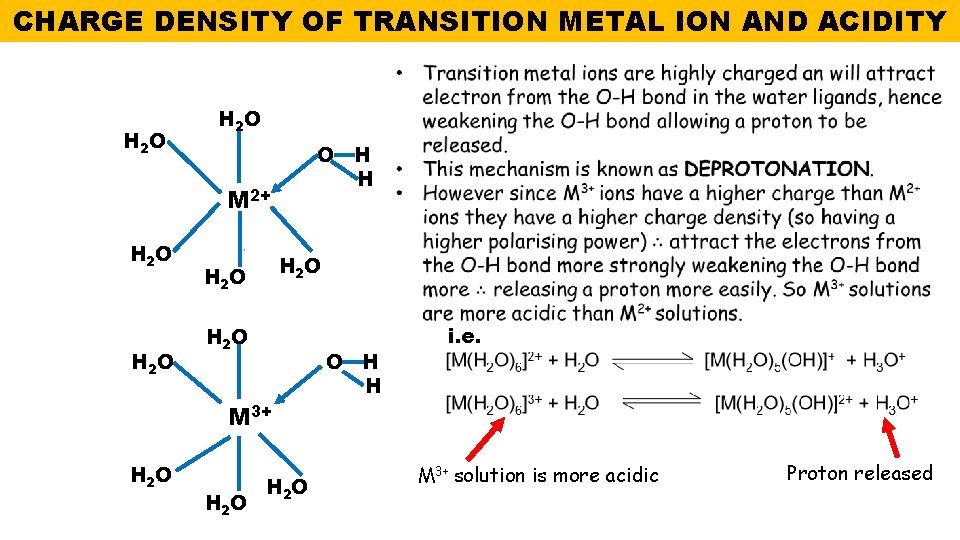
CHARGE DENSITY OF TRANSITION METAL ION AND ACIDITY H 2 O O H H M 2+ H 2 O H 2 O M 3+ H 2 O O H H i. e. M 3+ solution is more acidic Proton released
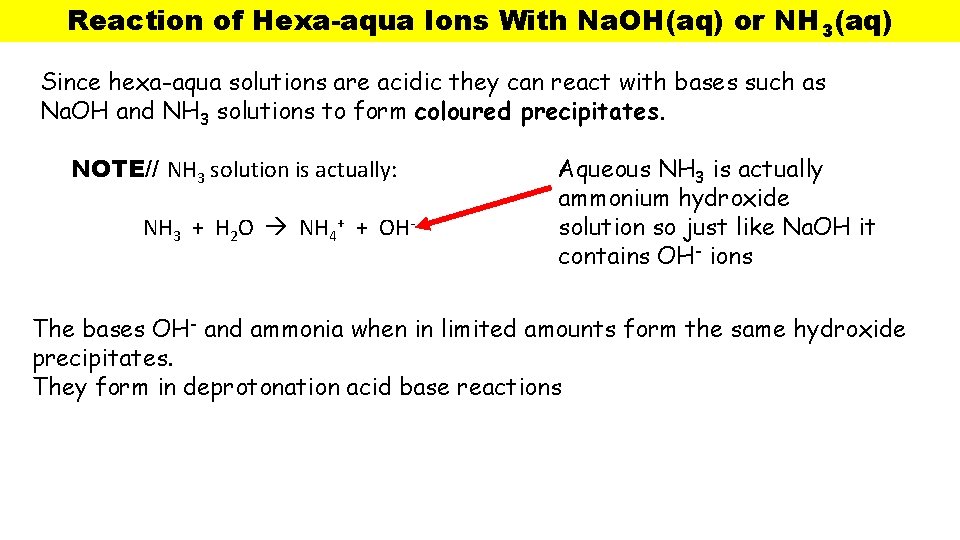
Reaction of Hexa-aqua Ions With Na. OH(aq) or NH 3(aq) Since hexa-aqua solutions are acidic they can react with bases such as Na. OH and NH 3 solutions to form coloured precipitates. NOTE// NH 3 solution is actually: NH 3 + H 2 O NH 4+ + OH- Aqueous NH 3 is actually ammonium hydroxide solution so just like Na. OH it contains OH- ions The bases OH- and ammonia when in limited amounts form the same hydroxide precipitates. They form in deprotonation acid base reactions
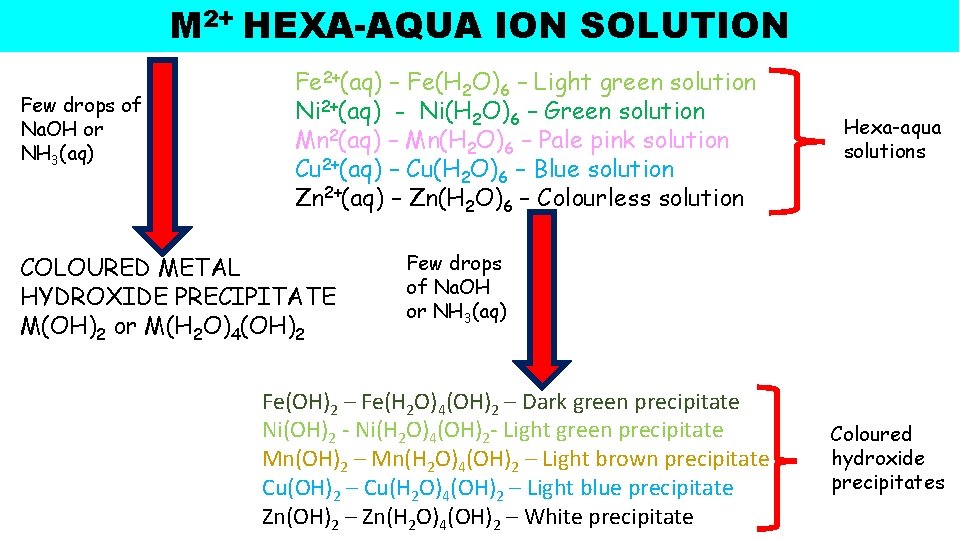
M 2+ HEXA-AQUA ION SOLUTION Few drops of Na. OH or NH 3(aq) Fe 2+(aq) – Fe(H 2 O)6 – Light green solution Ni 2+(aq) - Ni(H 2 O)6 – Green solution Mn 2(aq) – Mn(H 2 O)6 – Pale pink solution Cu 2+(aq) – Cu(H 2 O)6 – Blue solution Zn 2+(aq) – Zn(H 2 O)6 – Colourless solution COLOURED METAL HYDROXIDE PRECIPITATE M(OH)2 or M(H 2 O)4(OH)2 Hexa-aqua solutions Few drops of Na. OH or NH 3(aq) Fe(OH)2 – Fe(H 2 O)4(OH)2 – Dark green precipitate Ni(OH)2 - Ni(H 2 O)4(OH)2 - Light green precipitate Mn(OH)2 – Mn(H 2 O)4(OH)2 – Light brown precipitate Cu(OH)2 – Cu(H 2 O)4(OH)2 – Light blue precipitate Zn(OH)2 – Zn(H 2 O)4(OH)2 – White precipitate Coloured hydroxide precipitates
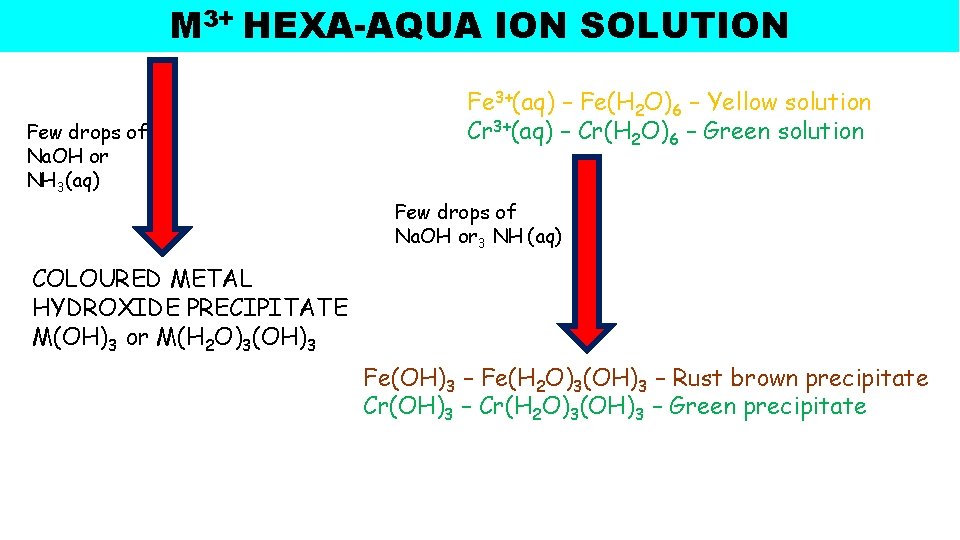
3+ HEXA-AQUA ION SOLUTION M M 3+ HEXA-AQUA ION SOLUTION Few drops of Na. OH or NH 3(aq) Fe 3+(aq) – Fe(H 2 O)6 – Yellow solution Cr 3+(aq) – Cr(H 2 O)6 – Green solution Few drops of Na. OH or 3 NH (aq) COLOURED METAL HYDROXIDE PRECIPITATE M(OH)3 or M(H 2 O)3(OH)3 Fe(OH)3 – Fe(H 2 O)3(OH)3 – Rust brown precipitate Cr(OH)3 – Cr(H 2 O)3(OH)3 – Green precipitate
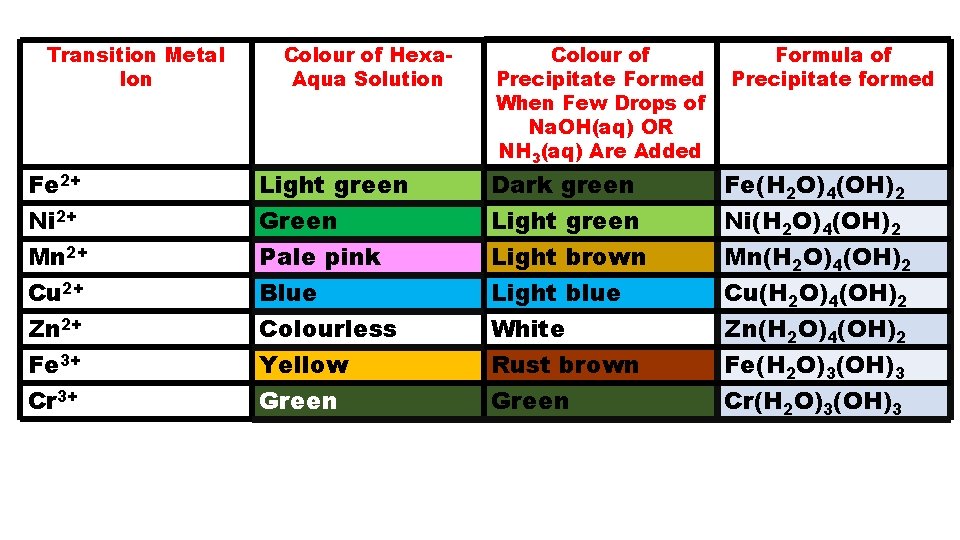
Transition Metal Ion Fe 2+ Ni 2+ Mn 2+ Cu 2+ Zn 2+ Fe 3+ Cr 3+ Colour of Hexa. Aqua Solution Light green Green Pale pink Blue Colourless Yellow Green Colour of Precipitate Formed When Few Drops of Na. OH(aq) OR NH 3(aq) Are Added Dark green Light brown Light blue White Rust brown Green Formula of Precipitate formed Fe(H 2 O)4(OH)2 Ni(H 2 O)4(OH)2 Mn(H 2 O)4(OH)2 Cu(H 2 O)4(OH)2 Zn(H 2 O)4(OH)2 Fe(H 2 O)3(OH)3 Cr(H 2 O)3(OH)3
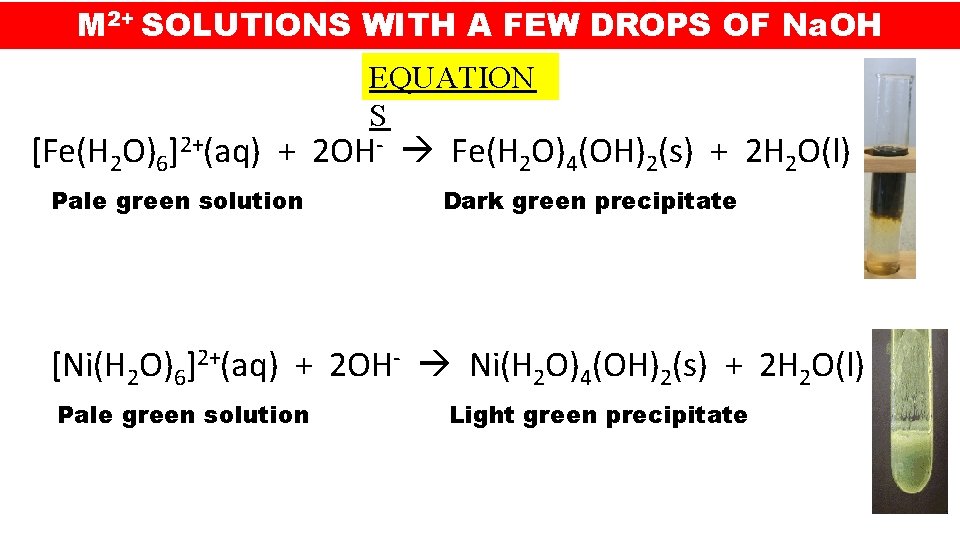
M 2+ SOLUTIONS WITH A FEW DROPS OF Na. OH EQUATION S [Fe(H 2 O)6]2+(aq) + 2 OH- Fe(H 2 O)4(OH)2(s) + 2 H 2 O(l) Pale green solution Dark green precipitate [Ni(H 2 O)6]2+(aq) + 2 OH- Ni(H 2 O)4(OH)2(s) + 2 H 2 O(l) Pale green solution Light green precipitate
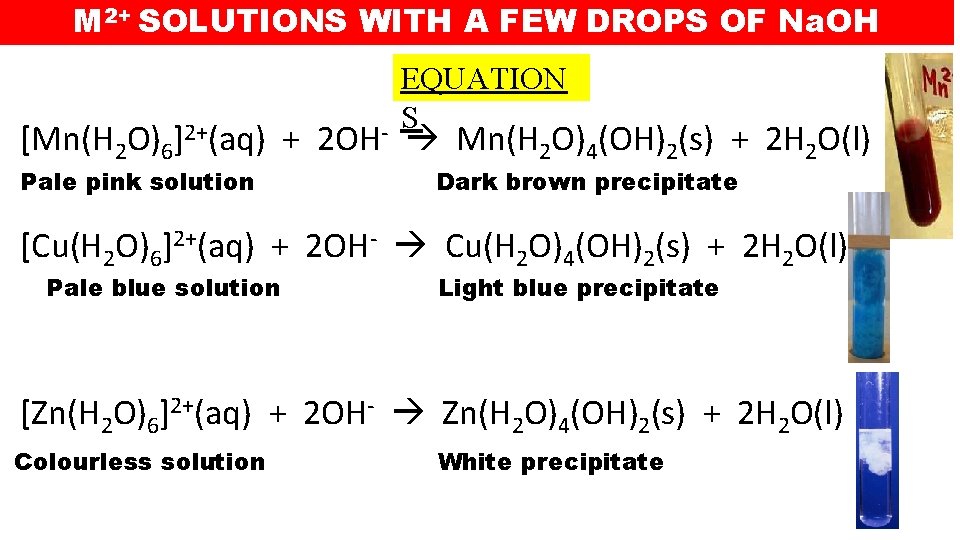
M 2+ SOLUTIONS WITH A FEW DROPS OF Na. OH EQUATION S [Mn(H 2 O)6]2+(aq) + 2 OH- Mn(H 2 O)4(OH)2(s) + 2 H 2 O(l) Pale pink solution Dark brown precipitate [Cu(H 2 O)6]2+(aq) + 2 OH- Cu(H 2 O)4(OH)2(s) + 2 H 2 O(l) Pale blue solution Light blue precipitate [Zn(H 2 O)6]2+(aq) + 2 OH- Zn(H 2 O)4(OH)2(s) + 2 H 2 O(l) Colourless solution White precipitate
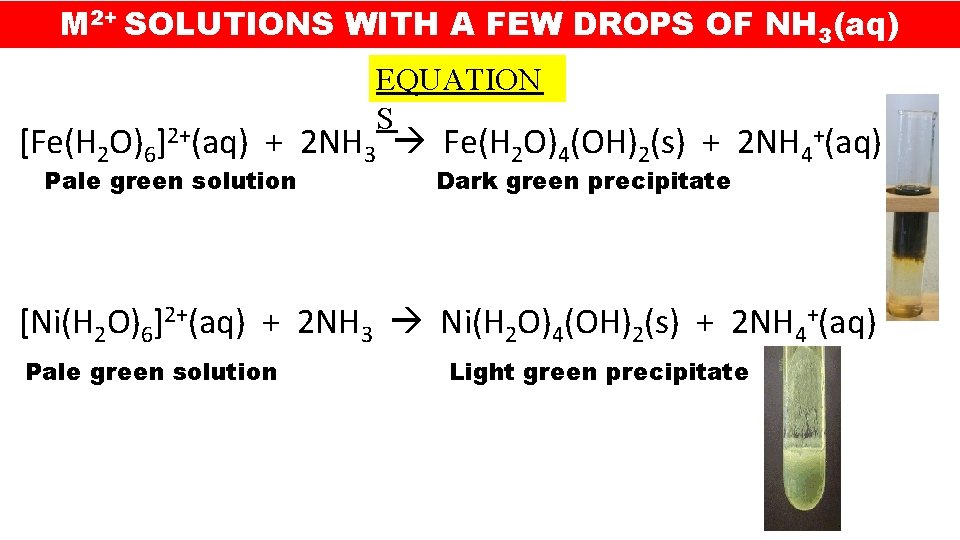
M 2+ SOLUTIONS WITH A FEW DROPS OF NH 3(aq) EQUATION S [Fe(H 2 O)6]2+(aq) + 2 NH 3 Fe(H 2 O)4(OH)2(s) + 2 NH 4+(aq) Pale green solution Dark green precipitate [Ni(H 2 O)6]2+(aq) + 2 NH 3 Ni(H 2 O)4(OH)2(s) + 2 NH 4+(aq) Pale green solution Light green precipitate
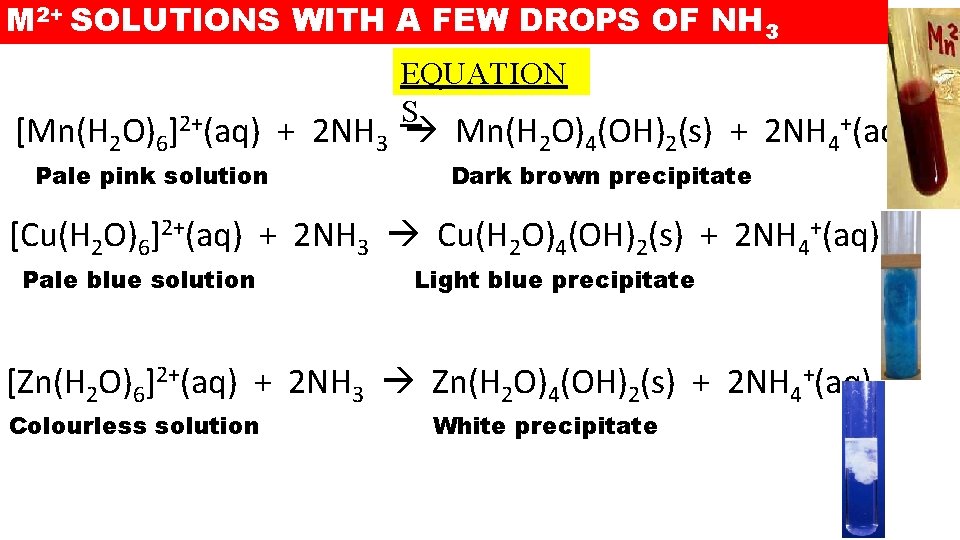
M 2+ SOLUTIONS WITH A FEW DROPS OF NH 3 EQUATION S [Mn(H 2 O)6]2+(aq) + 2 NH 3 Mn(H 2 O)4(OH)2(s) + 2 NH 4+(aq) Pale pink solution Dark brown precipitate [Cu(H 2 O)6]2+(aq) + 2 NH 3 Cu(H 2 O)4(OH)2(s) + 2 NH 4+(aq) Pale blue solution Light blue precipitate [Zn(H 2 O)6]2+(aq) + 2 NH 3 Zn(H 2 O)4(OH)2(s) + 2 NH 4+(aq) Colourless solution White precipitate
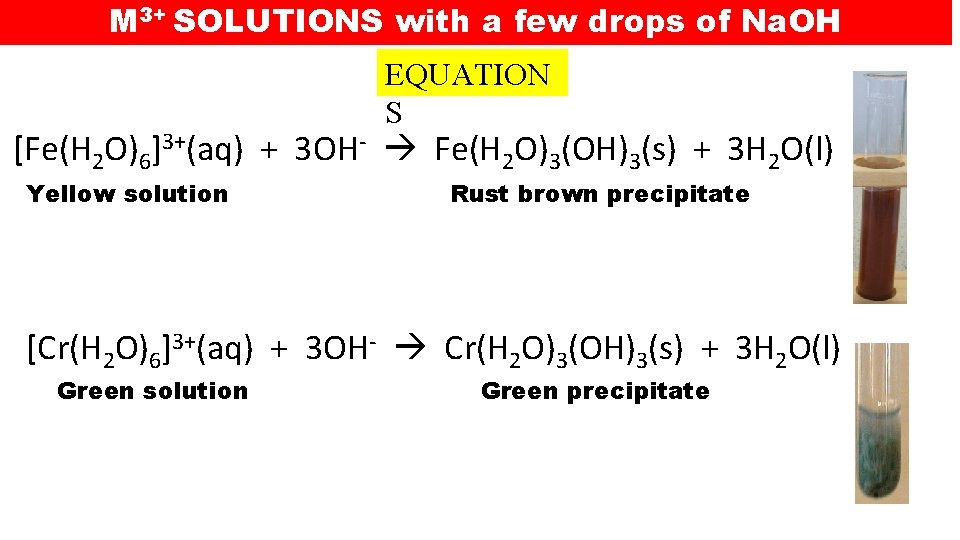
M 3+ SOLUTIONS with a few drops of Na. OH EQUATION S [Fe(H 2 O)6]3+(aq) + 3 OH- Fe(H 2 O)3(OH)3(s) + 3 H 2 O(l) Yellow solution Rust brown precipitate [Cr(H 2 O)6]3+(aq) + 3 OH- Cr(H 2 O)3(OH)3(s) + 3 H 2 O(l) Green solution Green precipitate
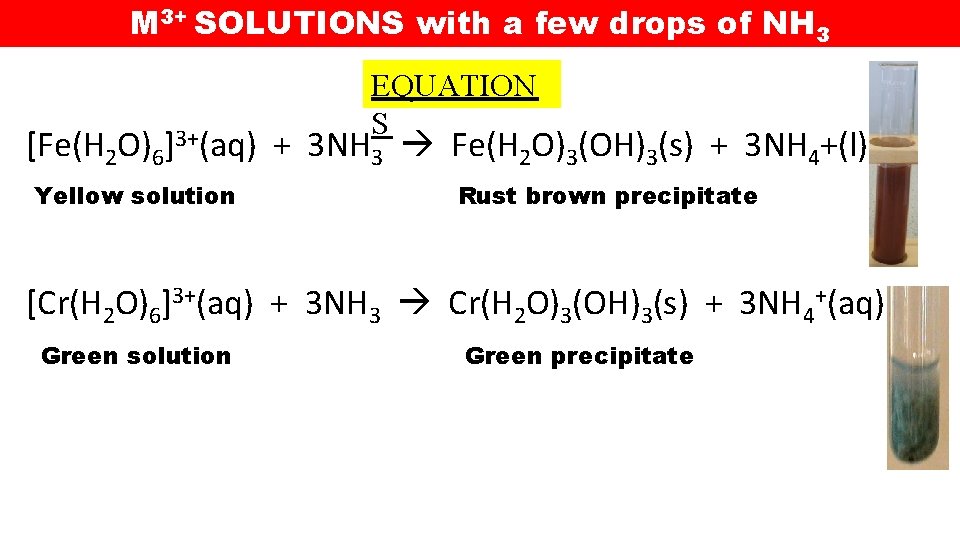
M 3+ SOLUTIONS with a few drops of NH 3 EQUATION S [Fe(H 2 O)6]3+(aq) + 3 NH 3 Fe(H 2 O)3(OH)3(s) + 3 NH 4+(l) Yellow solution Rust brown precipitate [Cr(H 2 O)6]3+(aq) + 3 NH 3 Cr(H 2 O)3(OH)3(s) + 3 NH 4+(aq) Green solution Green precipitate
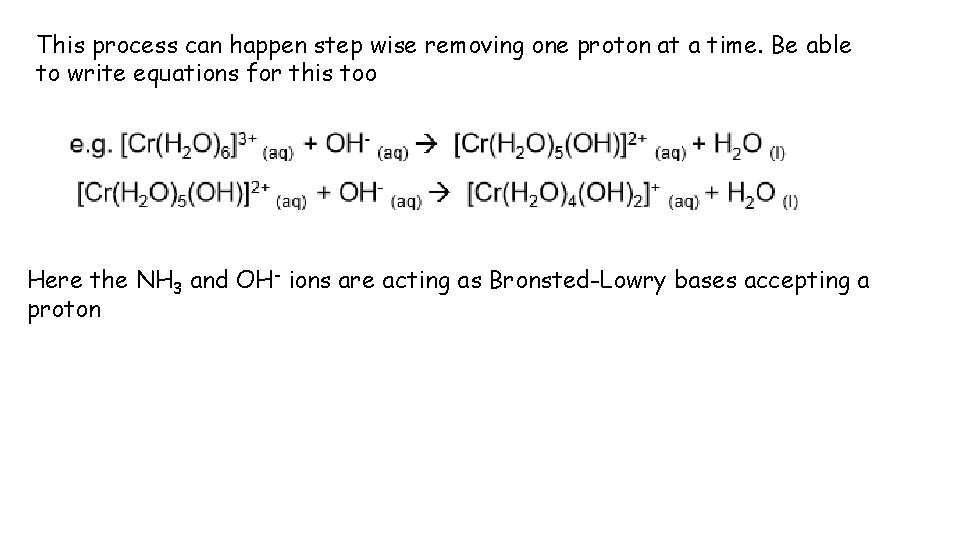
This process can happen step wise removing one proton at a time. Be able to write equations for this too Here the NH 3 and OH- ions are acting as Bronsted-Lowry bases accepting a proton
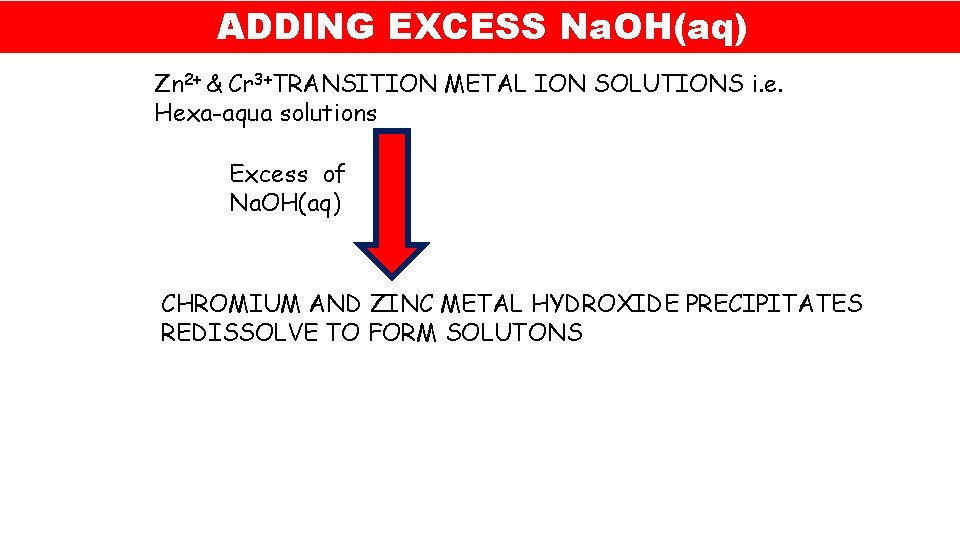
ADDING EXCESS Na. OH(aq) Zn 2+ & Cr 3+TRANSITION METAL ION SOLUTIONS i. e. Hexa-aqua solutions Excess of Na. OH(aq) CHROMIUM AND ZINC METAL HYDROXIDE PRECIPITATES REDISSOLVE TO FORM SOLUTONS
EXCESS Na. OH [Cr(H 2 O)6]3+ (aq) Cr(H 2 O)3(OH)3(s) Few drops Na. OH Green solution Excess Na. OH Green precipitate [Cr(OH)6]3 -(aq) Green Solution Equations [Cr(H 2 O)6]3+(aq) + 3 OH-(aq) [Cr(H 2 O)3(OH)3](s) + 3 H 2 O(l) Few drops of Na. OH [Cr(H 2 O)3(OH)3](s) + 3 OH-(aq) [Cr(OH)6]3 -(aq) + 3 H 2 O(l) Green precipitate redissolves in excess Na. OH
EXCESS Na. OH [Zn(H 2 O)6]2+(aq) [Zn(H 2 O)3(OH)3](s) Few drops Na. OH Colourless solution Excess Na. OH White precipitate [Zn(OH)4]2 -(aq) Colourless Solution Equations [Zn(H 2 O)6]2+(aq) + 2 OH-(aq) [Zn(H 2 O)4(OH)2](s) + 2 H 2 O(l) Few drops of Na. OH [Zn(H 2 O)4(OH)2](s) + 2 OH-(aq) [Zn(OH)4]2 -(aq) + 4 H 2 O(l) White precipitate redissolves in excess Na. OH
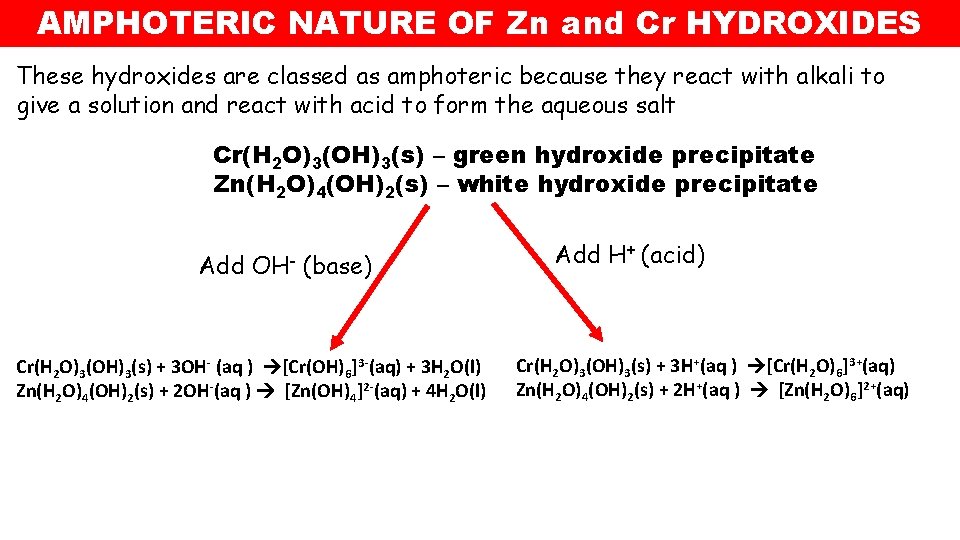
AMPHOTERIC NATURE OF Zn and Cr HYDROXIDES These hydroxides are classed as amphoteric because they react with alkali to give a solution and react with acid to form the aqueous salt Cr(H 2 O)3(OH)3(s) – green hydroxide precipitate Zn(H 2 O)4(OH)2(s) – white hydroxide precipitate Add OH- (base) Cr(H 2 O)3(OH)3(s) + 3 OH- (aq ) [Cr(OH)6]3 -(aq) + 3 H 2 O(l) Zn(H 2 O)4(OH)2(s) + 2 OH-(aq ) [Zn(OH)4]2 -(aq) + 4 H 2 O(l) Add H+ (acid) Cr(H 2 O)3(OH)3(s) + 3 H+(aq ) [Cr(H 2 O)6]3+(aq) Zn(H 2 O)4(OH)2(s) + 2 H+(aq ) [Zn(H 2 O)6]2+(aq)
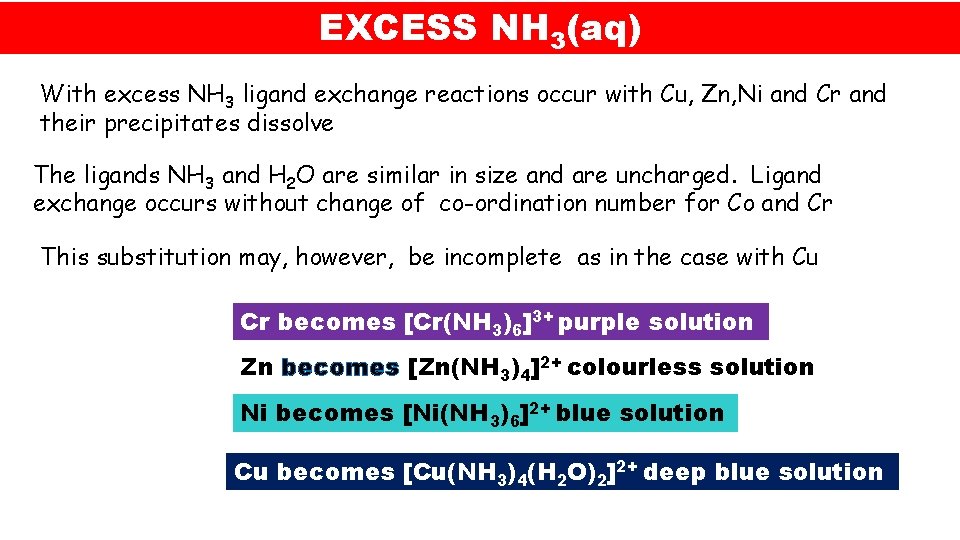
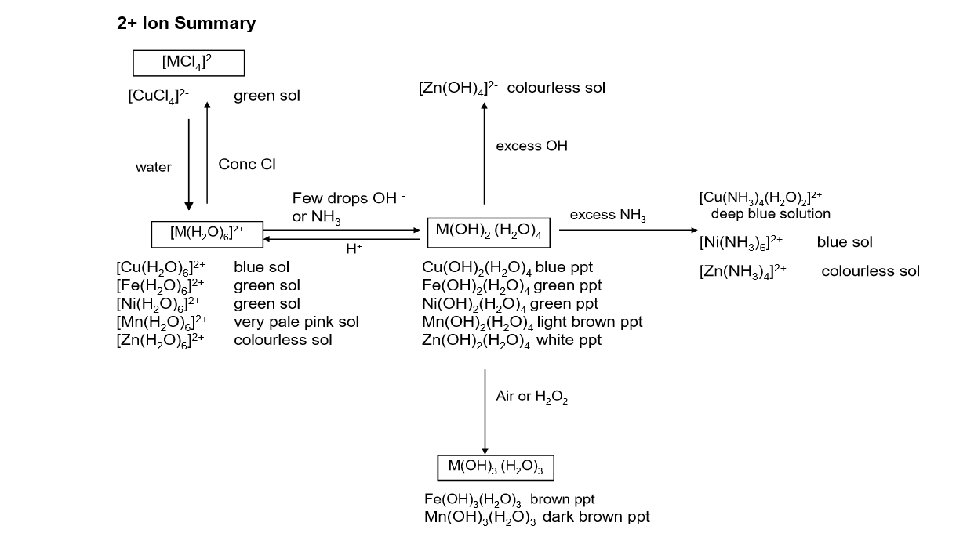
EXCESS NH 3(aq) With excess NH 3 ligand exchange reactions occur with Cu, Zn, Ni and Cr and their precipitates dissolve The ligands NH 3 and H 2 O are similar in size and are uncharged. Ligand exchange occurs without change of co-ordination number for Co and Cr This substitution may, however, be incomplete as in the case with Cu Cr becomes [Cr(NH 3)6]3+ purple solution Zn becomes [Zn(NH 3)4]2+ colourless solution Ni becomes [Ni(NH 3)6]2+ blue solution Cu becomes [Cu(NH 3)4(H 2 O)2]2+ deep blue solution
EXCESS NH 3 SOLUTION EQUATIONS Cr(OH)3(H 2 O)3(s) + 6 NH 3(aq) Green precipitate redissolves [Cr(NH 3)6]3+(aq) + 3 H 2 O(l) + 3 OH- (aq) Purple solution Cu(OH)2(H 2 O)4(s) + 4 NH 3(aq) [Cu(NH 3)4(H 2 O)2]2+ (aq) + 2 H 2 O (l) + 2 OH- (aq) Blue precipitate redissolves Royal blue solution Ni(OH)2(H 2 O)4(s) + 6 NH 3 (aq) [Ni(NH 3)6]2+(aq) + 4 H 2 O (l) + 2 OH- (aq) Green precipitate redissolves Blue solution Here the NH 3 and OH- ions are acting as Bronsted-Lowry bases accepting a proton
SUMMARY SO FAR – [M(H 2 O)4(OH)2](s) [Fe(H 2 O)4(OH)2] – Dark green ppte [Ni(H 2 O)4(OH)2] – Green ppte [Mn(H 2 O)4(OH)2] – Pale pink ppte [Cu(H 2 O)4(OH)2] – Light blue ppte [Zn(H 2 O)4(OH)2] – White ppte Few drops Na. OH(aq) Excess Na. OH(aq) [Zn(OH)4]2[Cr(OH)6]3– 2+ M (aq) Few drops NH 3(aq) [M(H 2 O)6]2+(aq) [Fe(H 2 O)4(OH)2] – Dark green ppte [Ni(H 2 O)4(OH)2] – Green ppte [Mn(H 2 O)4(OH)2] – Pale pink ppte [Cu(H 2 O)4(OH)2] – Light blue ppte [Zn(H 2 O)4(OH)2] – White ppte [Fe(H 2 O)6]2+ - Light green solution [Ni(H 2 O)6]2+ - Green solution [Mn(H 2 O)6]2+ - Pale pink solution [Cu(H 2 O)6]2+ - Light blue solution [Zn(H 2 O)6]2+ - Colourless solution - colourless solution -Green solution Excess NH 3(aq) [Cr(NH 3)6]3+ - Purple solution [Cu(H 2 O)4(NH 3)2]2+ - Royal blue solution [Ni(NH 3)6]2+ - blue solution
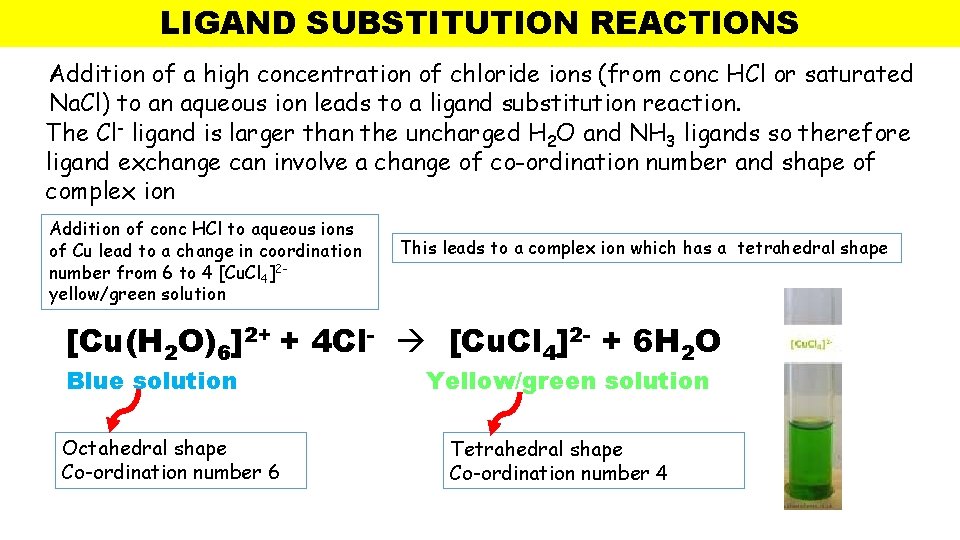
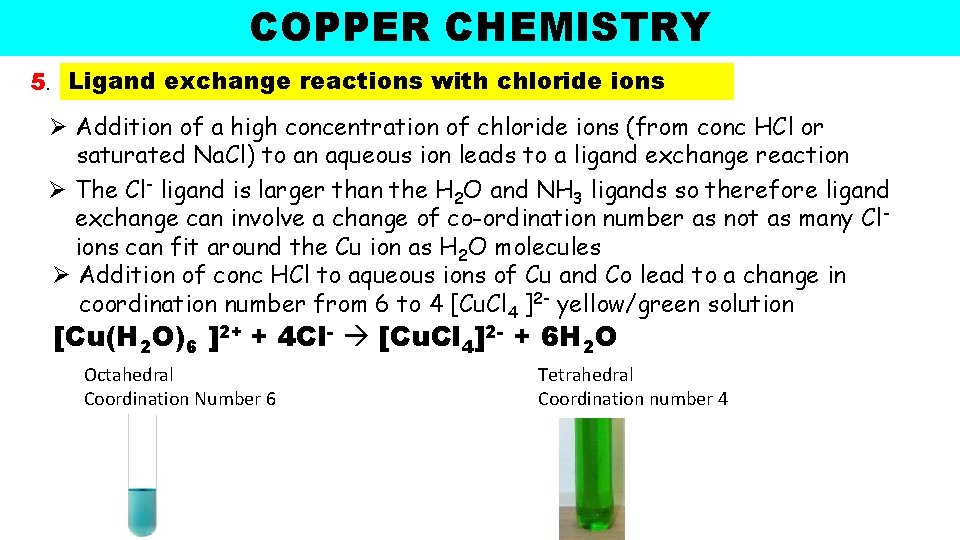
LIGAND SUBSTITUTION REACTIONS Addition of a high concentration of chloride ions (from conc HCl or saturated Na. Cl) to an aqueous ion leads to a ligand substitution reaction. The Cl- ligand is larger than the uncharged H 2 O and NH 3 ligands so therefore ligand exchange can involve a change of co-ordination number and shape of complex ion Addition of conc HCl to aqueous ions of Cu lead to a change in coordination number from 6 to 4 [Cu. Cl 4]2 yellow/green solution This leads to a complex ion which has a tetrahedral shape [Cu(H 2 O)6]2+ + 4 Cl- [Cu. Cl 4]2 - + 6 H 2 O Blue solution Octahedral shape Co-ordination number 6 Yellow/green solution Tetrahedral shape Co-ordination number 4
Be careful: If solid copper chloride (or any other metal )is dissolved in water it forms the aqueous [Cu(H 2 O)6]2+ complex and not the chloride [Cu. Cl 4]2 - complex
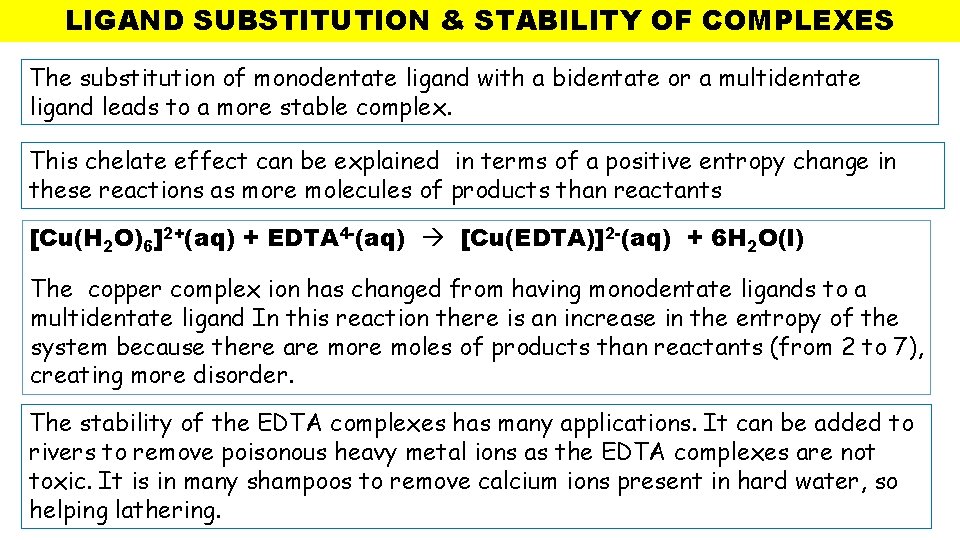
LIGAND SUBSTITUTION & STABILITY OF COMPLEXES The substitution of monodentate ligand with a bidentate or a multidentate ligand leads to a more stable complex. This chelate effect can be explained in terms of a positive entropy change in these reactions as more molecules of products than reactants [Cu(H 2 O)6]2+(aq) + EDTA 4 -(aq) [Cu(EDTA)]2 -(aq) + 6 H 2 O(l) The copper complex ion has changed from having monodentate ligands to a multidentate ligand In this reaction there is an increase in the entropy of the system because there are moles of products than reactants (from 2 to 7), creating more disorder. The stability of the EDTA complexes has many applications. It can be added to rivers to remove poisonous heavy metal ions as the EDTA complexes are not toxic. It is in many shampoos to remove calcium ions present in hard water, so helping lathering.
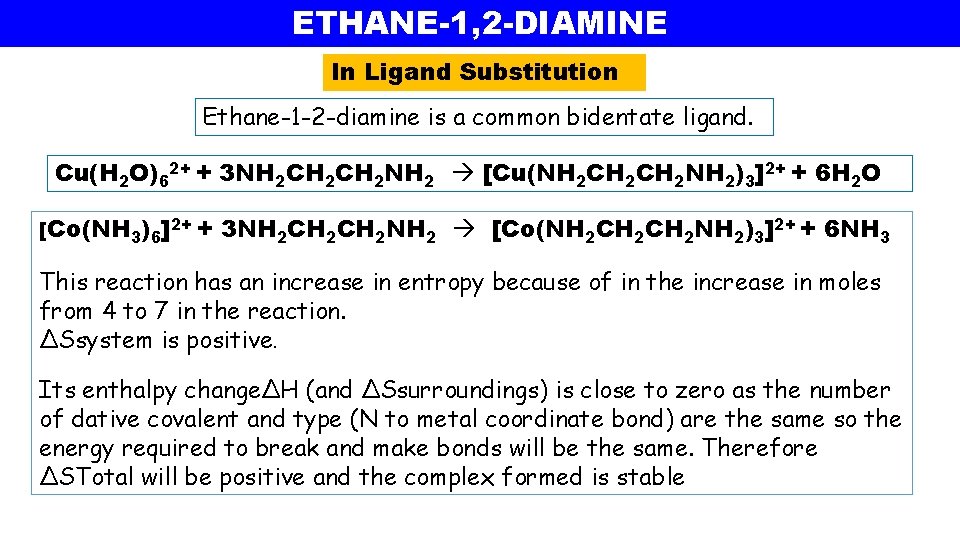
ETHANE-1, 2 -DIAMINE In Ligand Substitution Ethane-1 -2 -diamine is a common bidentate ligand. Cu(H 2 O)62+ + 3 NH 2 CH 2 NH 2 [Cu(NH 2 CH 2 NH 2)3]2+ + 6 H 2 O [Co(NH 3)6]2+ + 3 NH 2 CH 2 NH 2 [Co(NH 2 CH 2 NH 2)3]2+ + 6 NH 3 This reaction has an increase in entropy because of in the increase in moles from 4 to 7 in the reaction. ΔSsystem is positive. Its enthalpy changeΔH (and ΔSsurroundings) is close to zero as the number of dative covalent and type (N to metal coordinate bond) are the same so the energy required to break and make bonds will be the same. Therefore ΔSTotal will be positive and the complex formed is stable
ETHANE-1, 2 -DIAMINE There are 3 bidentate ligands in this complex each bonding in twice to the metal ion It has a coordination number of 6 Octahedral shape Bond angle around Cr 90 O
ETHANE-1, 2 -DIAMINE As A Base Ethane-1 -2 -diamine, as a base, can also carry out the deprotonation reactions (similar to those of ammonia) forming hydroxide precipitates. 2[Al(H 2 O)6]3+(aq) + 3 H 2 NCH 2 NH 2(aq) 2 Al(H 2 O)3(OH)3(s) + 3[H 3 NCH 2 NH 3]2+ (aq) Note small molecules such as NH 2 cannot act as bidentate ligands because even though they have two lone pairs they are too close together and would not be able to fit around the metal ion
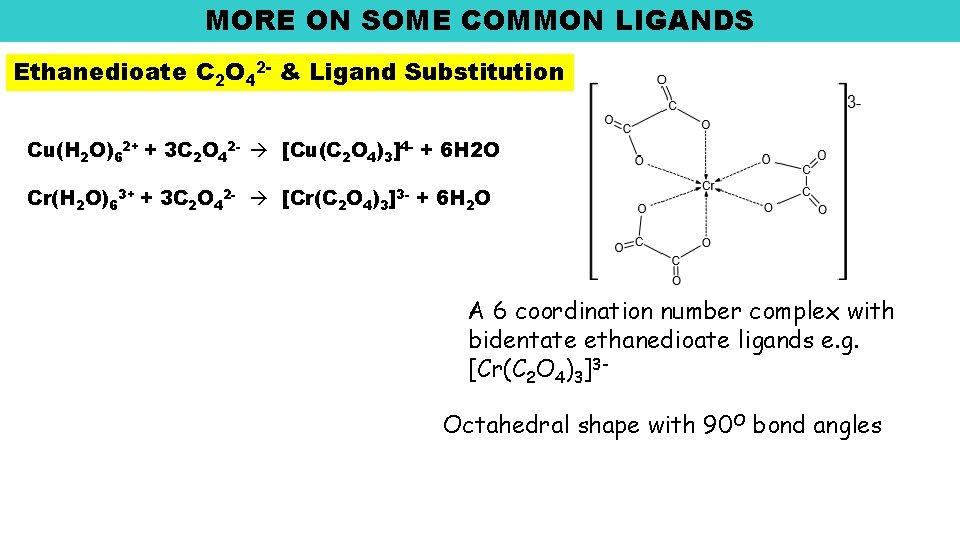
MORE ON SOME COMMON LIGANDS Ethanedioate C 2 O 42 - & Ligand Substitution Cu(H 2 O)62+ + 3 C 2 O 42 - [Cu(C 2 O 4)3]4 - + 6 H 2 O Cr(H 2 O)63+ + 3 C 2 O 42 - [Cr(C 2 O 4)3]3 - + 6 H 2 O A 6 coordination number complex with bidentate ethanedioate ligands e. g. [Cr(C 2 O 4)3]3 Octahedral shape with 90 O bond angles
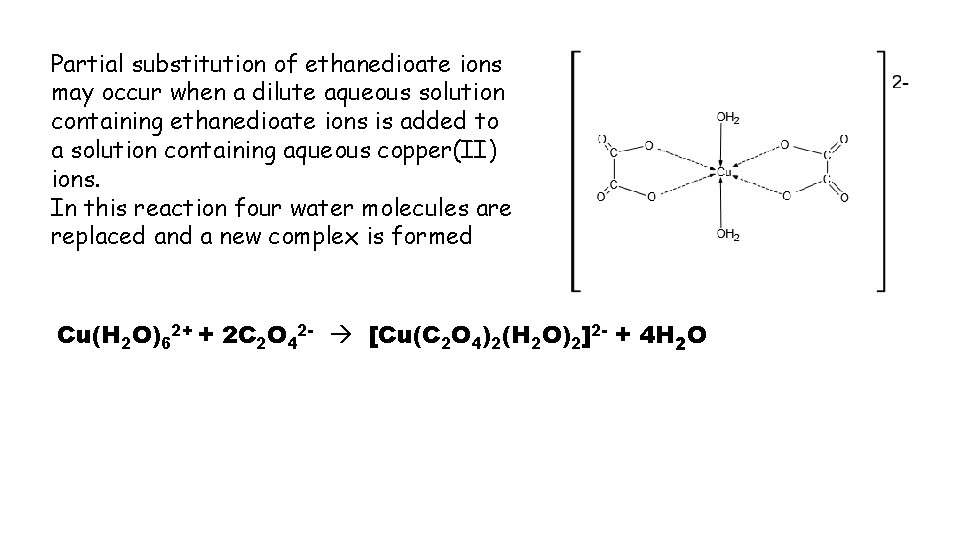
Partial substitution of ethanedioate ions may occur when a dilute aqueous solution containing ethanedioate ions is added to a solution containing aqueous copper(II) ions. In this reaction four water molecules are replaced and a new complex is formed Cu(H 2 O)62+ + 2 C 2 O 42 - [Cu(C 2 O 4)2(H 2 O)2]2 - + 4 H 2 O
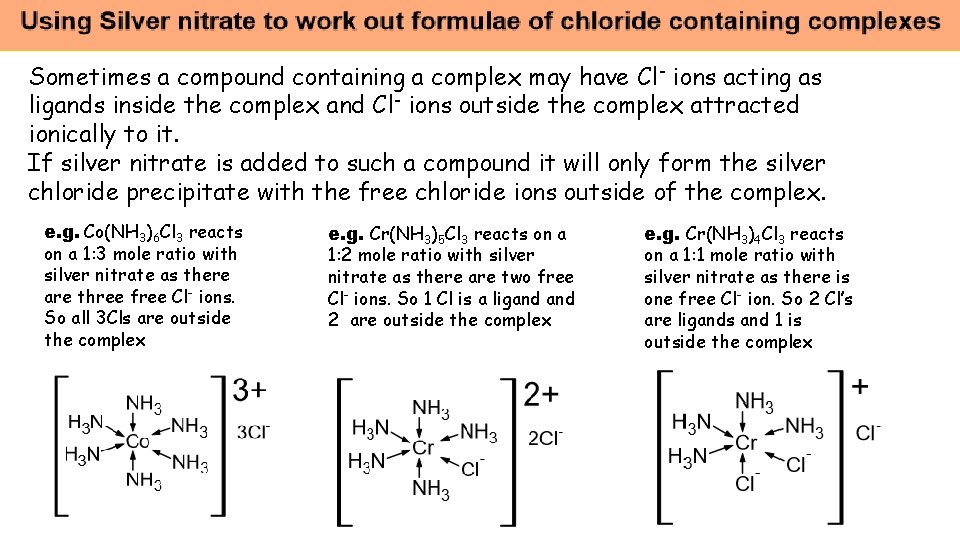
Sometimes a compound containing a complex may have Cl - ions acting as ligands inside the complex and Cl- ions outside the complex attracted ionically to it. If silver nitrate is added to such a compound it will only form the silver chloride precipitate with the free chloride ions outside of the complex. e. g. Co(NH 3)6 Cl 3 reacts on a 1: 3 mole ratio with silver nitrate as there are three free Cl- ions. So all 3 Cls are outside the complex e. g. Cr(NH 3)5 Cl 3 reacts on a 1: 2 mole ratio with silver nitrate as there are two free Cl- ions. So 1 Cl is a ligand 2 are outside the complex e. g. Cr(NH 3)4 Cl 3 reacts on a 1: 1 mole ratio with silver nitrate as there is one free Cl- ion. So 2 Cl’s are ligands and 1 is outside the complex
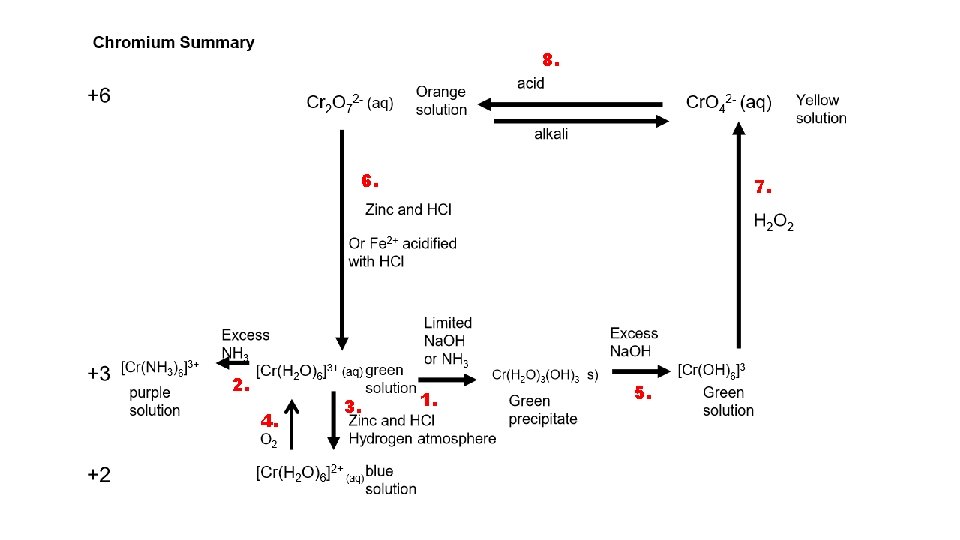
8. 6. 2. 4. 3. 7. 1. 5.
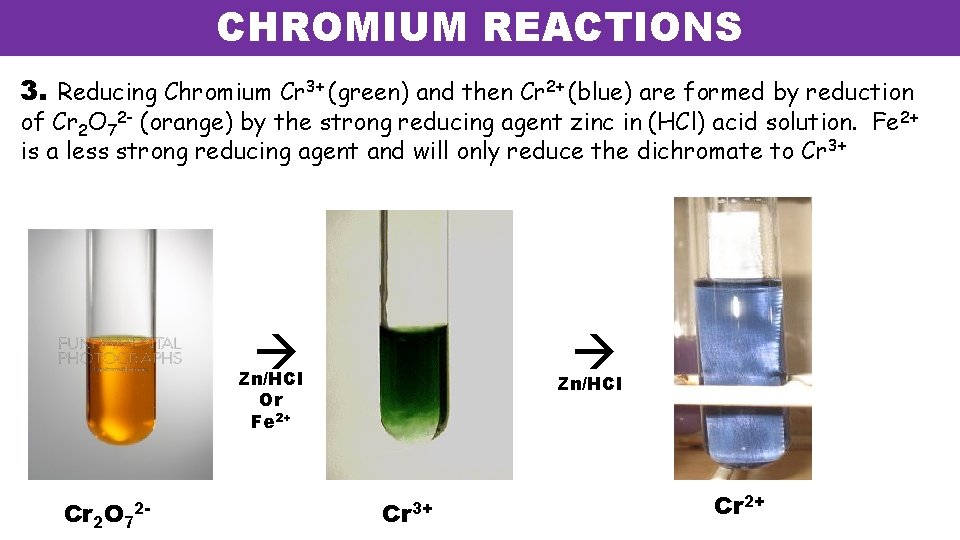
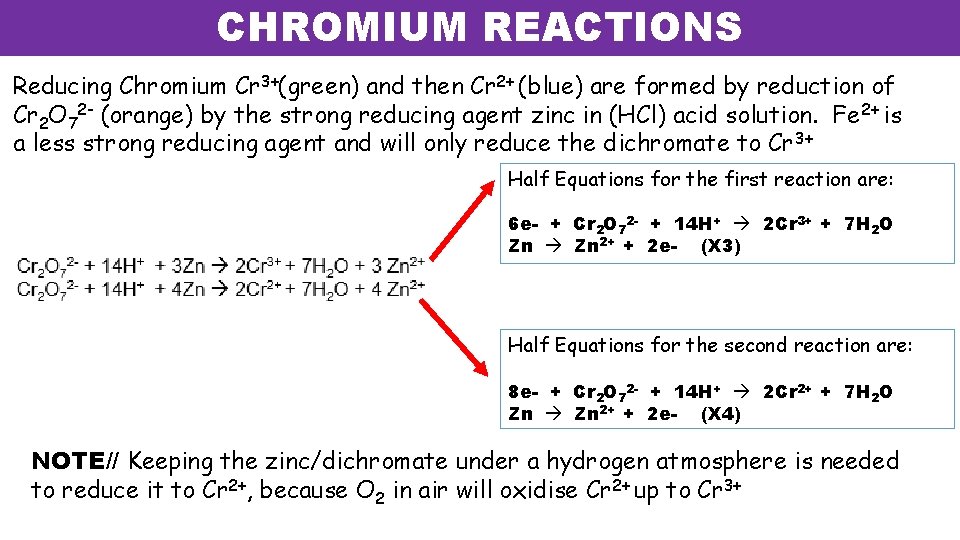
CHROMIUM REACTIONS 3. Reducing Chromium Cr 3+ (green) and then Cr 2+ (blue) are formed by reduction of Cr 2 O 72 - (orange) by the strong reducing agent zinc in (HCl) acid solution. Fe 2+ is a less strong reducing agent and will only reduce the dichromate to Cr 3+ Zn/HCl Or Fe 2+ Cr 2 O 7 2 - Zn/HCl Cr 3+ Cr 2+
CHROMIUM REACTIONS Reducing Chromium Cr 3+(green) and then Cr 2+ (blue) are formed by reduction of Cr 2 O 72 - (orange) by the strong reducing agent zinc in (HCl) acid solution. Fe 2+ is a less strong reducing agent and will only reduce the dichromate to Cr 3+ Half Equations for the first reaction are: 6 e- + Cr 2 O 72 - + 14 H+ 2 Cr 3+ + 7 H 2 O Zn 2+ + 2 e- (X 3) Half Equations for the second reaction are: 8 e- + Cr 2 O 72 - + 14 H+ 2 Cr 2+ + 7 H 2 O Zn 2+ + 2 e- (X 4) NOTE// Keeping the zinc/dichromate under a hydrogen atmosphere is needed to reduce it to Cr 2+, because O 2 in air will oxidise Cr 2+ up to Cr 3+
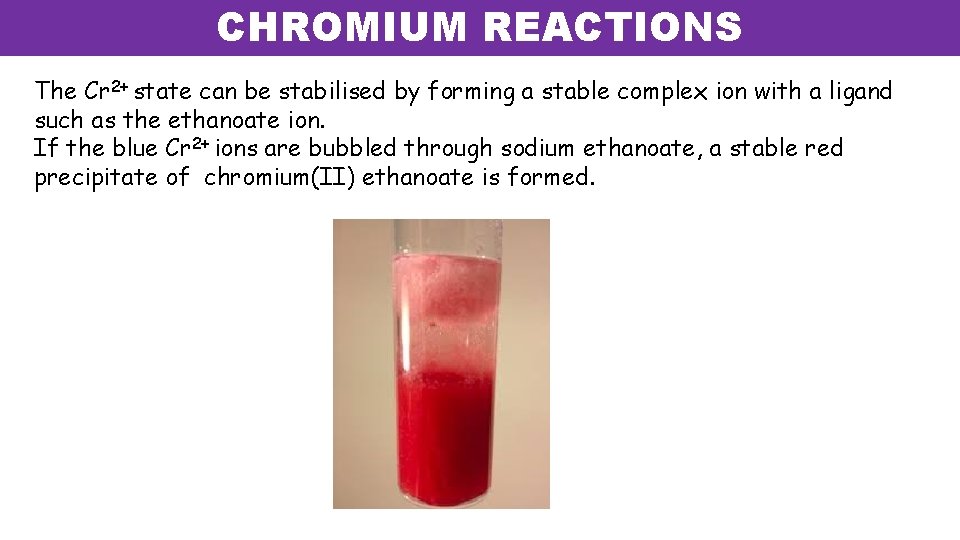
CHROMIUM REACTIONS The Cr 2+ state can be stabilised by forming a stable complex ion with a ligand such as the ethanoate ion. If the blue Cr 2+ ions are bubbled through sodium ethanoate, a stable red precipitate of chromium(II) ethanoate is formed.
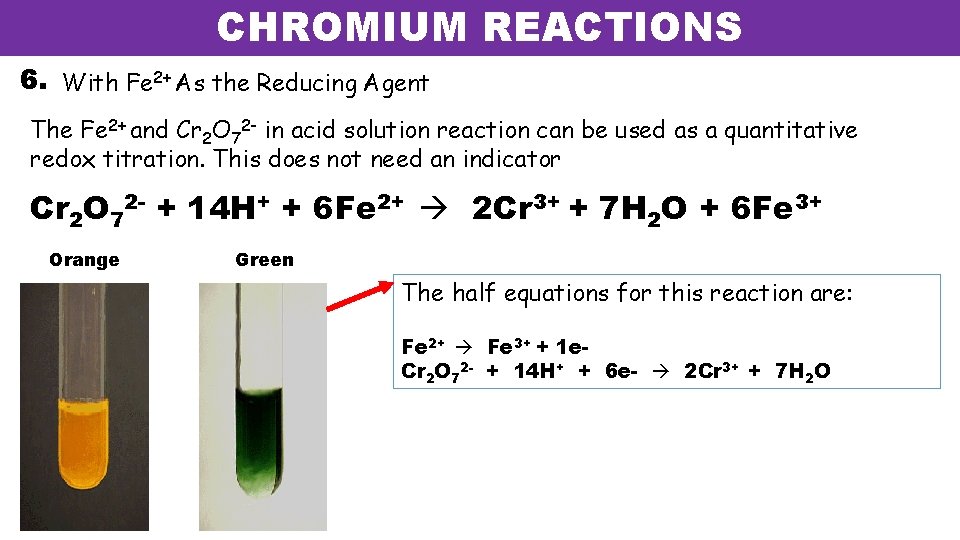
CHROMIUM REACTIONS 6. With Fe 2+ As the Reducing Agent The Fe 2+ and Cr 2 O 72 - in acid solution reaction can be used as a quantitative redox titration. This does not need an indicator Cr 2 O 72 - + 14 H+ + 6 Fe 2+ 2 Cr 3+ + 7 H 2 O + 6 Fe 3+ Orange Green The half equations for this reaction are: Fe 2+ Fe 3+ + 1 e. Cr 2 O 72 - + 14 H+ + 6 e- 2 Cr 3+ + 7 H 2 O
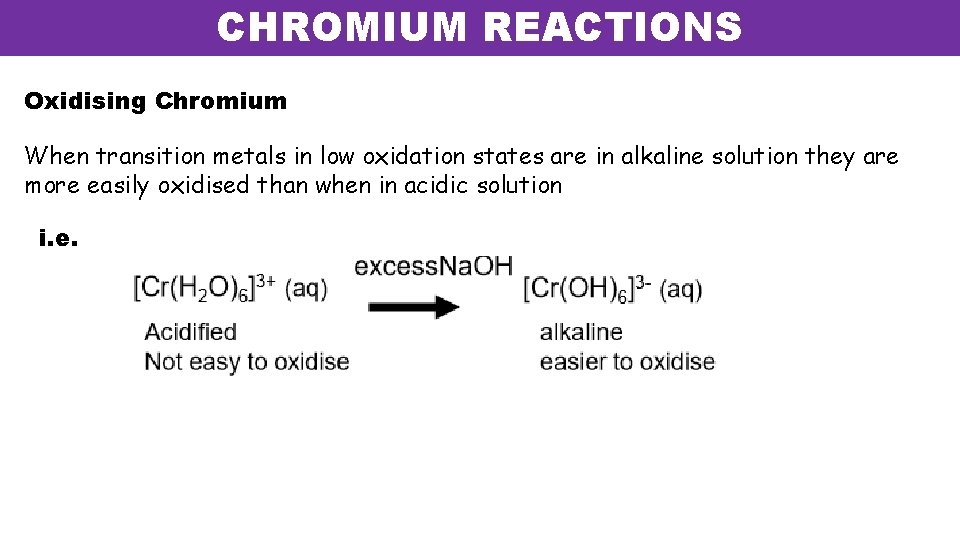
CHROMIUM REACTIONS Oxidising Chromium When transition metals in low oxidation states are in alkaline solution they are more easily oxidised than when in acidic solution i. e.
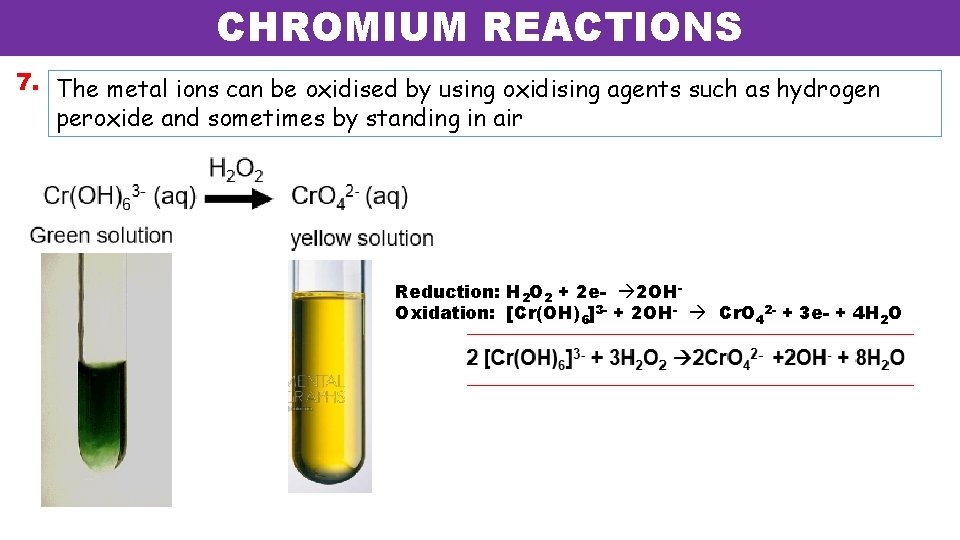
CHROMIUM REACTIONS 7. The metal ions can be oxidised by using oxidising agents such as hydrogen peroxide and sometimes by standing in air Reduction: H 2 O 2 + 2 e- 2 OHOxidation: [Cr(OH)6]3 - + 2 OH- Cr. O 42 - + 3 e- + 4 H 2 O
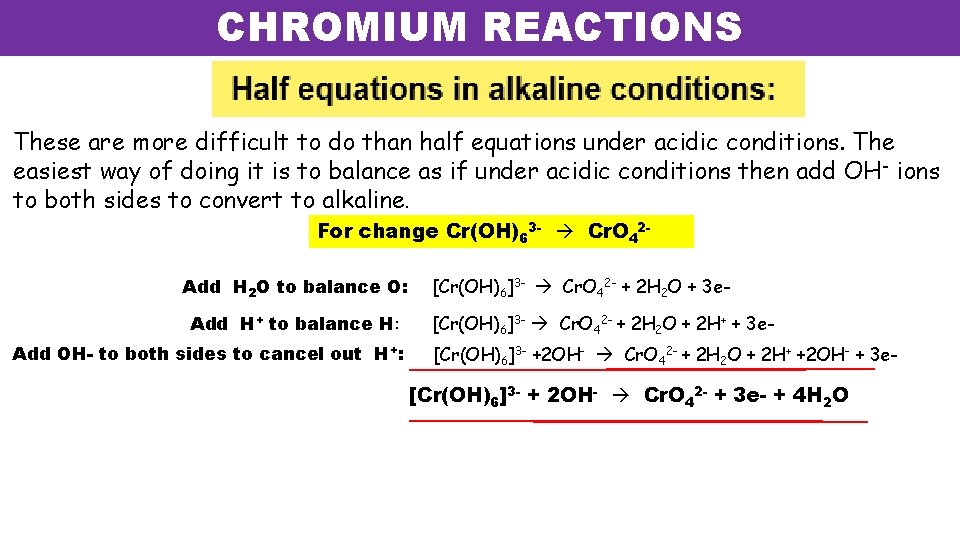
CHROMIUM REACTIONS These are more difficult to do than half equations under acidic conditions. The easiest way of doing it is to balance as if under acidic conditions then add OH - ions to both sides to convert to alkaline. For change Cr(OH)63 - Cr. O 42 Add H 2 O to balance O: Add H+ to balance H: Add OH- to both sides to cancel out H+: [Cr(OH)6]3 - Cr. O 42 - + 2 H 2 O + 3 e[Cr(OH)6]3 - Cr. O 42 - + 2 H 2 O + 2 H+ + 3 e[Cr(OH)6]3 - +2 OH- Cr. O 42 - + 2 H 2 O + 2 H+ +2 OH- + 3 e- [Cr(OH)6]3 - + 2 OH- Cr. O 42 - + 3 e- + 4 H 2 O
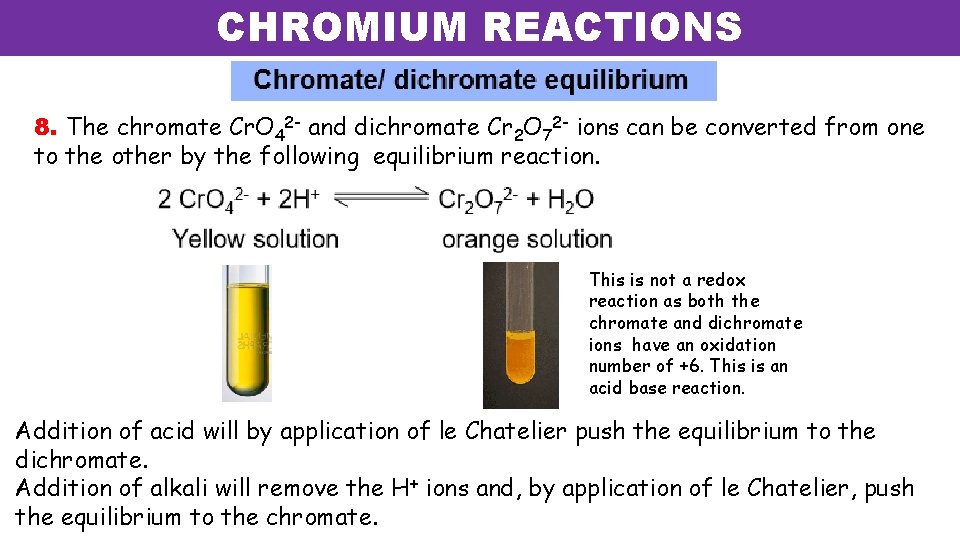
CHROMIUM REACTIONS 8. The chromate Cr. O 42 - and dichromate Cr 2 O 72 - ions can be converted from one to the other by the following equilibrium reaction. This is not a redox reaction as both the chromate and dichromate ions have an oxidation number of +6. This is an acid base reaction. Addition of acid will by application of le Chatelier push the equilibrium to the dichromate. Addition of alkali will remove the H+ ions and, by application of le Chatelier, push the equilibrium to the chromate.
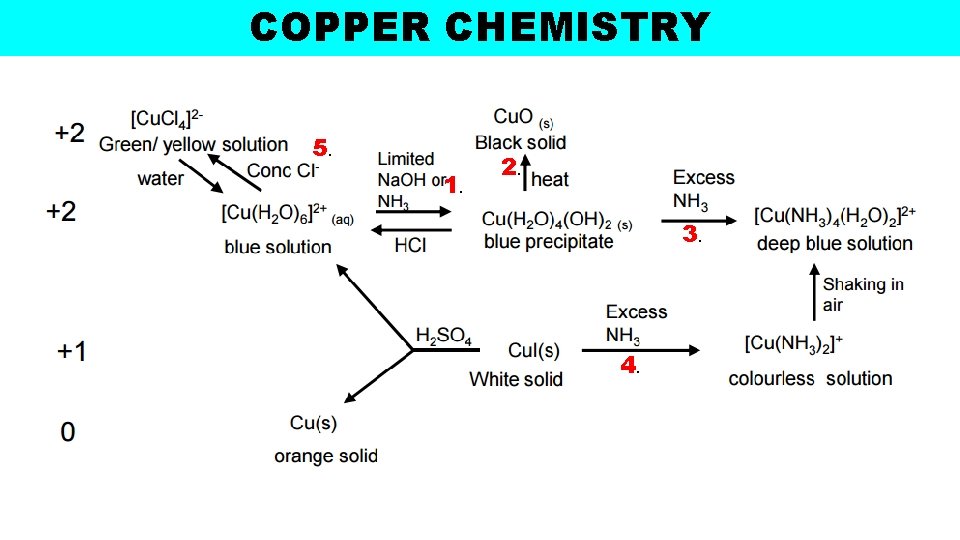
COPPER CHEMISTRY 5. 1. 2. 3. 4.
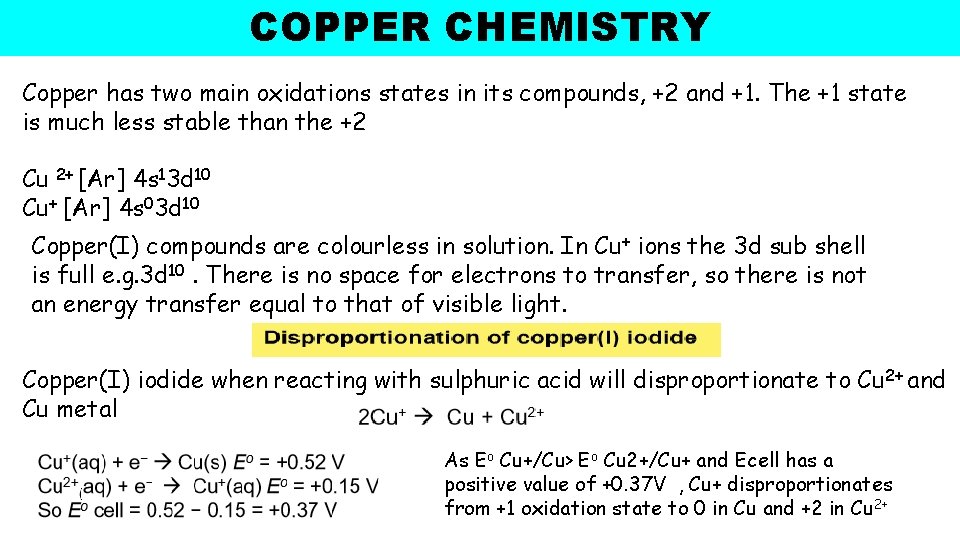
COPPER CHEMISTRY Copper has two main oxidations states in its compounds, +2 and +1. The +1 state is much less stable than the +2 Cu 2+ [Ar] 4 s 13 d 10 Cu+ [Ar] 4 s 03 d 10 Copper(I) compounds are colourless in solution. In Cu + ions the 3 d sub shell is full e. g. 3 d 10. There is no space for electrons to transfer, so there is not an energy transfer equal to that of visible light. Copper(I) iodide when reacting with sulphuric acid will disproportionate to Cu 2+ and Cu metal As Eo Cu+/Cu> Eo Cu 2+/Cu+ and Ecell has a positive value of +0. 37 V , Cu+ disproportionates from +1 oxidation state to 0 in Cu and +2 in Cu 2+
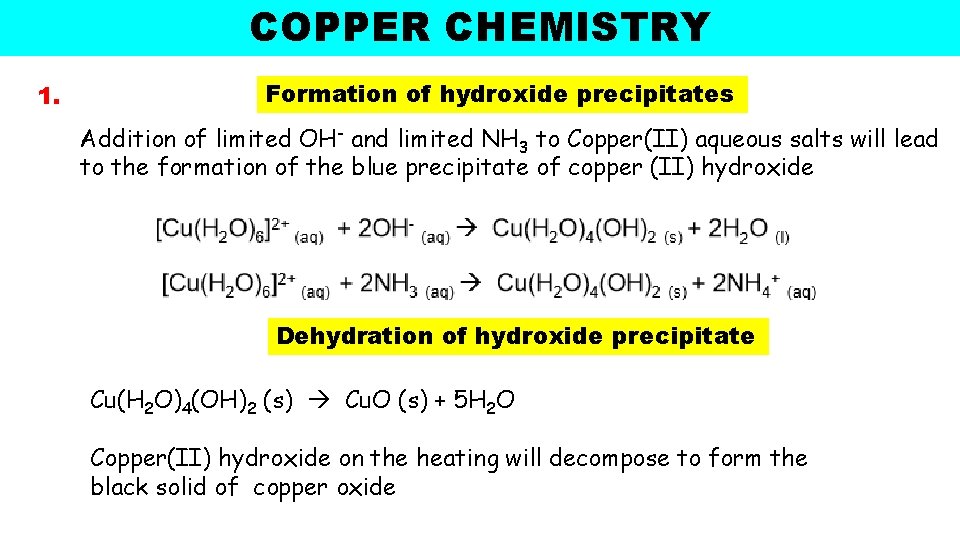
COPPER CHEMISTRY 1. Formation of hydroxide precipitates Addition of limited OH- and limited NH 3 to Copper(II) aqueous salts will lead to the formation of the blue precipitate of copper (II) hydroxide Dehydration of hydroxide precipitate Cu(H 2 O)4(OH)2 (s) Cu. O (s) + 5 H 2 O Copper(II) hydroxide on the heating will decompose to form the black solid of copper oxide
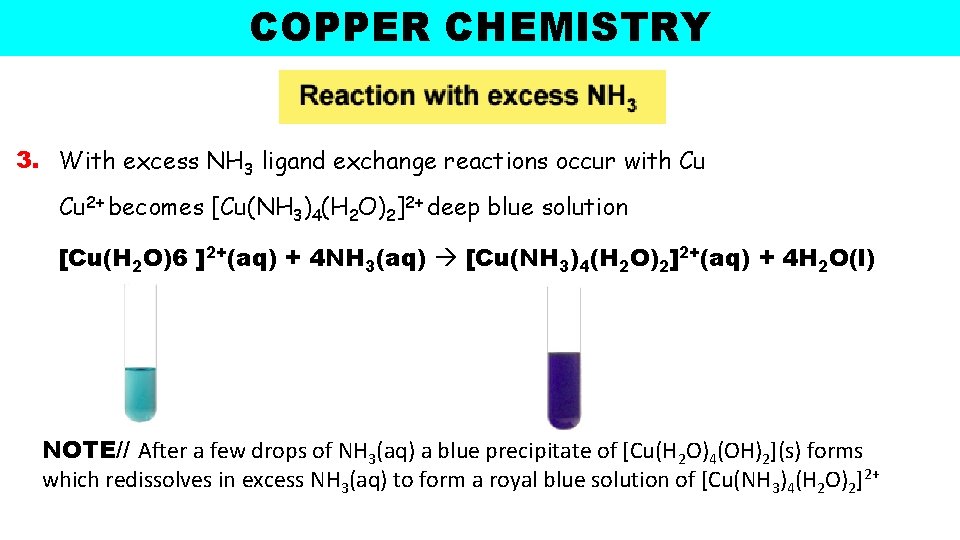
COPPER CHEMISTRY 3. With excess NH 3 ligand exchange reactions occur with Cu Cu 2+ becomes [Cu(NH 3)4(H 2 O)2]2+ deep blue solution [Cu(H 2 O)6 ]2+(aq) + 4 NH 3(aq) [Cu(NH 3)4(H 2 O)2]2+(aq) + 4 H 2 O(l) NOTE// After a few drops of NH 3(aq) a blue precipitate of [Cu(H 2 O)4(OH)2](s) forms which redissolves in excess NH 3(aq) to form a royal blue solution of [Cu(NH 3)4(H 2 O)2]2+
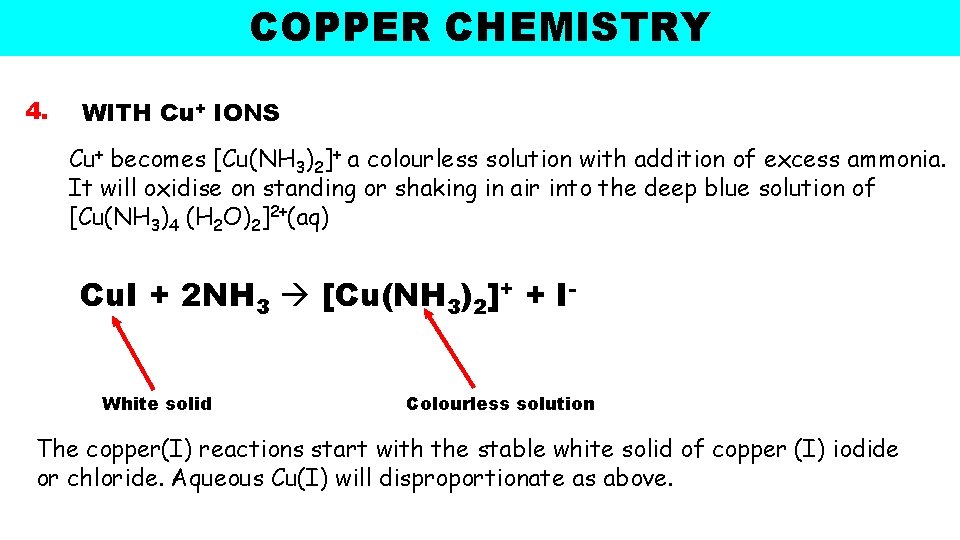
COPPER CHEMISTRY 4. WITH Cu+ IONS Cu+ becomes [Cu(NH 3)2]+ a colourless solution with addition of excess ammonia. It will oxidise on standing or shaking in air into the deep blue solution of [Cu(NH 3)4 (H 2 O)2]2+(aq) Cu. I + 2 NH 3 [Cu(NH 3)2]+ + IWhite solid Colourless solution The copper(I) reactions start with the stable white solid of copper (I) iodide or chloride. Aqueous Cu(I) will disproportionate as above.
COPPER CHEMISTRY 5. Ligand exchange reactions with chloride ions Ø Addition of a high concentration of chloride ions (from conc HCl or saturated Na. Cl) to an aqueous ion leads to a ligand exchange reaction Ø The Cl- ligand is larger than the H 2 O and NH 3 ligands so therefore ligand exchange can involve a change of co-ordination number as not as many Cl ions can fit around the Cu ion as H 2 O molecules Ø Addition of conc HCl to aqueous ions of Cu and Co lead to a change in coordination number from 6 to 4 [Cu. Cl 4 ]2 - yellow/green solution [Cu(H 2 O)6 ]2+ + 4 Cl- [Cu. Cl 4]2 - + 6 H 2 O Octahedral Coordination Number 6 Tetrahedral Coordination number 4
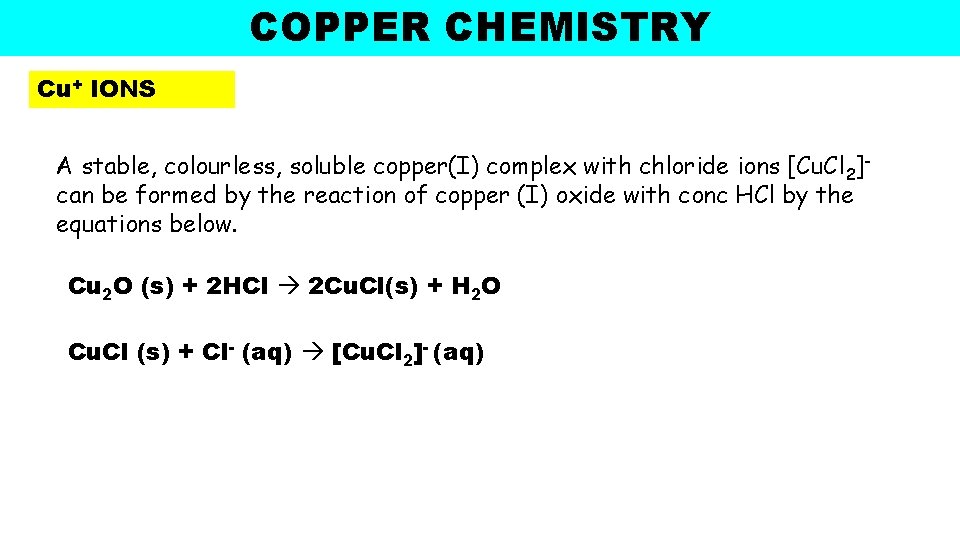
COPPER CHEMISTRY Cu+ IONS A stable, colourless, soluble copper(I) complex with chloride ions [Cu. Cl 2]can be formed by the reaction of copper (I) oxide with conc HCl by the equations below. Cu 2 O (s) + 2 HCl 2 Cu. Cl(s) + H 2 O Cu. Cl (s) + Cl- (aq) [Cu. Cl 2]- (aq)