
Transition Indicator 13 IDEA Part B Indicators for
Transition & Indicator 13
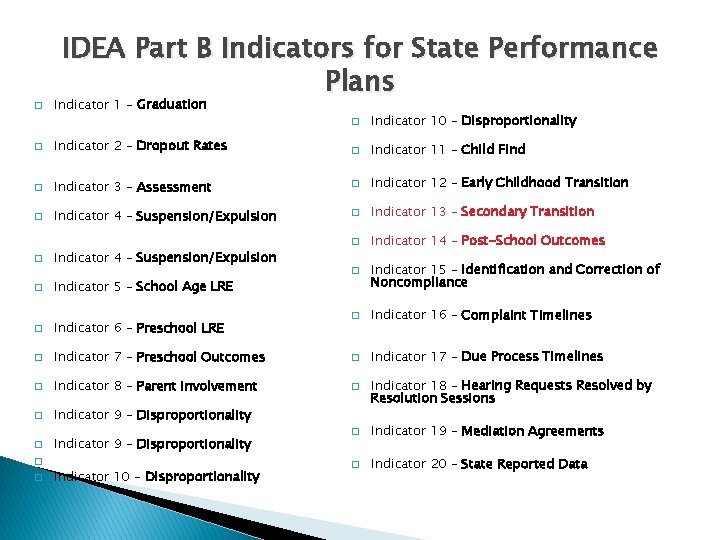
� IDEA Part B Indicators for State Performance Plans Indicator 1 – Graduation � Indicator 10 – Disproportionality � Indicator 11 – Child Find � Indicator 2 – Dropout Rates � Indicator 3 – Assessment � Indicator 12 – Early Childhood Transition � Indicator 4 – Suspension/Expulsion � Indicator 13 – Secondary Transition � Indicator 14 – Post-School Outcomes � � Indicator 4 – Suspension/Expulsion � Indicator 5 – School Age LRE � Indicator 16 – Complaint Timelines Indicator 17 – Due Process Timelines � Indicator 6 – Preschool LRE � Indicator 7 – Preschool Outcomes � � Indicator 8 – Parent Involvement � � Indicator 9 – Disproportionality � � Indicator 10 – Disproportionality Indicator 15 – Identification and Correction of Noncompliance Indicator 18 – Hearing Requests Resolved by Resolution Sessions � Indicator 19 – Mediation Agreements � Indicator 20 – State Reported Data
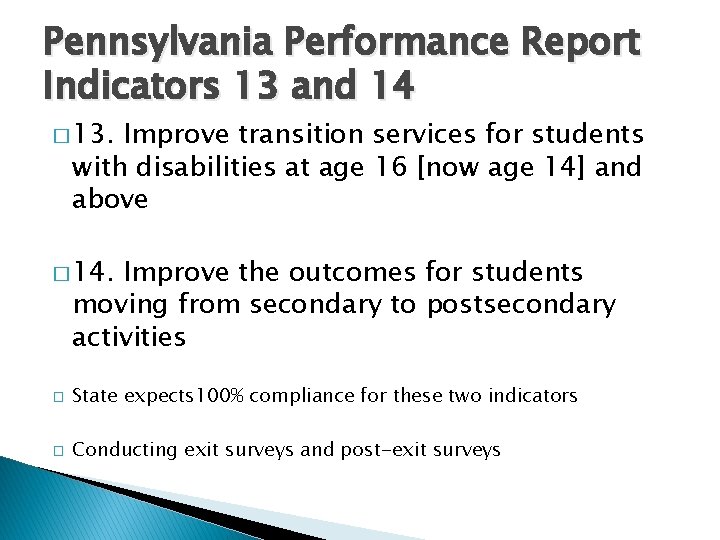
Pennsylvania Performance Report Indicators 13 and 14 � 13. Improve transition services for students with disabilities at age 16 [now age 14] and above � 14. Improve the outcomes for students moving from secondary to postsecondary activities � State expects 100% compliance for these two indicators � Conducting exit surveys and post-exit surveys

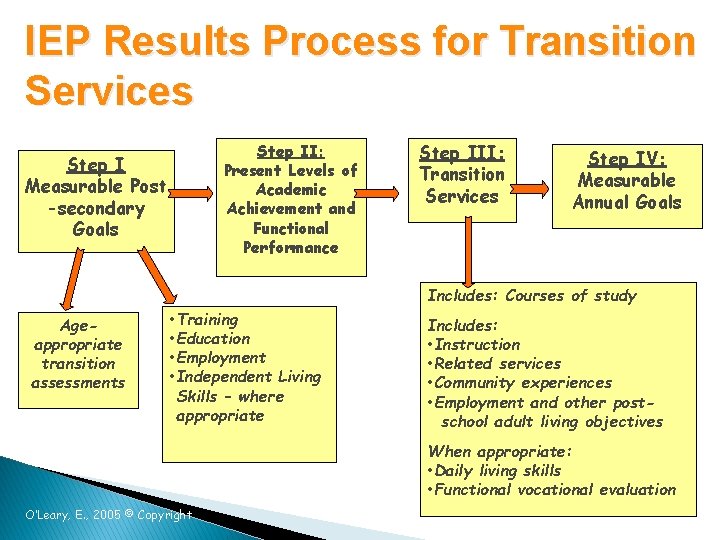
IEP Results Process for Transition Services Step II: Present Levels of Academic Achievement and Functional Performance Step I Measurable Post -secondary Goals Step III: Transition Services Step IV: Measurable Annual Goals Includes: Courses of study Ageappropriate transition assessments • Training • Education • Employment • Independent Living Skills – where appropriate Includes: • Instruction • Related services • Community experiences • Employment and other postschool adult living objectives When appropriate: • Daily living skills • Functional vocational evaluation O’Leary, E. , 2005 © Copyright
What are transition assessments? � Formal and/or informal assessments which: ◦ Provide relevant information about the student in relation to key areas of transition planning ◦ Provide information about the student’s current levels of functional performance ◦ Indicate appropriate accommodations to support student success ◦ Provide a basis for measurable postsecondary goals ◦ Provide a basis for measurable annual goals
Assessments � Combination of formal and informal to reflect the following areas: ◦ Interests ◦ Preferences ◦ Aptitudes ◦ Abilities It is considered a transition assessment if it is important or pertinent to post-school goals Assessments may overlap in providing information relevant to more than one area of the transition plan.
Examples of Formal assessments � Standardized ◦ ◦ ◦ tests measure student abilities SAT ACT ERB PSSA Woodcock-Johnson � Aptitude ◦ IQ tests measure student capabilities ◦ During the re-evaluation year, at least one formal assessment needs to be administered
Informal Assessments � Student surveys/interviews � Parent surveys/interviews � Observations � Teacher questionnaires � Work samples � Curriculum-Based Assessments � Functional Behavioral Assessments � Situational assessments � Progress monitoring probes
What should be in the Present levels? � Formal and informal assessments with a vision of the student’s ultimate goal: ◦ Standardized tests ◦ Anecdotal input from teachers, students, and parents ◦ Curriculum based assessments ◦ Strengths and needs must be bulleted, not in paragraph form, and have transition statements in the needs
Examples of Post-school goals � See hand out ◦ Should say “has the goal” ◦ Can’t say not a need ◦ Example: Jane has the goal of independent living without supports.
Courses of Study � Must be listed in the IEP. � The courses the student will take in order to achieve postsecondary goals. � Should be listed for each of the 3 areas � Can be repeated � For example: ◦ Post-secondary education- College Prep. English, Algebra 2, American History, Chemistry ◦ Employment- Office Applications, College Prep English, child development, psychology ◦ Independent living- Cooking, Sewing, Art, Child Development
Activities � At least one activity needs to relate to IEP goal � See handout � Person responsible can be parent, counselor, student, teacher � Should keep a running list so that at graduation it is evident the activities that student has completed to prepare for life after high school.
Measurable annual goals � Must contain four parts: ◦ Condition – when, where, how ◦ Student’s name ◦ Observable behavior no fuzzy words ◦ Criteria 100% of the time on 5 observed consecutive opportunities ◦ Ideally contains a baseline
Phillip’s and Julia’s IEP � What are Phillip/Julia’s transition assessments? � What were the conclusions? � Where does Phillip/Julia want to be after graduation? � What are the classes, services, training, accommodations to get Phillip/Julia there? � What is Phillip/Julia going to do to get there?
- Slides: 15