
Transition Economies Porter Model Comparisons Maj Ryan Craycraft

- Slides: 23
Transition Economies: Porter Model Comparisons Maj Ryan Craycraft
Introduction • Thesis • Porter Model Explanation • Case Studies – Russia – Poland – China • Conclusion
Proposition • If a country is to be successful in the global market economy, its domestic businesses must be competitive. • IV: High levels of competitiveness • DV: Successful Market Economy
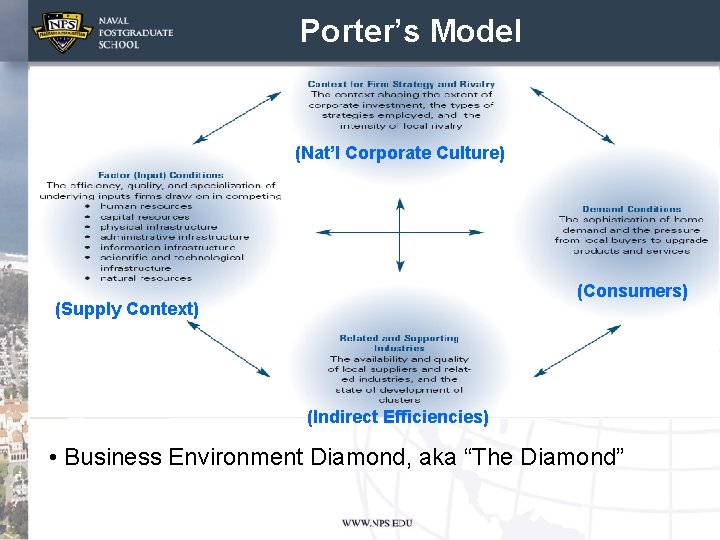
Michael Porter’s Index • Michael Porter, Harvard Business School has developed a competitive index – “The Current Competitiveness Index examines the microeconomic bases of a nation’s GDP per capita. ” • Macroeconomic conditions are usually the object of study, but although necessary, they are not sufficient • Microeconomic conditions are what actually create wealth and “sustainable productivity” • Comparative in nature
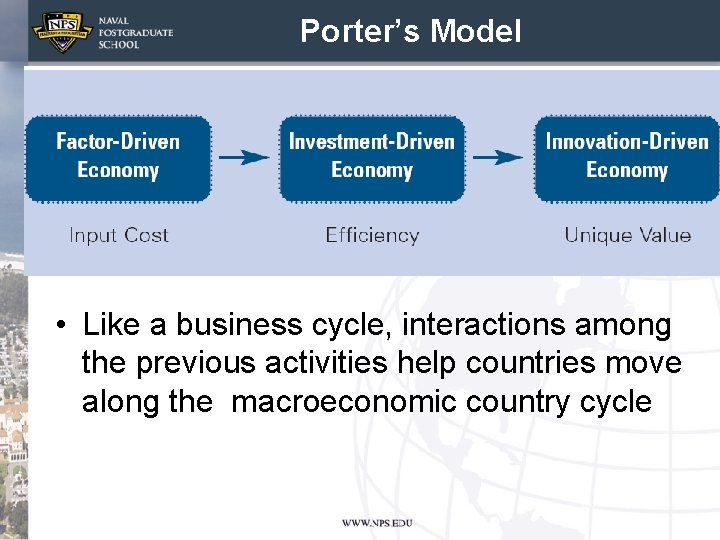
Porter’s Model • Like a business cycle, interactions among the previous activities help countries move along the macroeconomic country cycle
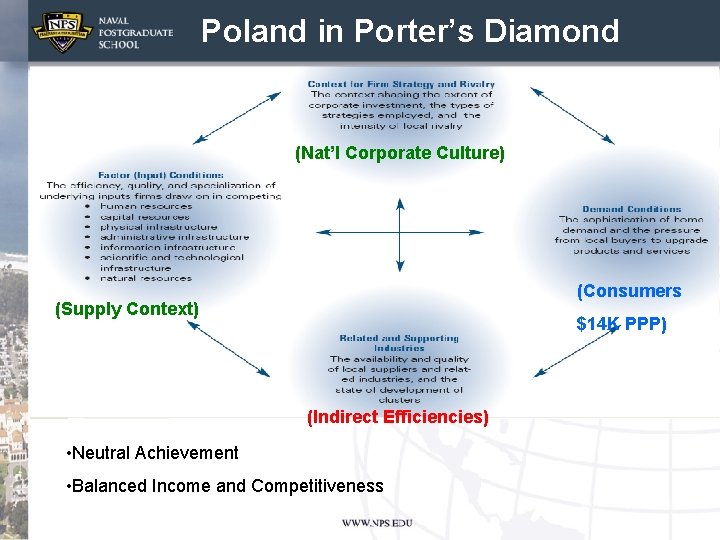
Porter’s Model (Nat’l Corporate Culture) (Consumers) (Supply Context) (Indirect Efficiencies) • Business Environment Diamond, aka “The Diamond”
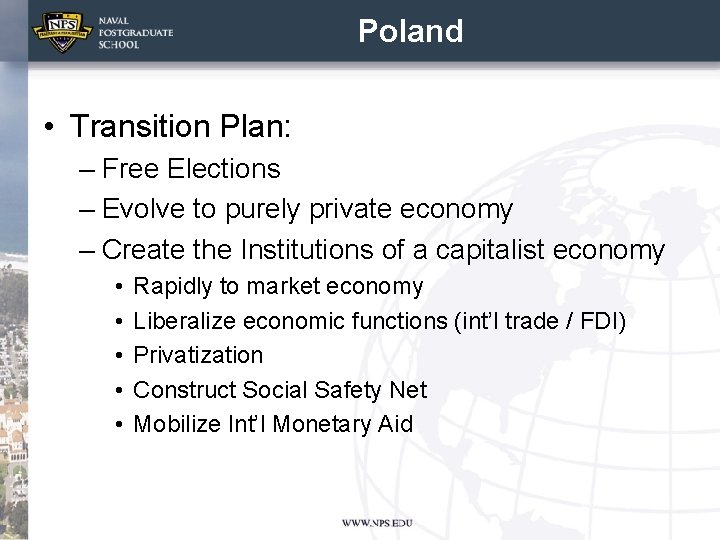
Poland • Transition Plan: – Free Elections – Evolve to purely private economy – Create the Institutions of a capitalist economy • • • Rapidly to market economy Liberalize economic functions (int’l trade / FDI) Privatization Construct Social Safety Net Mobilize Int’l Monetary Aid
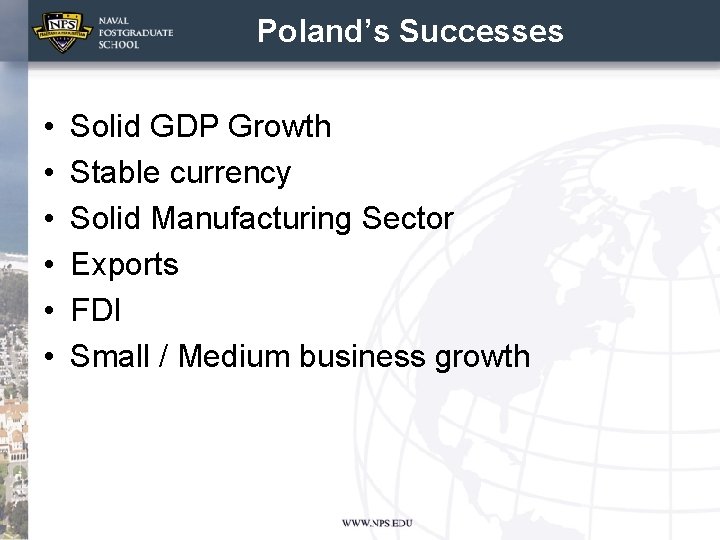
Poland’s Successes • • • Solid GDP Growth Stable currency Solid Manufacturing Sector Exports FDI Small / Medium business growth
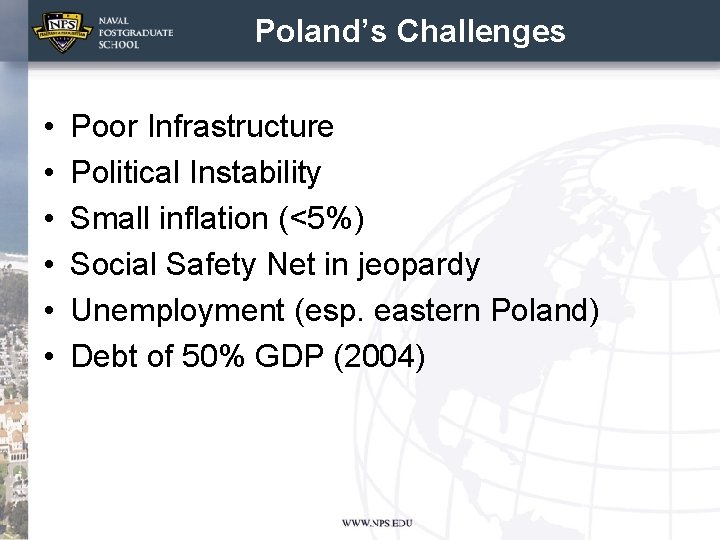
Poland’s Challenges • • • Poor Infrastructure Political Instability Small inflation (<5%) Social Safety Net in jeopardy Unemployment (esp. eastern Poland) Debt of 50% GDP (2004)
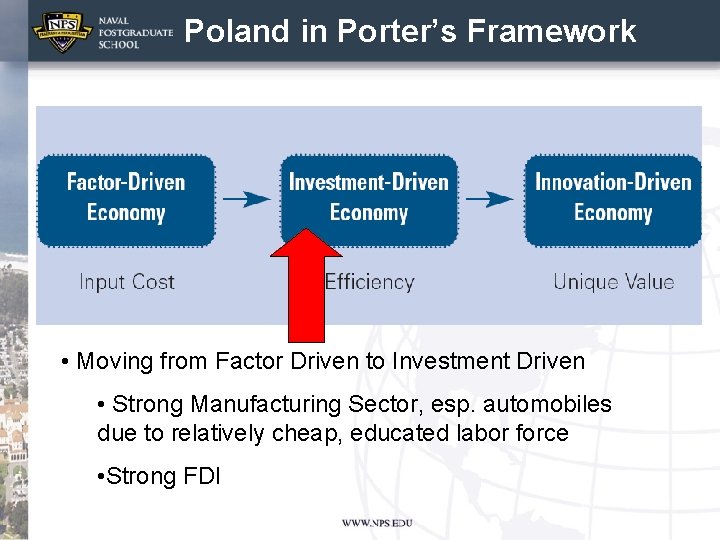
Poland in Porter’s Framework • Moving from Factor Driven to Investment Driven • Strong Manufacturing Sector, esp. automobiles due to relatively cheap, educated labor force • Strong FDI
Poland in Porter’s Diamond (Nat’l Corporate Culture) (Consumers (Supply Context) $14 K PPP) (Indirect Efficiencies) • Neutral Achievement • Balanced Income and Competitiveness
Russia: A Middle Income Country • Also a shock-therapy transition • #1 CIS country, but behind E. Europe countries – No EU Charter guidance
Russia: Strengths • Macroeconomic Stability (oil revenue) – 7 th highest fiscal surplus in 2006 • Cold War capacities – Higher education – Research institutions spurring innovation – Cultural factors that support innovation • Flexible labor market
Russia: Challenges • Public institutions • Health factors – Infant mortality – Life expectancy • Petrodollars preventing necessary painful reforms • Inflation near 10% • Technological readiness of business sector • Low intensity of domestic competition
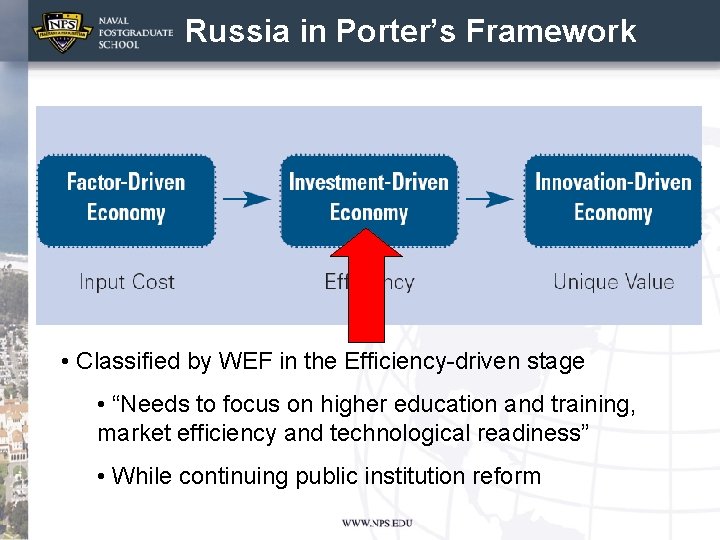
Russia in Porter’s Framework • Classified by WEF in the Efficiency-driven stage • “Needs to focus on higher education and training, market efficiency and technological readiness” • While continuing public institution reform
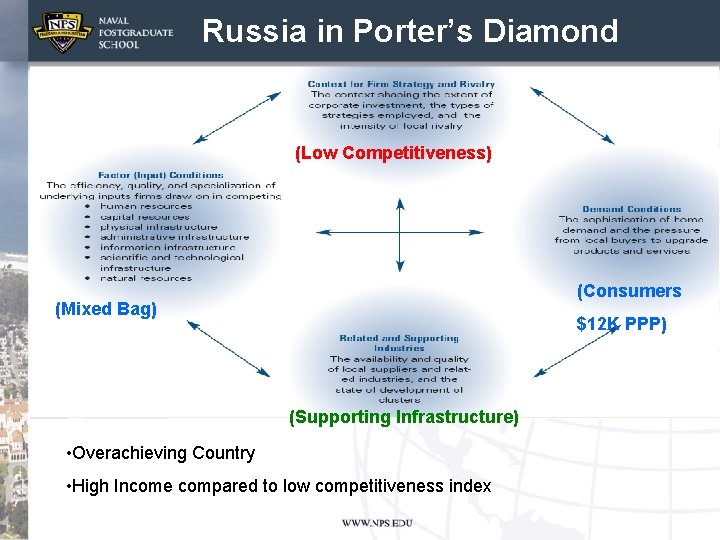
Russia in Porter’s Diamond (Low Competitiveness) (Consumers (Mixed Bag) $12 K PPP) (Supporting Infrastructure) • Overachieving Country • High Income compared to low competitiveness index
China: Commanded Transition • Slow transition method • Excess production allowed to go the open market • When private enterprise failed, it was cancelled • Government-controlled financial system
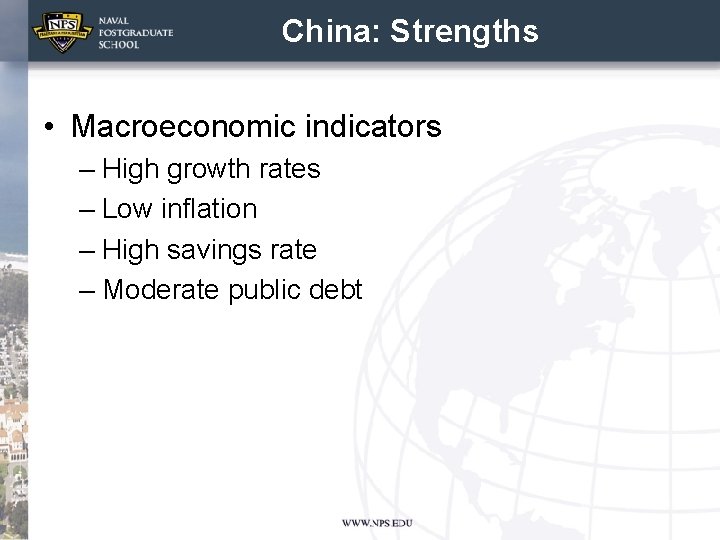
China: Strengths • Macroeconomic indicators – High growth rates – Low inflation – High savings rate – Moderate public debt
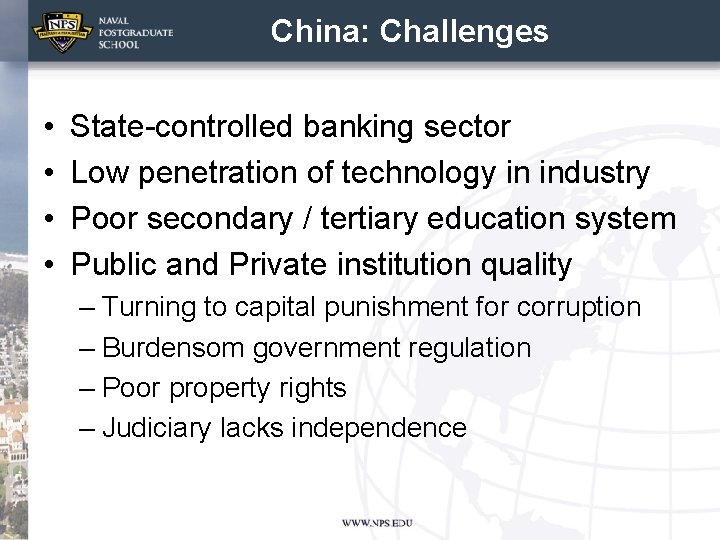
China: Challenges • • State-controlled banking sector Low penetration of technology in industry Poor secondary / tertiary education system Public and Private institution quality – Turning to capital punishment for corruption – Burdensom government regulation – Poor property rights – Judiciary lacks independence
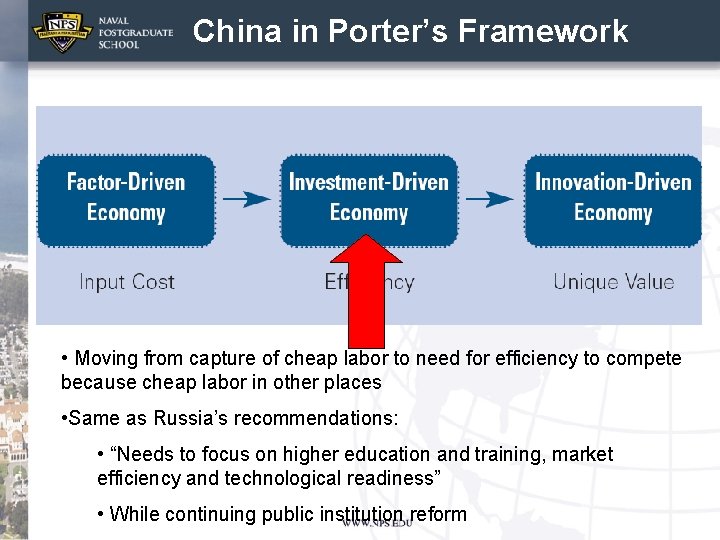
China in Porter’s Framework • Moving from capture of cheap labor to need for efficiency to compete because cheap labor in other places • Same as Russia’s recommendations: • “Needs to focus on higher education and training, market efficiency and technological readiness” • While continuing public institution reform
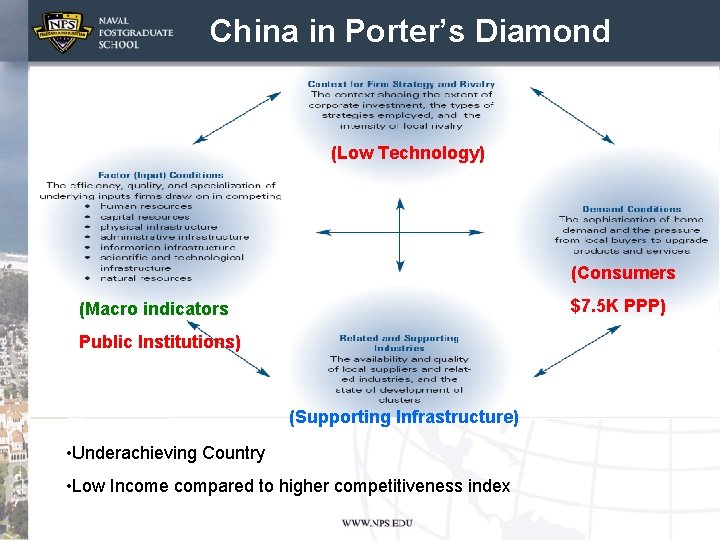
China in Porter’s Diamond (Low Technology) (Consumers $7. 5 K PPP) (Macro indicators Public Institutions) (Supporting Infrastructure) • Underachieving Country • Low Income compared to higher competitiveness index
Conclusion • Transition from Factor-driven economy to Investment-driven economy has coincided with evolution from developing country to middle-income, developed country • New challenge will be to move from Investment-driven to Innovation-driven in order to sustain growth
References • Porter, Michael E. “Enhancing the Microeconomic Foundations of Prosperity: The Current Competitiveness Index” • Hunter, Richard J. and Leo V. Ryan, “A Transitional Analysis of the Polish Economy: After Fifteen Years, Still a ‘Work in Progress, ” Global Economic Journal 5: 2, 2005. • Economist. com, Poland Country Briefing Factsheet, • Marageta Drzeniek, “Russia’s Competitiveness at the Crossroads”, Paper presented at World Economic Forum Russia CEO Roundtable, June 2007, http: //www. weforum. org/en/events/russia 2007/index. htm • Economist. com, China Country Briefing Factsheet, • Porter, Michael E. , World Economic Forum, World Competitiveness Report 2006 -2007