
Transition Definition movement passage or change from one

- Slides: 19
Transition Definition: movement, passage, or change from one position, state, stage, subject, concept, etc. , to another change: The transition from preschool to kindergarten. The transition from primary to high school. The transition from school to university or vocation. The transition from adolescence to adulthood. The transition from present to…. better in future
Why is Transition Planning Important? - Provides an opportunity to review personal accomplishment and create an individualized vision for the future.
When does Transition Planning begin? - As early as possible - the youth may be 14 years old - Starting early allows time to adequate prepare and implement a Transition Plan that will address the challenges of preparing for adulthood
Strategies for Transition Planning (1) - Person Centered Planning - Student Involvement - Family Involvement - Community Involvement: educators, therapists, socials workers, current and future service providers, community businesses and etc. - The transition coordinator plays a key role within the transition planning team. - Focus on strengths and abilities rather than disabilities
Strategies for Transition Planning (2) -The development of services and supports are responsive to each individual’s unique needs and dreams - Effective communication and collaboration of Transition Planning Team - Provide Responsive Services -Utilize Existing Community Supports.
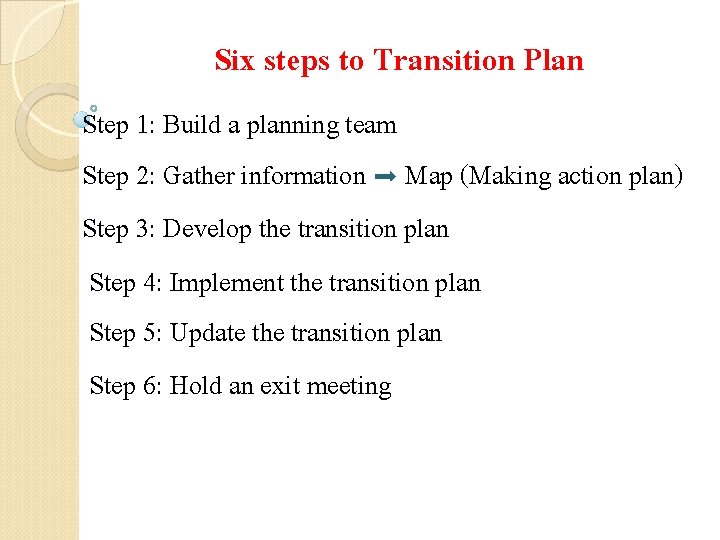
Six steps to Transition Plan Step 1: Build a planning team Step 2: Gather information Map (Making action plan) Step 3: Develop the transition plan Step 4: Implement the transition plan Step 5: Update the transition plan Step 6: Hold an exit meeting
Step 1: Build a Planning Team (1) -The Transition Planning Team: • To develops goals, identifies problem, creates solutions and establishes links between agencies and community resources. • Does effectively the right composition of team members is required.
Step 1: Build a Planning Team (2) • Planning Team members : 2 -8 people • student, parent/guardian, school personal, social workers, community members, current service providers, service agencies for adults, student’s network • Appropriate members: Who knows the student the best? Who does the student trust and feel comfortable around? Who does the student look to for advice and support? Who would the student like to help him/her with transition from school to adulthood?
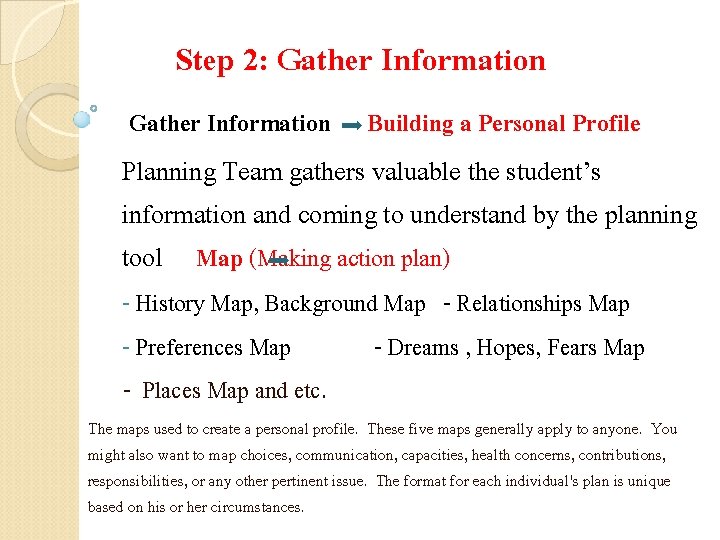
Step 2: Gather Information Building a Personal Profile Planning Team gathers valuable the student’s information and coming to understand by the planning tool Map (Making action plan) - History Map, Background Map - Relationships Map - Preferences Map - Dreams , Hopes, Fears Map - Places Map and etc. The maps used to create a personal profile. These five maps generally apply to anyone. You might also want to map choices, communication, capacities, health concerns, contributions, responsibilities, or any other pertinent issue. The format for each individual's plan is unique based on his or her circumstances.
History Map, Background Map - A personal history for the student from birth to present is generated by the group. The individual and those who have known him or her contribute information by telling stories about significant events. -The background map created helps the group to understand the life experience of the student and his or her family
Relationships Map This map illustrates the person’s relationships. - The inner circle is for those who are closest to the student. It includes people who see the student everyday or with whom the student has a very close bond. - The second circle is for those people the student is involved with on a regular basis. - The outer area is for those people whom the student knows and finds meaningful, but with whom there is not as much opportunity to have contact.
Preferences Map reminds the participants that the wishes of the student should be the basis for the dream the group discovers capacities to build on and conditions to avoid. These map helps illustrate patterns in the interest and unique contributions of the student, it also helps identify patterns in the conditions that block or challenge the development of opportunities.
Dreams , Hopes, Fears Map - Dreams and Hopes are new images of the future emerge as an individual and people who care explore ways to fully express the student's capacities and interests in the community. Participants bring together inner hopes and dreams with a new appreciation for the student’s gifts and preferences to form a shared dream for the future. This chart helps illustrate what the student desires for his or her home, job, community life, and personal life. This is a picture of a dream. - Fears
Places Map - The places history for the student from birth to present and may be in the future which generated by the group.
Step 3: Develop the transition plan Planning Team team considers the syudents’s goals, the available services and supports in the following areas: • health (medical needs and healthy lifestyle) • daily living (self-care, meal preparation, etc. ) • housing / living arrangements • finances and money management • socialization • transportation • recreation • community involvement • cultural associations ◦(Consider. Transition Program Components)
Step 4: Implement the Transition Planning Team puts the Transition Plan into action includes assigning very specific, detailed responsibilities and timelines. Who will do what, when and how must be decided by the team. - Effective communication must be established to ensure that the tasks/actions are carried out on time. - The transition coordinator or a parent may choose to take on the responsibility of ensuring that team members follow through with the actions recorded in the Transition Plan
Step 5: Update the transition plan The transition coordinator schedules follow-up meetings and updates the plan as needed. The family member may initiate the process by identifying a need to review the plan.
Step 6: Hold an exit meeting The transition coordinator organizes this final planning session. At this stage of the process, the student is nearing the end of the school. Here, the Transition Plan is finalized, tasks and objectives achieved by the group to date are identified, and any transition planning goals or objectives that have not been accomplished are addressed.
bibliography Betsy Mc. Ginnity & Betsy Bixler. (2010). Planning for Successful Transitions for Students with Visual Impairments and Additional Disabilities. B. C. Ministry of Children and Family Development. Transition Planning For Youth with special needs. Retrieved August, 7, 2011 from http: //www. mch. gov. BC. ca/spec_needs/pdf/support_guide. pdf. Cameameto, R. , Levine, P. , & Wagner, M. (2004). Transition Planning for Students with Disabilities. A Special Topic Report from the National Longitudinal Transition Study-2 (NLTS 2). Menlo Park, CA: SRI international. Moss, K. and Wiley, D. (2011). A Brief Guide to Personal Futures Planning (Manual).