
Transition Challenges and Opportunities Preliminary Findings of Country






- Slides: 25
Transition Challenges and Opportunities – Preliminary Findings of Country Consultations NOVEMBER 3, 2017
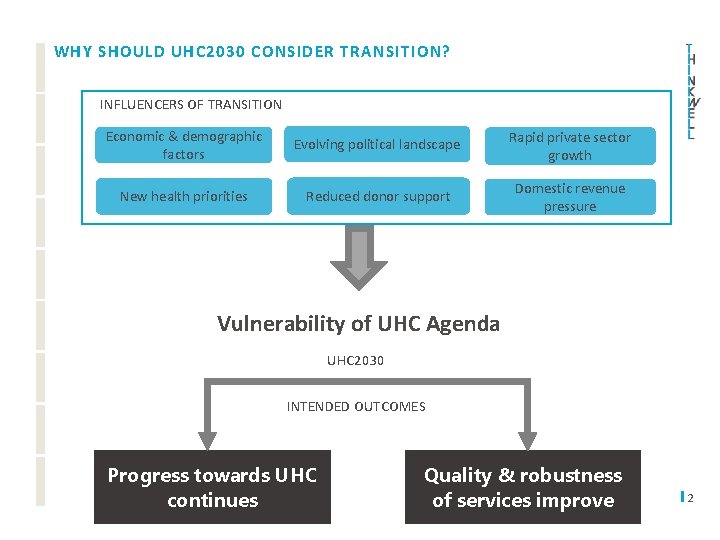
WHY SHOULD UHC 2030 CONSIDER TRANSITION? INFLUENCERS OF TRANSITION Economic & demographic Rapid private sector Evolving political landscape factors Immunization budget stabilized or increased growth New health priorities Reduced donor support Domestic revenue pressure Vulnerability of UHC Agenda UHC 2030 INTENDED OUTCOMES Progress towards UHC continues Quality & robustness of services improve 2
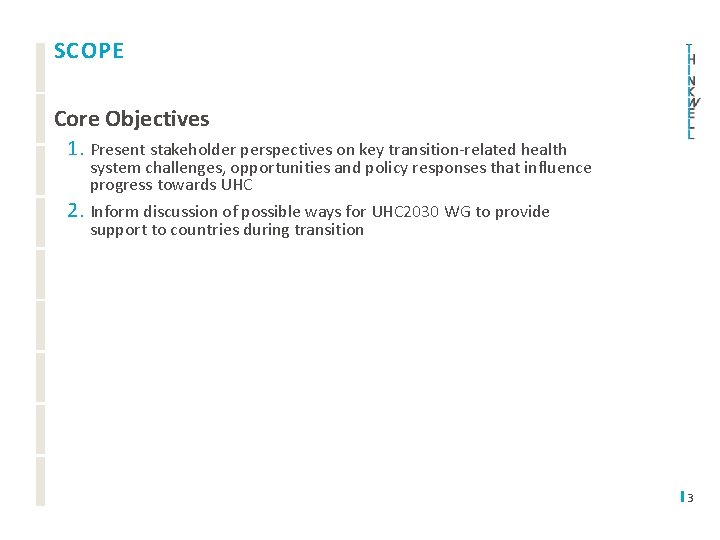
SCOPE Core Objectives 1. Present stakeholder perspectives on key transition-related health system challenges, opportunities and policy responses that influence progress towards UHC 2. Inform discussion of possible ways for UHC 2030 WG to provide support to countries during transition 3
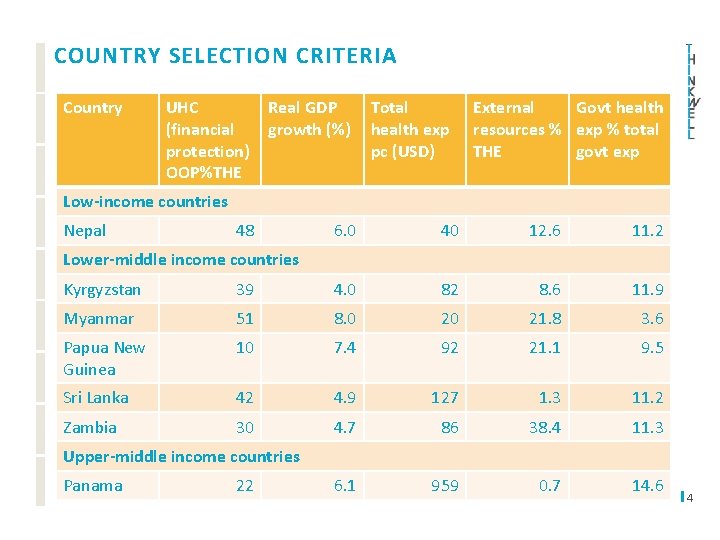
COUNTRY SELECTION CRITERIA Country UHC (financial protection) OOP%THE Real GDP growth (%) Total health exp pc (USD) External Govt health resources % exp % total THE govt exp Low-income countries Nepal 48 6. 0 40 12. 6 11. 2 Lower-middle income countries Kyrgyzstan 39 4. 0 82 8. 6 11. 9 Myanmar 51 8. 0 20 21. 8 3. 6 Papua New Guinea 10 7. 4 92 21. 1 9. 5 Sri Lanka 42 4. 9 127 1. 3 11. 2 Zambia 30 4. 7 86 38. 4 11. 3 6. 1 959 0. 7 14. 6 Upper-middle income countries Panama 22 4
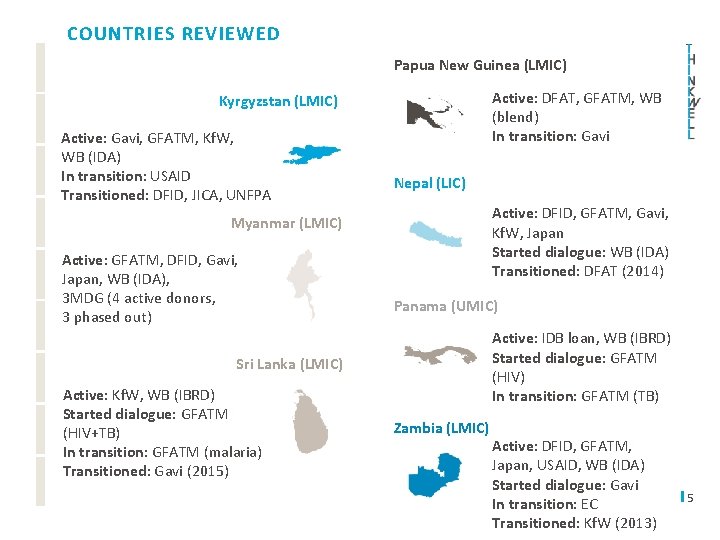
COUNTRIES REVIEWED Papua New Guinea (LMIC) Active: DFAT, GFATM, WB (blend) In transition: Gavi Kyrgyzstan (LMIC) Active: Gavi, GFATM, Kf. W, WB (IDA) In transition: USAID Transitioned: DFID, JICA, UNFPA Nepal (LIC) Active: DFID, GFATM, Gavi, Kf. W, Japan Started dialogue: WB (IDA) Transitioned: DFAT (2014) Myanmar (LMIC) Active: GFATM, DFID, Gavi, Japan, WB (IDA), 3 MDG (4 active donors, 3 phased out) Panama (UMIC) Active: IDB loan, WB (IBRD) Started dialogue: GFATM (HIV) In transition: GFATM (TB) Sri Lanka (LMIC) Active: Kf. W, WB (IBRD) Started dialogue: GFATM (HIV+TB) In transition: GFATM (malaria) Transitioned: Gavi (2015) Zambia (LMIC) Active: DFID, GFATM, Japan, USAID, WB (IDA) Started dialogue: Gavi In transition: EC Transitioned: Kf. W (2013) 5
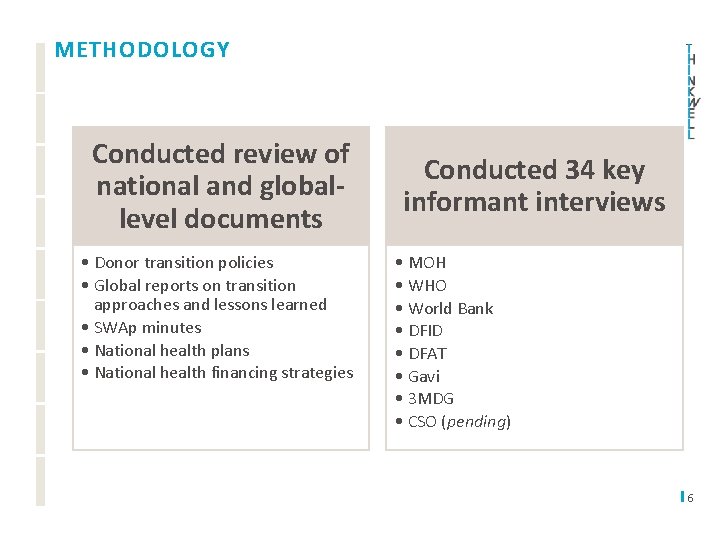
METHODOLOGY Conducted review of national and globallevel documents • Donor transition policies • Global reports on transition approaches and lessons learned • SWAp minutes • National health plans • National health financing strategies Conducted 34 key informant interviews • MOH • WHO • World Bank • DFID • DFAT • Gavi • 3 MDG • CSO (pending) 6
Exploring the Issues
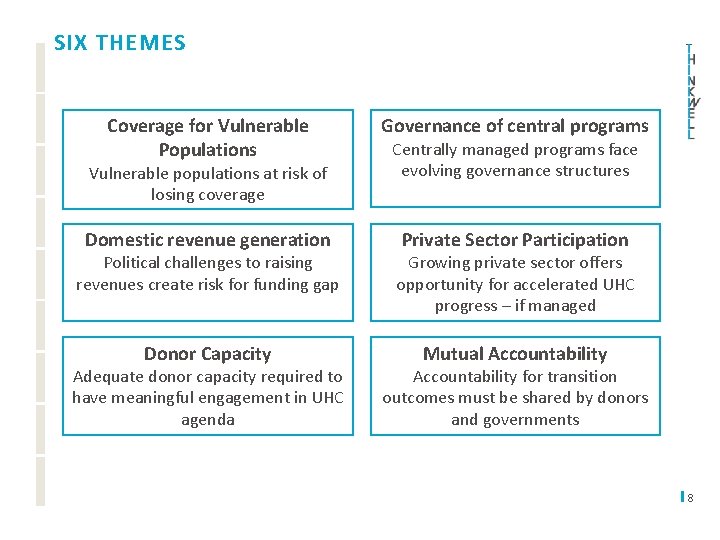
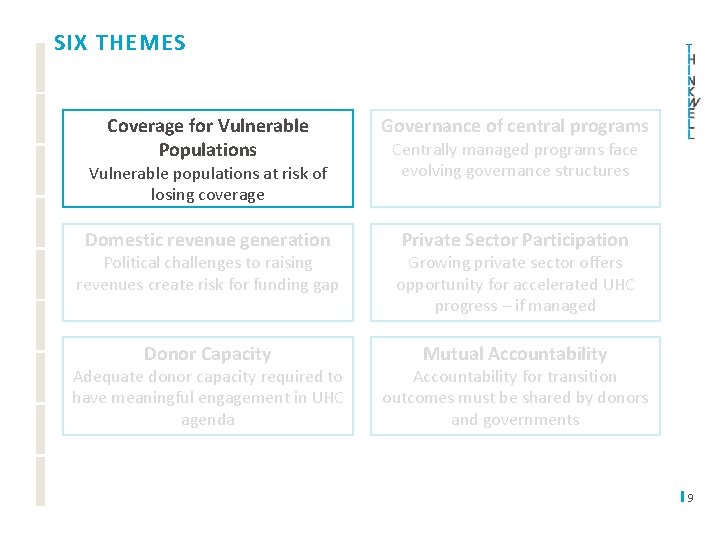
SIX THEMES Coverage for Vulnerable Populations Governance of central programs Domestic revenue generation Private Sector Participation Vulnerable populations at risk of losing coverage Centrally managed programs face evolving governance structures Political challenges to raising revenues create risk for funding gap Growing private sector offers opportunity for accelerated UHC progress – if managed Donor Capacity Mutual Accountability Adequate donor capacity required to have meaningful engagement in UHC agenda Accountability for transition outcomes must be shared by donors and governments 8
SIX THEMES Coverage for Vulnerable Populations Governance of central programs Domestic revenue generation Private Sector Participation Vulnerable populations at risk of losing coverage Centrally managed programs face evolving governance structures Political challenges to raising revenues create risk for funding gap Growing private sector offers opportunity for accelerated UHC progress – if managed Donor Capacity Mutual Accountability Adequate donor capacity required to have meaningful engagement in UHC agenda Accountability for transition outcomes must be shared by donors and governments 9
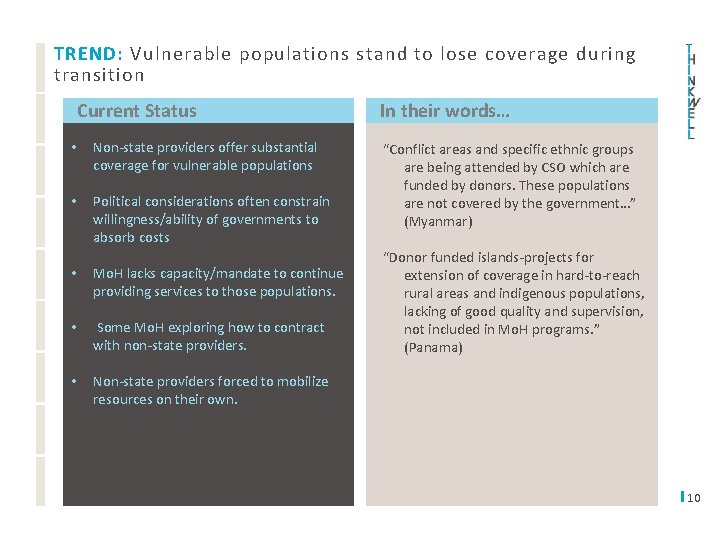
TREND: Vulnerable populations stand to lose coverage during transition Current Status • Non-state providers offer substantial coverage for vulnerable populations • Political considerations often constrain willingness/ability of governments to absorb costs • Mo. H lacks capacity/mandate to continue providing services to those populations. • Some Mo. H exploring how to contract with non-state providers. • Non-state providers forced to mobilize resources on their own. I In their words… “Conflict areas and specific ethnic groups are being attended by CSO which are funded by donors. These populations are not covered by the government…” (Myanmar) “Donor funded islands-projects for extension of coverage in hard-to-reach rural areas and indigenous populations, lacking of good quality and supervision, not included in Mo. H programs. ” (Panama) 10
UHC 2030 Engagement Outcome Scenario FUTURE SCENARIOS FOR VULNERABLE POPULATION COVERAGE Vulnerable population groups lose coverage and access to priority health interventions Reduced financial protection, increased OOP Funding for vulnerable populations face Sustained coverage and financial protection volatility for potential vulnerable population Include vulnerable population groups explicitly in any transition dialogue Support focused advocacy campaign to maintain coverage for vulnerable populations 11
SIX THEMES Coverage for Vulnerable Populations Governance of central programs Domestic revenue generation Private Sector Participation Vulnerable populations at risk of losing coverage Centrally managed programs face evolving governance structures Political challenges to raising revenues create risk for funding gap Growing private sector offers opportunity for accelerated UHC progress – if managed Donor Capacity Mutual Accountability Adequate donor capacity required to have meaningful engagement in UHC agenda Accountability for transition outcomes must be shared by donors and governments 12
TREND: Structural changes in health financing architecture is putting pressure on how central programs are governed Current Status • Donor financing mandated strong centralized planning and management structures for key vertical programs (FP, Immunization, HIV/AIDs) • Financing of traditionally centralized programs (immunization, FP) still considered a centralized function, though shifts imminent as financing mechanisms mature • As donors exit and financing evolves, question of how centralized programs are governed becomes paramount. • Countries embarking on strategic purchasing or fiscal decentralization often lack capacity to prioritize key public health priorities I In their words… “In the current decentralization that Nepal is undergoing, development partners want to see how funds will be deployed and what will be the accountability mechanism, and only then they will determine how to work with local bodies. ” (Nepal) “Most external funding is managed outside of the government. All budgetary decisions are made at the technical program level, and therefore MOF is not involved at all. ” (Myanmar) 13
UHC 2030 Engagement Outcome Scenario FUTURE SCENARIOS FOR GOVERNANCE OF VERTICAL PROGRAMS Centralized programs ‘confused’ in face of strategic purchasing & decentralization Transition threatens existing structures mandated by donors Governance of key central programs will Strong and evolved governance of public weaken, resulting reduced coverage health programs in in place post-transition Create transition “workstream” focused on governance of central programs Focused TA on central program governance 14
SIX THEMES Coverage for Vulnerable Populations Governance of central programs Domestic revenue generation Private Sector Participation Vulnerable populations at risk of losing coverage Centrally managed programs face evolving governance structures Political challenges to raising revenues create risk for funding gap Growing private sector offers opportunity for accelerated UHC progress – if managed Donor Capacity Mutual Accountability Adequate donor capacity required to have meaningful engagement in UHC agenda Accountability for transition outcomes must be shared by donors and governments 15
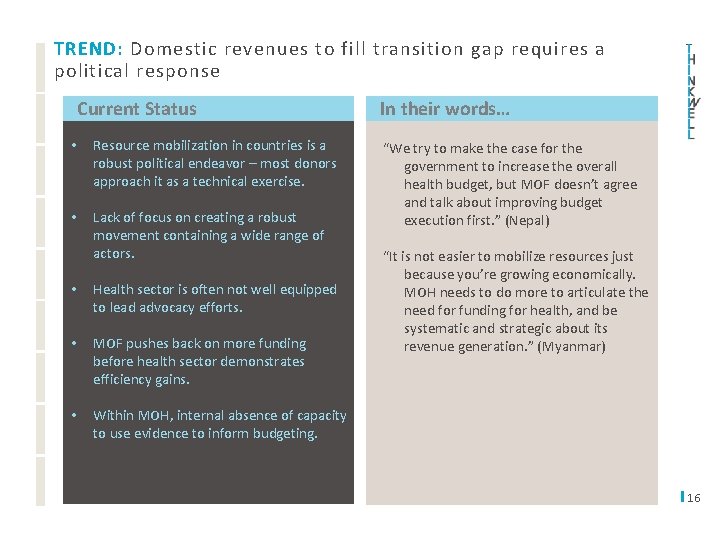
TREND: Domestic revenues to fill transition gap requires a political response Current Status • Resource mobilization in countries is a robust political endeavor – most donors approach it as a technical exercise. • Lack of focus on creating a robust movement containing a wide range of actors. • Health sector is often not well equipped to lead advocacy efforts. • MOF pushes back on more funding before health sector demonstrates efficiency gains. • Within MOH, internal absence of capacity to use evidence to inform budgeting. I In their words… “We try to make the case for the government to increase the overall health budget, but MOF doesn’t agree and talk about improving budget execution first. ” (Nepal) “It is not easier to mobilize resources just because you’re growing economically. MOH needs to do more to articulate the need for funding for health, and be systematic and strategic about its revenue generation. ” (Myanmar) 16
UHC 2030 Engagement Outcome Scenario FUTURE SCENARIOS FOR DOMESTIC REVENUES Countries will not be able to mobilize sufficient resources to sustain priority interventions Health sector will continue to be less prioritized than other sectors in budgeting Strategic and tailored advocacy will Domestic revenues insufficient to fill contribute to increased domestic revenue transition gap generation Identify champions and aligned interests to engage key stakeholders Support countries in developing high-level advocacy strategy 17
SIX THEMES Coverage for Vulnerable Populations Governance of central programs Domestic revenue generation Private Sector Participation Vulnerable populations at risk of losing coverage Centrally managed programs face evolving governance structures Political challenges to raising revenues create risk for funding gap Growing private sector offers opportunity for accelerated UHC progress – if managed Donor Capacity Mutual Accountability Adequate donor capacity required to have meaningful engagement in UHC agenda Accountability for transition outcomes must be shared by donors and governments 18
TREND: Rapid private sector growth is often not guided towards achieving UHC objectives Current Status • Private sector delivery growing rapidly in many transitioning countries • Regulatory systems are weak and market shaping opportunities are not fully leveraged • Private sector is often focused on ‘lowhanging fruit’ – curative services for wealthy populations • Enormous market opportunity of low income populations not realized I In their words… “There’s limited regulation of the private sector, but real opportunities for them to try to support the MOH in how to deliver specialist services. ” (Nepal) “The public cannot reach everywhere. . . the private sector can play a big role here, around health financing strategy, how to reach underserved. . . but how will the contracting of services work within a government-led system? ” (Nepal) 19
UHC 2030 Engagement Outcome Scenario FUTURE SCENARIOS PRIVATE PROVISION Private provision will continue to grow Opportunities to serve low/lowmiddle income will continue to expand Unregulated growth private sector will Market optimized forof private participation result intoinequitable coverage support UHC Market shaping activities to address gaps between private providers, investors, and government Regulatory efforts to support coherence in private provision Government capacity to engage private providers 20
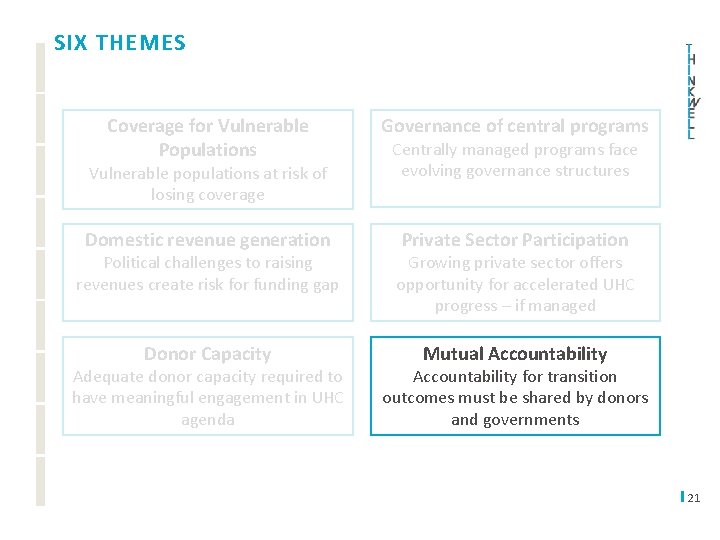
SIX THEMES Coverage for Vulnerable Populations Governance of central programs Domestic revenue generation Private Sector Participation Vulnerable populations at risk of losing coverage Centrally managed programs face evolving governance structures Political challenges to raising revenues create risk for funding gap Growing private sector offers opportunity for accelerated UHC progress – if managed Donor Capacity Mutual Accountability Adequate donor capacity required to have meaningful engagement in UHC agenda Accountability for transition outcomes must be shared by donors and governments 21
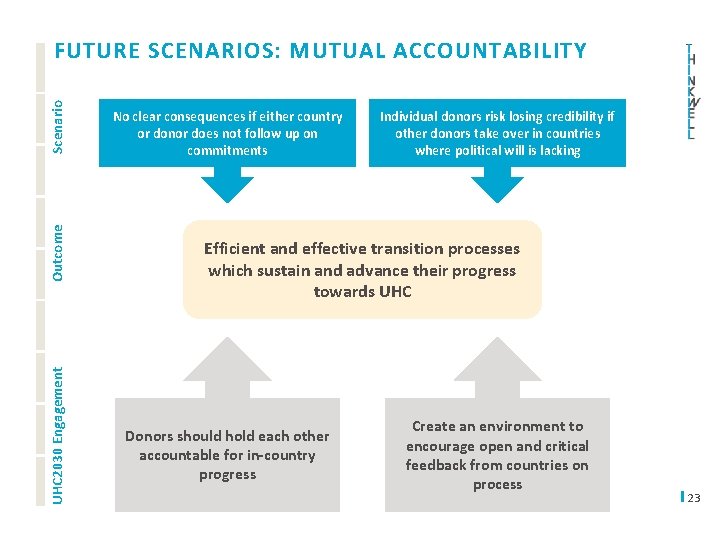
TREND: Mutual accountability for outcomes post-transition are needed Current Status • Most donors do not consider health system readiness indicators as part of their transition criteria • There are no clear implications if the roles and responsibilities established in a transition process are not respected • Transition frameworks do not allow for countries to hold partners accountable if they provide insufficient support throughout the process, delay disbursements of transition grants, or provide confusing/incorrect information on what is expected of the country, etc. I In their words… “Donors shouldn’t push a country towards transition if it clearly has nor the financial nor the programmatic capacity to take it over. ” (Papua New Guinea) “Although donors are pushing the government, and explaining what moving into middle income status will mean, the country’s expectation is that donors will not only continue to fund, but also that they will provide sector support rather than off-budget support through earmarked activities. ” (Nepal) 22
UHC 2030 Engagement Outcome Scenario FUTURE SCENARIOS: MUTUAL ACCOUNTABILITY No clear consequences if either country or donor does not follow up on commitments Individual donors risk losing credibility if other donors take over in countries where political will is lacking Effectiveness and outcomes of transition Efficient and effective transition processes processsustain variesand based on in-country donor which advance their progress and MOH capacity commitment towardsand UHC Donors should hold each other accountable for in-country progress Create an environment to encourage open and critical feedback from countries on process 23
GLOBAL MAPPING TOOL — Offers an overview of the financial support for health from the WB, GFATM, Gavi, Germany, EC, France, Japan, and hopefully more in the future — — Includes all low and middle income countries Shows where DPs are active, where programs are (or are expected) to transition Also includes a number of fiscal space and aid dependency indicators Possibility to filter by income grouping, geographic location, number of transitions 24
THANK YOU