
Transition Challenge 2021 Drama The purpose of these
- Slides: 26
Transition Challenge 2021: Drama The purpose of these tasks are to prepare you with some of the skills you will need to be successful in your A Level Drama and Theatre studies as well as equipping you with information that you will use throughout the course. This will help you to get a step ahead before you start. I very much look forward to seeing you in September! Please email if you have any questions: crossinghamr@wallingfordschool. com
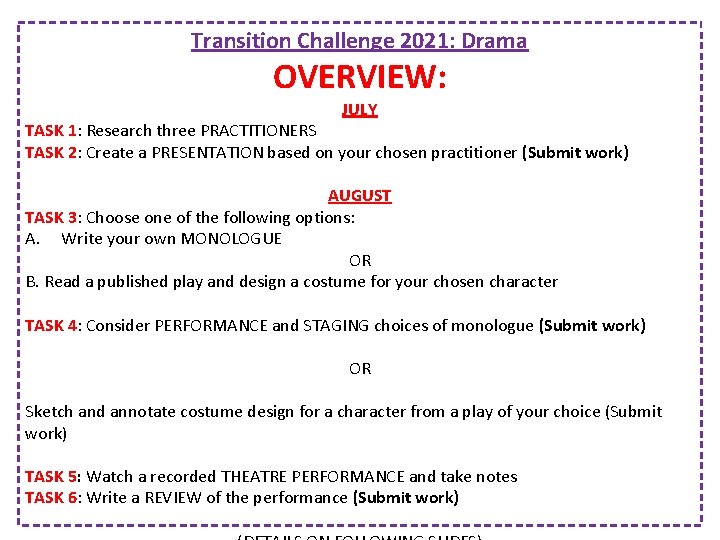
Transition Challenge 2021: Drama OVERVIEW: JULY TASK 1: Research three PRACTITIONERS TASK 2: Create a PRESENTATION based on your chosen practitioner (Submit work) AUGUST TASK 3: Choose one of the following options: A. Write your own MONOLOGUE OR B. Read a published play and design a costume for your chosen character TASK 4: Consider PERFORMANCE and STAGING choices of monologue (Submit work) OR Sketch and annotate costume design for a character from a play of your choice (Submit work) TASK 5: Watch a recorded THEATRE PERFORMANCE and take notes TASK 6: Write a REVIEW of the performance (Submit work)
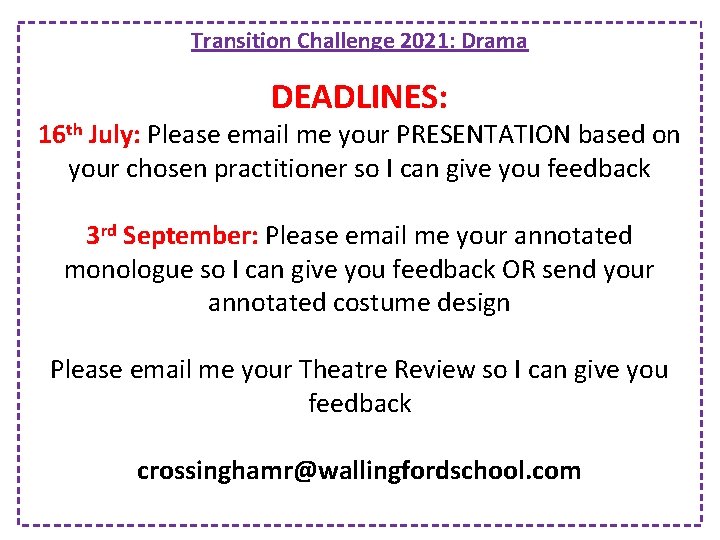
Transition Challenge 2021: Drama DEADLINES: 16 th July: Please email me your PRESENTATION based on your chosen practitioner so I can give you feedback 3 rd September: Please email me your annotated monologue so I can give you feedback OR send your annotated costume design Please email me your Theatre Review so I can give you feedback crossinghamr@wallingfordschool. com
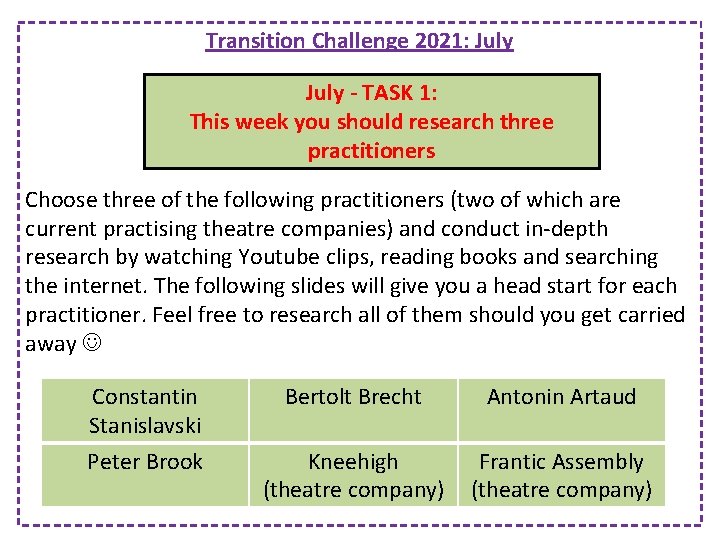
Transition Challenge 2021: July - TASK 1: This week you should research three practitioners Choose three of the following practitioners (two of which are current practising theatre companies) and conduct in-depth research by watching Youtube clips, reading books and searching the internet. The following slides will give you a head start for each practitioner. Feel free to research all of them should you get carried away Constantin Stanislavski Bertolt Brecht Antonin Artaud Peter Brook Kneehigh (theatre company) Frantic Assembly (theatre company)
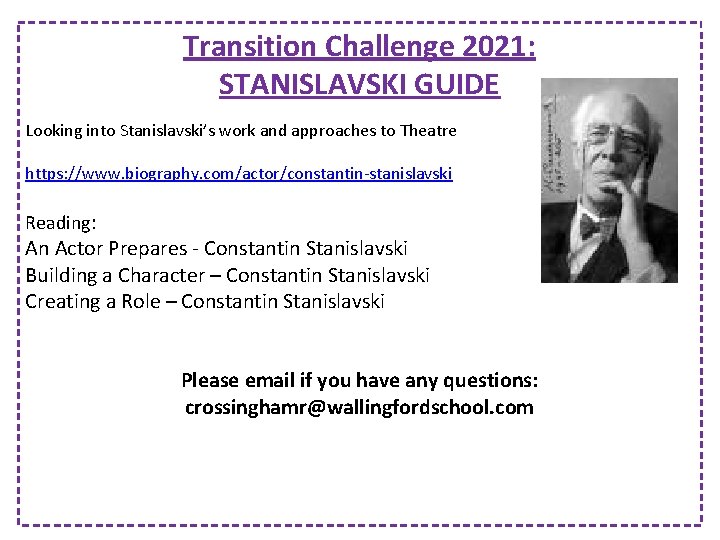
Transition Challenge 2021: STANISLAVSKI GUIDE Looking into Stanislavski’s work and approaches to Theatre https: //www. biography. com/actor/constantin-stanislavski Reading: An Actor Prepares - Constantin Stanislavski Building a Character – Constantin Stanislavski Creating a Role – Constantin Stanislavski Please email if you have any questions: crossinghamr@wallingfordschool. com
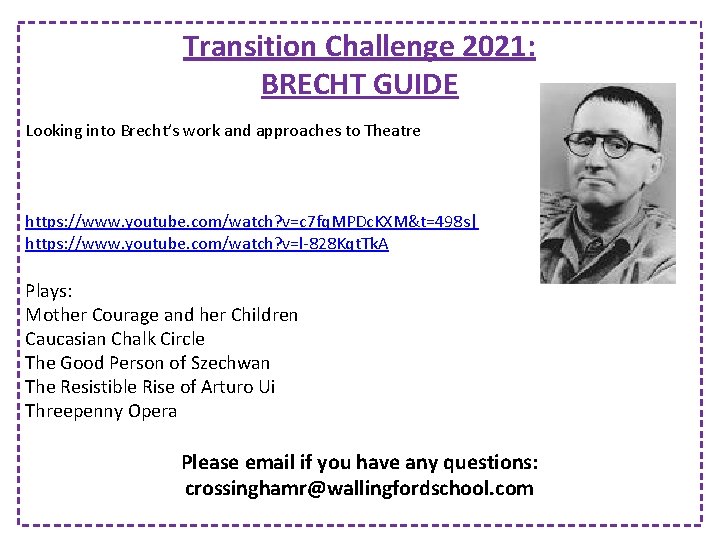
Transition Challenge 2021: BRECHT GUIDE Looking into Brecht’s work and approaches to Theatre https: //www. youtube. com/watch? v=c 7 fq. MPDc. KXM&t=498 s| https: //www. youtube. com/watch? v=l-828 Kqt. Tk. A Plays: Mother Courage and her Children Caucasian Chalk Circle The Good Person of Szechwan The Resistible Rise of Arturo Ui Threepenny Opera Please email if you have any questions: crossinghamr@wallingfordschool. com
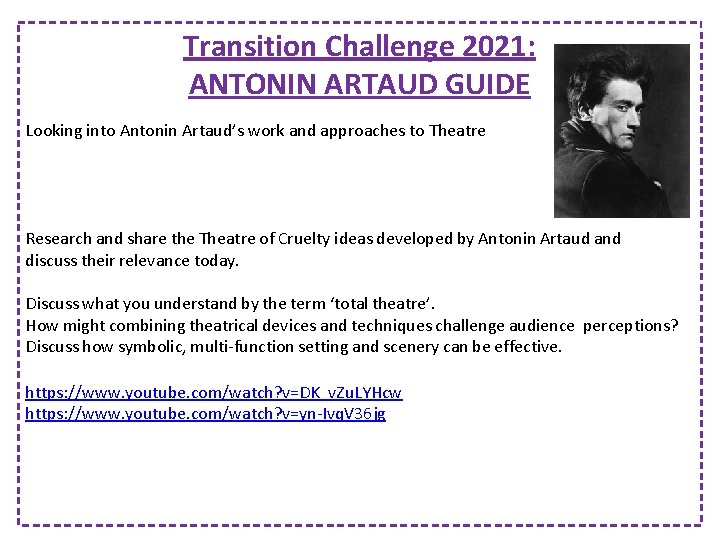
Transition Challenge 2021: ANTONIN ARTAUD GUIDE Looking into Antonin Artaud’s work and approaches to Theatre Research and share the Theatre of Cruelty ideas developed by Antonin Artaud and discuss their relevance today. Discuss what you understand by the term ‘total theatre’. How might combining theatrical devices and techniques challenge audience perceptions? Discuss how symbolic, multi-function setting and scenery can be effective. https: //www. youtube. com/watch? v=DK_v. Zu. LYHcw https: //www. youtube. com/watch? v=yn-Ivq. V 36 jg
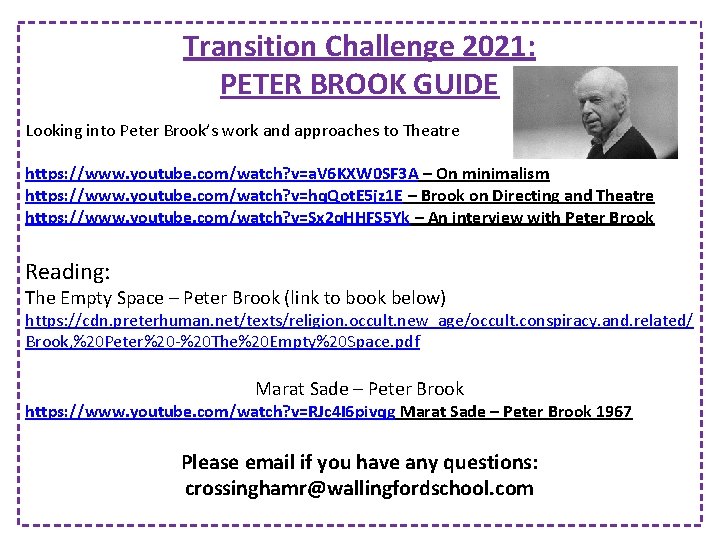
Transition Challenge 2021: PETER BROOK GUIDE Looking into Peter Brook’s work and approaches to Theatre https: //www. youtube. com/watch? v=a. V 6 KXW 0 SF 3 A – On minimalism https: //www. youtube. com/watch? v=hq. Qot. E 5 jz 1 E – Brook on Directing and Theatre https: //www. youtube. com/watch? v=Sx 2 q. HHFS 5 Yk – An interview with Peter Brook Reading: The Empty Space – Peter Brook (link to book below) https: //cdn. preterhuman. net/texts/religion. occult. new_age/occult. conspiracy. and. related/ Brook, %20 Peter%20 -%20 The%20 Empty%20 Space. pdf Marat Sade – Peter Brook https: //www. youtube. com/watch? v=RJc 4 I 6 pivqg Marat Sade – Peter Brook 1967 Please email if you have any questions: crossinghamr@wallingfordschool. com
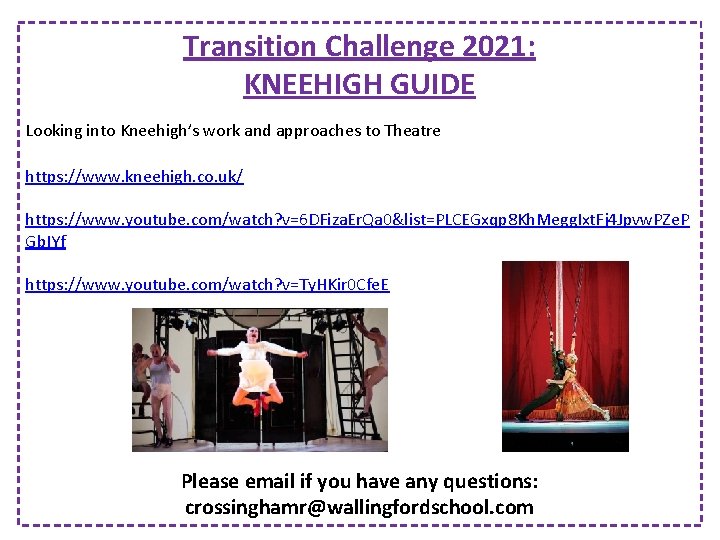
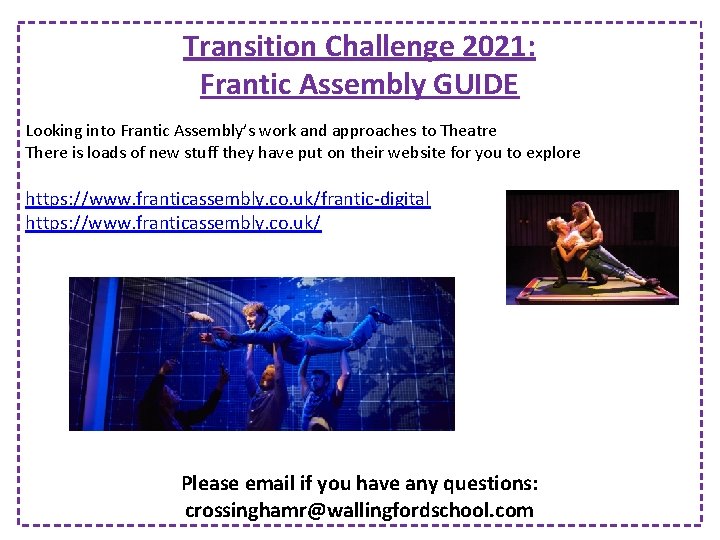
Transition Challenge 2021: KNEEHIGH GUIDE Looking into Kneehigh’s work and approaches to Theatre https: //www. kneehigh. co. uk/ https: //www. youtube. com/watch? v=6 DFiza. Er. Qa 0&list=PLCEGxqp 8 Kh. Megg. Ixt. Fj 4 Jpvw. PZe. P Gb. IYf https: //www. youtube. com/watch? v=Ty. HKir 0 Cfe. E Please email if you have any questions: crossinghamr@wallingfordschool. com
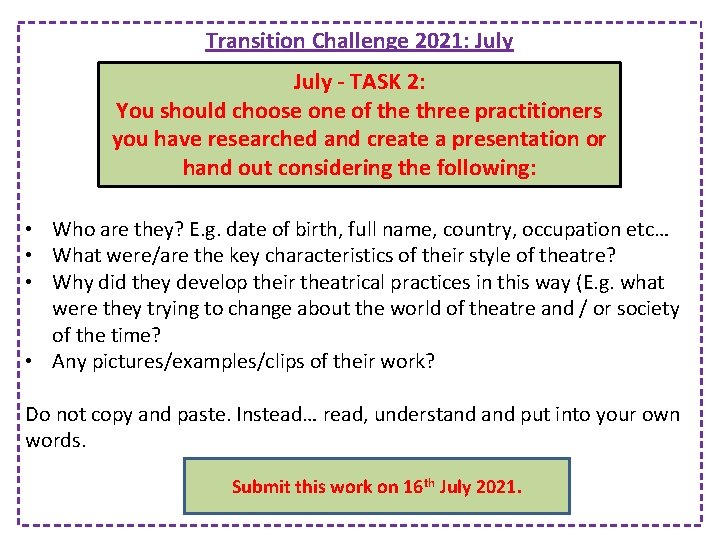
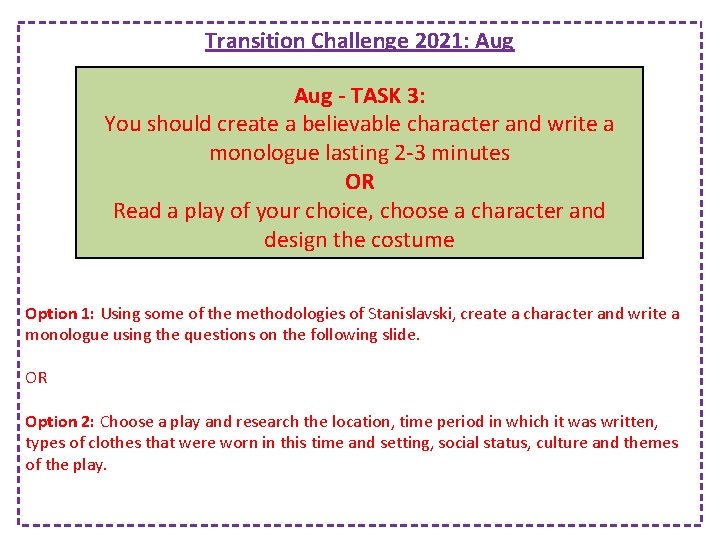
Transition Challenge 2021: Frantic Assembly GUIDE Looking into Frantic Assembly’s work and approaches to Theatre There is loads of new stuff they have put on their website for you to explore https: //www. franticassembly. co. uk/frantic-digital https: //www. franticassembly. co. uk/ Please email if you have any questions: crossinghamr@wallingfordschool. com
Transition Challenge 2021: July - TASK 2: You should choose one of the three practitioners you have researched and create a presentation or hand out considering the following: • Who are they? E. g. date of birth, full name, country, occupation etc… • What were/are the key characteristics of their style of theatre? • Why did they develop their theatrical practices in this way (E. g. what were they trying to change about the world of theatre and / or society of the time? • Any pictures/examples/clips of their work? Do not copy and paste. Instead… read, understand put into your own words. Submit this work on 16 th July 2021.
Transition Challenge 2021: Aug - TASK 3: You should create a believable character and write a monologue lasting 2 -3 minutes OR Read a play of your choice, choose a character and design the costume Option 1: Using some of the methodologies of Stanislavski, create a character and write a monologue using the questions on the following slide. OR Option 2: Choose a play and research the location, time period in which it was written, types of clothes that were worn in this time and setting, social status, culture and themes of the play.
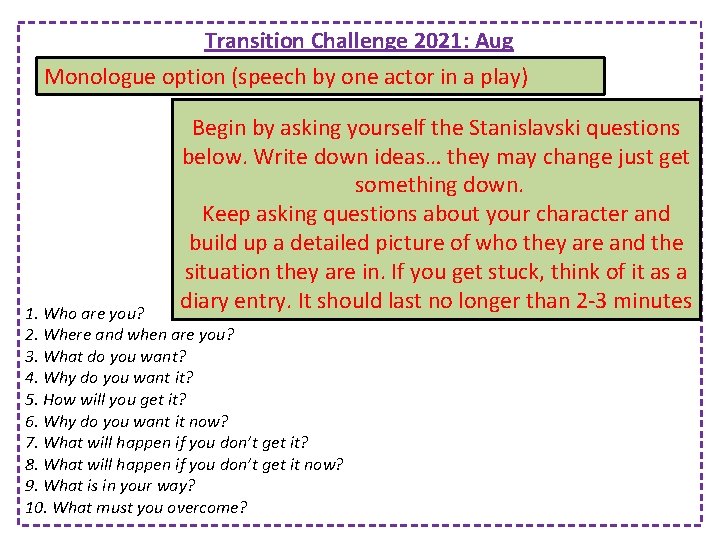
Transition Challenge 2021: Aug Monologue option (speech by one actor in a play) Begin by asking yourself the Stanislavski questions below. Write down ideas… they may change just get something down. Keep asking questions about your character and build up a detailed picture of who they are and the situation they are in. If you get stuck, think of it as a diary entry. It should last no longer than 2 -3 minutes 1. Who are you? 2. Where and when are you? 3. What do you want? 4. Why do you want it? 5. How will you get it? 6. Why do you want it now? 7. What will happen if you don’t get it? 8. What will happen if you don’t get it now? 9. What is in your way? 10. What must you overcome?
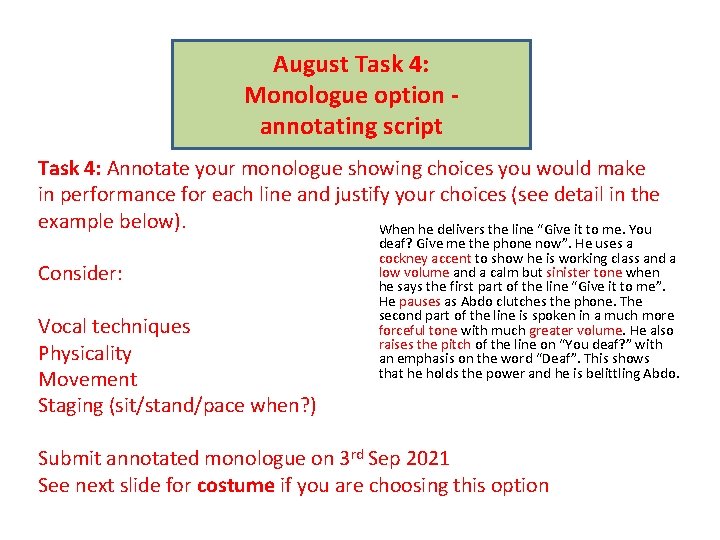
August Task 4: Monologue option annotating script Task 4: Annotate your monologue showing choices you would make in performance for each line and justify your choices (see detail in the example below). When he delivers the line “Give it to me. You Consider: Vocal techniques Physicality Movement Staging (sit/stand/pace when? ) deaf? Give me the phone now”. He uses a cockney accent to show he is working class and a low volume and a calm but sinister tone when he says the first part of the line “Give it to me”. He pauses as Abdo clutches the phone. The second part of the line is spoken in a much more forceful tone with much greater volume. He also raises the pitch of the line on “You deaf? ” with an emphasis on the word “Deaf”. This shows that he holds the power and he is belittling Abdo. Submit annotated monologue on 3 rd Sep 2021 See next slide for costume if you are choosing this option
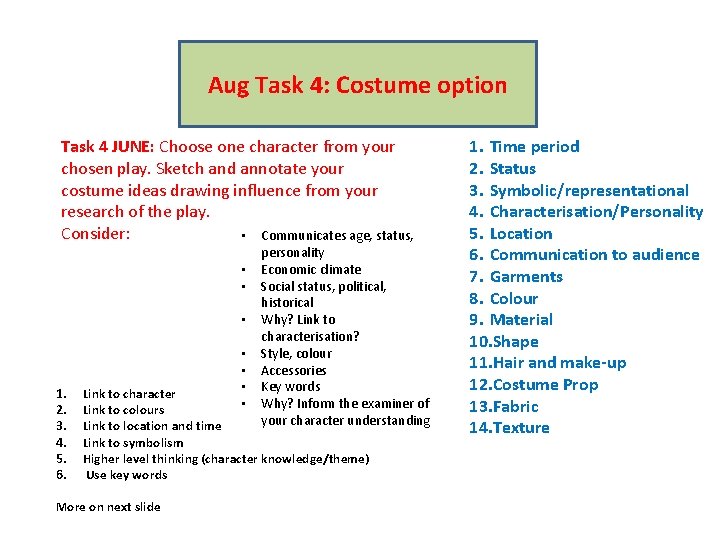
Aug Task 4: Costume option Task 4 JUNE: Choose one character from your chosen play. Sketch and annotate your costume ideas drawing influence from your research of the play. Consider: • Communicates age, status, • • • 1. 2. 3. 4. 5. 6. • • personality Economic climate Social status, political, historical Why? Link to characterisation? Style, colour Accessories Key words Why? Inform the examiner of your character understanding Link to character Link to colours Link to location and time Link to symbolism Higher level thinking (character knowledge/theme) Use key words More on next slide 1. Time period 2. Status 3. Symbolic/representational 4. Characterisation/Personality 5. Location 6. Communication to audience 7. Garments 8. Colour 9. Material 10. Shape 11. Hair and make-up 12. Costume Prop 13. Fabric 14. Texture
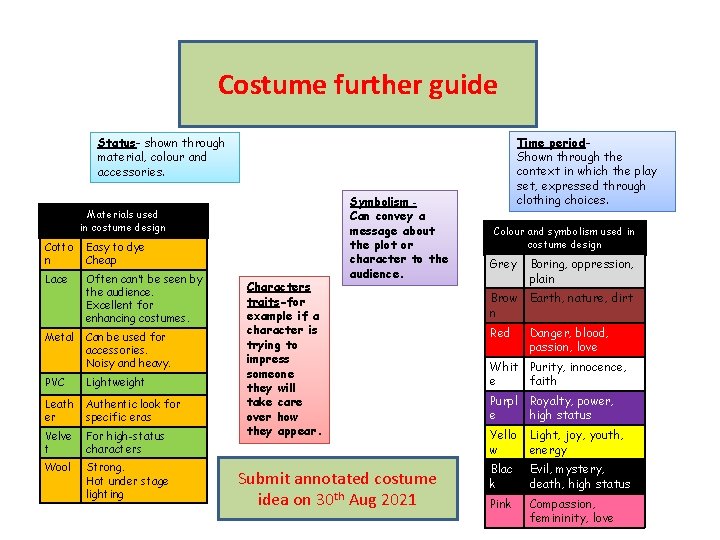
Costume further guide Time period. Shown through the context in which the play set, expressed through clothing choices. Status- shown through material, colour and accessories. Materials used in costume design Cotto n Easy to dye Cheap Lace Often can’t be seen by the audience. Excellent for enhancing costumes. Metal Can be used for accessories. Noisy and heavy. PVC Lightweight Leath er Authentic look for specific eras Velve t For high-status characters Wool Strong. Hot under stage lighting Characters traits-for example if a character is trying to impress someone they will take care over how they appear. Symbolism – Can convey a message about the plot or character to the audience. Submit annotated costume idea on 30 th Aug 2021 Colour and symbolism used in costume design Grey Boring, oppression, plain Brow Earth, nature, dirt n Red Danger, blood, passion, love Whit Purity, innocence, e faith Purpl Royalty, power, e high status Yello w Light, joy, youth, energy Blac k Evil, mystery, death, high status Pink Compassion, femininity, love
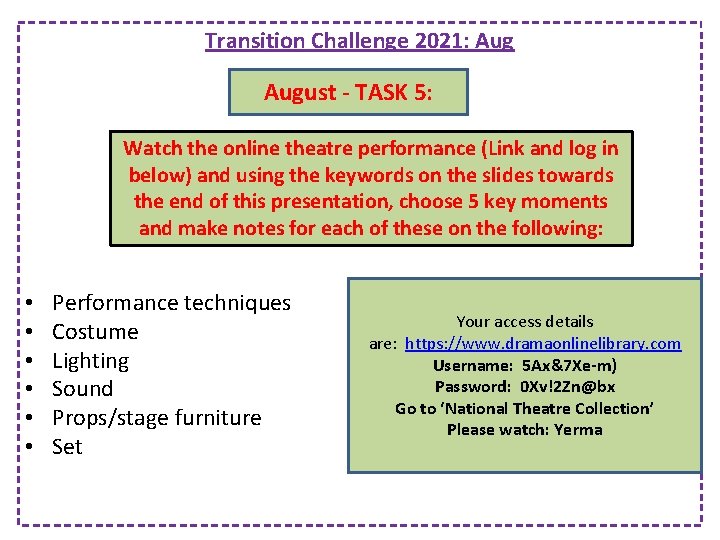
Transition Challenge 2021: August - TASK 5: Watch the online theatre performance (Link and log in below) and using the keywords on the slides towards the end of this presentation, choose 5 key moments and make notes for each of these on the following: • • • Performance techniques Costume Lighting Sound Props/stage furniture Set Your access details are: https: //www. dramaonlinelibrary. com Username: 5 Ax&7 Xe-m) Password: 0 Xv!2 Zn@bx Go to ‘National Theatre Collection’ Please watch: Yerma
August - Task 6: Live Theatre Question Analyse and evaluate the live performance you have seen in light of the following statement: ‘Live theatre today has no connection to the lives of young people’ This question asks you to respond to a thought-provoking statement in light of watching a piece of live theatre. At the heart of the statement is the debate that live performance has no relevance or interest to young people. You will need to engage with the statement as an informed member of the audience and discuss the contribution made by different theatre makers. You will want to offer the following in your response to the question: • • • Arguments that agree, disagree or offer a balanced reaction to the statement Analysis and understanding of the role of the director and how specific production values have been used to communicate ideas and meaning to an audience Analysis and evaluation of how dramatic elements have been used to create theatrical impact such as set, lighting, costume, sound, staging and acting (key moments) The evaluation of key theatre makers, their collaboration and the contribution they have made to specific aspects of the production Reference to key moments An understanding of the overall aims and intentions of the production.
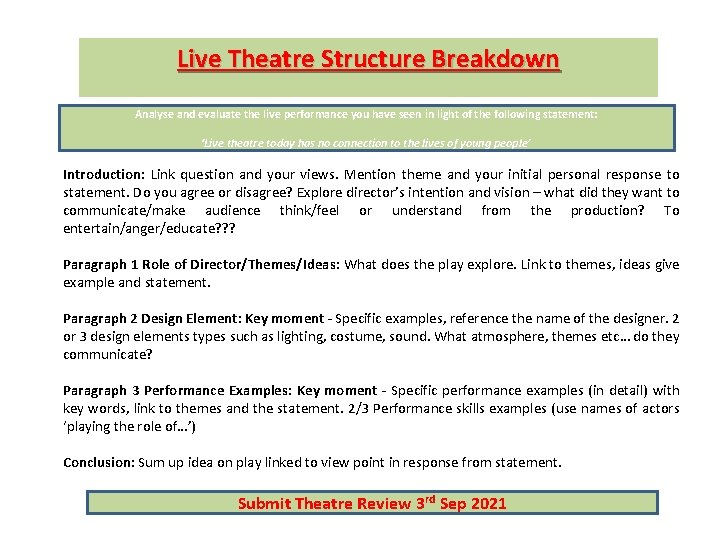
Live Theatre Structure Breakdown Analyse and evaluate the live performance you have seen in light of the following statement: ‘Live theatre today has no connection to the lives of young people’ Introduction: Link question and your views. Mention theme and your initial personal response to statement. Do you agree or disagree? Explore director’s intention and vision – what did they want to communicate/make audience think/feel or understand from the production? To entertain/anger/educate? ? ? Paragraph 1 Role of Director/Themes/Ideas: What does the play explore. Link to themes, ideas give example and statement. Paragraph 2 Design Element: Key moment - Specific examples, reference the name of the designer. 2 or 3 design elements types such as lighting, costume, sound. What atmosphere, themes etc… do they communicate? Paragraph 3 Performance Examples: Key moment - Specific performance examples (in detail) with key words, link to themes and the statement. 2/3 Performance skills examples (use names of actors ‘playing the role of…’) Conclusion: Sum up idea on play linked to view point in response from statement. Submit Theatre Review 3 rd Sep 2021
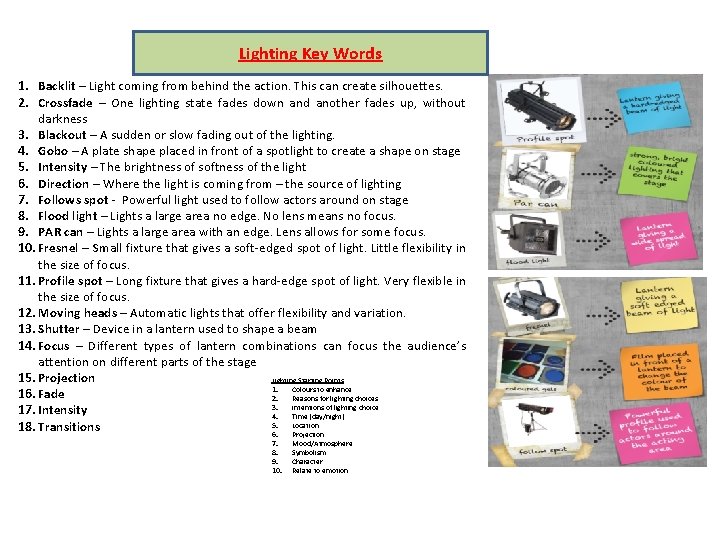
Lighting Key Words 1. Backlit – Light coming from behind the action. This can create silhouettes. 2. Crossfade – One lighting state fades down and another fades up, without darkness 3. Blackout – A sudden or slow fading out of the lighting. 4. Gobo – A plate shape placed in front of a spotlight to create a shape on stage 5. Intensity – The brightness of softness of the light 6. Direction – Where the light is coming from – the source of lighting 7. Follows spot - Powerful light used to follow actors around on stage 8. Flood light – Lights a large area no edge. No lens means no focus. 9. PAR can – Lights a large area with an edge. Lens allows for some focus. 10. Fresnel – Small fixture that gives a soft-edged spot of light. Little flexibility in the size of focus. 11. Profile spot – Long fixture that gives a hard-edge spot of light. Very flexible in the size of focus. 12. Moving heads – Automatic lights that offer flexibility and variation. 13. Shutter – Device in a lantern used to shape a beam 14. Focus – Different types of lantern combinations can focus the audience’s attention on different parts of the stage 15. Projection Lighting Starting Points 1. Colours to enhance 16. Fade 2. Reasons for lighting choices 3. Intentions of lighting choice 17. Intensity 4. Time (day/night) 5. Location 18. Transitions 6. Projection 7. 8. 9. 10. Mood/Atmosphere Symbolism Character Relate to emotion
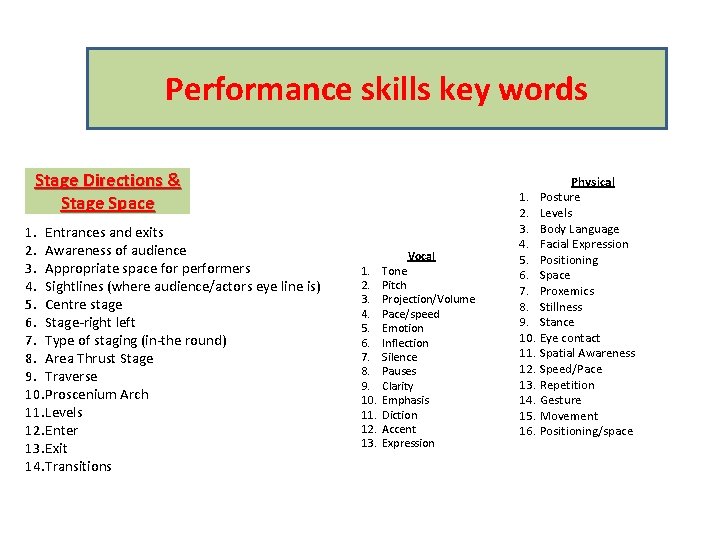
Performance skills key words Stage Directions & Stage Space 1. Entrances and exits 2. Awareness of audience 3. Appropriate space for performers 4. Sightlines (where audience/actors eye line is) 5. Centre stage 6. Stage-right left 7. Type of staging (in-the round) 8. Area Thrust Stage 9. Traverse 10. Proscenium Arch 11. Levels 12. Enter 13. Exit 14. Transitions 1. 2. 3. 4. 5. 6. 7. 8. 9. 10. 11. 12. 13. Vocal Tone Pitch Projection/Volume Pace/speed Emotion Inflection Silence Pauses Clarity Emphasis Diction Accent Expression Physical 1. Posture 2. Levels 3. Body Language 4. Facial Expression 5. Positioning 6. Space 7. Proxemics 8. Stillness 9. Stance 10. Eye contact 11. Spatial Awareness 12. Speed/Pace 13. Repetition 14. Gesture 15. Movement 16. Positioning/space
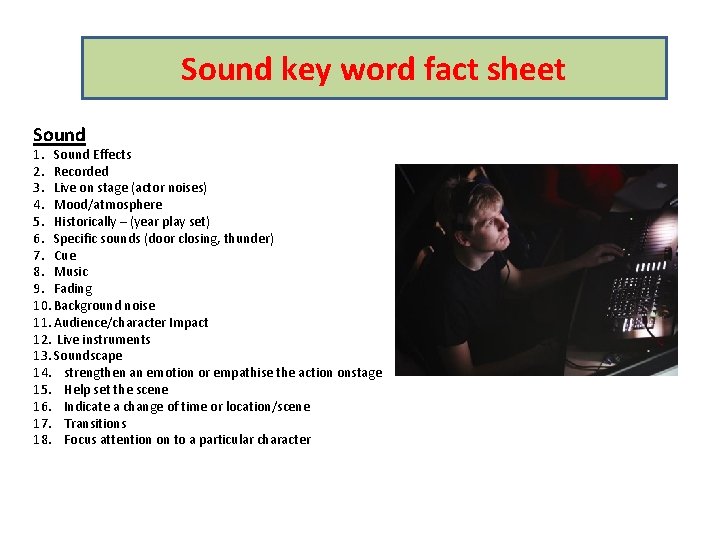
Sound key word fact sheet Sound 1. Sound Effects 2. Recorded 3. Live on stage (actor noises) 4. Mood/atmosphere 5. Historically – (year play set) 6. Specific sounds (door closing, thunder) 7. Cue 8. Music 9. Fading 10. Background noise 11. Audience/character Impact 12. Live instruments 13. Soundscape 14. strengthen an emotion or empathise the action onstage 15. Help set the scene 16. Indicate a change of time or location/scene 17. Transitions 18. Focus attention on to a particular character
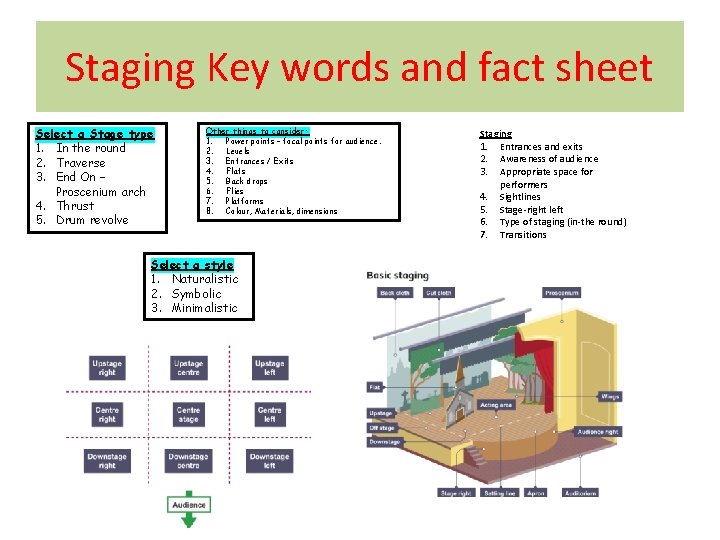
Staging Key words and fact sheet Select a Stage type 1. In the round 2. Traverse 3. End On – Proscenium arch 4. Thrust 5. Drum revolve Other things to consider: 1. Power points – focal points for audience. 2. Levels 3. Entrances / Exits 4. Flats 5. Back drops 6. Flies 7. Platforms 8. Colour, Materials, dimensions Select a style 1. Naturalistic 2. Symbolic 3. Minimalistic Staging 1. Entrances and exits 2. Awareness of audience 3. Appropriate space for performers 4. Sightlines 5. Stage-right left 6. Type of staging (in-the round) 7. Transitions
Transition Challenge 2021: OPTIONAL EXTRAS Other things that you could be doing include: Using the amazing resource from Drama Online (you have the log in details below) and watch other productions that take your fancy… Your access details are: https: //www. dramaonlinelibrary. com Username: 5 Ax&7 Xe-m) Password: 0 Xv!2 Zn@bx Go to ‘National Theatre collection’ Watch the following interesting clips: https: //www. youtube. com/watch? v=Gv. JRh. CQ-n. LI https: //www. youtube. com/watch? v=M 6 VFf. Gv. AVZI Explore the reading list on the next slide…
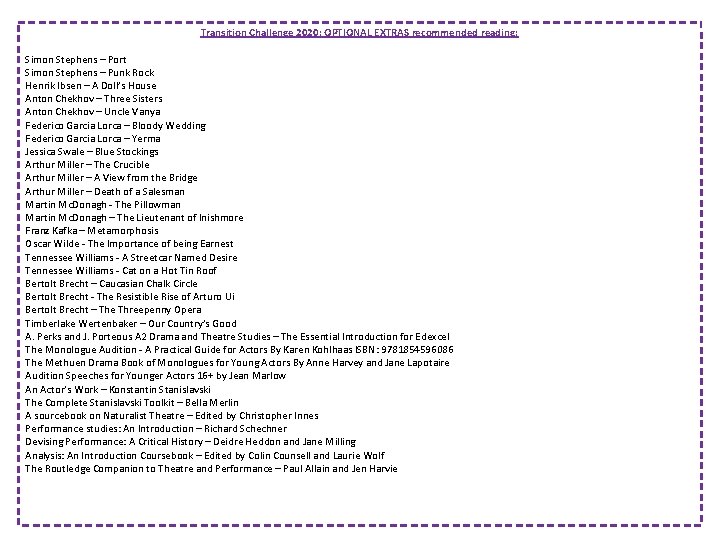
Transition Challenge 2020: OPTIONAL EXTRAS recommended reading: Simon Stephens – Port Simon Stephens – Punk Rock Henrik Ibsen – A Doll’s House Anton Chekhov – Three Sisters Anton Chekhov – Uncle Vanya Federico Garcia Lorca – Bloody Wedding Federico Garcia Lorca – Yerma Jessica Swale – Blue Stockings Arthur Miller – The Crucible Arthur Miller – A View from the Bridge Arthur Miller – Death of a Salesman Martin Mc. Donagh - The Pillowman Martin Mc. Donagh – The Lieutenant of Inishmore Franz Kafka – Metamorphosis Oscar Wilde - The Importance of being Earnest Tennessee Williams - A Streetcar Named Desire Tennessee Williams - Cat on a Hot Tin Roof Bertolt Brecht – Caucasian Chalk Circle Bertolt Brecht - The Resistible Rise of Arturo Ui Bertolt Brecht – The Threepenny Opera Timberlake Wertenbaker – Our Country’s Good A. Perks and J. Porteous A 2 Drama and Theatre Studies – The Essential Introduction for Edexcel The Monologue Audition - A Practical Guide for Actors By Karen Kohlhaas ISBN: 9781854596086 The Methuen Drama Book of Monologues for Young Actors By Anne Harvey and Jane Lapotaire Audition Speeches for Younger Actors 16+ by Jean Marlow An Actor’s Work – Konstantin Stanislavski The Complete Stanislavski Toolkit – Bella Merlin A sourcebook on Naturalist Theatre – Edited by Christopher Innes Performance studies: An Introduction – Richard Schechner Devising Performance: A Critical History – Deidre Heddon and Jane Milling Analysis: An Introduction Coursebook – Edited by Colin Counsell and Laurie Wolf The Routledge Companion to Theatre and Performance – Paul Allain and Jen Harvie
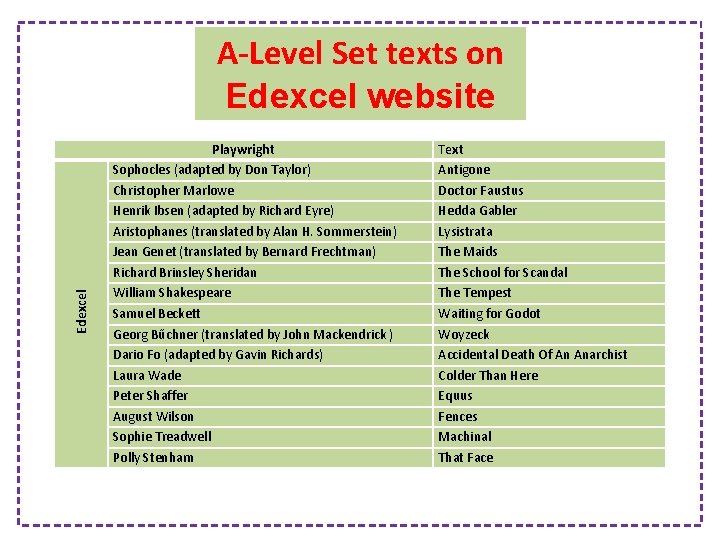
Edexcel A-Level Set texts on Edexcel website Playwright Sophocles (adapted by Don Taylor) Christopher Marlowe Henrik Ibsen (adapted by Richard Eyre) Aristophanes (translated by Alan H. Sommerstein) Jean Genet (translated by Bernard Frechtman) Richard Brinsley Sheridan William Shakespeare Samuel Beckett Georg Bűchner (translated by John Mackendrick ) Dario Fo (adapted by Gavin Richards) Laura Wade Peter Shaffer August Wilson Sophie Treadwell Polly Stenham Text Antigone Doctor Faustus Hedda Gabler Lysistrata The Maids The School for Scandal The Tempest Waiting for Godot Woyzeck Accidental Death Of An Anarchist Colder Than Here Equus Fences Machinal That Face