
Transition BellRingers By Mindy Lingo Malarie Deardorff University

Transition Bell-Ringers By: Mindy Lingo & Malarie Deardorff University of Oklahoma
Today’s Agenda ■ Introduction of Speakers – How Bell-Ringers Started ■ Importance of Transition Education Curriculum ■ ME! Lessons for Teaching Self-Awareness and Self-Advocacy ■ Transition Education Bell-Ringers – Implementation and Results ■ Additional Bell-Ringers – Adaptations to Bell-Ringers
Transition Curriculum ■ Research shows that by promoting self-determination in adolescents with disabilities, the more likely their productive adult outcomes (i. e. , employment, independent living, quality of life, and life satisfaction) will increase (Wehmeyer & Schwartz, 1997) ■ Schools with the most promising transition practices improved students’ self-determination by including the of use (a) curriculum designed specifically for self-determination, (b) teaching and coaching methods to enhance student participation in the IEP process, and (c) non-instructional practices to enhance students’ choices and decision making skills (Karvonen, Test, Wood, Browder, & Algozzine, 2004) ■ Many students with disabilities cannot learn the skills and behaviors associated with self-determination on their own, they still have a desire to master the skills and this is only possible through guidance of teachers (Campbell-Whatley, 2008).
Student Led IEPs ■ Students are more likely to take ownership of the educational planning when they are actively involved in the process (Fiedler & Danneker, 2007). ■ Students are gaining important life skills and demonstrating self-determination when they lead their IEP meetings through goal setting, planning, self-evaluation, mediation, public speaking, self-advocacy, and mediation skills (Martin, et al. , 2006) ■ Student-led IEP meetings provide opportunities for students to learn and participate in important social skills (Torgeson, Miner, & Shen, 2004).
Bell-Ringers ■ A tool teachers use within their classroom to help focus their students’ minds. ■ Short activity designed to be completed independently during the first few minutes of class while the teacher is taking attendance or completing other administrative tasks. ■ Reinforces that learning starts as soon as students enter the room ■ Recommended by education experts like Harry Wong and Fred Jones as effective behavior management techniques ■ Also called bell work, daily warm-up, do nows, mini lessons.
ME! Lessons for Teaching Self-Awareness and Self-Advocacy ■ ME! Lessons teach students to understand special education, special education rights and responsibilities, IEP components, personal strengths and weaknesses, accommodations, and selfadvocacy skills. ■ Activities include role-playing, case studies, Power. Point presentations, teacher-directed instruction, video clips, a student research project, and opportunities for students to familiarize themselves with their own IEP. While completing the lessons, students create a portfolio containing information to aid future self-advocacy endeavors.

Transition Education Bell-Ringers ■ The Transition Education Bell Ringers (formerly known as ME! Bell Ringers) consist of 50, 10 minute lessons devoted to teaching self-awareness, selfadvocacy, disability awareness, and student-led IEPs. ■ Can be used once a week for a full school year or introduced the first 40 -50 school days. ■ Adaptable to meet classroom needs. ■ Teacher developed to meet the need of teaching transition skills in
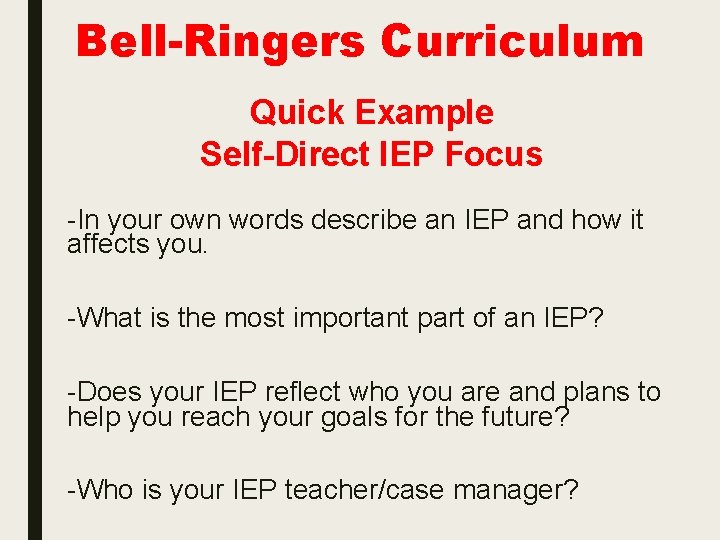
Bell-Ringers Curriculum Quick Example Self-Direct IEP Focus -In your own words describe an IEP and how it affects you. -What is the most important part of an IEP? -Does your IEP reflect who you are and plans to help you reach your goals for the future? -Who is your IEP teacher/case manager?
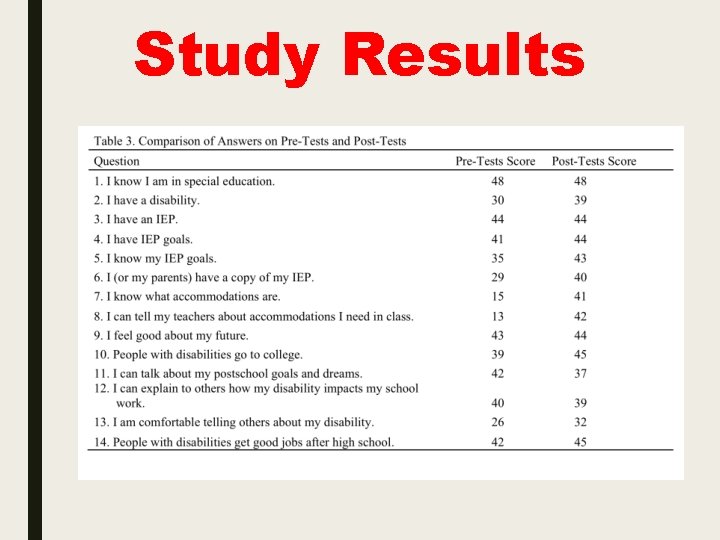
Study Results
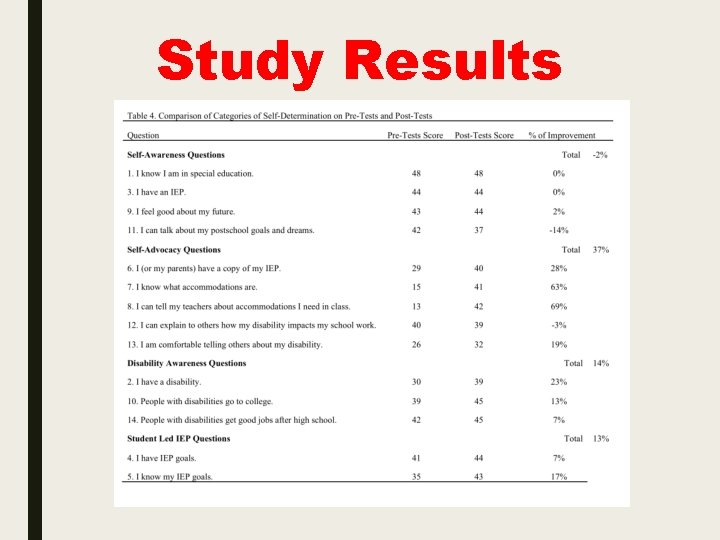
Study Results
Additional Bell-Ringers ■ Fundamental Bell Ringers – teaches self-determination concepts using simpler language and concepts. Can be used in elementary setting and be adapted for students working on alternate achievement standards. ■ Financial Literacy Bell Ringers – Aligned with personal financial literacy objectives, great for secondary math classes both special education and general education.
Bell-Ringers Curriculum Access Through Zarrow Center Bellringers
Adaptation of Bell-Ringers ■ The bell-ringers were designed so you can adapt them to meet your personalized needs. Download from Zarrow Center website and adjust accordingly. ■ Real-life examples for adaptations: – Picking and choosing which bell-ringers benefit your students the most. – Doing all the first of school year prior to IEP meetings – Doing once a week – Modifying content for classroom needs.
Adapted Bell-Ringers for Functional Academic Classroom ■ Bell-Ringers ■ Handouts to Supplement
Additional Resources Tying the Knot- Zarrow Center Website Skills to Pay the Bills- US Department of Labor
Contact Information Mindy Lingo @ mindylingo@ou. edu Malarie Deardorff @ malarie. deardorff@ou. edu Zarrow Center for Learning Enrichment Website http: //www. ou. edu/education/centers-andpartnerships/zarrow. html
References ■ Campbell-Whatley, G. D. (2008). Teaching students about their disability: Increasing self-determination skills and self-concept. International Journal of Special Education, 23(2), 136 -144. ■ Fiedler, C. R. , & Danneker, J. E. (2007). Self-advocacy instruction: Bridging the research-to-practice gap. Focus on Exceptional Children, 39(8), 1 -20. ■ Karvonen, M. , Test, D. W. , Wood, W. M. , Browder, D. , & Algozzine, B. (2004). Putting self-determination into practice. Exceptional Children, 71, 23 – 41. ■ Martin, J. E. , Van Dycke, J. L. , Christensen W. R. , Greene B. A. , Gardner J. E. , & Lovett D. L. (2006). Increasing student participation in IEP meetings: Establishing the Self-Directed IEP as an evidenced-based practice. Exceptional Children, 72(3), 299 -316. ■ Torgerson, C. W. , Miner, C. A. , & Shen, H. (2004). Developing student competence in self-directed IEPs. TEACHING Exceptional Children, 38, 4247. ■ Wehmeyer, M. , & Swartz, M. (1997). Self-determination and positive adult outcomes: A follow-up study of youth with mental retardation. Exceptional Children, 63, 245 -255.
- Slides: 18