
Transition 101 Oklahoma Transition Institute Jim Martin OU
















- Slides: 129
Transition 101 Oklahoma Transition Institute Jim Martin, OU Zarrow Center Marcie Stickney, Norman Public Schools Oct 15, 2018 1: 00 to 3: 30
Agenda 1. 2. 3. 4. OTI Overview Transition Defined Legally Transition Defined Programmatically Eight Transition Big Ideas Presentation Materials May Be Downloaded at http: //zarrowcenter. ou. edu
Introductions – Get to Know Your Neighbors ■ ■ Name Affiliation Position Describe One Effective Transition Practice
Overview of the Oklahoma Transition Institute (OTI)
OTI’s Mission The mission of the Oklahoma Transition Council is to improve transition education, planning, and services that lead to successful post-school outcomes for students with disabilities.
OTI Origin Story ■ ■ Adopted from New Mexico’s transition change efforts Based on Dr. Paula Kohler’s Transition Taxonomy Assistance from the National Secondary Transition Technical Assistance Center started OTI and facilitated it becoming established OTC now operates independently of any one agency. Lead agencies and others who pool resources to make it happen.
OTI Origin Story Continues ■ ■ In 2002, an ad hoc group from Departments of Education, Rehabilitation, Career & Technology Education, higher education, and public schools met to discuss how to improve transition education and post-school outcomes In 2004, the Oklahoma Transition Council formed to develop the Oklahoma Transition Institute This year we are holding the 13 th OTI, which means the first OTI was held in. . 2006 Approximately 35 teams developed implementation plans to improve their transition education practices. OTI has grown considerably over the years with the 8 th, 9 th, 10 th and 11 th Institutes registering close to 500 attendees from across the state, with almost 600 people attending the 12 th OTI
A Few of the OTC Members ● Department of Rehabilitation Services ● State Department of Education ● OU Zarrow Center ● Sooner Success ● OK Rehabilitation Council ● Tech-Now ● ABLE Tech ● OK Autism Network
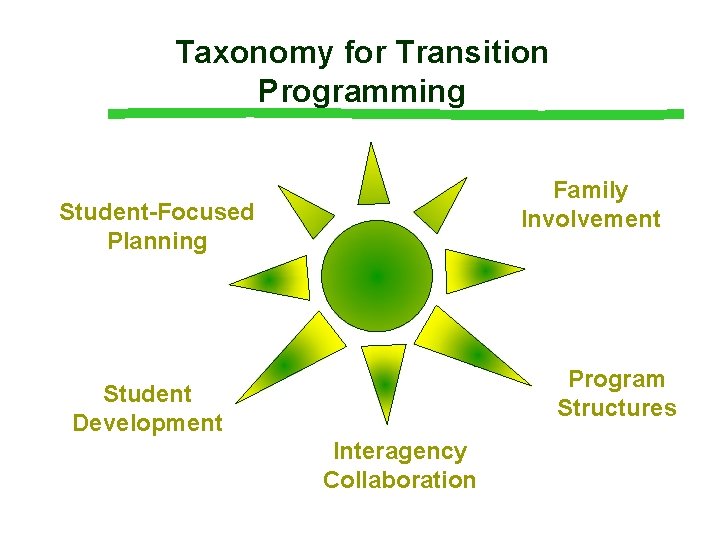
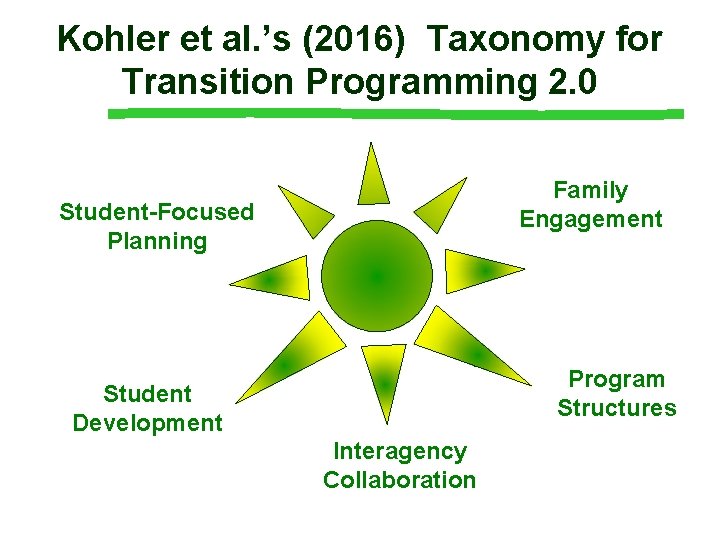
Taxonomy for Transition Programming Family Involvement Student-Focused Planning Program Structures Student Development Interagency Collaboration
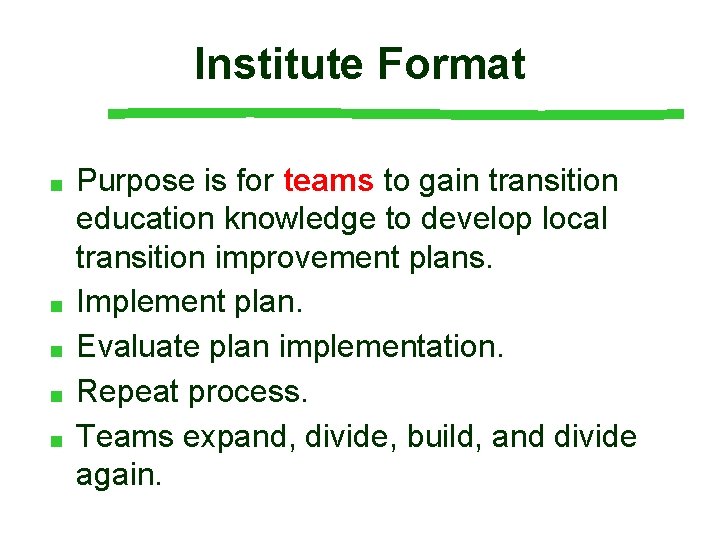
Institute Format ■ ■ ■ Purpose is for teams to gain transition education knowledge to develop local transition improvement plans. Implement plan. Evaluate plan implementation. Repeat process. Teams expand, divide, build, and divide again.
Team Function ■ ■ ■ Teams meet regularly to implement plan and to gain new knowledge. Teams expand to add new educational and community members. Team leader and others attend regional meetings to gain new knowledge and review progress on plan implementation.
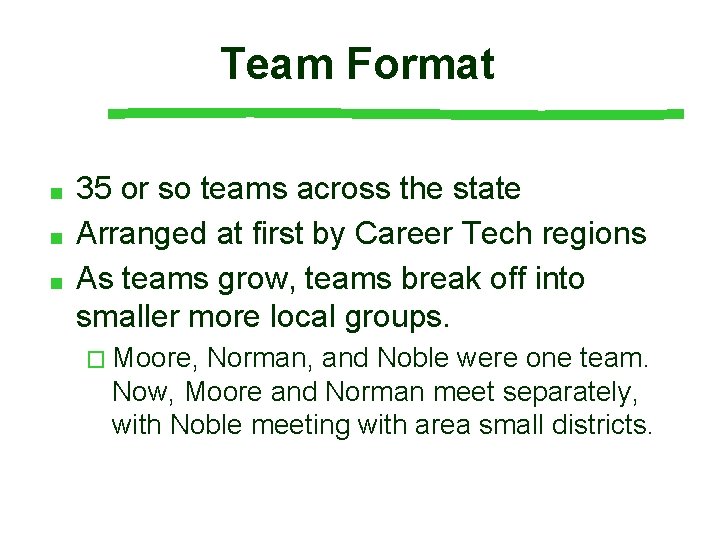
Team Format ■ ■ ■ 35 or so teams across the state Arranged at first by Career Tech regions As teams grow, teams break off into smaller more local groups. � Moore, Norman, and Noble were one team. Now, Moore and Norman meet separately, with Noble meeting with area small districts.
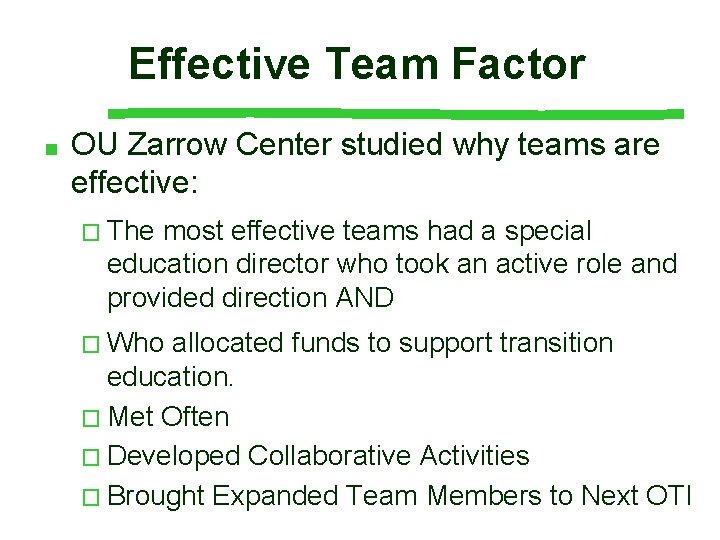
Effective Team Factor ■ OU Zarrow Center studied why teams are effective: � The most effective teams had a special education director who took an active role and provided direction AND � Who allocated funds to support transition education. � Met Often � Developed Collaborative Activities � Brought Expanded Team Members to Next OTI
Making the Most of Your Team ■ ■ ■ Consider the needs of your students/youth Identify resources in your area Offer what you have to bring to the table Be open to new ideas/suggestions Have a “We can” mentality instead of “We can’t” Commit to an ongoing process
Why Transition?
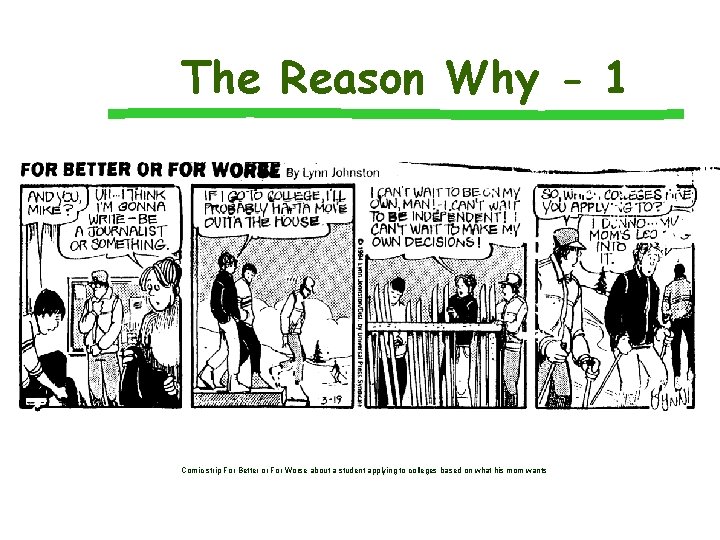
The Reason Why - 1 Comic strip For Better or For Worse about a student applying to colleges based on what his mom wants
Quiz Time
Critical Question ■ What is the purpose of special education as defined by IDEA 2004? 18
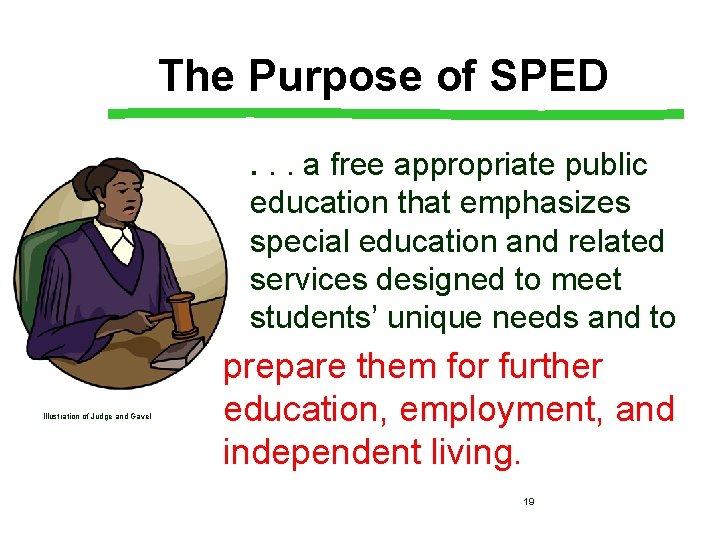
The Purpose of SPED. . . a free appropriate public education that emphasizes special education and related services designed to meet students’ unique needs and to Illustration of Judge and Gavel prepare them for further education, employment, and independent living. 19
Transition Legally
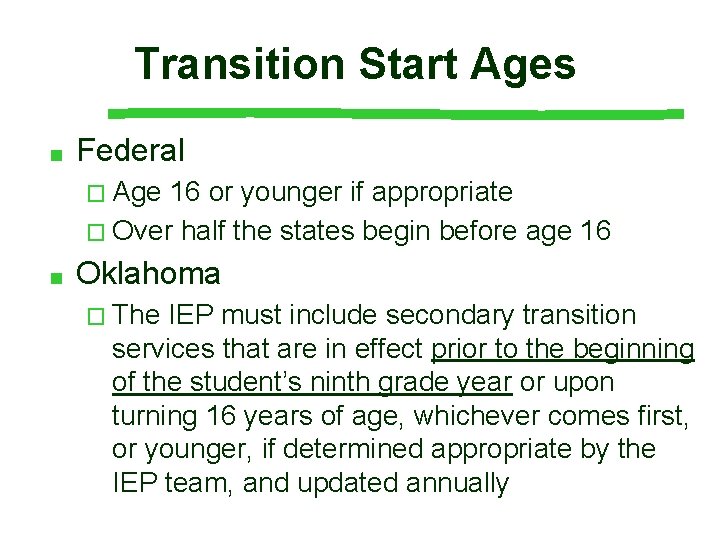
Transition Start Ages ■ Federal � Age 16 or younger if appropriate � Over half the states begin before age 16 ■ Oklahoma � The IEP must include secondary transition services that are in effect prior to the beginning of the student’s ninth grade year or upon turning 16 years of age, whichever comes first, or younger, if determined appropriate by the IEP team, and updated annually
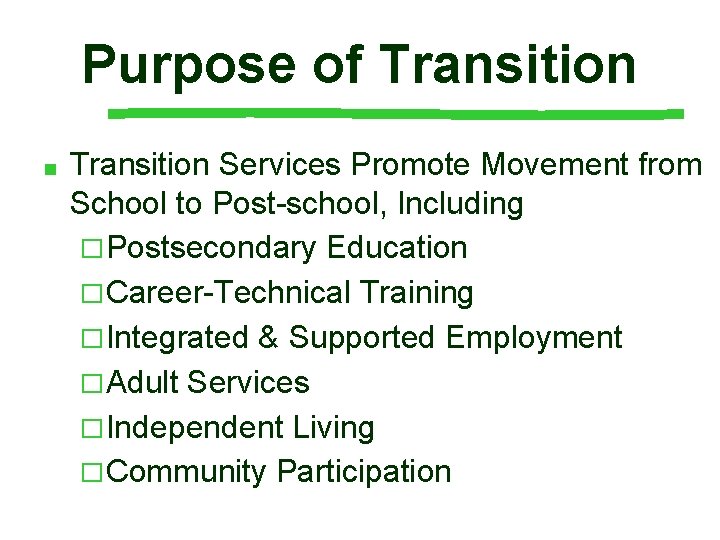
Purpose of Transition ■ Transition Services Promote Movement from School to Post-school, Including � Postsecondary Education � Career-Technical Training � Integrated & Supported Employment � Adult Services � Independent Living � Community Participation
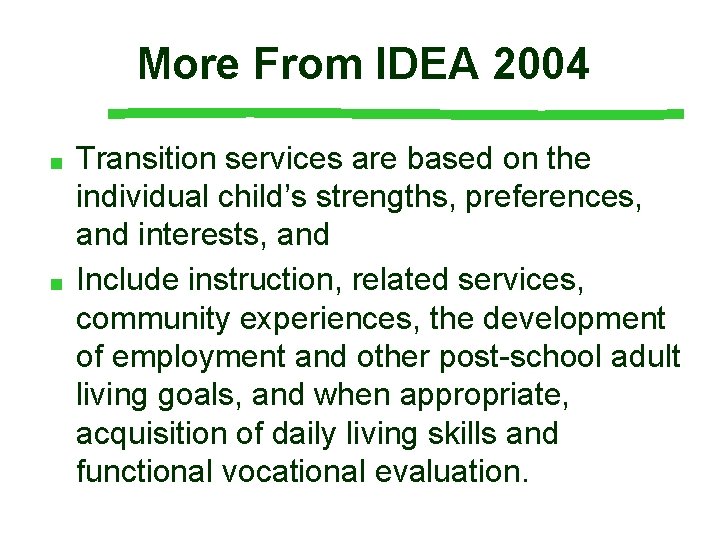
More From IDEA 2004 ■ ■ Transition services are based on the individual child’s strengths, preferences, and interests, and Include instruction, related services, community experiences, the development of employment and other post-school adult living goals, and when appropriate, acquisition of daily living skills and functional vocational evaluation.
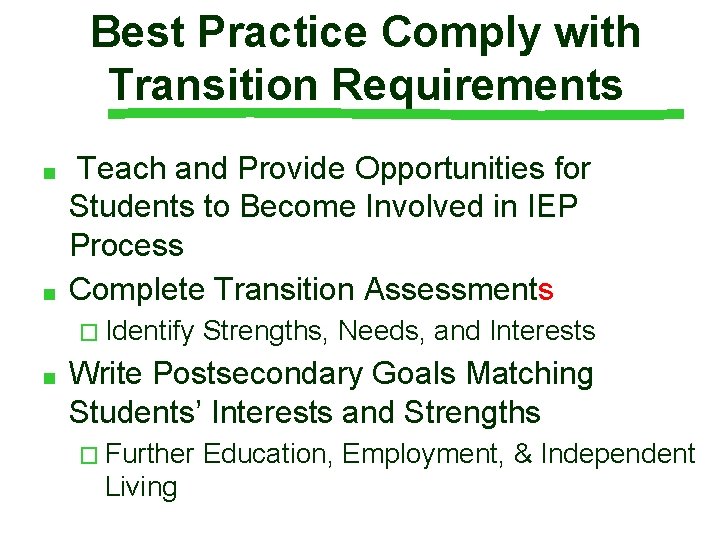
Best Practice Comply with Transition Requirements ■ ■ Teach and Provide Opportunities for Students to Become Involved in IEP Process Complete Transition Assessments � Identify ■ Strengths, Needs, and Interests Write Postsecondary Goals Matching Students’ Interests and Strengths � Further Living Education, Employment, & Independent
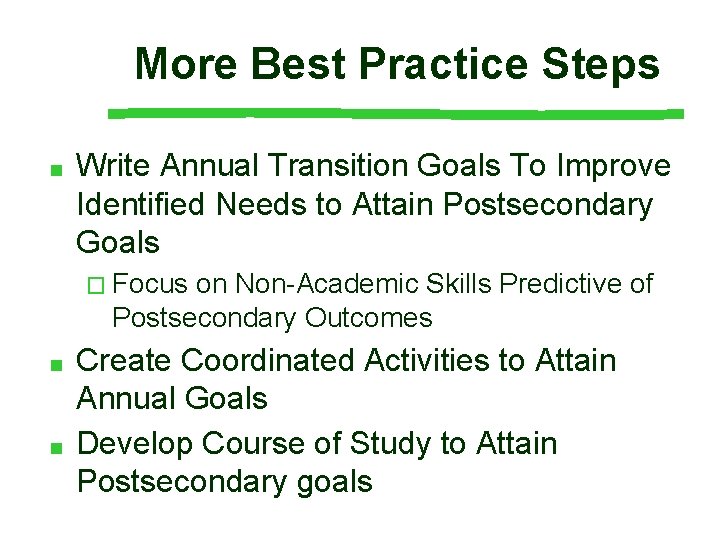
More Best Practice Steps ■ Write Annual Transition Goals To Improve Identified Needs to Attain Postsecondary Goals � Focus on Non-Academic Skills Predictive of Postsecondary Outcomes ■ ■ Create Coordinated Activities to Attain Annual Goals Develop Course of Study to Attain Postsecondary goals
IDEA vs ADA
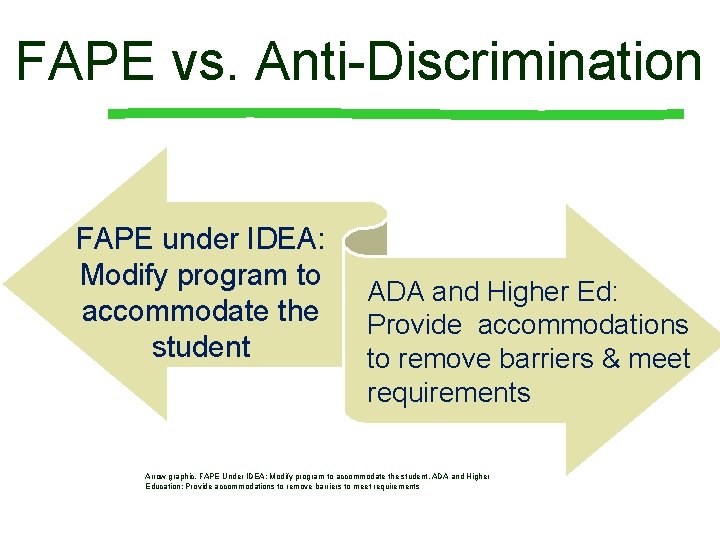
FAPE vs. Anti-Discrimination FAPE under IDEA: Modify program to accommodate the student ADA and Higher Ed: Provide accommodations to remove barriers & meet requirements Arrow graphic. FAPE Under IDEA: Modify program to accommodate the student. ADA and Higher Education: Provide accommodations to remove barriers to meet requirements
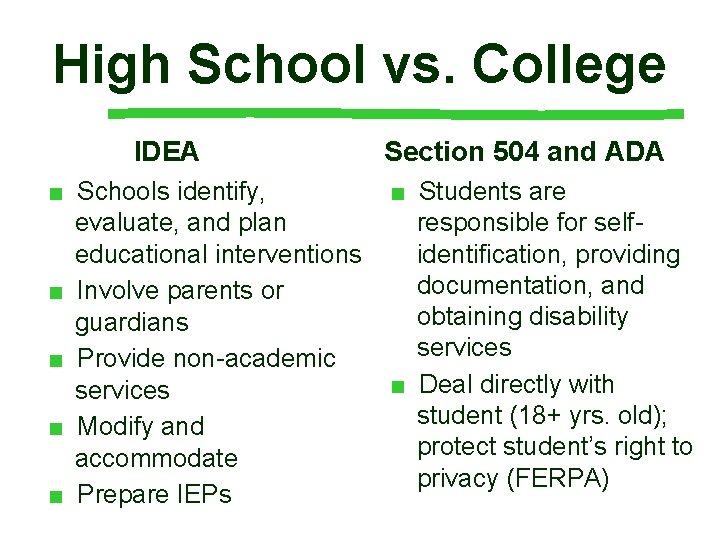
High School vs. College IDEA ■ Schools identify, evaluate, and plan educational interventions ■ Involve parents or guardians ■ Provide non-academic services ■ Modify and accommodate ■ Prepare IEPs Section 504 and ADA ■ Students are responsible for selfidentification, providing documentation, and obtaining disability services ■ Deal directly with student (18+ yrs. old); protect student’s right to privacy (FERPA)
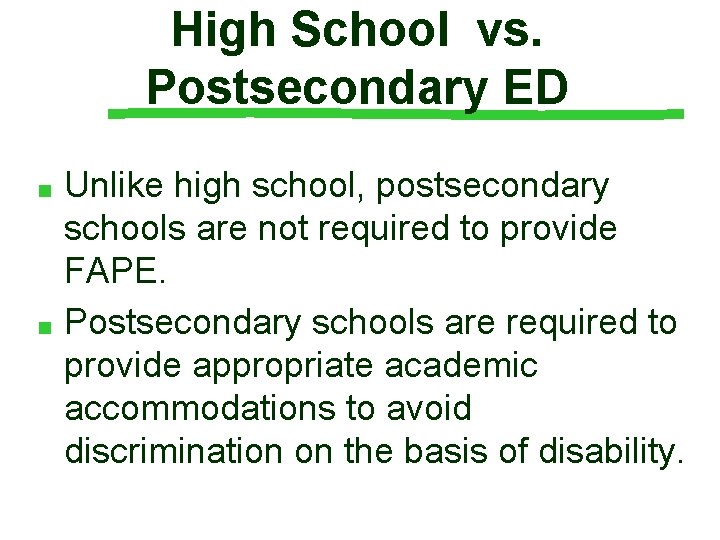
High School vs. Postsecondary ED Unlike high school, postsecondary schools are not required to provide FAPE. ■ Postsecondary schools are required to provide appropriate academic accommodations to avoid discrimination on the basis of disability. ■
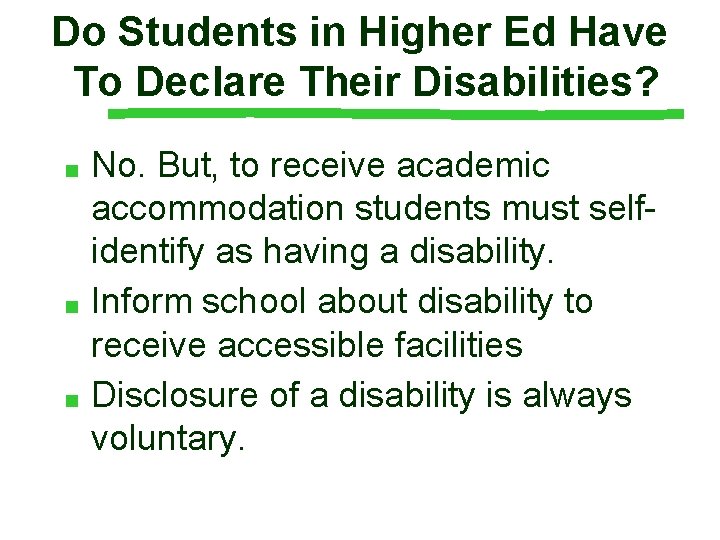
Do Students in Higher Ed Have To Declare Their Disabilities? No. But, to receive academic accommodation students must selfidentify as having a disability. ■ Inform school about disability to receive accessible facilities ■ Disclosure of a disability is always voluntary. ■
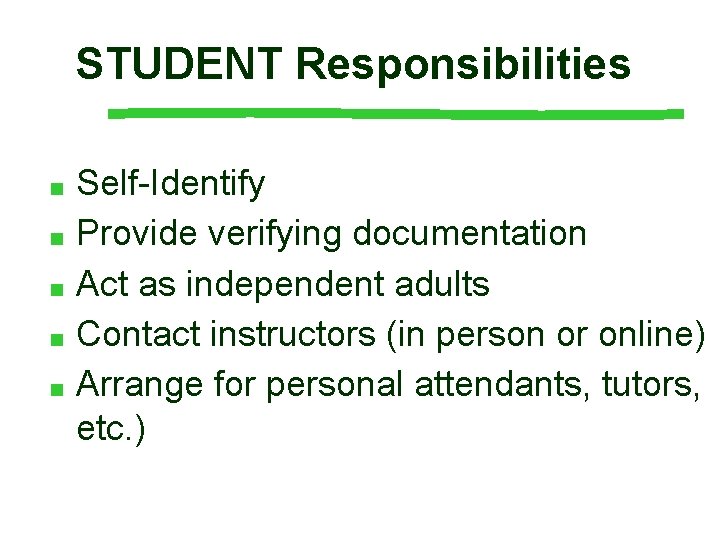
STUDENT Responsibilities Self-Identify ■ Provide verifying documentation ■ Act as independent adults ■ Contact instructors (in person or online) ■ Arrange for personal attendants, tutors, etc. ) ■
College Disability Services Varies ■ Quality and depth of services can vary greatly from school to school ■ Each program must apply services equally for students with disabilities in that school based on identified needs
Transition Programmatically
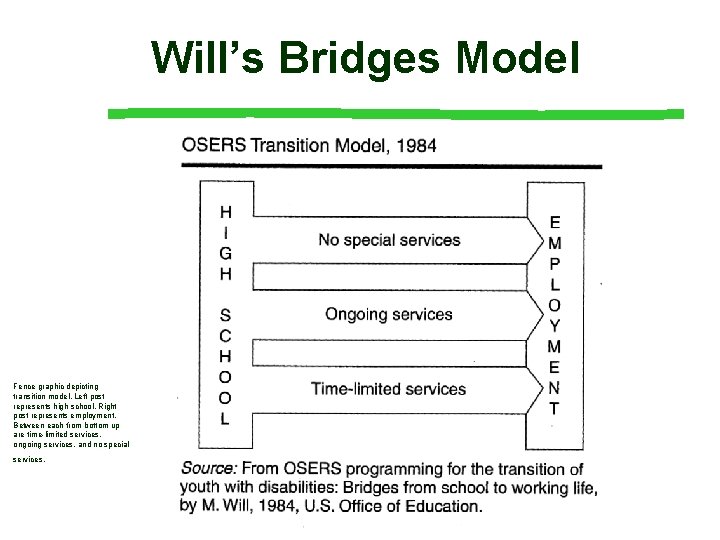
Will’s Bridges Model Fence graphic depicting transition model. Left post represents high school. Right post represents employment. Between each from bottom up are time-limited services, ongoing services, and no special services.
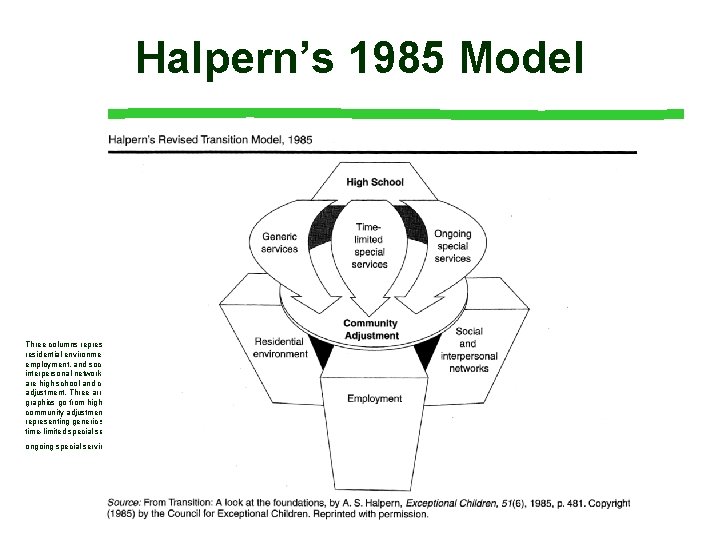
Halpern’s 1985 Model Three columns representing residential environment, employment, and social and interpersonal networks. On top are high school and community adjustment. Three arrow graphics go from high school to community adjustment representing generic service, time-limited special services, and ongoing special services .
Kohler et al. ’s (2016) Taxonomy for Transition Programming 2. 0 Family Engagement Student-Focused Planning Program Structures Student Development Interagency Collaboration
Eight Transition Big IDEAS
Big IDEA #1
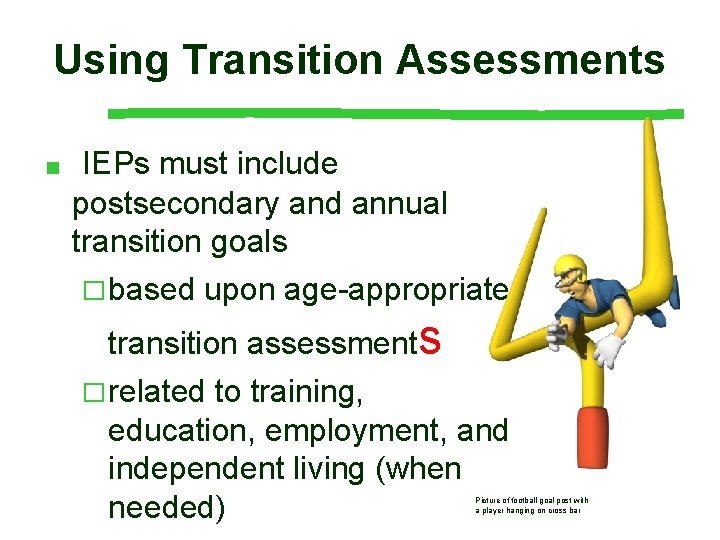
Using Transition Assessments ■ IEPs must include postsecondary and annual transition goals � based upon age-appropriate transition assessments � related to training, education, employment, and independent living (when needed) Picture of football goal post with a player hanging on cross bar
Using Transition Assessments ■ Consider your partners ■ Share results with the IEP team ■ Results assist VR in better understanding the student and in developing their IPE; likewise, ask your partners to share their assessment results with you to include in Present Levels
Transition Assessment & The Courts ■ Prince, Plotner, & Yell (2014) examined district court findings and found. . . � Use multiple assessments across transition domains � DO NOT solely use informal assessments ■ At Least One NEEDS To Be An ASSESSMENT with ample validity evidence � Maximize student participation in the transition planning process
Case Law Decision Case involved not conducting adequate transition assessments. Decision: ■ Told school to focus on meaningful non-academic goals to prepare students for post-school life. Massachusetts Bureau Of Special Education Appeals And Currently Under Appeal In Federal Court, Dracut Public Schools, BSEA #08 -5330, 15 MSER 78 (2009).
DCDT Transition Standards ■ ■ ■ Use valid and reliable transition assessments Use assessments on an ongoing basis Use assessments to identify student interests, skills, and needs Interpret results for students, families, and other professionals Involve students in the transition planning process
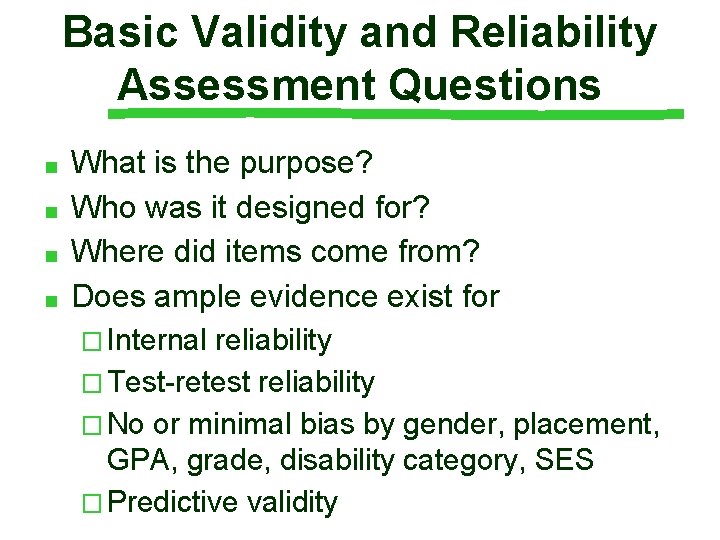
Basic Validity and Reliability Assessment Questions ■ ■ What is the purpose? Who was it designed for? Where did items come from? Does ample evidence exist for � Internal reliability � Test-retest reliability � No or minimal bias by gender, placement, GPA, grade, disability category, SES � Predictive validity
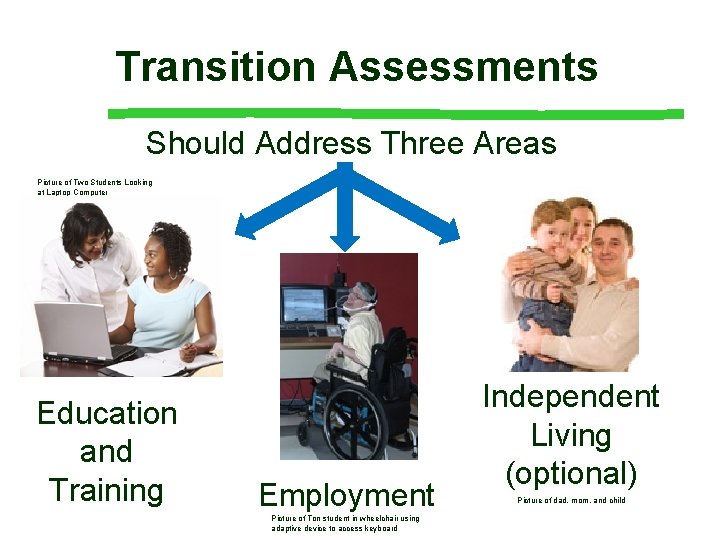
Transition Assessments Should Address Three Areas Picture of Two Students Looking at Laptop Computer Education and Training Employment Picture of Ton student in wheelchair using adaptive device to access keyboard Independent Living (optional) Picture of dad, mom, and child
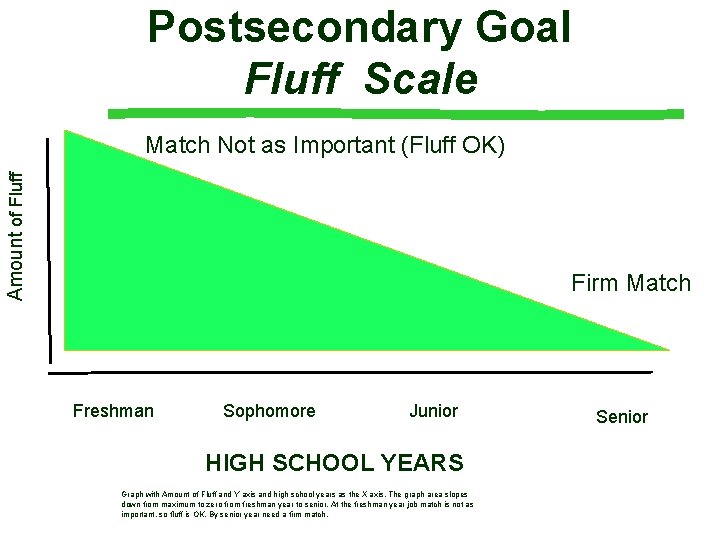
Postsecondary Goal Fluff Scale Amount of Fluff Match Not as Important (Fluff OK) Firm Match Freshman Sophomore Junior HIGH SCHOOL YEARS Graph with Amount of Fluff and Y axis and high school years as the X axis. The graph area slopes down from maximum to zero from freshman year to senior. At the freshman year job match is not as important, so fluff is OK. By senior year need a firm match. Senior
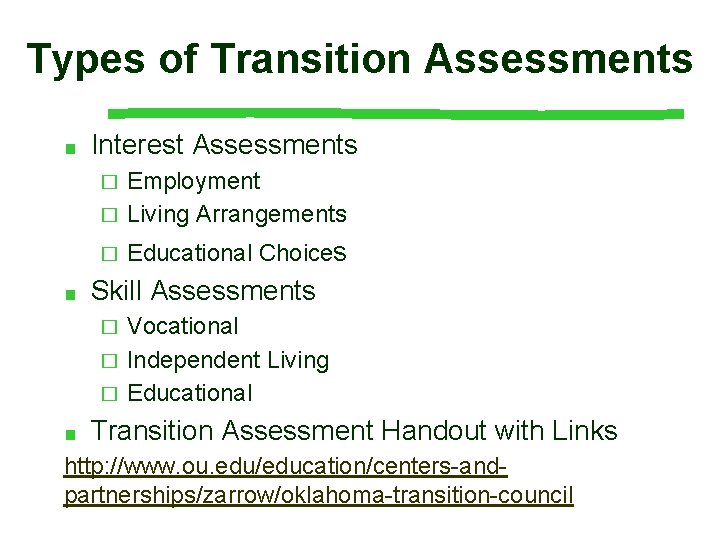
Types of Transition Assessments ■ Interest Assessments Employment � Living Arrangements � � ■ Educational Choices Skill Assessments Vocational � Independent Living � Educational � ■ Transition Assessment Handout with Links http: //www. ou. edu/education/centers-andpartnerships/zarrow/oklahoma-transition-council
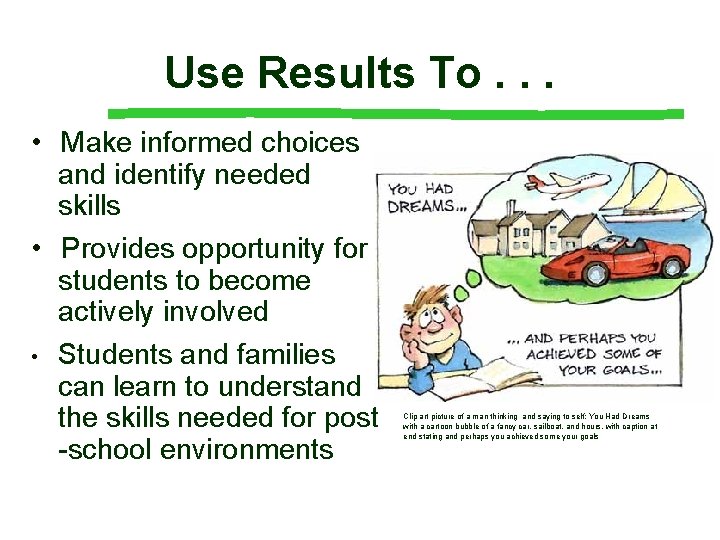
Use Results To. . . • Make informed choices and identify needed skills • Provides opportunity for students to become actively involved • Students and families can learn to understand the skills needed for post -school environments Clip art picture of a man thinking and saying to self: You Had Dreams with a cartoon bubble of a fancy car, sailboat, and hours, with caption at end stating and perhaps you achieved some your goals
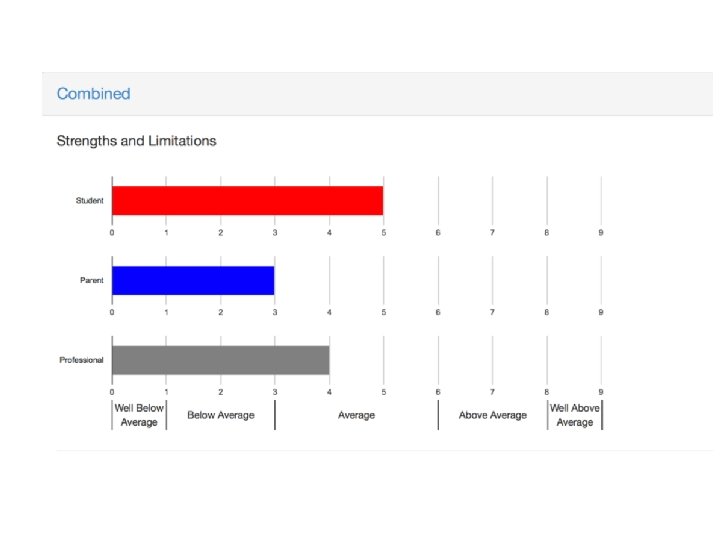
Transition Assessment and Goal Generator ■ ■ An easy-to-use assessment based upon behaviors and experiences research has identified as predictive of post-school employment and further education TAGG assessment yields priority ranked annual transition goals and an overall strengths and needs profile. Ample validity evidence, including predictive validity, support use $3. 00 per TAGG set
TAGG Constructs ■ ■ Strengths and Limitations Disability Awareness Student Involvement in the IEP Persistence ■ ■ Goal setting and attainment Interacting with Others Employment Support Community
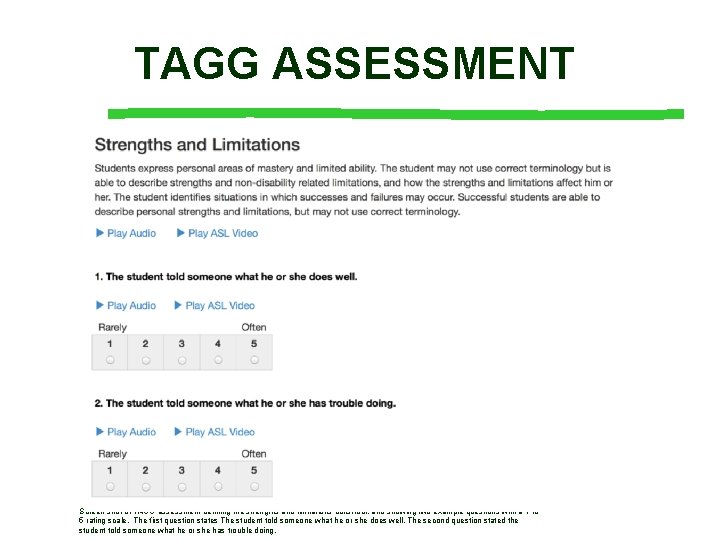
TAGG ASSESSMENT Screen shot of TAGG assessment defining the strengths and limitations construct, and showing two example questions with a 1 to 5 rating scale. The first question states The student told someone what he or she does well. The second question stated the student told someone what he or she has trouble doing.
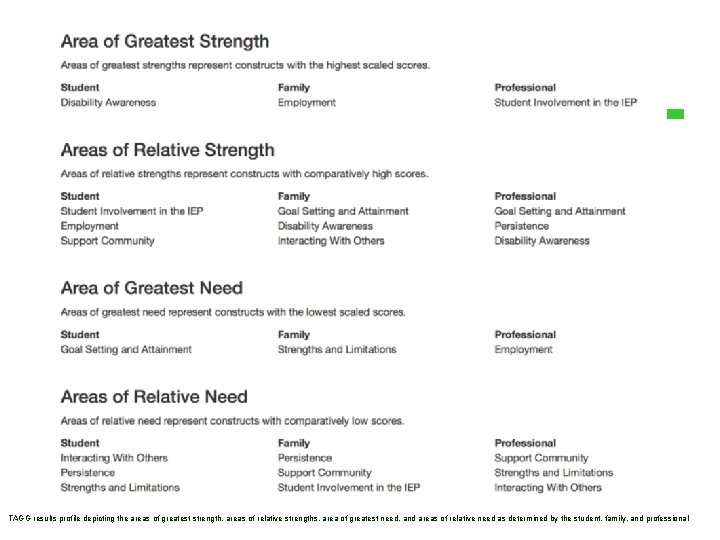
TAGG results profile depicting the areas of greatest strength, areas of relative strengths, area of greatest need, and areas of relative need as determined by the student, family, and professional
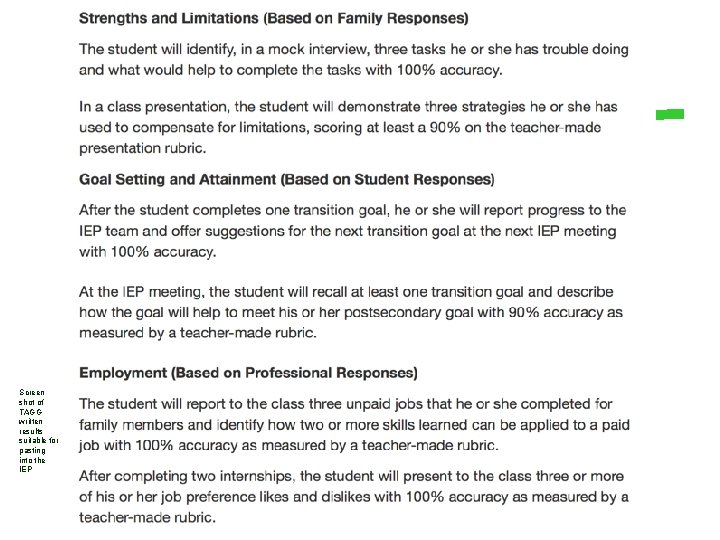
Screen shot of TAGG written results suitable for pasting into the IEP
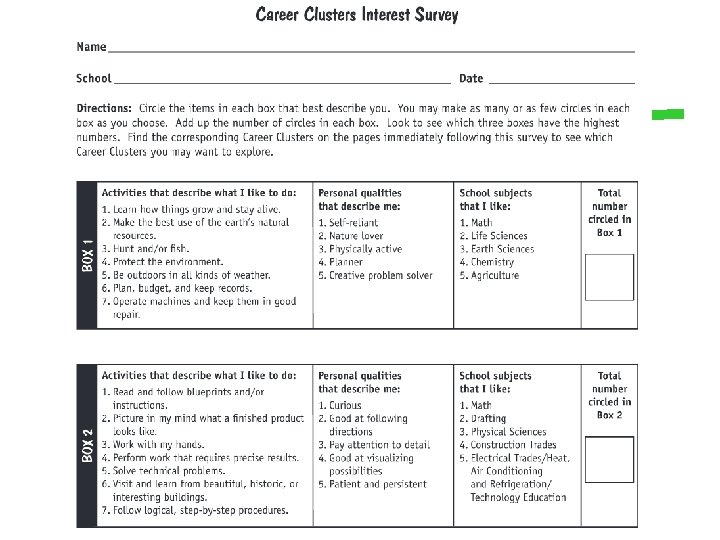
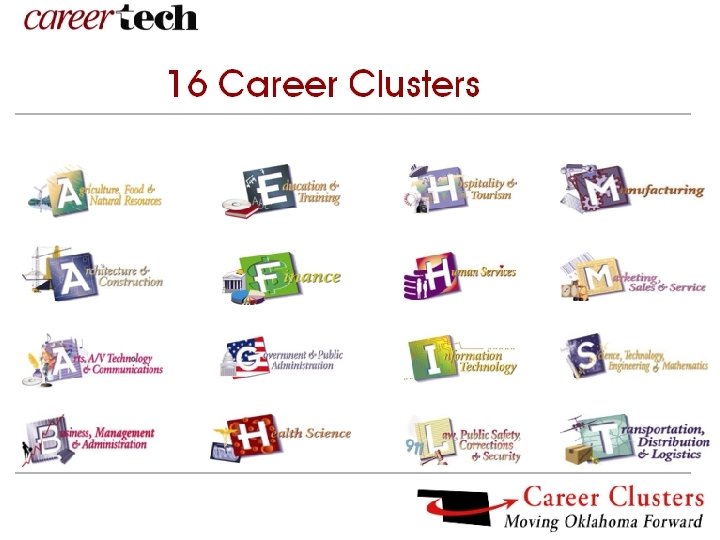
Career Clusters ■ ■ ■ Career Tech programs match career clusters results http: //www. careertech. org/sites/default/file s/Student. Interest. Survey-English. pdf Free
Screen shot of the first two boxes of the career clusters interest survey
Screen shot of the 16 career clusters from the career tech website
On-Line Career Cluster Assessments (Free) ■ Education Planner � http: //www. educationplanner. org/students/car eer-planning/find-careers/careerclusters. shtml � Relates results to O-Net jobs
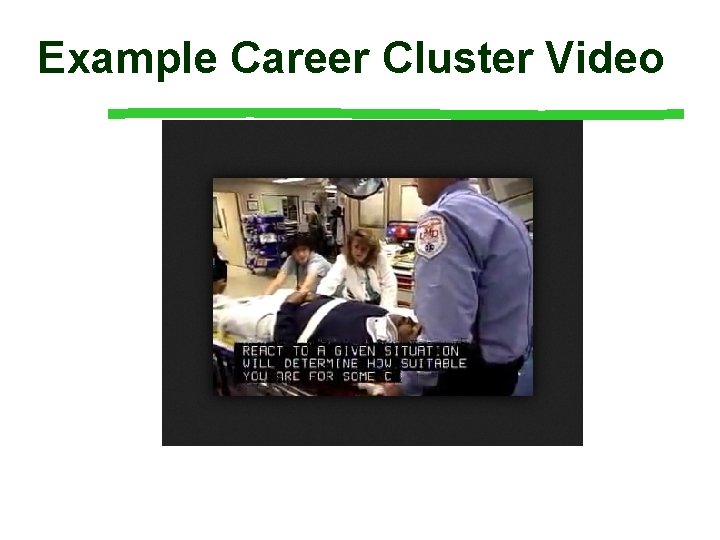
Career One Stop Assessments & Videos ■ Career Clusters Videos � https: //www. careeronestop. org/Videos/Care er. Videos/career-videos. aspx ■ ■ Used for career exploration in identified clusters. Used for interest assessment for students who have trouble reading.
Example Career Cluster Video
OK Career Guide ■ ■ www. okcareerguide. org Use Kuder Assessments � Kuder Interests Assessments ■ Results in career pathways (i. e. , clusters) � Kuder Skills Confidence Assessment � Super’s Work Values Inventory
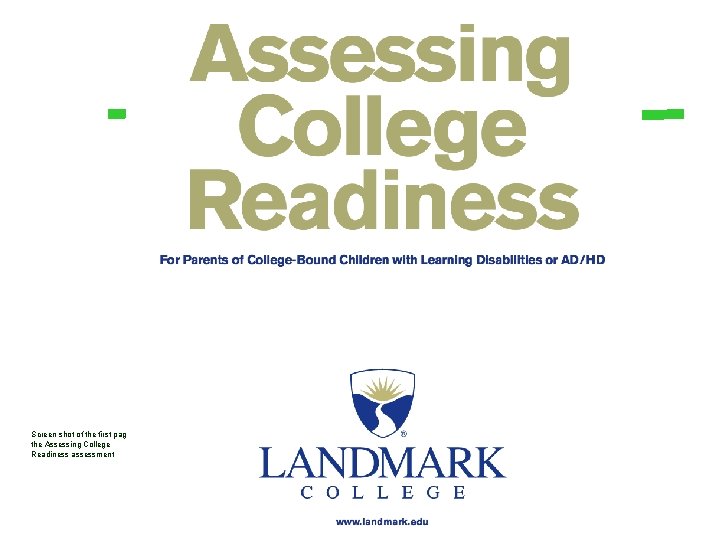
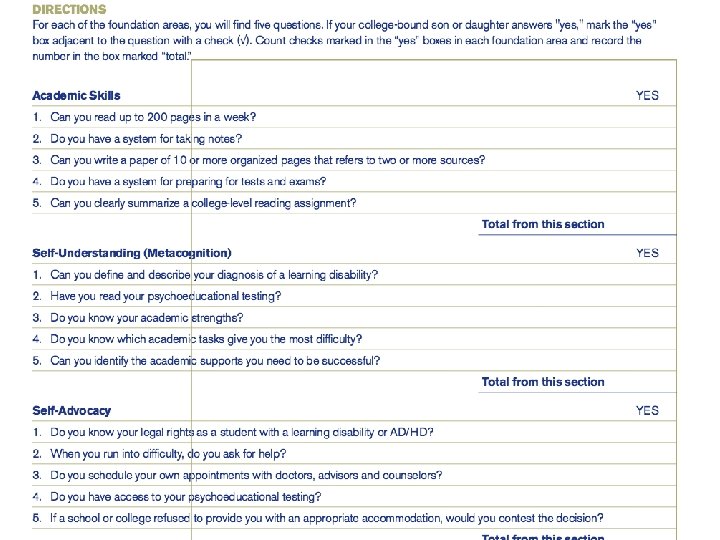
Guide to Assessing College Readiness ■ ■ ■ Landmark College Assessment � http: //www. iidc. indiana. edu/styles/iidc/defiles/INS TRC/Webinars/College. Readiness_Assessment. pdf Five Domains ■ Academic Skills ■ Self-Understanding ■ Self-Advocacy ■ Executive Functioning ■ Motivation and Confidence Cost: Free
Screen shot of the first page of the Assessing College Readiness assessment
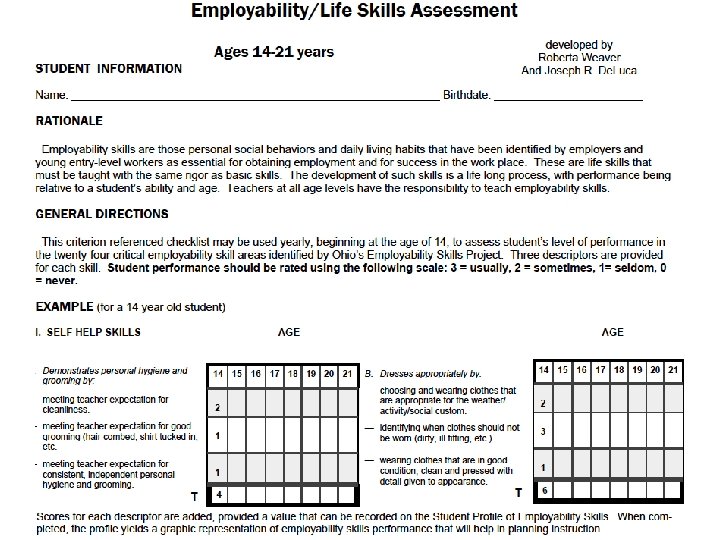
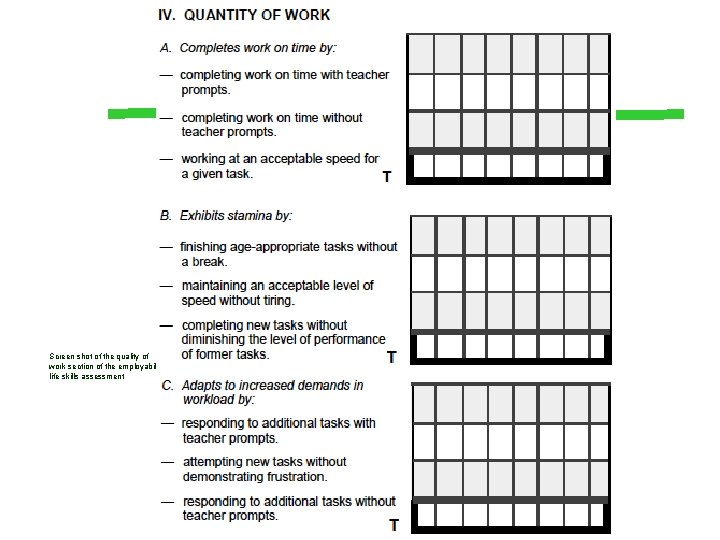
Employability/Life Skill Assessment https: //www. iidc. indiana. edu/styles/iidc/defil es/INSTRC/Webinars/Employability_skills_ checklist. pdf ■ Self-Help Skills ■ Work Habits ■ Task Related ■ Work Quality ■ Attitude
Screen shot of the employability life skills assessment cover page
Screen shot of the quality of work section of the employability life skills assessment
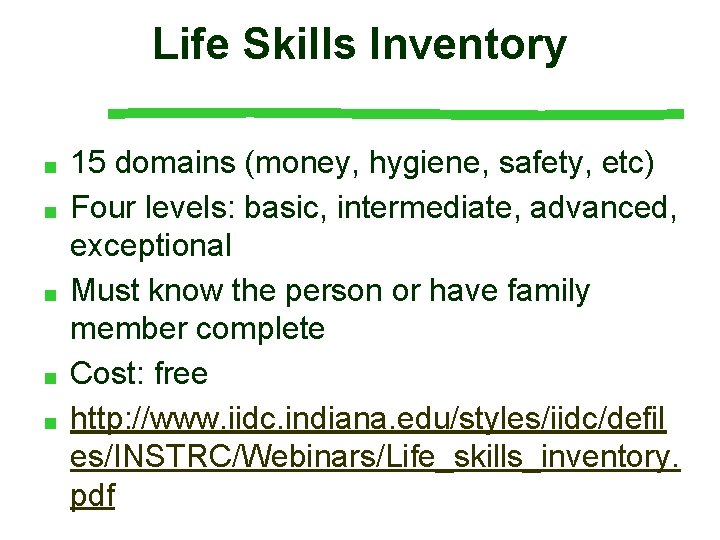
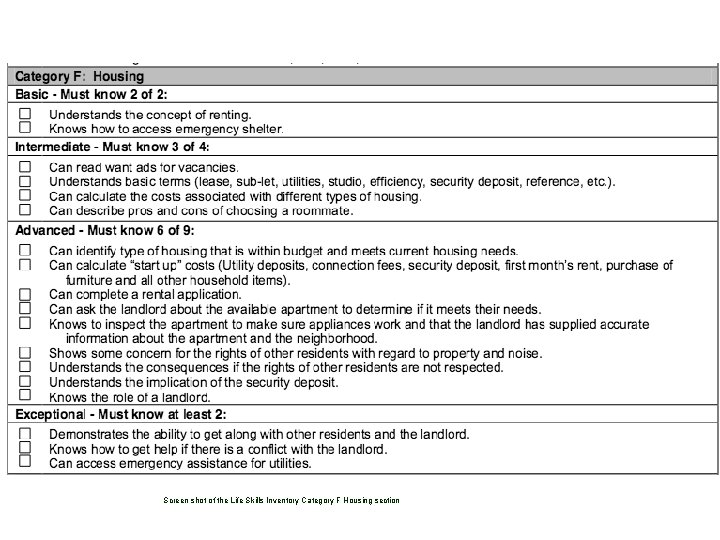
Life Skills Inventory ■ ■ ■ 15 domains (money, hygiene, safety, etc) Four levels: basic, intermediate, advanced, exceptional Must know the person or have family member complete Cost: free http: //www. iidc. indiana. edu/styles/iidc/defil es/INSTRC/Webinars/Life_skills_inventory. pdf
Screen shot of the Life Skills Inventory Category F Housing section
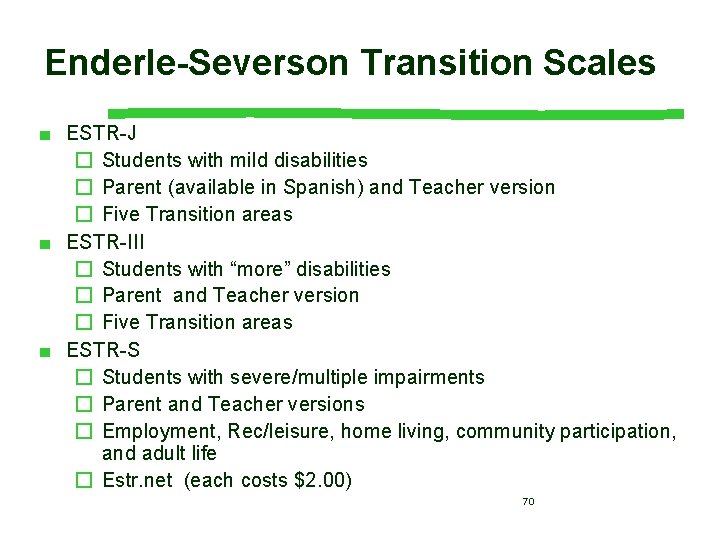
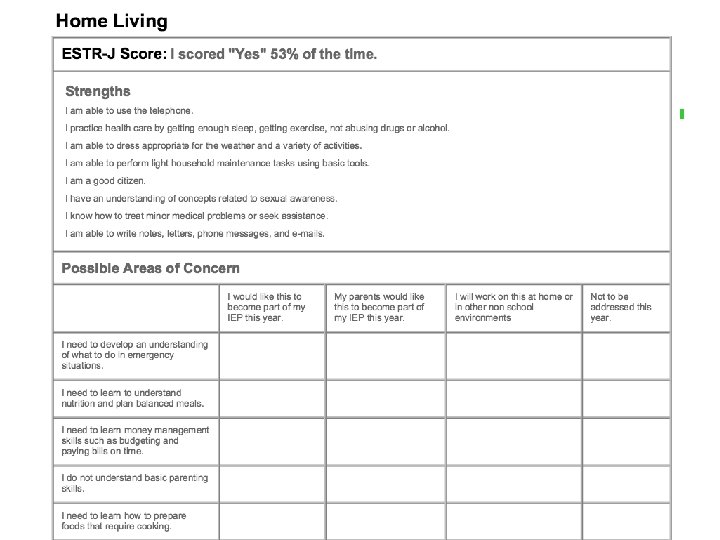
Enderle-Severson Transition Scales ■ ESTR-J � Students with mild disabilities � Parent (available in Spanish) and Teacher version � Five Transition areas ■ ESTR-III � Students with “more” disabilities � Parent and Teacher version � Five Transition areas ■ ESTR-S � Students with severe/multiple impairments � Parent and Teacher versions � Employment, Rec/leisure, home living, community participation, and adult life � Estr. net (each costs $2. 00) 70
Screen shot the example ESTR-J Strengths Report
Casey Life Skills ● ● ● ● Web based and FREE!!! Spanish, French or English, with numerous supplemental assessments Youth and caregiver formats Automatically scored and sent to you Can obtain class summaries Provides different levels of questions for students across functioning levels http: //lifeskills. casey. org/ 72
Casey Life Skills Details ■ ■ Appropriate for all youth ages 14 to 21 regardless of living circumstances (i. e. , in foster care, with bio-parents, in group homes or other places). Comprehensive with 113 assessment items categorized within eight areas for skills, knowledge and awareness. Youth can complete one area at a time or finish the whole assessment in approximately 30 -40 minute
Screen shot of the daily living scoring options for the Casey Life Skills Assessment 74
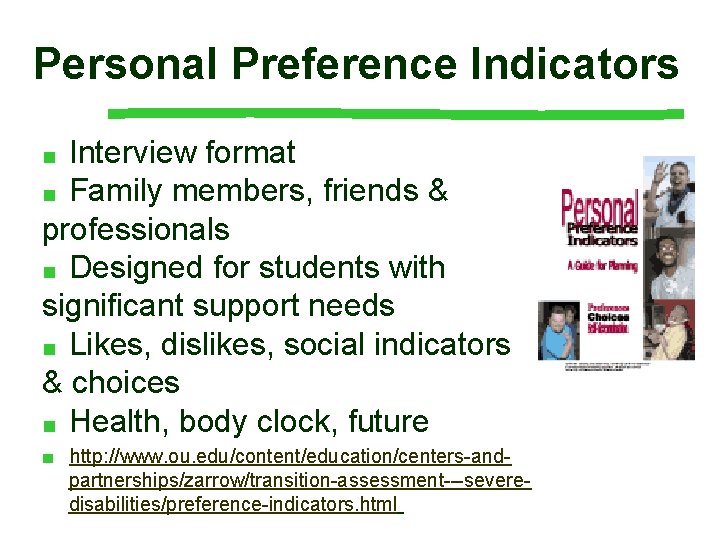
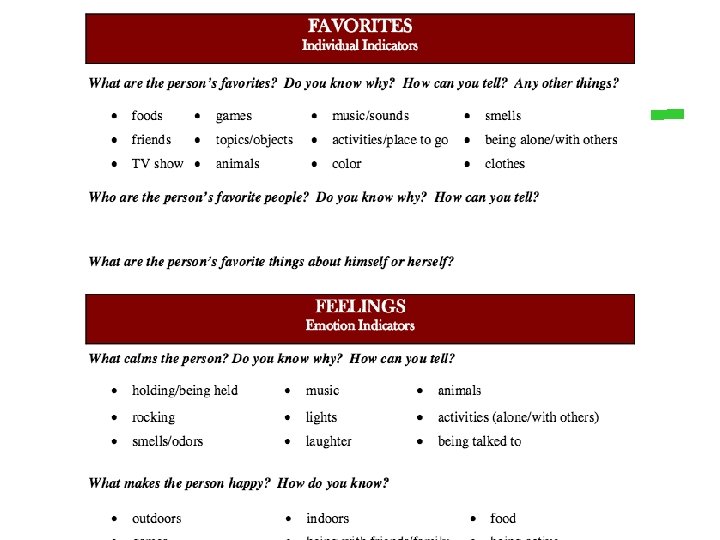
Personal Preference Indicators Interview format ■ Family members, friends & professionals ■ Designed for students with significant support needs ■ Likes, dislikes, social indicators & choices ■ Health, body clock, future ■ ■ http: //www. ou. edu/content/education/centers-andpartnerships/zarrow/transition-assessment---severedisabilities/preference-indicators. html
Screen shot of the quality of favorites and feeling sections of the employability life skills assessment
Other Similar Assessments ■ ■ ■ Child Preference Indicators Employment Support Indicators http: //www. ou. edu/content/education/cente rs-and-partnerships/zarrow/transitionassessment---severedisabilities/preference-indicators. html
More on Assessments ■ When done correctly, assessments will: Provide a wealth of information about the student; � Show growth and development over time; � Highlight strengths as well as areas of need; and � Be useful information for the entire IEP team (especially VR, Workforce, DD). �
Big IDEA #2
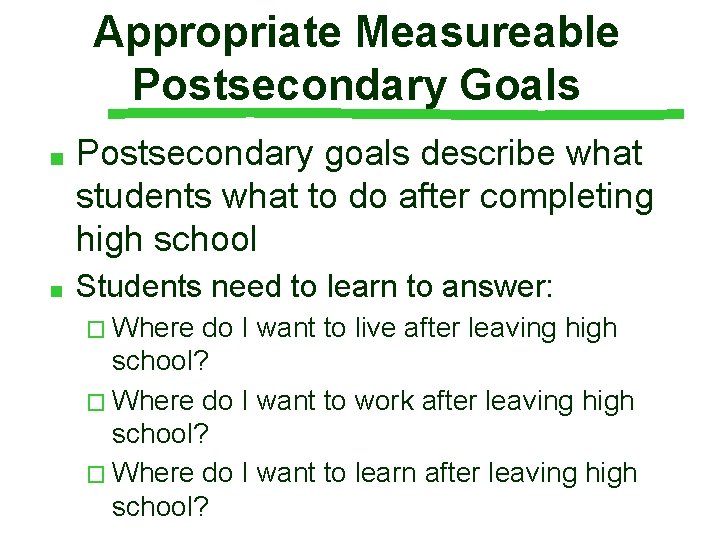
Appropriate Measureable Postsecondary Goals ■ Postsecondary goals describe what students what to do after completing high school ■ Students need to learn to answer: � Where do I want to live after leaving high school? � Where do I want to work after leaving high school? � Where do I want to learn after leaving high school?
Examples and Non-Examples ■ After leaving high school, Marcie will attend the culinary arts program at City Technology Center ■ Jim will job shadow workers in a body shop ■ After graduation, I will attend the Army, learn through on-the-job training and Army classes, and will live on base ■ ■ ■ Marcie will look for a job Upon graduation, Jim will work in a local body shop After graduation I will talk to military recruiters about joining.
Big IDEA #3
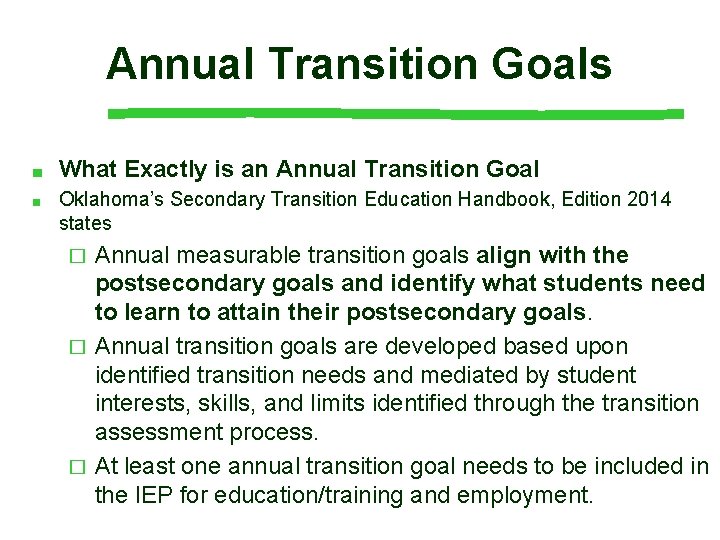
Annual Transition Goals ■ What Exactly is an Annual Transition Goal ■ Oklahoma’s Secondary Transition Education Handbook, Edition 2014 states Annual measurable transition goals align with the postsecondary goals and identify what students need to learn to attain their postsecondary goals. � Annual transition goals are developed based upon identified transition needs and mediated by student interests, skills, and limits identified through the transition assessment process. � At least one annual transition goal needs to be included in the IEP for education/training and employment. �
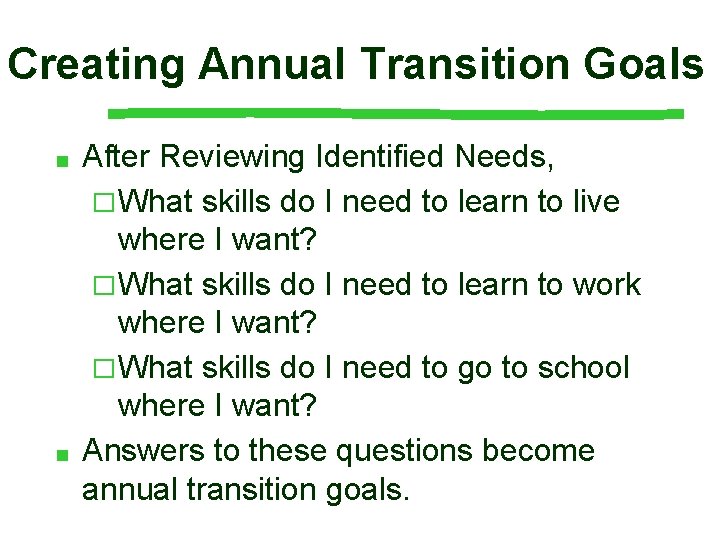
Creating Annual Transition Goals ■ ■ After Reviewing Identified Needs, � What skills do I need to learn to live where I want? � What skills do I need to learn to work where I want? � What skills do I need to go to school where I want? Answers to these questions become annual transition goals.
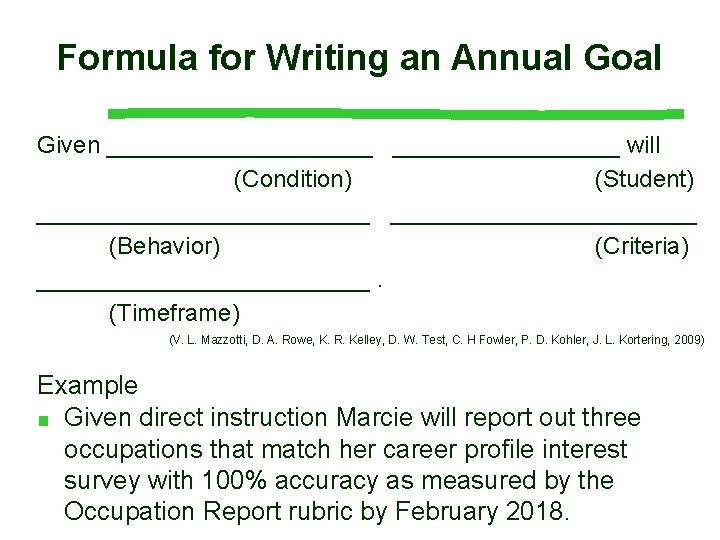
Formula for Writing an Annual Goal Given __________ will (Condition) (Student) _____________ (Behavior) (Criteria) _____________. (Timeframe) (V. L. Mazzotti, D. A. Rowe, K. R. Kelley, D. W. Test, C. H Fowler, P. D. Kohler, J. L. Kortering, 2009) Example ■ Given direct instruction Marcie will report out three occupations that match her career profile interest survey with 100% accuracy as measured by the Occupation Report rubric by February 2018.
Generalizable Behaviors � Not all skills are equal � Focus on skills that when learned will generalize to any type of postsecondary goal. � Focus on skills we know that when learned will predict better education, employment, and/or independent living outcomes � DCDT Fast Facts http: //higherlogicdownload. s 3. amazonaws. com/SPED/34 aee 1 c 1 -7 ded-4 d 59 -af 82 da 4 af 08 d 5 fc 4/Uploaded. Images/DCDT_Fast_Facts/Non. Academic_Behaviors_Associated_With_Post-School_Employment_and_Education. pdf
Non-Academic Behaviors Predictive of Postschool Education and Employment ■ ■ Knowing Strengths and Limitations Disability Awareness Persistence Interacting with Others ■ ■ Handout Available At Goal Setting and Attainment Employment Student Involvement in the IEP and IEP Process Knowing and Using Support Community http: //www. ou. edu/content/education/centers-andpartnerships/zarrow/presentations. html
Partner Contributions ■ What can VR, Workforce, and others bring to the table for goal setting? � � � ■ Knowledge of higher education demands; Information about in-demand jobs; Perspective of the student outside of the classroom; Needs of employers; and Results from their own assessments to help with planning. If VR or another partner is providing a transition service or paying for one, a goal should be written in the IEP to reflect that (as well as coordinated services).
Big IDEA #4
Course of Study Per OSDE ■ ■ “The course of study lists specific courses/electives that assist the students in being prepared upon graduation to achieve the postsecondary goals. It is updated annually and if the postsecondary goals change, so may the course of study”. http: //sde. ok. gov/sde/sites/ok. gov. sde/files/Oklahoma%27 s%20 Secondary%20 Transit ion%20 Handbook. pdf
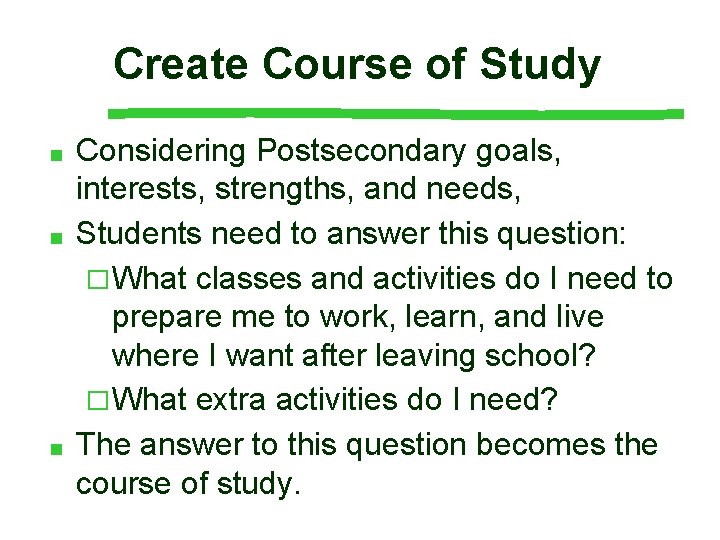
Create Course of Study ■ ■ ■ Considering Postsecondary goals, interests, strengths, and needs, Students need to answer this question: � What classes and activities do I need to prepare me to work, learn, and live where I want after leaving school? � What extra activities do I need? The answer to this question becomes the course of study.
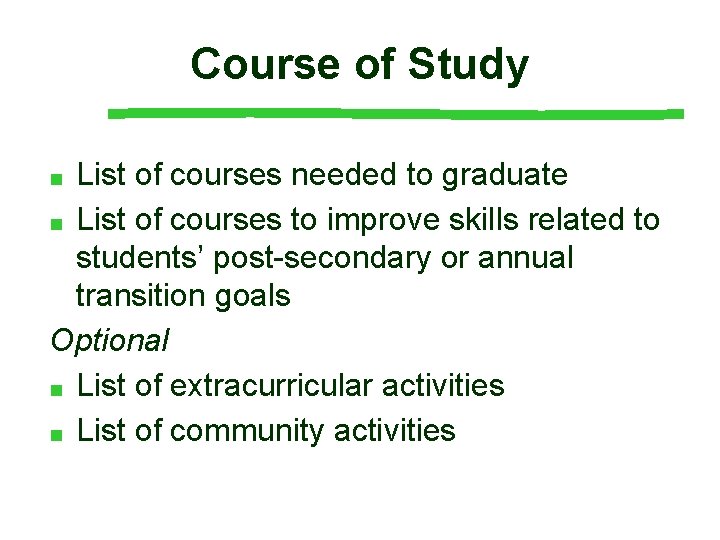
Course of Study List of courses needed to graduate ■ List of courses to improve skills related to students’ post-secondary or annual transition goals Optional ■ List of extracurricular activities ■ List of community activities ■
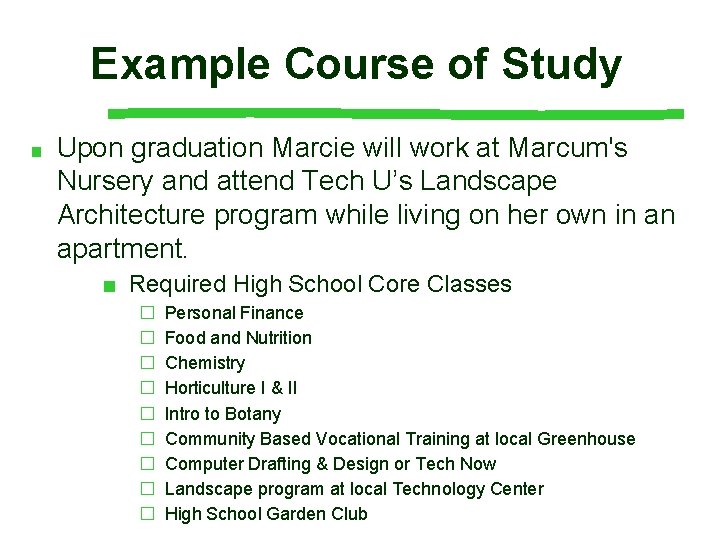
Example Course of Study ■ Upon graduation Marcie will work at Marcum's Nursery and attend Tech U’s Landscape Architecture program while living on her own in an apartment. ■ Required High School Core Classes � � � � � Personal Finance Food and Nutrition Chemistry Horticulture I & II Intro to Botany Community Based Vocational Training at local Greenhouse Computer Drafting & Design or Tech Now Landscape program at local Technology Center High School Garden Club
Big IDEA #5
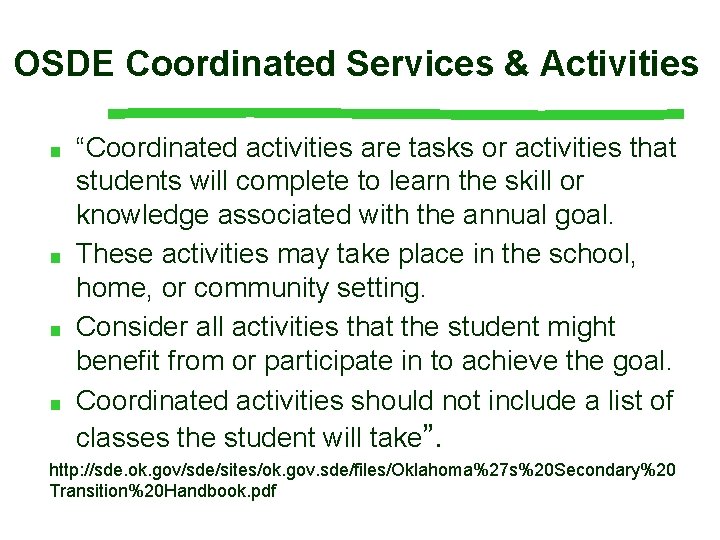
OSDE Coordinated Services & Activities ■ ■ “Coordinated activities are tasks or activities that students will complete to learn the skill or knowledge associated with the annual goal. These activities may take place in the school, home, or community setting. Consider all activities that the student might benefit from or participate in to achieve the goal. Coordinated activities should not include a list of classes the student will take”. http: //sde. ok. gov/sde/sites/ok. gov. sde/files/Oklahoma%27 s%20 Secondary%20 Transition%20 Handbook. pdf
Coordinated Activities Details ■ ■ ■ Activities have to do with instruction, formal or informal relating to transition goals. Can be provided outside the school site or in the community. Can be implemented by family, peers, agency supports, community members and/or school staff.
Coordinated Activities ■ Students need to answer: � What do I need to do to attain my annual transition goals? ■ ■ Answer become coordinated services to accompany annual transition goals. Can be implemented by family, peers, community people � Download ■ dozens of coordinated activity ideas http: //www. ou. edu/content/dam/Education/zarrow/ZC%20 Presentations/20 17%20 Presentations/OSDE%202017%20 Tx%20 Assessment%20 Worksho p/Coordinated%20 Set%20 of%20 Activities. pdf
Coordinated Activities ■ ■ ■ Activities have to do with instruction, formal or informal relating to transition goals. Can be provided outside the school site or in the community. Can be implemented by family, peers, agency supports, community members and/or school staff.
Post-school Linkages Identify Individuals or Organizations Offering Needed Support to Student After Leaving High School � � � Vocational Rehabilitation Counselor Job Coach Disability Resource Support at Career Technology Center Disability Resource Support at Higher Ed. Institution Medical Assistance Providers Mental Health Providers Family Friends and Business Associates - Networking Government Agencies DHS SS Community Providers Transportation
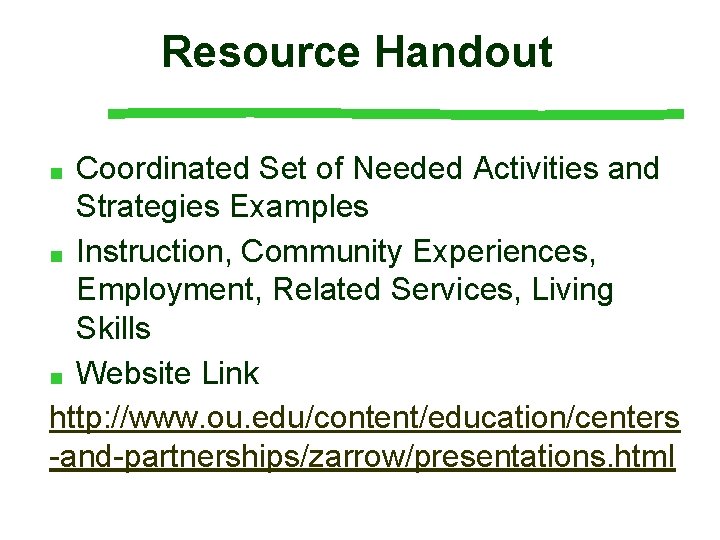
Resource Handout Coordinated Set of Needed Activities and Strategies Examples ■ Instruction, Community Experiences, Employment, Related Services, Living Skills ■ Website Link http: //www. ou. edu/content/education/centers -and-partnerships/zarrow/presentations. html ■
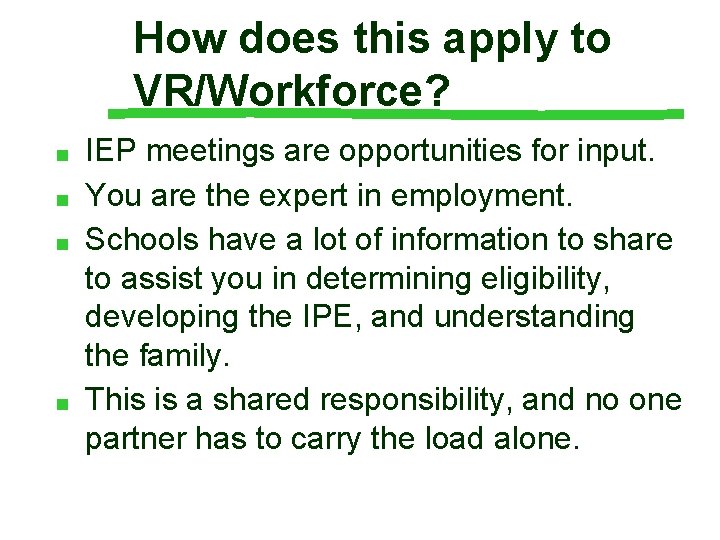
How does this apply to VR/Workforce? ■ ■ IEP meetings are opportunities for input. You are the expert in employment. Schools have a lot of information to share to assist you in determining eligibility, developing the IPE, and understanding the family. This is a shared responsibility, and no one partner has to carry the load alone.
Big IDEA #6 Student Engagement in IEP and Transition Planning Process
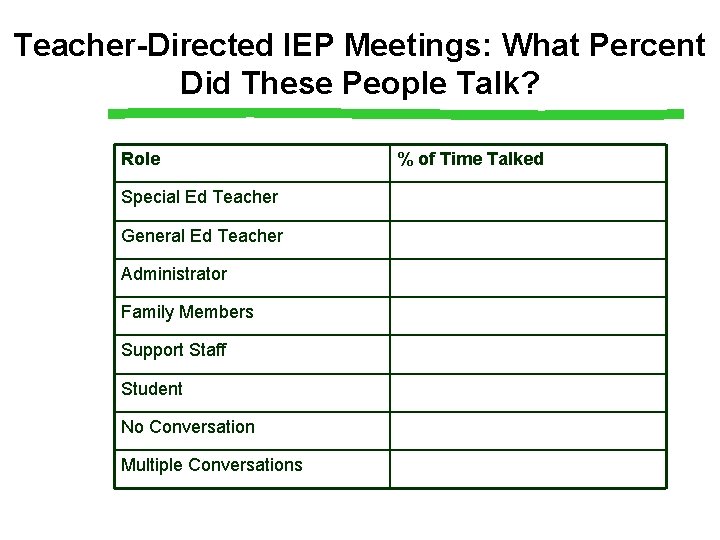
Teacher-Directed IEP Meetings: What Percent Did These People Talk? Role Special Ed Teacher General Ed Teacher Administrator Family Members Support Staff Student No Conversation Multiple Conversations % of Time Talked
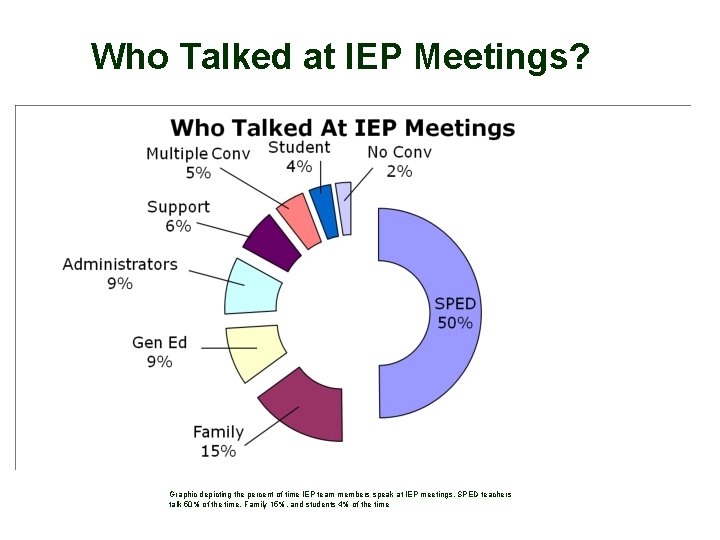
Who Talked at IEP Meetings? Graphic depicting the percent of time IEP team members speak at IEP meetings. SPED teachers talk 50% of the time, Family 15%, and students 4% of the time
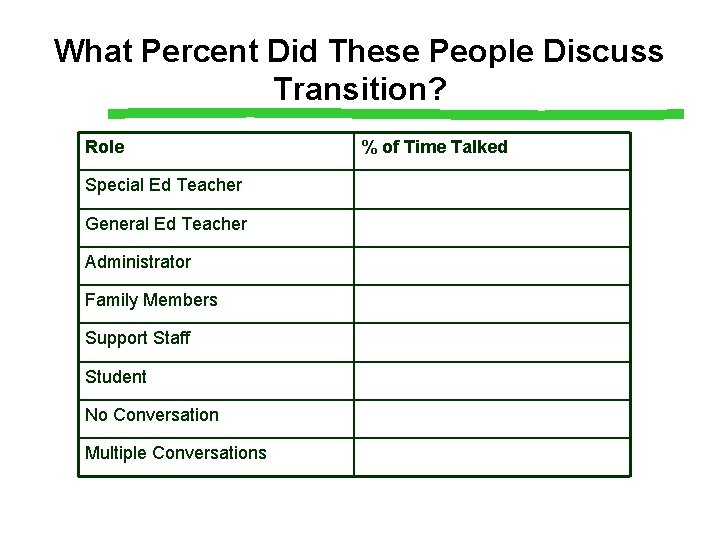
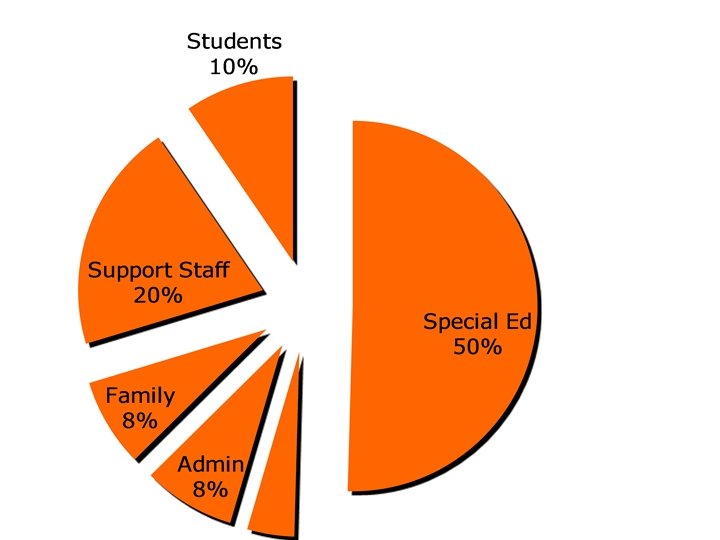
What Percent Did These People Discuss Transition? Role Special Ed Teacher General Ed Teacher Administrator Family Members Support Staff Student No Conversation Multiple Conversations % of Time Talked
am members talk about transition, when transition is % of the time, students 10%, and family 8%.
Spirit of IDEA ■ ■ Students need to attend IEP meeting at least when transition age or earlier Implies students be taught to know the language, their role, what to do, and are prepared to become actively involved before turning transition age Superman (Its not Easy) by Five for Fighting It’s Not Easy
Instructional Materials ■ OU Zarrow Center Website � Self-Directed IEP � Student-Directed Transition Planning � Whose Future Is It Anyway? ■ Self-Advocacy Strategy � http: //www. edgeenterprisesinc. com/product/s elf-advocacy-strategy-student-manual-cd/ ■ I’m Determined � http: //www. imdetermined. org/
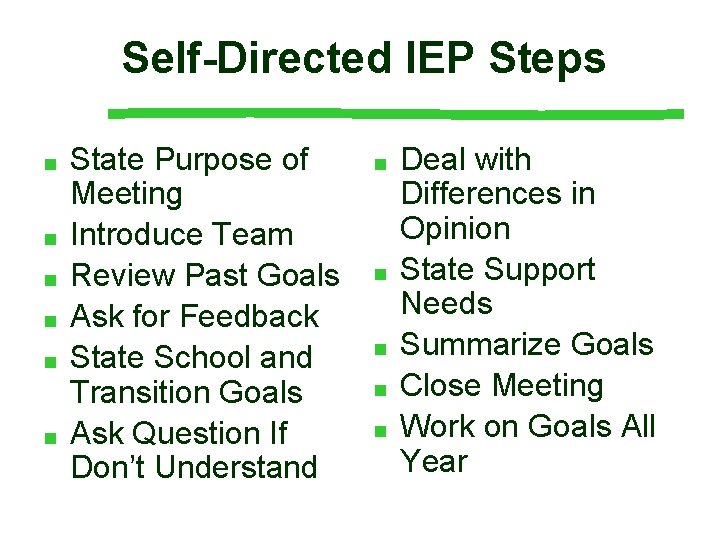
Self-Directed IEP Steps ■ ■ ■ State Purpose of Meeting Introduce Team Review Past Goals Ask for Feedback State School and Transition Goals Ask Question If Don’t Understand ■ ■ ■ Deal with Differences in Opinion State Support Needs Summarize Goals Close Meeting Work on Goals All Year
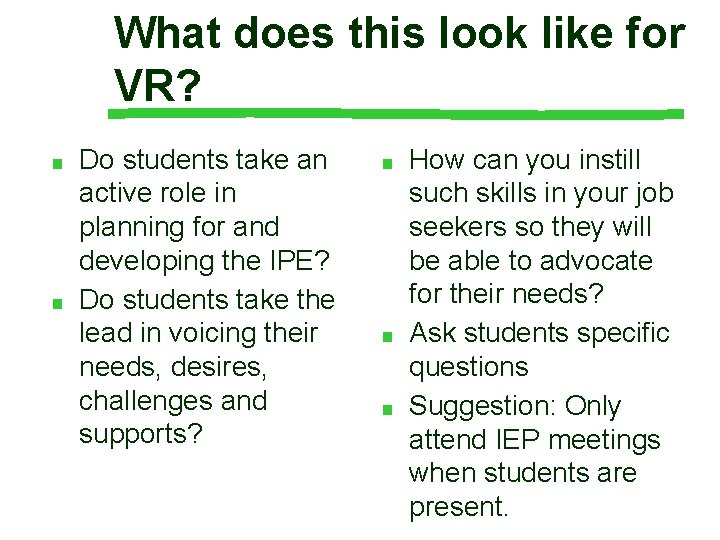
What does this look like for VR? ■ ■ Do students take an active role in planning for and developing the IPE? Do students take the lead in voicing their needs, desires, challenges and supports? ■ ■ ■ How can you instill such skills in your job seekers so they will be able to advocate for their needs? Ask students specific questions Suggestion: Only attend IEP meetings when students are present.
Big IDEA #7
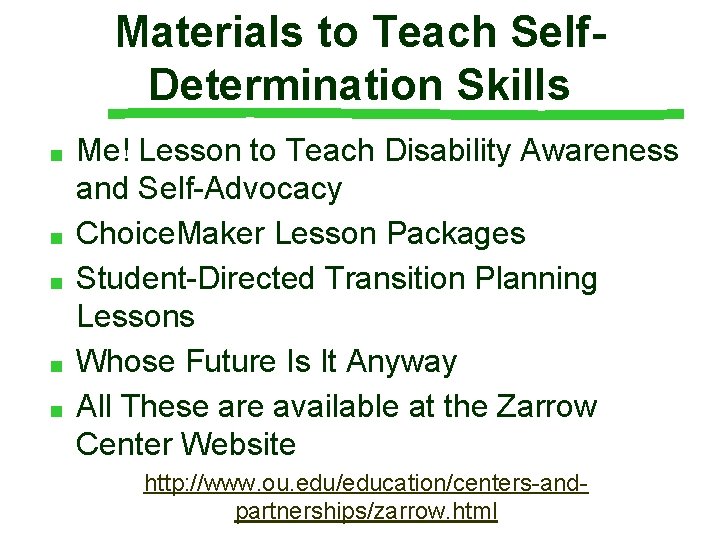
Materials to Teach Self. Determination Skills ■ ■ ■ Me! Lesson to Teach Disability Awareness and Self-Advocacy Choice. Maker Lesson Packages Student-Directed Transition Planning Lessons Whose Future Is It Anyway All These are available at the Zarrow Center Website http: //www. ou. edu/education/centers-andpartnerships/zarrow. html
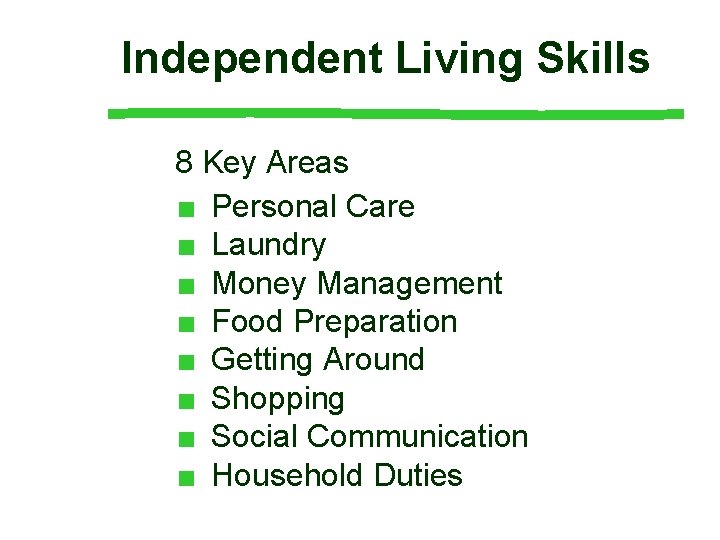
Independent Living Skills 8 Key Areas ■ Personal Care ■ Laundry ■ Money Management ■ Food Preparation ■ Getting Around ■ Shopping ■ Social Communication ■ Household Duties
Big IDEA #8
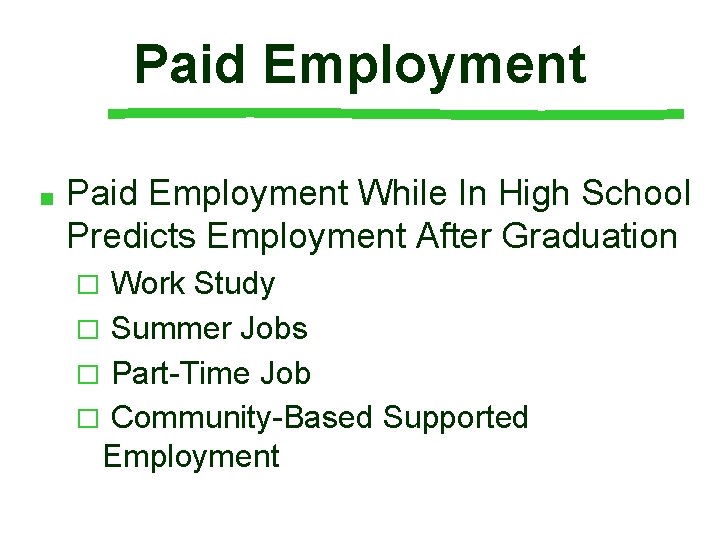
Paid Employment ■ Paid Employment While In High School Predicts Employment After Graduation Work Study � Summer Jobs � Part-Time Job � Community-Based Supported Employment �
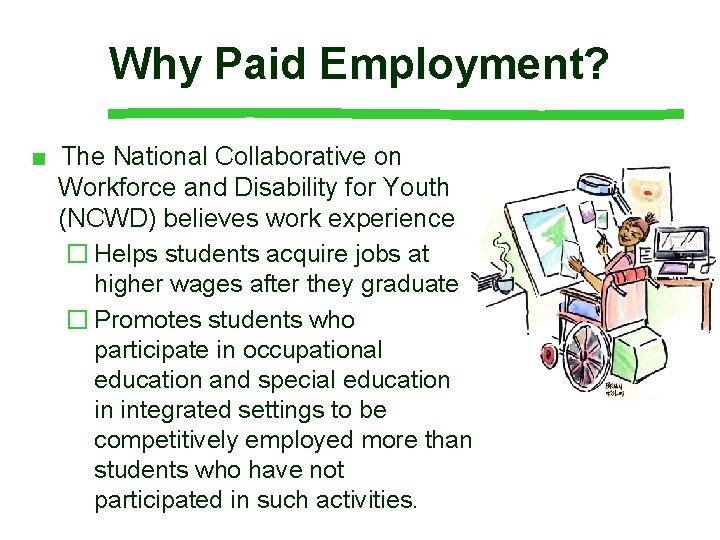
Why Paid Employment? ■ The National Collaborative on Workforce and Disability for Youth (NCWD) believes work experience � Helps students acquire jobs at higher wages after they graduate � Promotes students who participate in occupational education and special education in integrated settings to be competitively employed more than students who have not participated in such activities.
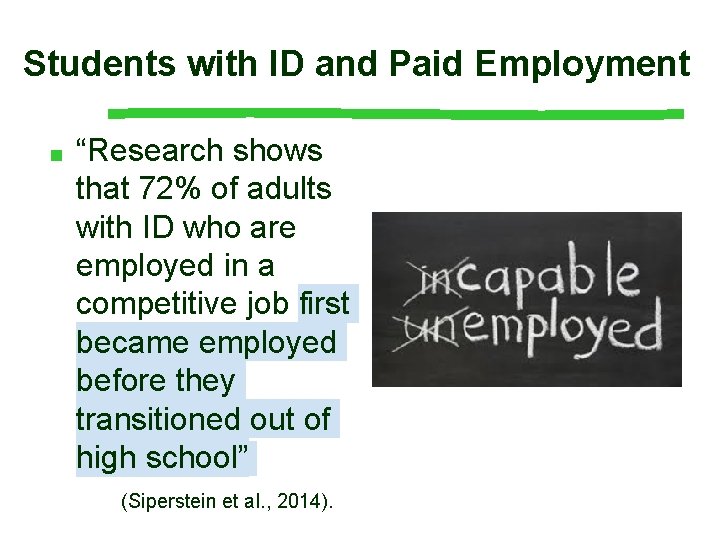
Students with ID and Paid Employment ■ “Research shows that 72% of adults with ID who are employed in a competitive job first became employed before they transitioned out of high school” (Siperstein et al. , 2014).
Did you know… ■ Paid work experiences (School Work Study) is one of the largest expenses for Oklahoma Department of Rehabilitation Services (OK-DRS)? ■ Transition Age Youth comprise about 1/3 or more of the OK-DRS total caseload?
Big IDEA #9
Agency Collaboration ■ ■ WIOA 2014 Department of Rehabilitation Services (DRS) Department of Human Services, Developmental Disability Services Division (DDSD) Workforce of Oklahoma
The Workforce Innovation and Opportunity Act (WIOA): Competitive Integrated Employment for People with Disabilities ■ “WIOA reforms planning requirements, previously governed by the Workforce Investment Act of 1998 (WIA), to foster better alignment of Federal investments in job training, to integrate service delivery across programs and improve efficiency in service delivery, and to ensure that the workforce system is job-driven and matches employers with skilled individuals. ” https: //oklahomaworks. gov/docs/2016/01/Updated-State-Plan. pdf What does that mean? https: //www. okabletech. org/wp-content/uploads/2017/08/Workforce_Accommodations-WIOA. pdf
OK Department of Rehabilitation ■ http: //www. okrehab. org/info/home Recommend referral/application at 15 ½ years of age � Serves individuals with disabilities in career readiness and employment � Supports WIOA documentation � Schools may sign working agreements allowing partnership and development of transition programs � Referral vs Application �
OK Department of Human Services ■ http: //www. okdrs. org/guide/OKDHSddsd/revisions/13266/view � Individuals must meet eligibility ■ Best Practice would be to apply young (early elementary years - IQ requirement) � http: //www. okdhs. org/services/dd/Pages/faq. aspx Supports employment with waiver services � Supports WIOA movement � Waiting list should not stop application process! � State funds exist to help support individuals to work/volunteer in the community during non-school hours (called CIE funds) �
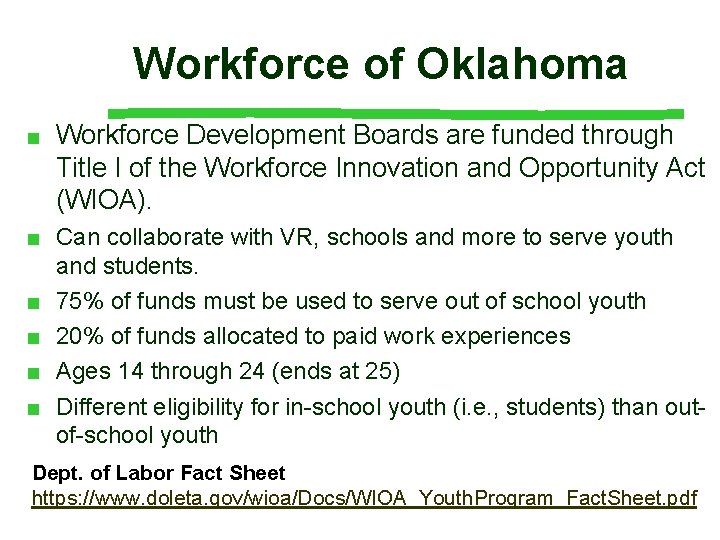
Workforce of Oklahoma ■ Workforce Development Boards are funded through Title I of the Workforce Innovation and Opportunity Act (WIOA). ■ Can collaborate with VR, schools and more to serve youth and students. ■ 75% of funds must be used to serve out of school youth ■ 20% of funds allocated to paid work experiences ■ Ages 14 through 24 (ends at 25) ■ Different eligibility for in-school youth (i. e. , students) than outof-school youth Dept. of Labor Fact Sheet https: //www. doleta. gov/wioa/Docs/WIOA_Youth. Program_Fact. Sheet. pdf
Workforce of Oklahoma ■ OK ABLE Tech fact sheet https: //www. okabletech. org/employmentservices/oklahoma-works-access-for-all/fact-sheets-onaccessibility-issues/the-workforce-innovation-andopportunity-act/ ■ Oklahoma Works https: //oklahomaworks. gov/about/ � One Stop Centers � State Strategies & Initiatives
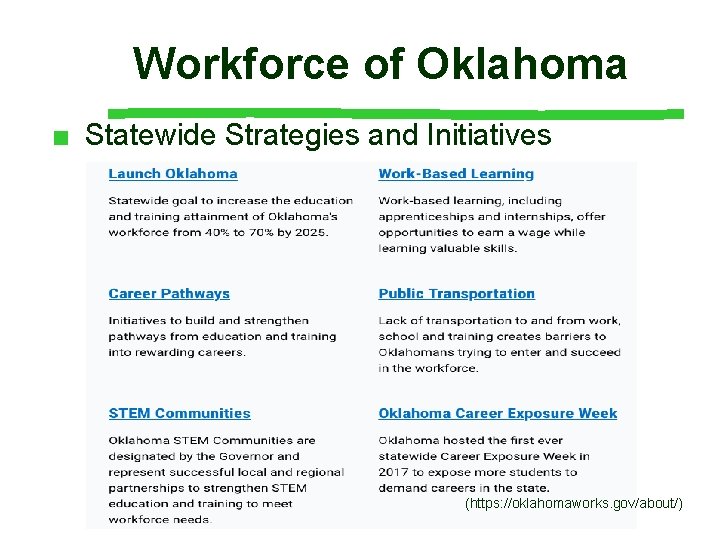
Workforce of Oklahoma ■ Statewide Strategies and Initiatives (https: //oklahomaworks. gov/about/)
Resource Handouts ■ Work-Based Learning. Includes an excellent section on Determining if Wages Need to Be Paid � http: //centerontransition. org/documents/public ations/Work_Based_Learning_Fast_Fact. pdf ■ Vocational Terms Explained � https: //docs. google. com/document/d/1 TAi. GCI x. PAd. Nm. FHXd. Bn 4 JXQA 8 i. Xu 6 B 0 e 6 d. JQu. Gh. RM 8 A/edit
Questions? 128
Contact Information Jim Martin, Ph. D. Email: jemartin@ou. edu Phone: (405) 325 -8951 Website: https: //zarrowcenter. ou. edu Marcie Stickney, M. Ed. Email: marcies@norman. k 12. ok. us Phone: (405) 366 -5843 Norman Public Schools