
Transit Oriented Development Integrating landuse and transport TRANSIT
- Slides: 30
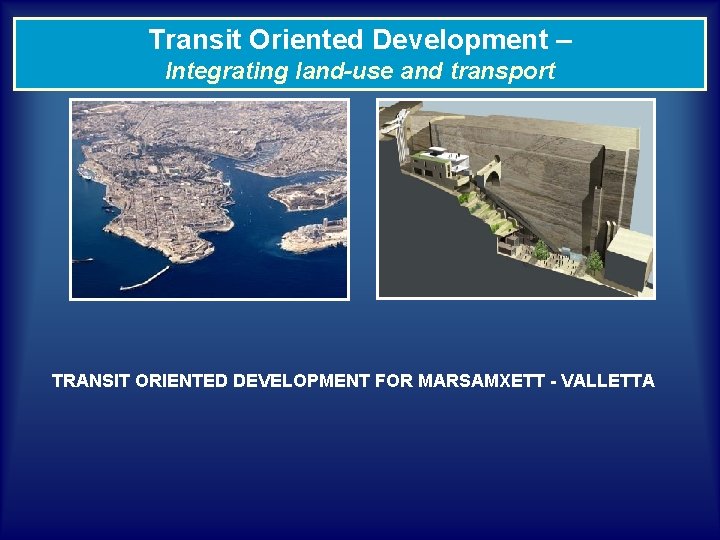
Transit Oriented Development – Integrating land-use and transport TRANSIT ORIENTED DEVELOPMENT FOR MARSAMXETT - VALLETTA
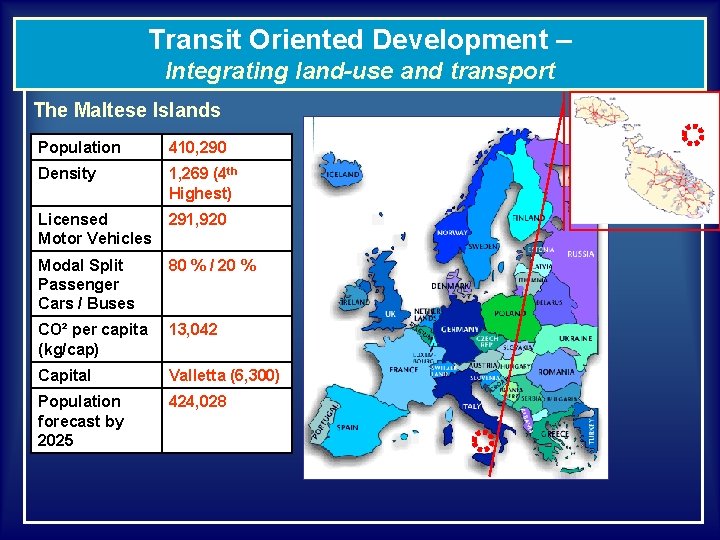
Transit Oriented Development – Integrating land-use and transport The Maltese Islands Population 410, 290 Density 1, 269 (4 th Highest) Licensed Motor Vehicles 291, 920 Modal Split Passenger Cars / Buses 80 % / 20 % CO² per capita (kg/cap) 13, 042 Capital Valletta (6, 300) Population forecast by 2025 424, 028
Transit Oriented Development – Integrating land-use and transport TOD Concept TOD An integrated transit & urban policy tool for the future
Transit Oriented Development – Why TOD? We must ask ourselves these specific questions on Transit and Urban Planning. How are cities evolving in the 21 st Century? How are the cities exigencies changing in the 21 st Century?
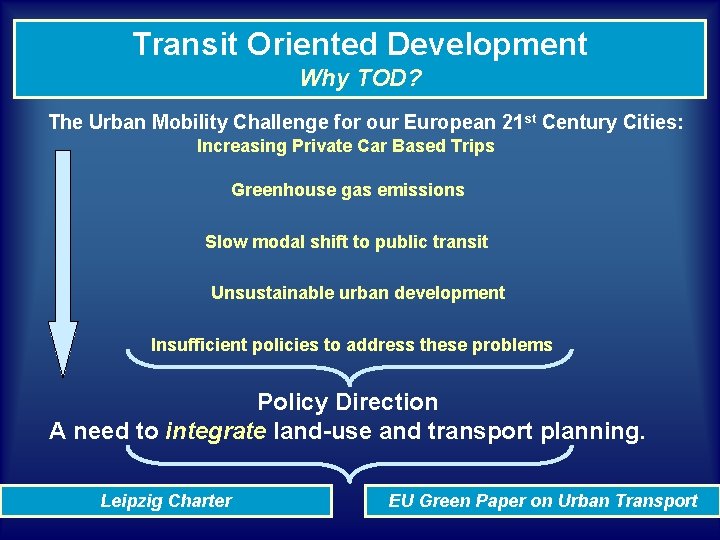
Transit Oriented Development Why TOD? The Urban Mobility Challenge for our European 21 st Century Cities: Increasing Private Car Based Trips Greenhouse gas emissions Slow modal shift to public transit Unsustainable urban development Insufficient policies to address these problems Policy Direction A need to integrate land-use and transport planning. Leipzig Charter EU Green Paper on Urban Transport
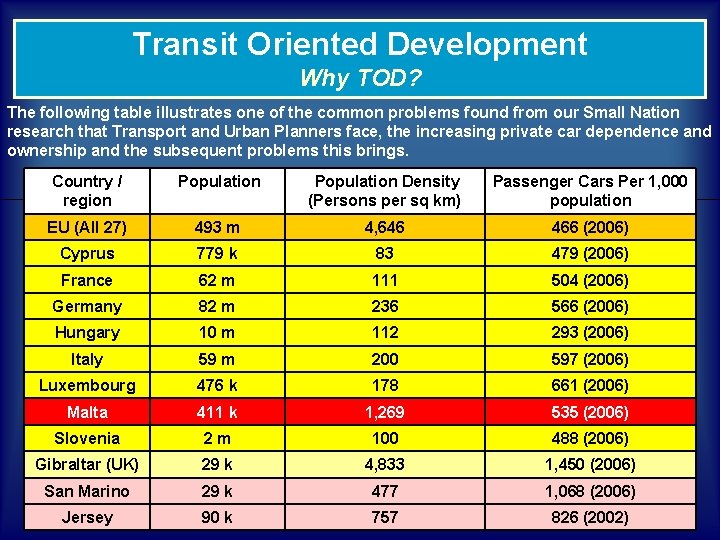
Transit Oriented Development Why TOD? The following table illustrates one of the common problems found from our Small Nation research that Transport and Urban Planners face, the increasing private car dependence and ownership and the subsequent problems this brings. Country / region Population Density (Persons per sq km) Passenger Cars Per 1, 000 population EU (All 27) 493 m 4, 646 466 (2006) Cyprus 779 k 83 479 (2006) France 62 m 111 504 (2006) Germany 82 m 236 566 (2006) Hungary 10 m 112 293 (2006) Italy 59 m 200 597 (2006) Luxembourg 476 k 178 661 (2006) Malta 411 k 1, 269 535 (2006) Slovenia 2 m 100 488 (2006) Gibraltar (UK) 29 k 4, 833 1, 450 (2006) San Marino 29 k 477 1, 068 (2006) Jersey 90 k 757 826 (2002)
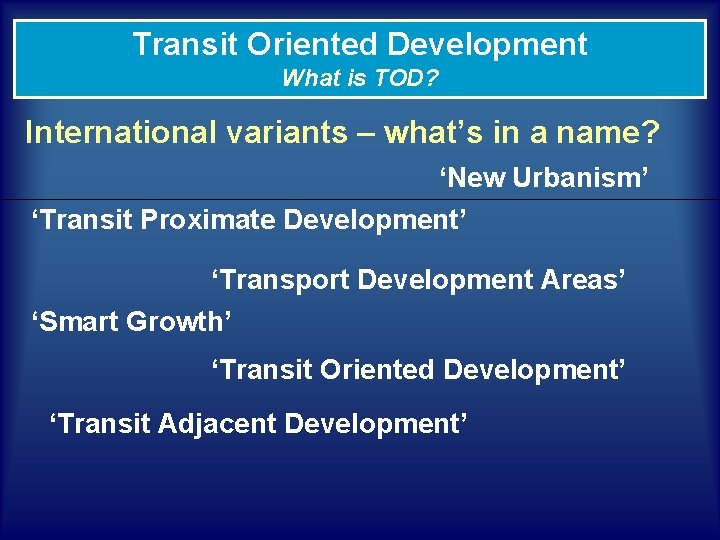
Transit Oriented Development What is TOD? International variants – what’s in a name? ‘New Urbanism’ ‘Transit Proximate Development’ ‘Transport Development Areas’ ‘Smart Growth’ ‘Transit Oriented Development’ ‘Transit Adjacent Development’
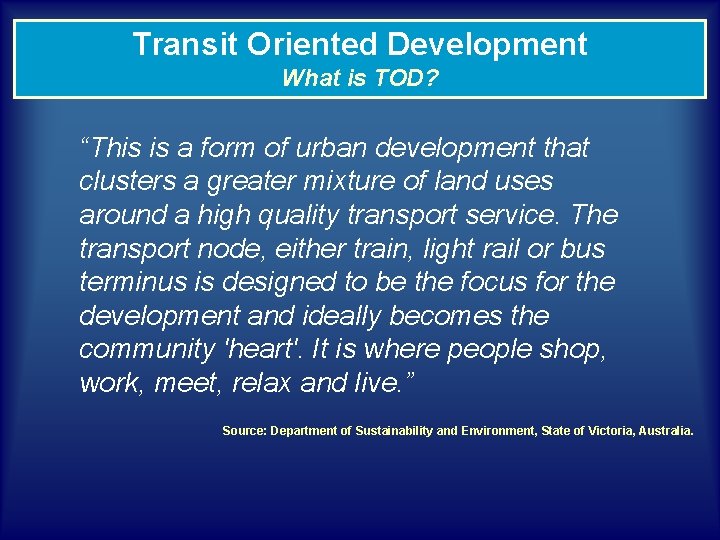
Transit Oriented Development What is TOD? “This is a form of urban development that clusters a greater mixture of land uses around a high quality transport service. The transport node, either train, light rail or bus terminus is designed to be the focus for the development and ideally becomes the community 'heart'. It is where people shop, work, meet, relax and live. ” Source: Department of Sustainability and Environment, State of Victoria, Australia.
Transit Oriented Development What is TOD – basic principle ‘Build communities, not projects’
Transit Oriented Development What is TOD? Origins of policy – international context • The concept of TOD is not exactly ‘new’. Cities in Europe, North America and Australasia post WW 2 have many of the characteristics of TOD communities integrated into their planning. • TOD as a specific policy measure has emerged in the last twenty years particularly in cities found in Australia, Canada and the USA concentrating growth in the centre of a city to avoid urban sprawl and advocating a more ‘compactable approach’ to land uses and transit needs of the local environment. • International context has used TOD as a tool to establish and enhance real estate markets. • National framework requirement (example Maltese Government ~ OP regulations) • Legislative requirement by law (examples Maryland, California) Specific question? • Are we implementing ‘TOD’ and not exactly realising it?
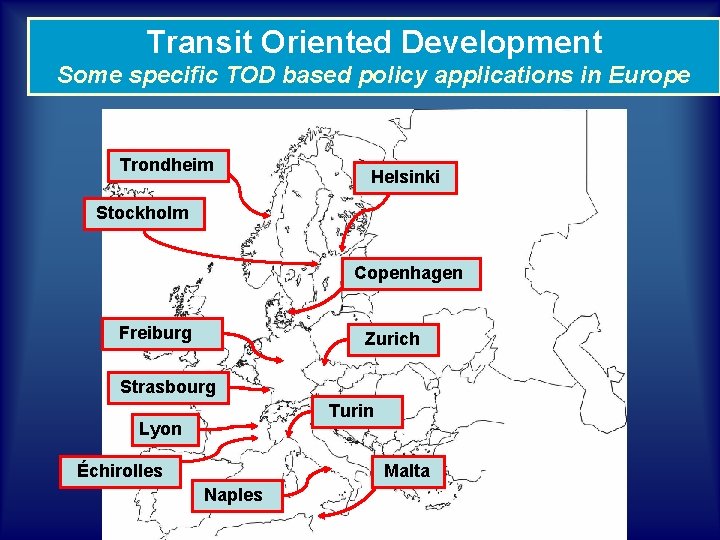
Transit Oriented Development Some specific TOD based policy applications in Europe Trondheim Helsinki Stockholm Copenhagen Freiburg Zurich Strasbourg Turin Lyon Échirolles Malta Naples
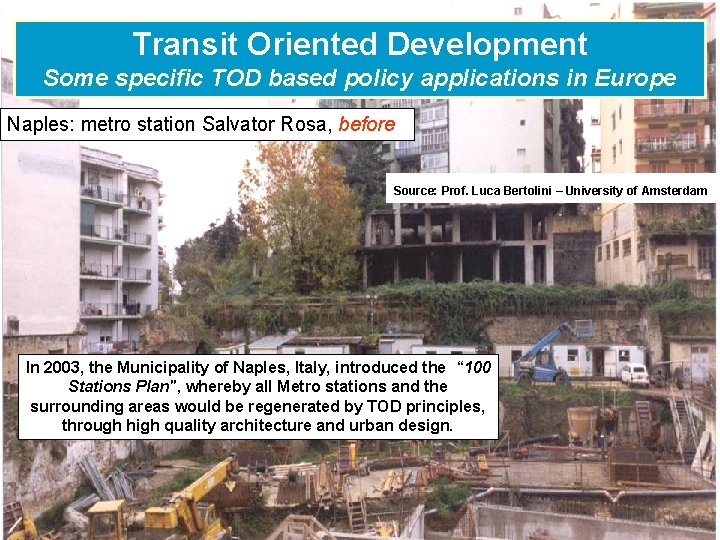
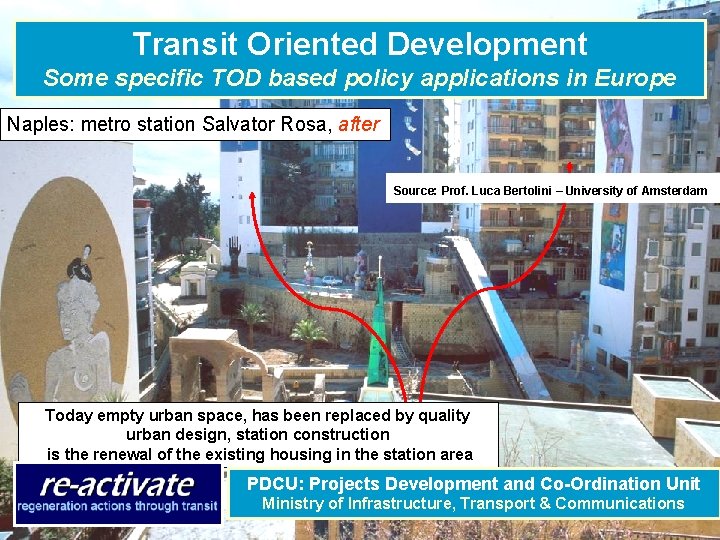
Transit Oriented Development Some specific TOD based policy applications in Europe Naples: metro station Salvator Rosa, before Source: Prof. Luca Bertolini – University of Amsterdam In 2003, the Municipality of Naples, Italy, introduced the “ 100 Stations Plan", whereby all Metro stations and the surrounding areas would be regenerated by TOD principles, through high quality architecture and urban design.
Transit Oriented Development Some specific TOD based policy applications in Europe Naples: metro station Salvator Rosa, after Source: Prof. Luca Bertolini – University of Amsterdam Today empty urban space, has been replaced by quality urban design, station construction is the renewal of the existing housing in the station area PDCU: Projects Development and Co-Ordination Unit Ministry of Infrastructure, Transport & Communications
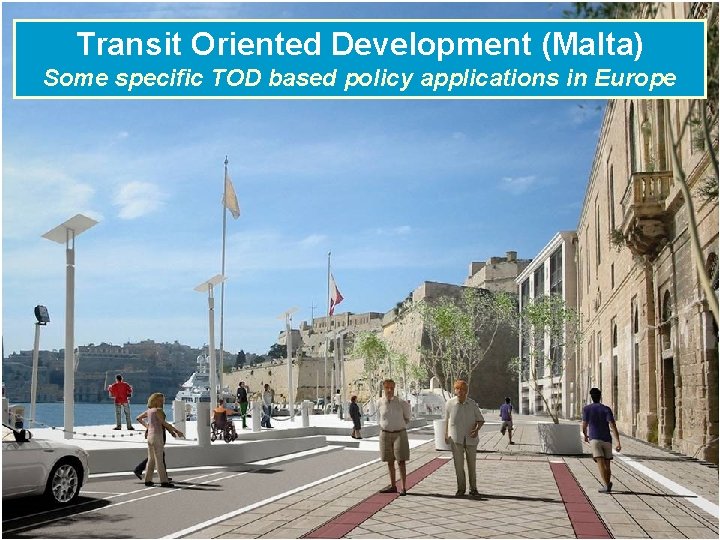
Transit Oriented Development (Malta) Some specific TOD based policy applications in Europe
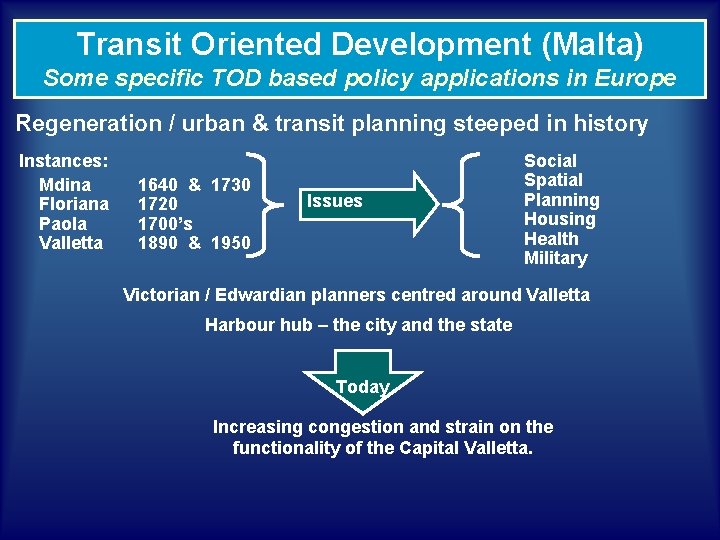
Transit Oriented Development (Malta) Some specific TOD based policy applications in Europe Regeneration / urban & transit planning steeped in history Instances: Mdina Floriana Paola Valletta 1640 & 1730 1720 1700’s 1890 & 1950 Issues Social Spatial Planning Housing Health Military Victorian / Edwardian planners centred around Valletta Harbour hub – the city and the state Today Increasing congestion and strain on the functionality of the Capital Valletta.
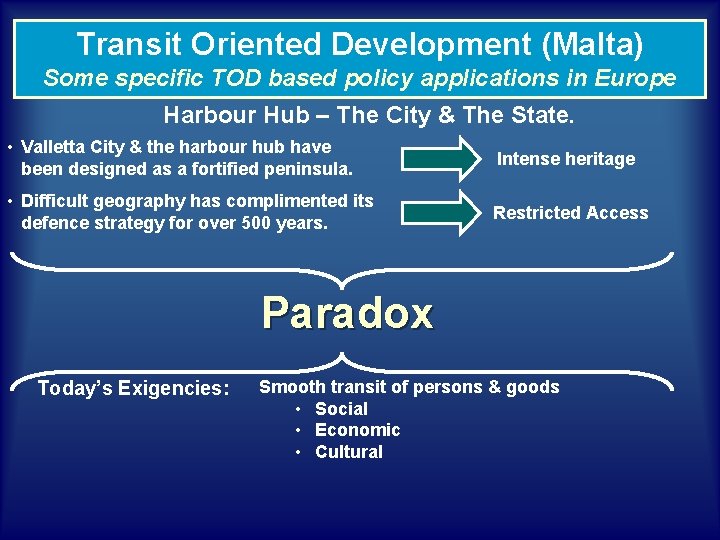
Transit Oriented Development (Malta) Some specific TOD based policy applications in Europe Harbour Hub – The City & The State. • Valletta City & the harbour hub have been designed as a fortified peninsula. Intense heritage • Difficult geography has complimented its defence strategy for over 500 years. Restricted Access Paradox Today’s Exigencies: Smooth transit of persons & goods • Social • Economic • Cultural
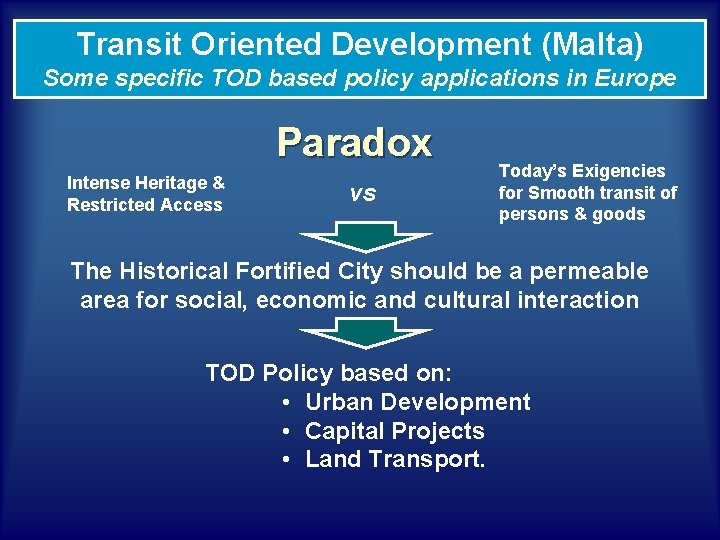
Transit Oriented Development (Malta) Some specific TOD based policy applications in Europe Paradox Intense Heritage & Restricted Access vs Today’s Exigencies for Smooth transit of persons & goods The Historical Fortified City should be a permeable area for social, economic and cultural interaction TOD Policy based on: • Urban Development • Capital Projects • Land Transport.
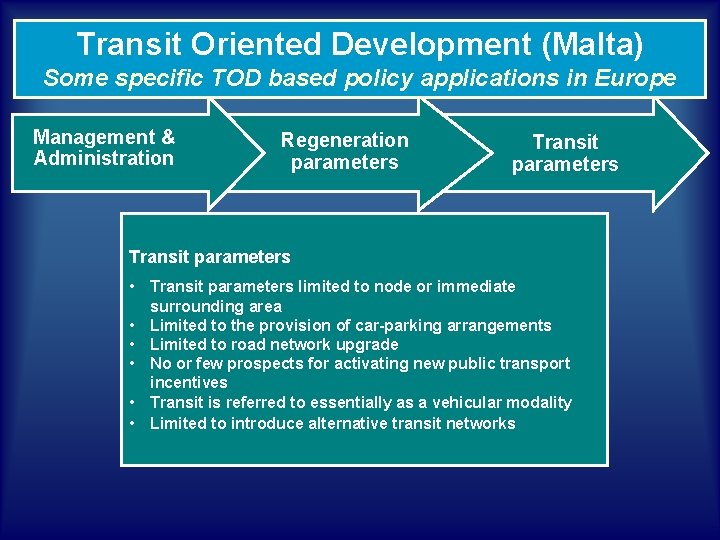
Transit Oriented Development (Malta) Some specific TOD based policy applications in Europe Management & Administration Regeneration parameters Transit parameters Management and Administration Regeneration parameters • • • • Transit parameters limited to node or immediate Long termed land concessions Only now is area regeneration seen as a system counteracting surrounding Cumbersome contractual re-development Limited to the provision of obligations car-parking arrangements Low-resourced Government bodydirectly with private No Regeneration Agency to deal Limited to road network upgrade Noor PPP or PFI arrangement prospects sector involvement No few prospects for activating new public transport Slow and highly bureaucratic Government Limited ideas for adaptive re-use or use of historic fabric incentives agencies/authorities Incongruence between lease / concession parameters Transit is referred to essentially as a vehicular modalityand economic possibilities Lack ofto commercial awarenesstransit networks Limited introduce alternative
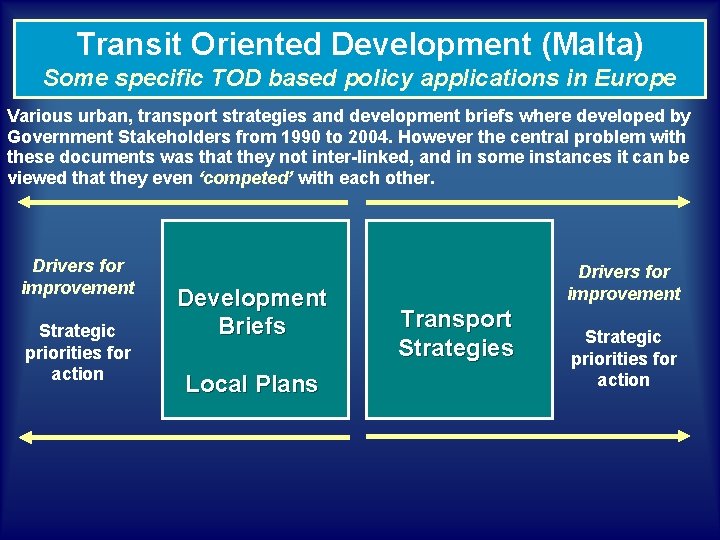
Transit Oriented Development (Malta) Some specific TOD based policy applications in Europe Various urban, transport strategies and development briefs where developed by Government Stakeholders from 1990 to 2004. However the central problem with these documents was that they not inter-linked, and in some instances it can be viewed that they even ‘competed’ with each other. Drivers for improvement Strategic priorities for action Development Briefs Local Plans Drivers for improvement Transport Strategies Strategic priorities for action
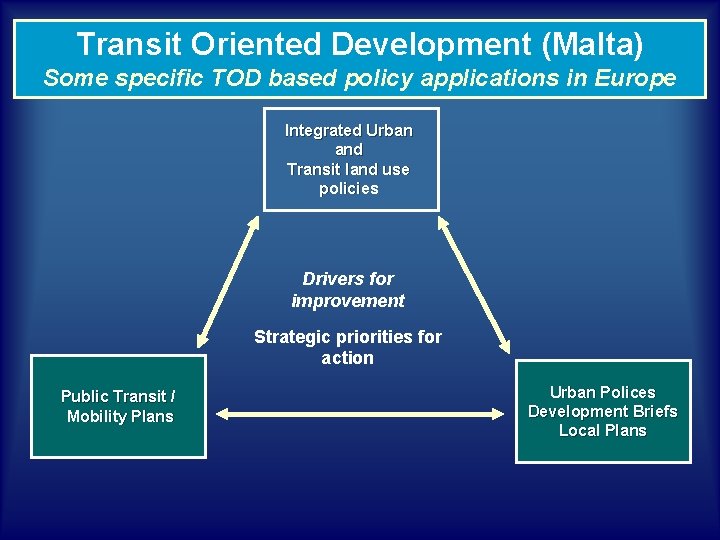
Transit Oriented Development (Malta) Some specific TOD based policy applications in Europe Integrated Urban and Transit land use policies Drivers for improvement Strategic priorities for action Public Transit / Mobility Plans Urban Polices Development Briefs Local Plans
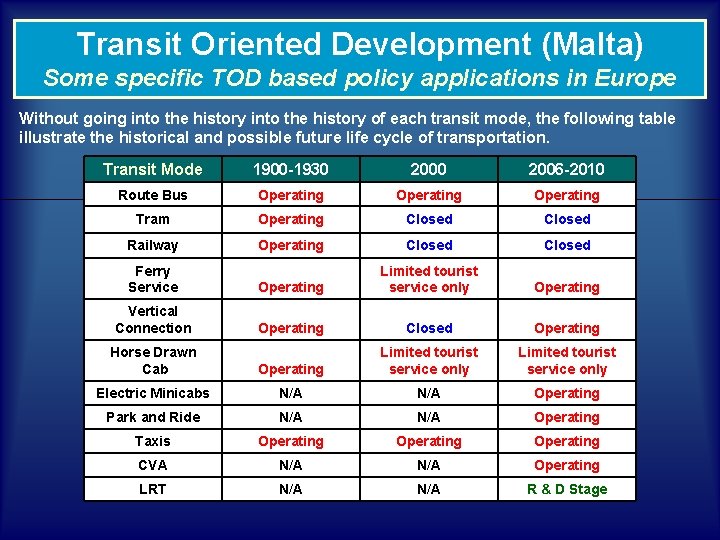
Transit Oriented Development (Malta) Some specific TOD based policy applications in Europe Without going into the history of each transit mode, the following table illustrate the historical and possible future life cycle of transportation. Transit Mode 1900 -1930 2006 -2010 Route Bus Operating Tram Operating Closed Railway Operating Closed Ferry Service Operating Limited tourist service only Operating Vertical Connection Operating Closed Operating Horse Drawn Cab Operating Limited tourist service only Electric Minicabs N/A Operating Park and Ride N/A Operating Taxis Operating CVA N/A Operating LRT N/A R & D Stage
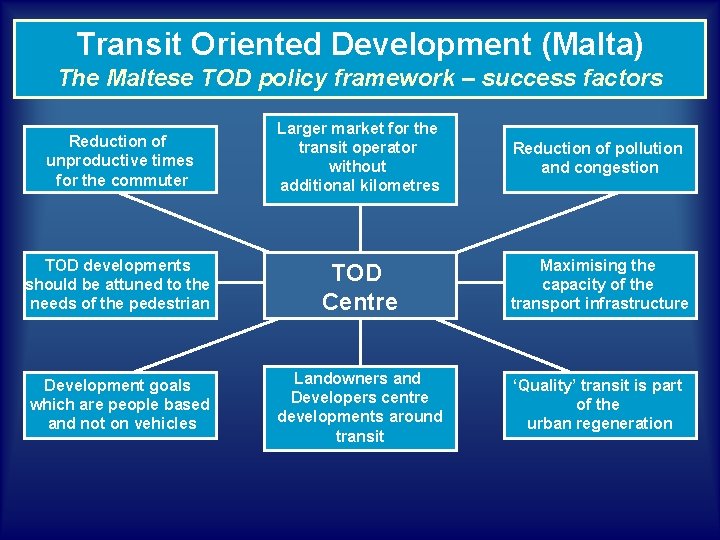
Transit Oriented Development (Malta) The Maltese TOD policy framework – success factors Reduction of unproductive times for the commuter Larger market for the transit operator without additional kilometres Reduction of pollution and congestion TOD developments should be attuned to the needs of the pedestrian TOD Centre Maximising the capacity of the transport infrastructure Development goals which are people based and not on vehicles Landowners and Developers centre developments around transit ‘Quality’ transit is part of the urban regeneration
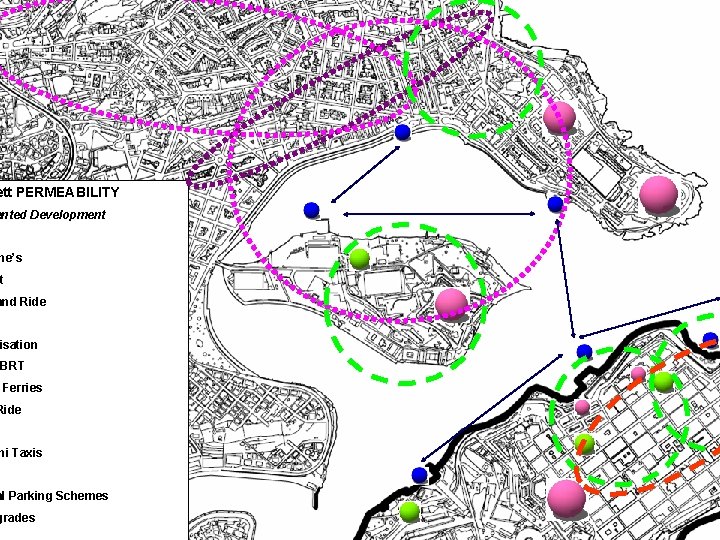
ett PERMEABILITY ented Development ne’s et and Ride isation /BRT Ferries Ride ni Taxis al Parking Schemes grades
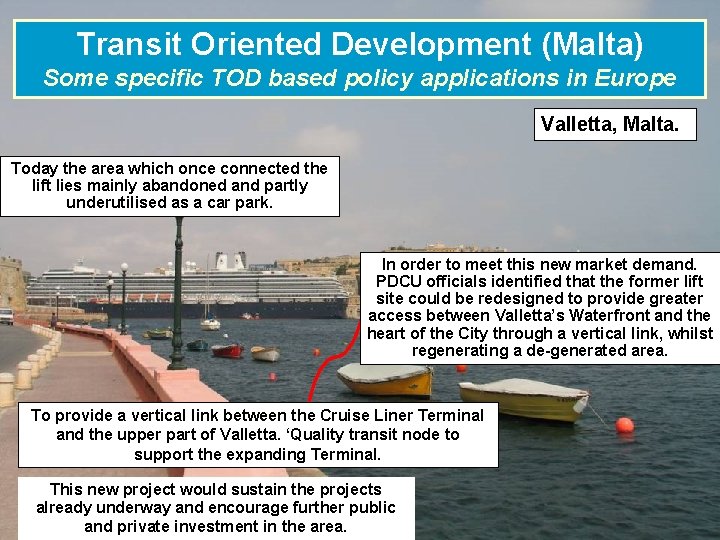
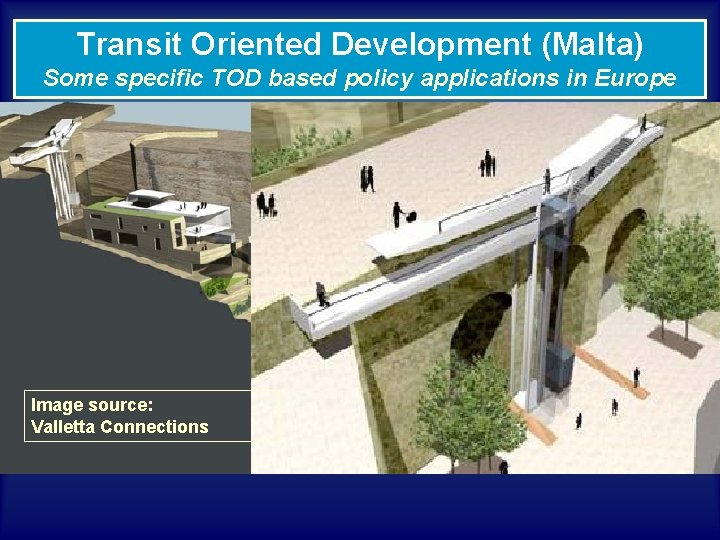
Transit Oriented Development (Malta) Some specific TOD based policy applications in Europe Valletta, Malta. Today the area which once connected the lift lies mainly abandoned and partly underutilised as a car park. In order to meet this new market demand. PDCU officials identified that the former lift site could be redesigned to provide greater access between Valletta’s Waterfront and the heart of the City through a vertical link, whilst regenerating a de-generated area. To provide a vertical link between the Cruise Liner Terminal and the upper part of Valletta. ‘Quality transit node to support the expanding Terminal. This new project would sustain the projects already underway and encourage further public and private investment in the area.
Transit Oriented Development (Malta) Some specific TOD based policy applications in Europe Image source: Valletta Connections
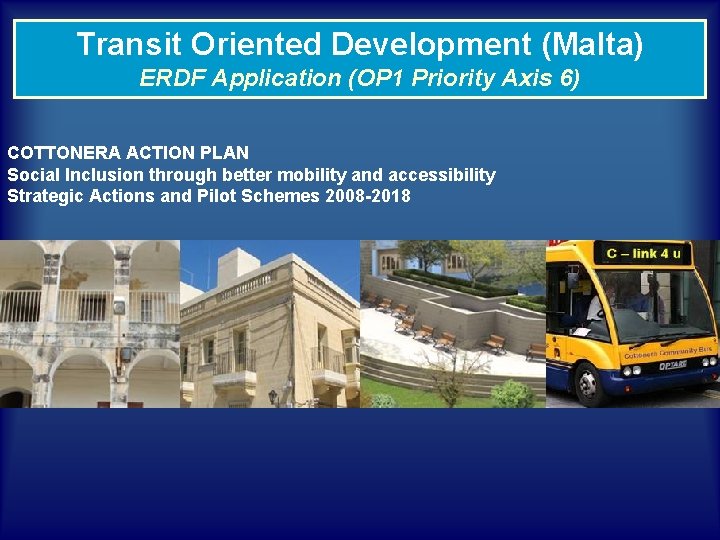
Transit Oriented Development (Malta) ERDF Application (OP 1 Priority Axis 6) COTTONERA ACTION PLAN Social Inclusion through better mobility and accessibility Strategic Actions and Pilot Schemes 2008 -2018
Transit Oriented Development (Malta) ERDF Application (OP 1 Priority Axis 6) • The purpose of this project is to launch an integrated approach to urban regeneration for the Cottonera Three Cities region through improved accessibility, transportation links and revitalised living conditions for all residents in the area. • A stream of initiatives and projects has been launched for the Cottonera; The Cottonera Waterfront Redevelopment, Santa Margerita Car Park, Restoration Programme for the Fortifications, Dock No 1 Regeneration Project, upgrade and embellishment of the Vittoriosa Quay. • The purpose of this project is to integrate these various initiatives and to launch regeneration with a holistic approach so as to create multi-speed projects which will effect the core areas of Cottonera’s Three Cities. • Introduction of new forms of transit nodes and accessibility options to support the local community of Cottonera, the first wave of regeneration projects, earmarked projects, expanding tourist and leisure market. • Collaborative joint venture with six governmental organisations.
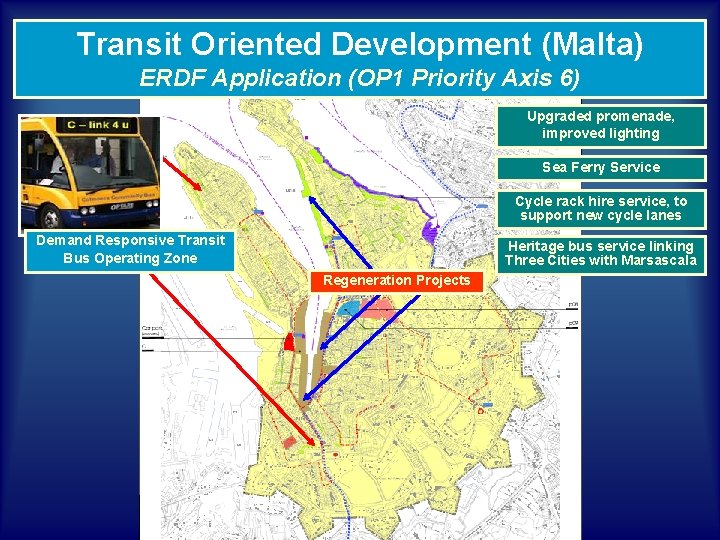
Transit Oriented Development (Malta) ERDF Application (OP 1 Priority Axis 6) Upgraded promenade, improved lighting Sea Ferry Service Cycle rack hire service, to support new cycle lanes Demand Responsive Transit Bus Operating Zone Heritage bus service linking Three Cities with Marsascala Regeneration Projects
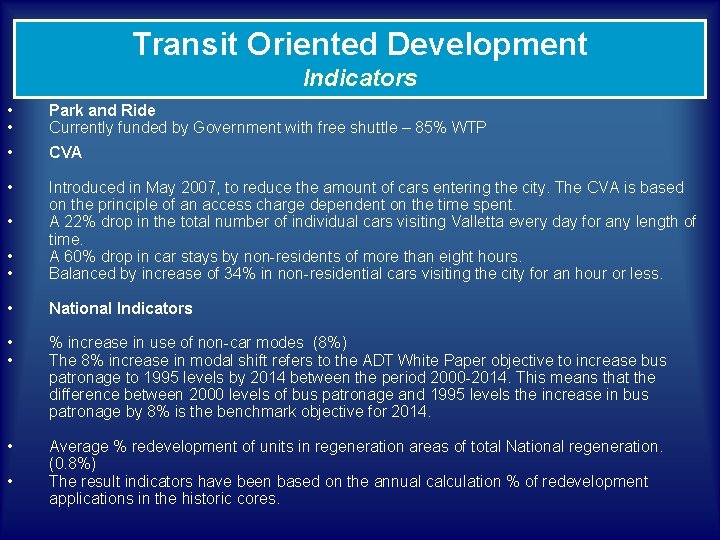
Transit Oriented Development Indicators • • Park and Ride Currently funded by Government with free shuttle – 85% WTP • CVA • • • Introduced in May 2007, to reduce the amount of cars entering the city. The CVA is based on the principle of an access charge dependent on the time spent. A 22% drop in the total number of individual cars visiting Valletta every day for any length of time. A 60% drop in car stays by non-residents of more than eight hours. Balanced by increase of 34% in non-residential cars visiting the city for an hour or less. • National Indicators • • % increase in use of non-car modes (8%) The 8% increase in modal shift refers to the ADT White Paper objective to increase bus patronage to 1995 levels by 2014 between the period 2000 -2014. This means that the difference between 2000 levels of bus patronage and 1995 levels the increase in bus patronage by 8% is the benchmark objective for 2014. • Average % redevelopment of units in regeneration areas of total National regeneration. (0. 8%) The result indicators have been based on the annual calculation % of redevelopment applications in the historic cores. • •
Transit Oriented Development Conclusions “transit agencies are not just about running trains and buses they are also in the business of creating markets that will fill those trains and buses, largely through cutting deals with private developers to build trip-generators near train stops. ” Source: Transit Cooperative Research Program