
TRANSIT BENEFIT Integrity Awareness Training Training Objectives Clarify
TRANSIT BENEFIT Integrity Awareness Training
Training Objectives • Clarify transit benefit requirements • Emphasize internal controls in place to minimize fraud and abuse • Learn consequences of non-compliance • Enhance understanding through real life scenarios • Educate participants to their roles and responsibilities
Topics • Program Overview • • Background and Objectives Role of TRANServe Website Content Legal Implications • Understanding the Certification Statement • Scenarios

Background • 1991 - Established as a Federal Transit Administration pilot program Federal • 1993 - Federal Employees Clean Air Incentives Act • 2000 - Executive Order 13150 Federal Workforce Transportation Fringe Benefit
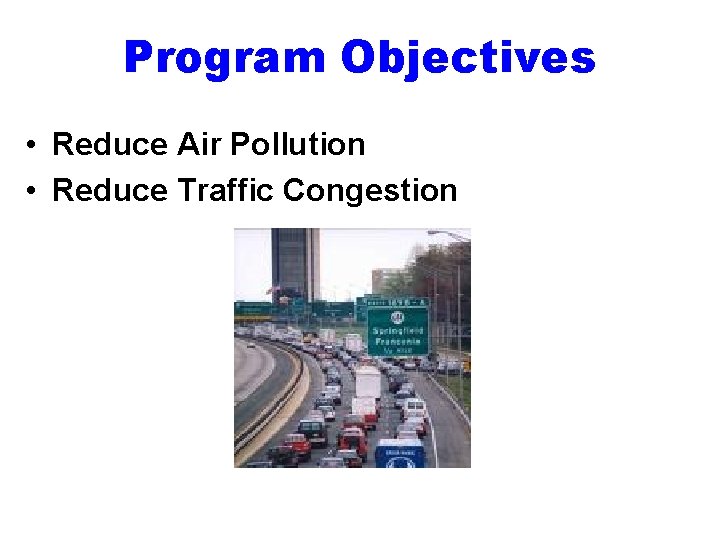
Program Objectives • Reduce Air Pollution • Reduce Traffic Congestion

Role of TRANServe Service Provider to Federal Employers: – Distribute Transit Benefit to Qualified Federal Employees – Administer the Transit Benefit Program for DHS-ICE – Establish Best Practices
Program Resources TRANServe. dot. gov ü Application & Recertification link ü DOT Expense & Verification Worksheet ü Transit Benefit Integrity Training ü Frequently Asked Questions (FAQ) ü Best Practices & Internal Controls ü DOT Policy ü GAO/OIG Audits & Findings ü Fraud & Abuse Penalties ü Transit Links to assist in fare validation
Legal Implications Tax Evasion & Fraud Employees who misuse transit subsidies are subject to appropriate administrative action including discipline and disqualification from DHS-ICE Transit Benefits in the future. Disciplinary penalties may range from a letter of admonishment to removal from Federal service depending on the severity of the abuse.
Knowledge Check The Transit Benefit Program objective is to: A. Increase compensation of federal employees per month. B. Provide incentive to federal employees to use public transportation to reduce air pollution and traffic congestion. C. Reward the employees for their hard work.
The Answer The correct answer is B. The Federal Workforce Transportation Fringe Benefit Program was established by Executive Order 13150 to reduce air pollution and traffic congestion.
Knowledge Check If I misuse my transit benefit by selling it, sharing it, or overestimating my commuting cost, I could be removed from service to the federal government. TRUE FALSE
The Answer The correct answer is TRUE. Disciplinary penalties could range from a letter of admonishment to removal from Federal service depending on the severity of the abuse.
Knowledge Check The role of TRANServe’s Transit Benefit Program is : A. Administer the Transit Benefit Program for DHS-ICE B. Establish Best Practices. C. All of the above.
The Answer The answer is C. All of the above. The Secretary of Transportation put TRANServe in place to administer the Transit Benefit Program, to distribute the transit benefit and to establish Best Practices around transit benefit programs.
Certification is Required Anyone who signs up for the transit benefit through TRANServe must certify that certain conditions are true. The following slides define certification and elaborate on these conditions.
What Does Certification Mean? “To formally and legally attest a specific statement to be true”

Certification Statement
Certification What did I just agree to? • I am employed by DHS-ICE • I am eligible for a public transportation fare benefit • I will only use the transit benefit for my daily commute to and from work • I will not give, sell or transfer my transit benefit to anyone else • I will not use the Government-provided transit benefit in excess of the statutory limit • I will not include parking fees in the computation of the daily, weekly or monthly commuting cost
Certification Part I “I certify that I am employed by the DHS-ICE and not named on a federally subsidized parking permit with the DHS-ICE or any other federal agency. ” This means: üYou do not have federally subsidized parking üYou are not listed on any federal parking pass üYou do not park your personally owned or leased vehicle at a government parking lot or garage
Certification Part II “I certify that I am eligible for a public transportation fare benefit, will use it for my daily commute to and from work, and will not transfer it to anyone else. ” This means: üYou are qualified to receive the transit benefit üYou use mass transportation to commute to and from work üYou will not give or sell your subsidy benefit to anyone
Certification Part III “I certify that in any given month, I will not use the Government provided transit benefit in excess of the statutory limit. ” This means: üYou will not use Government provided fare media in excess of your monthly estimated commuting cost üAfter you use your monthly transit benefit, you agree to pay additional cost, out of pocket
Certification Part IV “I certify that I will not claim the transit benefit in excess of my actual monthly commuting expense and that parking fees are not included in the computation of the daily, weekly or monthly commuting costs. ” This means: üYou will research and know the cost of your commute üYou will not falsify your monthly estimated commuting cost üYou will not include any parking fees when computing your daily, weekly or monthly commuting costs
Knowledge Check After riding the train for five years, Sharon just joined a carpool. She receives the maximum monthly transit benefit for her commute. She has decided to sell her benefit at a 10% discount to her best friend since she believes the benefit belongs to her. Is this the correct course of action for Sharon. YES NO
The Answer The correct answer is NO. It is against the law to sell or give away your transit benefit. Unused transit benefits must be returned to your Agency. Electronic fare media is automatically returned. Paper fare media must be returned to your Transit Benefit Program Coordinator, who will return it to TRANServe and credit your transit benefit record.
Knowledge Check Carmen travels from Virginia to get to work. His commuting costs are $264 per month. He is qualified to receive additional transit benefit since his commute is so costly. TRUE FALSE
The Answer The correct answer is FALSE. The federal government will provide employees up to the maximum subsidy amount for mass transportation commuting cost. The employee must cover the additional amount, “out of pocket”.
Scenarios The following scenarios were developed from the DOT Program Policy and Guidance Document and from the Frequently Asked Questions on the DOT Transit Benefit Internet Site, http: //transerve. dot. gov
Scenario 1 My commuting costs have changed. What do I do?
Scenario 1 My commuting costs have changed. You must update your application whenever you have a change to your costs, address, name or office. Follow these steps: 1. Go to TRANServe. dot. gov 2. Click the “Participants” Page 3. Click DHS-ICE Transit Benefit Enrollment/Change Applications 4. Log in using your government email address
Scenario 1 My commuting costs have changed. Application Update Steps continued: 5. Choose “Certify/Enroll” 6. Read and Click “I Agree”, if appropriate 7. Enter “Reason for Certification” 8. Complete and Submit the Application Worksheet and the Transit Benefit Application. 9. You will receive email notification throughout the approval process. .
Scenario 2 I ride in a carpool. Do I qualify for the transit benefit?
Scenario 2 I ride in a carpool. No. A carpool does not meet the definition of mass transportation and its riders are not eligible to receive the Transit Benefit.
Scenario 3 I ride mass transit and park in the lot near the station. Can I use my benefit to pay for parking in the commuter lot?
Scenario 3 I ride mass transit and park in the lot near the station. No. Indirect costs, such as gas, mileage, or parking cannot be included as part of the estimated commuting cost.
Knowledge Check Chris is going to an off-site meeting. She is using mass transportation to and from the meeting, and decides to use her transit benefit. This is the correct course of action. TRUE FALSE
The Answer The correct answer is FALSE. Travel to an off-site meeting or training class is an office expense. The Transit Benefit is provided solely for your home-to-work-to-home commute via mass transportation.
Scenario 4 I plan to go on extended leave. Can I still receive my transit benefit?
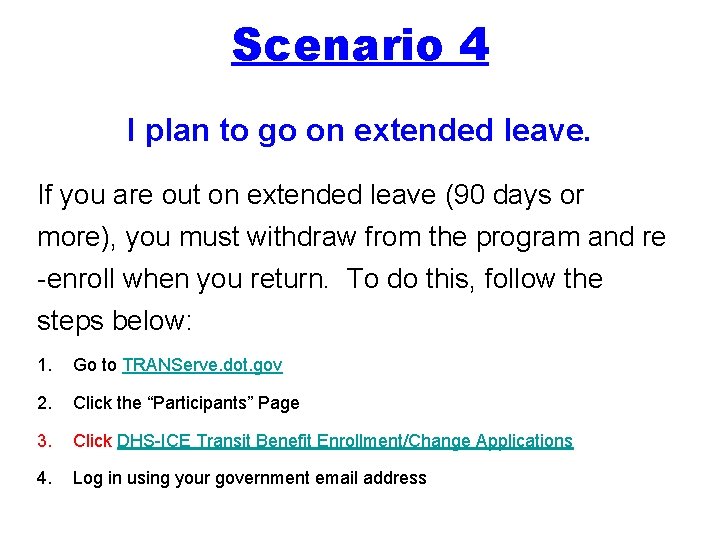
Scenario 4 I plan to go on extended leave. If you are out on extended leave (90 days or more), you must withdraw from the program and re -enroll when you return. To do this, follow the steps below: 1. Go to TRANServe. dot. gov 2. Click the “Participants” Page 3. Click DHS-ICE Transit Benefit Enrollment/Change Applications 4. Log in using your government email address
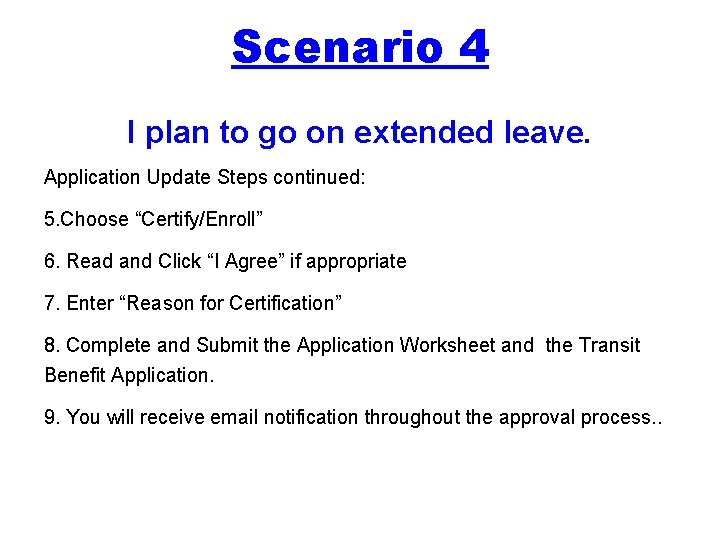
Scenario 4 I plan to go on extended leave. Application Update Steps continued: 5. Choose “Certify/Enroll” 6. Read and Click “I Agree” if appropriate 7. Enter “Reason for Certification” 8. Complete and Submit the Application Worksheet and the Transit Benefit Application. 9. You will receive email notification throughout the approval process. .
Knowledge Check Shunda is leaving DHS-ICE to work for DOJ. She believes the correct way to handle her leftover transit benefit is to: A. Give the leftovers to her sister. B. Sell her extra transit benefit to her co-worker. C. Return the excess Transit Benefit to her Agency Point of Contact to return for credit to the Agency.
The Answer The correct answer is C. The Transit Benefit is not transferable and must not to be sold. If you are in the NCR Smart. Benefits® Program, unused transit benefit amounts must be returned to your Agency.
Scenario 5 I have been on TDY the past two months. How do I get my Transit Benefit for the months I missed?
Scenario 5 I have been on TDY the past two months. This is a monthly benefit based on the actual cost of your home-to-work-to-home commute. If you are not coming to work, you are not paying to commute and must not accept a transit benefit. If you received a paper benefit in advance of going on TDY, you must factor your absence into the amount you receive at the next distribution. An unused excess electronic benefit is returned automatically.
Scenario 6 I plan to telecommute Do I need to change my benefit amount?
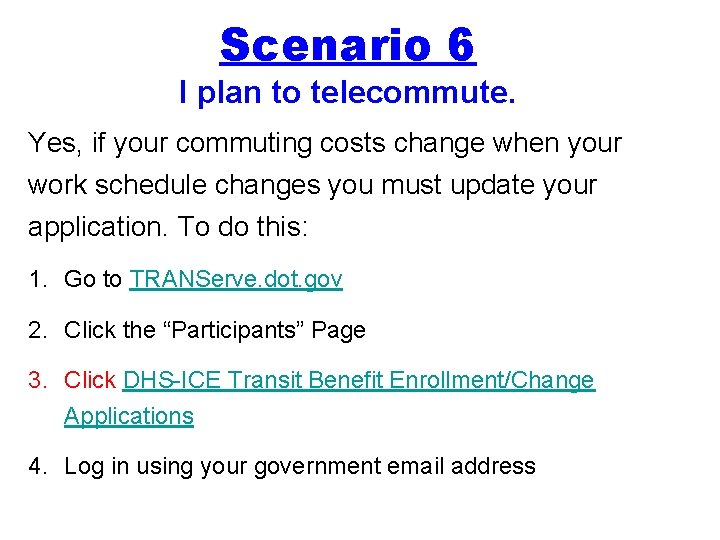
Scenario 6 I plan to telecommute. Yes, if your commuting costs change when your work schedule changes you must update your application. To do this: 1. Go to TRANServe. dot. gov 2. Click the “Participants” Page 3. Click DHS-ICE Transit Benefit Enrollment/Change Applications 4. Log in using your government email address
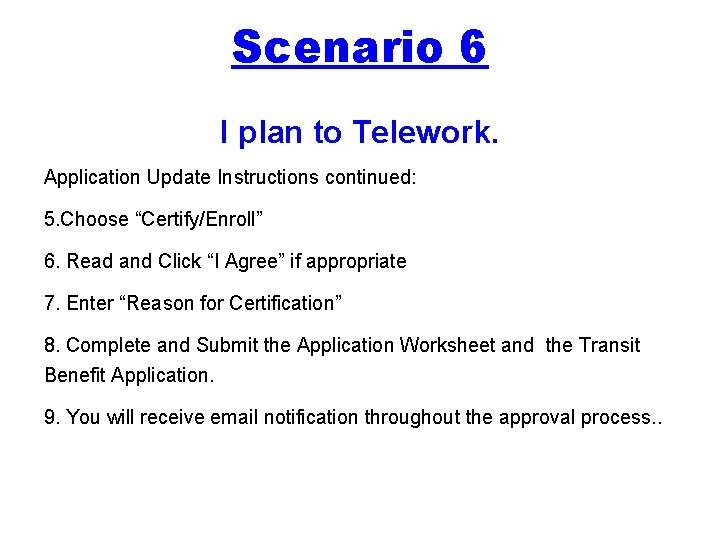
Scenario 6 I plan to Telework. Application Update Instructions continued: 5. Choose “Certify/Enroll” 6. Read and Click “I Agree” if appropriate 7. Enter “Reason for Certification” 8. Complete and Submit the Application Worksheet and the Transit Benefit Application. 9. You will receive email notification throughout the approval process. .
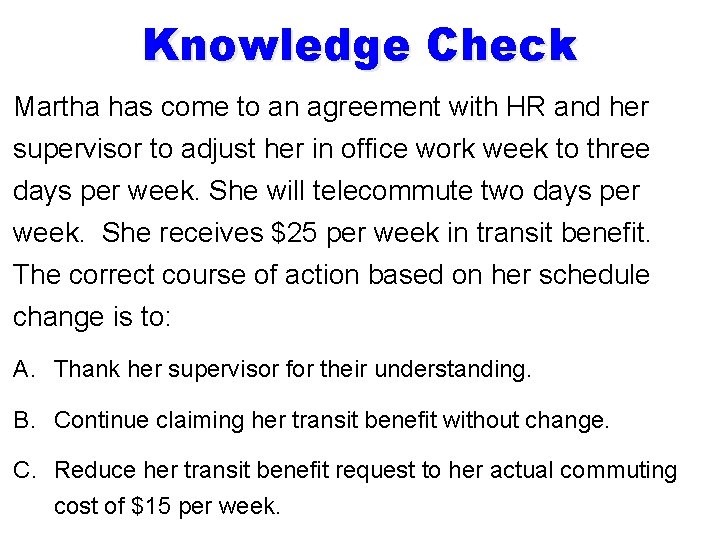
Knowledge Check Martha has come to an agreement with HR and her supervisor to adjust her in office work week to three days per week. She will telecommute two days per week. She receives $25 per week in transit benefit. The correct course of action based on her schedule change is to: A. Thank her supervisor for their understanding. B. Continue claiming her transit benefit without change. C. Reduce her transit benefit request to her actual commuting cost of $15 per week.
The Answer The correct answer is C. You must update your transit benefit application whenever your expenses for mass transportation change.
Scenario 7 My fare media was lost, stolen or damaged Who do I contact?
Scenario 7 My fare media was lost, stolen or damaged Once the fare media is distributed to you, you are responsible for its safekeeping. Lost or stolen fare media will not be replaced by the Department. Some transit authorities have a process by which to exchange damaged fare media. Your Agency’s Program Coordinator may be able to advise you in the handling of damaged fare media.
Scenario 7 What if my fare media is lost, stolen or damaged? Electronic Fare Media : When you purchase a reloadable electronic fare media card, be sure to register it with the Transit Authority Provider, if this option is available to you. Registration prevents a permanent loss of irreplaceable Transit Benefit funds. The electronic fare media on a lost, stolen or damaged card can be transferred to the new card. Note: You must pay for the new card with personal funds.
Scenario 8 My vanpool driver is not paying. Is that fair?
Scenario 8 My vanpool driver is not paying. Passenger Rates may be waived or reduced for the driver, who is not eligible to receive the transit benefit. Vanpool charges must reflect reasonable costs of doing business and rates charged must be the same for all passengers.
Knowledge Check José has damaged paper fare card. The Department will replace this card. TRUE FALSE
The Answer The correct answer is FALSE Once paper fare media is distributed and becomes damaged, it is your responsibility to have it replaced by the transit authority.
Scenario 10 I didn’t use all my benefit. Can I give it to a co-worker?
Scenario 10 I didn’t use all my benefit. No. Your transit benefit belongs to you, and no one else. Did you know it’s against the rules (and the law) to sell or give your transit benefit to someone else? The program was designed to assist employees with public transportation costs in an effort to cut-down air pollution and relieve traffic congestion. The IRS code states that this is a tax-free benefit. http: //www. irs. gov/pub/irstege/fringe_benefit_fslg. pdf
Knowledge Check Phil pays $200 every month for his vanpool. He notices other riders at his stop are being charged a different rate. Phil should: A. Change his certified commuting cost to reflect the higher rate he’s being charged. B. Find a new vanpool. C. Report the incident to his Agency Point of Contact.
The Answer The correct answer is C. Employees are responsible to determine the amount they are charged represents fair market value. To report cases of additional or excessive fees targeted to federal transit benefit participants, contact your Agency Program Coordinator or your Agency Inspector General.
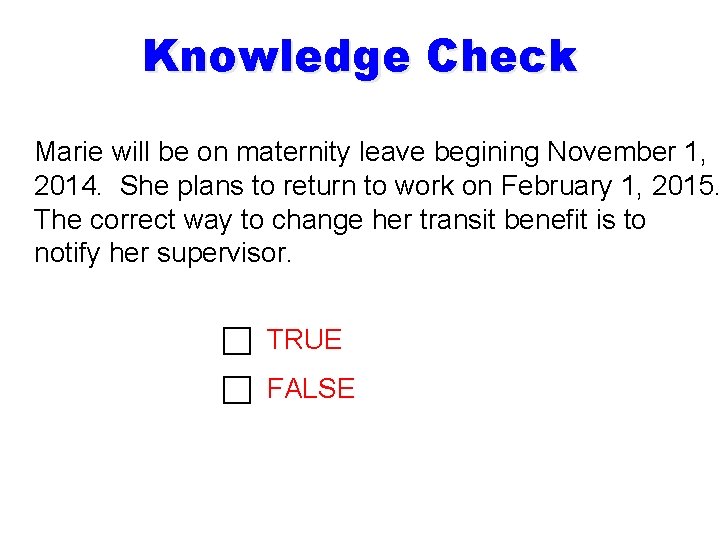
Knowledge Check Marie will be on maternity leave begining November 1, 2014. She plans to return to work on February 1, 2015. The correct way to change her transit benefit is to notify her supervisor. TRUE FALSE
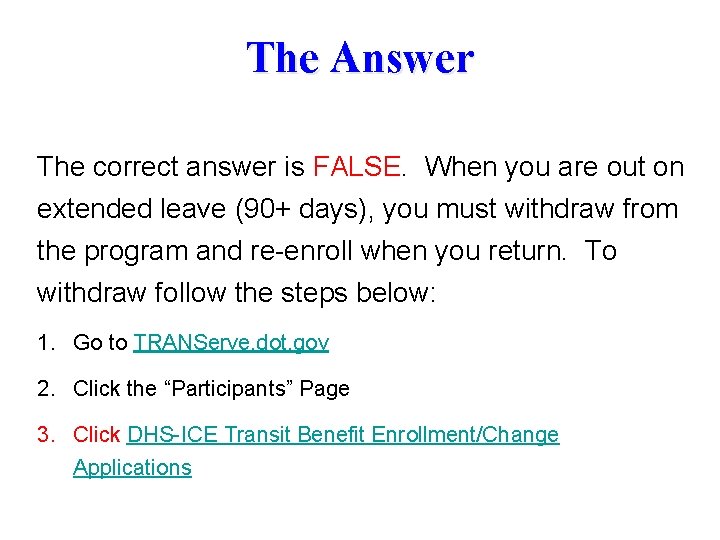
The Answer The correct answer is FALSE. When you are out on extended leave (90+ days), you must withdraw from the program and re-enroll when you return. To withdraw follow the steps below: 1. Go to TRANServe. dot. gov 2. Click the “Participants” Page 3. Click DHS-ICE Transit Benefit Enrollment/Change Applications
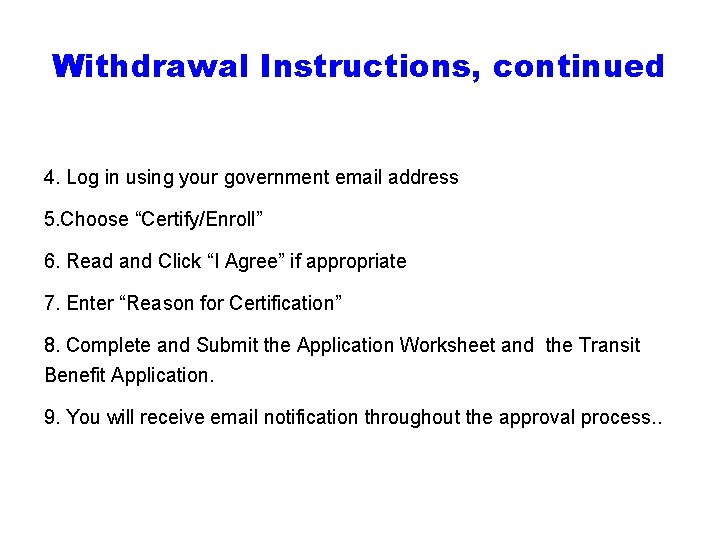
Withdrawal Instructions, continued 4. Log in using your government email address 5. Choose “Certify/Enroll” 6. Read and Click “I Agree” if appropriate 7. Enter “Reason for Certification” 8. Complete and Submit the Application Worksheet and the Transit Benefit Application. 9. You will receive email notification throughout the approval process. .
You have successfully completed TRANSIT BENEFIT INTEGRITY TRAINING ______________ ( Enter Name Here) Provide this certificate to Supervisor & check the confirmation box on the application.
- Slides: 63