
Transistors Ever wonder how things get turned on
- Slides: 9
Transistors! Ever wonder how things get turned on and off or you can control the sound level of things?
�We’ve talked about magnetic fields, electric fields and how we’ve used them. �Now let’s go onto transistors (they use electric charges) and how we’ve benefited from them
First: Semi-Conductors �Crystalline solids that can conduct electric current under certain conditions �Usually made from silicon (common) or germanium (rare). �By adding trace amounts of other elements (germanium, indium or arsenic) you can make the silicon better at conducting electricity ◦ This is because adding elements will force the silicon to lose or gain electrons.
Types of Semi-Conductors �P type- positive charges APPEARS to flow ◦ These semi-conductors have many atoms that are missing electrons (holes) �N Type-negative charges flow ◦ These semi-conductors have atoms with an abundance of electrons
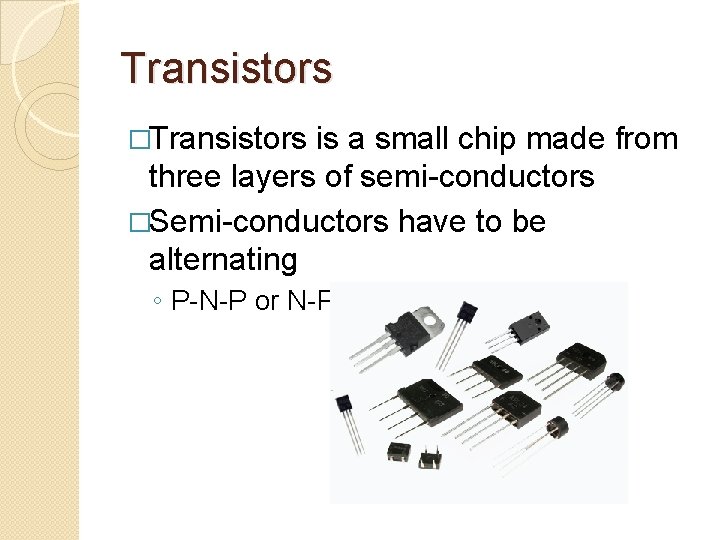
Transistors �Transistors is a small chip made from three layers of semi-conductors �Semi-conductors have to be alternating ◦ P-N-P or N-P-N
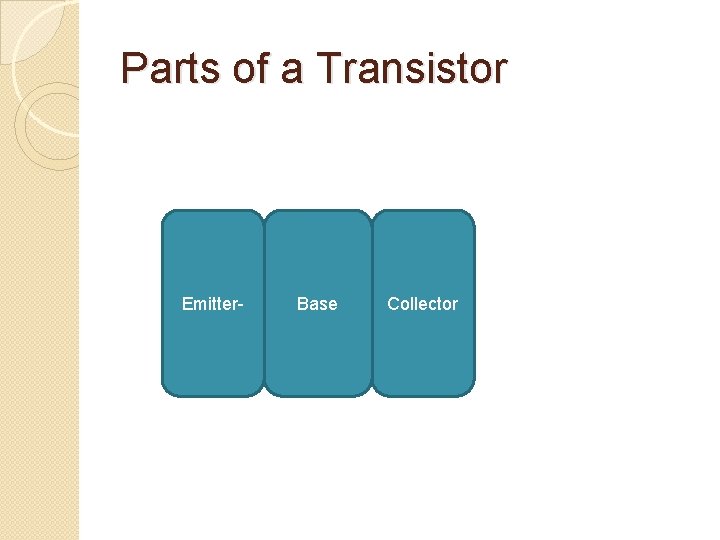
Parts of a Transistor Emitter- Base Collector
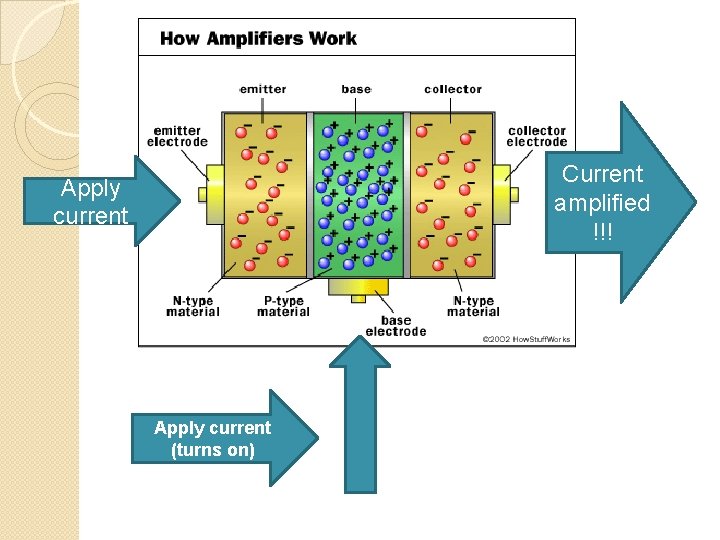
What do transistors do? �Transistors can be used to turn things on or off ◦ (apply current at base) �Transistors can be used as amplifiers and can make voltages bigger ◦ (apply current at base AND emitter)
Current amplified !!! Apply current (turns on)
Where do I find transistors? �In just about every electronic device you can buy today. �Switching transistors: cars, lamps, radios �Amplifier: dimmers, speakers, microphones, guitars, keyboard (not the computer one), hearing aides.