
Transistor Introduction to Bipolar Junction Transistor BJT Introduction

Transistor Introduction to Bipolar Junction Transistor (BJT)

Introduction • Beside diodes, the most popular semiconductor devices is transistors. • Transistors are more complex and can be used in many ways • Most important feature: can amplify signals and as switch • Amplification can make weak signal strong (make sounds louder and signal levels greater), in general, provide function called Gain
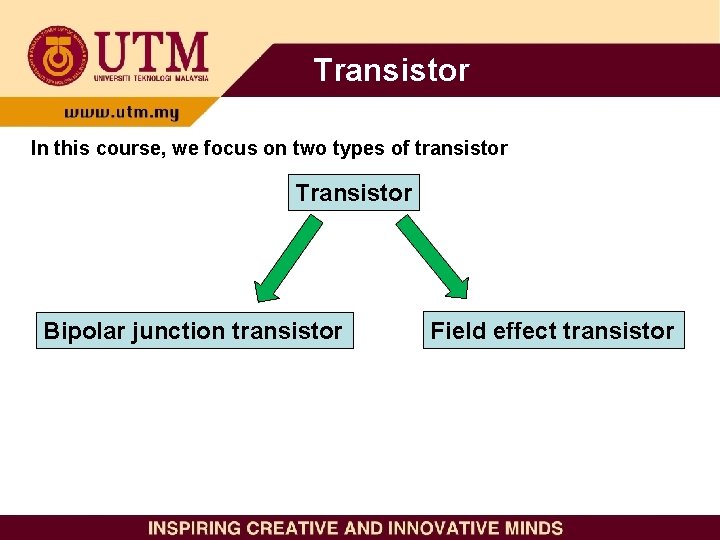
Transistor In this course, we focus on two types of transistor Transistor Bipolar junction transistor Field effect transistor

Bipolar junction transistor • • • BJT is bipolar because both holes (+) and electrons (-) will take part in the current flow through the device – N-type regions contains free electrons (negative carriers) – P-type regions contains free holes (positive carriers) 2 types of BJT – NPN transistor – PNP transistor The transistor regions are: – Emitter (E) – send the carriers into the base region and then on to the collector – Base (B) – acts as control region. It can allow none, some or many carriers to flow – Collector (C) – collects the carriers
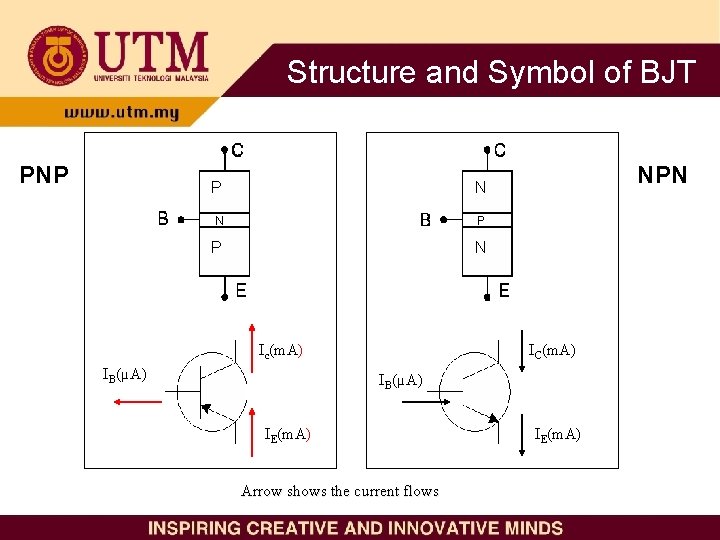
Structure and Symbol of BJT PNP P N N P P N Ic(m. A) IB(µA) NPN IC(m. A) IB(µA) IE(m. A) Arrow shows the current flows IE(m. A)
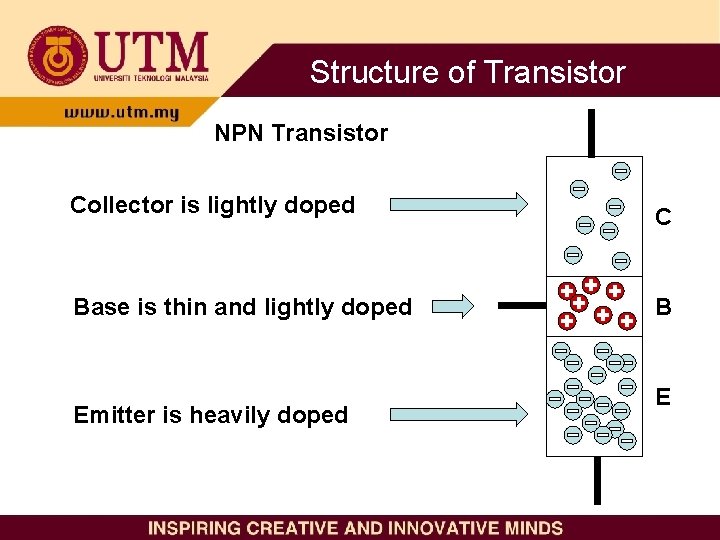
Structure of Transistor NPN Transistor Collector is lightly doped C Base is thin and lightly doped B Emitter is heavily doped E
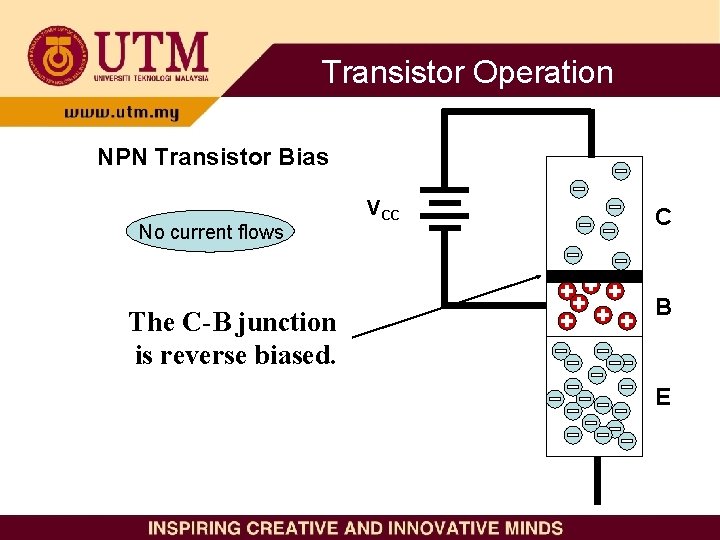
Transistor Operation NPN Transistor Bias No current flows The C-B junction is reverse biased. VCC C B E

Transistor Operation NPN Transistor Bias C The B-E junction is forward biased. Current flows from B to E IB B E VEE IE
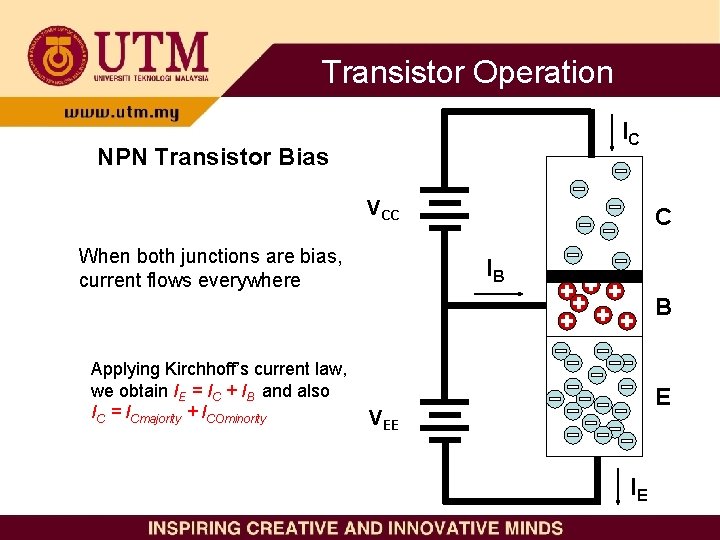
Transistor Operation IC NPN Transistor Bias VCC When both junctions are bias, current flows everywhere C IB B Applying Kirchhoff’s current law, we obtain IE = IC + IB and also IC = ICmajority + ICOminority E VEE IE
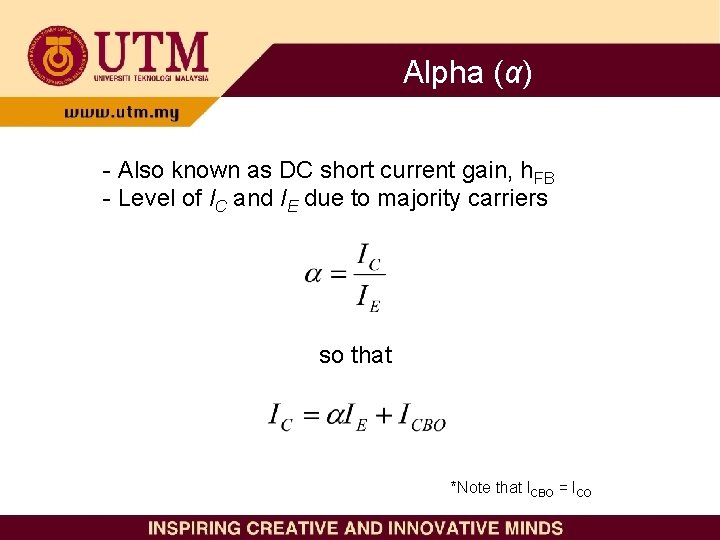
Alpha (α) - Also known as DC short current gain, h. FB - Level of IC and IE due to majority carriers so that *Note that ICBO = ICO
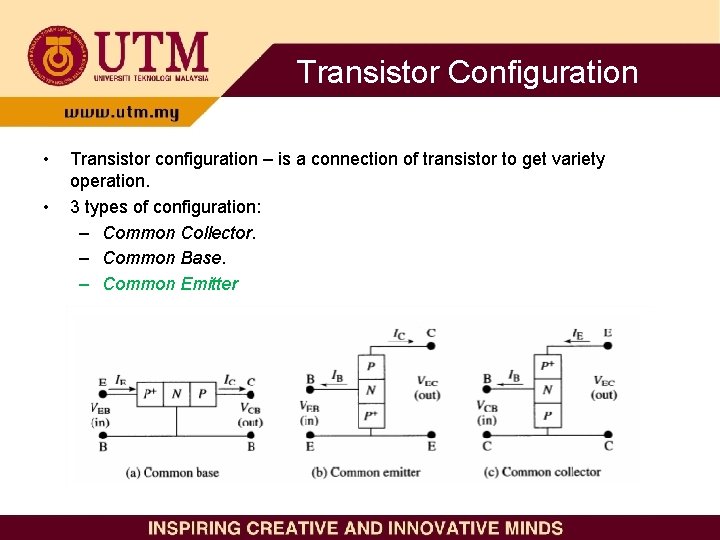
Transistor Configuration • • Transistor configuration – is a connection of transistor to get variety operation. 3 types of configuration: – Common Collector. – Common Base. – Common Emitter
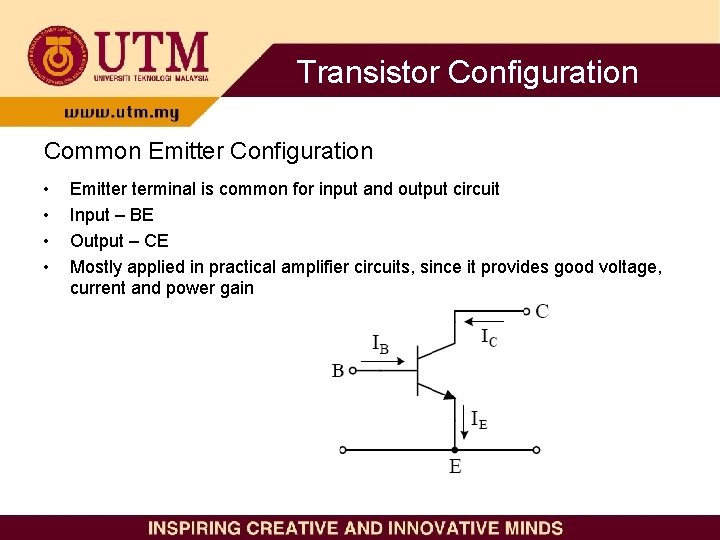
Transistor Configuration Common Emitter Configuration • • Emitter terminal is common for input and output circuit Input – BE Output – CE Mostly applied in practical amplifier circuits, since it provides good voltage, current and power gain
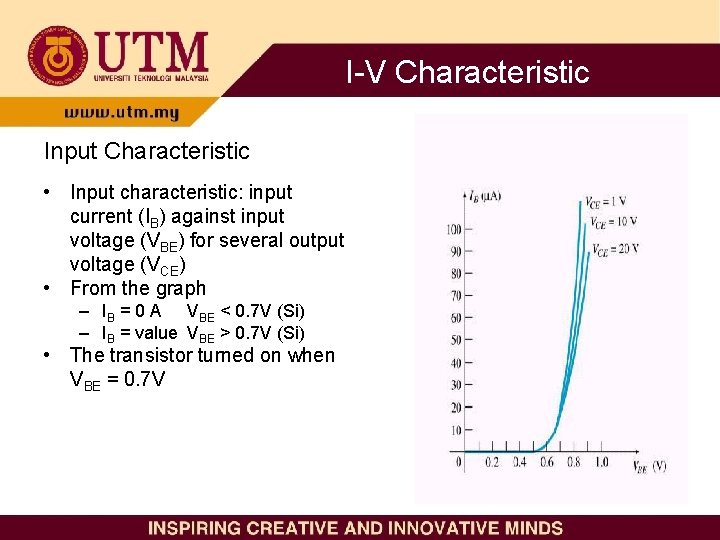
I-V Characteristic Input Characteristic • Input characteristic: input current (IB) against input voltage (VBE) for several output voltage (VCE) • From the graph – IB = 0 A VBE < 0. 7 V (Si) – IB = value VBE > 0. 7 V (Si) • The transistor turned on when VBE = 0. 7 V
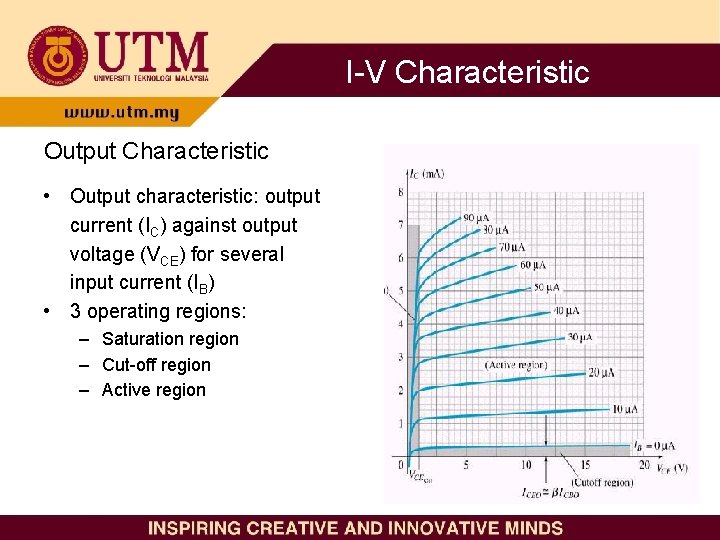
I-V Characteristic Output Characteristic • Output characteristic: output current (IC) against output voltage (VCE) for several input current (IB) • 3 operating regions: – Saturation region – Cut-off region – Active region
I-V Characteristic • Saturation region – in which both junctions are forward-biased and IC increase linearly with VCE • Cut-off region – where both junctions are reverse-biased, the IB is very small, and essentially no IC flows, IC is essentially zero with increasing VCE • Active region – in which the transistor can act as a linear amplifier, where the BE junction is forward-biased and BC junction is reverse-biased. IC increases drastically although only small changes of IB. • Saturation and cut-off regions – areas where the transistor can operate as a switch • Active region – area where transistor operates as an amplifier
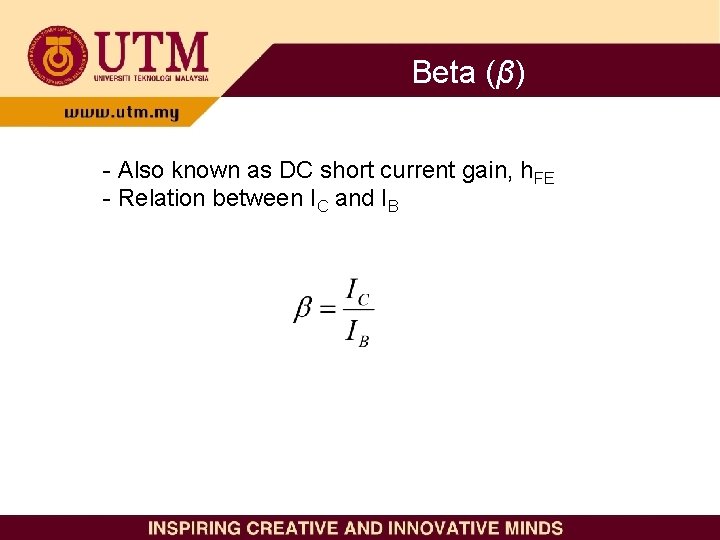
Beta (β) - Also known as DC short current gain, h. FE - Relation between IC and IB
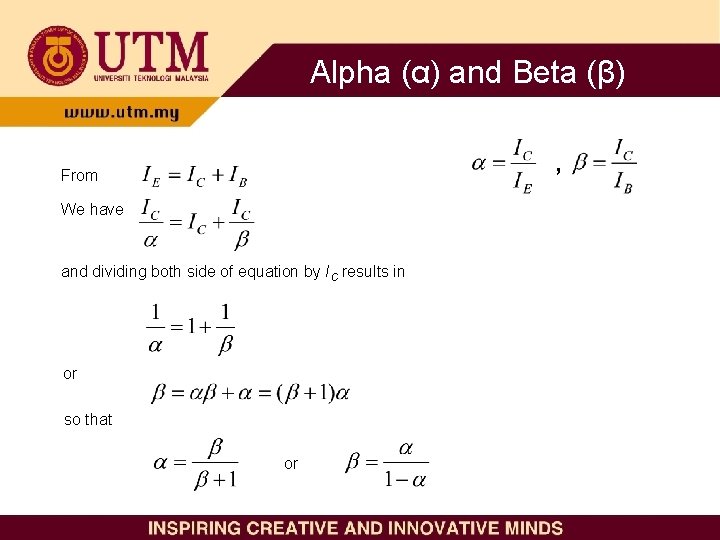
Alpha (α) and Beta (β) , From We have and dividing both side of equation by IC results in or so that or
- Slides: 17