
Transient Ischemic Attack TIA a transient episode of
![Grade of Recommendation Level of Evidence Therapy [A] 1 a Systemic review of RCTs](https://slidetodoc.com/presentation_image_h2/8ded6d72a8ca136bd1782699f42f5a28/image-12.jpg "Grade of Recommendation Level of Evidence Therapy [A] 1 a Systemic review of RCTs")
![Grade of Recommendation Level of Evidence Therapy [A] 1 a Systemic review of RCTs](https://slidetodoc.com/presentation_image_h2/8ded6d72a8ca136bd1782699f42f5a28/image-29.jpg "Grade of Recommendation Level of Evidence Therapy [A] 1 a Systemic review of RCTs")
- Slides: 40
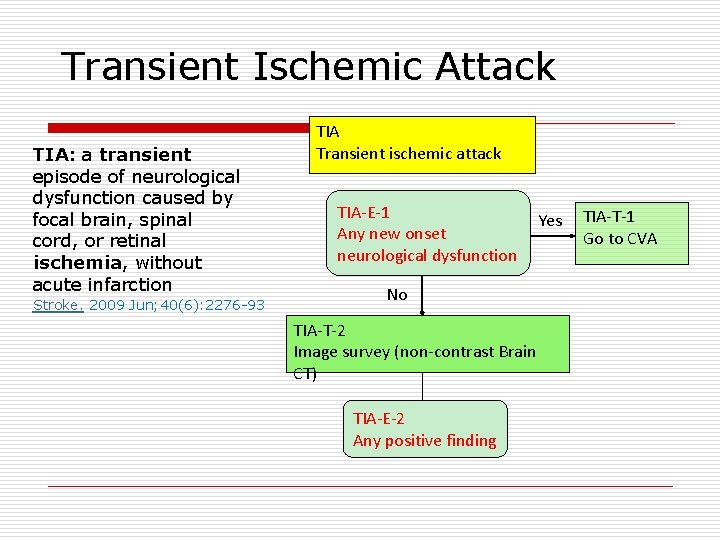
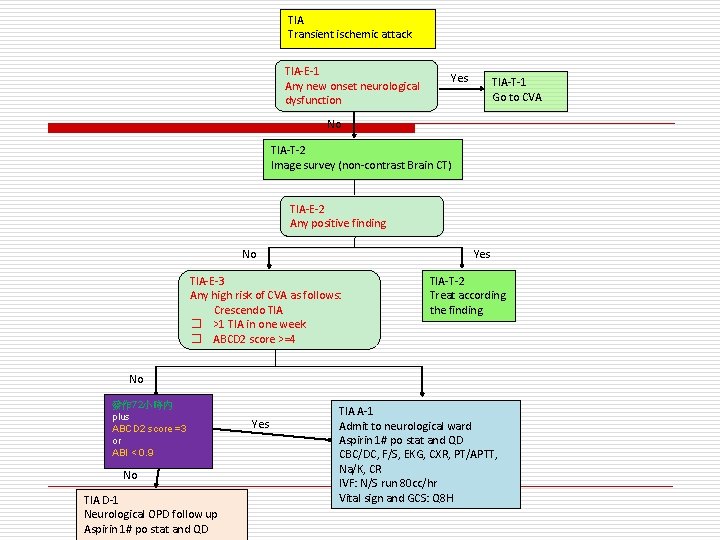
Transient Ischemic Attack TIA: a transient episode of neurological dysfunction caused by focal brain, spinal cord, or retinal ischemia, without acute infarction Stroke. 2009 Jun; 40(6): 2276 -93 TIA Transient ischemic attack TIA-E-1 Any new onset neurological dysfunction No TIA-T-2 Image survey (non-contrast Brain CT) TIA-E-2 Any positive finding Yes TIA-T-1 Go to CVA
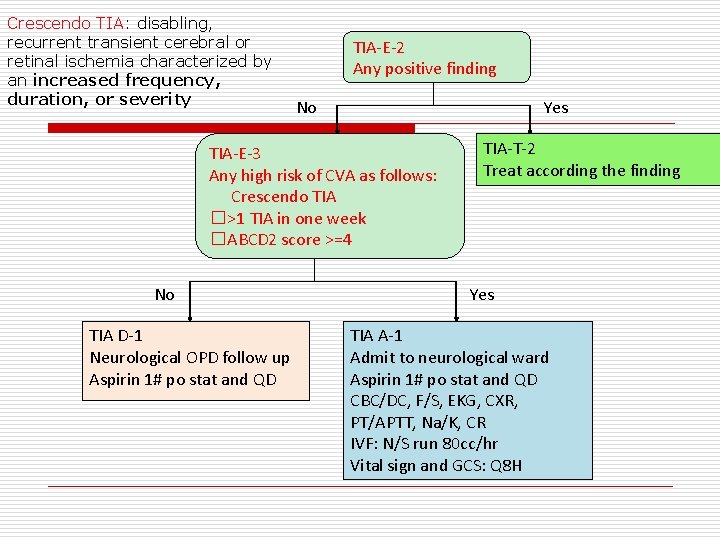
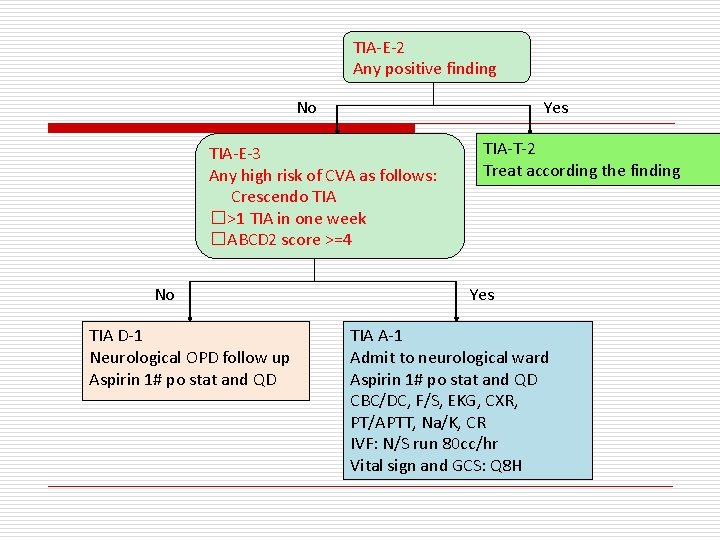
Crescendo TIA: disabling, recurrent transient cerebral or retinal ischemia characterized by an increased frequency, duration, or severity TIA-E-2 Any positive finding No Yes TIA-E-3 Any high risk of CVA as follows: Crescendo TIA �>1 TIA in one week �ABCD 2 score >=4 No TIA D-1 Neurological OPD follow up Aspirin 1# po stat and QD TIA-T-2 Treat according the finding Yes TIA A-1 Admit to neurological ward Aspirin 1# po stat and QD CBC/DC, F/S, EKG, CXR, PT/APTT, Na/K, CR IVF: N/S run 80 cc/hr Vital sign and GCS: Q 8 H
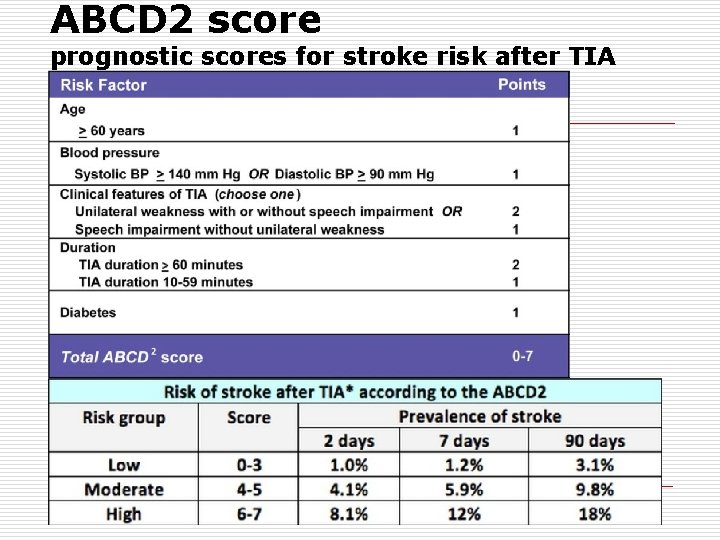
ABCD 2 score prognostic scores for stroke risk after TIA
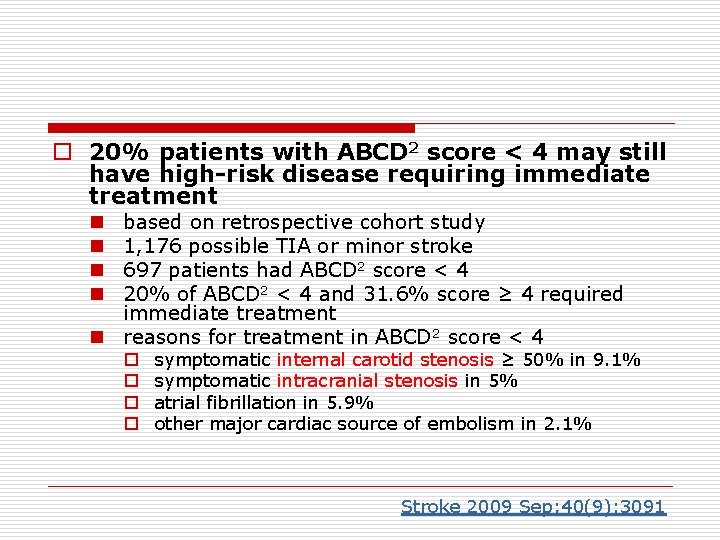
o 20% patients with ABCD 2 score < 4 may still have high-risk disease requiring immediate treatment based on retrospective cohort study 1, 176 possible TIA or minor stroke 697 patients had ABCD 2 score < 4 20% of ABCD 2 < 4 and 31. 6% score ≥ 4 required immediate treatment n reasons for treatment in ABCD 2 score < 4 n n o o symptomatic internal carotid stenosis ≥ 50% in 9. 1% symptomatic intracranial stenosis in 5% atrial fibrillation in 5. 9% other major cardiac source of embolism in 2. 1% Stroke 2009 Sep; 40(9): 3091
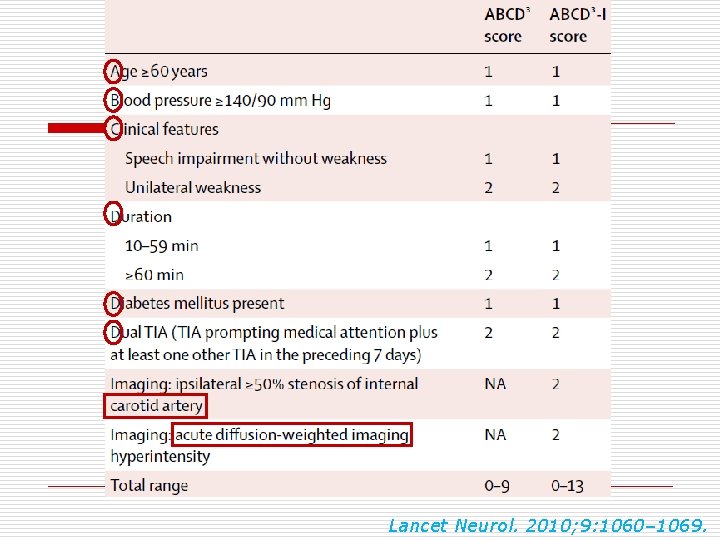
Lancet Neurol. 2010; 9: 1060– 1069.
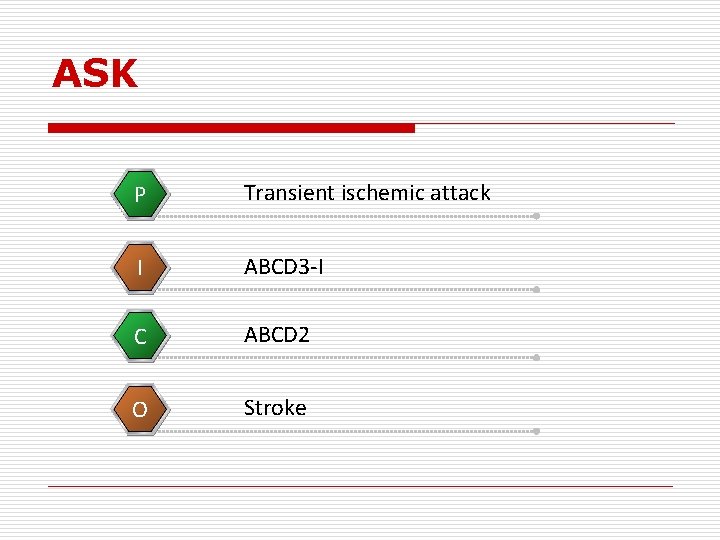
ASK P Transient ischemic attack I ABCD 3 -I C ABCD 2 O Stroke
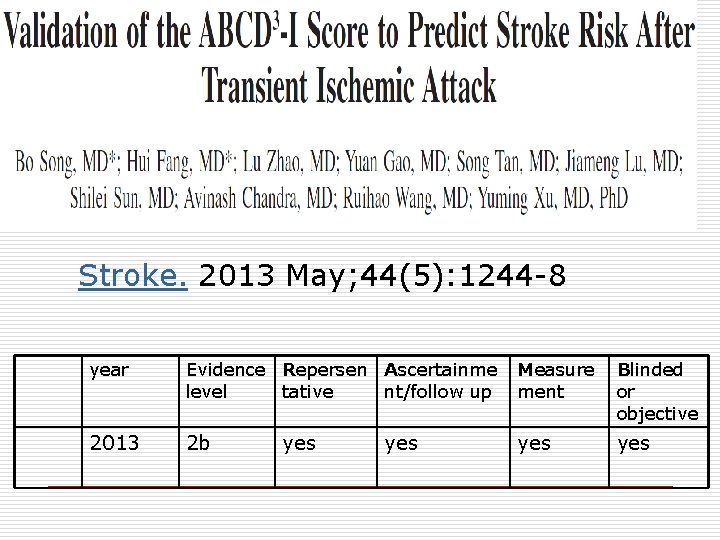
Acquire o. Database : Pub. Med, Medline o. Key word: Transient ischemic attact, ABCD 3 -I, ABCD 2, Stroke
Stroke. 2013 May; 44(5): 1244 -8 year Evidence Repersen Ascertainme level tative nt/follow up Measure ment Blinded or objective 2013 2 b yes yes
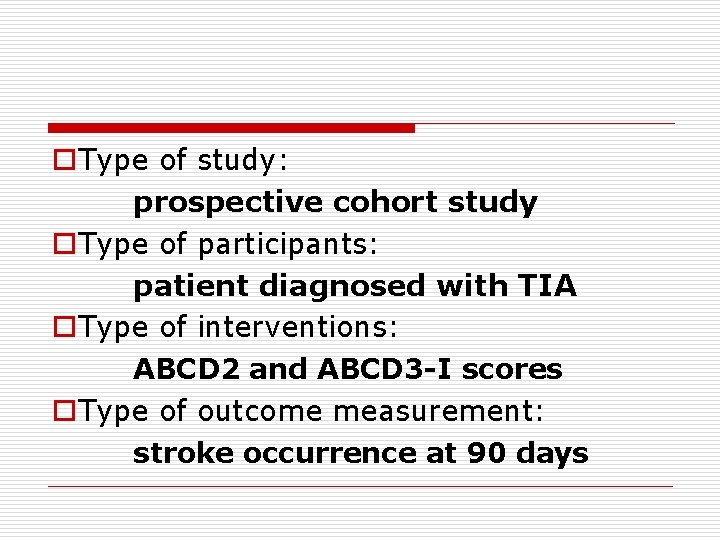
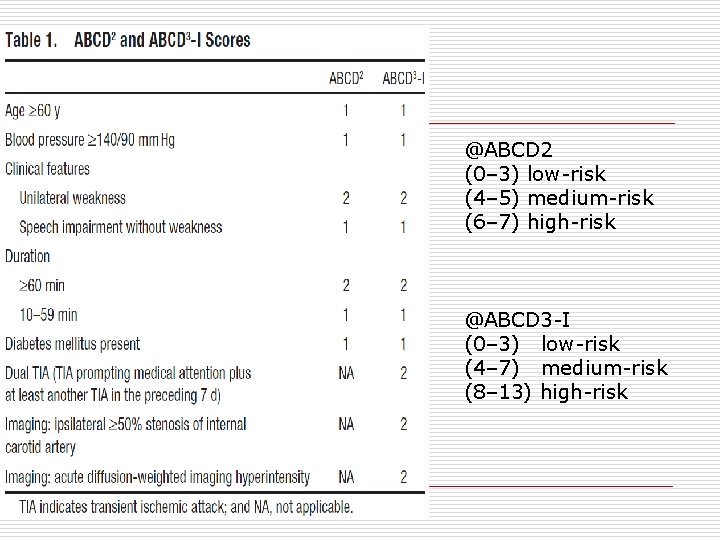
o. Type of study: prospective cohort study o. Type of participants: patient diagnosed with TIA o. Type of interventions: ABCD 2 and ABCD 3 -I scores o. Type of outcome measurement: stroke occurrence at 90 days
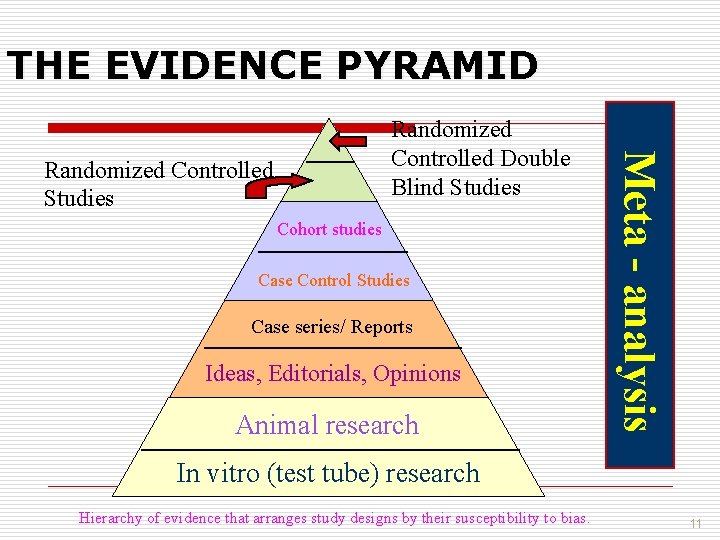
THE EVIDENCE PYRAMID Randomized Controlled Studies Cohort studies Case Control Studies Case series/ Reports Ideas, Editorials, Opinions Animal research Meta - analysis Randomized Controlled Double Blind Studies In vitro (test tube) research Hierarchy of evidence that arranges study designs by their susceptibility to bias. 11
Grade of Recommendation Level of Evidence Therapy [A] 1 a Systemic review of RCTs 1 b Single RCT 1 c ‘All-or-none’ 2 a Systemic review of cohort studies 2 b Cohort or poor RCT 2 c ‘Outcomes’ research 3 a Systemic review of casecontrol studies 3 b Case-control study [C] 4 Case series [D] 5 Expert opinion, physiology, bench research [B]
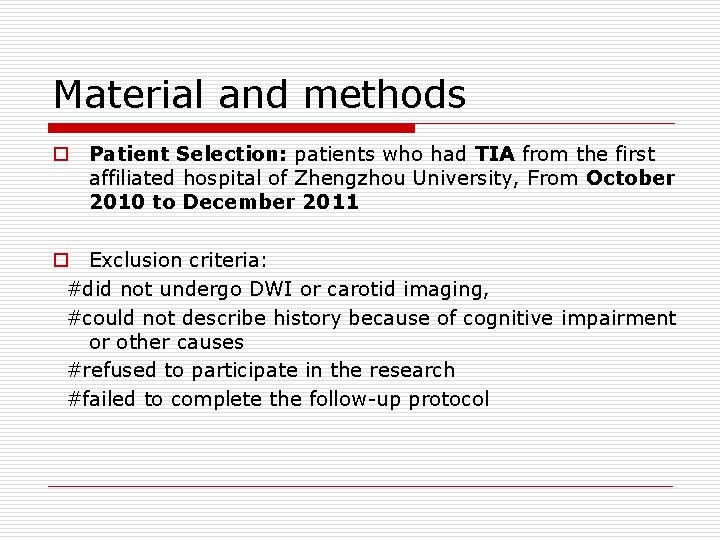
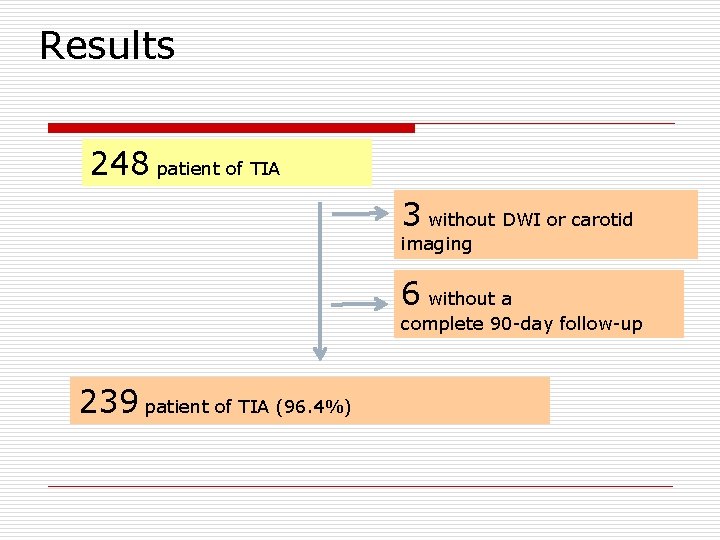
Material and methods o Patient Selection: patients who had TIA from the first affiliated hospital of Zhengzhou University, From October 2010 to December 2011 o Exclusion criteria: #did not undergo DWI or carotid imaging, #could not describe history because of cognitive impairment or other causes #refused to participate in the research #failed to complete the follow-up protocol
@ABCD 2 (0– 3) low-risk (4– 5) medium-risk (6– 7) high-risk @ABCD 3 -I (0– 3) low-risk (4– 7) medium-risk (8– 13) high-risk
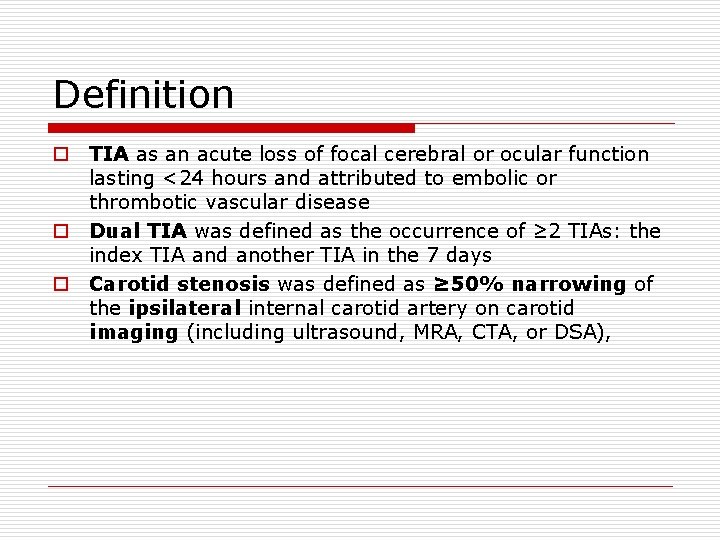
Definition o TIA as an acute loss of focal cerebral or ocular function lasting <24 hours and attributed to embolic or thrombotic vascular disease o Dual TIA was defined as the occurrence of ≥ 2 TIAs: the index TIA and another TIA in the 7 days o Carotid stenosis was defined as ≥ 50% narrowing of the ipsilateral internal carotid artery on carotid imaging (including ultrasound, MRA, CTA, or DSA),
Results 248 patient of TIA 3 without DWI or carotid imaging 6 without a complete 90 -day follow-up 239 patient of TIA (96. 4%)
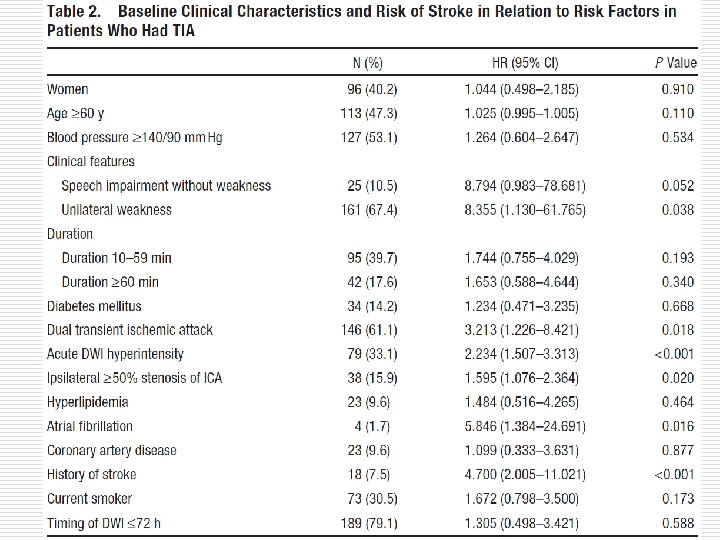
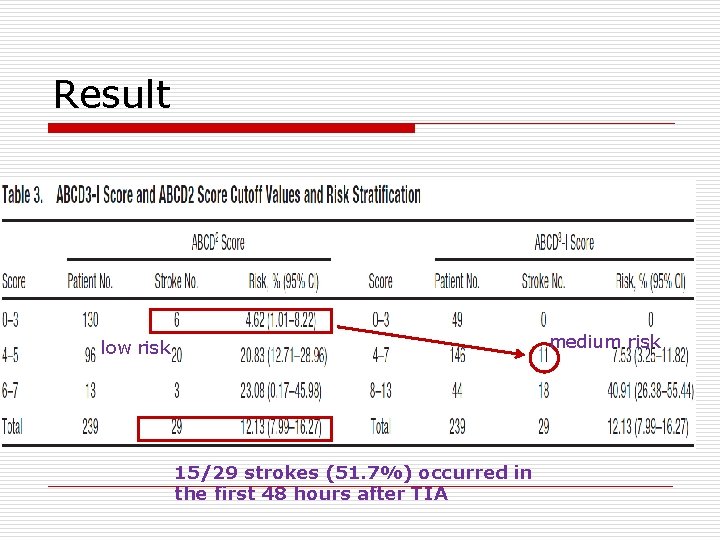
Result medium risk low risk 15/29 strokes (51. 7%) occurred in the first 48 hours after TIA
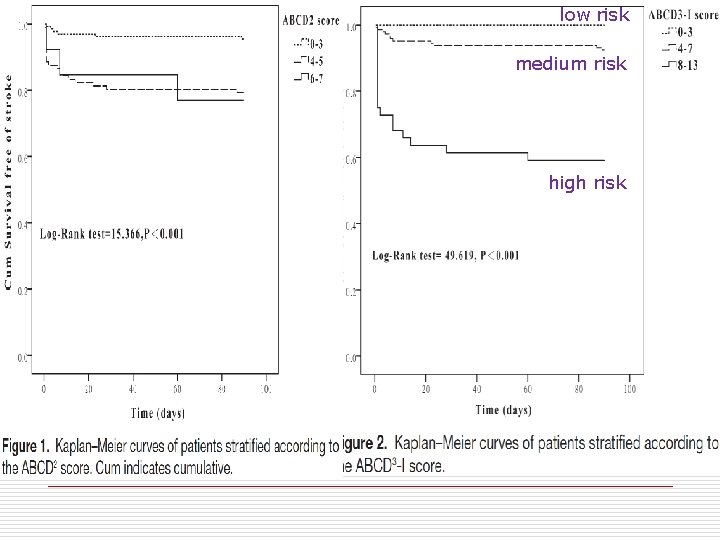
low risk medium risk high risk
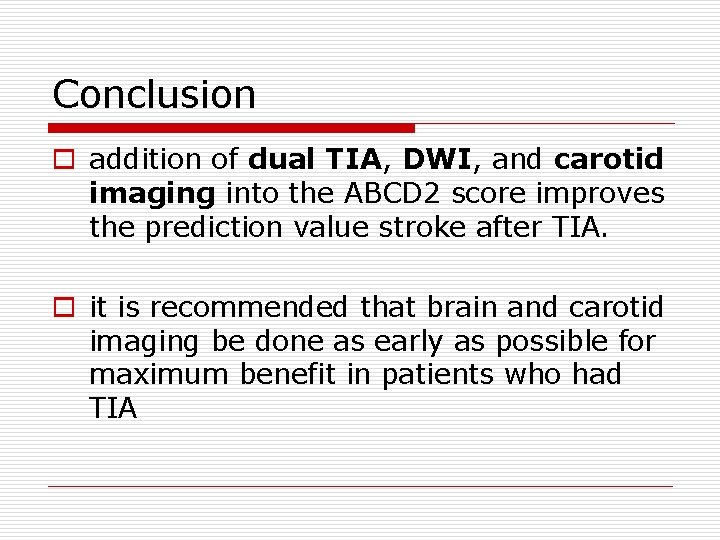
Conclusion o addition of dual TIA, DWI, and carotid imaging into the ABCD 2 score improves the prediction value stroke after TIA. o it is recommended that brain and carotid imaging be done as early as possible for maximum benefit in patients who had TIA
RAMBO CHECKLIST: o�� Yes �� No �� Unclear ■R研究族群是否具有代表性( Representative) ■ A是否有足夠的確認和追蹤( Ascertainment/follow-up) ■ Mbo結果的估計值(Measurement) 公正、恰當? (blinded or objective)
Noninvasive imaging of the cervicocephalic vessels should be performed routinely as part of the evaluation of patients with suspected TIAs (Class I, Level of Evidence A) Stroke. 2009; 40: 2276 -2293. )
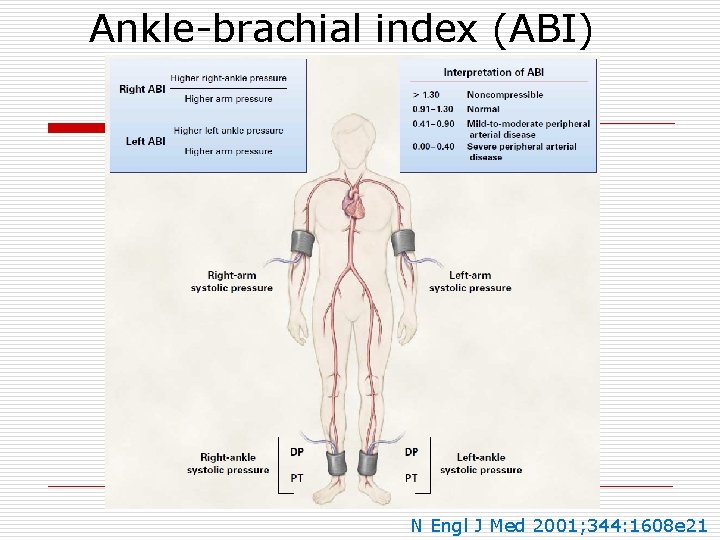
Ankle-brachial index (ABI) N Engl J Med 2001; 344: 1608 e 21
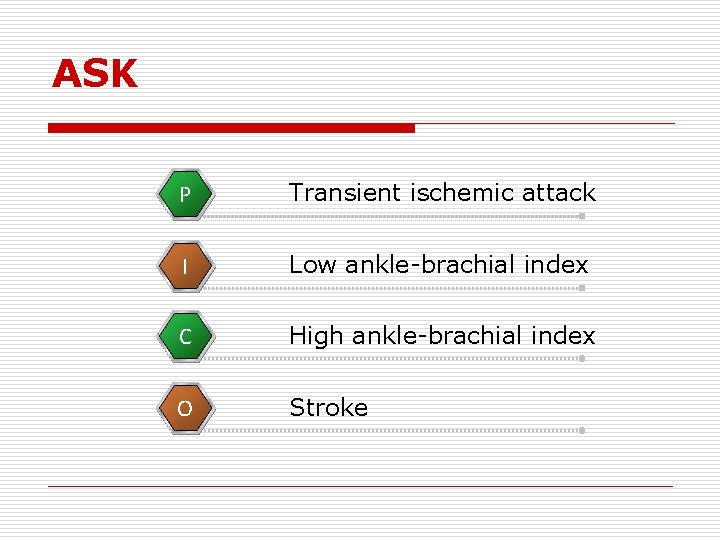
ASK P Transient ischemic attack I Low ankle-brachial index C High ankle-brachial index O Stroke
Acquire o. Database : Pub. Med, Medline o. Key word: Transient ischemic attack, ankle-brachial index, stroke
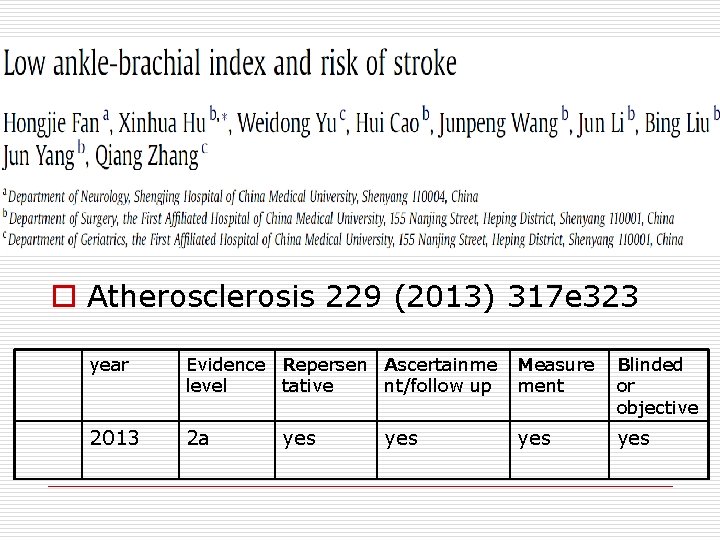
o Atherosclerosis 229 (2013) 317 e 323 year Evidence Repersen Ascertainme level tative nt/follow up Measure ment Blinded or objective 2013 2 a yes yes
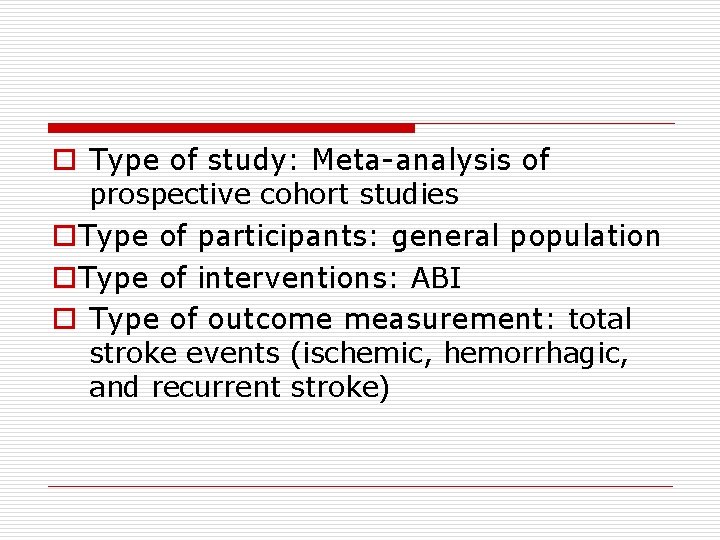
o Type of study: Meta-analysis of prospective cohort studies o. Type of participants: general population o. Type of interventions: ABI o Type of outcome measurement: total stroke events (ischemic, hemorrhagic, and recurrent stroke)
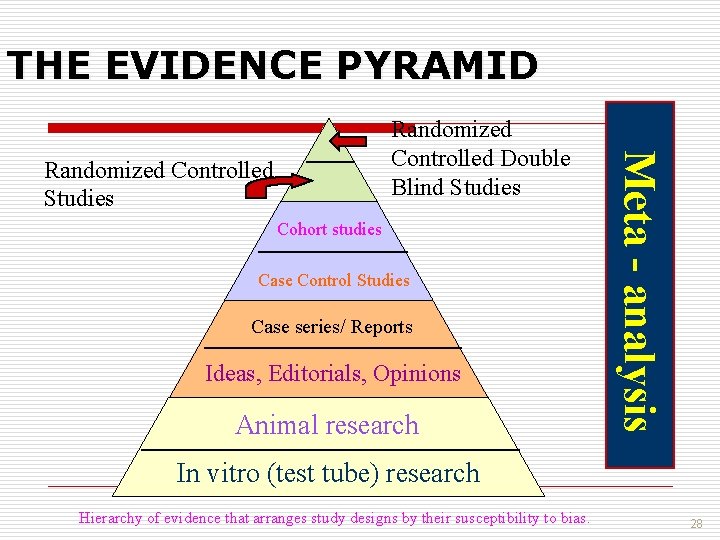
THE EVIDENCE PYRAMID Randomized Controlled Studies Cohort studies Case Control Studies Case series/ Reports Ideas, Editorials, Opinions Animal research Meta - analysis Randomized Controlled Double Blind Studies In vitro (test tube) research Hierarchy of evidence that arranges study designs by their susceptibility to bias. 28
Grade of Recommendation Level of Evidence Therapy [A] 1 a Systemic review of RCTs 1 b Single RCT 1 c ‘All-or-none’ 2 a Systemic review of cohort studies 2 b Cohort or poor RCT 2 c ‘Outcomes’ research 3 a Systemic review of casecontrol studies 3 b Case-control study [C] 4 Case series [D] 5 Expert opinion, physiology, bench research [B]
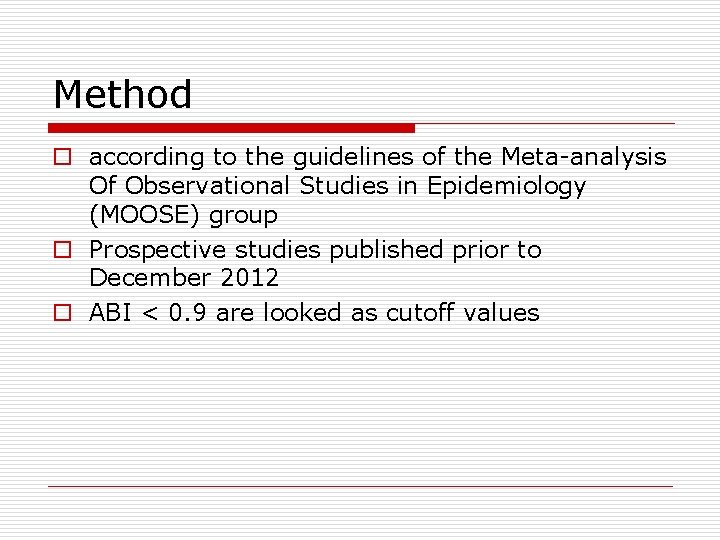
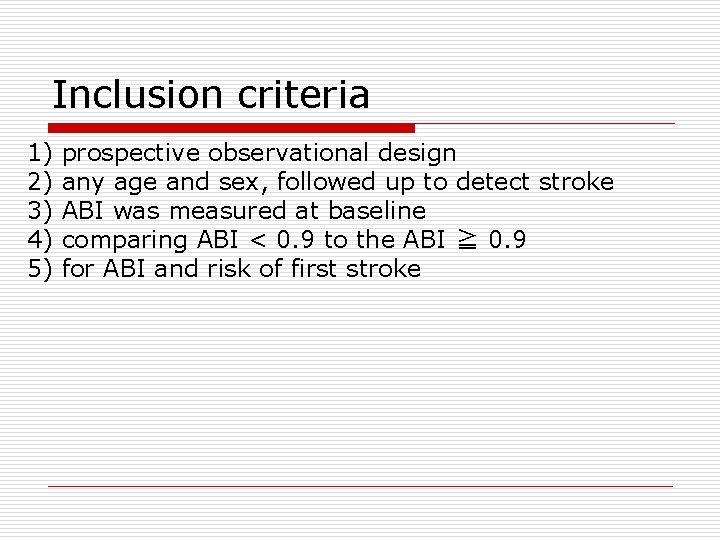
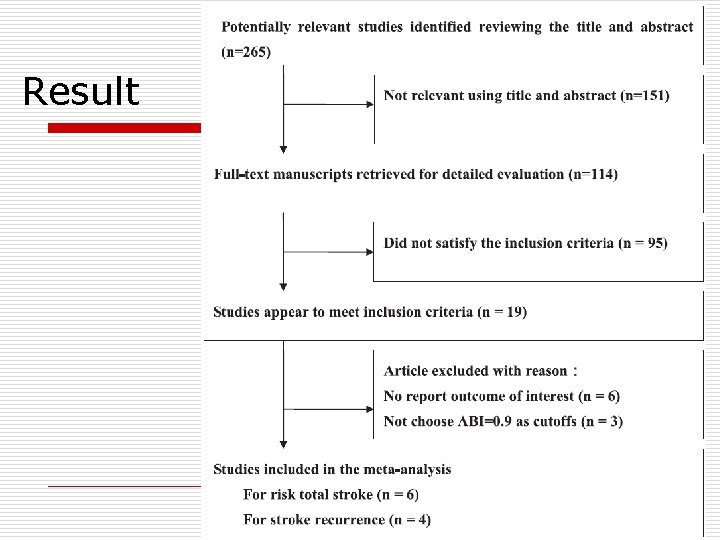
Method o according to the guidelines of the Meta-analysis Of Observational Studies in Epidemiology (MOOSE) group o Prospective studies published prior to December 2012 o ABI < 0. 9 are looked as cutoff values
Inclusion criteria 1) 2) 3) 4) 5) prospective observational design any age and sex, followed up to detect stroke ABI was measured at baseline comparing ABI < 0. 9 to the ABI ≧ 0. 9 for ABI and risk of first stroke
Result
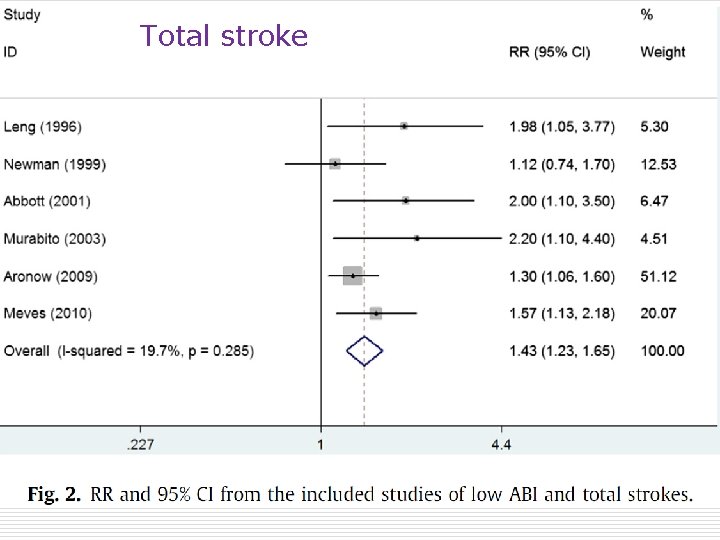
Total stroke
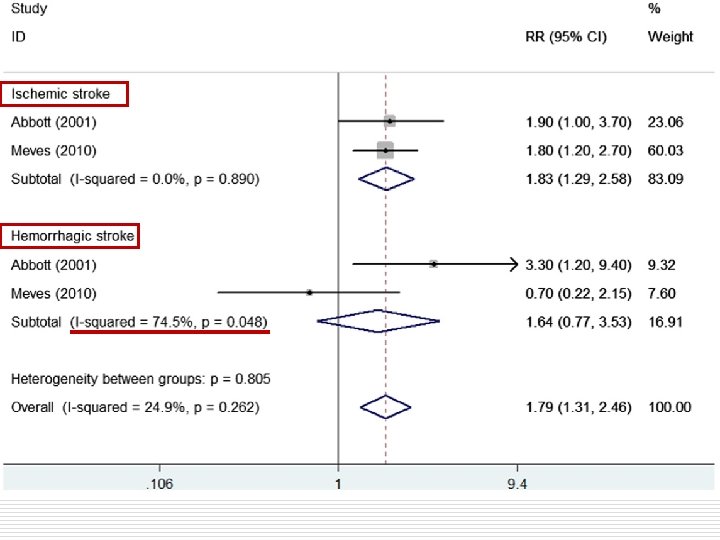
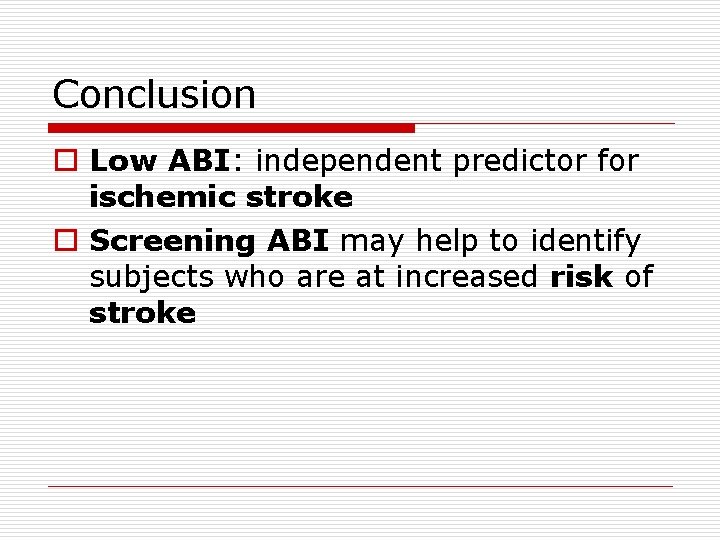
Conclusion o Low ABI: independent predictor for ischemic stroke o Screening ABI may help to identify subjects who are at increased risk of stroke
RAMBO CHECKLIST: o�� Yes �� No �� Unclear ■ R研究族群是否具有代表性( Representative) ■ A是否有足夠的確認和追蹤( Ascertainment/follow-up) ■ Mbo結果的估計值(Measurement) 公正、恰當? (blinded or objective)
TIA-E-2 Any positive finding No Yes TIA-E-3 Any high risk of CVA as follows: Crescendo TIA �>1 TIA in one week �ABCD 2 score >=4 No TIA D-1 Neurological OPD follow up Aspirin 1# po stat and QD TIA-T-2 Treat according the finding Yes TIA A-1 Admit to neurological ward Aspirin 1# po stat and QD CBC/DC, F/S, EKG, CXR, PT/APTT, Na/K, CR IVF: N/S run 80 cc/hr Vital sign and GCS: Q 8 H
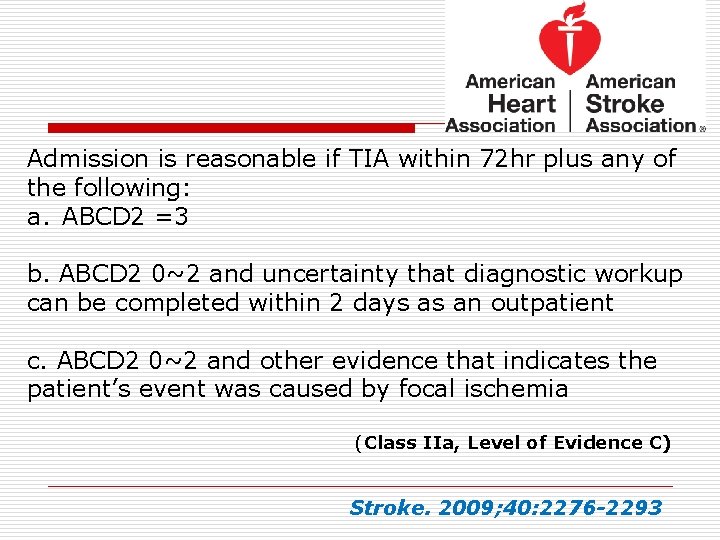
Admission is reasonable if TIA within 72 hr plus any of the following: a. ABCD 2 =3 b. ABCD 2 0~2 and uncertainty that diagnostic workup can be completed within 2 days as an outpatient c. ABCD 2 0~2 and other evidence that indicates the patient’s event was caused by focal ischemia (Class IIa, Level of Evidence C) Stroke. 2009; 40: 2276 -2293
TIA Transient ischemic attack TIA-E-1 Any new onset neurological dysfunction Yes TIA-T-1 Go to CVA No TIA-T-2 Image survey (non-contrast Brain CT) TIA-E-2 Any positive finding No Yes TIA-E-3 Any high risk of CVA as follows: Crescendo TIA � >1 TIA in one week � ABCD 2 score >=4 TIA-T-2 Treat according the finding No 發作 72小時內 plus ABCD 2 score =3 or ABI < 0. 9 No TIA D-1 Neurological OPD follow up Aspirin 1# po stat and QD Yes TIA A-1 Admit to neurological ward Aspirin 1# po stat and QD CBC/DC, F/S, EKG, CXR, PT/APTT, Na/K, CR IVF: N/S run 80 cc/hr Vital sign and GCS: Q 8 H
Reference o o o o Easton JD, Saver JL, Albers GW, et al. Definition and evaluation of transient ischemic attack. Stroke 2009; 40: 2276– 93. Johnston SC, Rothwell PM, Nguyen-Huynh MN, et al. Validation and refinement of scores to predict very early stroke risk after transient ischaemic attack. Lancet 2007; 369: 283– 92. Stroke 2009 Sep; 40(9): 3091 Merwick A, Albers GW, Amarenco P, Arsava EM, Ay H, Calvet D, et al. Addition of brain and carotid imaging to the ABCD 2 score to identify patients at early risk of stroke after transient ischaemic attack: a multicentre observational study. Lancet Neurol. 2010; 9: 1060– 1069. Stroke. 2013; 44: 1244 -1248 Stroke. 2011; 42: 227 -276 Hiatt WR. Medical treatment of peripheral arterial disease and claudication. N Engl J Med 2001; 344: 1608 e 21. Atherosclerosis 229 (2013) 317 e 323