
TRANSIENT CONDUCTION 1 Whenever the boundary temperatures change
TRANSIENT CONDUCTION 1
Whenever the boundary temperatures change the temperature at each point of the system change with time until steady-state temperature distribution is reached. These are categorized as unsteady, or transient heat conduction. Cooling of a hot metal billet with air or water is a typical example. The simplest situation is where temperature gradients within the solid are small such that uniform temperature can be assumed at any time. The analysis that uses this approach is termed as lumped capacitance method. Following this, analytical and numerical methods will also be seen. 2
4. 1 THE LUMPED CAPACITANCE METHOD A typical application in heat treatment is quenching where a metal or an alloy with initial temperature Ti is suddenly immersed in a liquid of lower temperature, T∞ < Ti. This is shown in figchp 5fig 5. 1. pptx. If quenching begins at time t = 0, then given sufficient time, the temperature of the solid will decrease eventually to T∞. The heat transfer is due to convection on the surface. The assumption, here, is that the temperature of the solid is spatially uniform. This assumption, according to Fourier’s law implies infinite k which is clearly impossible. But when 3
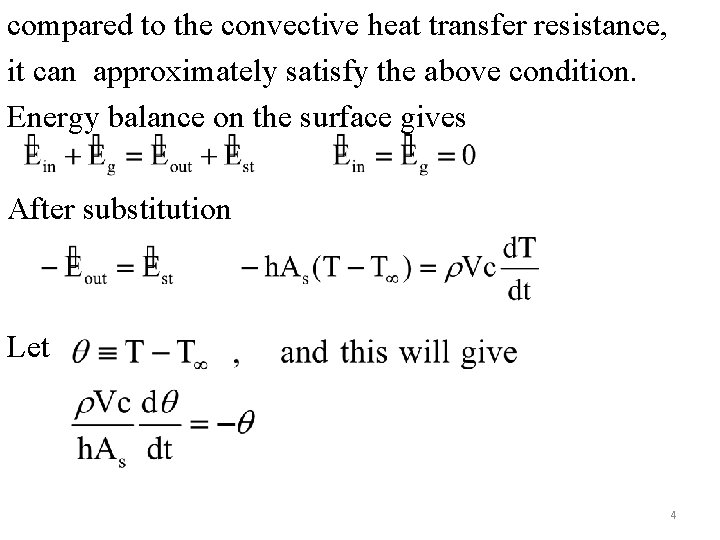
compared to the convective heat transfer resistance, it can approximately satisfy the above condition. Energy balance on the surface gives After substitution Let 4
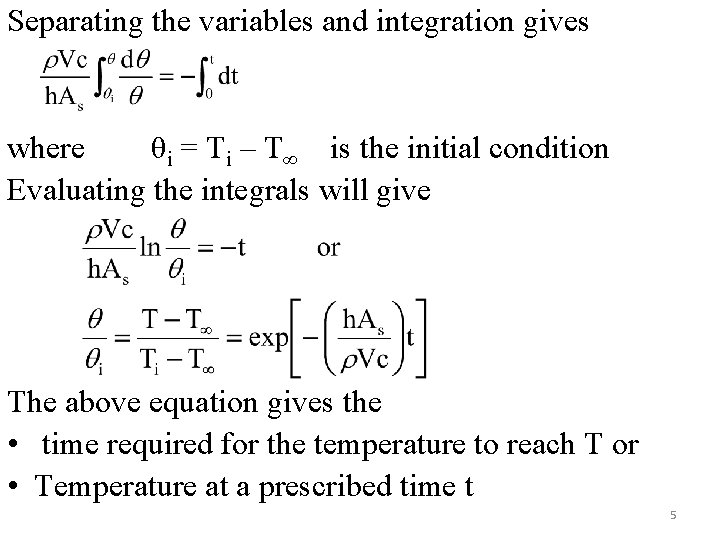
Separating the variables and integration gives where θi = Ti – T∞ is the initial condition Evaluating the integrals will give The above equation gives the • time required for the temperature to reach T or • Temperature at a prescribed time t 5
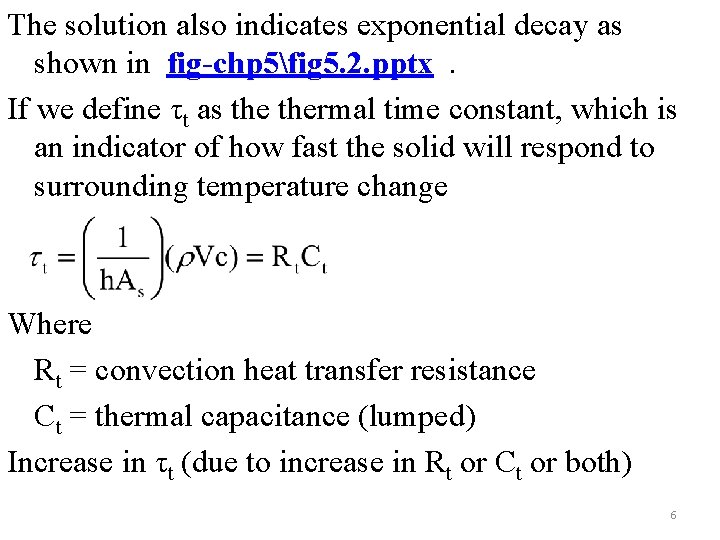
The solution also indicates exponential decay as shown in fig-chp 5fig 5. 2. pptx. If we define τt as thermal time constant, which is an indicator of how fast the solid will respond to surrounding temperature change Where Rt = convection heat transfer resistance Ct = thermal capacitance (lumped) Increase in τt (due to increase in Rt or Ct or both) 6
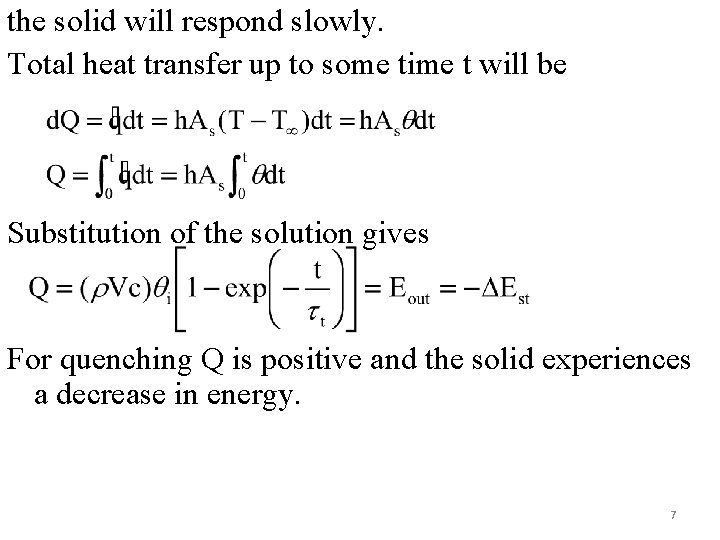
the solid will respond slowly. Total heat transfer up to some time t will be Substitution of the solution gives For quenching Q is positive and the solid experiences a decrease in energy. 7
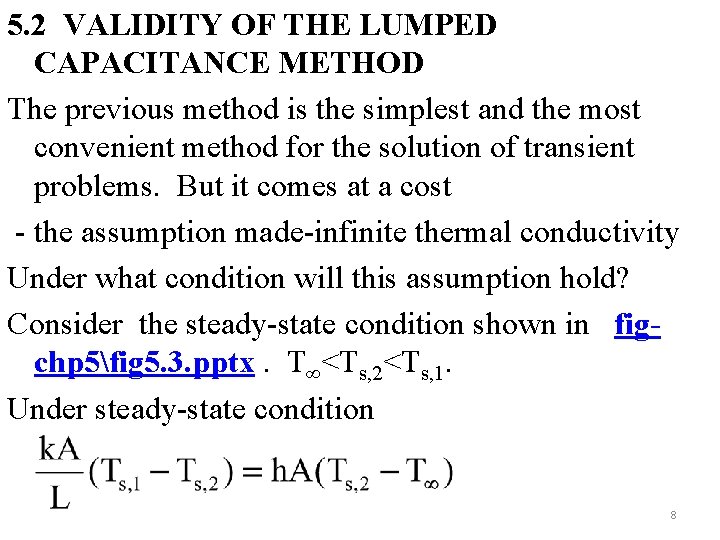
5. 2 VALIDITY OF THE LUMPED CAPACITANCE METHOD The previous method is the simplest and the most convenient method for the solution of transient problems. But it comes at a cost - the assumption made-infinite thermal conductivity Under what condition will this assumption hold? Consider the steady-state condition shown in figchp 5fig 5. 3. pptx. T∞<Ts, 2<Ts, 1. Under steady-state condition 8
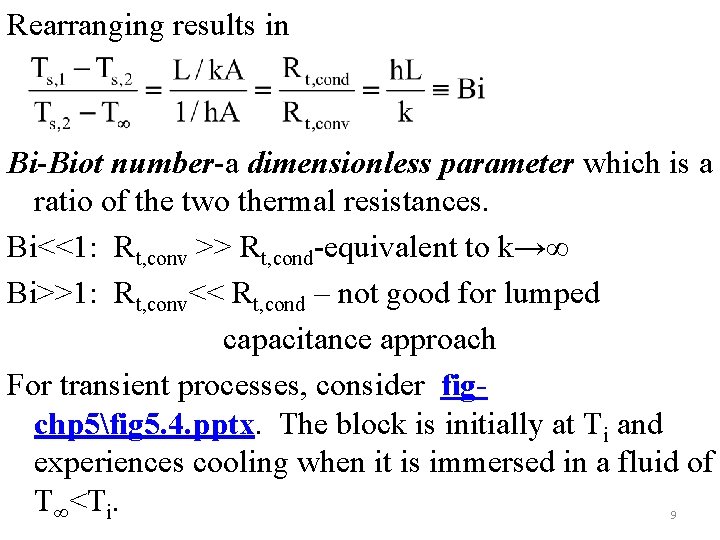
Rearranging results in Bi-Biot number-a dimensionless parameter which is a ratio of the two thermal resistances. Bi<<1: Rt, conv >> Rt, cond-equivalent to k→∞ Bi>>1: Rt, conv<< Rt, cond – not good for lumped capacitance approach For transient processes, consider figchp 5fig 5. 4. pptx. The block is initially at Ti and experiences cooling when it is immersed in a fluid of T∞<Ti. 9
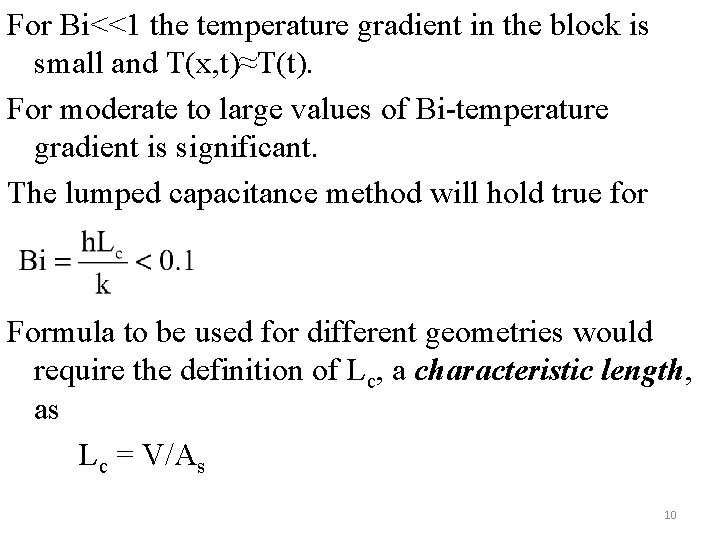
For Bi<<1 the temperature gradient in the block is small and T(x, t)≈T(t). For moderate to large values of Bi-temperature gradient is significant. The lumped capacitance method will hold true for Formula to be used for different geometries would require the definition of Lc, a characteristic length, as Lc = V/As 10
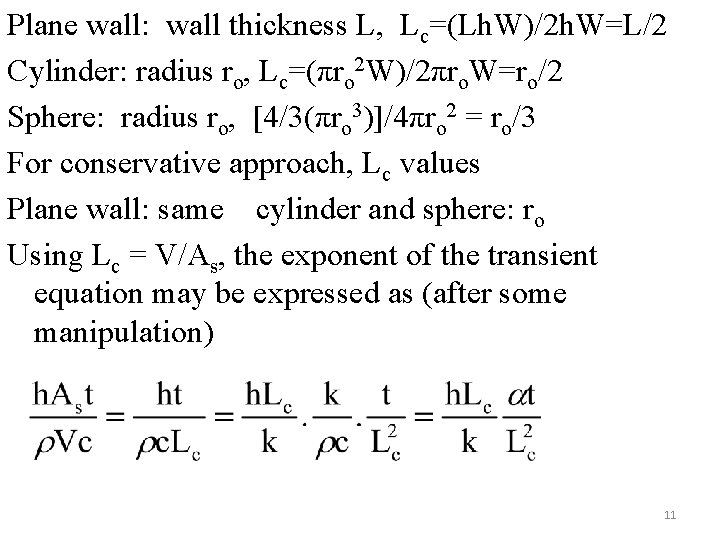
Plane wall: wall thickness L, Lc=(Lh. W)/2 h. W=L/2 Cylinder: radius ro, Lc=(πro 2 W)/2πro. W=ro/2 Sphere: radius ro, [4/3(πro 3)]/4πro 2 = ro/3 For conservative approach, Lc values Plane wall: same cylinder and sphere: ro Using Lc = V/As, the exponent of the transient equation may be expressed as (after some manipulation) 11
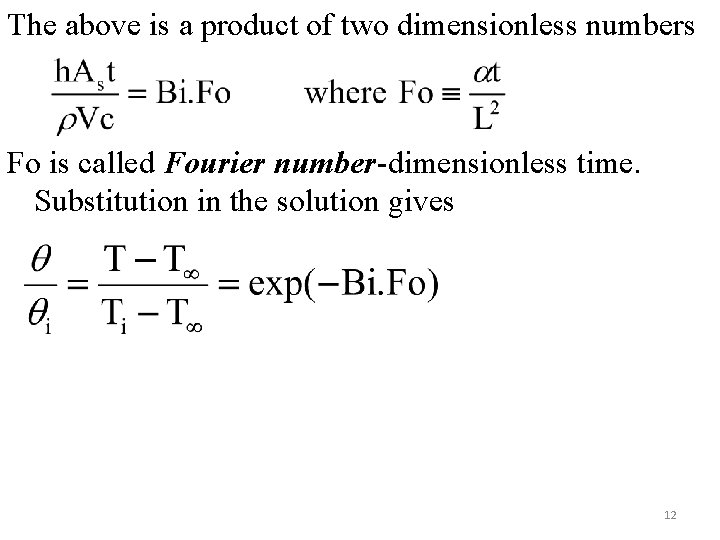
The above is a product of two dimensionless numbers Fo is called Fourier number-dimensionless time. Substitution in the solution gives 12
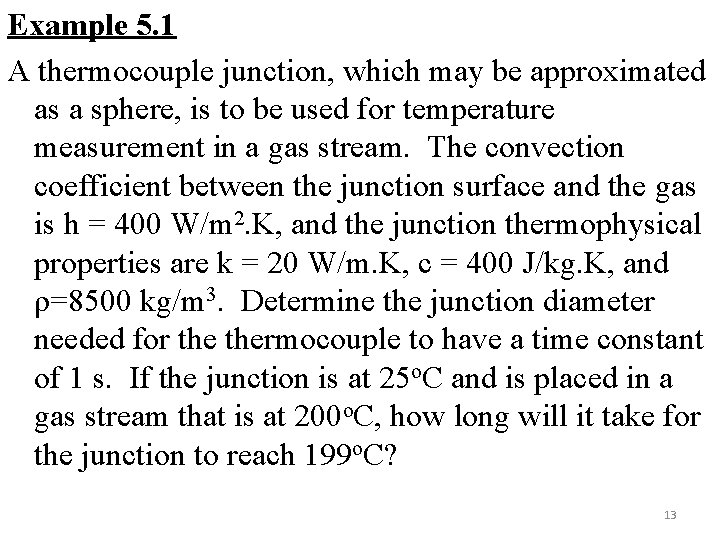
Example 5. 1 A thermocouple junction, which may be approximated as a sphere, is to be used for temperature measurement in a gas stream. The convection coefficient between the junction surface and the gas is h = 400 W/m 2. K, and the junction thermophysical properties are k = 20 W/m. K, c = 400 J/kg. K, and ρ=8500 kg/m 3. Determine the junction diameter needed for thermocouple to have a time constant of 1 s. If the junction is at 25 o. C and is placed in a gas stream that is at 200 o. C, how long will it take for the junction to reach 199 o. C? 13
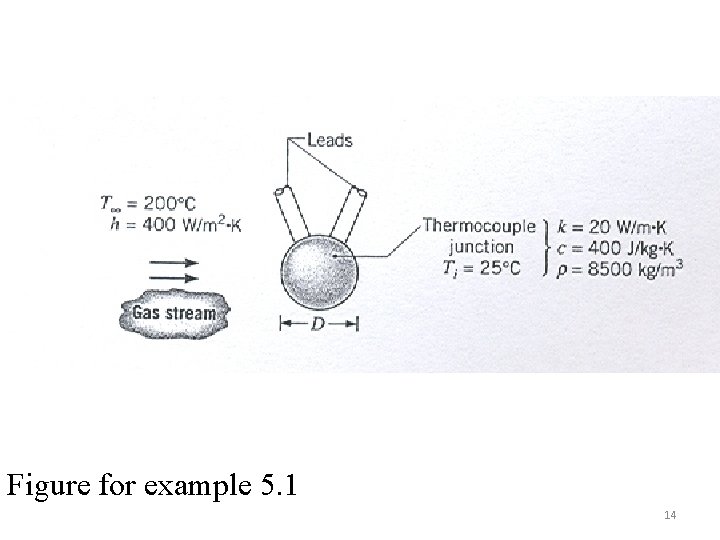
Figure for example 5. 1 14
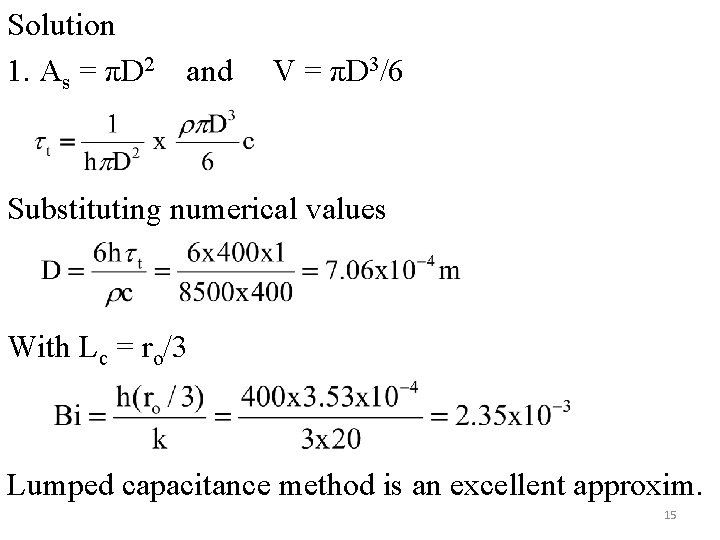
Solution 1. As = πD 2 and V = πD 3/6 Substituting numerical values With Lc = ro/3 Lumped capacitance method is an excellent approxim. 15
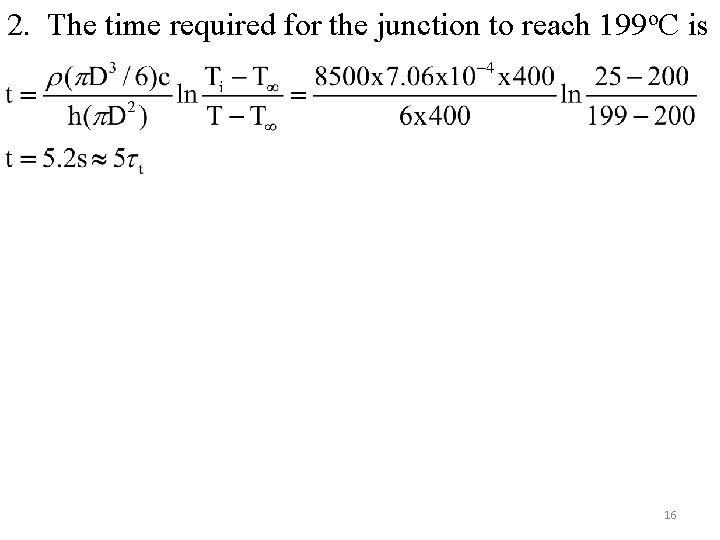
2. The time required for the junction to reach 199 o. C is 16
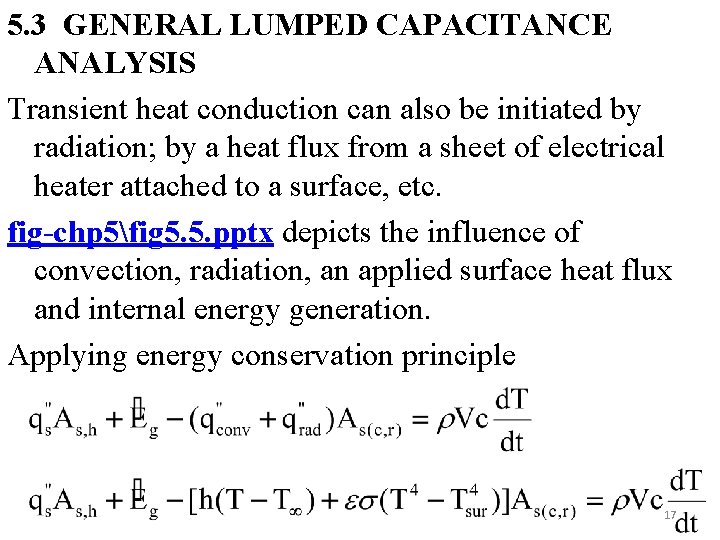
5. 3 GENERAL LUMPED CAPACITANCE ANALYSIS Transient heat conduction can also be initiated by radiation; by a heat flux from a sheet of electrical heater attached to a surface, etc. fig-chp 5fig 5. 5. pptx depicts the influence of convection, radiation, an applied surface heat flux and internal energy generation. Applying energy conservation principle 17
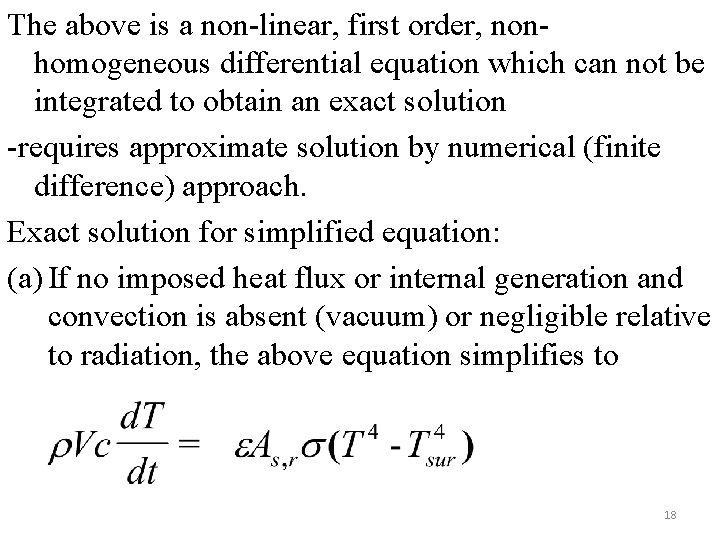
The above is a non-linear, first order, nonhomogeneous differential equation which can not be integrated to obtain an exact solution -requires approximate solution by numerical (finite difference) approach. Exact solution for simplified equation: (a) If no imposed heat flux or internal generation and convection is absent (vacuum) or negligible relative to radiation, the above equation simplifies to 18
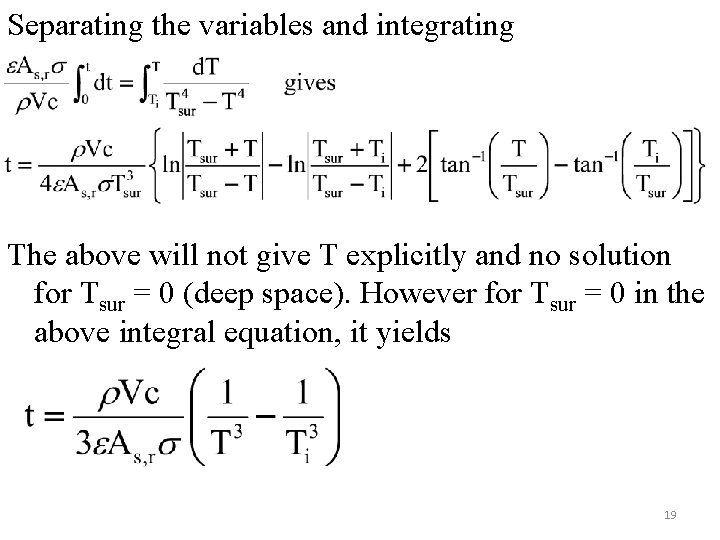
Separating the variables and integrating The above will not give T explicitly and no solution for Tsur = 0 (deep space). However for Tsur = 0 in the above integral equation, it yields 19
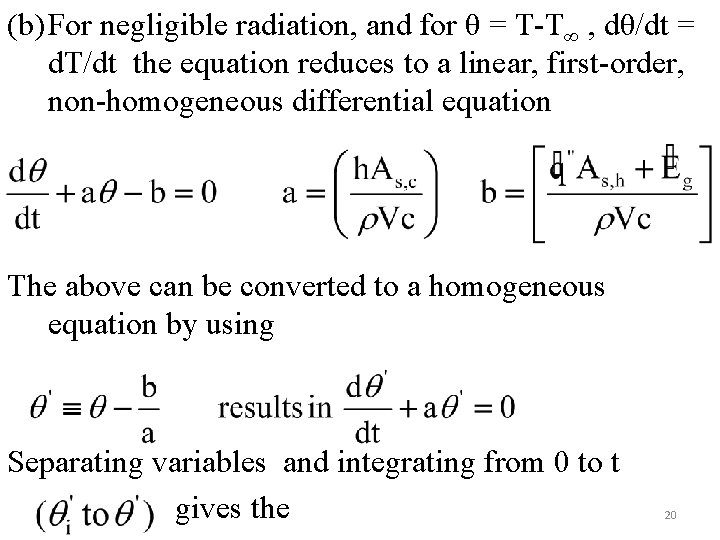
(b) For negligible radiation, and for θ = T-T∞ , dθ/dt = d. T/dt the equation reduces to a linear, first-order, non-homogeneous differential equation The above can be converted to a homogeneous equation by using Separating variables and integrating from 0 to t gives the 20
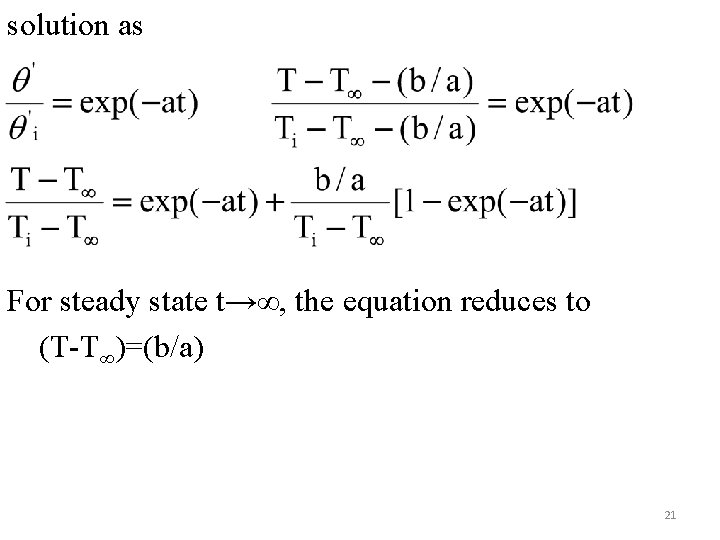
solution as For steady state t→∞, the equation reduces to (T-T∞)=(b/a) 21
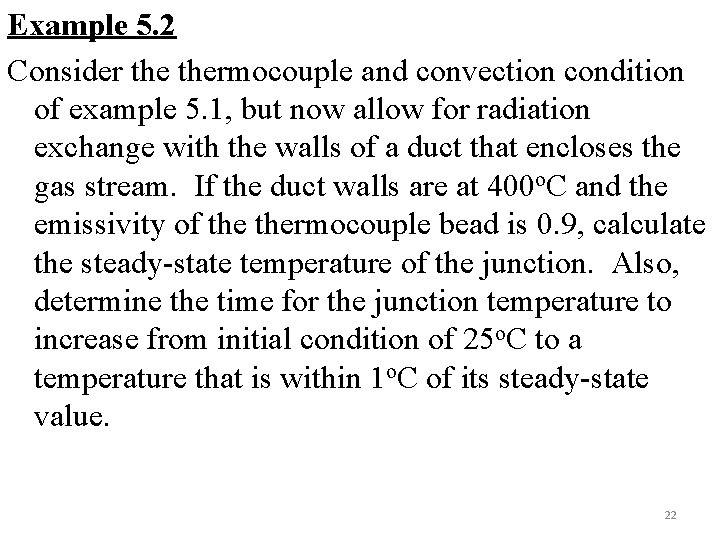
Example 5. 2 Consider thermocouple and convection condition of example 5. 1, but now allow for radiation exchange with the walls of a duct that encloses the gas stream. If the duct walls are at 400 o. C and the emissivity of thermocouple bead is 0. 9, calculate the steady-state temperature of the junction. Also, determine the time for the junction temperature to increase from initial condition of 25 o. C to a temperature that is within 1 o. C of its steady-state value. 22
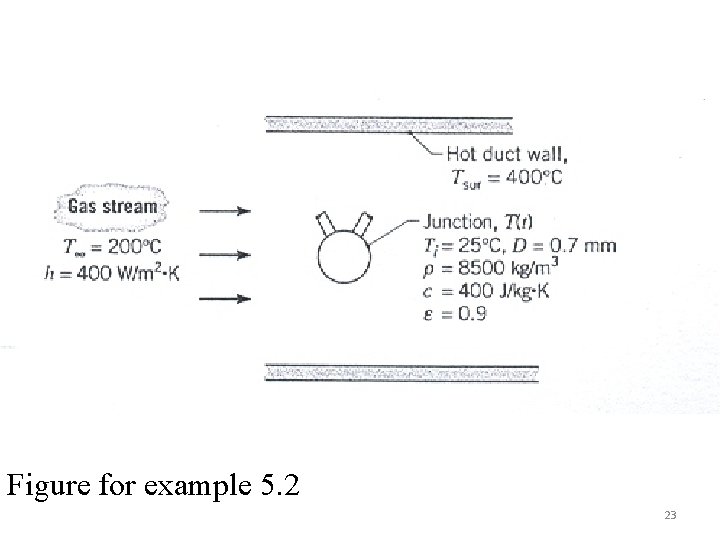
Figure for example 5. 2 23
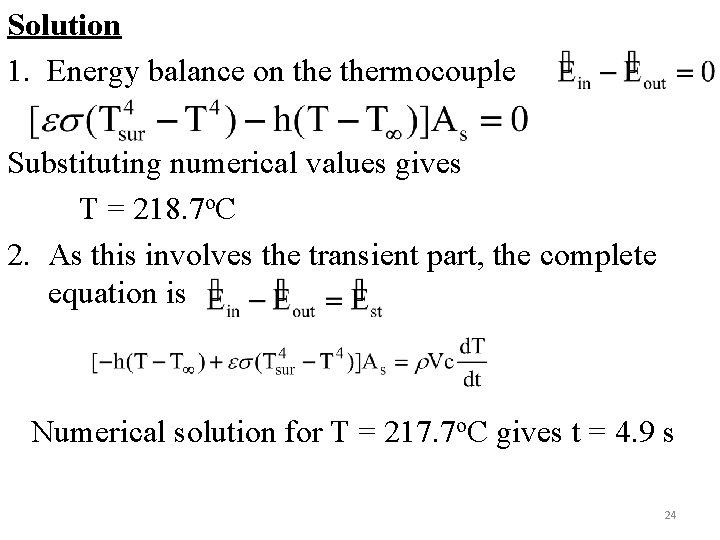
Solution 1. Energy balance on thermocouple Substituting numerical values gives T = 218. 7 o. C 2. As this involves the transient part, the complete equation is Numerical solution for T = 217. 7 o. C gives t = 4. 9 s 24
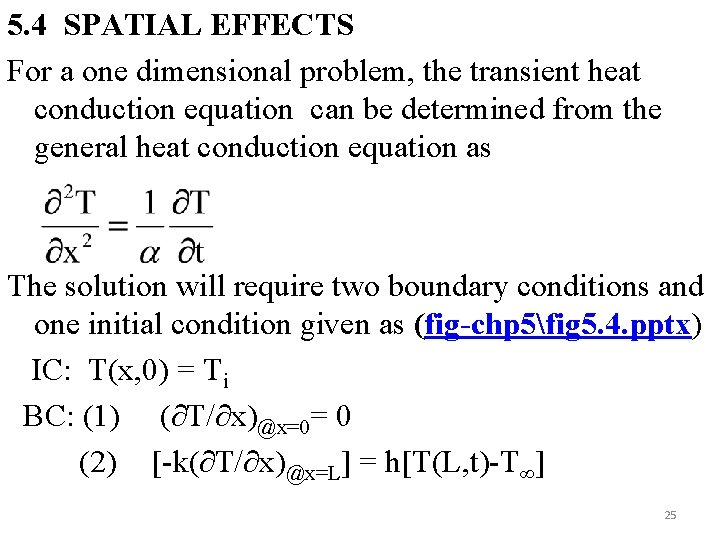
5. 4 SPATIAL EFFECTS For a one dimensional problem, the transient heat conduction equation can be determined from the general heat conduction equation as The solution will require two boundary conditions and one initial condition given as (fig-chp 5fig 5. 4. pptx) IC: T(x, 0) = Ti BC: (1) (∂T/∂x)@x=0= 0 (2) [-k(∂T/∂x)@x=L] = h[T(L, t)-T∞] 25
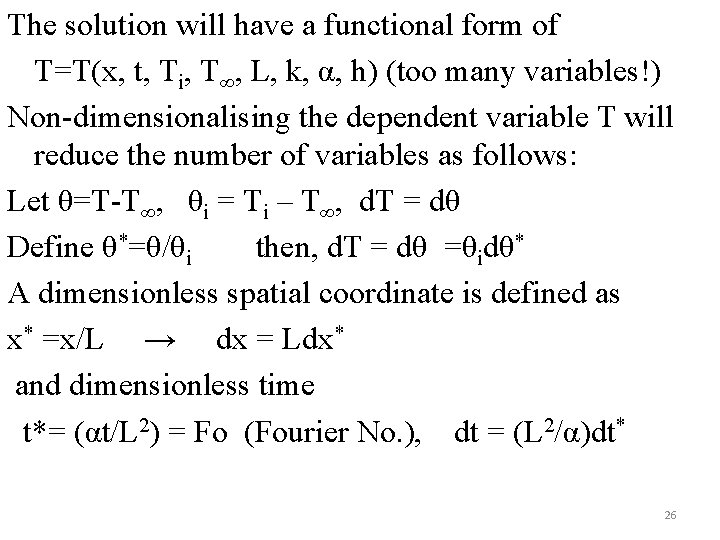
The solution will have a functional form of T=T(x, t, Ti, T∞, L, k, α, h) (too many variables!) Non-dimensionalising the dependent variable T will reduce the number of variables as follows: Let θ=T-T∞, θi = Ti – T∞, d. T = dθ Define θ*=θ/θi then, d. T = dθ =θidθ* A dimensionless spatial coordinate is defined as x* =x/L → dx = Ldx* and dimensionless time t*= (αt/L 2) = Fo (Fourier No. ), dt = (L 2/α)dt* 26
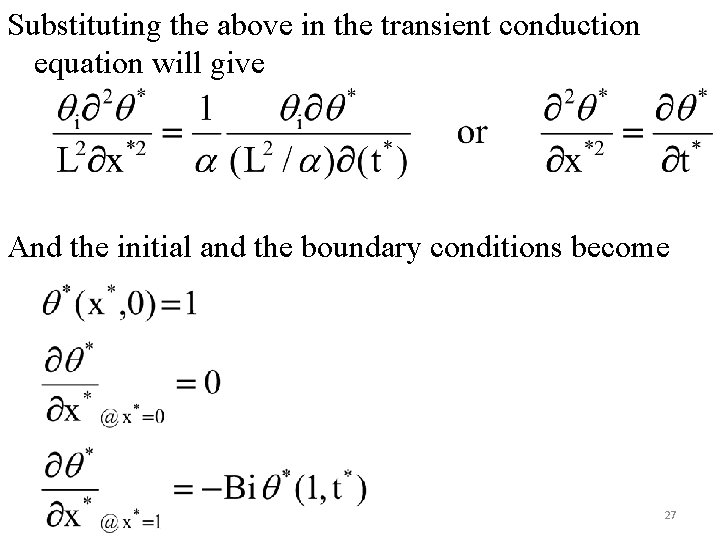
Substituting the above in the transient conduction equation will give And the initial and the boundary conditions become 27
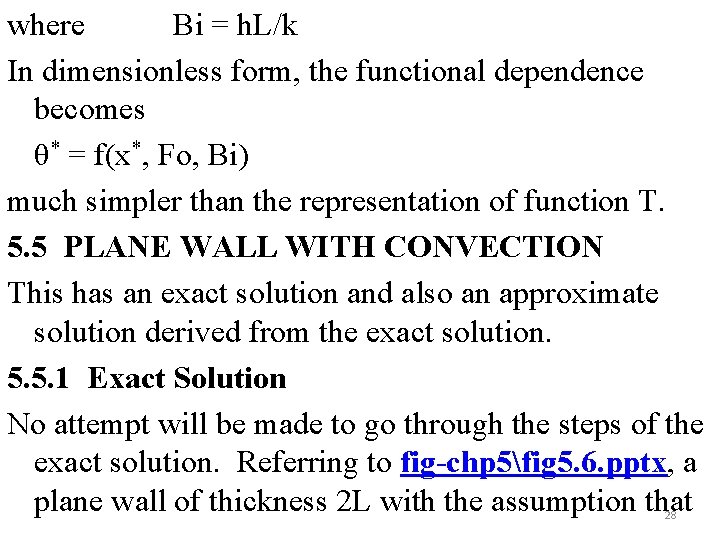
where Bi = h. L/k In dimensionless form, the functional dependence becomes θ* = f(x*, Fo, Bi) much simpler than the representation of function T. 5. 5 PLANE WALL WITH CONVECTION This has an exact solution and also an approximate solution derived from the exact solution. 5. 5. 1 Exact Solution No attempt will be made to go through the steps of the exact solution. Referring to fig-chp 5fig 5. 6. pptx, a plane wall of thickness 2 L with the assumption that 28
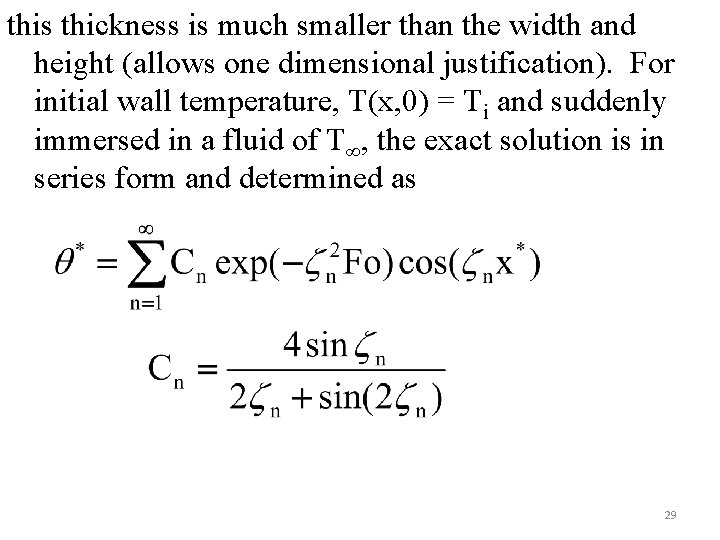
this thickness is much smaller than the width and height (allows one dimensional justification). For initial wall temperature, T(x, 0) = Ti and suddenly immersed in a fluid of T∞, the exact solution is in series form and determined as 29
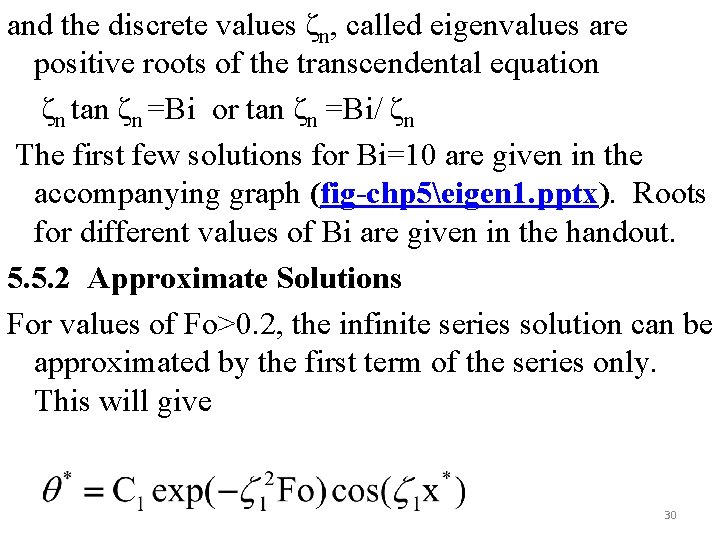
and the discrete values ζn, called eigenvalues are positive roots of the transcendental equation ζn tan ζn =Bi or tan ζn =Bi/ ζn The first few solutions for Bi=10 are given in the accompanying graph (fig-chp 5eigen 1. pptx). Roots for different values of Bi are given in the handout. 5. 5. 2 Approximate Solutions For values of Fo>0. 2, the infinite series solution can be approximated by the first term of the series only. This will give 30
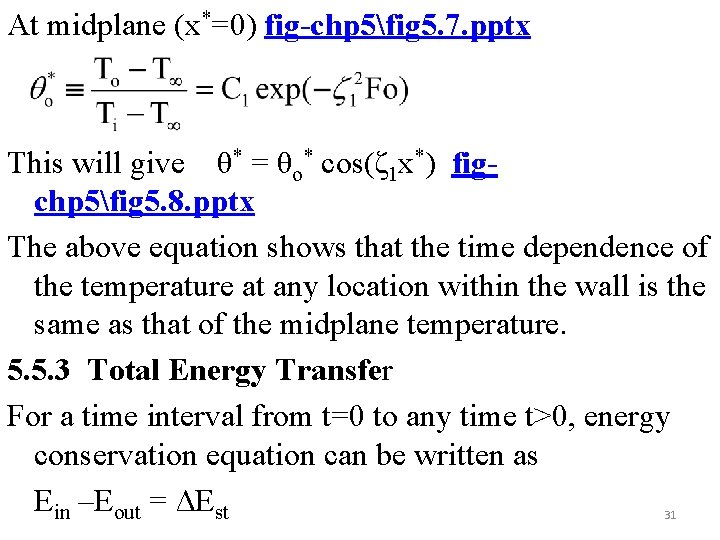
At midplane (x*=0) fig-chp 5fig 5. 7. pptx This will give θ* = θo* cos(ζ 1 x*) figchp 5fig 5. 8. pptx The above equation shows that the time dependence of the temperature at any location within the wall is the same as that of the midplane temperature. 5. 5. 3 Total Energy Transfer For a time interval from t=0 to any time t>0, energy conservation equation can be written as Ein –Eout = ΔEst 31
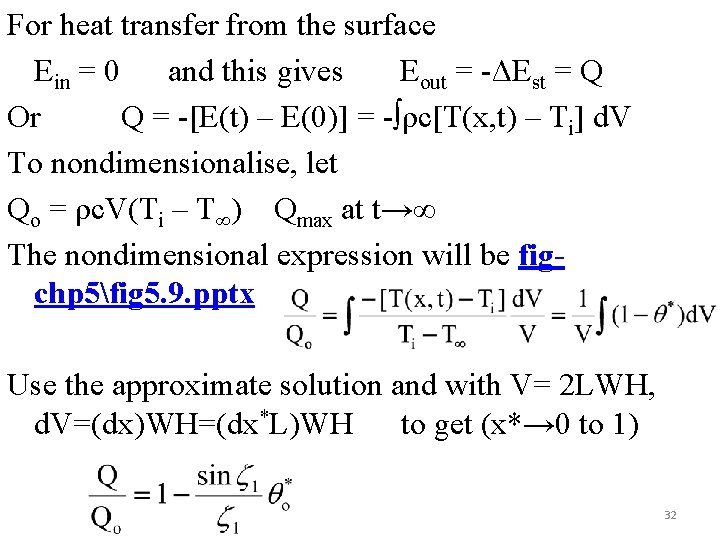
For heat transfer from the surface Ein = 0 and this gives Eout = -ΔEst = Q Or Q = -[E(t) – E(0)] = -∫ρc[T(x, t) – Ti] d. V To nondimensionalise, let Qo = ρc. V(Ti – T∞) Qmax at t→∞ The nondimensional expression will be figchp 5fig 5. 9. pptx Use the approximate solution and with V= 2 LWH, d. V=(dx)WH=(dx*L)WH to get (x*→ 0 to 1) 32
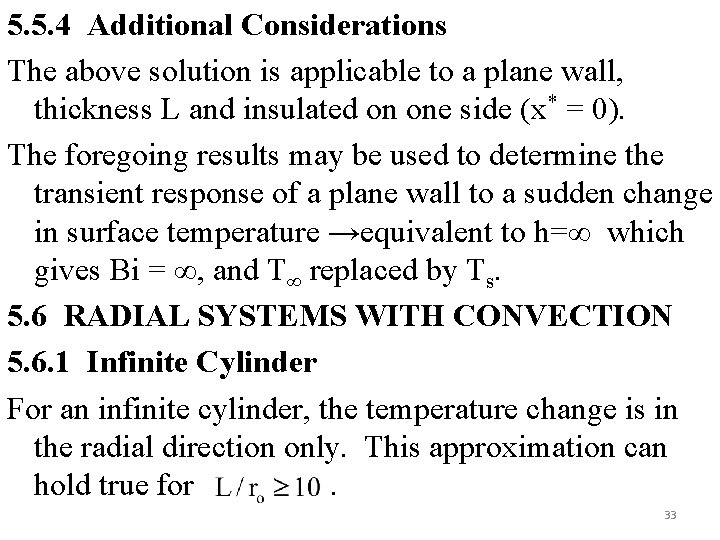
5. 5. 4 Additional Considerations The above solution is applicable to a plane wall, thickness L and insulated on one side (x* = 0). The foregoing results may be used to determine the transient response of a plane wall to a sudden change in surface temperature →equivalent to h=∞ which gives Bi = ∞, and T∞ replaced by Ts. 5. 6 RADIAL SYSTEMS WITH CONVECTION 5. 6. 1 Infinite Cylinder For an infinite cylinder, the temperature change is in the radial direction only. This approximation can hold true for. 33
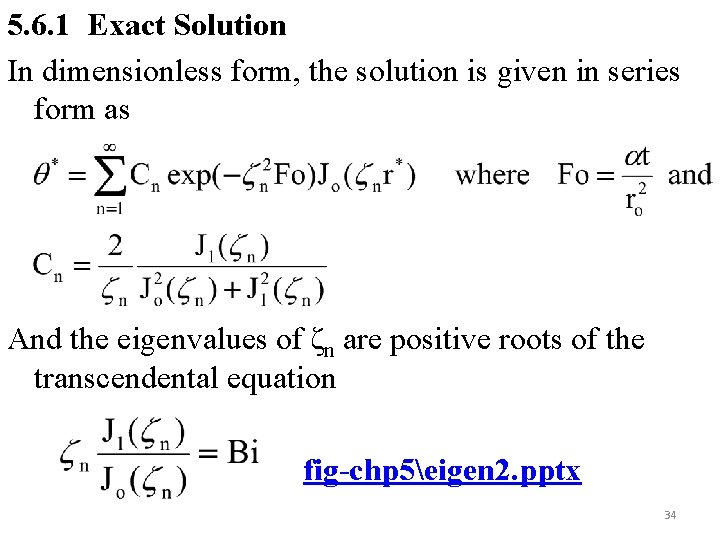
5. 6. 1 Exact Solution In dimensionless form, the solution is given in series form as And the eigenvalues of ζn are positive roots of the transcendental equation fig-chp 5eigen 2. pptx 34
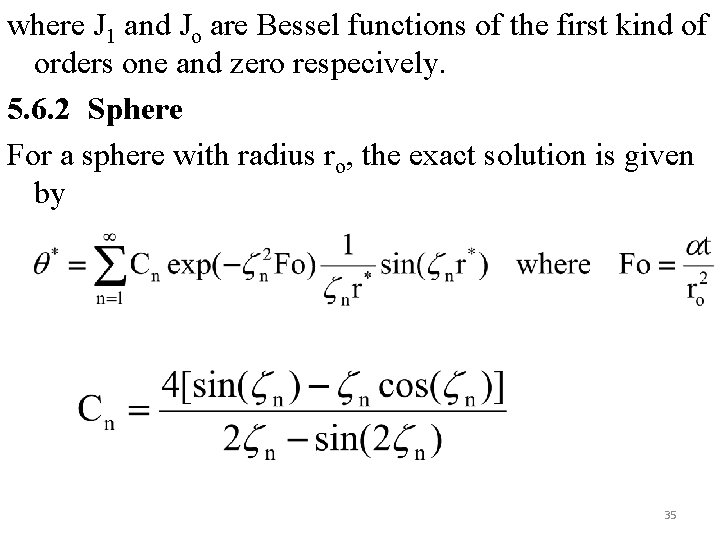
where J 1 and Jo are Bessel functions of the first kind of orders one and zero respecively. 5. 6. 2 Sphere For a sphere with radius ro, the exact solution is given by 35
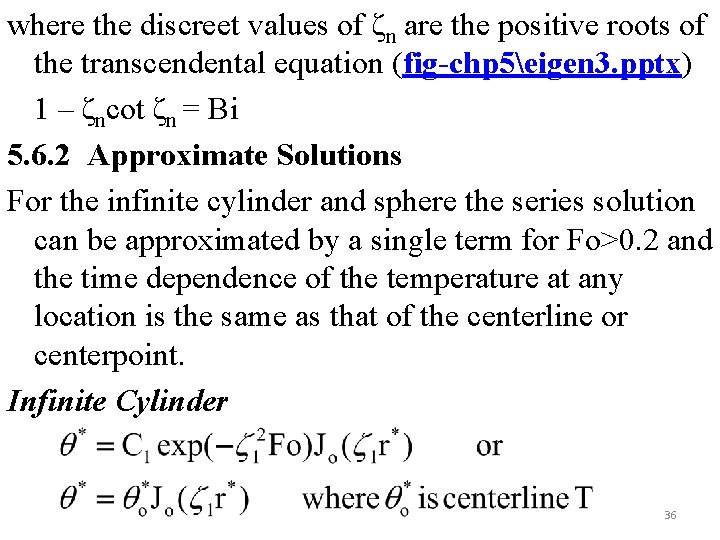
where the discreet values of ζn are the positive roots of the transcendental equation (fig-chp 5eigen 3. pptx) 1 – ζncot ζn = Bi 5. 6. 2 Approximate Solutions For the infinite cylinder and sphere the series solution can be approximated by a single term for Fo>0. 2 and the time dependence of the temperature at any location is the same as that of the centerline or centerpoint. Infinite Cylinder 36
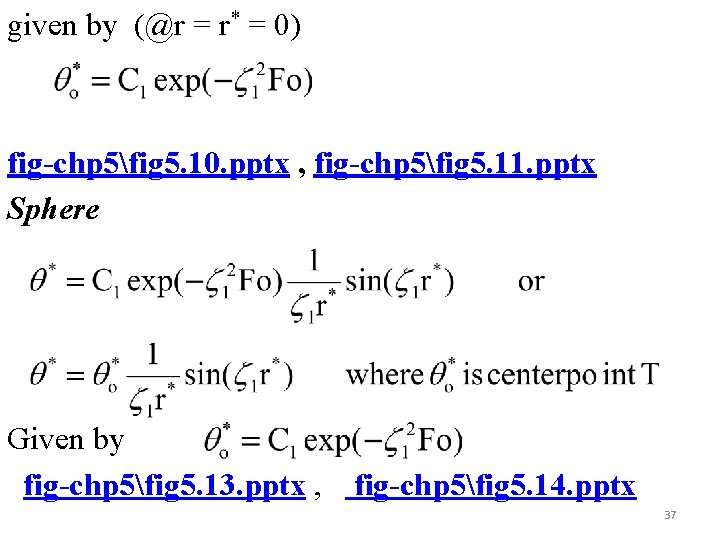
given by (@r = r* = 0) fig-chp 5fig 5. 10. pptx , fig-chp 5fig 5. 11. pptx Sphere Given by fig-chp 5fig 5. 13. pptx , fig-chp 5fig 5. 14. pptx 37
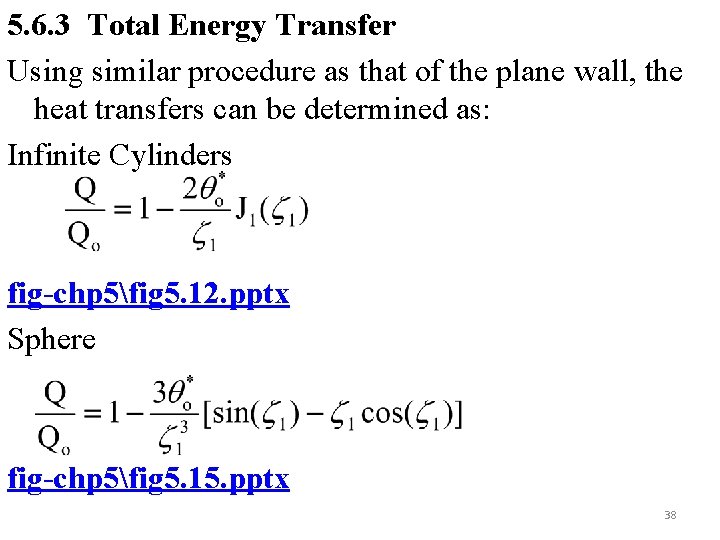
5. 6. 3 Total Energy Transfer Using similar procedure as that of the plane wall, the heat transfers can be determined as: Infinite Cylinders fig-chp 5fig 5. 12. pptx Sphere fig-chp 5fig 5. 15. pptx 38
5. 6. 4 Additional Considerations The above also gives the solution when the cylinder or sphere is subjected to a sudden change in surface temperature to Ts. Replace T∞ by Ts which results due to infinite h value, hence infinite Bi. Example 5. 3 A new process for treatment of a special material is to be evaluated. The material, a sphere of radius ro = 5 mm, is initially in equilibrium at 400 o. C in a furnace. It is suddenly removed from the furnace and subjected to a two-step cooling process. 39
Step 1 Cooling in air at 20 o. C for a period of time ta until the center temperature reaches a critical value, Ta(0, ta)=335 o. C. For this situation, the convective heat transfer coefficient is ha = 10 W/m 2. K. After the sphere has reached this critical temperature, the second step is initiated. Step 2 Cooling in a well-stirred water bath at 20 o. C, with a convective heat transfer coefficient of hw = 6000 W/m 2. K. 40
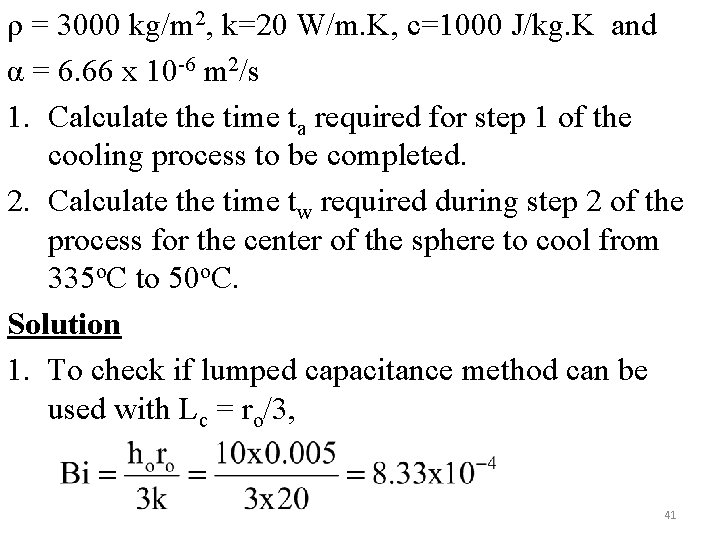
ρ = 3000 kg/m 2, k=20 W/m. K, c=1000 J/kg. K and α = 6. 66 x 10 -6 m 2/s 1. Calculate the time ta required for step 1 of the cooling process to be completed. 2. Calculate the time tw required during step 2 of the process for the center of the sphere to cool from 335 o. C to 50 o. C. Solution 1. To check if lumped capacitance method can be used with Lc = ro/3, 41
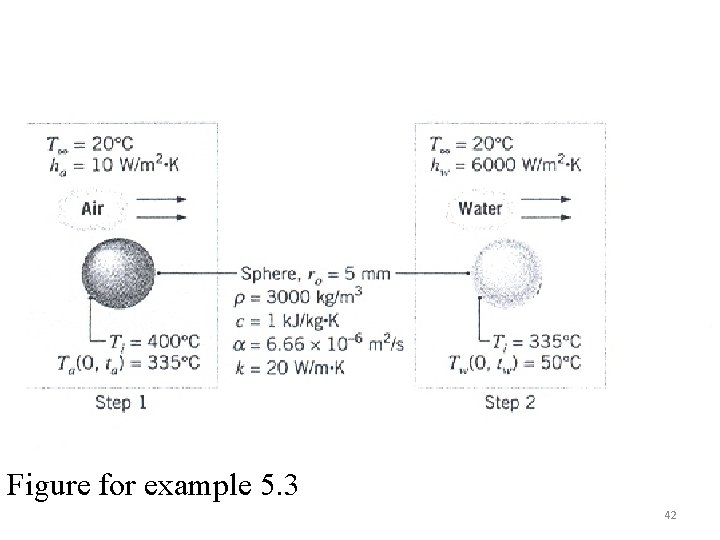
Figure for example 5. 3 42
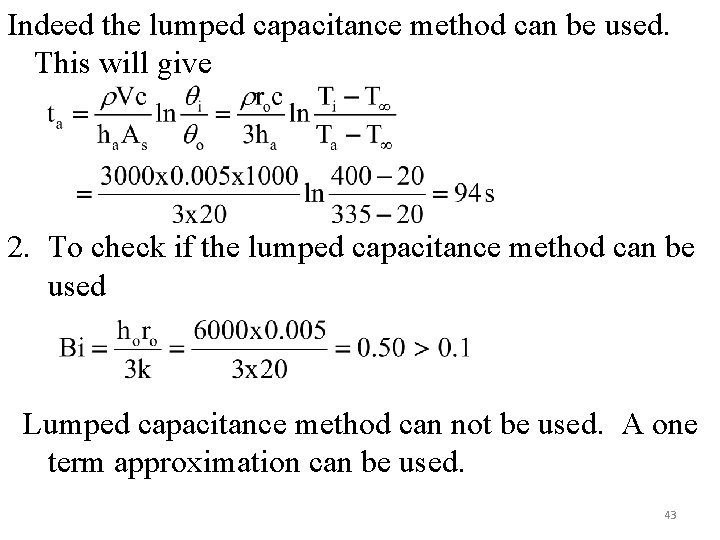
Indeed the lumped capacitance method can be used. This will give 2. To check if the lumped capacitance method can be used Lumped capacitance method can not be used. A one term approximation can be used. 43
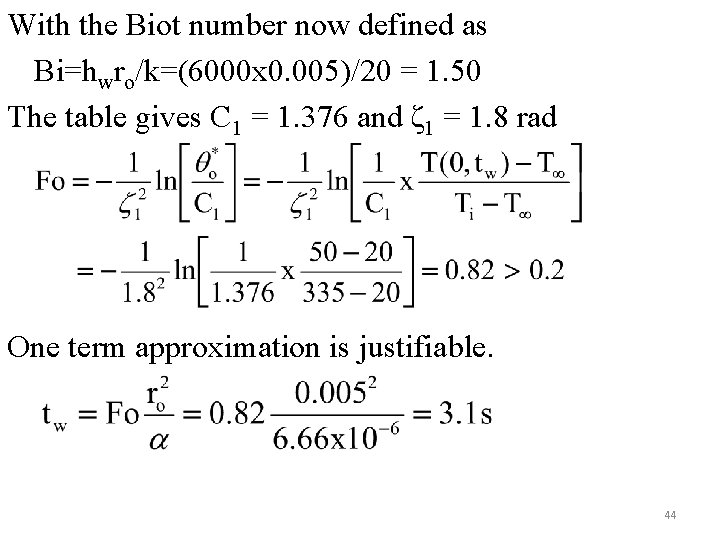
With the Biot number now defined as Bi=hwro/k=(6000 x 0. 005)/20 = 1. 50 The table gives C 1 = 1. 376 and ζ 1 = 1. 8 rad One term approximation is justifiable. 44
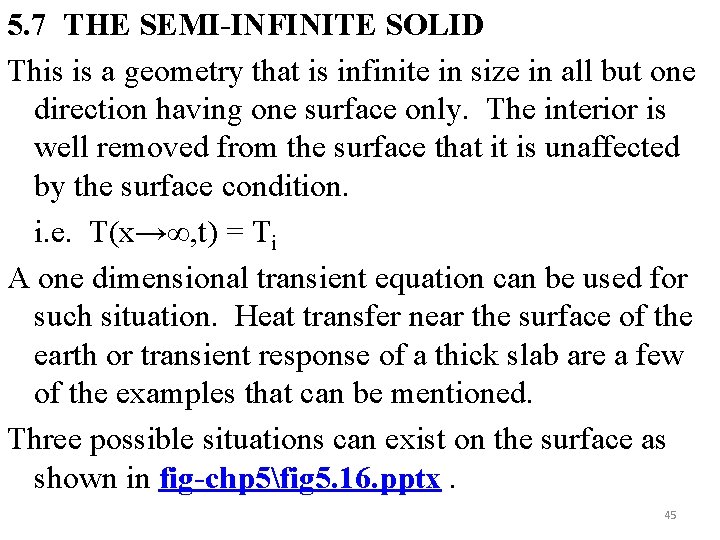
5. 7 THE SEMI-INFINITE SOLID This is a geometry that is infinite in size in all but one direction having one surface only. The interior is well removed from the surface that it is unaffected by the surface condition. i. e. T(x→∞, t) = Ti A one dimensional transient equation can be used for such situation. Heat transfer near the surface of the earth or transient response of a thick slab are a few of the examples that can be mentioned. Three possible situations can exist on the surface as shown in fig-chp 5fig 5. 16. pptx. 45
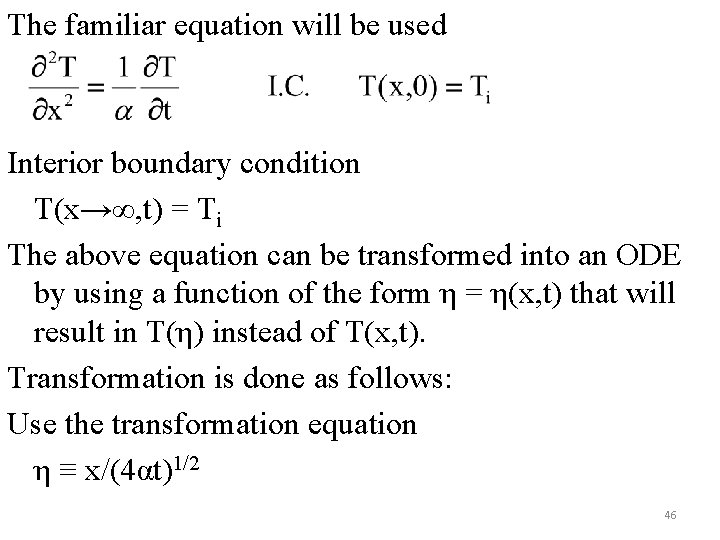
The familiar equation will be used Interior boundary condition T(x→∞, t) = Ti The above equation can be transformed into an ODE by using a function of the form η = η(x, t) that will result in T(η) instead of T(x, t). Transformation is done as follows: Use the transformation equation η ≡ x/(4αt)1/2 46
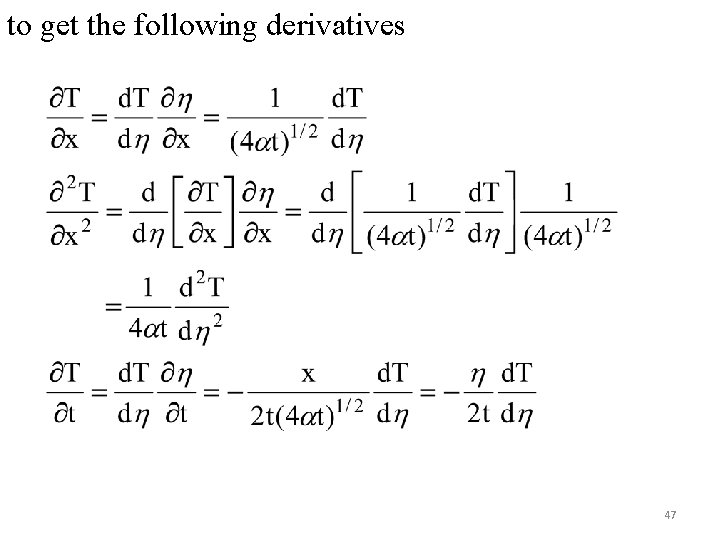
to get the following derivatives 47
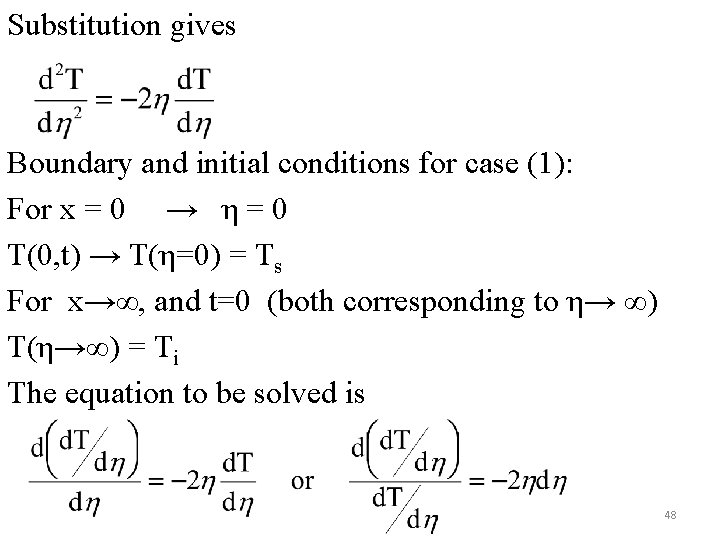
Substitution gives Boundary and initial conditions for case (1): For x = 0 → η = 0 T(0, t) → T(η=0) = Ts For x→∞, and t=0 (both corresponding to η→ ∞) T(η→∞) = Ti The equation to be solved is 48
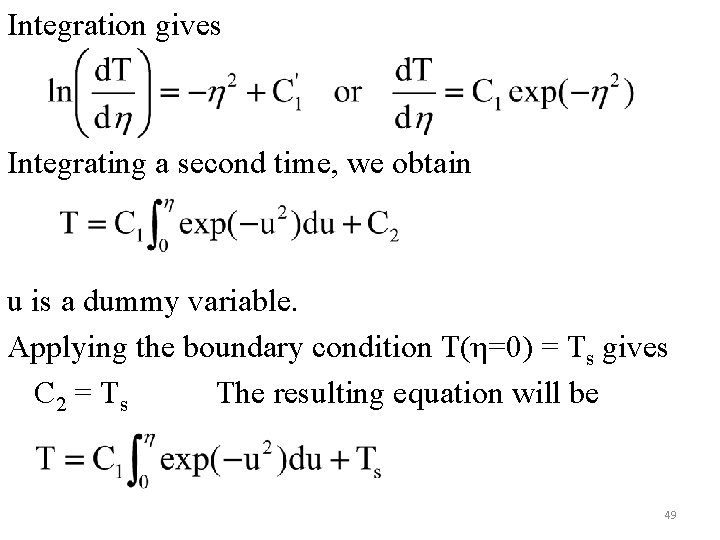
Integration gives Integrating a second time, we obtain u is a dummy variable. Applying the boundary condition T(η=0) = Ts gives C 2 = T s The resulting equation will be 49
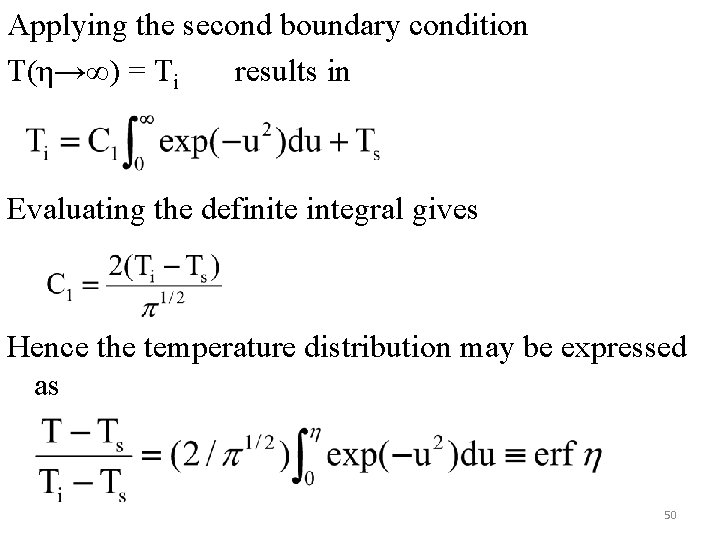
Applying the second boundary condition T(η→∞) = Ti results in Evaluating the definite integral gives Hence the temperature distribution may be expressed as 50
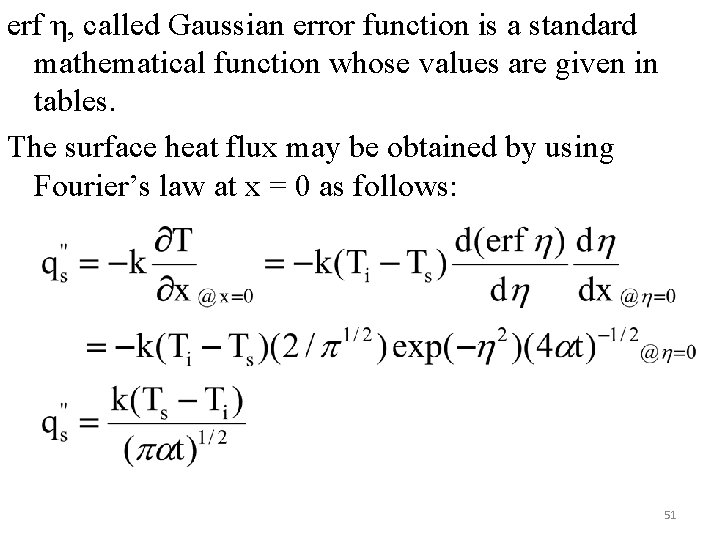
erf η, called Gaussian error function is a standard mathematical function whose values are given in tables. The surface heat flux may be obtained by using Fourier’s law at x = 0 as follows: 51
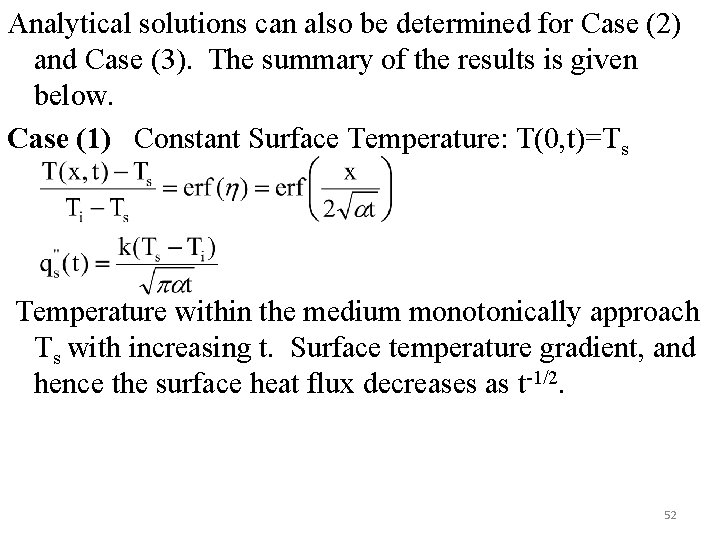
Analytical solutions can also be determined for Case (2) and Case (3). The summary of the results is given below. Case (1) Constant Surface Temperature: T(0, t)=Ts Temperature within the medium monotonically approach Ts with increasing t. Surface temperature gradient, and hence the surface heat flux decreases as t-1/2. 52
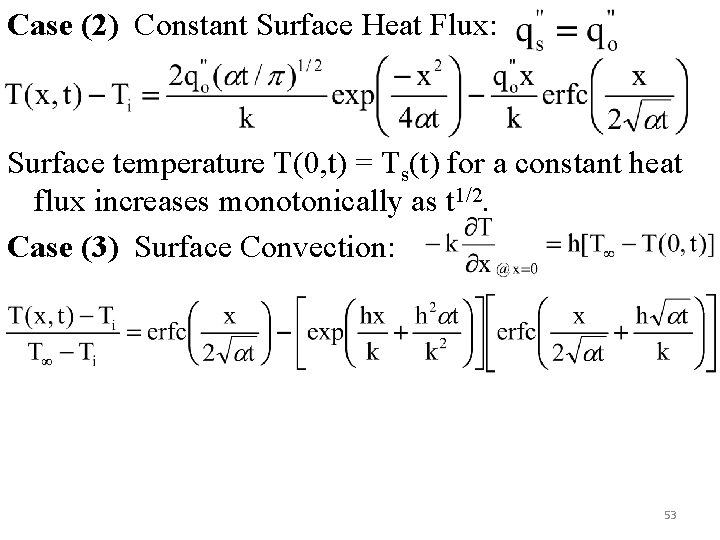
Case (2) Constant Surface Heat Flux: Surface temperature T(0, t) = Ts(t) for a constant heat flux increases monotonically as t 1/2. Case (3) Surface Convection: 53
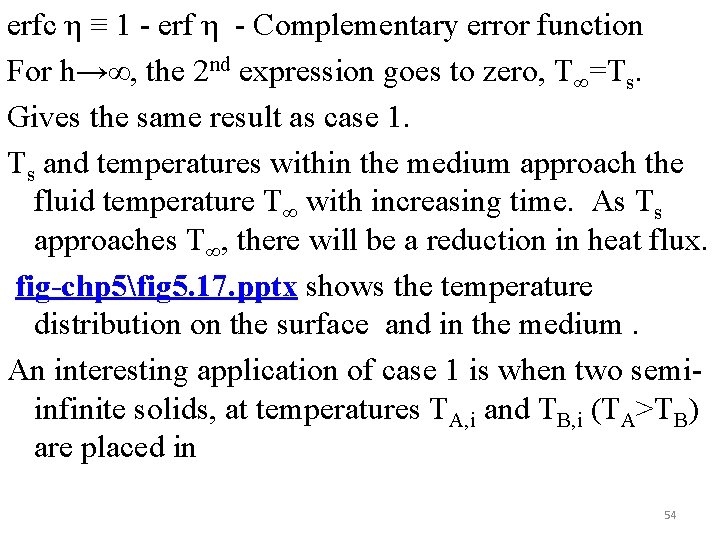
erfc η ≡ 1 - erf η - Complementary error function For h→∞, the 2 nd expression goes to zero, T∞=Ts. Gives the same result as case 1. Ts and temperatures within the medium approach the fluid temperature T∞ with increasing time. As Ts approaches T∞, there will be a reduction in heat flux. fig-chp 5fig 5. 17. pptx shows the temperature distribution on the surface and in the medium. An interesting application of case 1 is when two semiinfinite solids, at temperatures TA, i and TB, i (TA>TB) are placed in 54
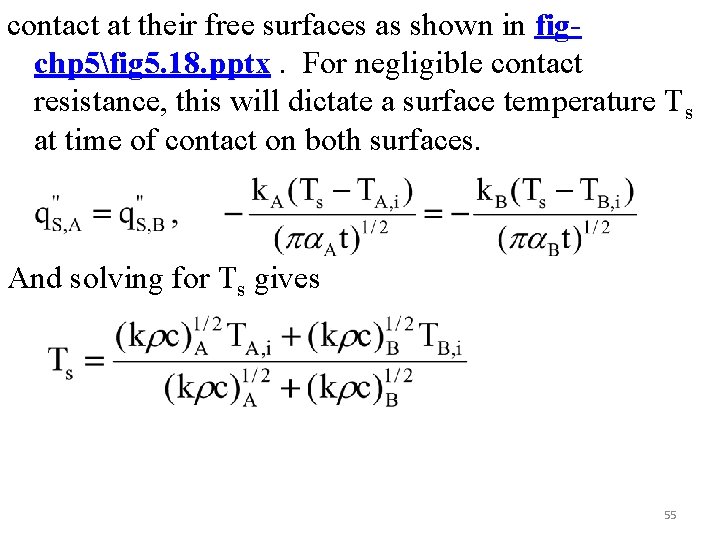
contact at their free surfaces as shown in figchp 5fig 5. 18. pptx. For negligible contact resistance, this will dictate a surface temperature Ts at time of contact on both surfaces. And solving for Ts gives 55
- Slides: 55