
Transfusion for Medical Students Nov 2014 Requesting blood
Transfusion for Medical Students Nov 2014
Requesting blood for transfusion
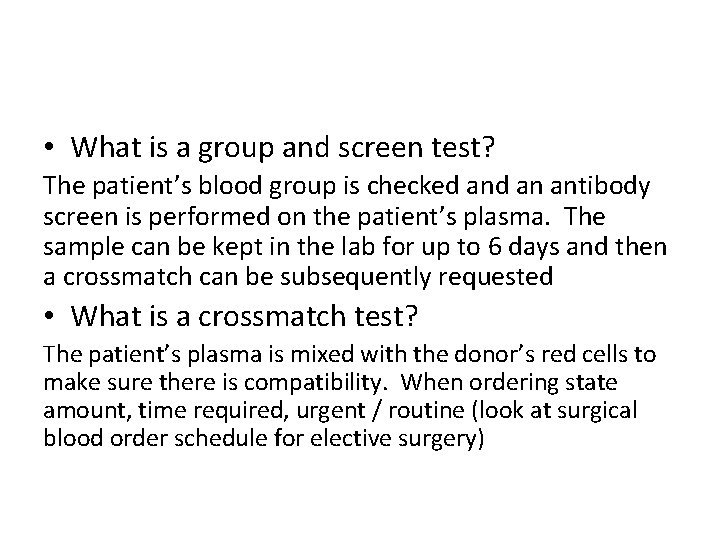
• What is a group and screen test? The patient’s blood group is checked an antibody screen is performed on the patient’s plasma. The sample can be kept in the lab for up to 6 days and then a crossmatch can be subsequently requested • What is a crossmatch test? The patient’s plasma is mixed with the donor’s red cells to make sure there is compatibility. When ordering state amount, time required, urgent / routine (look at surgical blood order schedule for elective surgery)
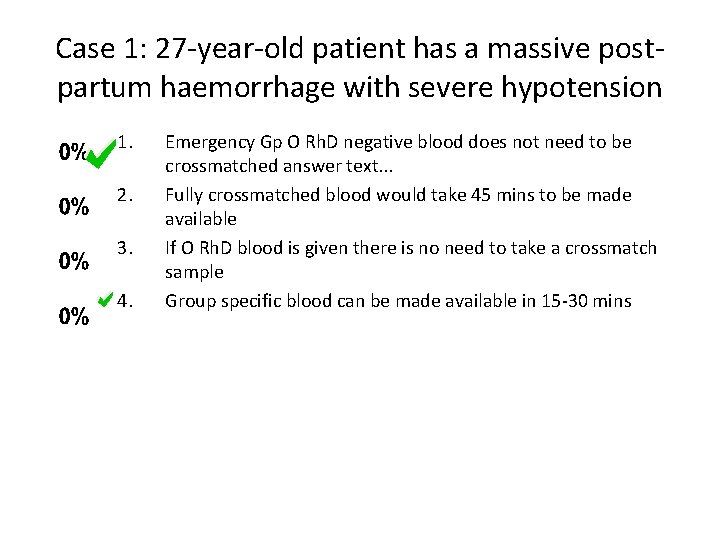
Case 1: 27 -year-old patient has a massive postpartum haemorrhage with severe hypotension 1. 2. 3. 4. Emergency Gp O Rh. D negative blood does not need to be crossmatched answer text. . . Fully crossmatched blood would take 45 mins to be made available If O Rh. D blood is given there is no need to take a crossmatch sample Group specific blood can be made available in 15 -30 mins
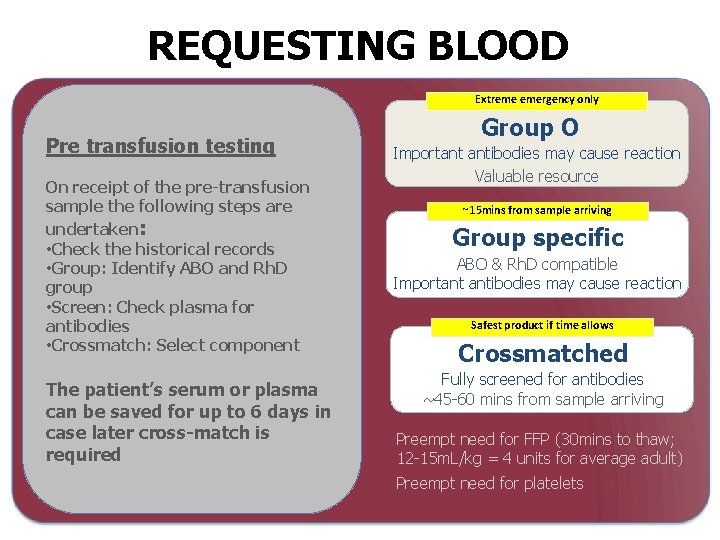
REQUESTING BLOOD Extreme emergency only Pre transfusion testing ASSESS URGENCY On receipt of the Choose the pre-transfusion right products sample the following steps are undertaken: • Check the historical records • Group: Identify ABO and Rh. D group Allocate a lead to plasma liaise with • Screen: Check for lab & porters antibodies • Crossmatch: Select component COMMUNICATE AVOID ERRORS The patient’s serum or plasma can be. Careful savedbedside for up labelling to 6 days in case later cross-match is XM, FBC, coag screen – swiftly to lab required Group O Important antibodies may cause reaction Valuable resource ~15 mins from sample arriving Group specific ABO & Rh. D compatible Important antibodies may cause reaction Safest product if time allows Crossmatched Fully screened for antibodies ~45 -60 mins from sample arriving Preempt need for FFP (30 mins to thaw; 12 -15 m. L/kg = 4 units for average adult) Preempt need for platelets
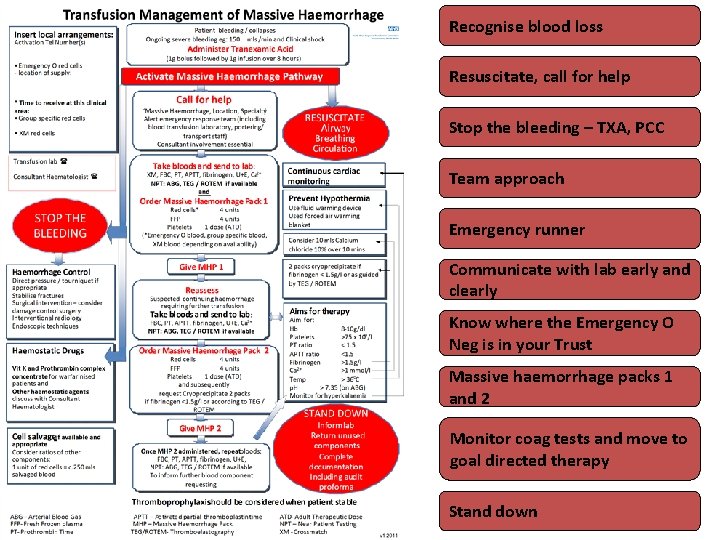
Recognise blood loss Resuscitate, call for help Stop the bleeding – TXA, PCC Team approach Emergency runner Communicate with lab early and clearly Know where the Emergency O Neg is in your Trust Massive haemorrhage packs 1 and 2 Monitor coag tests and move to goal directed therapy Stand down
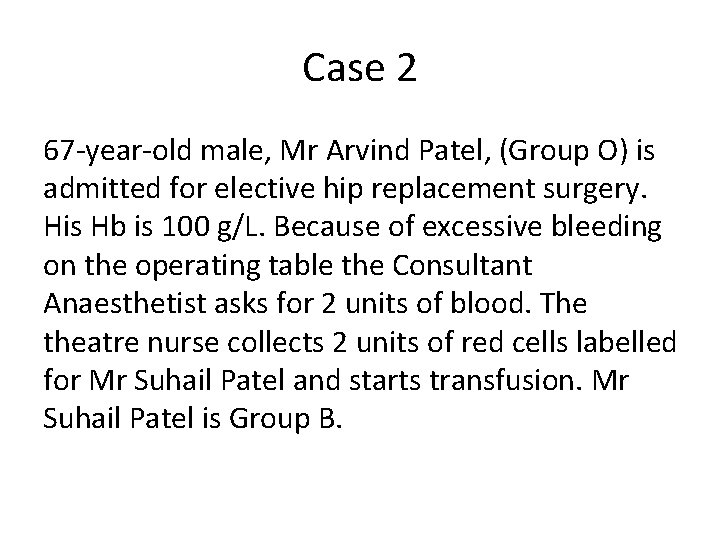
Case 2 67 -year-old male, Mr Arvind Patel, (Group O) is admitted for elective hip replacement surgery. His Hb is 100 g/L. Because of excessive bleeding on the operating table the Consultant Anaesthetist asks for 2 units of blood. The theatre nurse collects 2 units of red cells labelled for Mr Suhail Patel and starts transfusion. Mr Suhail Patel is Group B.
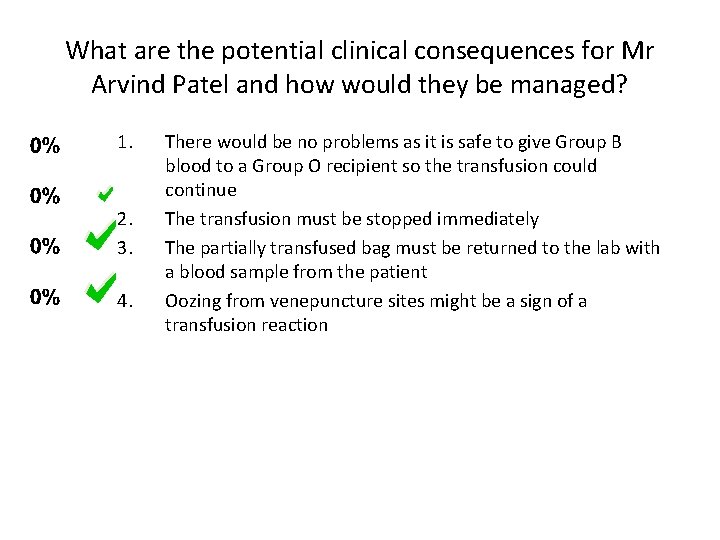
What are the potential clinical consequences for Mr Arvind Patel and how would they be managed? 1. 2. 3. 4. There would be no problems as it is safe to give Group B blood to a Group O recipient so the transfusion could continue The transfusion must be stopped immediately The partially transfused bag must be returned to the lab with a blood sample from the patient Oozing from venepuncture sites might be a sign of a transfusion reaction

Blood Groups Antibodies A Anti-B B Anti-A AB None O Anti-A Anti-B Rh. D positive or Rh. D negative A B AB O
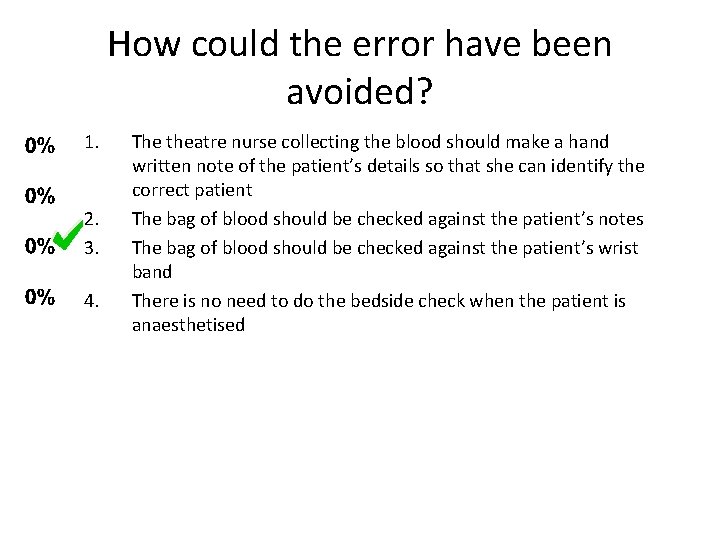
How could the error have been avoided? 1. 2. 3. 4. The theatre nurse collecting the blood should make a hand written note of the patient’s details so that she can identify the correct patient The bag of blood should be checked against the patient’s notes The bag of blood should be checked against the patient’s wrist band There is no need to do the bedside check when the patient is anaesthetised
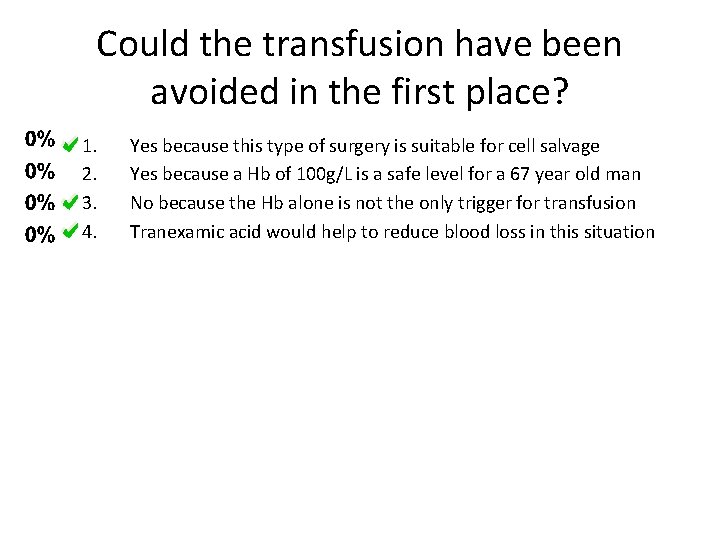
Could the transfusion have been avoided in the first place? 1. 2. 3. 4. Yes because this type of surgery is suitable for cell salvage Yes because a Hb of 100 g/L is a safe level for a 67 year old man No because the Hb alone is not the only trigger for transfusion Tranexamic acid would help to reduce blood loss in this situation

BLOOD “ 1 unit RBC” COMMON INDICATIONS Acute blood loss Only with significant blood volume loss Consider cell salvage Anaemia Hb < 70 g/L Likely requires transfusion Usual time: 3 hrs 4 hr limit from removal from cold storage to end of transfusion Blood warmer for rapid transfusions Refer to Trust Blood Transfusion Policy Consider correctible causes Anaemia Hb 70 - 100 g/L Consider correctible causes Transfuse if symptoms/needs eg IHD Pre-operative assessment Correction of anaemia reduces need for transfusion MBOS (Maximum Blood Ordering Schedule)
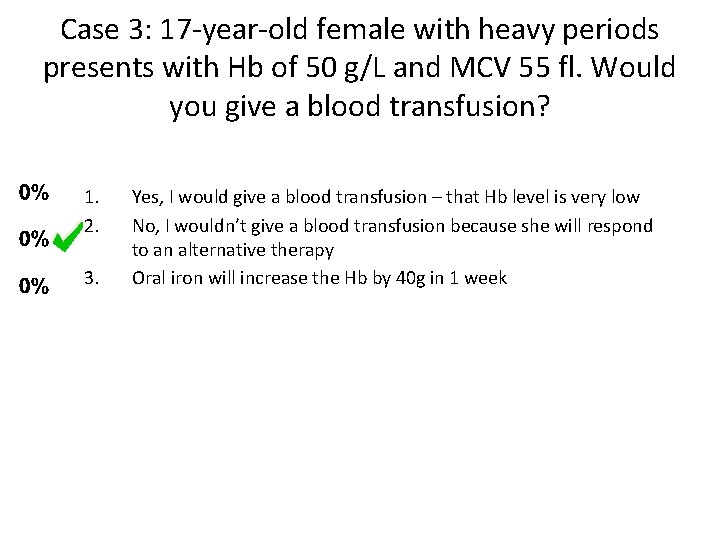
Case 3: 17 -year-old female with heavy periods presents with Hb of 50 g/L and MCV 55 fl. Would you give a blood transfusion? 1. 2. 3. Yes, I would give a blood transfusion – that Hb level is very low No, I wouldn’t give a blood transfusion because she will respond to an alternative therapy Oral iron will increase the Hb by 40 g in 1 week
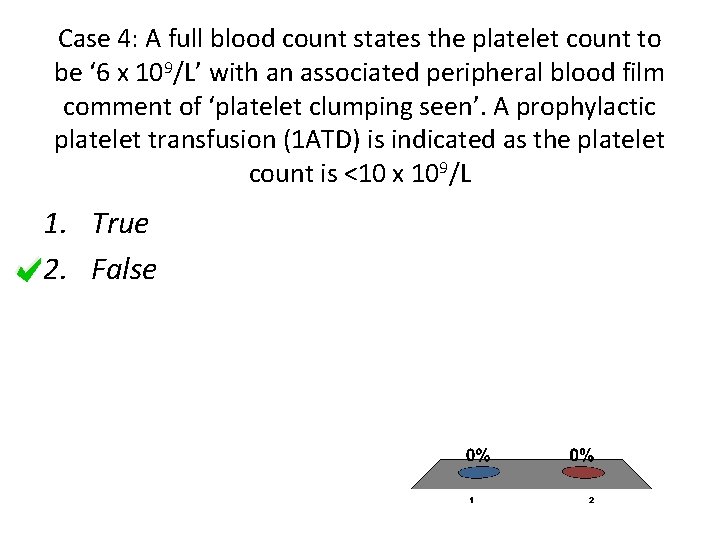
Case 4: A full blood count states the platelet count to be ‘ 6 x 10⁹/L’ with an associated peripheral blood film comment of ‘platelet clumping seen’. A prophylactic platelet transfusion (1 ATD) is indicated as the platelet count is <10 x 109/L 1. True 2. False
Fresh Frozen Plasma (FFP) is the optimal treatment available to treat life-threatening bleeding in patients on warfarin 1. True 2. False
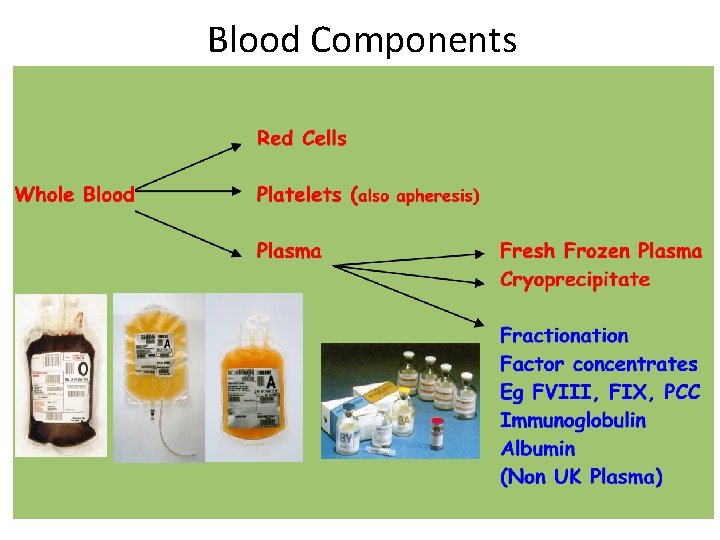
Blood Components
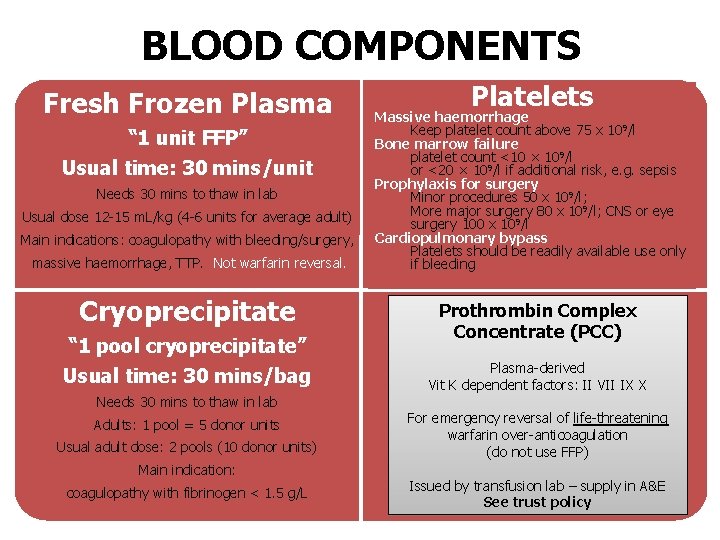
BLOOD COMPONENTS Fresh Frozen Plasma “ 1 unit FFP” Usual time: 30 mins/unit Needs 30 mins to thaw in lab Usual dose 12 -15 m. L/kg (4 -6 units for average adult) Main indications: coagulopathy with bleeding/surgery, massive haemorrhage, TTP. Not warfarin reversal. Cryoprecipitate “ 1 pool cryoprecipitate” Usual time: 30 mins/bag Needs 30 mins to thaw in lab Adults: 1 pool = 5 donor units Usual adult dose: 2 pools (10 donor units) Main indication: coagulopathy with fibrinogen < 1. 5 g/L Platelets Massive haemorrhage Keep platelet count above 75 x 109/l “ 1 failure ATD platelets” Bone marrow platelet count <10 × 109/l 30 risk, mins or <20 Usual × 109/l time: if additional e. g. sepsis Prophylaxis for surgery 1 hr limit Minor procedures 50 x 109/l; More major 80 x 109/l; dose CNS(ATD) or eye Usual dose: 1 surgery adult treatment 9 surgery 100 x 10 /l Shelf-life only 7 days from donation Cardiopulmonary bypass should or betreatment readily available use only Used. Platelets prophylaxis of bleeding / pre ifas bleeding procedure in patients with thrombocytopenia Prothrombin Complex Concentrate (PCC) Plasma-derived Vit K dependent factors: II VII IX X For emergency reversal of life-threatening warfarin over-anticoagulation (do not use FFP) Issued by transfusion lab – supply in A&E See trust policy
All patients with Hodgkin’s Disease should receive irradiated blood 1. True 2. False
All patients born after 1996 should have virally inactivated, non-UK sourced Plasma 1. True 2. False
All Stem Cell Transplant / Bone marrow transplant recipients require CMV negative blood 1. True 2. False
Pregnant women have no special blood requirements, so there is no need to inform the transfusion laboratory of their pregnancy or gestation on the request form 1. True 2. False
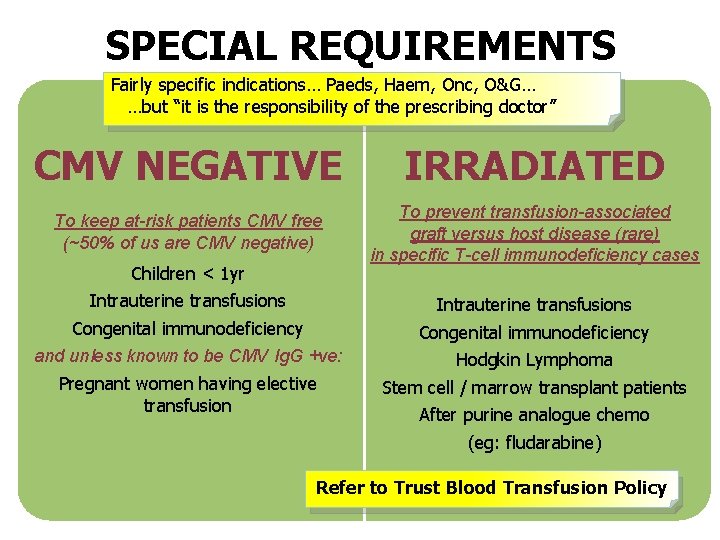
SPECIAL REQUIREMENTS Fairly specific indications… Paeds, Haem, Onc, O&G… …but “it is the responsibility of the prescribing doctor” CMV NEGATIVE IRRADIATED To keep at-risk patients CMV free (~50% of us are CMV negative) To prevent transfusion-associated graft versus host disease (rare) in specific T-cell immunodeficiency cases Children < 1 yr Intrauterine transfusions Congenital immunodeficiency and unless known to be CMV Ig. G +ve: Hodgkin Lymphoma Pregnant women having elective transfusion Stem cell / marrow transplant patients After purine analogue chemo (eg: fludarabine) Refer to Trust Blood Transfusion Policy
The risk of transmission of HIV with transfusion of red cells is 1 in 5 million donations in the UK (0. 2 per million donations) 1. True 2. False
A patient becomes acutely short of breath following a transfusion of FFP. Chest X-ray shows bilateral pulmonary infiltrates and you give diuretics with some effect. The case should be reported as a clinical incident via the hospital reporting system, so it can be followed up appropriately 1. True 2. False
All donors are now screened for v. CJD 1. True 2. False
A patient complains of feeling unwell during their transfusion. Their observation chart shows their temperature, BP, pulse rate and respiratory rate to be stable. No specific action is required 1. True 2. False
A patient develops mild urticaria following a platelet transfusion. You should administer IV chlorphenaramine (piriton) and IV hydrocortisone 1. True 2. False
Anaphylaxis is most likely to happen in the first 15 minutes of transfusion 1. True 2. False
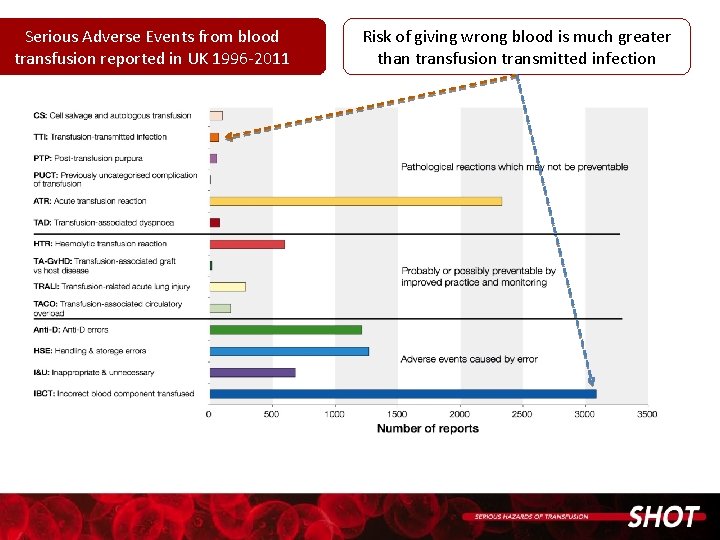
Serious Adverse Events from blood transfusion reported in UK 1996 -2011 Risk of giving wrong blood is much greater than transfusion transmitted infection
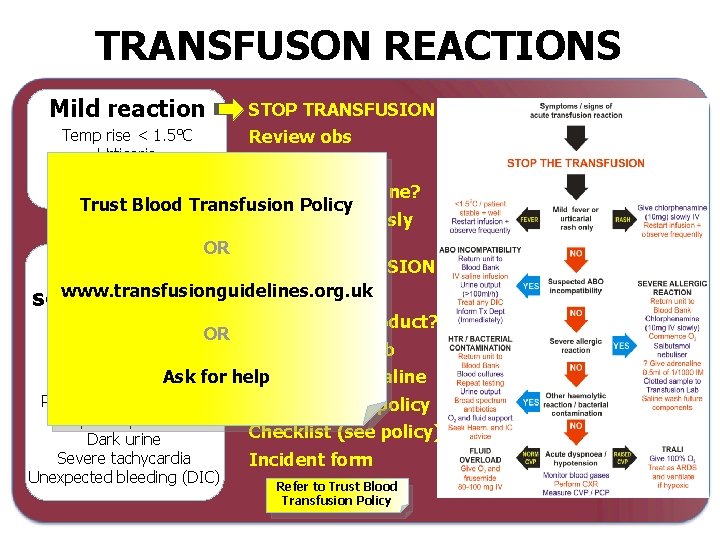
TRANSFUSON REACTIONS Mild reaction Temp rise < 1. 5°C Urticaria Rash Pruritis STOP TRANSFUSION Review obs Paracetamol Chlorpheniramine? Trust Blood Transfusion Policy Restart cautiously OR STOP TRANSFUSION Suspected www. transfusionguidelines. org. uk severe reaction Right patient? Right blood product? Pyrexia, rigors OR Hypotension Whole set to lab Loin / back pain New set with saline Ask for help Increasing anxiety Pain at the infusion site Full bloods as policy Respiratory distress Checklist (see policy) Dark urine Severe tachycardia Incident form Unexpected bleeding (DIC) Refer to Trust Blood Transfusion Policy
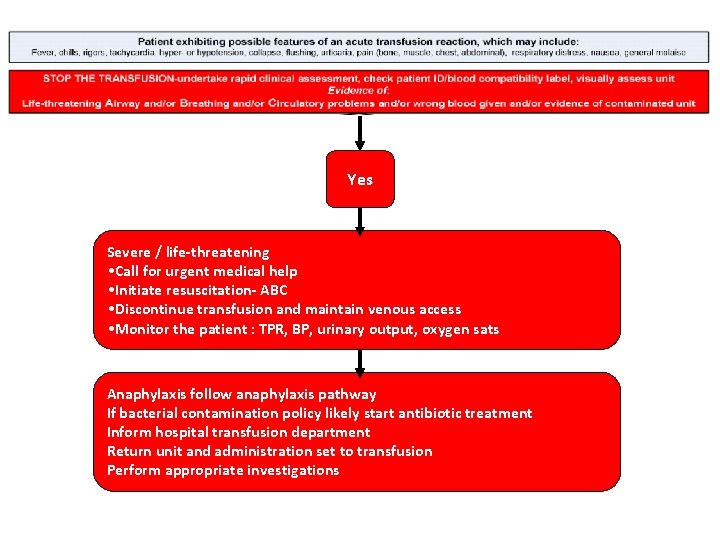
Yes Severe / life-threatening • Call for urgent medical help • Initiate resuscitation- ABC • Discontinue transfusion and maintain venous access • Monitor the patient : TPR, BP, urinary output, oxygen sats Anaphylaxis follow anaphylaxis pathway If bacterial contamination policy likely start antibiotic treatment Inform hospital transfusion department Return unit and administration set to transfusion Perform appropriate investigations
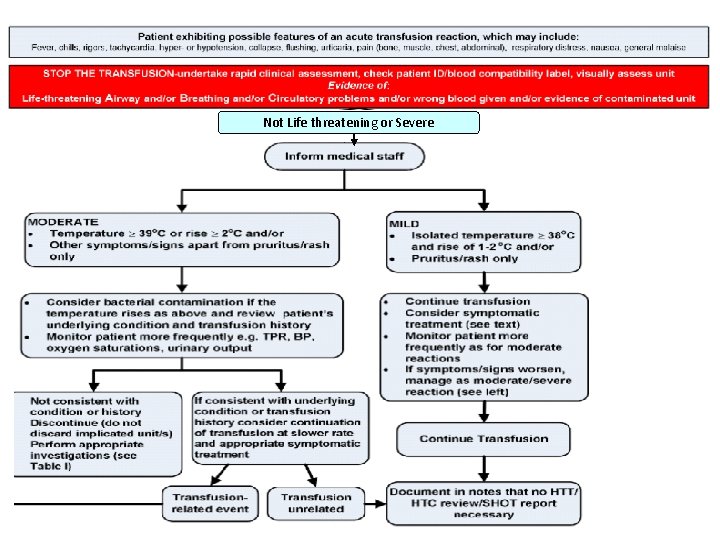
Not Life threatening or Severe
Resources Trust Guidelines and Policies Your Hospital Transfusion Team The Transfusion Handbook www. transfusionguidelines. org. uk
- Slides: 33