
Transforming School Culture How to Overcome Staff Division
- Slides: 33
Transforming School Culture How to Overcome Staff Division based on the book by Anthony Muhammad, Ph. D. School Improvement Technical Assistance Meeting September 17, 2009 Jane Massi, Title I Consultant 1
“Education for All” 2
Student Outcomes vs. Educator Intentions 3
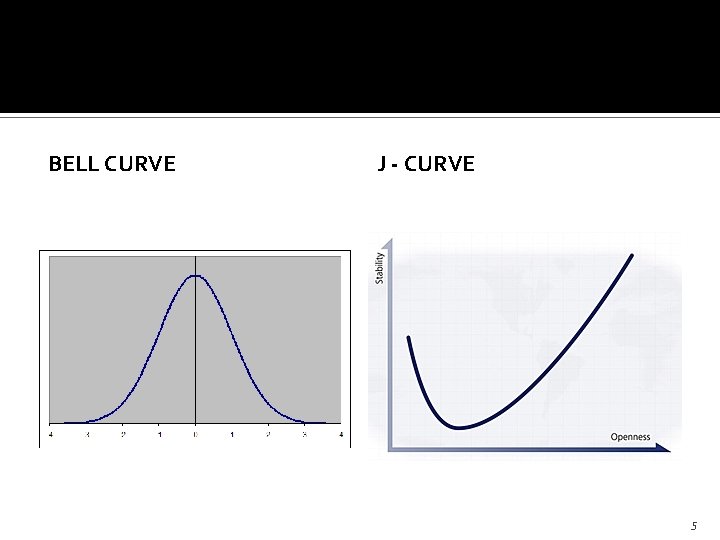
“…like fitting J-curve results into a bell-curve society. ” Douglas Reeves 4
BELL CURVE J - CURVE 5
Issues �Teacher Quality �Staff Expectations �Student Apathy �Inadequate Parental Support 6
School Culture Defined �Norms �Values & Beliefs �Rituals & Ceremonies �Symbols & Stories Kent D. Peterson 7
School Culture �Positive �Negative 8
School Culture �Positive Supports professional development for teachers Sense of responsibility for student learning Positive caring atmosphere 9
School Culture �Positive All children can learn. All children will learn because of what we do. Professional Learning Communities at Work by Rebecca and Richard Du. Fours 10
School Culture �Toxic Teacher relationships conflictual Staff does not believe in the ability of ALL students Helps to maintain “the gap” 11
What are some examples in your school? 12
Closing the Gap �Expectations �Belief Systems 13
Types of Change �Technical �Cultural 14
Old Belief System (pre-NCLB) �Students and their families were responsible for effectiveness of education. �Educators were the experts. �Schools provided students the opportunity to learn. �Students were expected to comply with educator demands to acquire knowledge. �Parents that supported the expert guidance would have achieving students. �Subjective grading systems were the norm. �Procedures were controlled by educators. 15
New Belief System �The school is accountable for student success. 16
Dr. Muhammad Belief System �It is not the student’s fault. �It is not the parent’s fault. �It is not the educator’s fault. 17
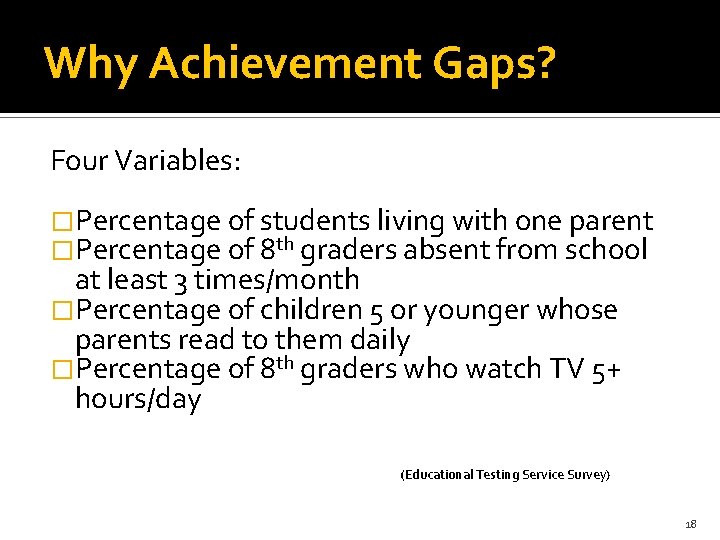
Why Achievement Gaps? Four Variables: �Percentage of students living with one parent �Percentage of 8 th graders absent from school at least 3 times/month �Percentage of children 5 or younger whose parents read to them daily �Percentage of 8 th graders who watch TV 5+ hours/day (Educational Testing Service Survey) 18
Predeterminations �Perceptual �Intrinsic �Institutional 19
Perceptual Predeterminations Teacher expectations clearly play a role in how much students learn. 20
Intrinsic Predeterminations Student expectations clearly play a role in how much students learn. 21
Institutional Predeterminations Society/schools play a role in how much students learn. 22
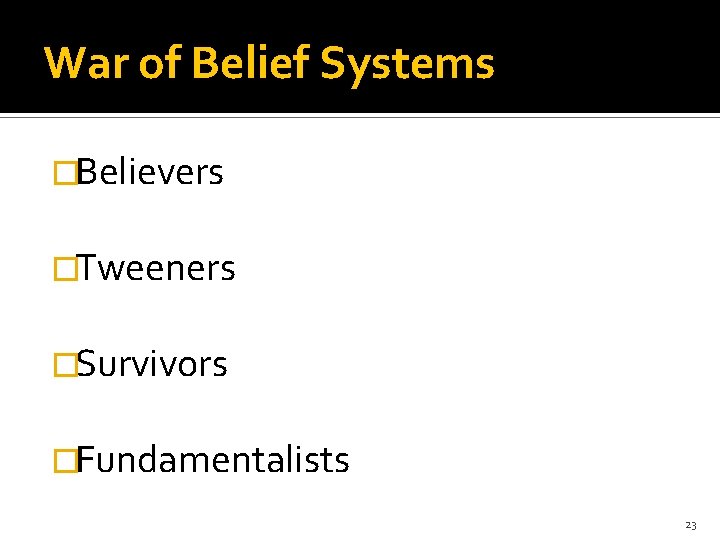
War of Belief Systems �Believers �Tweeners �Survivors �Fundamentalists 23
Believers �Goal: Academic success for each student 24
Tweeners �Goal: Organizational stability 25
Survivors �Goal: Emotional and mental survival 26
Fundamentalists �Goal: Maintaining the status quo 27
Activity Match the statements to their correct group. 28
Activity Answers and discussion. 29
What to do? �Believers If schools are to transform their cultures into positives, them must increase this population of Believers must become more vocal members of the school community. 30
What to do? �Tweeners School leaders cannot leave new teacher development to choice. Leaders must be proactive and put time and resources behind the support and development of tweeners in order to create the positive school culture a school needs. They must protect and groom Tweeners. 31
What to do? �Survivors School leaders must reduce the effects Survivors have on students. Remove them from the situation. Provide psychological treatment, paid leave or new career opportunities. 32
What to do? �Fundamentalists School leaders and Believers must meet Fundamentalists head on. They must curtail or eliminate fundamentalism in schools. 33