
Transforming lives transforming places After your foundation degree
- Slides: 15
Transforming lives transforming places: After your foundation degree. Presented by Dr Helen Bovill. Project with: Dr Neil Harrison, UWE. Vicki Bennet and Hilary Smith, Bath Spa. Liz Mckenzie, Plymouth University.
Contact details Dr Helen Bovill. Senior Lecturer. HEA Senior Fellow. Helen 2. bovill@uwe. ac. uk http: //people. uwe. ac. uk/Pages/person. aspx? accountname=campushl 2 -bovill Dr Neil Harrison. Senior Lecturer. Neil. Harrison@uwe. ac. uk Viki Bennett. Programme Leader: Early Years and TA Education v. bennett@bathspa. ac. uk Hilary Smith. Programme Leader, Primary and Early Years PGCE h. smith 2@bathspa. ac. uk Liz Mc. Kenzie. Lecturer in Education liz. mckenzie@plymouth. ac. uk
Presentation Outline • What the study is and where we are • Theory to help understand how students negotiate unknown landscape of HE • Theory to help understand how students negotiate professional landscape post HE • Overarching thoughts on study so far: 1. giving something back 2. Challenging expectations
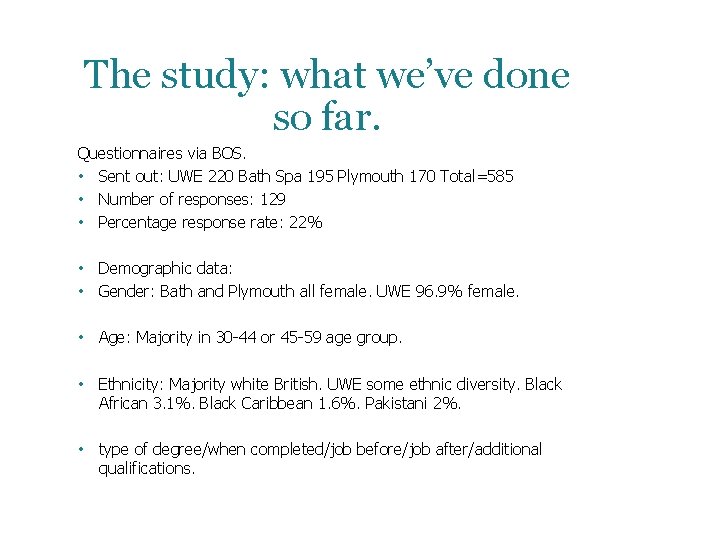
The study: what we’ve done so far. Questionnaires via BOS. • Sent out: UWE 220 Bath Spa 195 Plymouth 170 Total=585 • Number of responses: 129 • Percentage response rate: 22% • Demographic data: • Gender: Bath and Plymouth all female. UWE 96. 9% female. • Age: Majority in 30 -44 or 45 -59 age group. • Ethnicity: Majority white British. UWE some ethnic diversity. Black African 3. 1%. Black Caribbean 1. 6%. Pakistani 2%. • type of degree/when completed/job before/job after/additional qualifications.
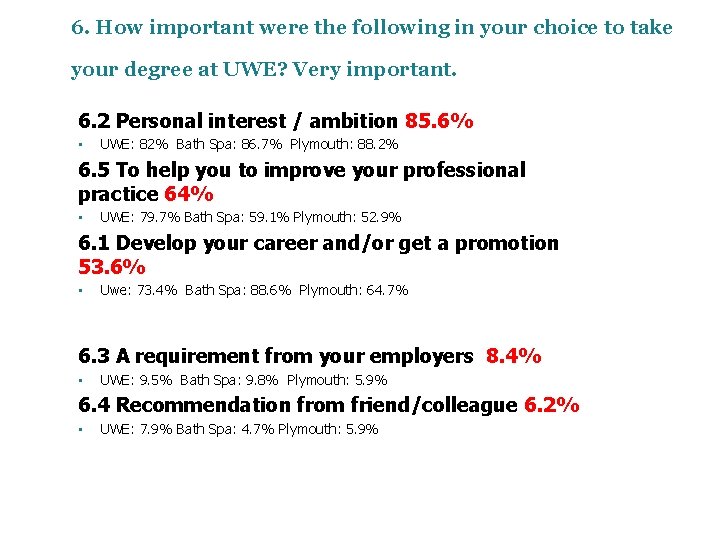
6. How important were the following in your choice to take your degree at UWE? Very important. 6. 2 Personal interest / ambition 85. 6% • UWE: 82% Bath Spa: 86. 7% Plymouth: 88. 2% 6. 5 To help you to improve your professional practice 64% • UWE: 79. 7% Bath Spa: 59. 1% Plymouth: 52. 9% 6. 1 Develop your career and/or get a promotion 53. 6% • Uwe: 73. 4% Bath Spa: 88. 6% Plymouth: 64. 7% 6. 3 A requirement from your employers 8. 4% • UWE: 9. 5% Bath Spa: 9. 8% Plymouth: 5. 9% 6. 4 Recommendation from friend/colleague 6. 2% • UWE: 7. 9% Bath Spa: 4. 7% Plymouth: 5. 9%
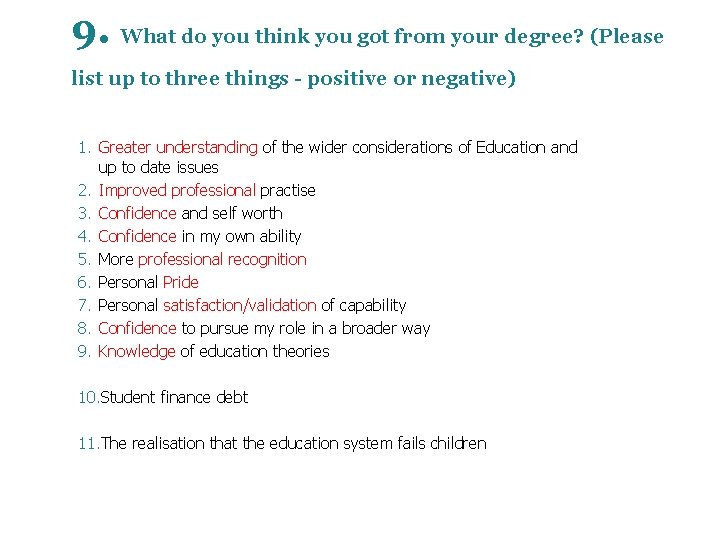
9. What do you think you got from your degree? (Please list up to three things - positive or negative) 1. Greater understanding of the wider considerations of Education and up to date issues 2. Improved professional practise 3. Confidence and self worth 4. Confidence in my own ability 5. More professional recognition 6. Personal Pride 7. Personal satisfaction/validation of capability 8. Confidence to pursue my role in a broader way 9. Knowledge of education theories 10. Student finance debt 11. The realisation that the education system fails children
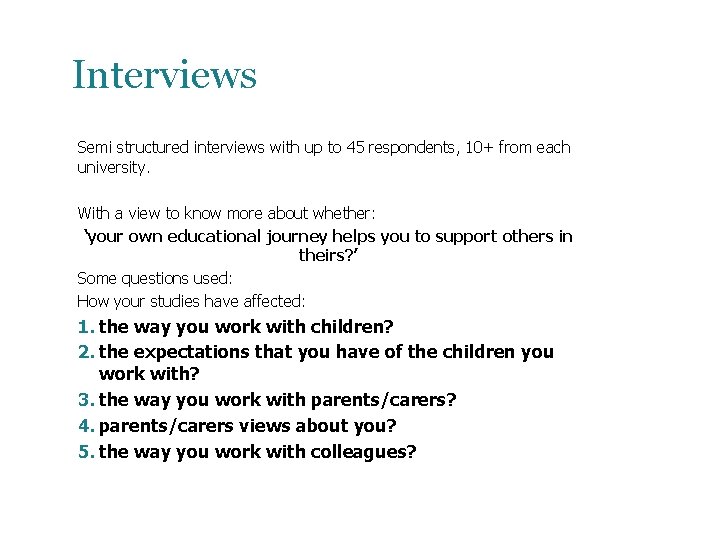
Interviews Semi structured interviews with up to 45 respondents, 10+ from each university. With a view to know more about whether: ‘your own educational journey helps you to support others in theirs? ’ Some questions used: How your studies have affected: 1. the way you work with children? 2. the expectations that you have of the children you work with? 3. the way you work with parents/carers? 4. parents/carers views about you? 5. the way you work with colleagues?
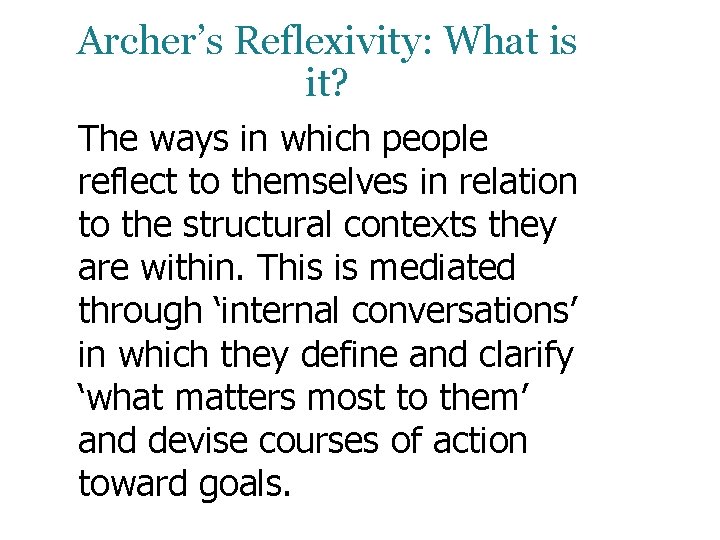
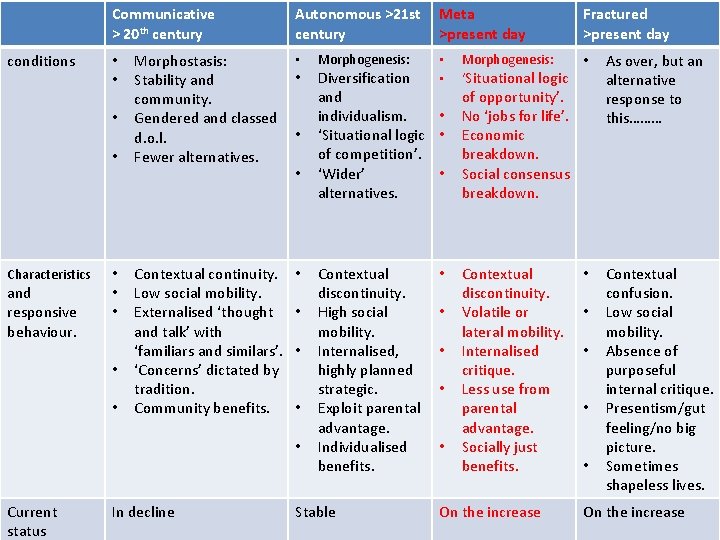
Archer’s Reflexivity: What is it? The ways in which people reflect to themselves in relation to the structural contexts they are within. This is mediated through ‘internal conversations’ in which they define and clarify ‘what matters most to them’ and devise courses of action toward goals.
Communicative > 20 th century conditions • • Characteristics and responsive behaviour. • • • Autonomous >21 st century Morphostasis: Stability and community. Gendered and classed d. o. l. Fewer alternatives. • Contextual continuity. Low social mobility. Externalised ‘thought and talk’ with ‘familiars and similars’. ‘Concerns’ dictated by tradition. Community benefits. • • Current status In decline Morphogenesis: Meta >present day • • Diversification and individualism. • ‘Situational logic • of competition’. ‘Wider’ • alternatives. Contextual discontinuity. High social mobility. Internalised, highly planned strategic. Exploit parental advantage. Individualised benefits. Stable • • • Fractured >present day Morphogenesis: ‘Situational logic • As over, but an alternative response to this……… Contextual discontinuity. Volatile or lateral mobility. Internalised critique. Less use from parental advantage. Socially just benefits. • Contextual confusion. Low social mobility. Absence of purposeful internal critique. Presentism/gut feeling/no big picture. Sometimes shapeless lives. of opportunity’. No ‘jobs for life’. Economic breakdown. Social consensus breakdown. On the increase • • On the increase
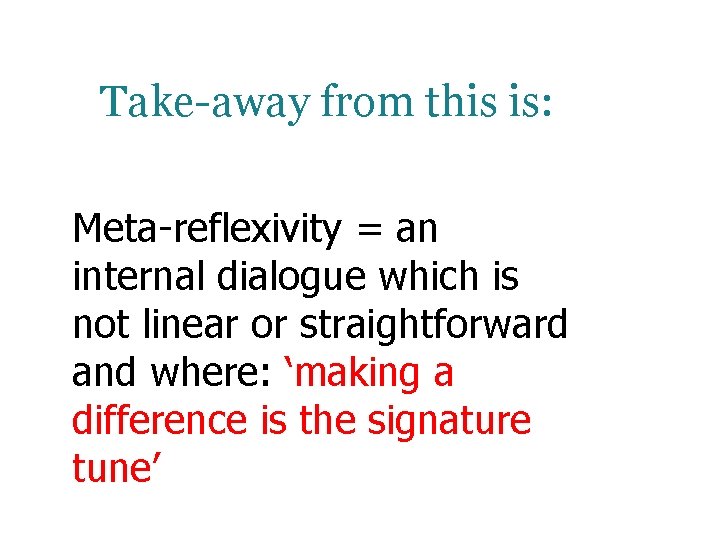
Take-away from this is: Meta-reflexivity = an internal dialogue which is not linear or straightforward and where: ‘making a difference is the signature tune’
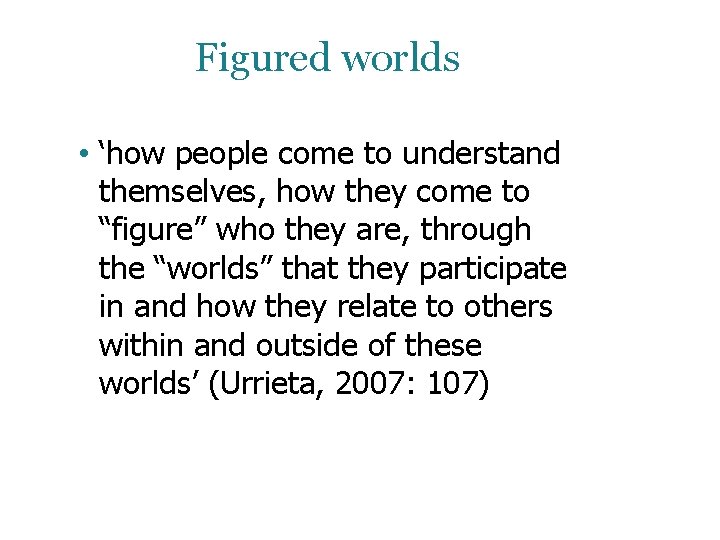
Figured worlds • ‘how people come to understand themselves, how they come to “figure” who they are, through the “worlds” that they participate in and how they relate to others within and outside of these worlds’ (Urrieta, 2007: 107)
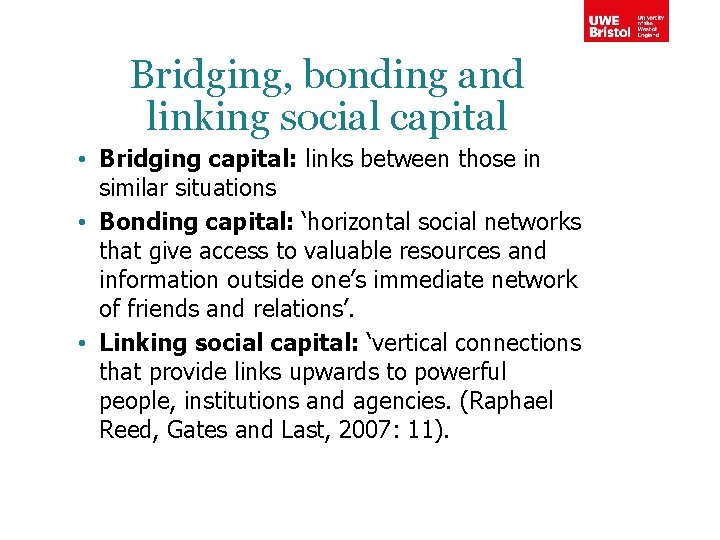
Bridging, bonding and linking social capital • Bridging capital: links between those in similar situations • Bonding capital: ‘horizontal social networks that give access to valuable resources and information outside one’s immediate network of friends and relations’. • Linking social capital: ‘vertical connections that provide links upwards to powerful people, institutions and agencies. (Raphael Reed, Gates and Last, 2007: 11).
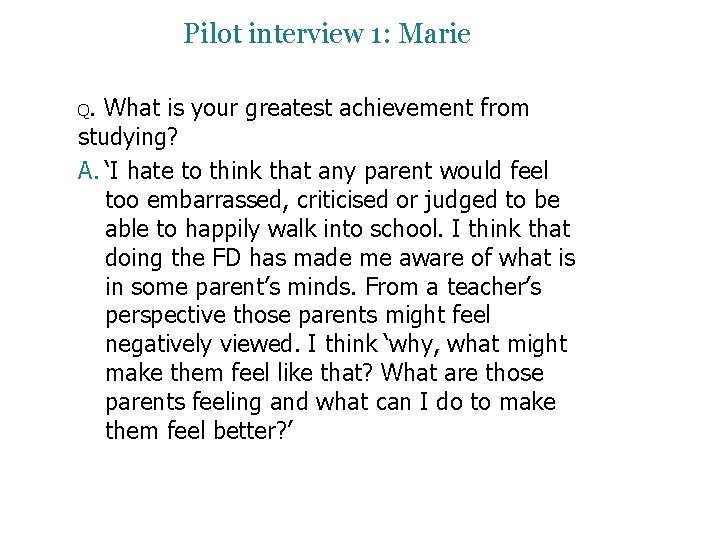
Pilot interview 1: Marie Q. What is your greatest achievement from studying? A. ‘I hate to think that any parent would feel too embarrassed, criticised or judged to be able to happily walk into school. I think that doing the FD has made me aware of what is in some parent’s minds. From a teacher’s perspective those parents might feel negatively viewed. I think ‘why, what might make them feel like that? What are those parents feeling and what can I do to make them feel better? ’
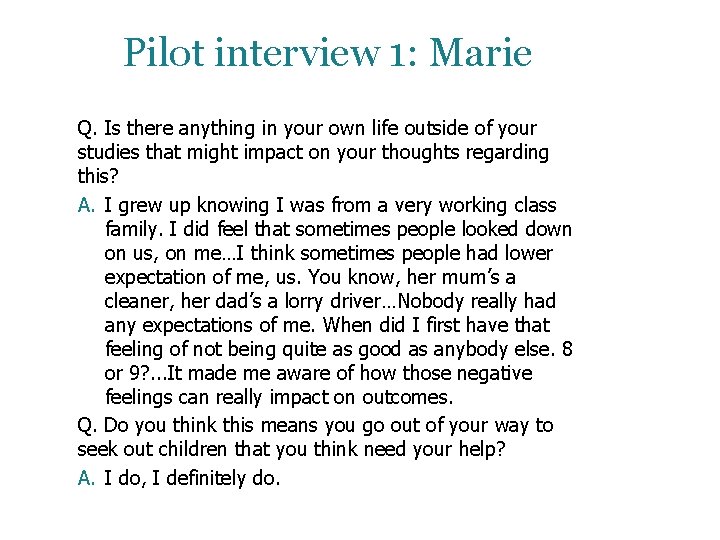
Pilot interview 1: Marie Q. Is there anything in your own life outside of your studies that might impact on your thoughts regarding this? A. I grew up knowing I was from a very working class family. I did feel that sometimes people looked down on us, on me…I think sometimes people had lower expectation of me, us. You know, her mum’s a cleaner, her dad’s a lorry driver…Nobody really had any expectations of me. When did I first have that feeling of not being quite as good as anybody else. 8 or 9? . . . It made me aware of how those negative feelings can really impact on outcomes. Q. Do you think this means you go out of your way to seek out children that you think need your help? A. I do, I definitely do.
References • • ARCHER, M. S. (2007) Making Our Way Through the World Cambridge: Cambridge University Press. ARCHER, M. S. (2008) The Internal Conversation: Mediating between structure and agency. Full Research Report. ESRC End of Award Report, RES 000 -23 -0349. Swindon: ESRC. ARCHER, M. S. (2008 a) The Internal Conversation: Mediating between structure and agency: Non-Technical Summary (Research summary). ESRC End of Award Report. RES-000 -23 -0349. Swindon: ESRC. Archer. (2012) The Reflexive Imperative in Late Modernity. London: Sage. Bovill, H (2012) ‘The importance of internal conversations and reflexivity for work-based students in higher education: valuing contextual continuity and ‘giving something back’, in International Journal of Lifelong Education. 31 (6): 687 -703. Urrieta, L. (2007) ‘Figured worlds and education: An introduction to the special issue’, in The Urban Review. 39 (2): 107 -115. Raphael Reed, L. , Gates, P. and Last, K. (2007) Young participation in higher education in the parliamentary constituencies of Birmingham Hodge Hill, Bristol South, Nottingham North and Sheffield Brightside. Technical Report. HEFCE, Bristol. Available at: http: //eprints. uwe. ac. uk/10461/1/Four%20 Cities%20 report. pdf (Accessed: November 2016).