
Transforming Grammars CF Grammar Terms Parse trees Graphical

- Slides: 16
Transforming Grammars
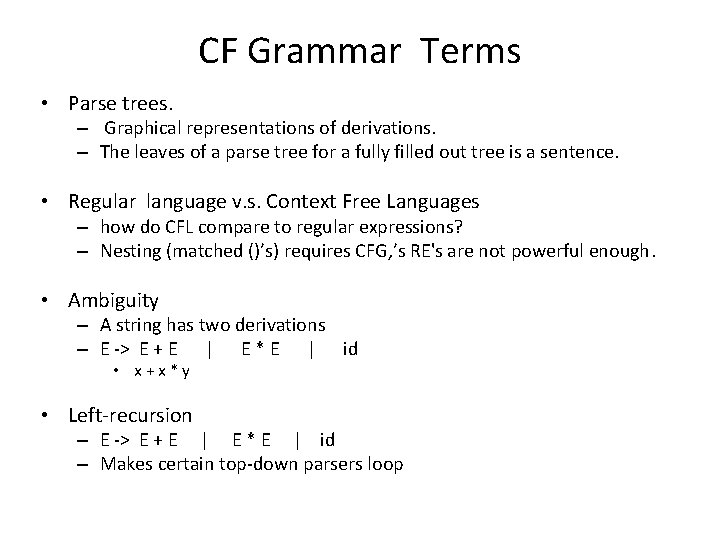
CF Grammar Terms • Parse trees. – Graphical representations of derivations. – The leaves of a parse tree for a fully filled out tree is a sentence. • Regular language v. s. Context Free Languages – how do CFL compare to regular expressions? – Nesting (matched ()’s) requires CFG, ’s RE's are not powerful enough. • Ambiguity – A string has two derivations – E -> E + E | E * E | id • x+x*y • Left-recursion – E -> E + E | E * E | id – Makes certain top-down parsers loop
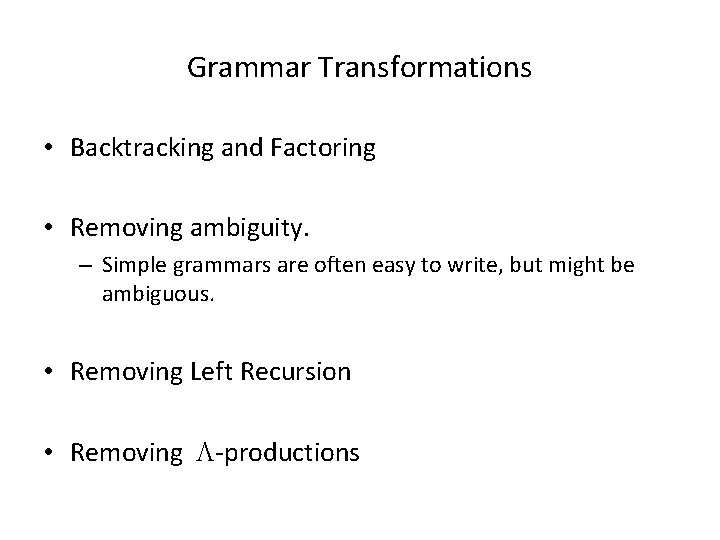
Grammar Transformations • Backtracking and Factoring • Removing ambiguity. – Simple grammars are often easy to write, but might be ambiguous. • Removing Left Recursion • Removing L-productions
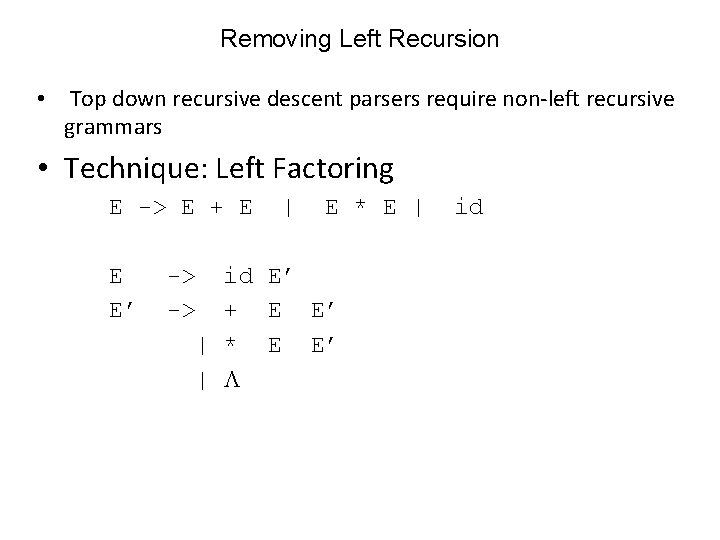
Removing Left Recursion • Top down recursive descent parsers require non-left recursive grammars • Technique: Left Factoring E -> E + E E E’ -> -> | | | E * E | id E’ + E E’ * E E’ L id
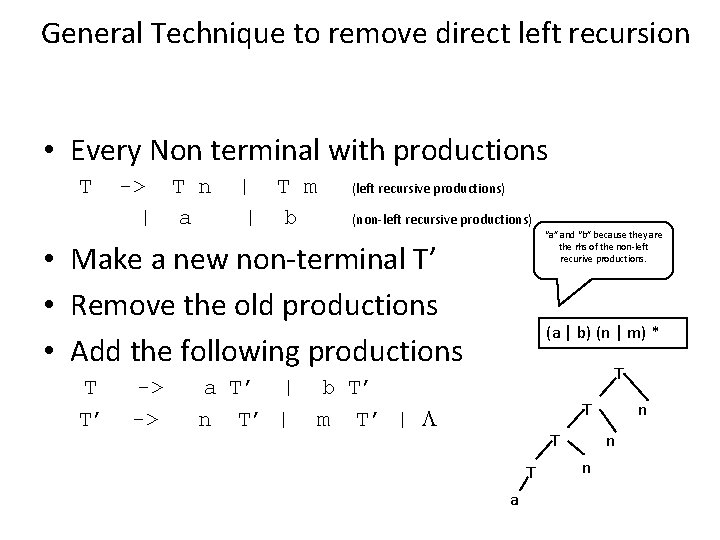
General Technique to remove direct left recursion • Every Non terminal with productions T -> T n | a | T m | b (left recursive productions) (non-left recursive productions) “a” and “b” because they are the rhs of the non-left recurive productions. • Make a new non-terminal T’ • Remove the old productions • Add the following productions T T’ -> -> (a | b) (n | m) * T a T’ | b T’ n T’ | m T’ | L T T T a n n n
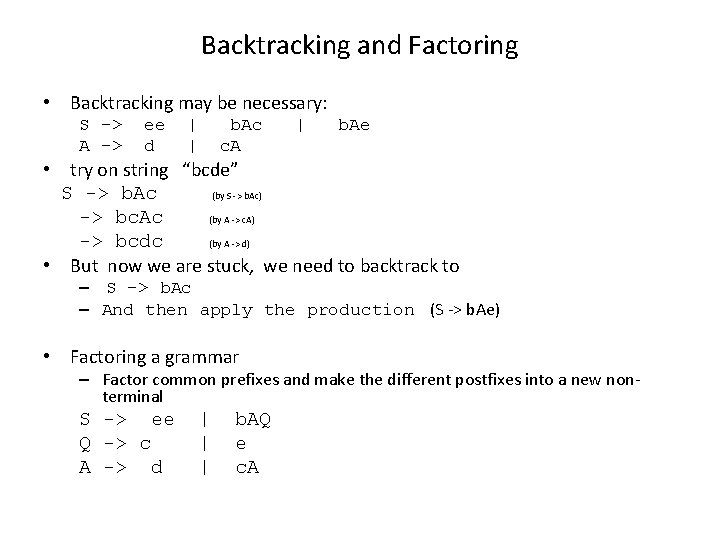
Backtracking and Factoring • Backtracking may be necessary: S -> A -> ee d | | b. Ac c. A | b. Ae • try on string “bcde” S -> b. Ac (by S -> b. Ac) -> bc. Ac (by A -> c. A) -> bcdc (by A -> d) • But now we are stuck, we need to backtrack to – S -> b. Ac – And then apply the production (S -> b. Ae) • Factoring a grammar – Factor common prefixes and make the different postfixes into a new nonterminal S -> ee Q -> c A -> d | | | b. AQ e c. A
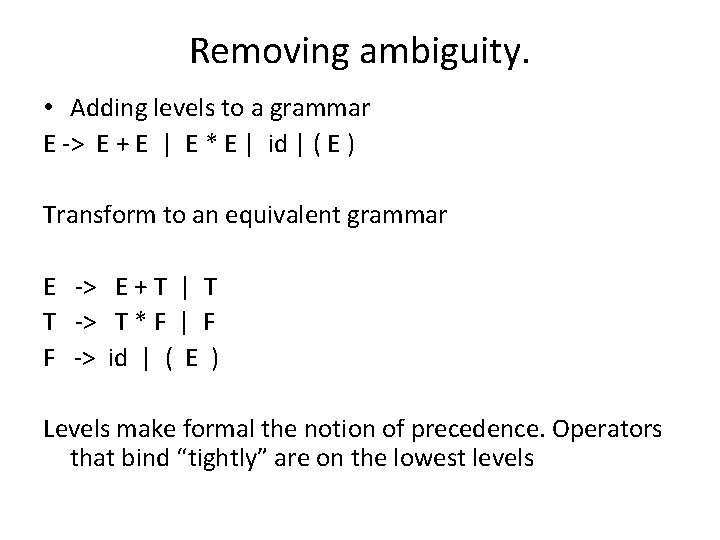
Removing ambiguity. • Adding levels to a grammar E -> E + E | E * E | id | ( E ) Transform to an equivalent grammar E -> E + T | T T -> T * F | F F -> id | ( E ) Levels make formal the notion of precedence. Operators that bind “tightly” are on the lowest levels
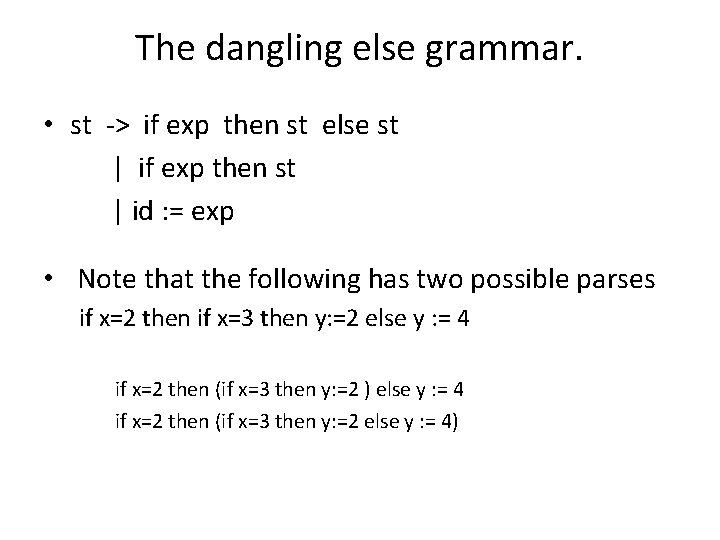
The dangling else grammar. • st -> if exp then st else st | if exp then st | id : = exp • Note that the following has two possible parses if x=2 then if x=3 then y: =2 else y : = 4 if x=2 then (if x=3 then y: =2 ) else y : = 4 if x=2 then (if x=3 then y: =2 else y : = 4)
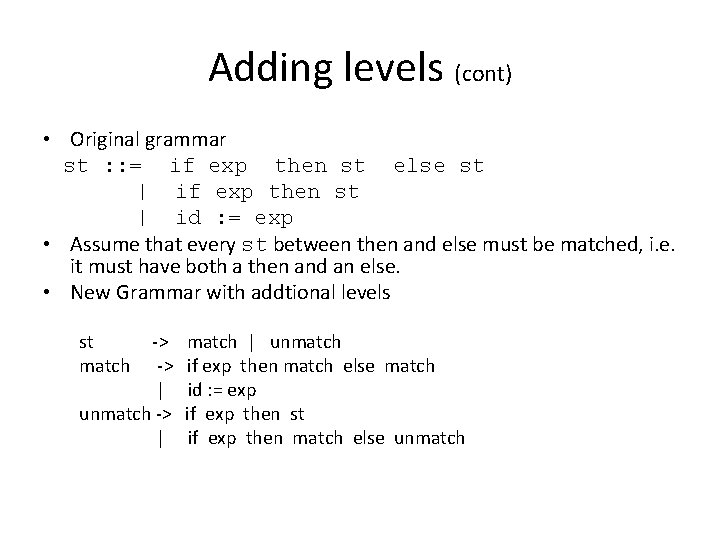
Adding levels (cont) • Original grammar st : : = if exp then st else st | if exp then st | id : = exp • Assume that every st between then and else must be matched, i. e. it must have both a then and an else. • New Grammar with addtional levels st match -> -> | unmatch -> | match | unmatch if exp then match else match id : = exp if exp then st if exp then match else unmatch
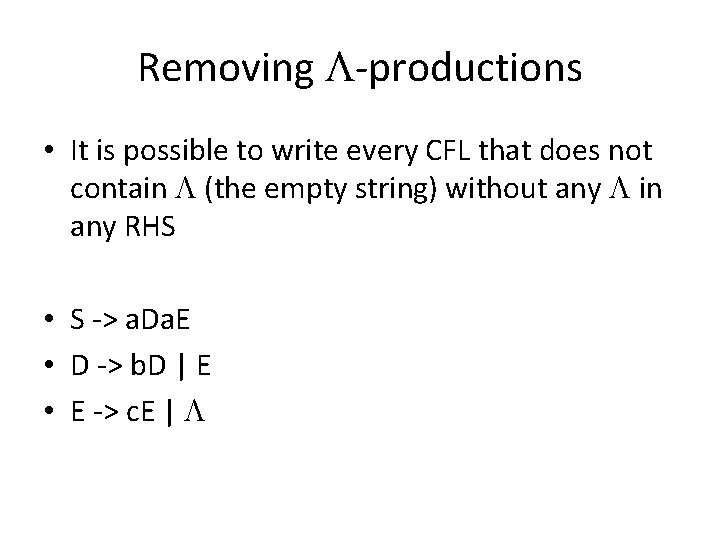
Removing L-productions • It is possible to write every CFL that does not contain L (the empty string) without any L in any RHS • S -> a. Da. E • D -> b. D | E • E -> c. E | L
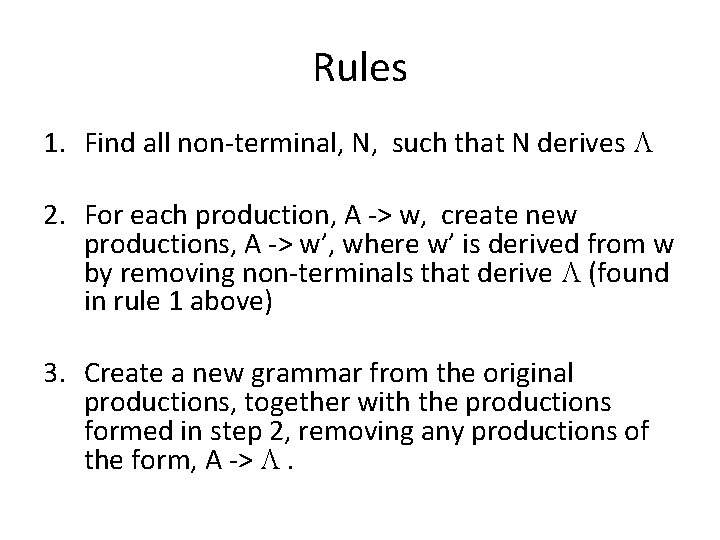
Rules 1. Find all non-terminal, N, such that N derives L 2. For each production, A -> w, create new productions, A -> w’, where w’ is derived from w by removing non-terminals that derive L (found in rule 1 above) 3. Create a new grammar from the original productions, together with the productions formed in step 2, removing any productions of the form, A -> L.
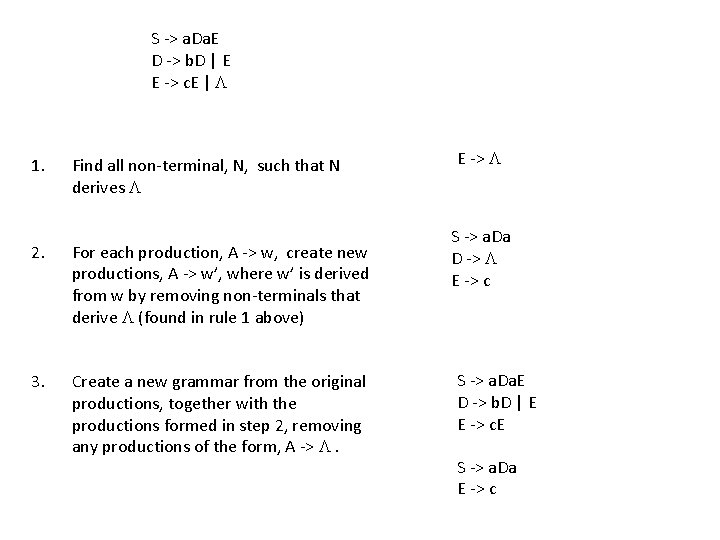
S -> a. Da. E D -> b. D | E E -> c. E | L 1. Find all non-terminal, N, such that N derives L 2. For each production, A -> w, create new productions, A -> w’, where w’ is derived from w by removing non-terminals that derive L (found in rule 1 above) 3. Create a new grammar from the original productions, together with the productions formed in step 2, removing any productions of the form, A -> L. E -> L S -> a. Da D -> L E -> c S -> a. Da. E D -> b. D | E E -> c. E S -> a. Da E -> c
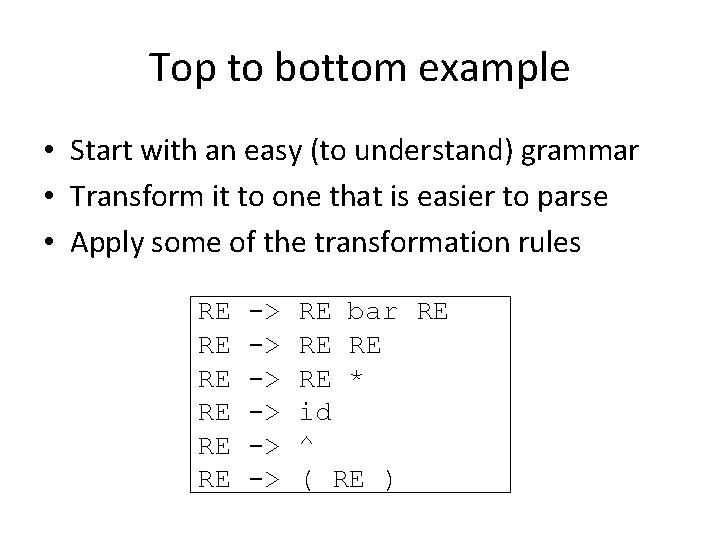
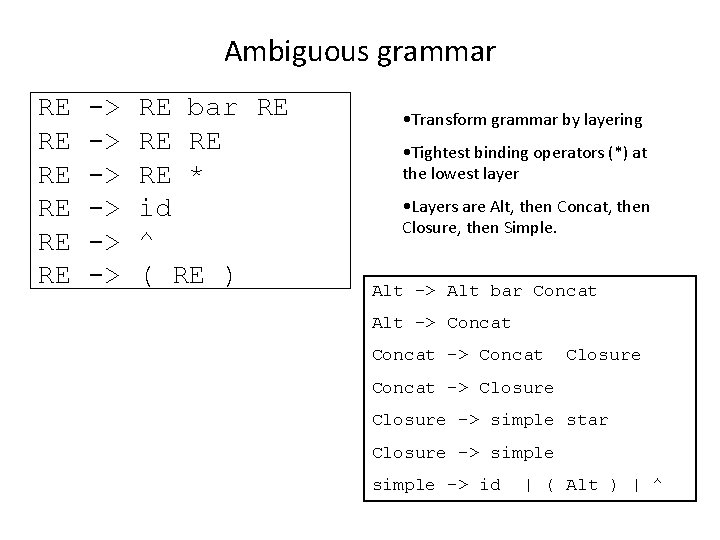
Top to bottom example • Start with an easy (to understand) grammar • Transform it to one that is easier to parse • Apply some of the transformation rules RE RE RE -> -> -> RE bar RE RE * id ^ ( RE )
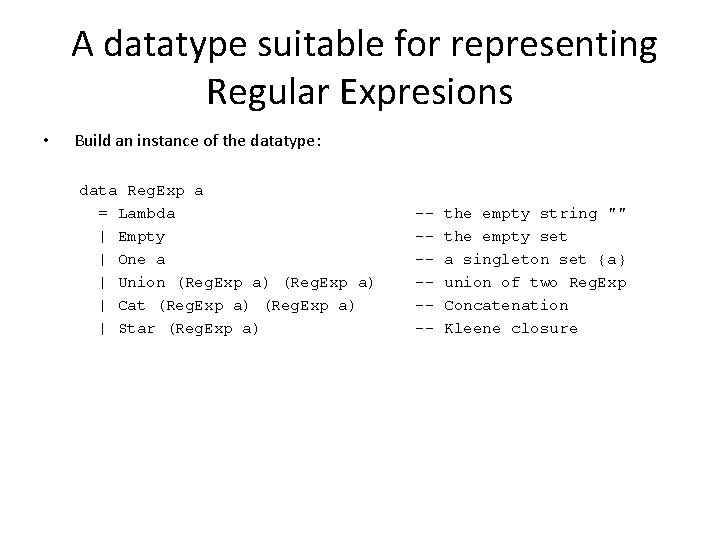
A datatype suitable for representing Regular Expresions • Build an instance of the datatype: data Reg. Exp a = Lambda | Empty | One a | Union (Reg. Exp a) | Cat (Reg. Exp a) | Star (Reg. Exp a) ------- the empty string "" the empty set a singleton set {a} union of two Reg. Exp Concatenation Kleene closure
Ambiguous grammar RE RE RE -> -> -> RE bar RE RE * id ^ ( RE ) • Transform grammar by layering • Tightest binding operators (*) at the lowest layer • Layers are Alt, then Concat, then Closure, then Simple. Alt -> Alt bar Concat Alt -> Concat Closure Concat -> Closure -> simple star Closure -> simple -> id | ( Alt ) | ^
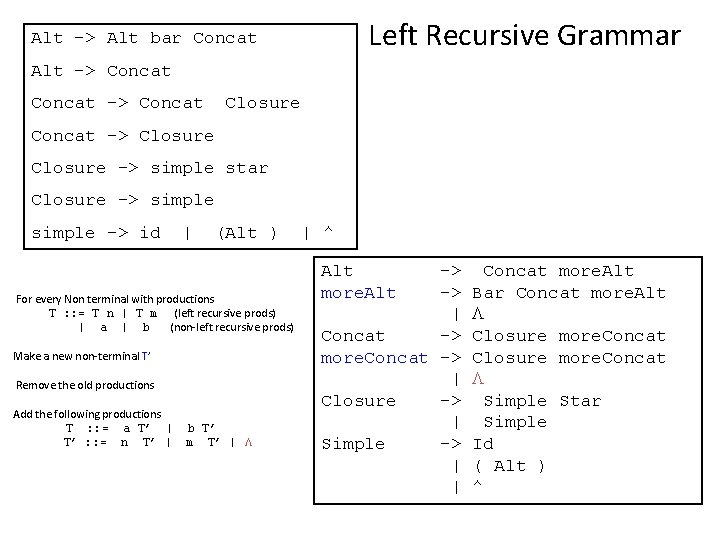
Left Recursive Grammar Alt -> Alt bar Concat Alt -> Concat Closure Concat -> Closure -> simple star Closure -> simple -> id | (Alt ) For every Non terminal with productions T : : = T n | T m (left recursive prods) | a | b (non-left recursive prods) Make a new non-terminal T’ Remove the old productions Add the following productions T : : = a T’ | T’ : : = n T’ | b T’ m T’ | L | ^ Alt more. Alt -> -> | Concat -> more. Concat -> | Closure -> | Simple -> | | Concat more. Alt Bar Concat more. Alt L Closure more. Concat L Simple Star Simple Id ( Alt ) ^