
Transformer BEE MODULE IV Iron Core Magnetic lines

Transformer BEE MODULE- IV
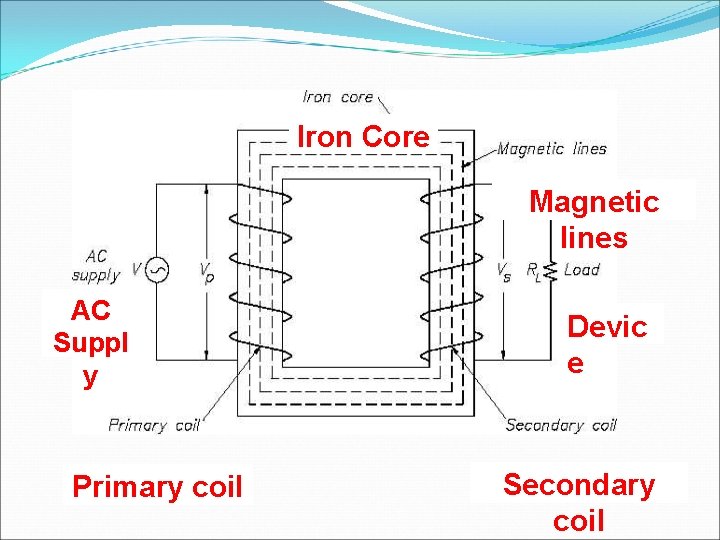
Iron Core Magnetic lines AC Suppl y Primary coil Devic e Secondary coil
Working principle Physical basis of a transformer is mutual induction between two circuits linked by a common magnetic flux. If one coil is connected to a source of alternating voltage, an alternating flux is set up in the laminated core, most of which is linked with the other coils in which it produces mutually induced emf
A transformer is a static device which is used to step up or step down voltages at constant frequency It consists of two coils, that are electrically isolated but magnetically linked The primary coil is connected to the power source and the secondary coil is connected to the load Voltage is stepped up or stepped down proportional to turns ratio The turn’s ratio is the ratio between the number of turns on the secondary (Ns)to the number of turns on the primary (Np).
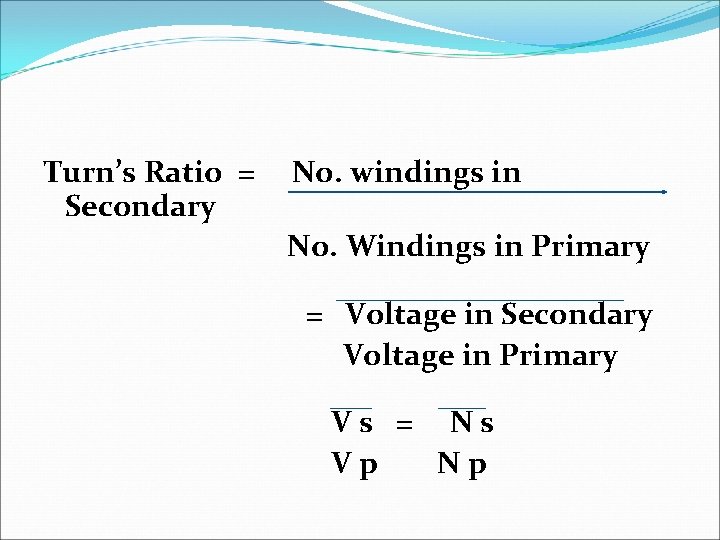
Turn’s Ratio = Secondary No. windings in No. Windings in Primary = Voltage in Secondary Voltage in Primary Vs = Ns Vp Np
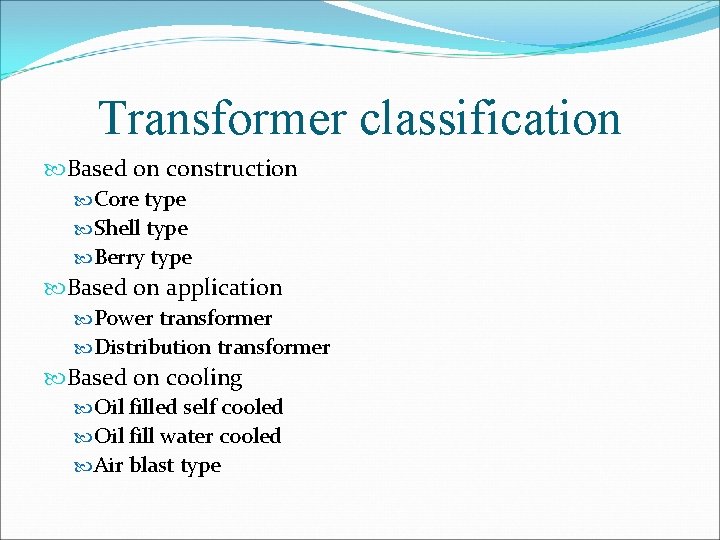
Transformer classification Based on construction Core type Shell type Berry type Based on application Power transformer Distribution transformer Based on cooling Oil filled self cooled Oil fill water cooled Air blast type
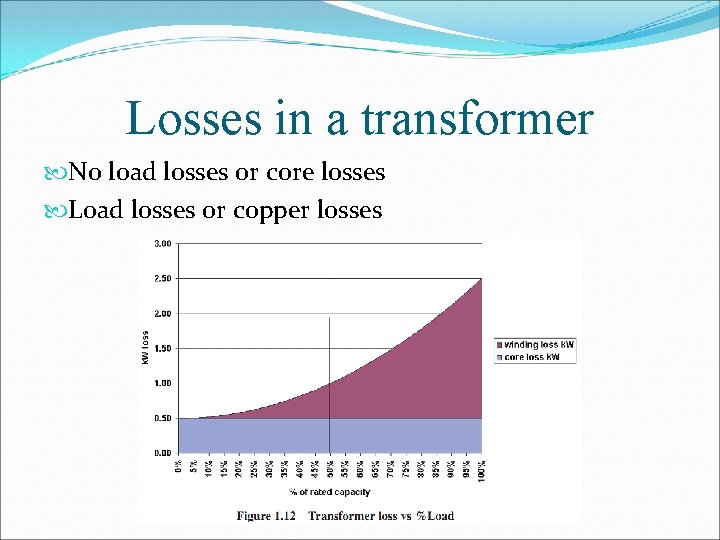
Losses in a transformer No load losses or core losses Load losses or copper losses
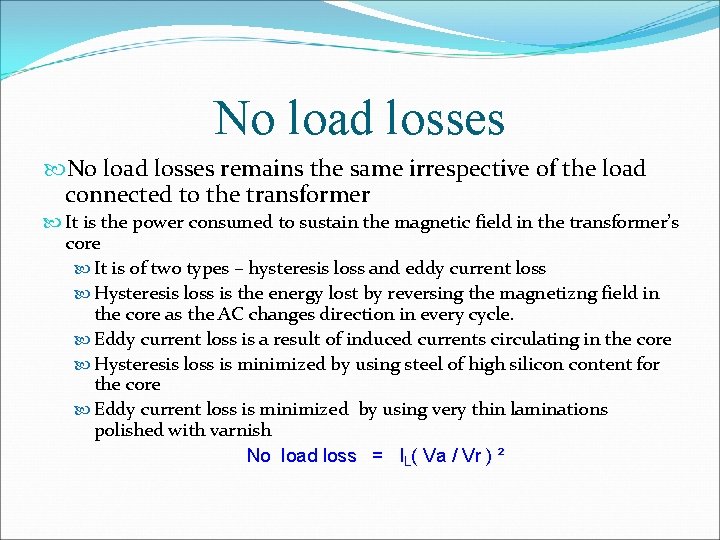
No load losses remains the same irrespective of the load connected to the transformer It is the power consumed to sustain the magnetic field in the transformer’s core It is of two types – hysteresis loss and eddy current loss Hysteresis loss is the energy lost by reversing the magnetizng field in the core as the AC changes direction in every cycle. Eddy current loss is a result of induced currents circulating in the core Hysteresis loss is minimized by using steel of high silicon content for the core Eddy current loss is minimized by using very thin laminations polished with varnish No load loss = IL( Va / Vr ) ²
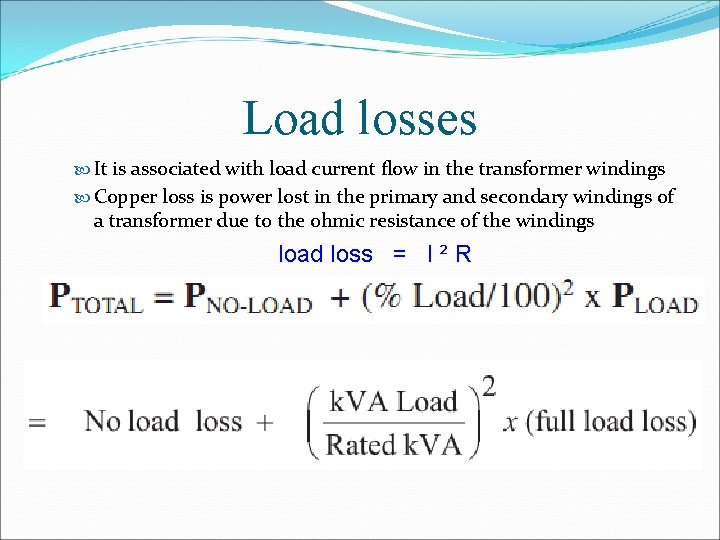
Load losses It is associated with load current flow in the transformer windings Copper loss is power lost in the primary and secondary windings of a transformer due to the ohmic resistance of the windings load loss = I ² R
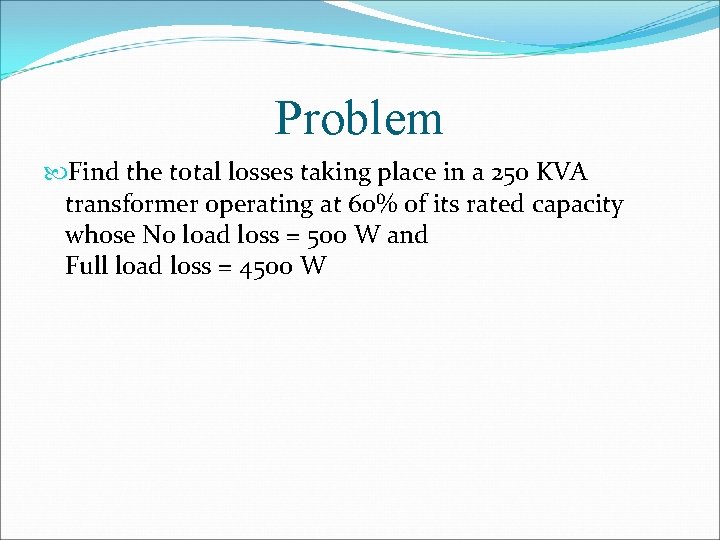
Problem Find the total losses taking place in a 250 KVA transformer operating at 60% of its rated capacity whose No load loss = 500 W and Full load loss = 4500 W
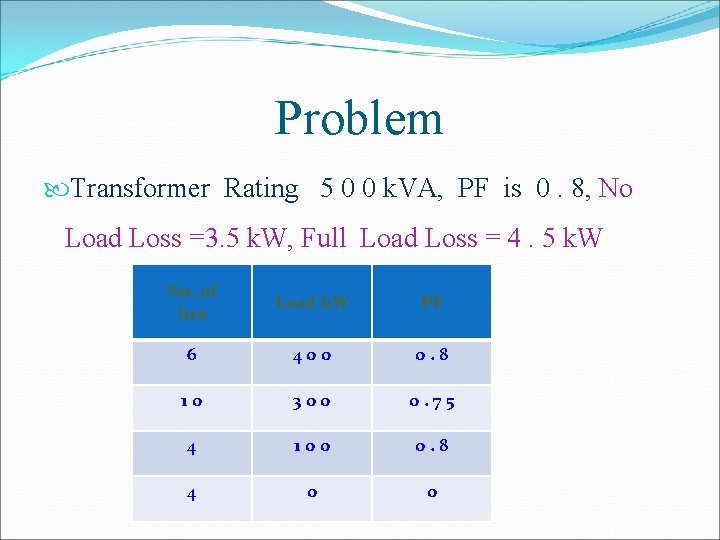
Problem Transformer Rating 5 0 0 k. VA, PF is 0. 8, No Load Loss =3. 5 k. W, Full Load Loss = 4. 5 k. W No. of hrs Load k. W PF 6 400 0. 8 10 300 0. 75 4 100 0. 8 4 0 0
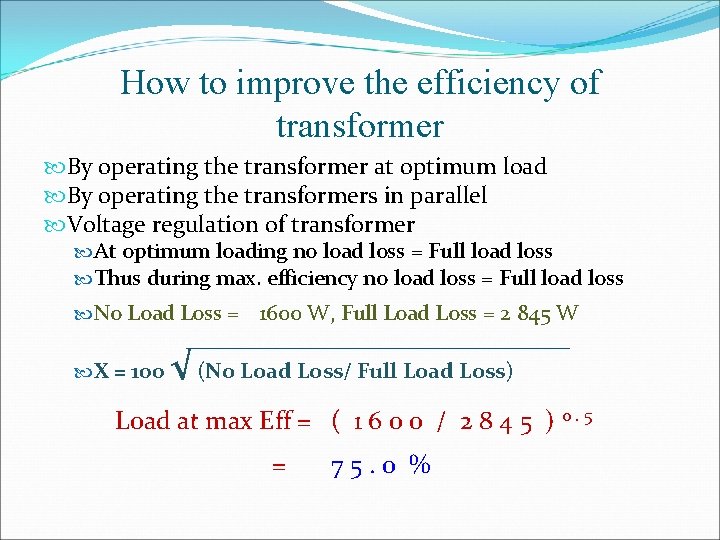
How to improve the efficiency of transformer By operating the transformer at optimum load By operating the transformers in parallel Voltage regulation of transformer At optimum loading no load loss = Full load loss Thus during max. efficiency no load loss = Full load loss No Load Loss = X = 100 1600 W, Full Load Loss = 2 845 W √ (No Load Loss/ Full Load Loss) Load at max Eff = ( 1 6 0 0 / 2 8 4 5 ) 0. 5 = 75. 0 %
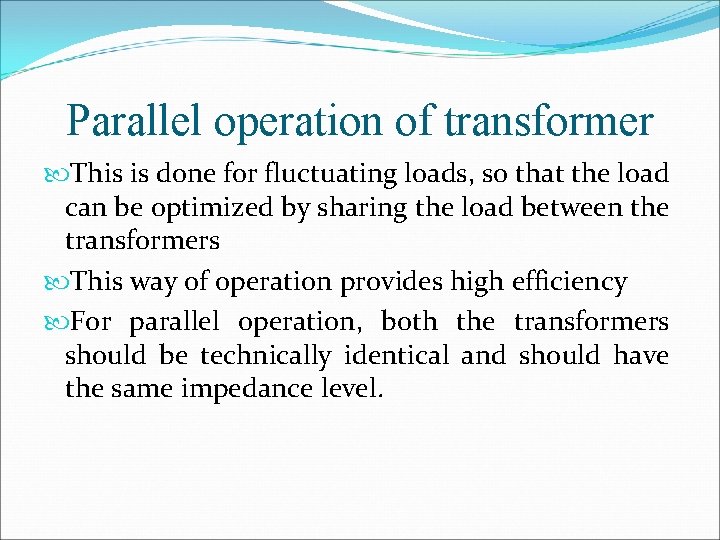
Parallel operation of transformer This is done for fluctuating loads, so that the load can be optimized by sharing the load between the transformers This way of operation provides high efficiency For parallel operation, both the transformers should be technically identical and should have the same impedance level.
Voltage regulation When the supply voltage changes, it causes tripping of voltage sensitive load devices The voltage regulation in transformers is done by altering the voltage transformation ratio with the help of tapping There are two methods of tap changing facility available Off-circuit tap changer On-load tap changer
Energy conservation in transformer % Loading of Transformer Efficiency No Load Losses Operating Power Factor improvement in capacitor installation On Load Tap Changer ( OLTC ) Parallel operation of Transformers Idle transformer Separate transformer for lighting
- Slides: 15