
Transformative social learning The importance of Systems thinking
- Slides: 11
Transformative social learning • The importance of Systems thinking • Social-ecological history and heritage counts * • An open framework for learning-tochange Rob O’Donoghue ELRC, Rhodes University environment * society * www. fundisaforchange. com science * sustainability
Systems thinking: A key for learning to change JUNE 2021 * page 2
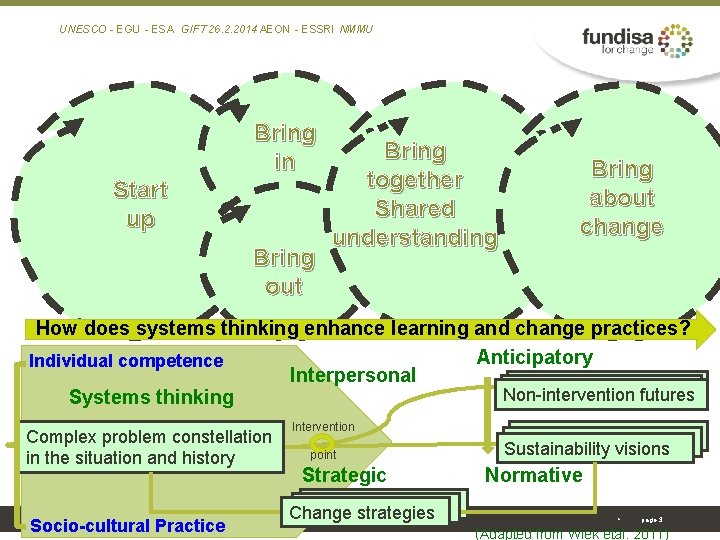
UNESCO‐EGU‐ESA GIFT 26. 2. 2014 AEON‐ESSRI NMMU Bring in Start up Bring out Bring together Shared understanding Bring about change How does systems thinking enhance learning and change practices? Anticipatory Individual competence Interpersonal unsustainabilityvisions unsustainability Non-intervention futures Systems thinking Complex problem constellation in the situation and history JUNE 2021 Socio-cultural Practice Intervention point Strategic Transition strateg Change strategies Sustainabilityvisions Sustainability visions Normative * page 3 (Adapted from Wiek etal. 2011)
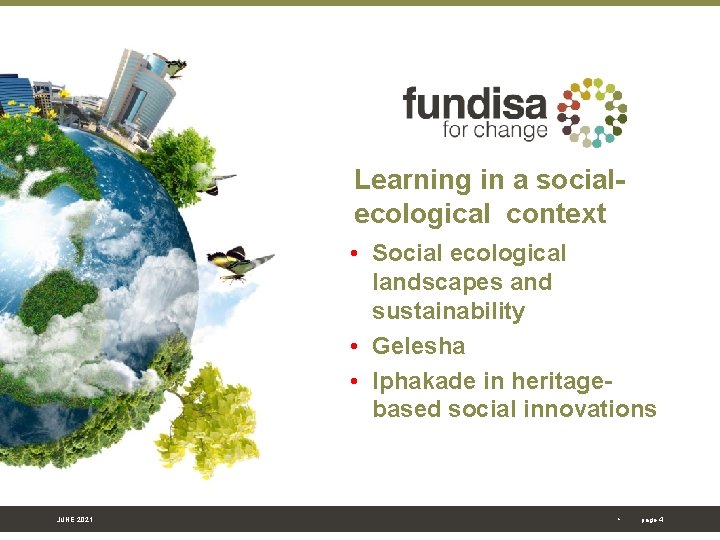
Learning in a socialecological context • Social ecological landscapes and sustainability • Gelesha • Iphakade in heritagebased social innovations JUNE 2021 * page 4
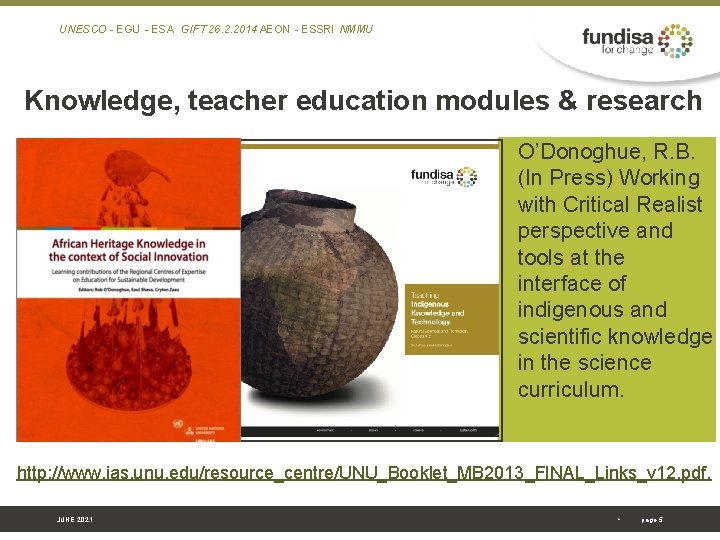
UNESCO‐EGU‐ESA GIFT 26. 2. 2014 AEON‐ESSRI NMMU Knowledge, teacher education modules & research O’Donoghue, R. B. (In Press) Working with Critical Realist perspective and tools at the interface of indigenous and scientific knowledge in the science curriculum. http: //www. ias. unu. edu/resource_centre/UNU_Booklet_MB 2013_FINAL_Links_v 12. pdf. JUNE 2021 * page 5
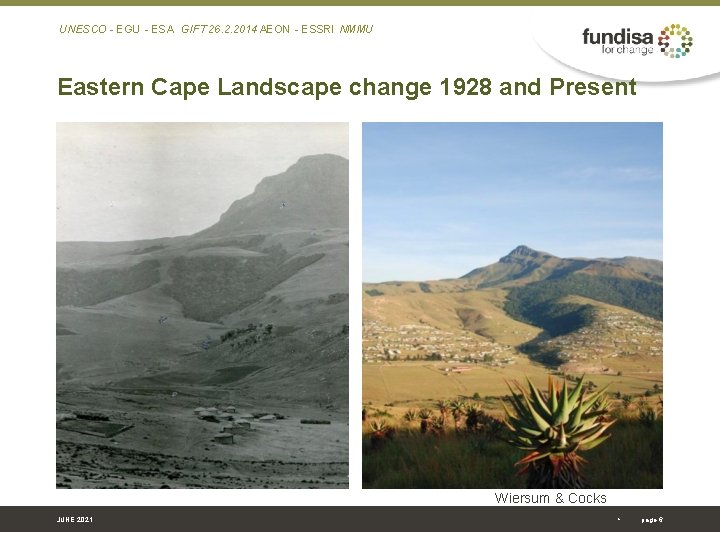
UNESCO‐EGU‐ESA GIFT 26. 2. 2014 AEON‐ESSRI NMMU Eastern Cape Landscape change 1928 and Present Wiersum & Cocks JUNE 2021 * page 6
UNESCO‐EGU‐ESA GIFT 26. 2. 2014 AEON‐ESSRI NMMU Zuurveld Climate Migration • The Xhosa would move their herds to the sweet veld of the Amathole Mountains. • Sweet veld pasture could not support heavy grazing in dry years so cattle were moved to the Zuurveld in dry summers. • Transhumance patterns were cut when colonial boundaries included the Zuurveld and excluded its Xhosa occupants. • Today stock is still migrated by truck but now much of the land is under conservation management as game parks. (Mostert, 1993: 236) JUNE 2021 * page 7
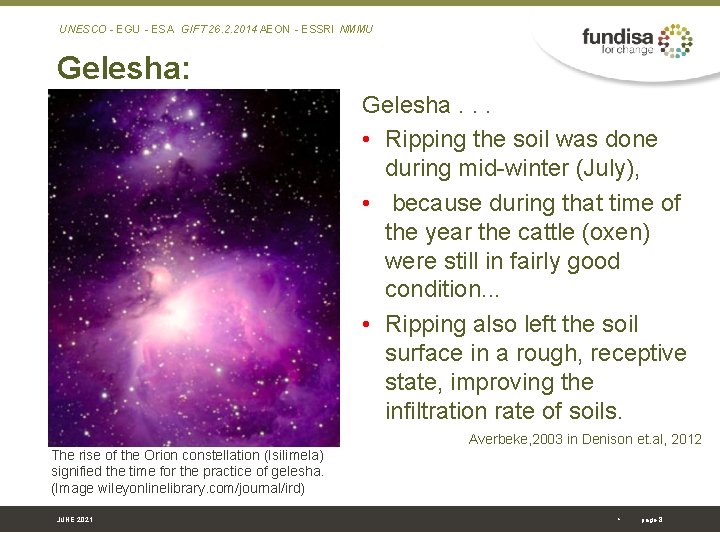
UNESCO‐EGU‐ESA GIFT 26. 2. 2014 AEON‐ESSRI NMMU Gelesha: Gelesha. . . • Ripping the soil was done during mid-winter (July), • because during that time of the year the cattle (oxen) were still in fairly good condition. . . • Ripping also left the soil surface in a rough, receptive state, improving the infiltration rate of soils. Averbeke, 2003 in Denison et. al, 2012 The rise of the Orion constellation (Isilimela) signified the time for the practice of gelesha. (Image wileyonlinelibrary. com/journal/ird) JUNE 2021 * page 8
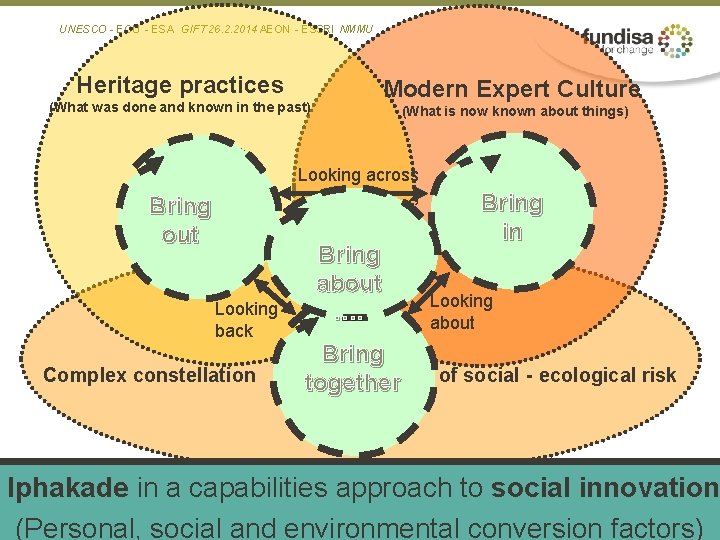
UNESCO‐EGU‐ESA GIFT 26. 2. 2014 AEON‐ESSRI NMMU Heritage practices Modern Expert Culture (What was done and known in the past) B ‘Bring out’ Bring Heritage practices and out knowledge Looking back Complex constellation (What is now known about things) C Looking across ‘Bring about’ ‘Bring in’ Bring Societal explanatory in knowledge LEARNING & SOCIAL Bring INNOVATION about Looking forward Looking (Iphakade) …. A Bring Livelihood Contexts of together about of social - ecological risk doing, knowing and being Iphakade in a capabilities approach to social innovation (Personal, social and environmental conversion factors) JUNE 2021 * page 9
UNESCO‐EGU‐ESA GIFT 26. 2. 2014 AEON‐ESSRI NMMU JUNE 2021 10 * page 10
UNESCO‐EGU‐ESA GIFT 26. 2. 2014 AEON‐ESSRI NMMU References: Denison, J. and Wotshela (2012) An overview of indigenous, indiginised and contemporary water harvesting and conservation practices in South Africa. In Irrigation and drainage 61 pp. 7 -23. Wileyonline. com. DOI: 10. 1002/ird. 1689. Kotze, E. Wakkerstroom: Grasslands, fire and war – past perspectives and present issues. In Edgecombe, R. and Guest, B. South Africa’s Environmental History: Cases and Comparisons. Cape Town, Davis Philip Publishers. Mc. Allister, J. (2002) Fire and the South African Grassland Biome. In Edgecombe, R. and Guest, B. South Africa’s Environmental History: Cases and Comparisons. Cape Town, Davis Philip Publishers. Mostert, N. (1993) Frontiers: The epic of South Afri- ca’s creation and the tragedy of the Xhosa People. London, Pimlico. O’Donoghue, R. B. (In Press) Working with Critical Realist perspective and tools at the interface of indigenous and scientific knowledge in the science curriculum. Forthcomong book on Critical Realism and Education edited by Leigh Price and Heila Lotz-Sisitka, Grahamstown, Rhodes University Wiek, A. Withycombe, L. and Redman, C. L. (2011) Key competencies in sustainability: a reference framework for academic program development. Integrated Research System for Sustainability Science, United Nations University, and Springer. Wiersum, K. F. and Cocks, M. (In Press) Enduring cultural landscapes of ama. Xhosa in former Ciskei. Forest and Nature Conservation Policy group, Wageningen University, the Netherlands and Institute of Social and Economic Research, Rhodes University, South Africa JUNE 2021 11 * page 11