
Transformations with Matrices Chapter 4 Section 4 Writing
- Slides: 16
Transformations with Matrices Chapter 4, Section 4
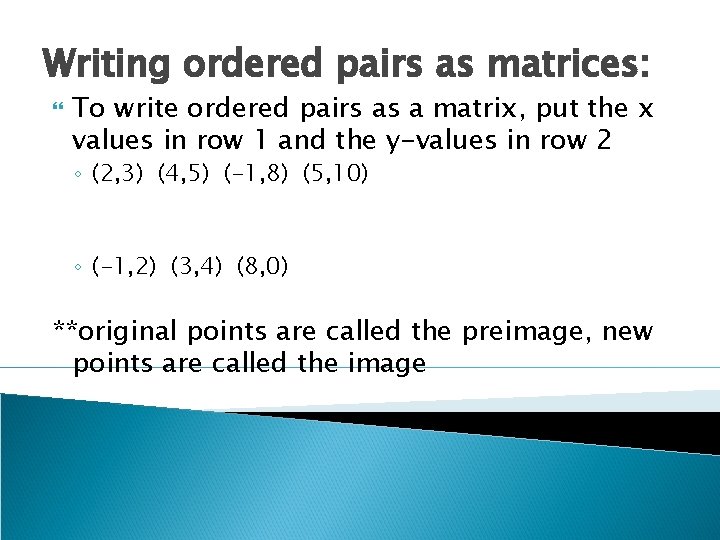
Writing ordered pairs as matrices: To write ordered pairs as a matrix, put the x values in row 1 and the y-values in row 2 ◦ (2, 3) (4, 5) (-1, 8) (5, 10) ◦ (-1, 2) (3, 4) (8, 0) **original points are called the preimage, new points are called the image
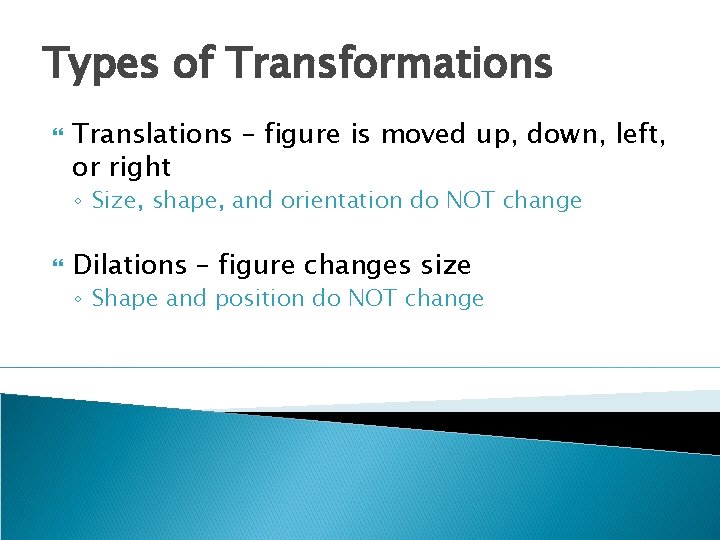
Types of Transformations Translations – figure is moved up, down, left, or right ◦ Size, shape, and orientation do NOT change Dilations – figure changes size ◦ Shape and position do NOT change
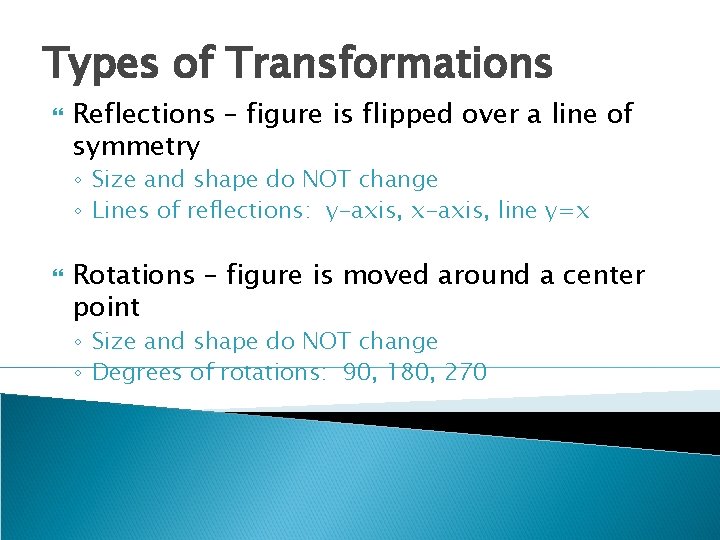
Types of Transformations Reflections – figure is flipped over a line of symmetry ◦ Size and shape do NOT change ◦ Lines of reflections: y-axis, x-axis, line y=x Rotations – figure is moved around a center point ◦ Size and shape do NOT change ◦ Degrees of rotations: 90, 180, 270
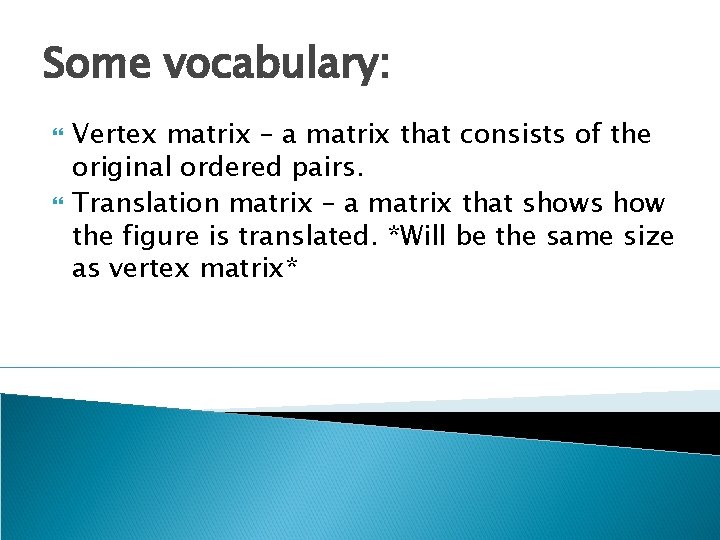
Some vocabulary: Vertex matrix – a matrix that consists of the original ordered pairs. Translation matrix – a matrix that shows how the figure is translated. *Will be the same size as vertex matrix*
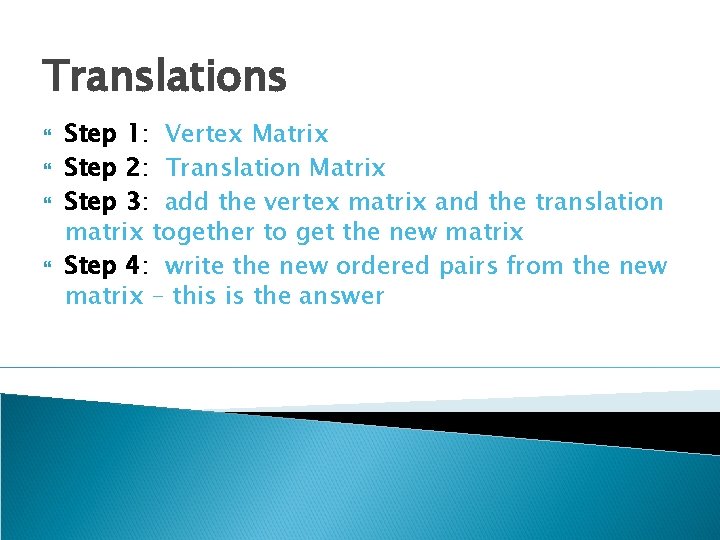
Translations Step 1: Vertex Matrix Step 2: Translation Matrix Step 3: add the vertex matrix and the translation matrix together to get the new matrix Step 4: write the new ordered pairs from the new matrix – this is the answer
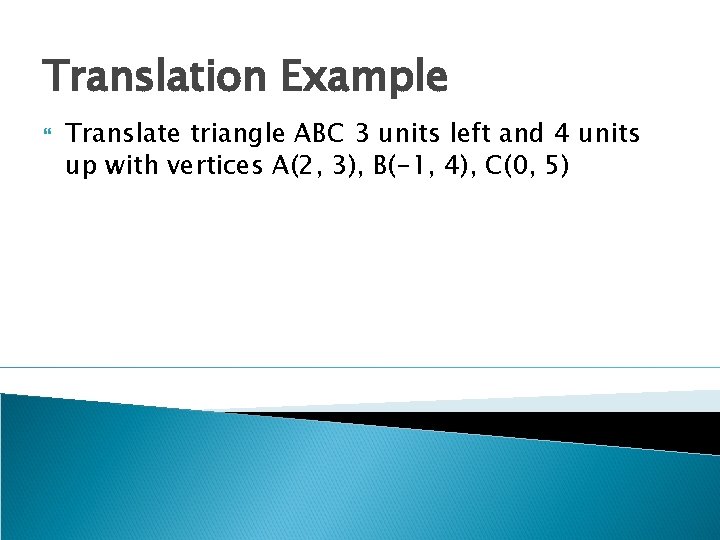
Translation Example Translate triangle ABC 3 units left and 4 units up with vertices A(2, 3), B(-1, 4), C(0, 5)
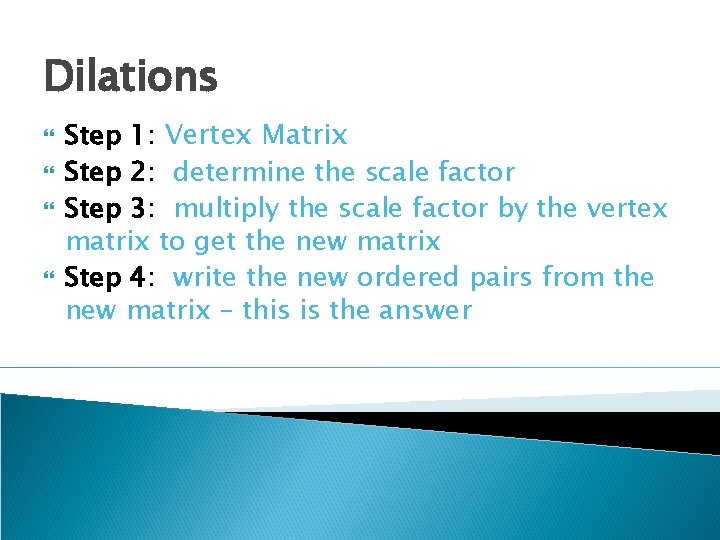
Dilations Step 1: Vertex Matrix Step 2: determine the scale factor Step 3: multiply the scale factor by the vertex matrix to get the new matrix Step 4: write the new ordered pairs from the new matrix – this is the answer
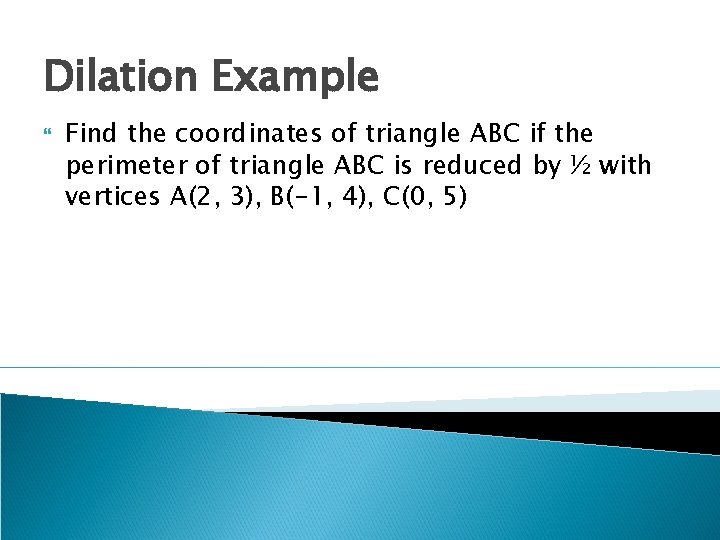
Dilation Example Find the coordinates of triangle ABC if the perimeter of triangle ABC is reduced by ½ with vertices A(2, 3), B(-1, 4), C(0, 5)
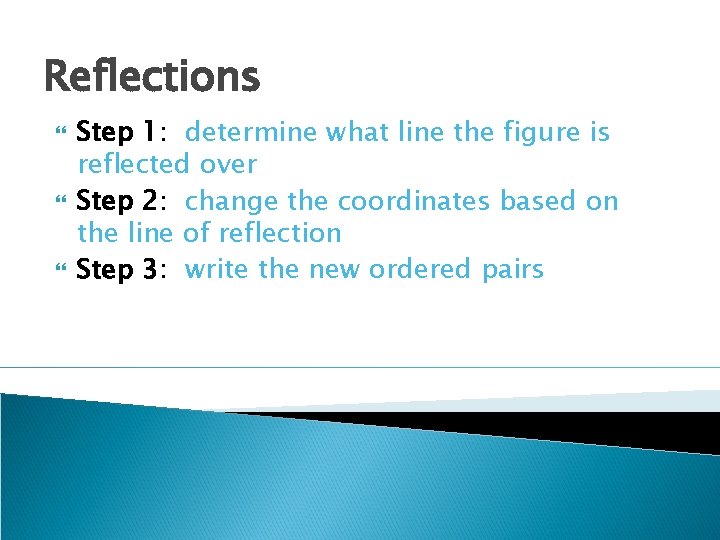
Reflections Step 1: determine what line the figure is reflected over Step 2: change the coordinates based on the line of reflection Step 3: write the new ordered pairs
Demonstrating a Reflection
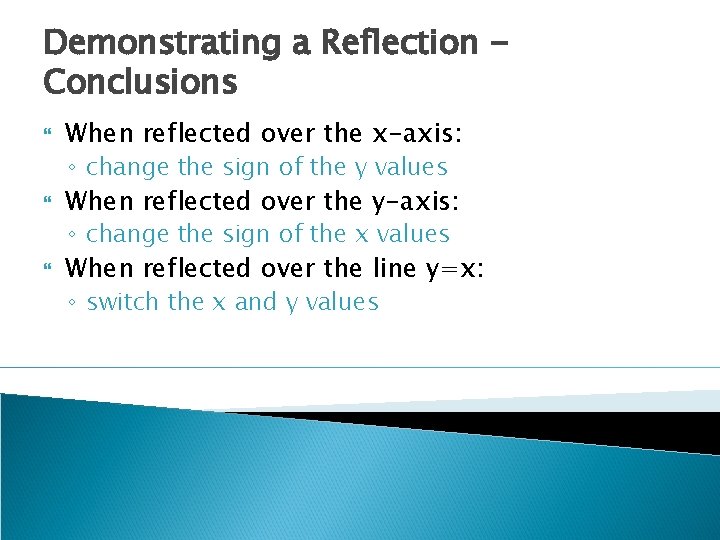
Demonstrating a Reflection Conclusions When reflected over the x-axis: ◦ change the sign of the y values When reflected over the y-axis: ◦ change the sign of the x values When reflected over the line y=x: ◦ switch the x and y values
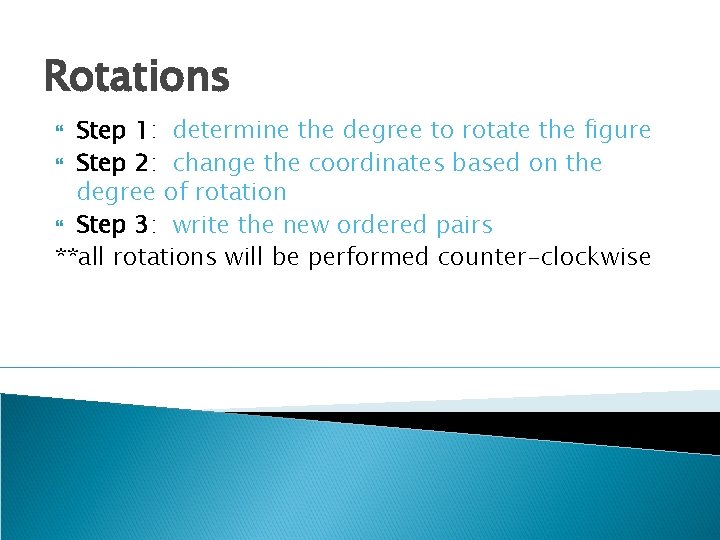
Rotations Step 1: determine the degree to rotate the figure Step 2: change the coordinates based on the degree of rotation Step 3: write the new ordered pairs **all rotations will be performed counter-clockwise
Demonstrating a Rotation
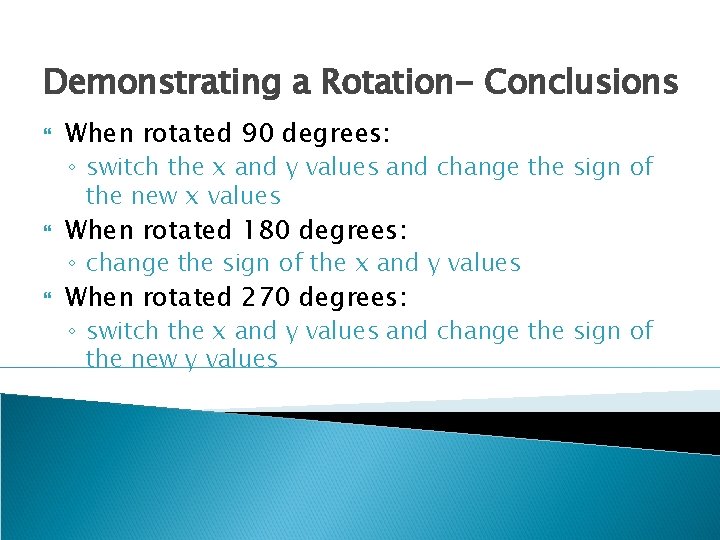
Demonstrating a Rotation- Conclusions When rotated 90 degrees: ◦ switch the x and y values and change the sign of the new x values When rotated 180 degrees: ◦ change the sign of the x and y values When rotated 270 degrees: ◦ switch the x and y values and change the sign of the new y values
Your turn: Classwork: ◦ 4 -4 in practice workbooks. Homework: ◦ Transformations handout Exit Slip: Describe each of the transformations using only 1 word for each one.