
Transformations Lesson 4 SCALING Intro Remember when you
Transformations: Lesson 4 SCALING
Intro Remember when you were little and you played with Play. Doh. . . You made a figure by either moulding it to what you wanted or used a cookie cutter to make a shape. . . let’s say a star shape. . . and because we were kids, we would play around with that shape, either squishing it or pulling it because we thought it was funny to see the end result: A messed up looking star!!!
Intro The messed up looking star looked weird because you were pulling it in either the xdirection only or the y-direction only. Pulling or squishing it distorts the picture and makes it look funny. Let’s see an example.
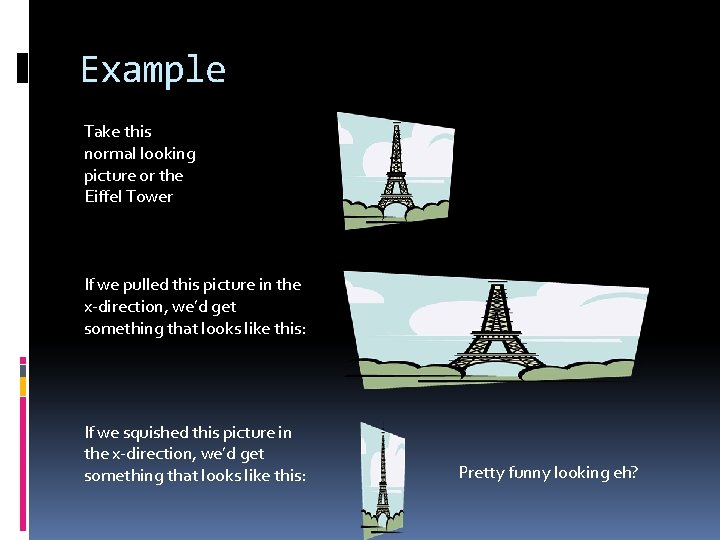
Example Take this normal looking picture or the Eiffel Tower If we pulled this picture in the x-direction, we’d get something that looks like this: If we squished this picture in the x-direction, we’d get something that looks like this: Pretty funny looking eh?
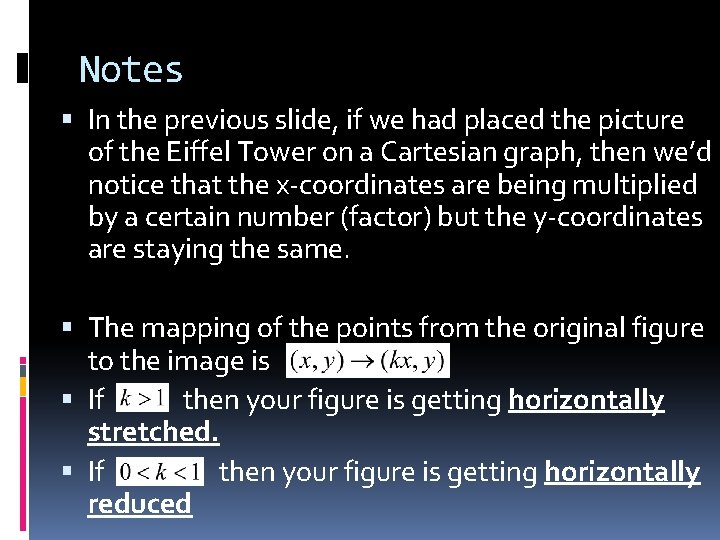
Notes In the previous slide, if we had placed the picture of the Eiffel Tower on a Cartesian graph, then we’d notice that the x-coordinates are being multiplied by a certain number (factor) but the y-coordinates are staying the same. The mapping of the points from the original figure to the image is If then your figure is getting horizontally stretched. If then your figure is getting horizontally reduced
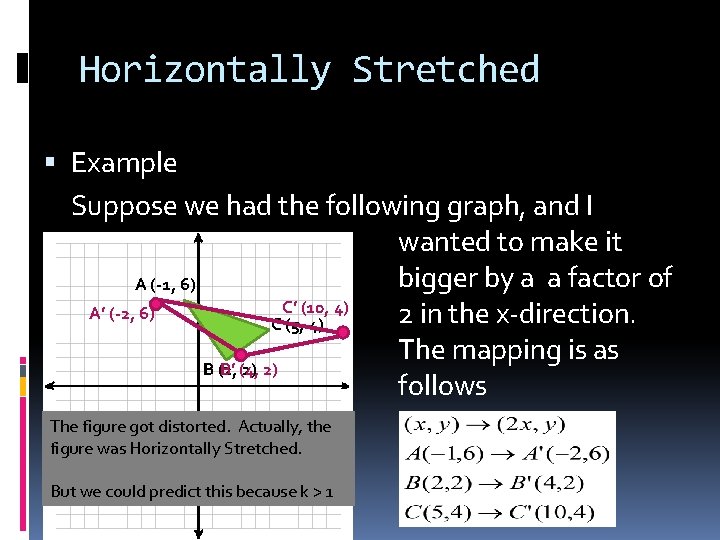
Horizontally Stretched Example Suppose we had the following graph, and I wanted to make it bigger by a a factor of A (-1, 6) C’ (10, 4) A’ (-2, 6) 2 in the x-direction. C (5, 4) The mapping is as B (2, B’ (4, 2) 2) follows The figure got distorted. Actually, the figure was Horizontally Stretched. But we could predict this because k > 1
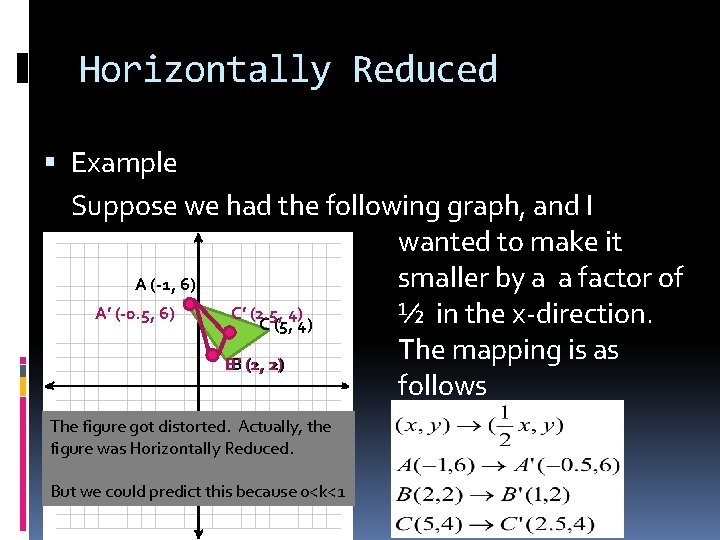
Horizontally Reduced Example Suppose we had the following graph, and I wanted to make it smaller by a a factor of A (-1, 6) A’ (-0. 5, 6) C’ (2. 5, 4) ½ in the x-direction. C (5, 4) The mapping is as B (1, (2, 2) B’ follows The figure got distorted. Actually, the figure was Horizontally Reduced. But we could predict this because 0<k<1
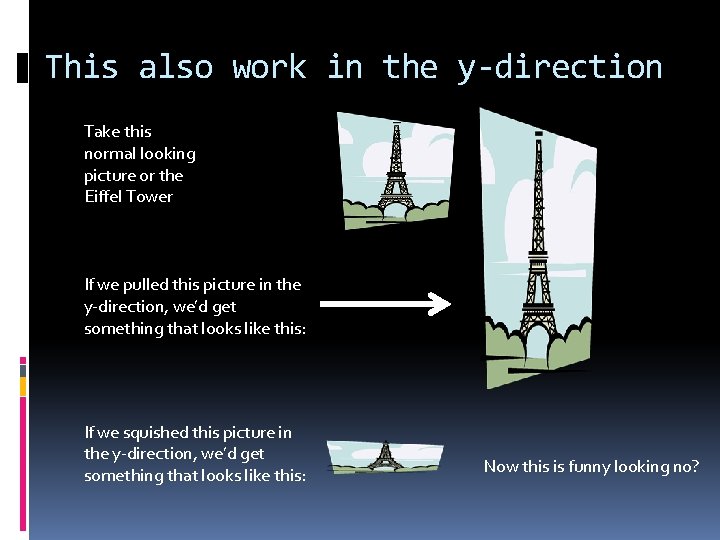
This also work in the y-direction Take this normal looking picture or the Eiffel Tower If we pulled this picture in the y-direction, we’d get something that looks like this: If we squished this picture in the y-direction, we’d get something that looks like this: Now this is funny looking no?
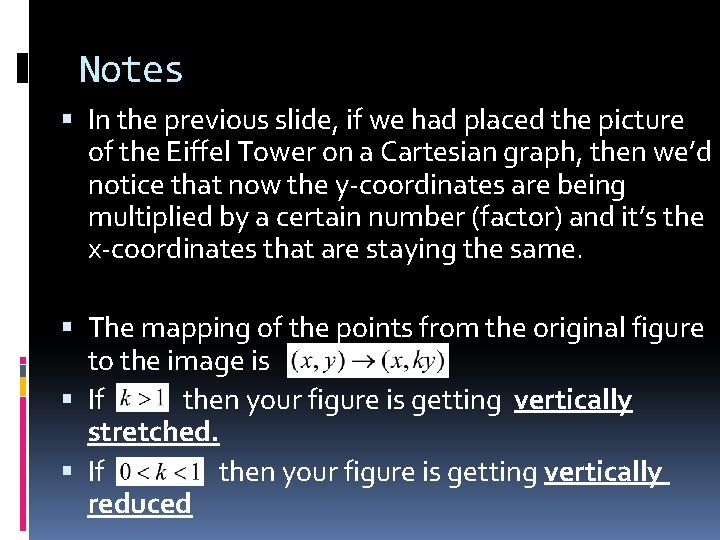
Notes In the previous slide, if we had placed the picture of the Eiffel Tower on a Cartesian graph, then we’d notice that now the y-coordinates are being multiplied by a certain number (factor) and it’s the x-coordinates that are staying the same. The mapping of the points from the original figure to the image is If then your figure is getting vertically stretched. If then your figure is getting vertically reduced
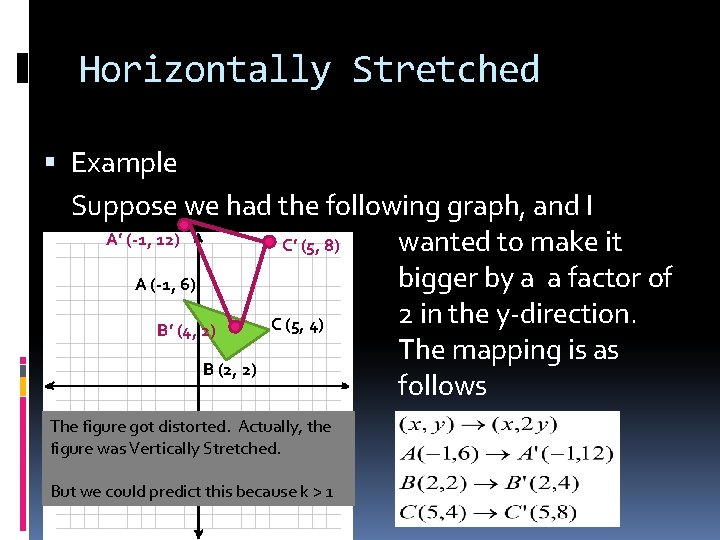
Horizontally Stretched Example Suppose we had the following graph, and I A’ (-1, 12) C’ (5, 8) wanted to make it bigger by a a factor of A (-1, 6) 2 in the y-direction. C (5, 4) B’ (4, 2) The mapping is as B (2, 2) follows The figure got distorted. Actually, the figure was Vertically Stretched. But we could predict this because k > 1
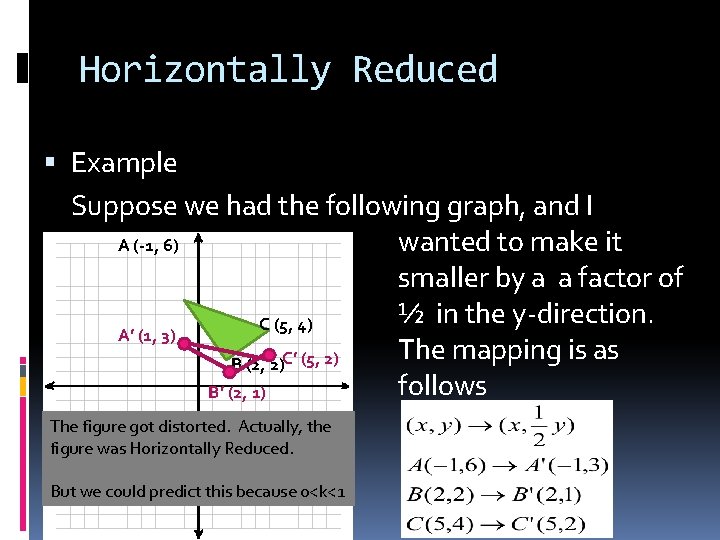
Horizontally Reduced Example Suppose we had the following graph, and I A (-1, 6) wanted to make it smaller by a a factor of ½ in the y-direction. C (5, 4) A’ (1, 3) The mapping is as B (2, 2)C’ (5, 2) follows B’ (2, 1) The figure got distorted. Actually, the figure was Horizontally Reduced. But we could predict this because 0<k<1
What if k is negative? ? The scale factor “k” is allowed to be negative. If your “k” value is negative, it doesn’t imply that your figure will automatically get smaller. The negative sign (-) means that it will be on the opposite side of the axis you are moving away from. Let me explain. .
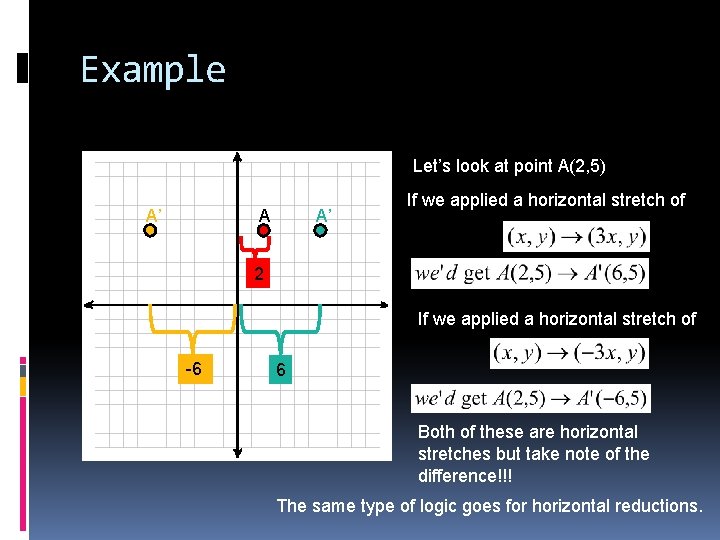
Example Let’s look at point A(2, 5) A’ A’ A If we applied a horizontal stretch of 2 If we applied a horizontal stretch of -6 6 Both of these are horizontal stretches but take note of the difference!!! The same type of logic goes for horizontal reductions.
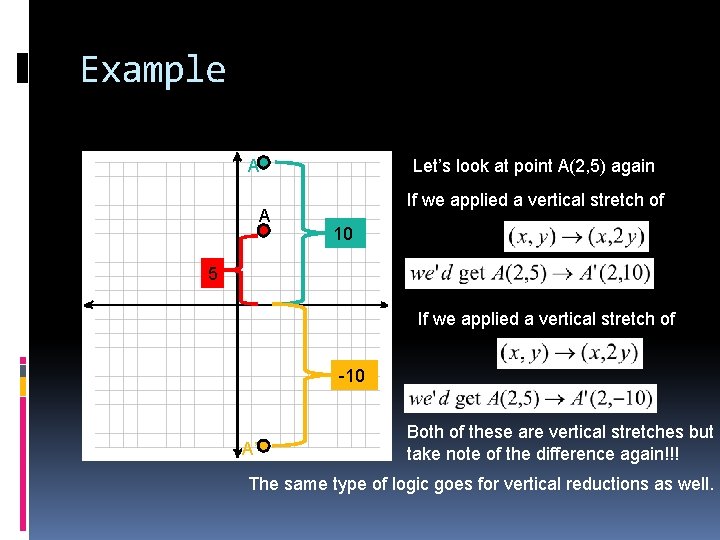
Example Let’s look at point A(2, 5) again A’ A If we applied a vertical stretch of 10 5 If we applied a vertical stretch of -10 A’ Both of these are vertical stretches but take note of the difference again!!! The same type of logic goes for vertical reductions as well.
That concludes this wonderful Power. Point. Hope you enjoyed the show!
- Slides: 15