
TRANSFORMATIONS Gursharan Singh Tatla professorgstatlagmail com www eazynotes
- Slides: 31
TRANSFORMATIONS Gursharan Singh Tatla professorgstatla@gmail. com www. eazynotes. com Gursharan Singh Tatla 1
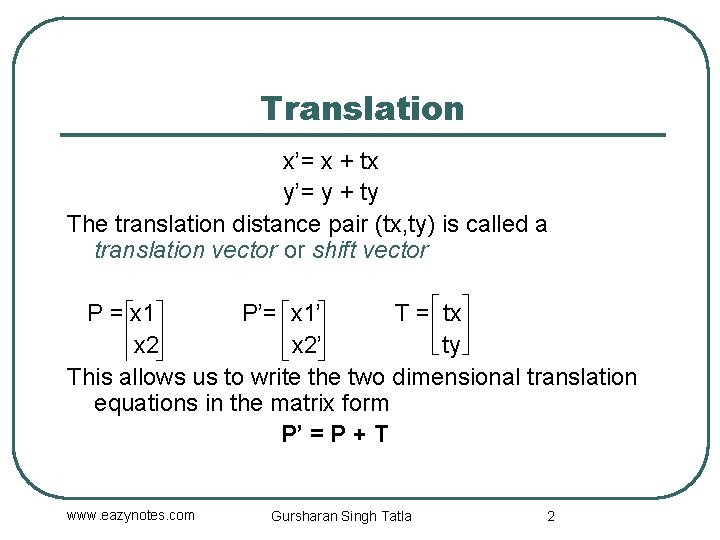
Translation x’= x + tx y’= y + ty The translation distance pair (tx, ty) is called a translation vector or shift vector P = x 1 P’= x 1’ T = tx x 2’ ty This allows us to write the two dimensional translation equations in the matrix form P’ = P + T www. eazynotes. com Gursharan Singh Tatla 2
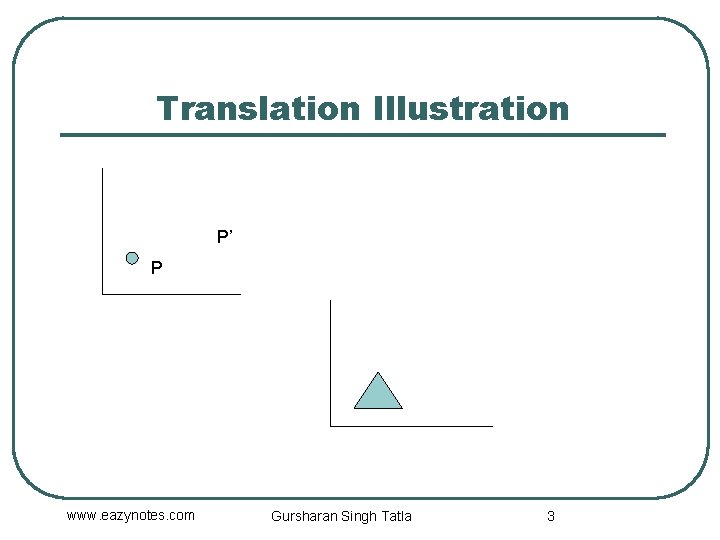
Translation Illustration P’ P www. eazynotes. com Gursharan Singh Tatla 3
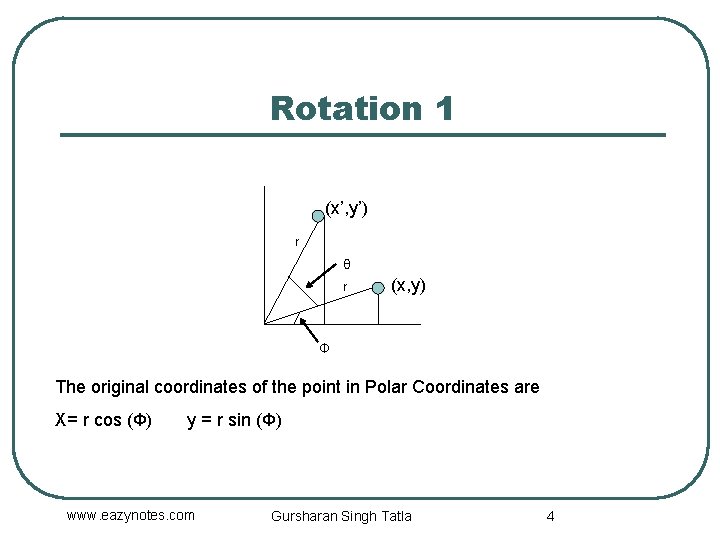
Rotation 1 (x’, y’) r θ r (x, y) Ф The original coordinates of the point in Polar Coordinates are X= r cos (Ф) y = r sin (Ф) www. eazynotes. com Gursharan Singh Tatla 4
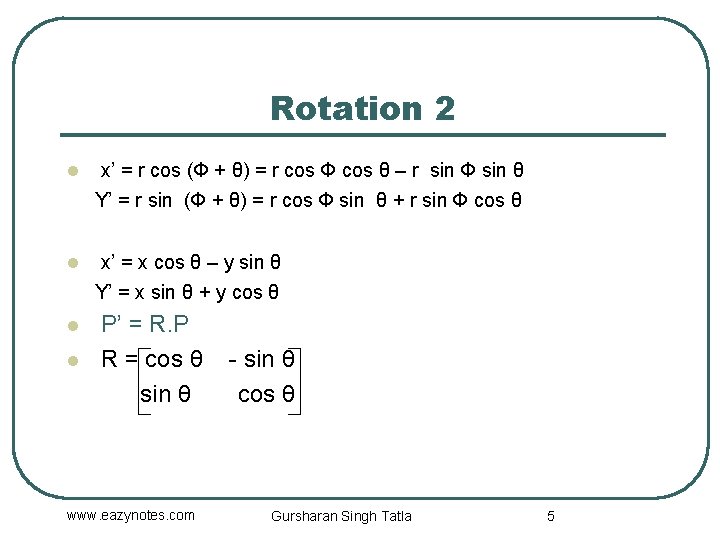
Rotation 2 l x’ = r cos (Ф + θ) = r cos Ф cos θ – r sin Ф sin θ Y’ = r sin (Ф + θ) = r cos Ф sin θ + r sin Ф cos θ l x’ = x cos θ – y sin θ Y’ = x sin θ + y cos θ l l P’ = R. P R = cos θ sin θ www. eazynotes. com - sin θ cos θ Gursharan Singh Tatla 5
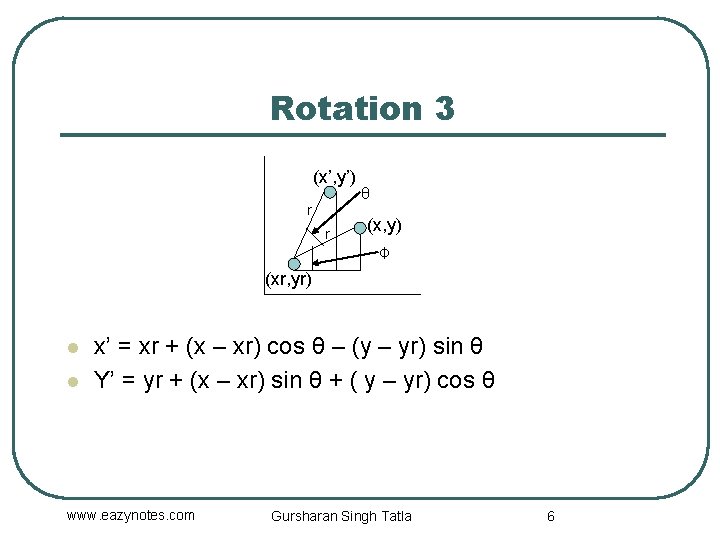
Rotation 3 (x’, y’) r r θ (x, y) Ф (xr, yr) l l x’ = xr + (x – xr) cos θ – (y – yr) sin θ Y’ = yr + (x – xr) sin θ + ( y – yr) cos θ www. eazynotes. com Gursharan Singh Tatla 6
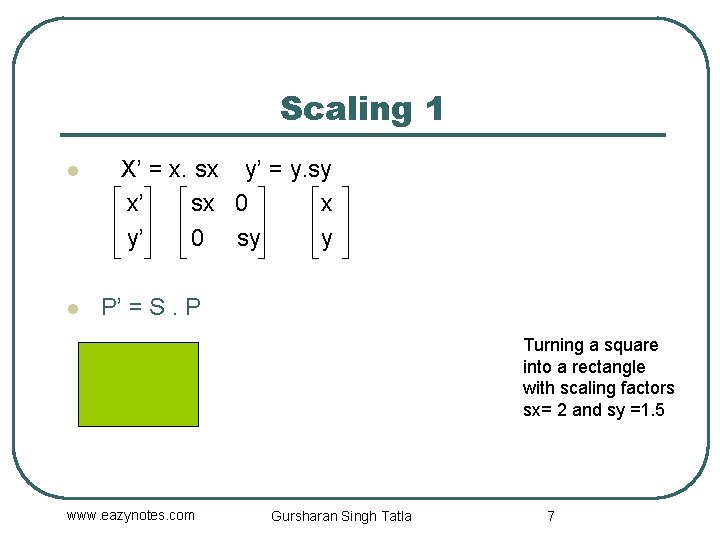
Scaling 1 l l X’ = x. sx y’ = y. sy x’ sx 0 x y’ 0 sy y P’ = S. P Turning a square into a rectangle with scaling factors sx= 2 and sy =1. 5 www. eazynotes. com Gursharan Singh Tatla 7
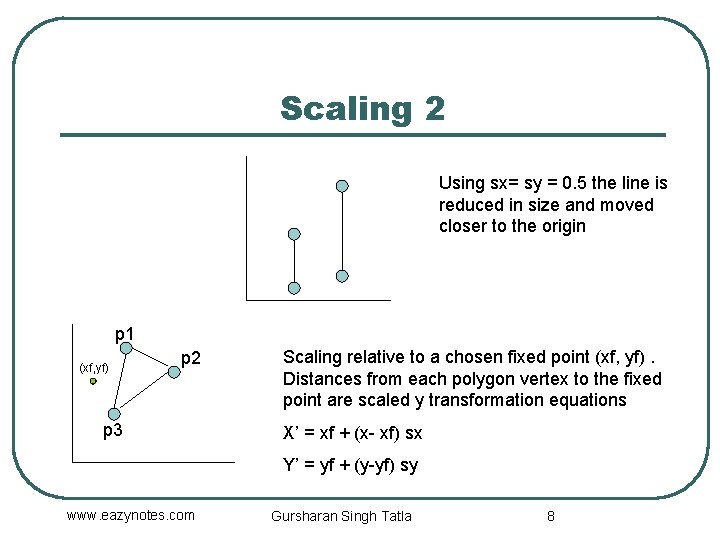
Scaling 2 Using sx= sy = 0. 5 the line is reduced in size and moved closer to the origin p 1 (xf, yf) p 2 p 3 Scaling relative to a chosen fixed point (xf, yf). Distances from each polygon vertex to the fixed point are scaled y transformation equations X’ = xf + (x- xf) sx Y’ = yf + (y-yf) sy www. eazynotes. com Gursharan Singh Tatla 8
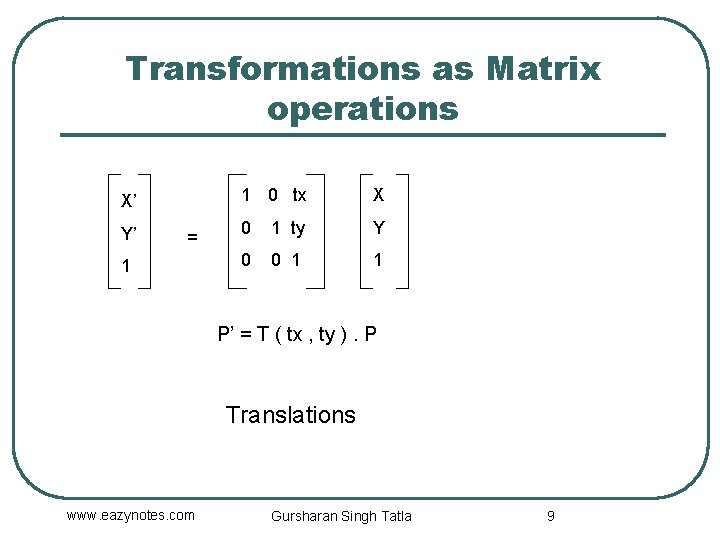
Transformations as Matrix operations X’ Y’ = 1 1 0 tx X 0 1 ty Y 0 0 1 1 P’ = T ( tx , ty ). P Translations www. eazynotes. com Gursharan Singh Tatla 9
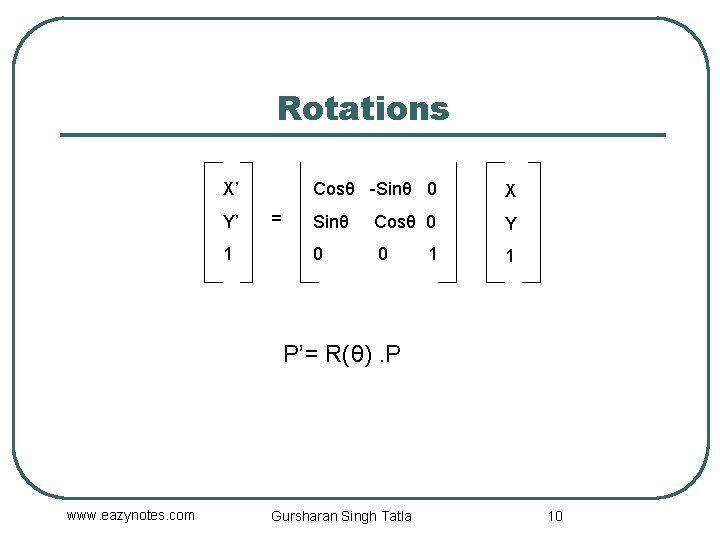
Rotations X’ Y’ 1 = Cosθ -Sinθ 0 X Sinθ Cosθ 0 Y 0 0 1 1 P’= R(θ). P www. eazynotes. com Gursharan Singh Tatla 10
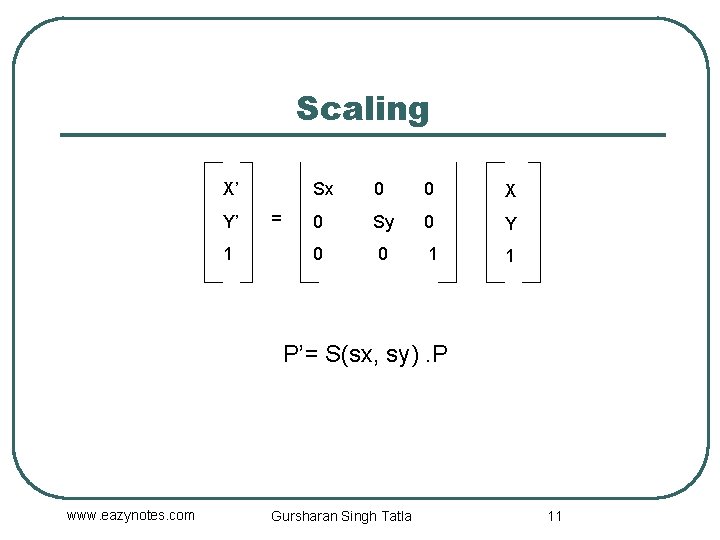
Scaling X’ Y’ 1 = Sx 0 0 X 0 Sy 0 Y 0 0 1 1 P’= S(sx, sy). P www. eazynotes. com Gursharan Singh Tatla 11
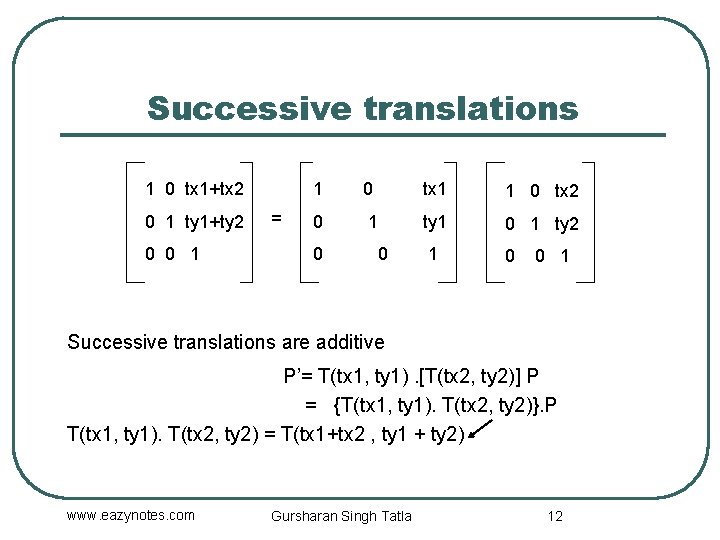
Successive translations 1 0 tx 1+tx 2 0 1 ty 1+ty 2 0 0 1 = 1 0 tx 1 1 0 tx 2 0 1 ty 1 0 1 ty 2 1 0 0 1 Successive translations are additive P’= T(tx 1, ty 1). [T(tx 2, ty 2)] P = {T(tx 1, ty 1). T(tx 2, ty 2)}. P T(tx 1, ty 1). T(tx 2, ty 2) = T(tx 1+tx 2 , ty 1 + ty 2) www. eazynotes. com Gursharan Singh Tatla 12
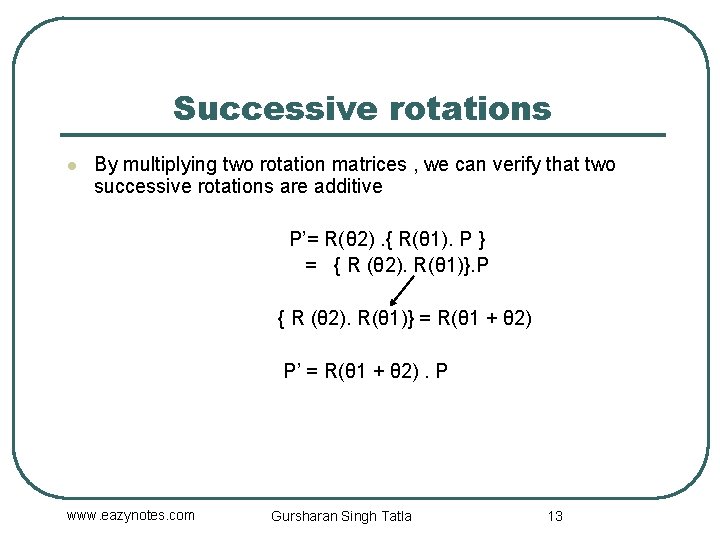
Successive rotations l By multiplying two rotation matrices , we can verify that two successive rotations are additive P’= R(θ 2). { R(θ 1). P } = { R (θ 2). R(θ 1)}. P { R (θ 2). R(θ 1)} = R(θ 1 + θ 2) P’ = R(θ 1 + θ 2). P www. eazynotes. com Gursharan Singh Tatla 13
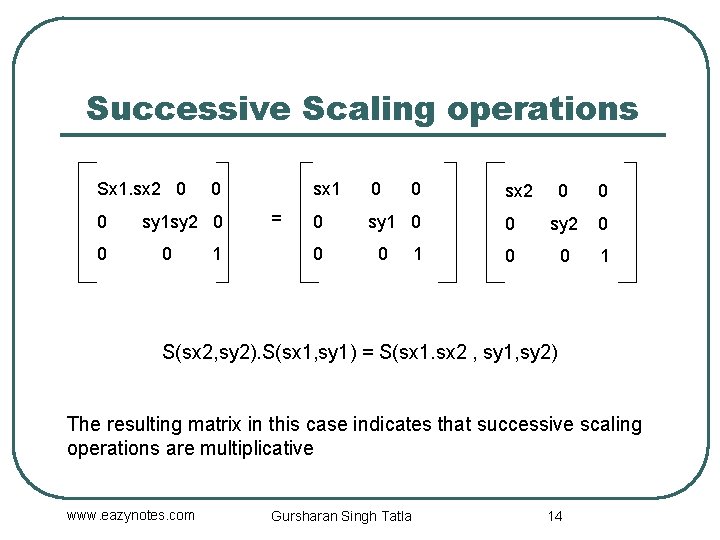
Successive Scaling operations Sx 1. sx 2 0 0 sy 1 sy 2 0 0 1 = sx 1 0 0 sy 1 0 0 1 sx 2 0 0 0 sy 2 0 0 0 1 S(sx 2, sy 2). S(sx 1, sy 1) = S(sx 1. sx 2 , sy 1, sy 2) The resulting matrix in this case indicates that successive scaling operations are multiplicative www. eazynotes. com Gursharan Singh Tatla 14
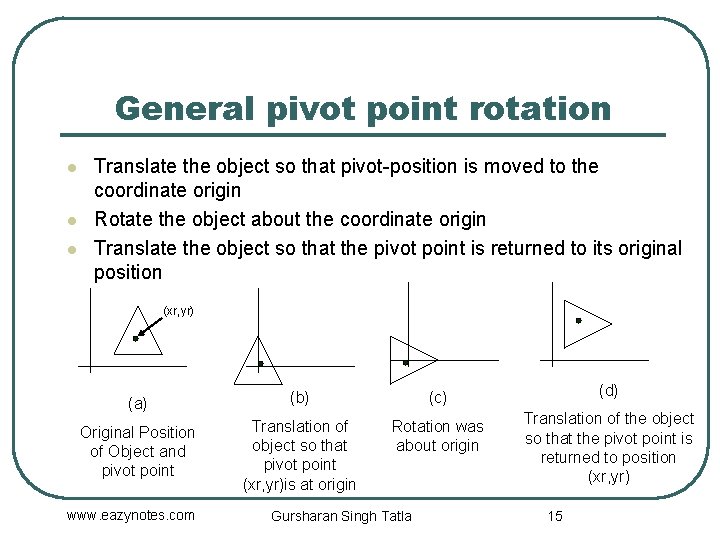
General pivot point rotation l l l Translate the object so that pivot-position is moved to the coordinate origin Rotate the object about the coordinate origin Translate the object so that the pivot point is returned to its original position (xr, yr) (a) (b) (c) (d) Original Position of Object and pivot point Translation of object so that pivot point (xr, yr)is at origin Rotation was about origin Translation of the object so that the pivot point is returned to position (xr, yr) www. eazynotes. com Gursharan Singh Tatla 15
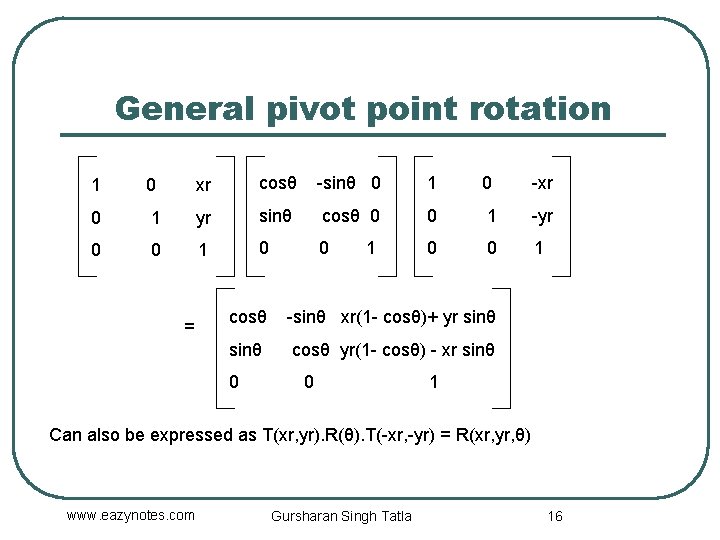
General pivot point rotation 1 0 xr cosθ -sinθ 0 1 0 -xr 0 1 yr sinθ cosθ 0 0 1 -yr 0 0 1 = 1 cosθ -sinθ xr(1 - cosθ)+ yr sinθ cosθ yr(1 - cosθ) - xr sinθ 0 0 1 Can also be expressed as T(xr, yr). R(θ). T(-xr, -yr) = R(xr, yr, θ) www. eazynotes. com Gursharan Singh Tatla 16
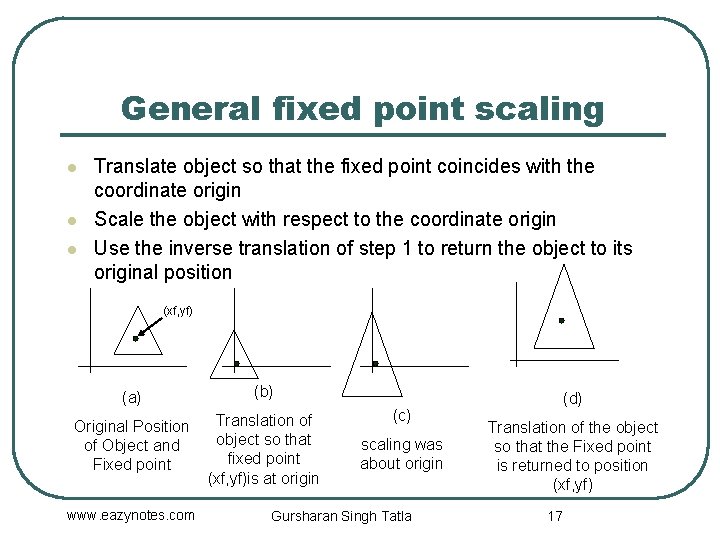
General fixed point scaling l l l Translate object so that the fixed point coincides with the coordinate origin Scale the object with respect to the coordinate origin Use the inverse translation of step 1 to return the object to its original position (xf, yf) (a) (b) Original Position of Object and Fixed point Translation of object so that fixed point (xf, yf)is at origin www. eazynotes. com (c) scaling was about origin Gursharan Singh Tatla (d) Translation of the object so that the Fixed point is returned to position (xf, yf) 17
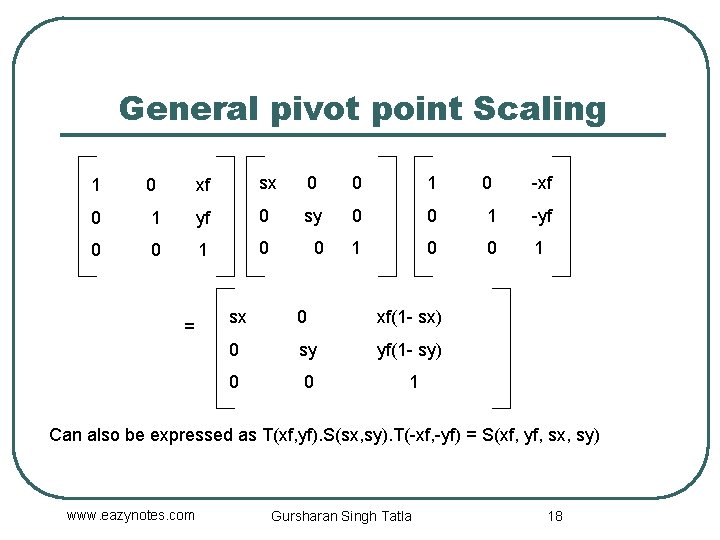
General pivot point Scaling 1 0 xf sx 0 0 1 0 -xf 0 1 yf 0 sy 0 0 1 -yf 0 0 1 = sx 0 xf(1 - sx) 0 sy yf(1 - sy) 0 0 1 Can also be expressed as T(xf, yf). S(sx, sy). T(-xf, -yf) = S(xf, yf, sx, sy) www. eazynotes. com Gursharan Singh Tatla 18
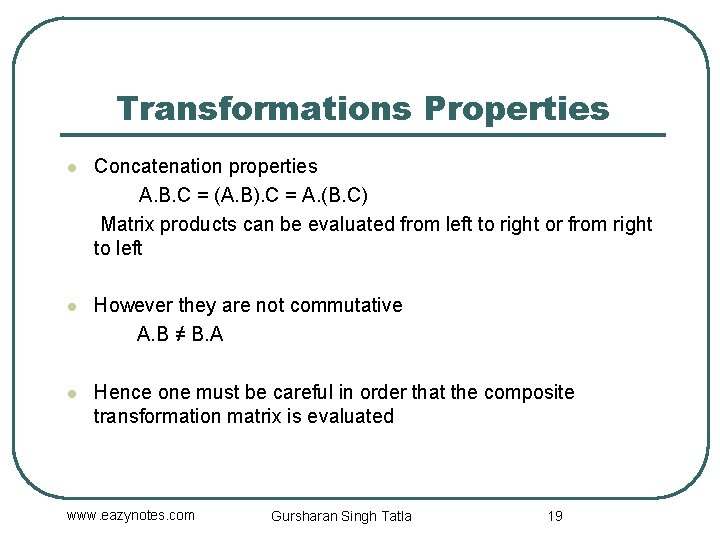
Transformations Properties l Concatenation properties A. B. C = (A. B). C = A. (B. C) Matrix products can be evaluated from left to right or from right to left l However they are not commutative A. B ≠ B. A l Hence one must be careful in order that the composite transformation matrix is evaluated www. eazynotes. com Gursharan Singh Tatla 19
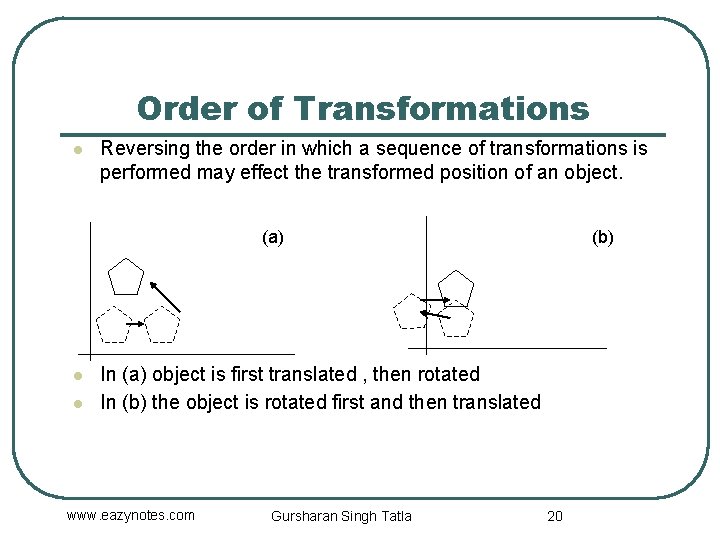
Order of Transformations l Reversing the order in which a sequence of transformations is performed may effect the transformed position of an object. (a) l l (b) In (a) object is first translated , then rotated In (b) the object is rotated first and then translated www. eazynotes. com Gursharan Singh Tatla 20
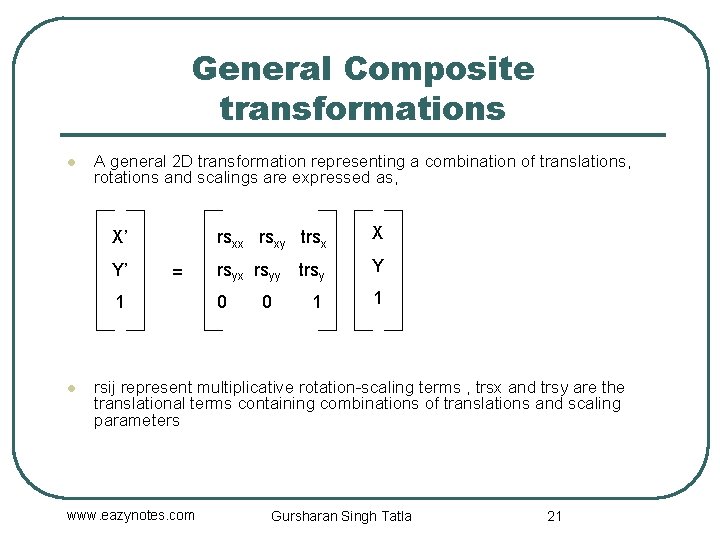
General Composite transformations l A general 2 D transformation representing a combination of translations, rotations and scalings are expressed as, X’ Y’ = 1 l rsxx rsxy trsx X rsyx rsyy trsy Y 1 1 0 0 rsij represent multiplicative rotation-scaling terms , trsx and trsy are the translational terms containing combinations of translations and scaling parameters www. eazynotes. com Gursharan Singh Tatla 21
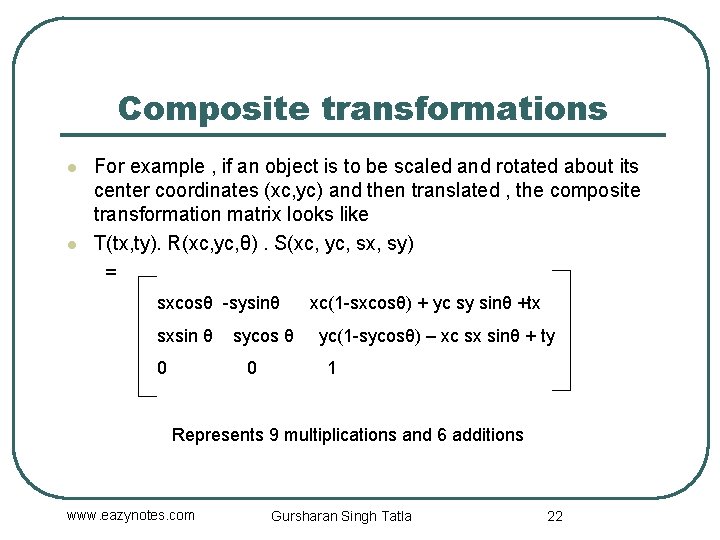
Composite transformations l l For example , if an object is to be scaled and rotated about its center coordinates (xc, yc) and then translated , the composite transformation matrix looks like T(tx, ty). R(xc, yc, θ). S(xc, yc, sx, sy) = sxcosθ -sysinθ sxsin θ 0 sycos θ 0 xc(1 -sxcosθ) + yc sy sinθ +tx yc(1 -sycosθ) – xc sx sinθ + ty 1 Represents 9 multiplications and 6 additions www. eazynotes. com Gursharan Singh Tatla 22
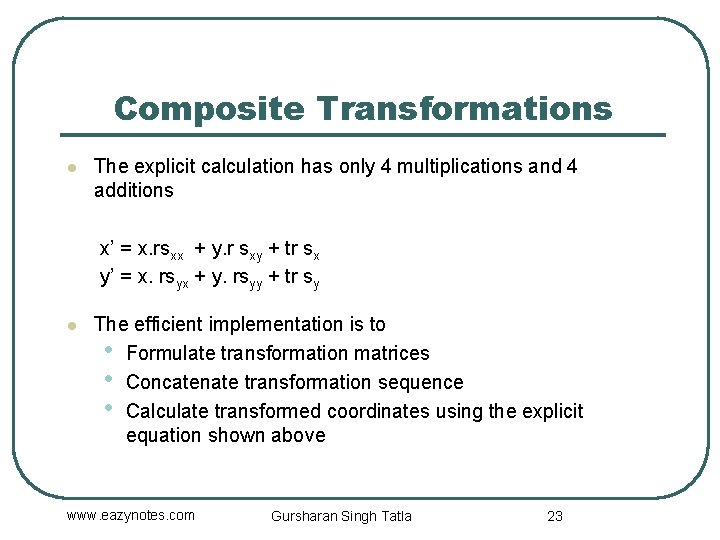
Composite Transformations l The explicit calculation has only 4 multiplications and 4 additions x’ = x. rsxx + y. r sxy + tr sx y’ = x. rsyx + y. rsyy + tr sy l The efficient implementation is to • Formulate transformation matrices • Concatenate transformation sequence • Calculate transformed coordinates using the explicit equation shown above www. eazynotes. com Gursharan Singh Tatla 23
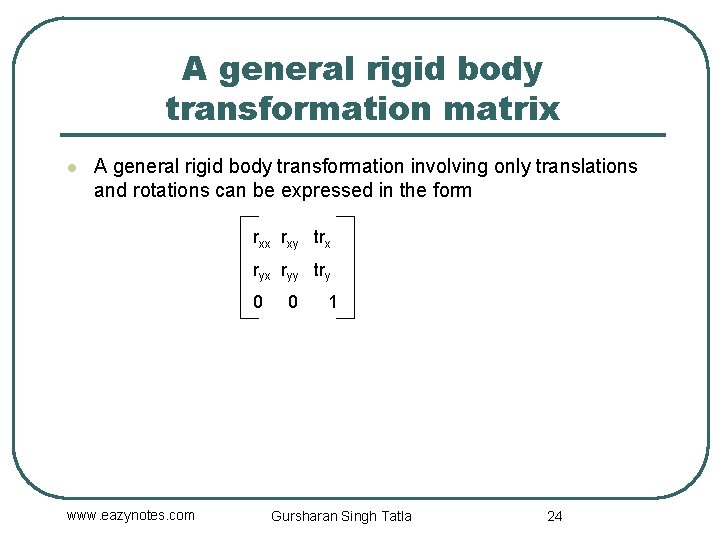
A general rigid body transformation matrix l A general rigid body transformation involving only translations and rotations can be expressed in the form rxx rxy trx ryy try 0 www. eazynotes. com 0 1 Gursharan Singh Tatla 24
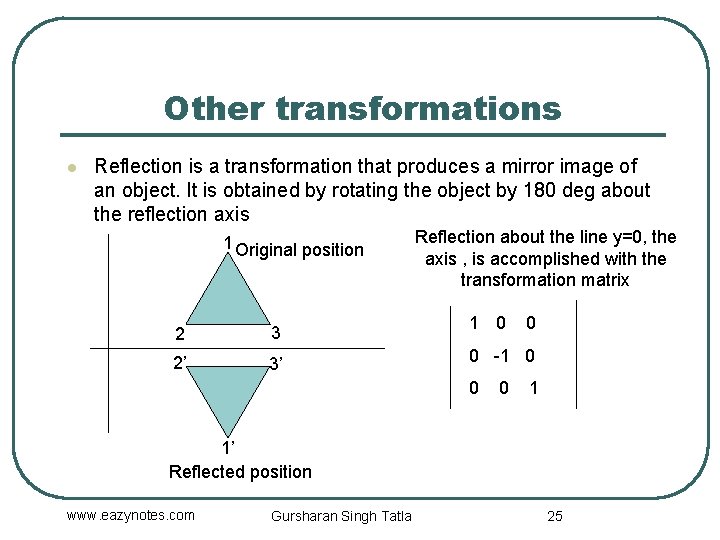
Other transformations l Reflection is a transformation that produces a mirror image of an object. It is obtained by rotating the object by 180 deg about the reflection axis 1 Original position 2 3 2’ 3’ Reflection about the line y=0, the axis , is accomplished with the transformation matrix 1 0 0 0 -1 0 0 0 1 1’ Reflected position www. eazynotes. com Gursharan Singh Tatla 25
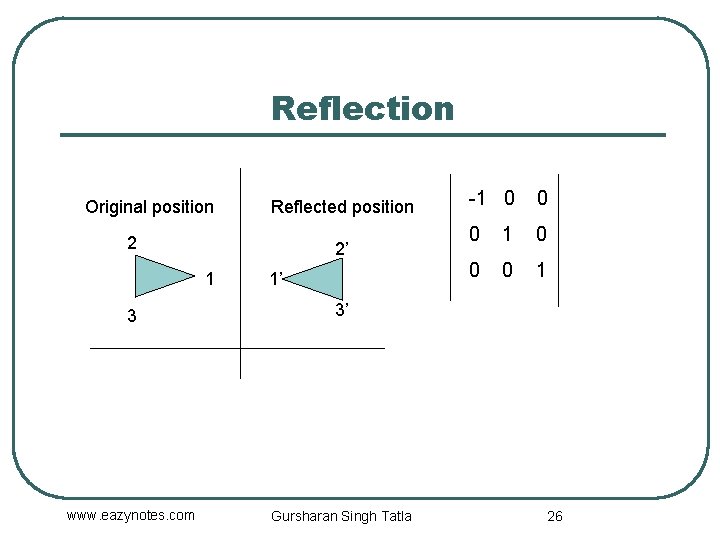
Reflection Original position Reflected position 2 2’ 1 1’ 3 3’ www. eazynotes. com Gursharan Singh Tatla -1 0 0 0 1 26
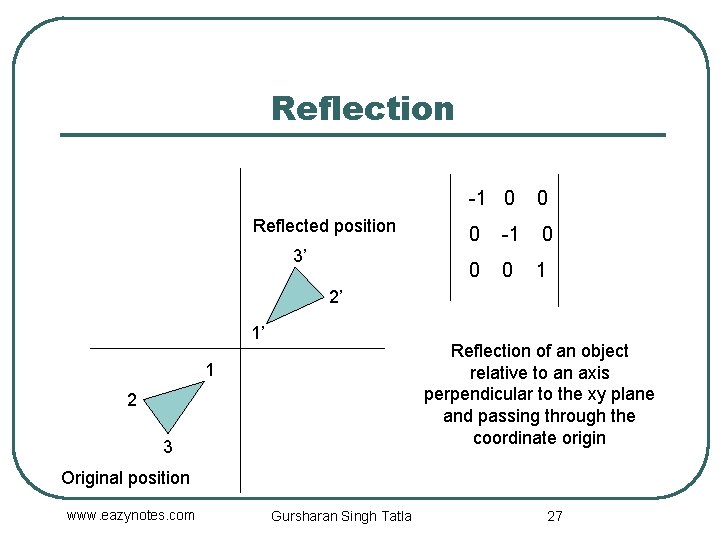
Reflection Reflected position 3’ -1 0 0 0 1 2’ 1’ Reflection of an object relative to an axis perpendicular to the xy plane and passing through the coordinate origin 1 2 3 Original position www. eazynotes. com Gursharan Singh Tatla 27
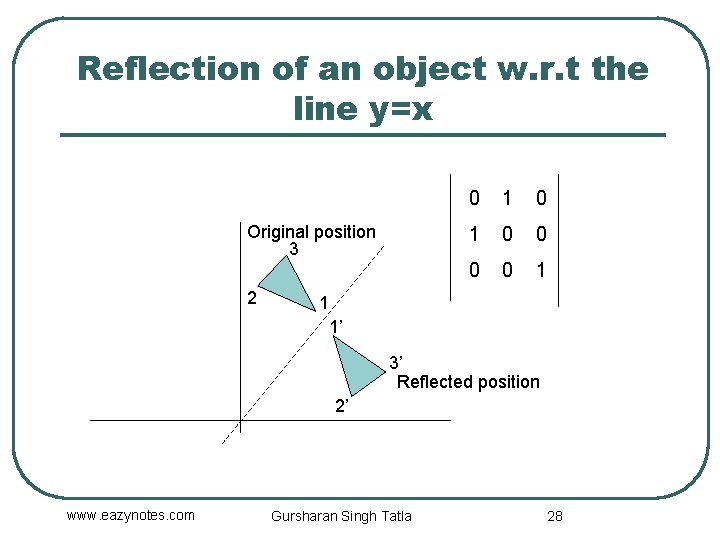
Reflection of an object w. r. t the line y=x Original position 3 2 0 1 0 0 1 1 1’ 3’ Reflected position 2’ www. eazynotes. com Gursharan Singh Tatla 28
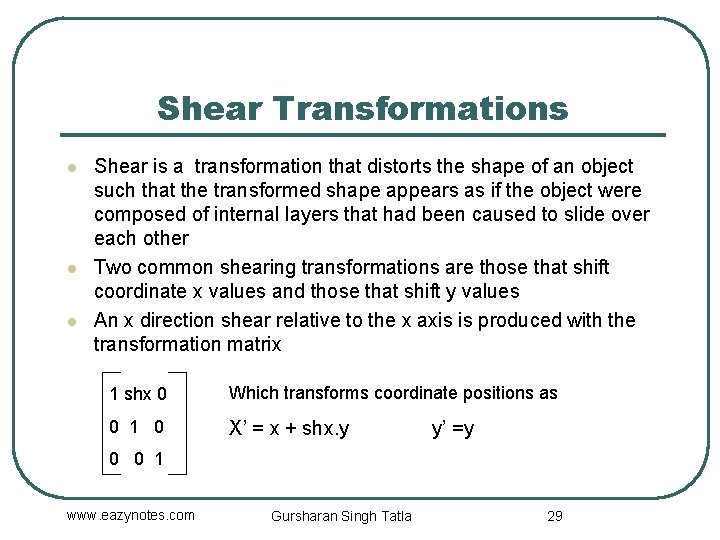
Shear Transformations l l l Shear is a transformation that distorts the shape of an object such that the transformed shape appears as if the object were composed of internal layers that had been caused to slide over each other Two common shearing transformations are those that shift coordinate x values and those that shift y values An x direction shear relative to the x axis is produced with the transformation matrix 1 shx 0 Which transforms coordinate positions as 0 1 0 X’ = x + shx. y y’ =y 0 0 1 www. eazynotes. com Gursharan Singh Tatla 29
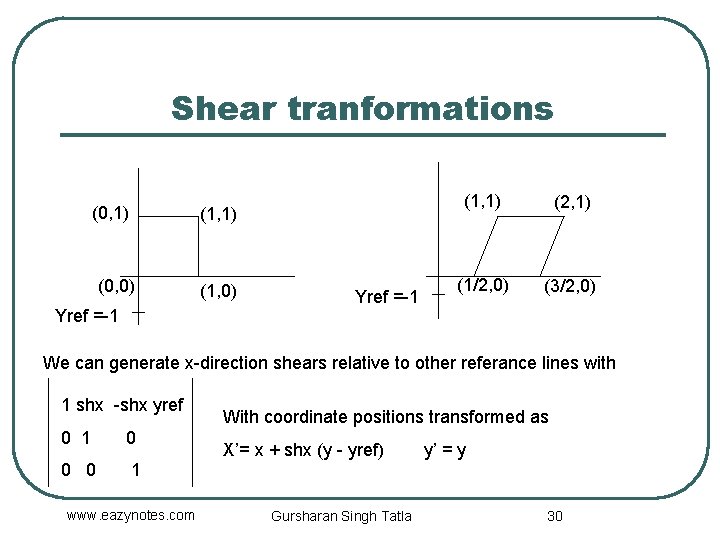
Shear tranformations (0, 1) (1, 1) (0, 0) Yref =-1 (1, 1) (2, 1) (1/2, 0) (3/2, 0) We can generate x-direction shears relative to other referance lines with 1 shx -shx yref 0 1 0 0 0 1 www. eazynotes. com With coordinate positions transformed as X’= x + shx (y - yref) Gursharan Singh Tatla y’ = y 30
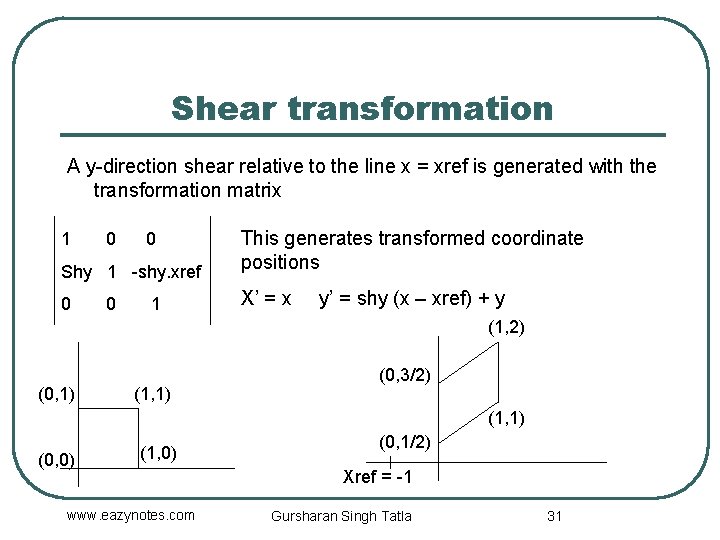
Shear transformation A y-direction shear relative to the line x = xref is generated with the transformation matrix Shy 1 -shy. xref This generates transformed coordinate positions 0 X’ = x 1 0 0 0 1 y’ = shy (x – xref) + y (1, 2) (0, 1) (1, 1) (0, 3/2) (1, 1) (0, 0) (1, 0) www. eazynotes. com (0, 1/2) Xref = -1 Gursharan Singh Tatla 31