
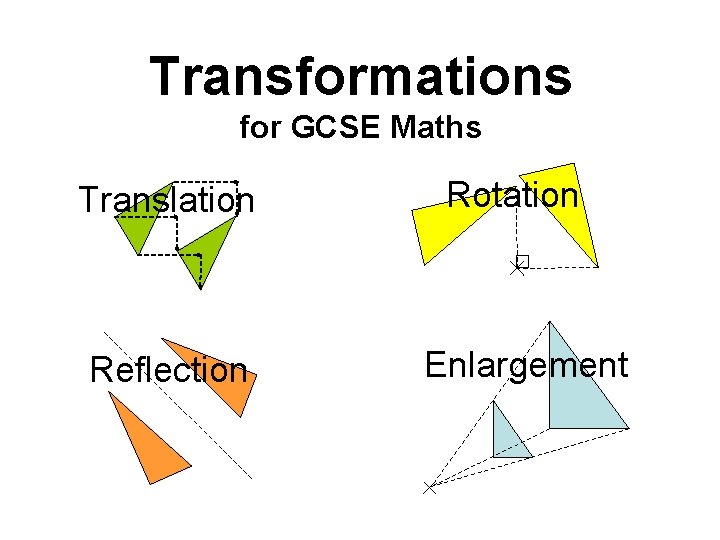
Transformations for GCSE Maths Translation Reflection Rotation Enlargement
- Slides: 15
Transformations for GCSE Maths Translation Reflection Rotation Enlargement
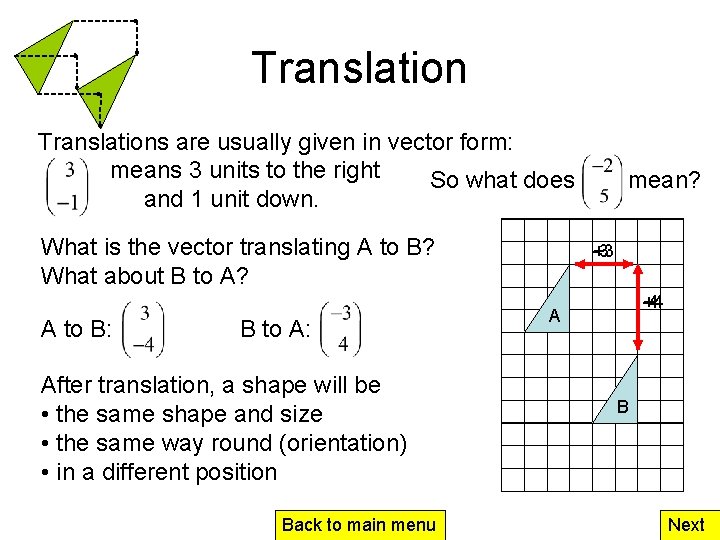
Translations are usually given in vector form: means 3 units to the right So what does and 1 unit down. What is the vector translating A to B? What about B to A? A to B: B to A: After translation, a shape will be • the same shape and size • the same way round (orientation) • in a different position Back to main menu mean? +3 -3 -4 +4 A B Next
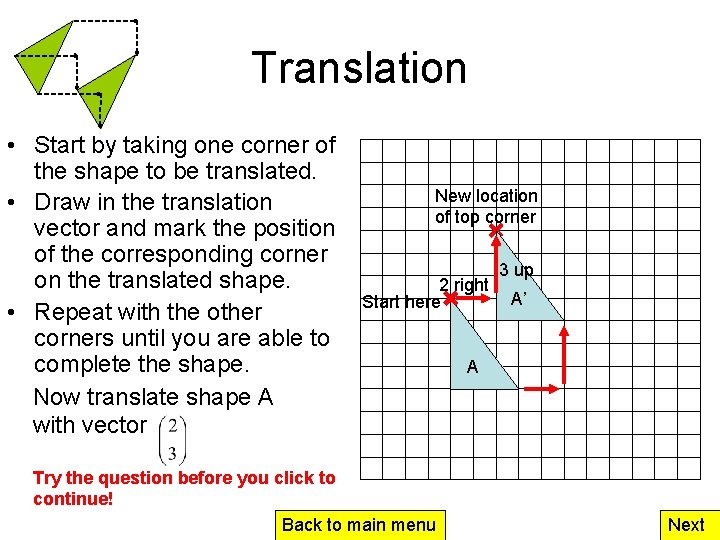
Translation • Start by taking one corner of the shape to be translated. • Draw in the translation vector and mark the position of the corresponding corner on the translated shape. • Repeat with the other corners until you are able to complete the shape. Now translate shape A with vector New location of top corner 2 right Start here Try the question before you click to continue! Back to main menu 3 up A’ A Next
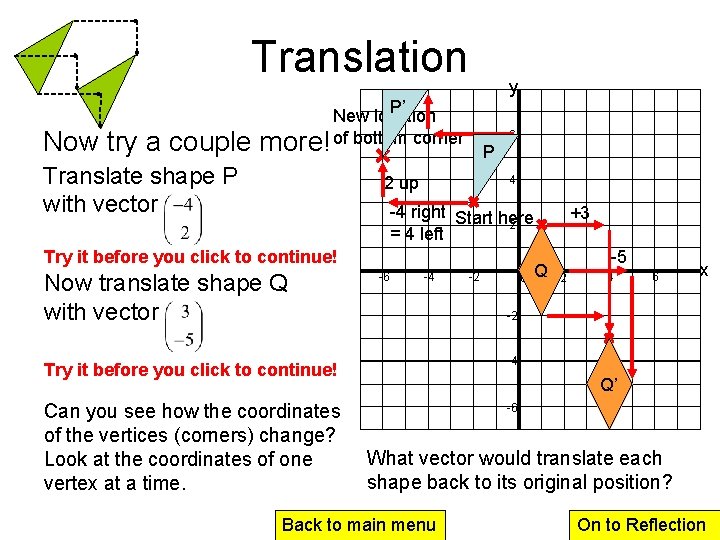
Translation Now try a couple y P’ New location more! of bottom corner Translate shape P with vector P 2 up 6 4 -4 right Start here 2 = 4 left Try it before you click to continue! Now translate shape Q with vector -6 -4 -2 0 +3 Q -5 2 4 6 x -2 Try it before you click to continue! -4 Can you see how the coordinates of the vertices (corners) change? Look at the coordinates of one vertex at a time. -6 Q’ What vector would translate each shape back to its original position? Back to main menu On to Reflection
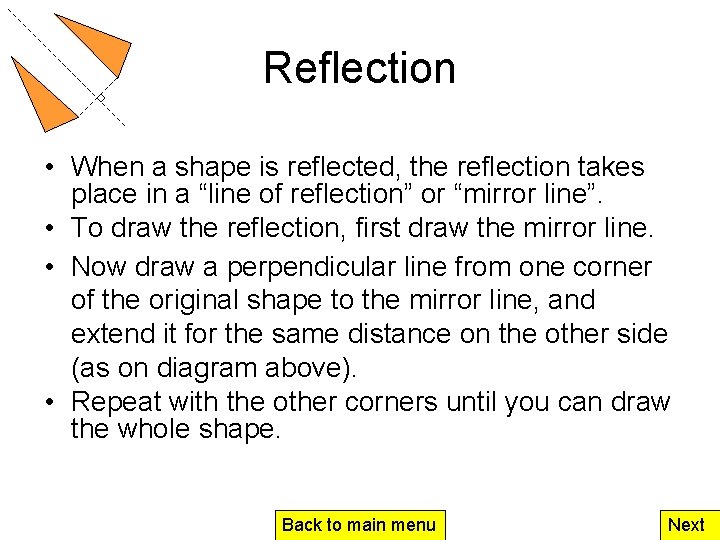
Reflection • When a shape is reflected, the reflection takes place in a “line of reflection” or “mirror line”. • To draw the reflection, first draw the mirror line. • Now draw a perpendicular line from one corner of the original shape to the mirror line, and extend it for the same distance on the other side (as on diagram above). • Repeat with the other corners until you can draw the whole shape. Back to main menu Next
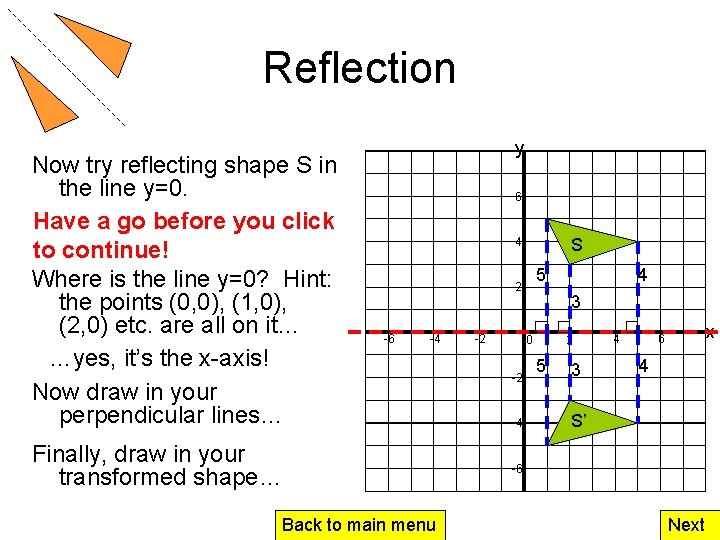
Reflection Now try reflecting shape S in the line y=0. Have a go before you click to continue! Where is the line y=0? Hint: the points (0, 0), (1, 0), (2, 0) etc. are all on it… …yes, it’s the x-axis! Now draw in your perpendicular lines… y 6 S 4 5 2 -6 -4 Finally, draw in your transformed shape… Back to main menu -2 3 0 -2 -4 4 2 5 3 4 x 6 4 S’ -6 Next
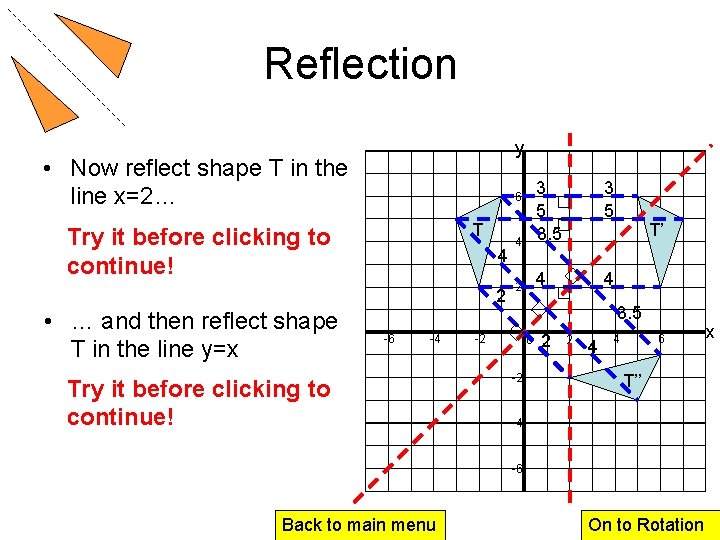
Reflection y • Now reflect shape T in the line x=2… T Try it before clicking to continue! 4 2 • … and then reflect shape T in the line y=x 3 5 4 3 5 3. 5 2 4 4 6 -6 -4 Try it before clicking to continue! T’ 3. 5 -2 0 -2 2 2 4 4 6 T’’ -4 -6 Back to main menu On to Rotation x
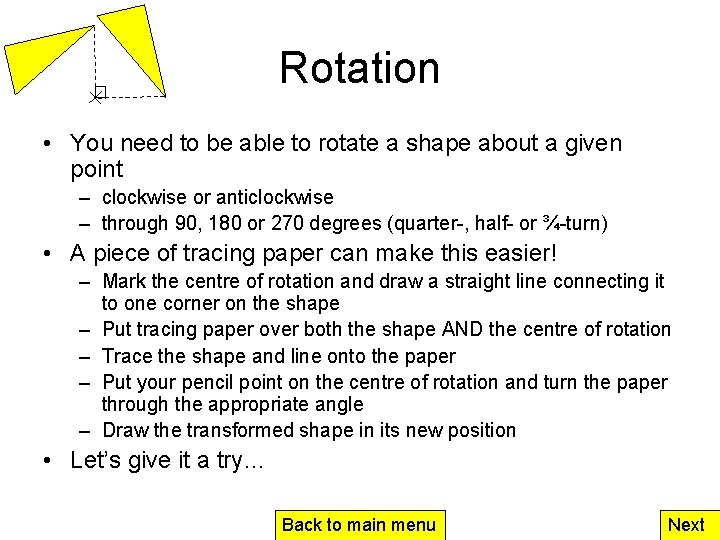
Rotation • You need to be able to rotate a shape about a given point – clockwise or anticlockwise – through 90, 180 or 270 degrees (quarter-, half- or ¾-turn) • A piece of tracing paper can make this easier! – Mark the centre of rotation and draw a straight line connecting it to one corner on the shape – Put tracing paper over both the shape AND the centre of rotation – Trace the shape and line onto the paper – Put your pencil point on the centre of rotation and turn the paper through the appropriate angle – Draw the transformed shape in its new position • Let’s give it a try… Back to main menu Next
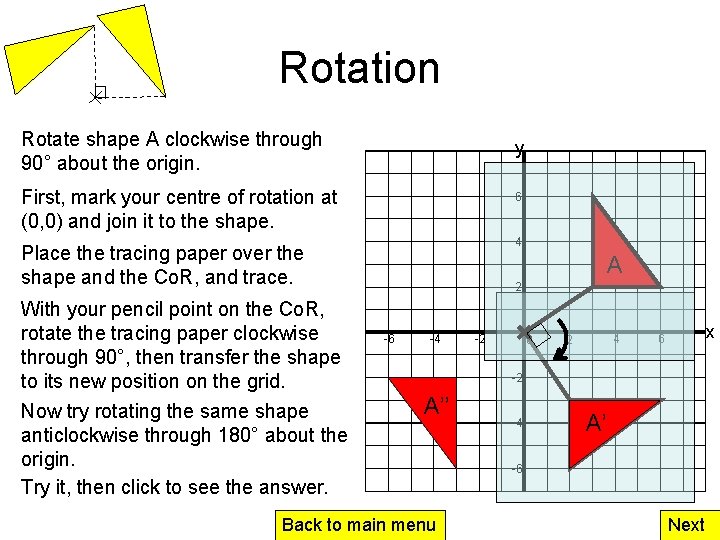
Rotation Rotate shape A clockwise through 90° about the origin. y First, mark your centre of rotation at (0, 0) and join it to the shape. 6 4 Place the tracing paper over the shape and the Co. R, and trace. With your pencil point on the Co. R, rotate the tracing paper clockwise through 90°, then transfer the shape to its new position on the grid. Now try rotating the same shape anticlockwise through 180° about the origin. Try it, then click to see the answer. A 2 -6 -4 -2 0 4 2 x 6 -2 A’’ Back to main menu -4 A’ -6 Next
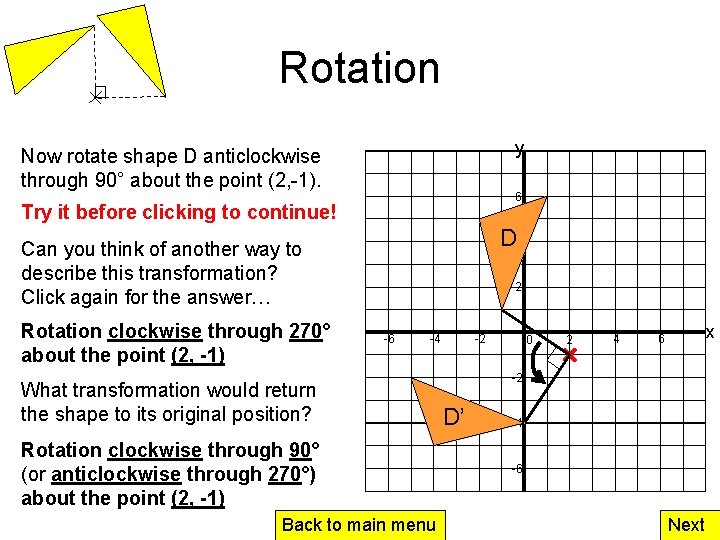
Rotation y Now rotate shape D anticlockwise through 90° about the point (2, -1). 6 Try it before clicking to continue! D 4 Can you think of another way to describe this transformation? Click again for the answer… Rotation clockwise through 270° about the point (2, -1) 2 -6 -4 What transformation would return the shape to its original position? Rotation clockwise through 90° (or anticlockwise through 270°) about the point (2, -1) Back to main menu -2 0 2 4 x 6 -2 D’ -4 -6 Next
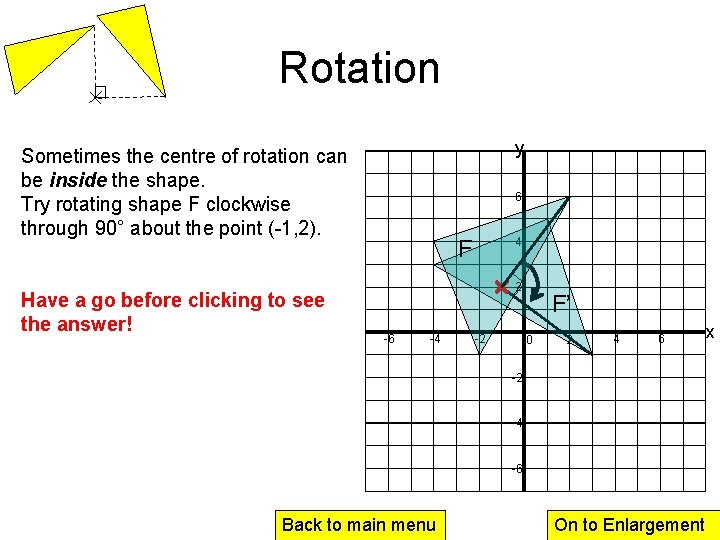
Rotation y Sometimes the centre of rotation can be inside the shape. Try rotating shape F clockwise through 90° about the point (-1, 2). Have a go before clicking to see the answer! 6 4 F 2 -6 -4 -2 F’ 0 2 4 6 -2 -4 -6 Back to main menu On to Enlargement x
Enlargement • You need to be able to enlarge a shape about a given point (the centre of enlargement) with a given scale factor • If the scale factor is more than 1, the shape will get bigger – e. g. a scale factor of 3 will result in a shape with sides 3 times as long (and 9 times the area!) • If the scale factor is less than 1, the shape will get smaller – but it’s still called an enlargement! – e. g. a scale factor of ½ will result in a shape with sides only half as long (and ¼ of the area!) Back to main menu Next
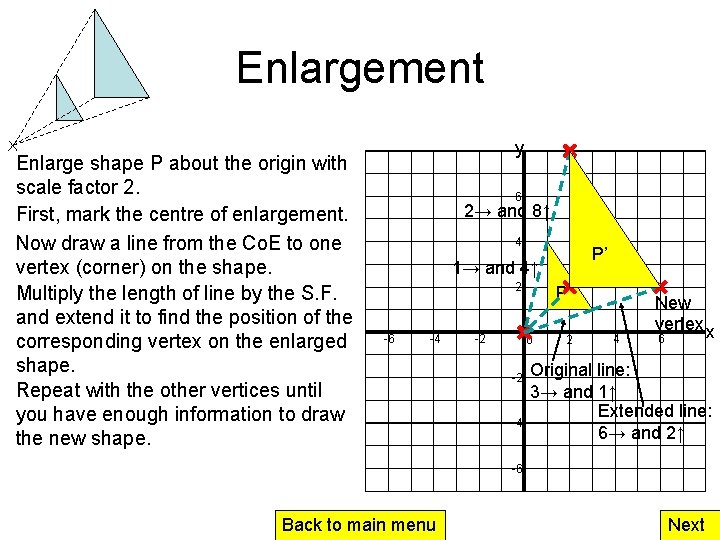
Enlargement Enlarge shape P about the origin with scale factor 2. First, mark the centre of enlargement. Now draw a line from the Co. E to one vertex (corner) on the shape. Multiply the length of line by the S. F. and extend it to find the position of the corresponding vertex on the enlarged shape. Repeat with the other vertices until you have enough information to draw the new shape. y 6 2→ and 8↑ 4 P’ 1→ and 4↑ 2 -6 -4 -2 P 0 -2 -4 2 4 New vertex x 6 Original line: 3→ and 1↑ Extended line: 6→ and 2↑ -6 Back to main menu Next
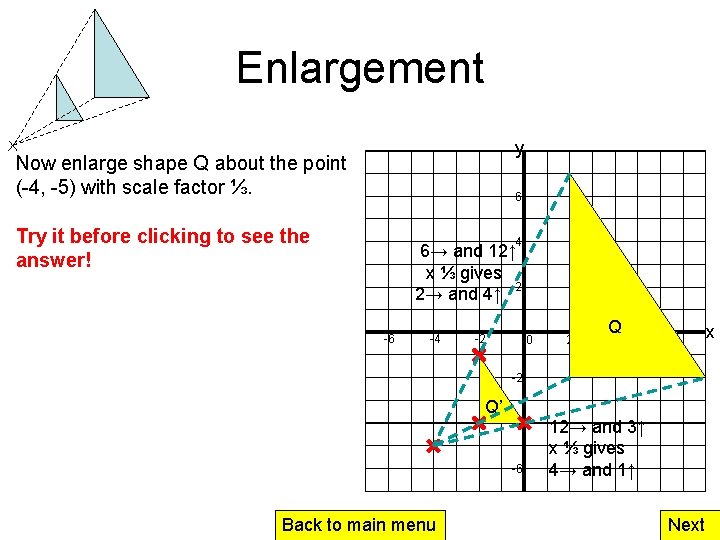
Enlargement y Now enlarge shape Q about the point (-4, -5) with scale factor ⅓. 6 Try it before clicking to see the answer! 4 6→ and 12↑ x ⅓ gives 2 2→ and 4↑ -6 -4 -2 0 2 Q 4 x 6 -2 Q’ -4 -6 Back to main menu 12→ and 3↑ x ⅓ gives 4→ and 1↑ Next
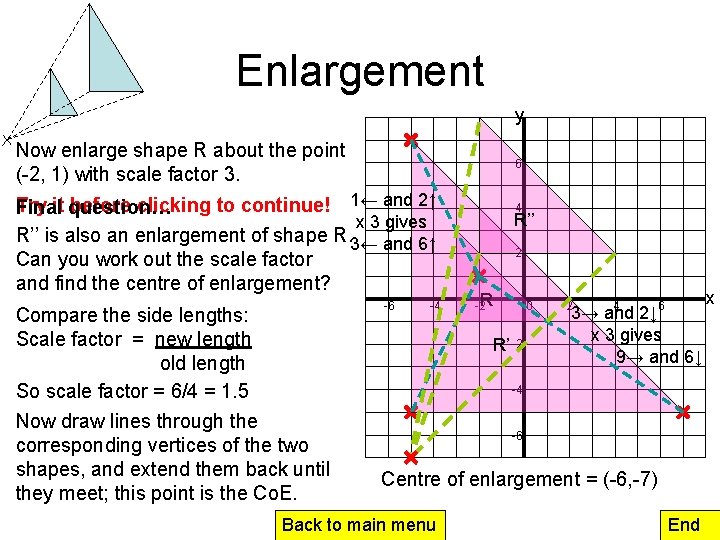
Enlargement y Now enlarge shape R about the point (-2, 1) with scale factor 3. 6 Try it question… before clicking to continue! 1← and 2↑ Final x 3 gives R’’ is also an enlargement of shape R. 3← and 6↑ Can you work out the scale factor and find the centre of enlargement? Compare the side lengths: Scale factor = new length old length So scale factor = 6/4 = 1. 5 Now draw lines through the corresponding vertices of the two shapes, and extend them back until they meet; this point is the Co. E. -6 -4 4 R’’ 2 -2 R 0 R’ -2 2 4 6 3→ and 2↓ x 3 gives 9→ and 6↓ -4 -6 Centre of enlargement = (-6, -7) Back to main menu End x