
Transformations Factoring finding a factored form from SOP
- Slides: 38
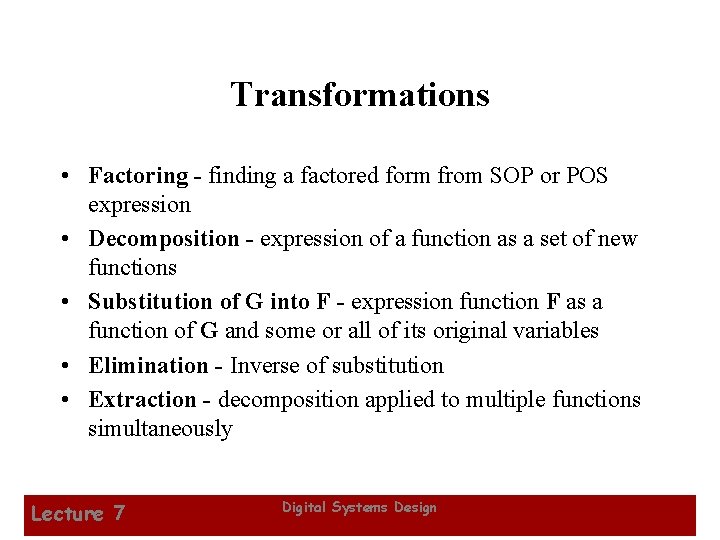
Transformations • Factoring - finding a factored form from SOP or POS expression • Decomposition - expression of a function as a set of new functions • Substitution of G into F - expression function F as a function of G and some or all of its original variables • Elimination - Inverse of substitution • Extraction - decomposition applied to multiple functions simultaneously Lecture 7 Digital Systems Design 1
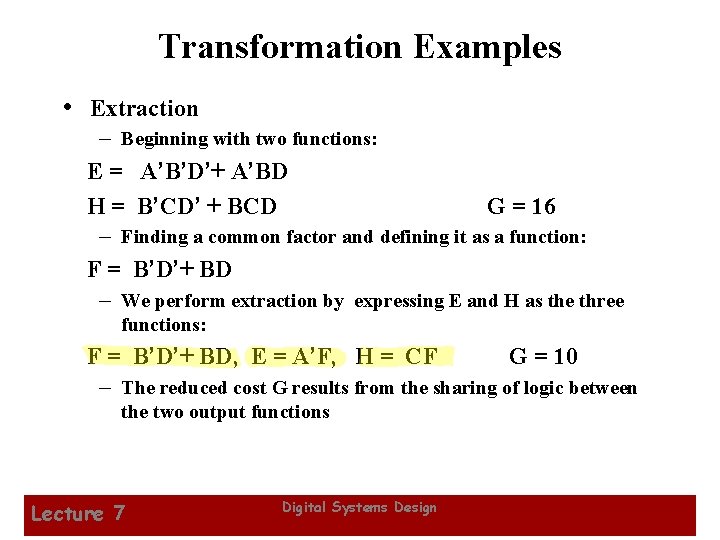
Transformation Examples • Extraction – Beginning with two functions: E = A’B’D’+ A’BD H = B’CD’ + BCD G = 16 – Finding a common factor and defining it as a function: F = B’D’+ BD – We perform extraction by expressing E and H as the three functions: F = B’D’+ BD, E = A’F, H = CF G = 10 – The reduced cost G results from the sharing of logic between the two output functions Lecture 7 Digital Systems Design 2
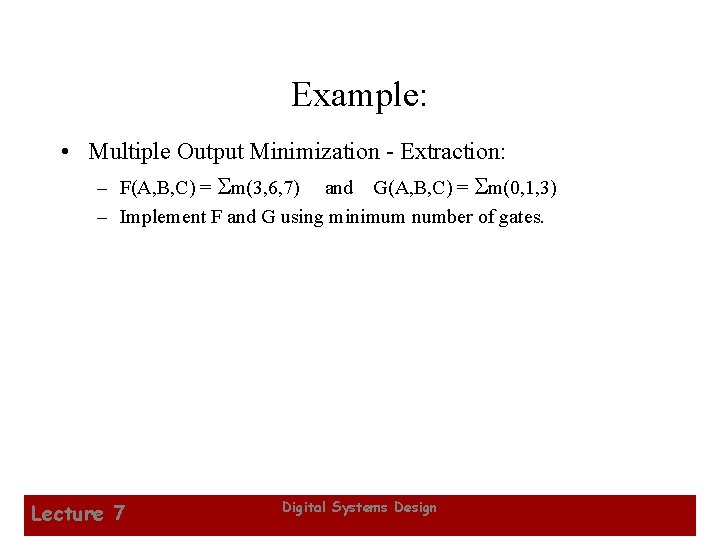
Example: • Multiple Output Minimization - Extraction: – F(A, B, C) = m(3, 6, 7) and G(A, B, C) = m(0, 1, 3) – Implement F and G using minimum number of gates. Lecture 7 Digital Systems Design 3
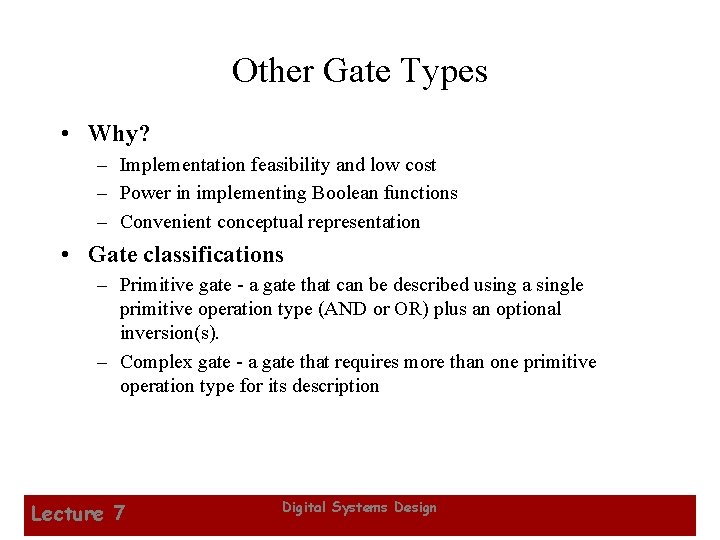
Other Gate Types • Why? – Implementation feasibility and low cost – Power in implementing Boolean functions – Convenient conceptual representation • Gate classifications – Primitive gate - a gate that can be described using a single primitive operation type (AND or OR) plus an optional inversion(s). – Complex gate - a gate that requires more than one primitive operation type for its description Lecture 7 Digital Systems Design 4
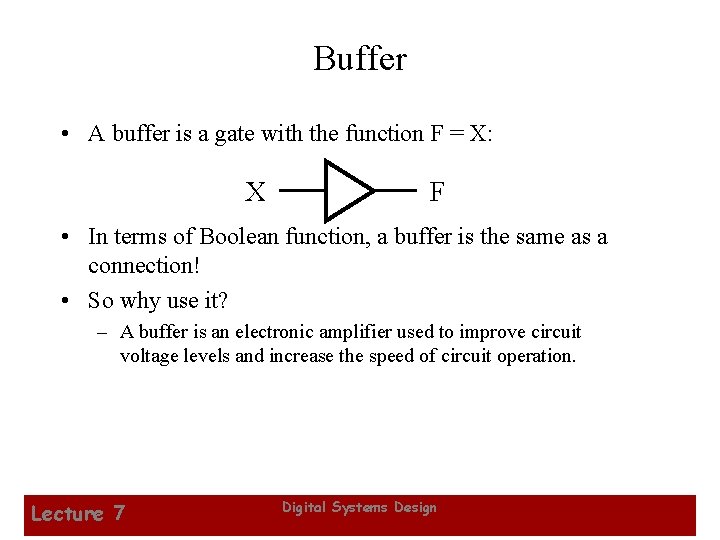
Buffer • A buffer is a gate with the function F = X: X F • In terms of Boolean function, a buffer is the same as a connection! • So why use it? – A buffer is an electronic amplifier used to improve circuit voltage levels and increase the speed of circuit operation. Lecture 7 Digital Systems Design 5
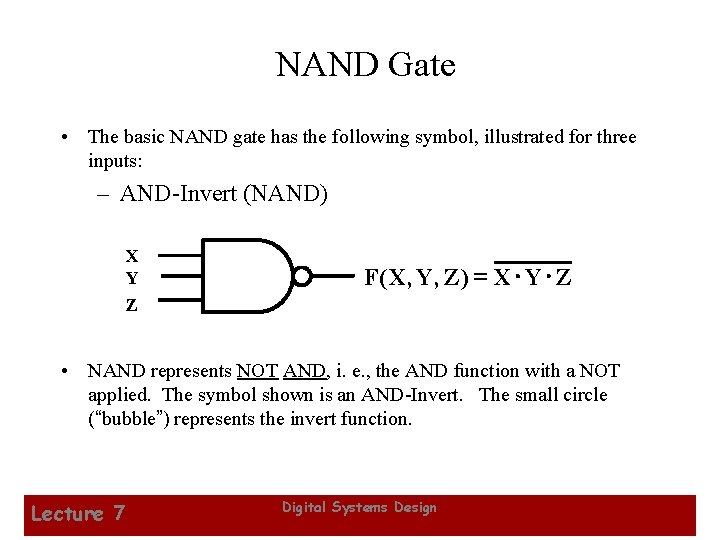
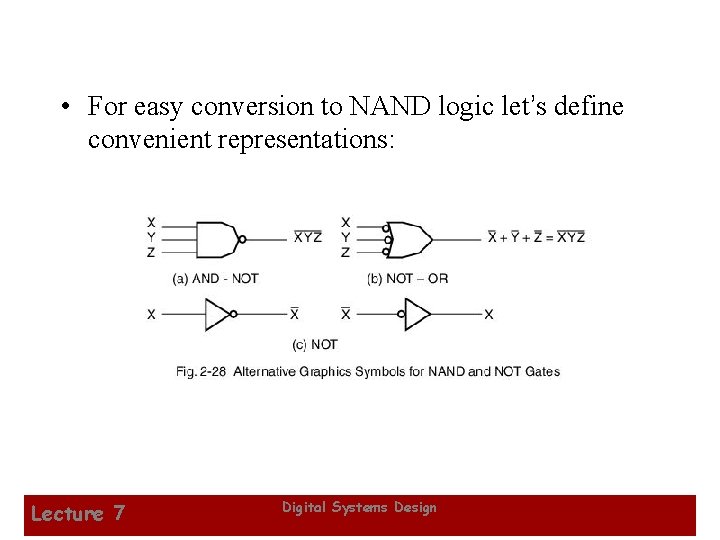
NAND Gate • The basic NAND gate has the following symbol, illustrated for three inputs: – AND-Invert (NAND) X Y Z F( X , Y , Z ) = X × Y × Z • NAND represents NOT AND, i. e. , the AND function with a NOT applied. The symbol shown is an AND-Invert. The small circle (“bubble”) represents the invert function. Lecture 7 Digital Systems Design 6
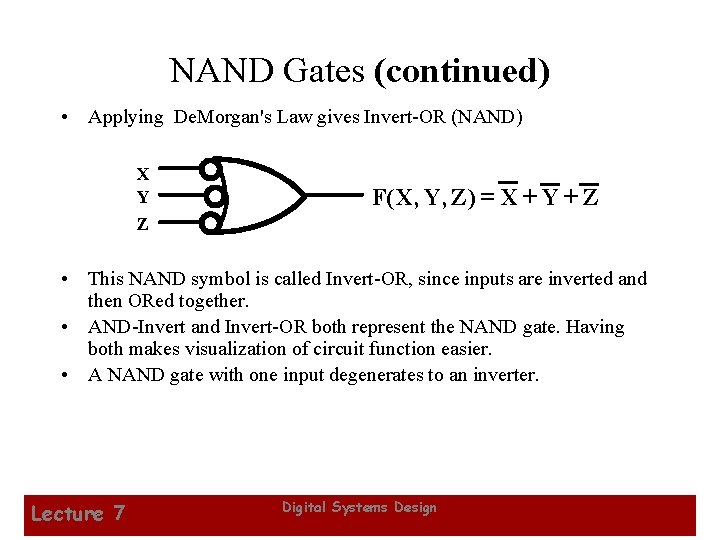
NAND Gates (continued) • Applying De. Morgan's Law gives Invert-OR (NAND) X Y Z F( X , Y , Z ) = X + Y + Z • This NAND symbol is called Invert-OR, since inputs are inverted and then ORed together. • AND-Invert and Invert-OR both represent the NAND gate. Having both makes visualization of circuit function easier. • A NAND gate with one input degenerates to an inverter. Lecture 7 Digital Systems Design 7
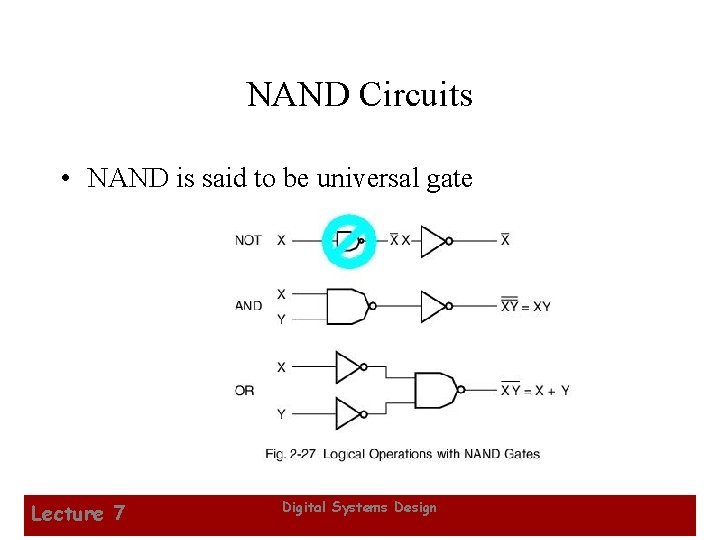
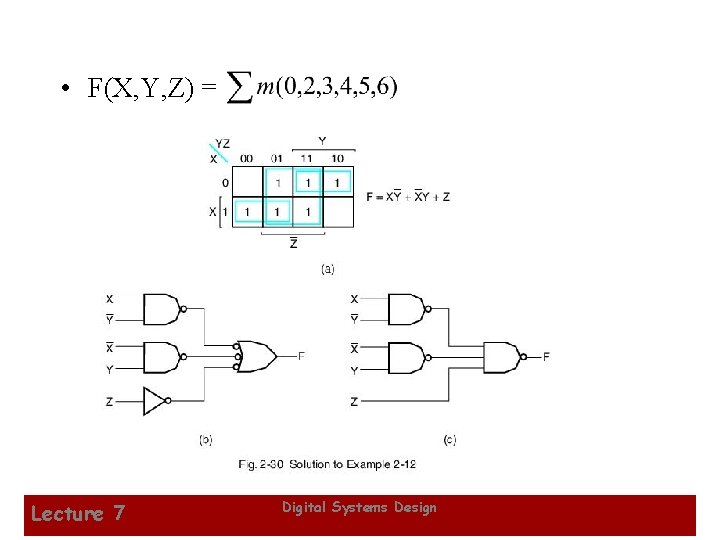
NAND Gates (continued) • The NAND gate is the natural implementation for the simplest and fastest electronic circuits • Universal gate - a gate type that can implement any Boolean function. • The NAND gate is a universal gate as shown in Figure 2 -30 of the text. • NAND usually does not have a operation symbol defined since – the NAND operation is not associative, and – we have difficulty dealing with non-associative mathematics! Lecture 7 Digital Systems Design 8
NAND Circuits • NAND is said to be universal gate Lecture 7 Digital Systems Design 9
• For easy conversion to NAND logic let’s define convenient representations: Lecture 7 Digital Systems Design 10
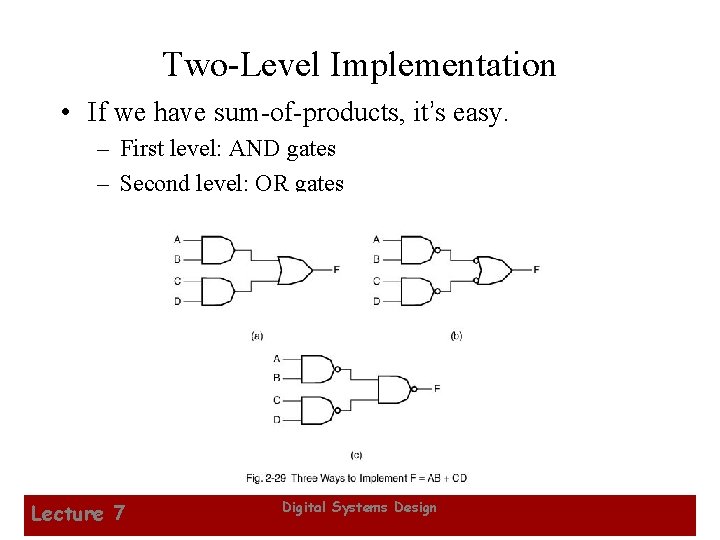
Two-Level Implementation • If we have sum-of-products, it’s easy. – First level: AND gates – Second level: OR gates Lecture 7 Digital Systems Design 11
• F(X, Y, Z) = Lecture 7 Digital Systems Design 12
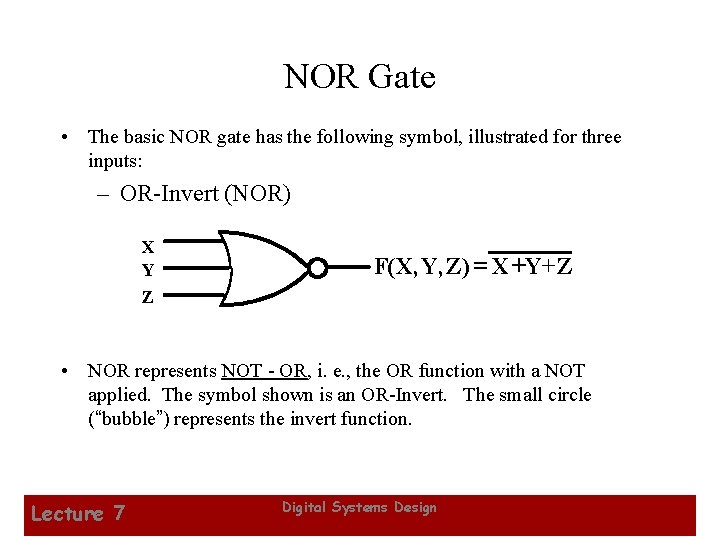
NOR Gate • The basic NOR gate has the following symbol, illustrated for three inputs: – OR-Invert (NOR) X Y Z F(X, Y, Z) = X +Y+ Z • NOR represents NOT - OR, i. e. , the OR function with a NOT applied. The symbol shown is an OR-Invert. The small circle (“bubble”) represents the invert function. Lecture 7 Digital Systems Design 13
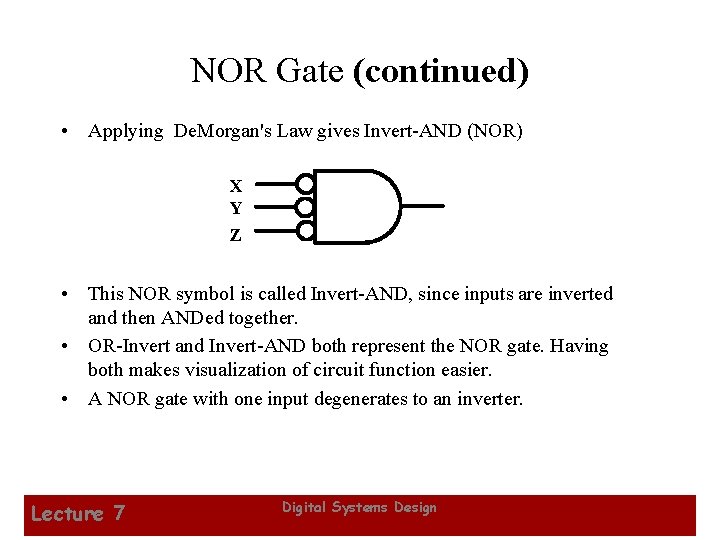
NOR Gate (continued) • Applying De. Morgan's Law gives Invert-AND (NOR) X Y Z • This NOR symbol is called Invert-AND, since inputs are inverted and then ANDed together. • OR-Invert and Invert-AND both represent the NOR gate. Having both makes visualization of circuit function easier. • A NOR gate with one input degenerates to an inverter. Lecture 7 Digital Systems Design 14
NOR Gate (continued) • The NOR gate is another natural implementation for the simplest and fastest electronic circuits • The NOR gate is a universal gate • NOR usually does not have a defined operation symbol since – the NOR operation is not associative, and – we have difficulty dealing with non-associative mathematics! Lecture 7 Digital Systems Design 15
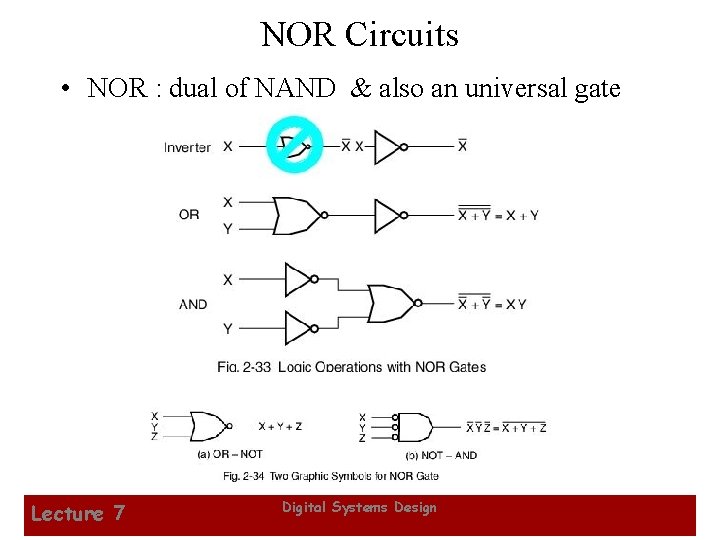
NOR Circuits • NOR : dual of NAND & also an universal gate Lecture 7 Digital Systems Design 16
Exclusive OR/ Exclusive NOR • The e. Xclusive OR (XOR) function is an important Boolean function used extensively in logic circuits. • The XOR function may be; – implemented directly as an electronic circuit (truly a gate) or – implemented by interconnecting other gate types (used as a convenient representation) • The e. Xclusive NOR function is the complement of the XOR function • By our definition, XOR and XNOR gates are complex gates. Lecture 7 Digital Systems Design 17
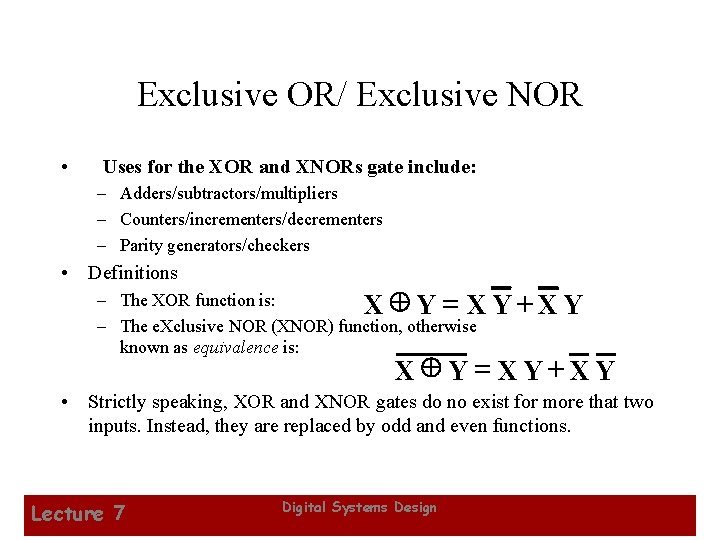
Exclusive OR/ Exclusive NOR • Uses for the XOR and XNORs gate include: – Adders/subtractors/multipliers – Counters/incrementers/decrementers – Parity generators/checkers • Definitions – The XOR function is: X Y = XY+ – The e. Xclusive NOR (XNOR) function, otherwise known as equivalence is: XY X Y = XY+XY • Strictly speaking, XOR and XNOR gates do no exist for more that two inputs. Instead, they are replaced by odd and even functions. Lecture 7 Digital Systems Design 18
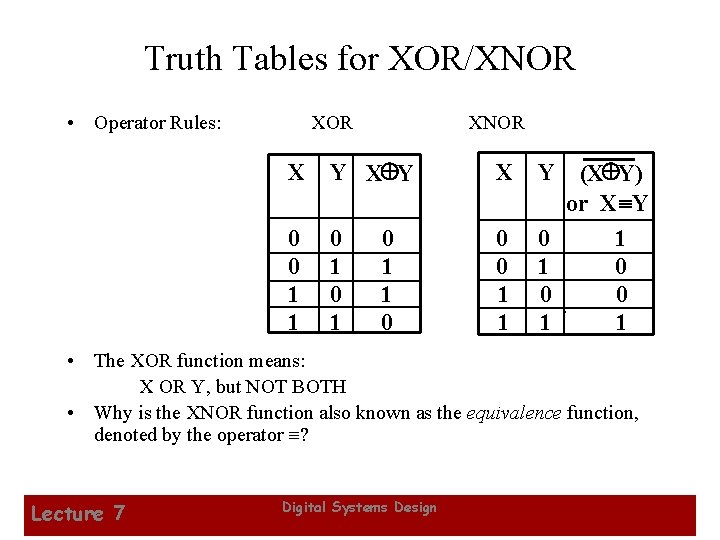
Truth Tables for XOR/XNOR • Operator Rules: XOR XNOR X Y X 0 0 1 1 0 1 0 0 1 1 0 Y (X Y) or X ºY 0 1 1 0 0 0 1 1 • The XOR function means: X OR Y, but NOT BOTH • Why is the XNOR function also known as the equivalence function, denoted by the operator ? Lecture 7 Digital Systems Design 19
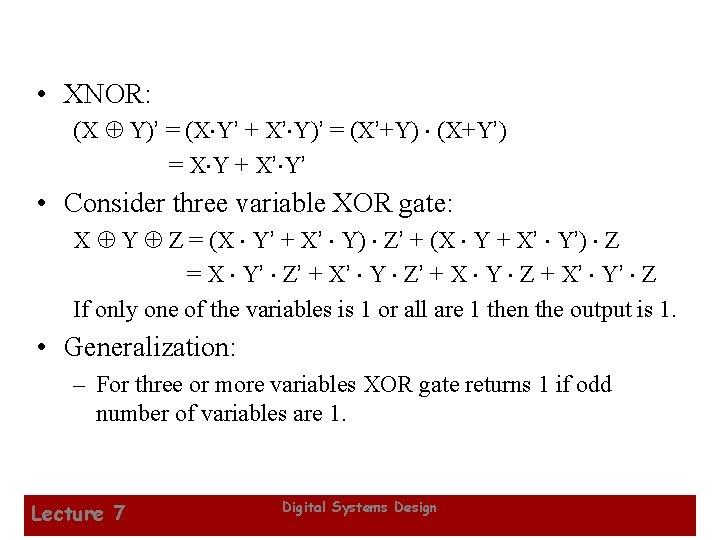
• XNOR: (X Y)’ = (X×Y’ + X’×Y)’ = (X’+Y) × (X+Y’) = X×Y + X’×Y’ • Consider three variable XOR gate: X Y Z = (X × Y’ + X’ × Y) × Z’ + (X × Y + X’ × Y’) × Z = X × Y’ × Z’ + X’ × Y × Z’ + X × Y × Z + X’ × Y’ × Z If only one of the variables is 1 or all are 1 then the output is 1. • Generalization: – For three or more variables XOR gate returns 1 if odd number of variables are 1. Lecture 7 Digital Systems Design 20
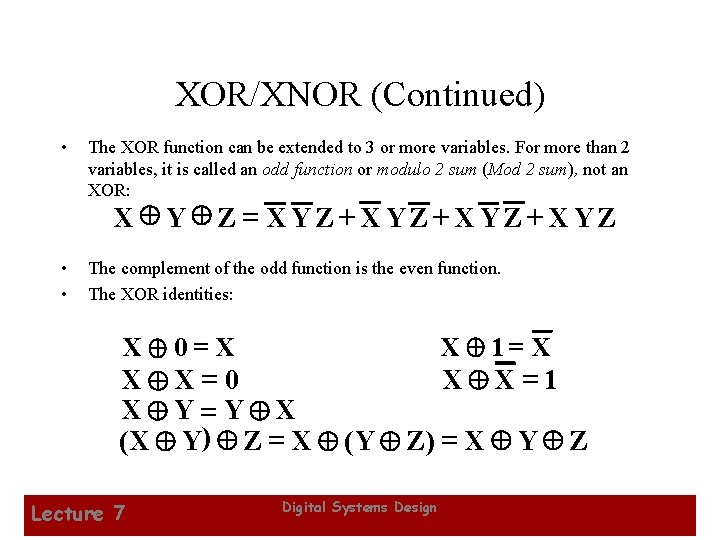
XOR/XNOR (Continued) • The XOR function can be extended to 3 or more variables. For more than 2 variables, it is called an odd function or modulo 2 sum (Mod 2 sum), not an XOR: X Y Z = XYZ+ XYZ • • The complement of the odd function is the even function. The XOR identities: X 0 = X X 1 = X X X =0 X X =1 X Y = Y X ( X Y) Z = X ( Y Z ) = X Y Z Lecture 7 Digital Systems Design 21
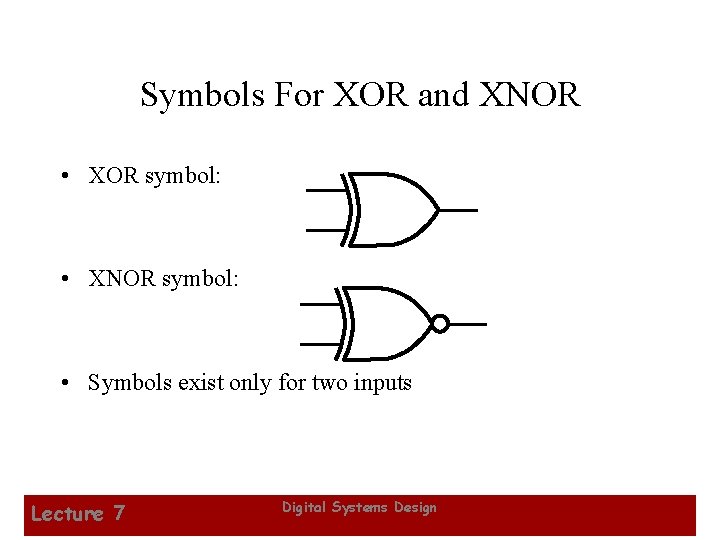
Symbols For XOR and XNOR • XOR symbol: • XNOR symbol: • Symbols exist only for two inputs Lecture 7 Digital Systems Design 22
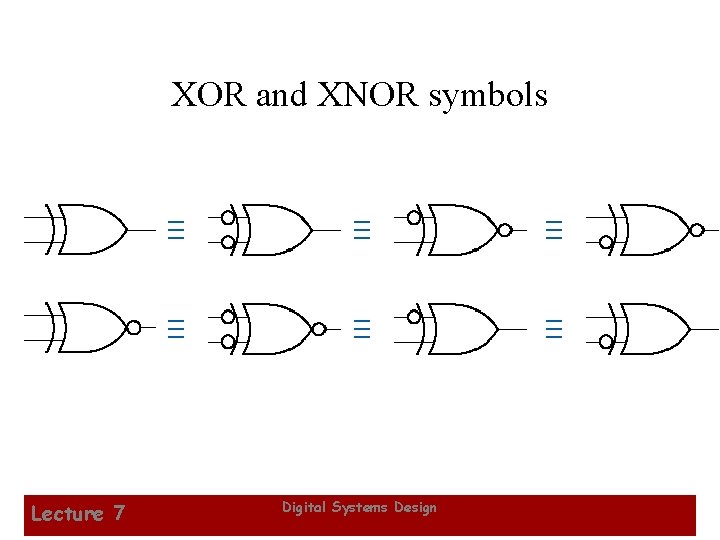
XOR and XNOR symbols Lecture 7 Digital Systems Design 23
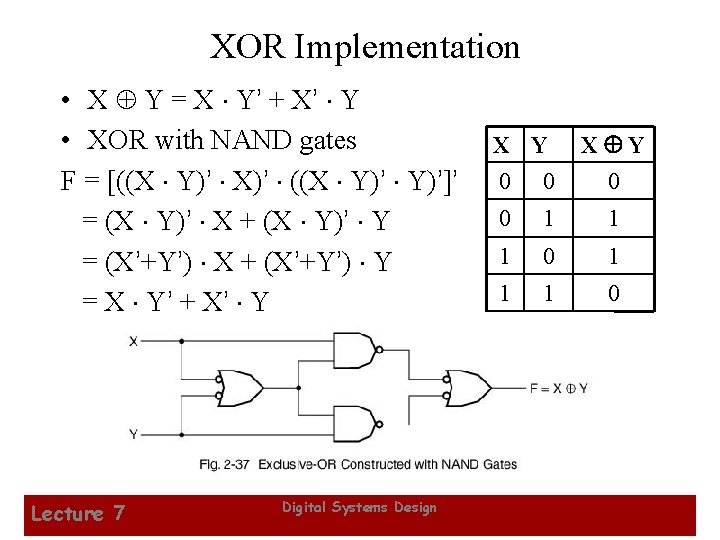
XOR Implementation • X Y = X × Y’ + X ’ × Y • XOR with NAND gates F = [((X × Y)’ × X)’ × ((X × Y)’]’ = (X × Y)’ × X + (X × Y)’ × Y = (X’+Y’) × X + (X’+Y’) × Y = X × Y’ + X ’ × Y Lecture 7 Digital Systems Design X Y 0 0 1 1 1 0 24
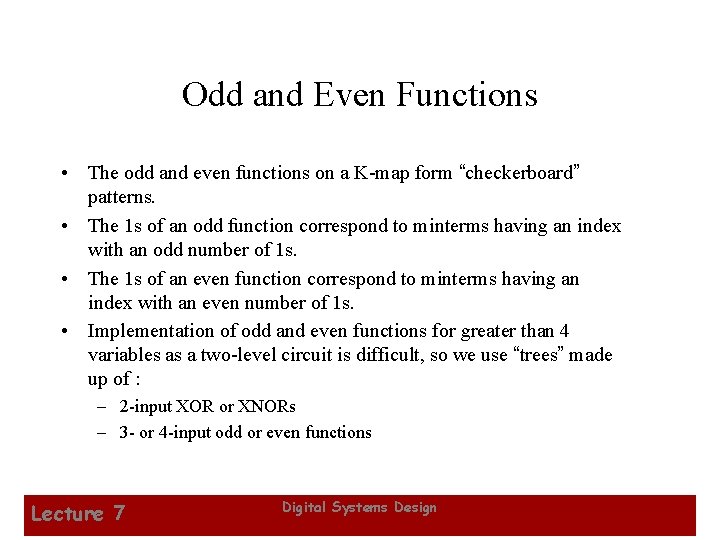
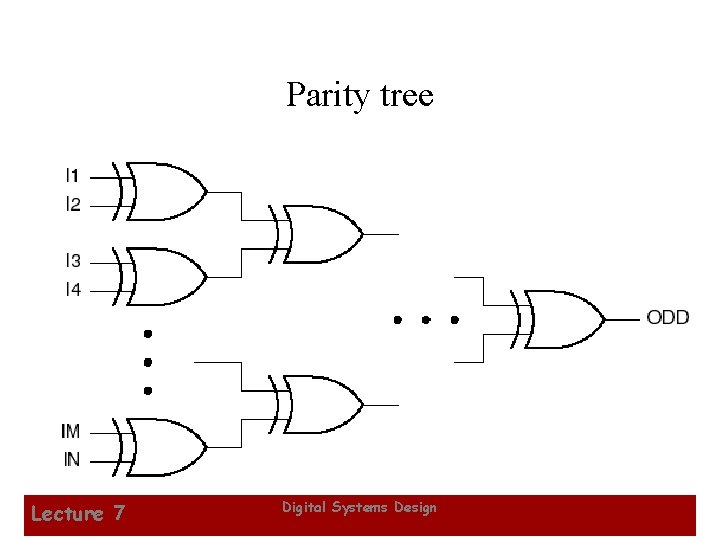
Odd and Even Functions • The odd and even functions on a K-map form “checkerboard” patterns. • The 1 s of an odd function correspond to minterms having an index with an odd number of 1 s. • The 1 s of an even function correspond to minterms having an index with an even number of 1 s. • Implementation of odd and even functions for greater than 4 variables as a two-level circuit is difficult, so we use “trees” made up of : – 2 -input XOR or XNORs – 3 - or 4 -input odd or even functions Lecture 7 Digital Systems Design 25
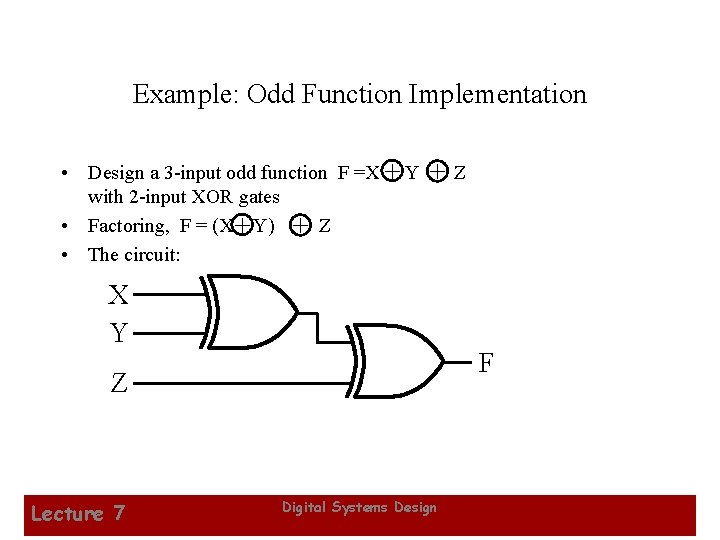
Example: Odd Function Implementation • Design a 3 -input odd function F =X + Y with 2 -input XOR gates • Factoring, F = (X + Y) + Z • The circuit: +Z X Y F Z Lecture 7 Digital Systems Design 26
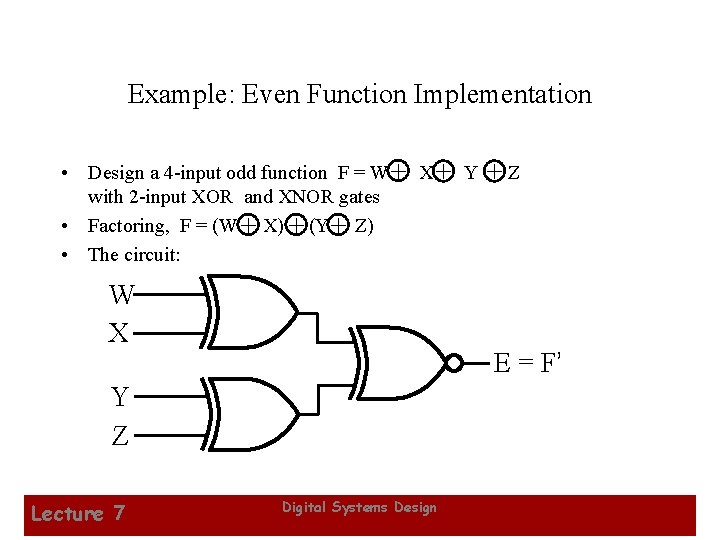
Example: Even Function Implementation • Design a 4 -input odd function F = W + X + Y with 2 -input XOR and XNOR gates • Factoring, F = (W + X) + (Y + Z) • The circuit: W X +Z E = F’ Y Z Lecture 7 Digital Systems Design 27
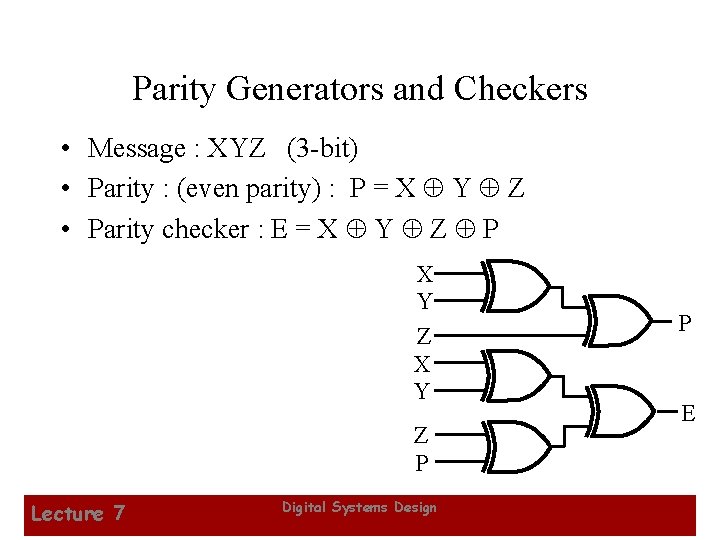
Parity Generators and Checkers • Message : XYZ (3 -bit) • Parity : (even parity) : P = X Y Z • Parity checker : E = X Y Z P X Y Z X Y P E Z P Lecture 7 Digital Systems Design 28
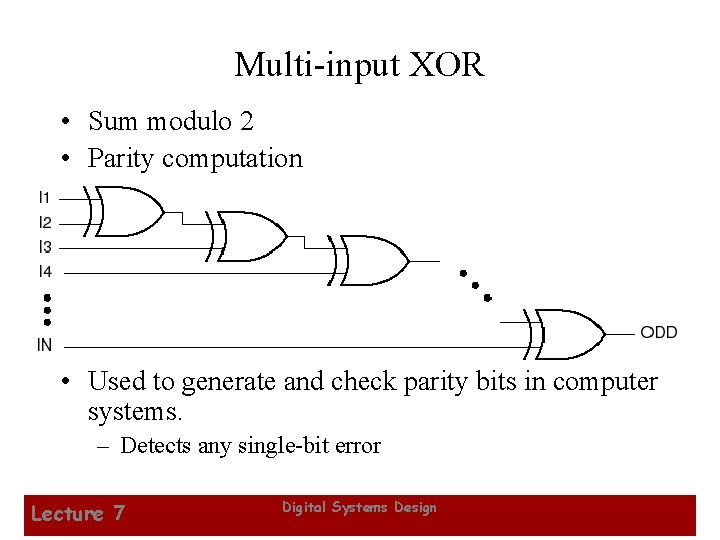
Multi-input XOR • Sum modulo 2 • Parity computation • Used to generate and check parity bits in computer systems. – Detects any single-bit error Lecture 7 Digital Systems Design 29
Parity tree Lecture 7 Digital Systems Design 30
Hi-Impedance Outputs • Logic gates introduced thus far – have 1 and 0 output values, – cannot have their outputs connected together, and – transmit signals on connections in only one direction. • Three-state logic adds a third logic value, – Hi-Impedance (Hi-Z), – giving three states: 0, 1, and Hi-Z on the outputs. • The presence of a Hi-Z state makes a gate output as described above behave quite differently: – “ 1 and 0” become “ 1, 0, and Hi-Z” – “cannot” becomes “can, ” and – “only one” becomes “two” Lecture 7 Digital Systems Design 31
Hi-Impedance Outputs (continued) • What is a Hi-Z value? – – – • The Hi-Z value behaves as an open circuit This means that, looking back into the circuit, the output appears to be disconnected. It is as if a switch between the internal circuitry and the output has been opened. Hi-Z may appear on the output of any gate, but we restrict gates to: – – a 3 -state buffer, or a transmission gate, each of which has one data input and one control input. Lecture 7 Digital Systems Design 32
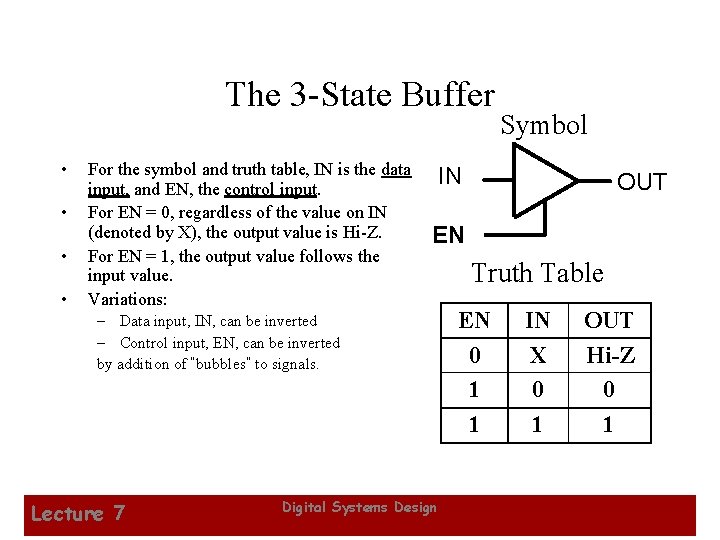
The 3 -State Buffer • • For the symbol and truth table, IN is the data input, and EN, the control input. For EN = 0, regardless of the value on IN (denoted by X), the output value is Hi-Z. For EN = 1, the output value follows the input value. Variations: IN OUT EN – Data input, IN, can be inverted – Control input, EN, can be inverted by addition of “bubbles” to signals. Lecture 7 Symbol Digital Systems Design Truth Table EN 0 1 1 IN X 0 1 OUT Hi-Z 0 1 33
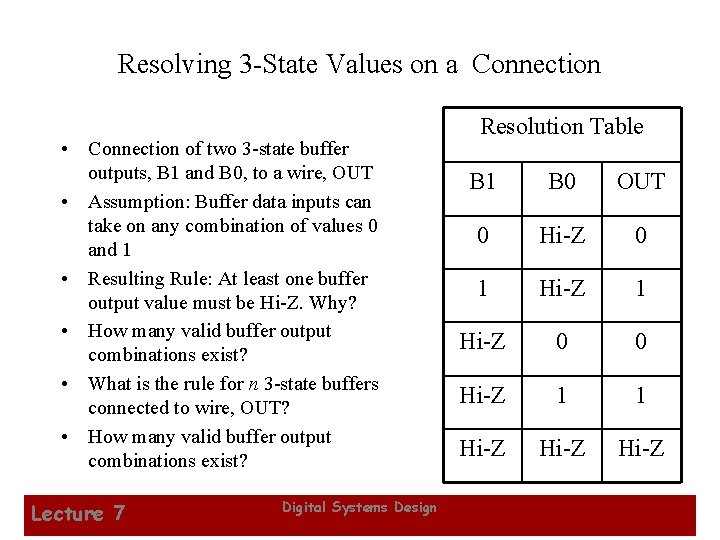
Resolving 3 -State Values on a Connection • Connection of two 3 -state buffer outputs, B 1 and B 0, to a wire, OUT • Assumption: Buffer data inputs can take on any combination of values 0 and 1 • Resulting Rule: At least one buffer output value must be Hi-Z. Why? • How many valid buffer output combinations exist? • What is the rule for n 3 -state buffers connected to wire, OUT? • How many valid buffer output combinations exist? Lecture 7 Digital Systems Design Resolution Table B 1 B 0 OUT 0 Hi-Z 0 1 Hi-Z 0 0 Hi-Z 1 1 Hi-Z 34
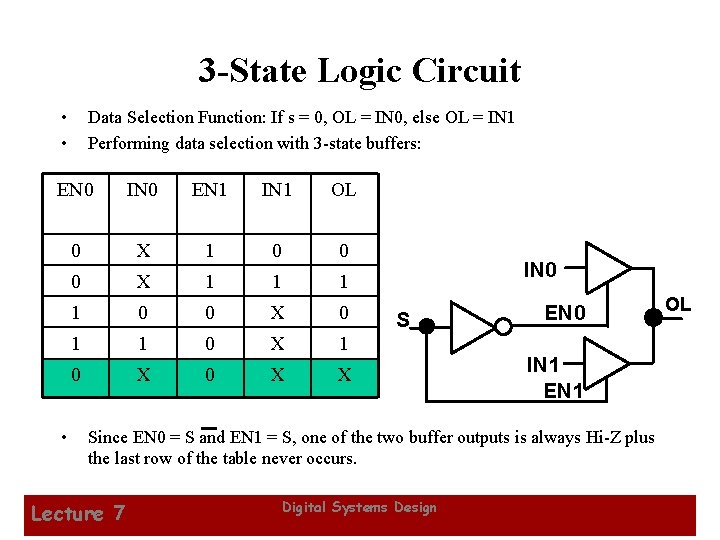
3 -State Logic Circuit • • Data Selection Function: If s = 0, OL = IN 0, else OL = IN 1 Performing data selection with 3 -state buffers: EN 0 IN 0 EN 1 IN 1 OL 0 X 1 0 0 0 X 1 1 0 0 X 0 1 1 0 X 0 X X • IN 0 S EN 0 OL IN 1 EN 1 Since EN 0 = S and EN 1 = S, one of the two buffer outputs is always Hi-Z plus the last row of the table never occurs. Lecture 7 Digital Systems Design 35
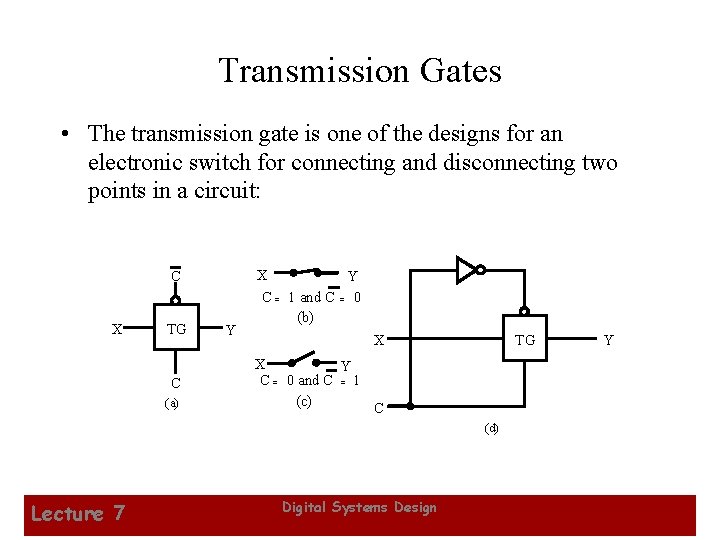
Transmission Gates • The transmission gate is one of the designs for an electronic switch for connecting and disconnecting two points in a circuit: X C X TG C (a) Y Y C = 1 and C = 0 (b) X TG Y X Y C = 0 and C = 1 (c) C (d) Lecture 7 Digital Systems Design 36
Transmission Gates (continued) • In many cases, X can be regarded as a data input and Y as an output. C and C, with complementary values applied, is a control input. • With these definitions, the transmission gate, provides a 3 -state output: – C = 1, Y = X (X = 0 or 1) – C = 0, Y = Hi-Z • Care must be taken when using the TG in design, however, since X and Y as input and output are interchangeable, and signals can pass in both directions. Lecture 7 Digital Systems Design 37
Circuit Example Using TG • Exclusive OR F = A + C • The basis for the function implementation is TGcontrolled paths to the output Lecture 7 Digital Systems Design 38