
Transformations A transformation is an operation that changes
- Slides: 23
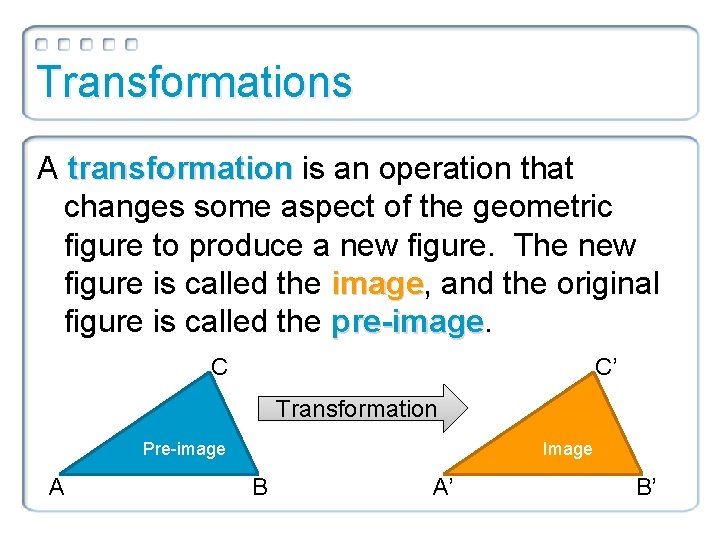
Transformations A transformation is an operation that changes some aspect of the geometric figure to produce a new figure. The new figure is called the image, image and the original figure is called the pre-image C C’ Transformation Pre-image A Image B A’ B’
Congruence Transformations A congruence transformation, transformation or isometry, isometry is a type of transformation that changes the position of a figure without changing its size or shape. – In other words, in an isometry, the preimage is congruent to the image. – There are three basic isometries…
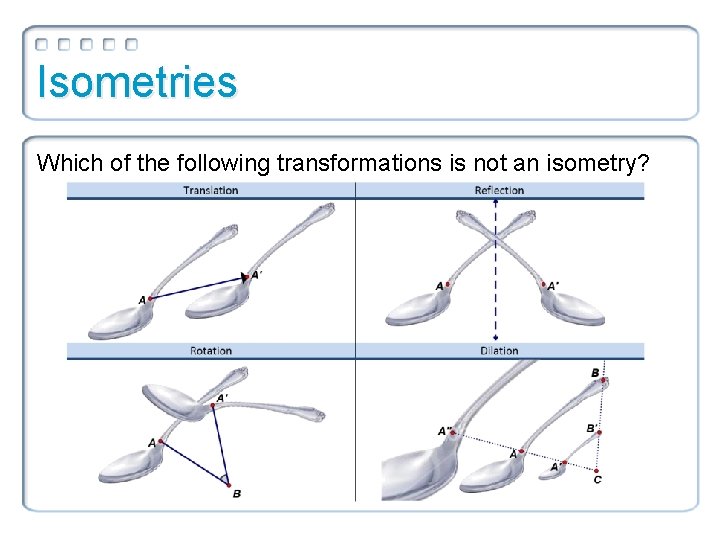
Isometries Which of the following transformations is not an isometry?
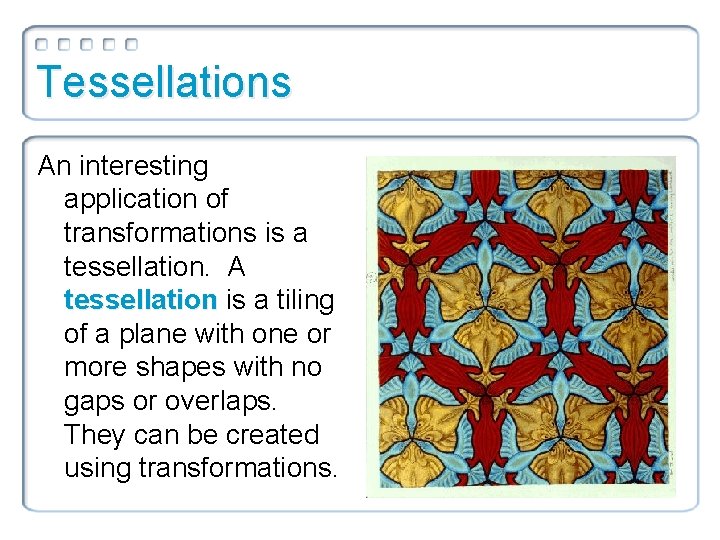
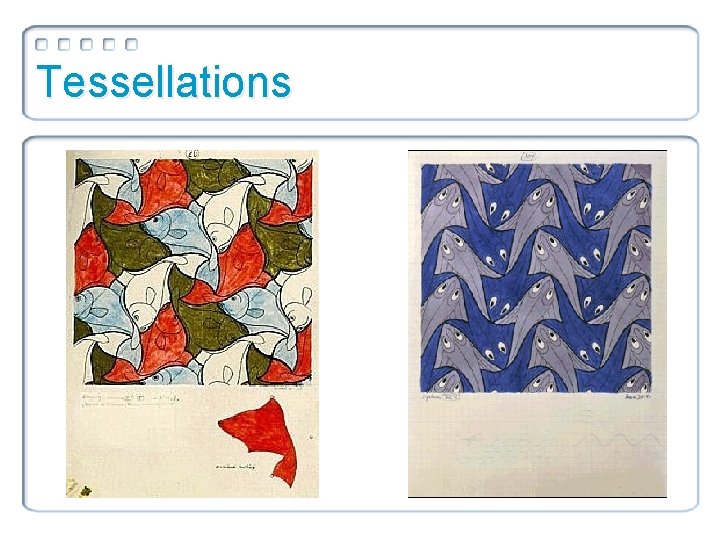
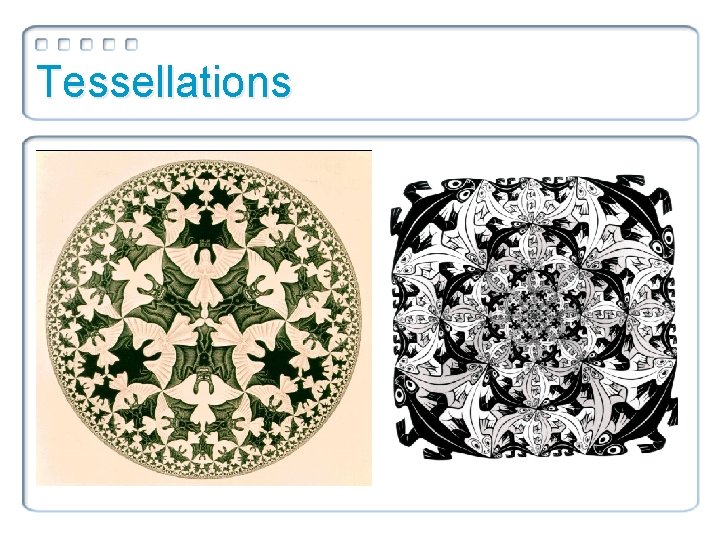
Tessellations An interesting application of transformations is a tessellation. A tessellation is a tiling of a plane with one or more shapes with no gaps or overlaps. They can be created using transformations.
Tessellations
Tessellations
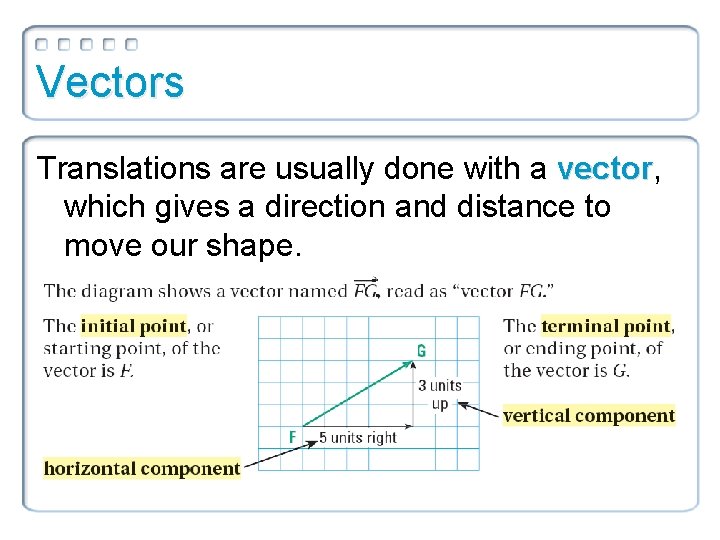
Vectors Translations are usually done with a vector, vector which gives a direction and distance to move our shape.
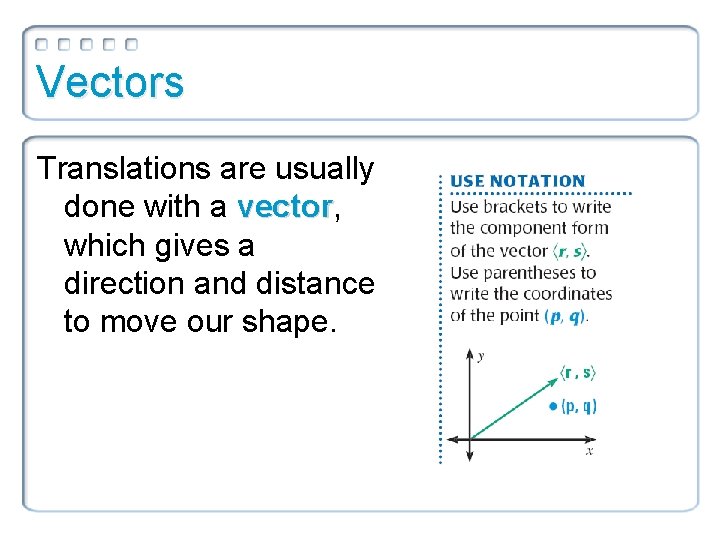
Vectors Translations are usually done with a vector, vector which gives a direction and distance to move our shape.
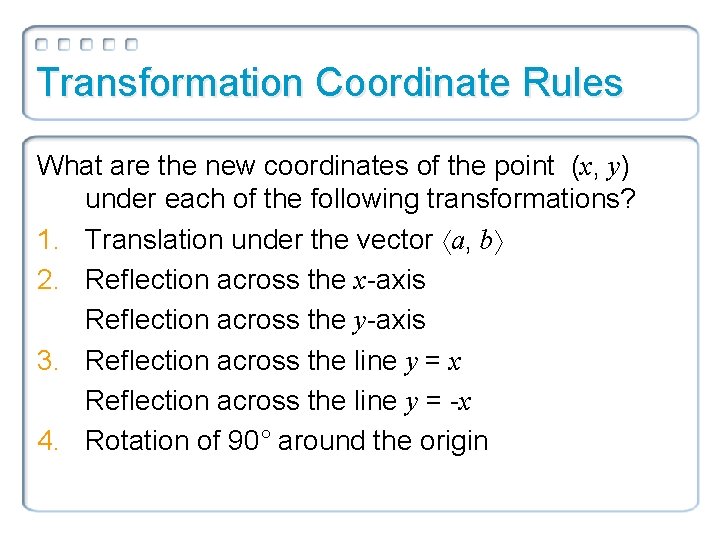
Transformation Coordinate Rules What are the new coordinates of the point (x, y) under each of the following transformations? 1. Translation under the vector a, b 2. Reflection across the x-axis Reflection across the y-axis 3. Reflection across the line y = x Reflection across the line y = -x 4. Rotation of 90° around the origin
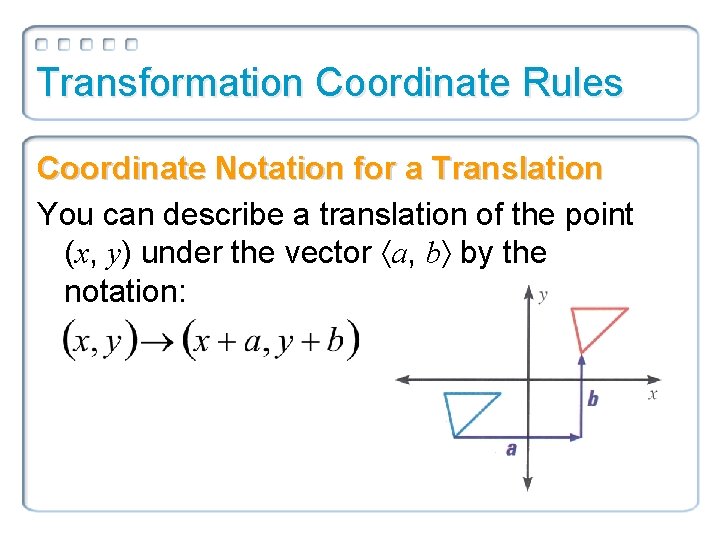
Transformation Coordinate Rules Coordinate Notation for a Translation You can describe a translation of the point (x, y) under the vector a, b by the notation:
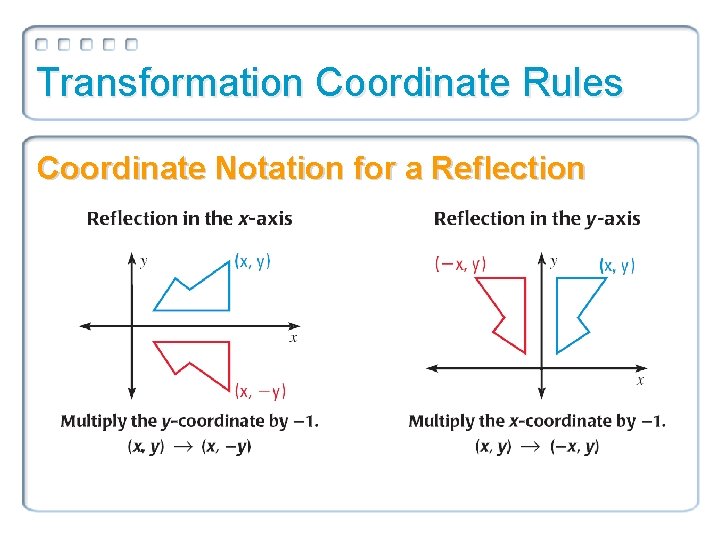
Transformation Coordinate Rules Coordinate Notation for a Reflection
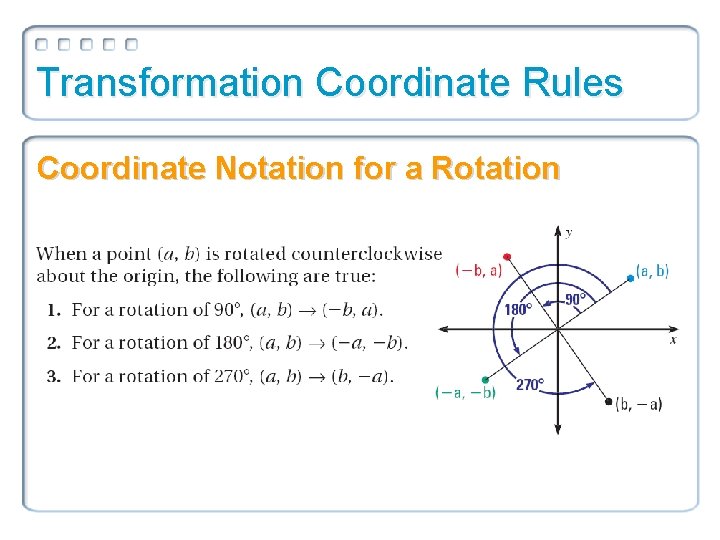
Transformation Coordinate Rules Coordinate Notation for a Rotation
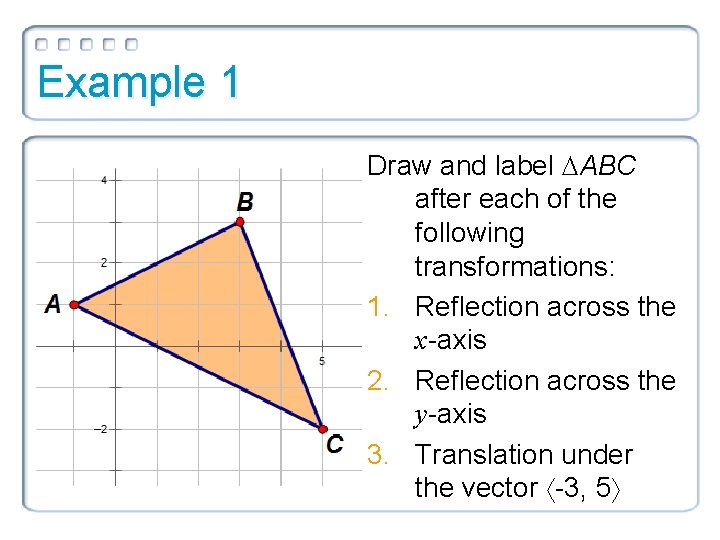
Example 1 Draw and label ABC after each of the following transformations: 1. Reflection across the x-axis 2. Reflection across the y-axis 3. Translation under the vector -3, 5
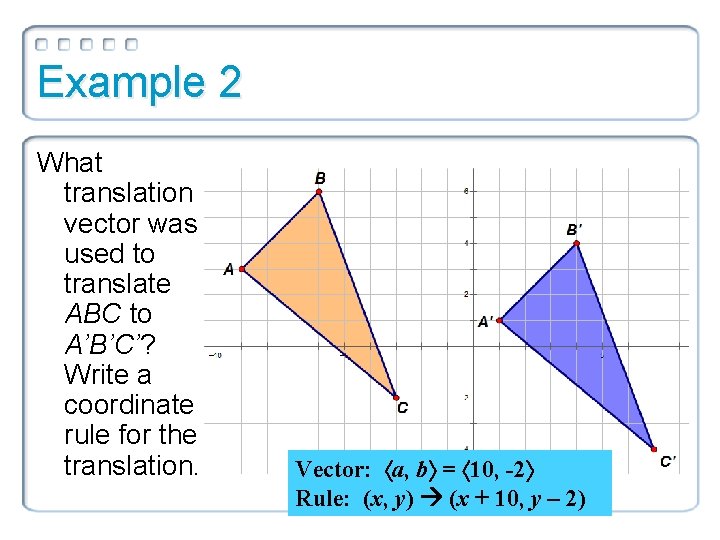
Example 2 What translation vector was used to translate ABC to A’B’C’? Write a coordinate rule for the translation. Vector: a, b = 10, -2 Rule: (x, y) (x + 10, y – 2)
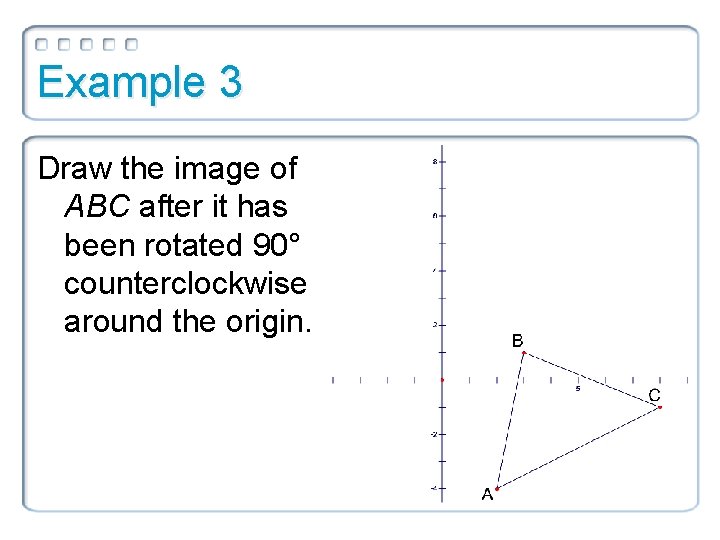
Example 3 Draw the image of ABC after it has been rotated 90° counterclockwise around the origin.
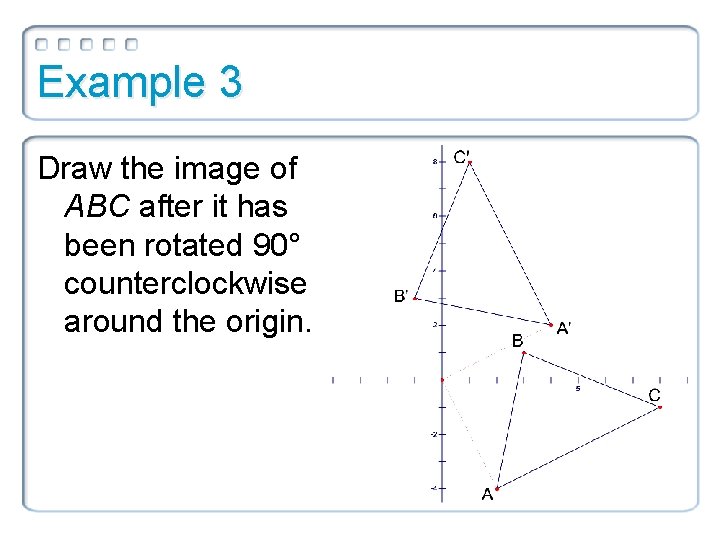
Example 3 Draw the image of ABC after it has been rotated 90° counterclockwise around the origin.
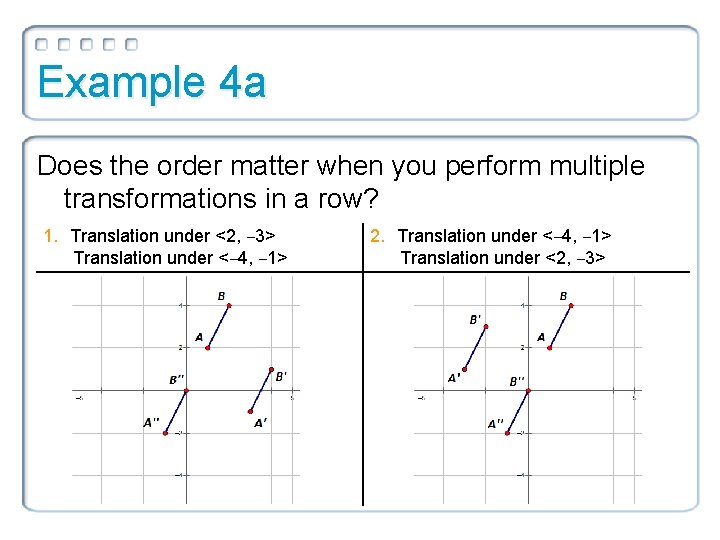
Example 4 a Does the order matter when you perform multiple transformations in a row? 1. Translation under <2, − 3> Translation under <− 4, − 1> 2. Translation under <− 4, − 1> Translation under <2, − 3>
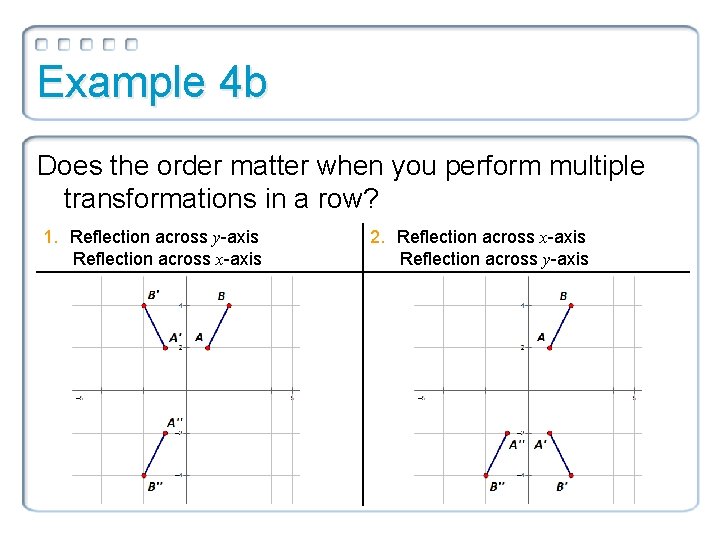
Example 4 b Does the order matter when you perform multiple transformations in a row? 1. Reflection across y-axis Reflection across x-axis 2. Reflection across x-axis Reflection across y-axis
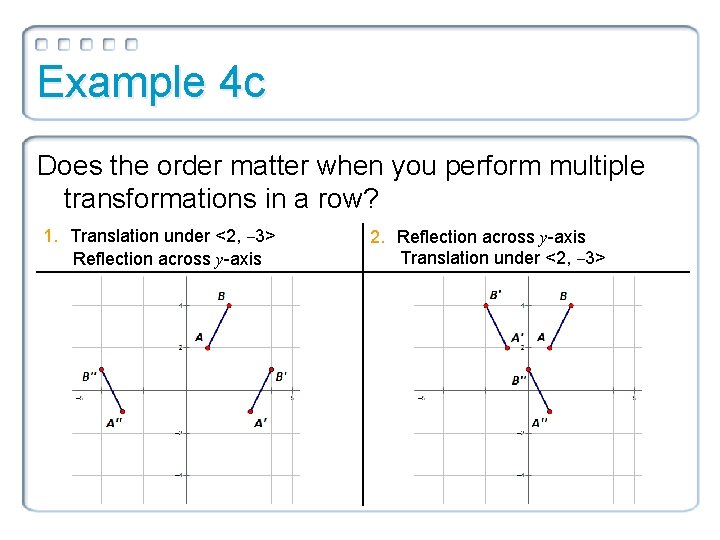
Example 4 c Does the order matter when you perform multiple transformations in a row? 1. Translation under <2, − 3> Reflection across y-axis 2. Reflection across y-axis Translation under <2, − 3>
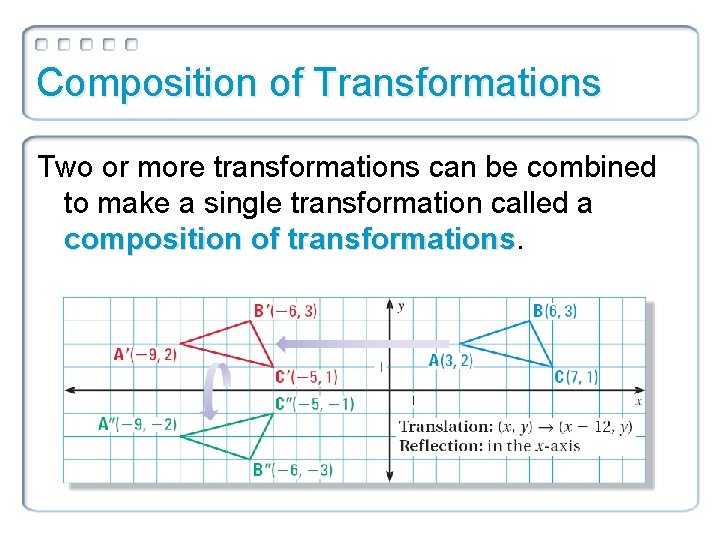
Composition of Transformations Two or more transformations can be combined to make a single transformation called a composition of transformations
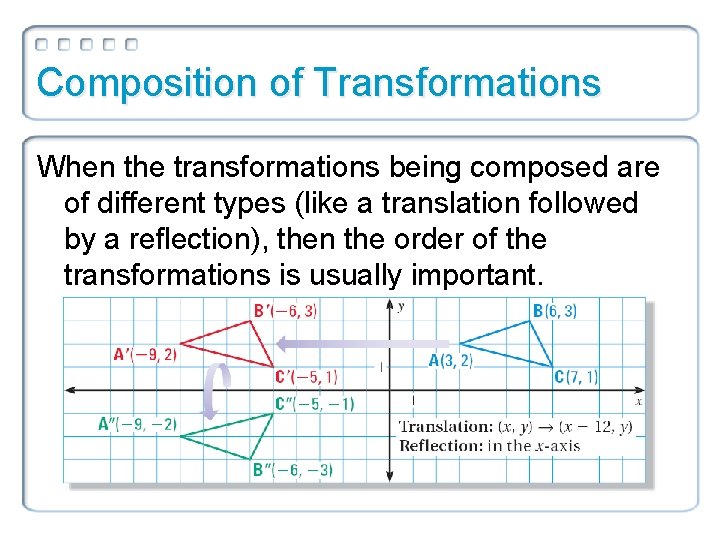
Composition of Transformations When the transformations being composed are of different types (like a translation followed by a reflection), then the order of the transformations is usually important.
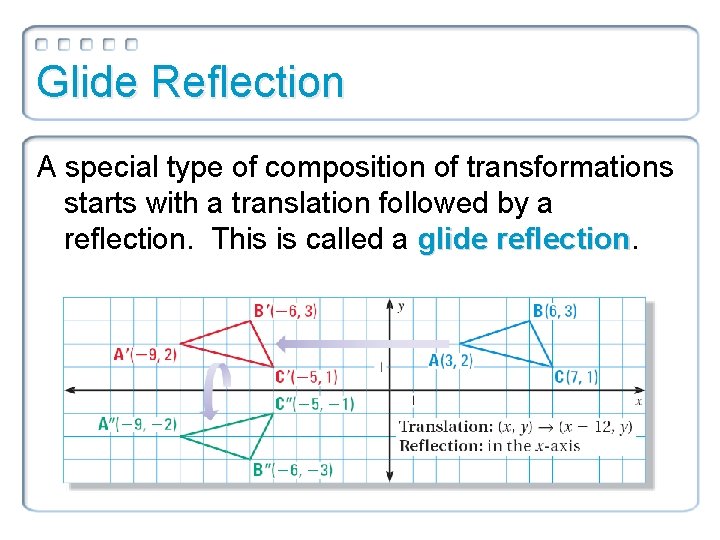
Glide Reflection A special type of composition of transformations starts with a translation followed by a reflection. This is called a glide reflection
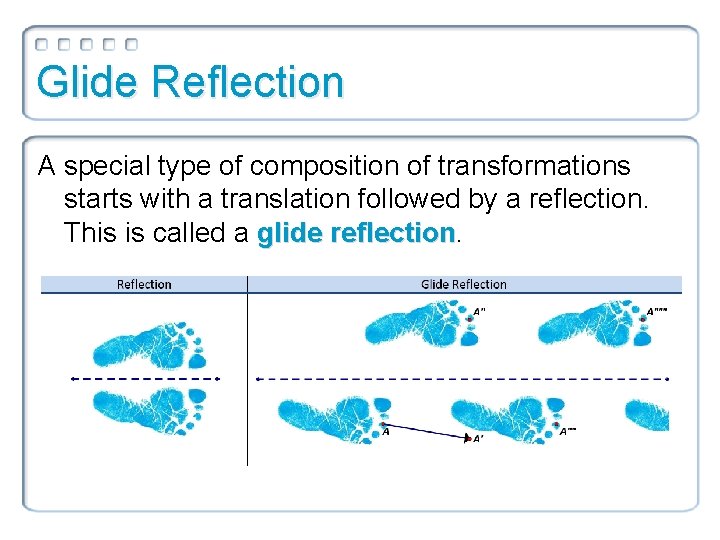
Glide Reflection A special type of composition of transformations starts with a translation followed by a reflection. This is called a glide reflection