
Transformational Leadership Transformational Leadership Model Britt Andreatta History
Transformational Leadership

Transformational Leadership Model Britt Andreatta
History § Most modern theory ~ seen as best fit for today’s businesses § Considers leadership in terms of the influence or effects that leaders may have on followers § Effective leaders create and promote desirable visions of the organization (includes perceptions, attitudes, commitments) § Leaders are change-oriented – Generate more creative solutions to problems – Respond more quickly to changes in environment or to mission
Transformational Leadership § Restore in organization a sense of meaning and purpose – Projects confidence and commitment to followers § Facilitate the emergence of leadership latent within organization – Attract new personnel of higher quality – Demonstrate more effective delegation – Challenge people more fully § Concerned with doing “the right thing”
5 Step Agenda 1. Create readiness for change by focusing attention on the unsatisfactory aspects of the organization 2. Overcome resistance by using non-threatening approaches to introduce change 3. Articulate a vision by combining rational reasoning and symbolic imagery 4. Generate commitment 5. Institutionalize commitment

Four I’s of Model 1. Individualized Consideration – develops associates to higher levels of ability and potential 2. Intellectual Stimulation – enables associates to think about old problems in new ways 3. Inspirational Motivation – communicates high standards of performance to associates 4. Idealized Influence – Associates share complete faith and trust in their leaders
Conditions for TL § Organizational crisis is likely to encourage transformational leadership because followers expect leader to take strong action § Turbulent conditions, uncertain environments, rapid changes, especially in technology § Need to be innovative to remain competitive § Have employees/volunteers who are not being used to their full potential (might see high turnover because of this) § Confronted with extremely difficult, complex problems
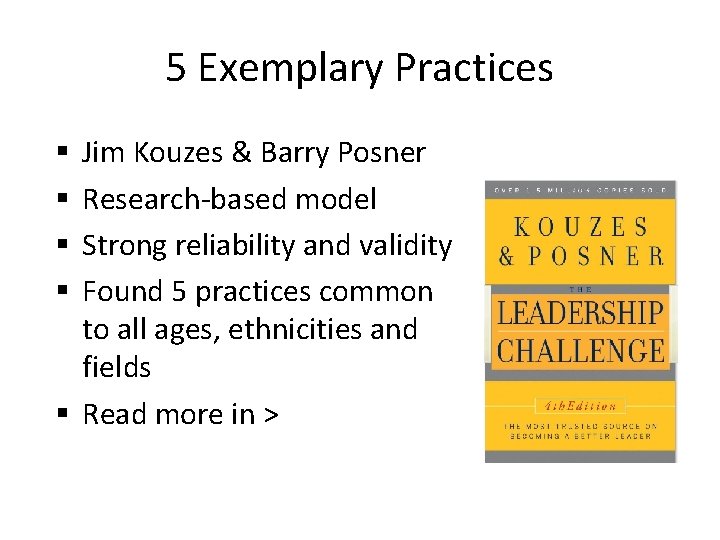
5 Exemplary Practices Jim Kouzes & Barry Posner Research-based model Strong reliability and validity Found 5 practices common to all ages, ethnicities and fields § Read more in > § §

The Research § Conducted research 4, 800 individual cases, plus 350, 000 surveys, and 325 studies § They asked: “Think about a time you were at your personal best as a leader … What were the key actions and behaviors you took as the leader that made a difference? ” § Found 5 exemplary practices
The 5 Practices of Exemplary Leadership § § § Model the Way Inspire a Shared Vision Challenge the Process Enable Others to Act Encourage the Heart
Challenging the Process § Innovating § Initiating § Making opportunities for change § Mistakes are seen as opportunities for growth

Inspiring a Shared Vision § Looking to the future § Dreaming of new possibilities § Giving direction and purpose to org § Sharing vision with others
Enabling Others to Act § Recognize you need others § Create atmosphere of mutual trust and respect § Create cooperative goals § Cultivate new leaders by giving them leadership opportunities
Modeling the Way § Have a set of standards and values § Be clear about your own values § Be consistent with your words and actions § Help others to see possibilities
Encouraging the Heart § Set high expectations for self and others § Encourage others to contribute § Give clear direction, substantial encouragement, and meaningful feedback § Celebrate individual and team accomplishments
- Slides: 16