
Transformational Geometry Chapter 6 Another Look at Functions
- Slides: 34
Transformational Geometry Chapter 6
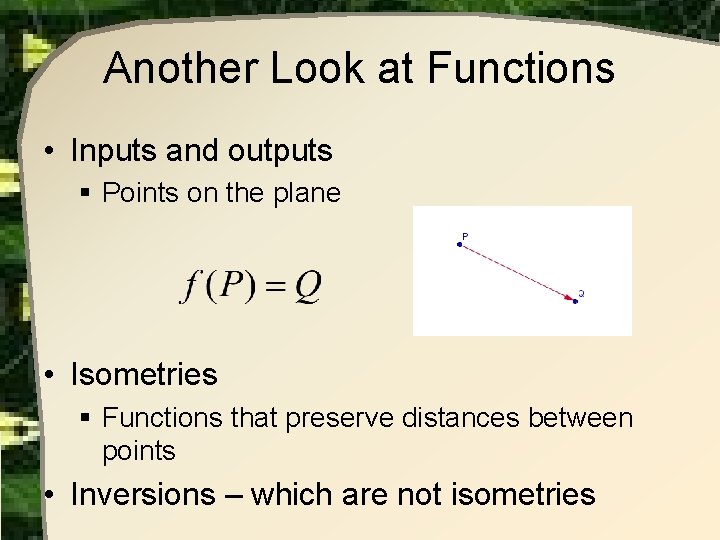
Another Look at Functions • Inputs and outputs § Points on the plane • Isometries § Functions that preserve distances between points • Inversions – which are not isometries
Another Look at Functions • Recall concept of a function § Mapping from set A (source, domain) § To set B (target, range) § Each input generates a unique output • Note § Behavior of function may restrict the extent of the domain or range
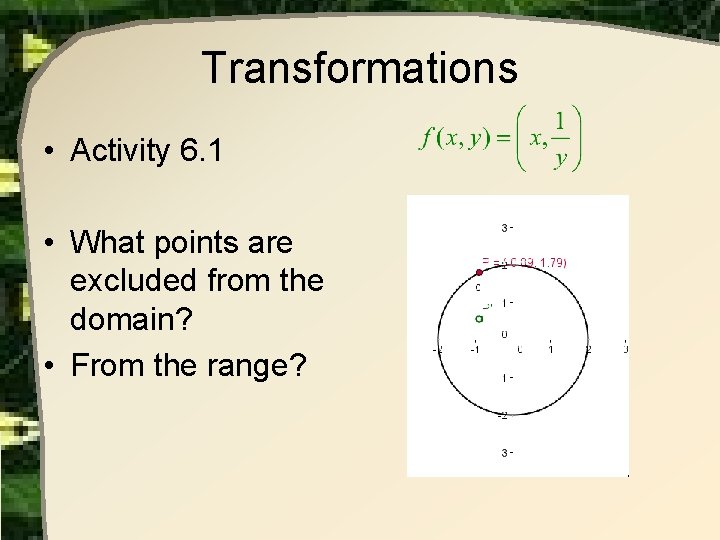
Transformations • Activity 6. 1 • What points are excluded from the domain? • From the range?
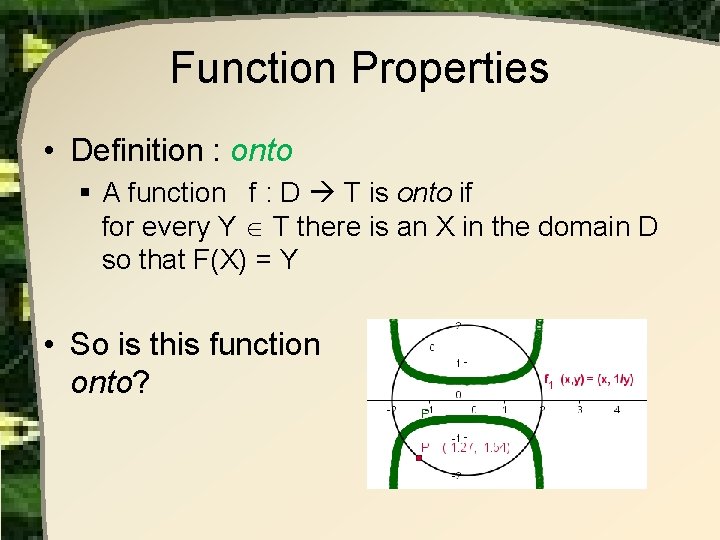
Function Properties • Definition : onto § A function f : D T is onto if for every Y T there is an X in the domain D so that F(X) = Y • So is this function onto?
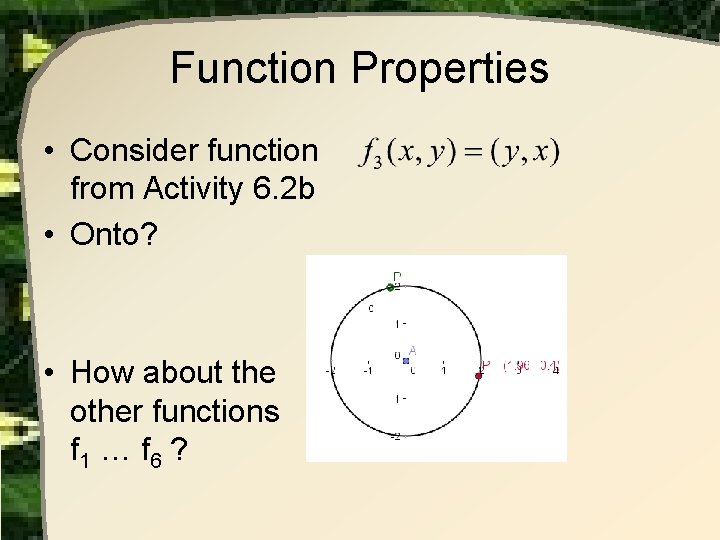
Function Properties • Consider function from Activity 6. 2 b • Onto? • How about the other functions f 1 … f 6 ?
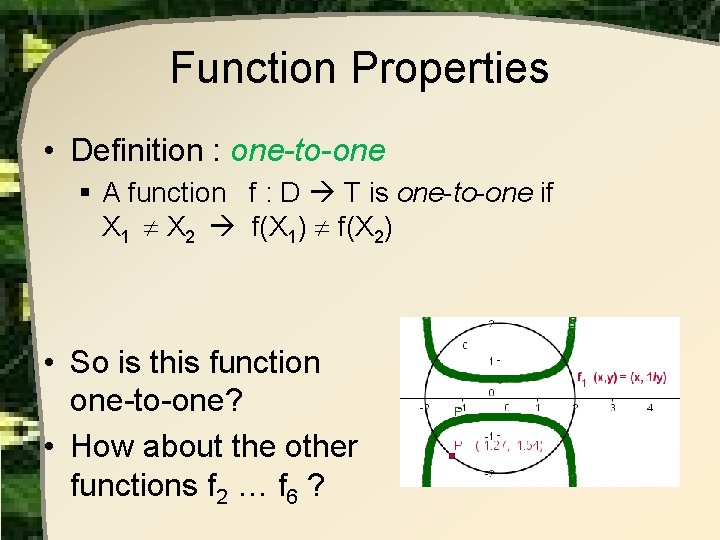
Function Properties • Definition : one-to-one § A function f : D T is one-to-one if X 1 X 2 f(X 1) f(X 2) • So is this function one-to-one? • How about the other functions f 2 … f 6 ?
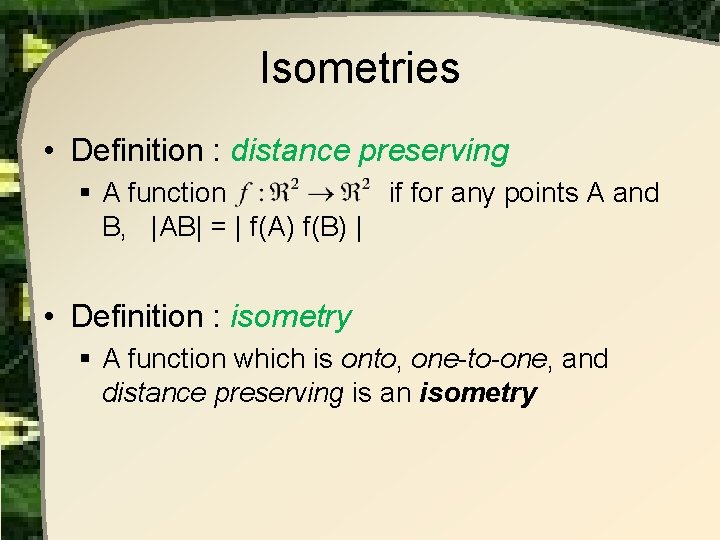
Isometries • Definition : distance preserving § A function if for any points A and B, |AB| = | f(A) f(B) | • Definition : isometry § A function which is onto, one-to-one, and distance preserving is an isometry
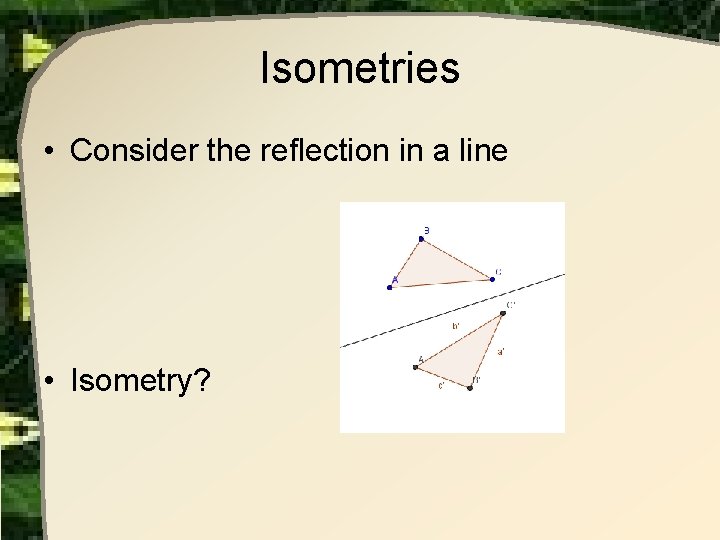
Isometries • Consider the reflection in a line • Isometry?
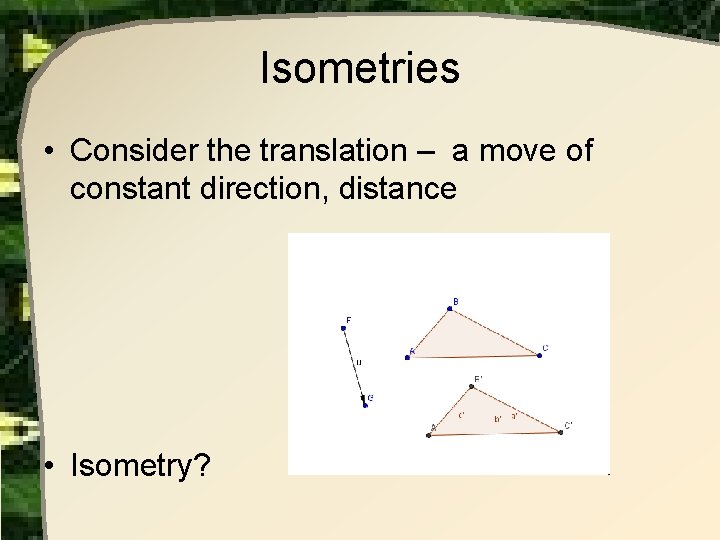
Isometries • Consider the translation – a move of constant direction, distance • Isometry?
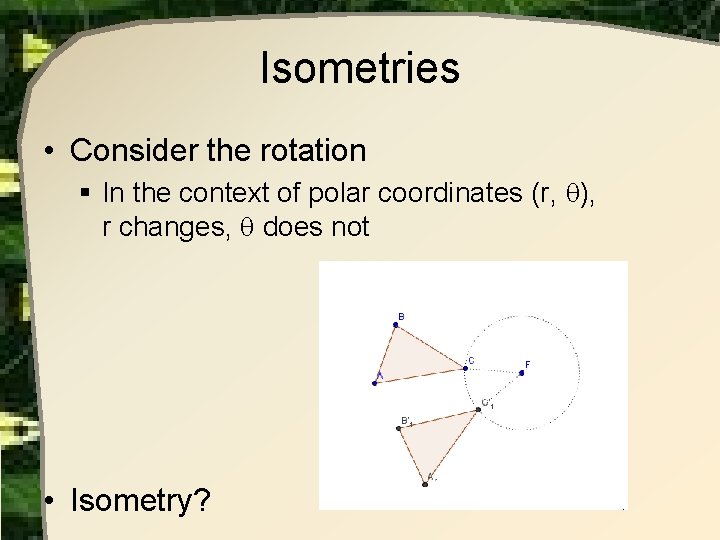
Isometries • Consider the rotation § In the context of polar coordinates (r, ), r changes, does not • Isometry?
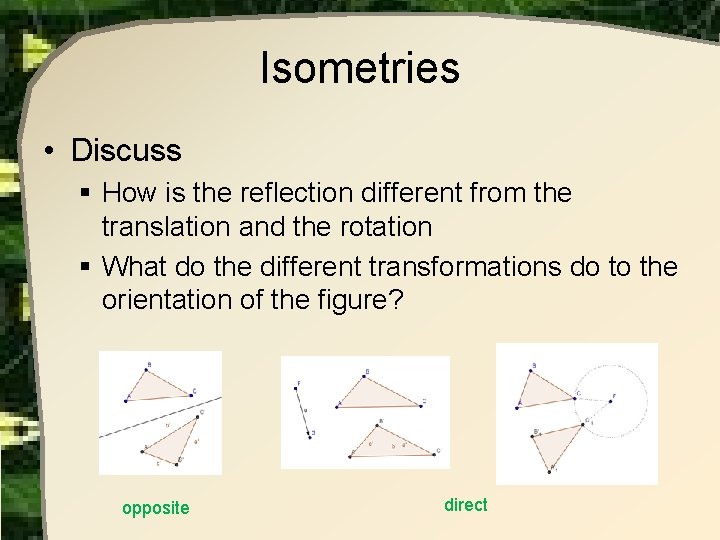
Isometries • Discuss § How is the reflection different from the translation and the rotation § What do the different transformations do to the orientation of the figure? opposite direct
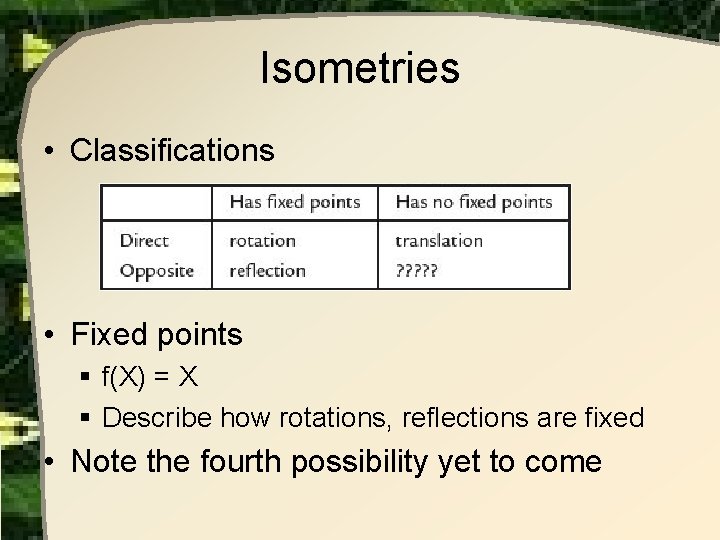
Isometries • Classifications • Fixed points § f(X) = X § Describe how rotations, reflections are fixed • Note the fourth possibility yet to come
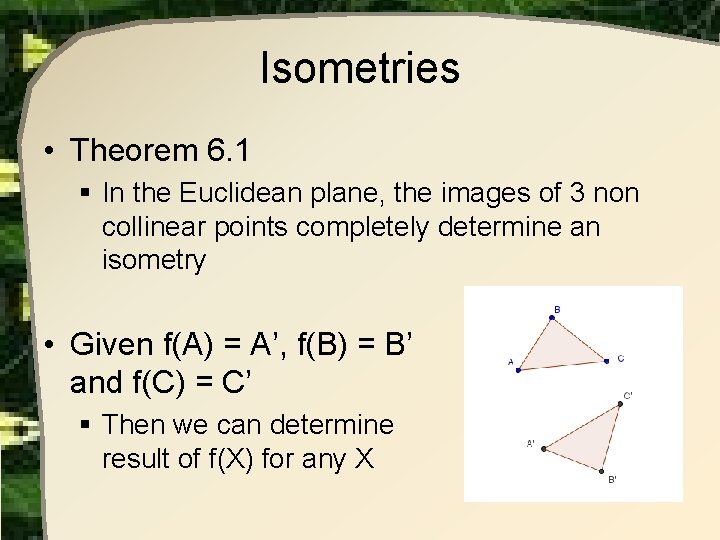
Isometries • Theorem 6. 1 § In the Euclidean plane, the images of 3 non collinear points completely determine an isometry • Given f(A) = A’, f(B) = B’ and f(C) = C’ § Then we can determine result of f(X) for any X
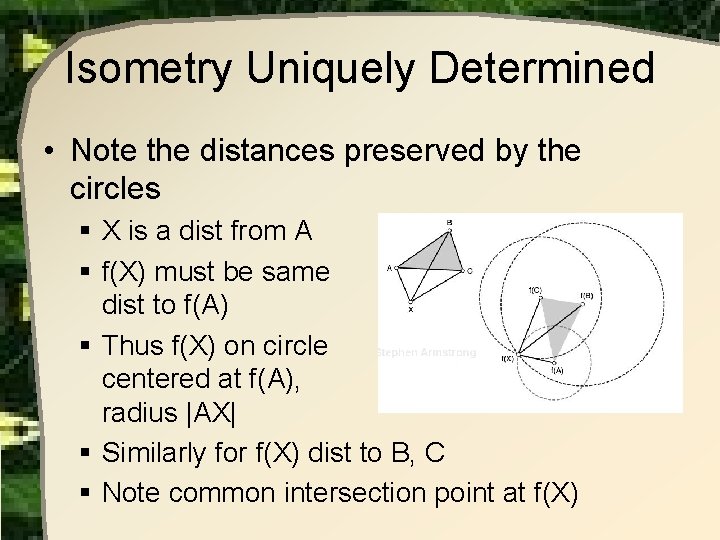
Isometry Uniquely Determined • Note the distances preserved by the circles § X is a dist from A § f(X) must be same dist to f(A) § Thus f(X) on circle centered at f(A), radius |AX| § Similarly for f(X) dist to B, C § Note common intersection point at f(X)
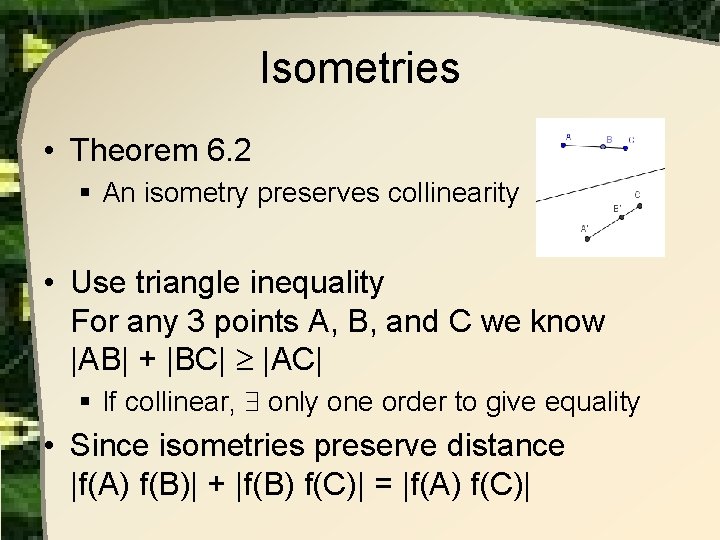
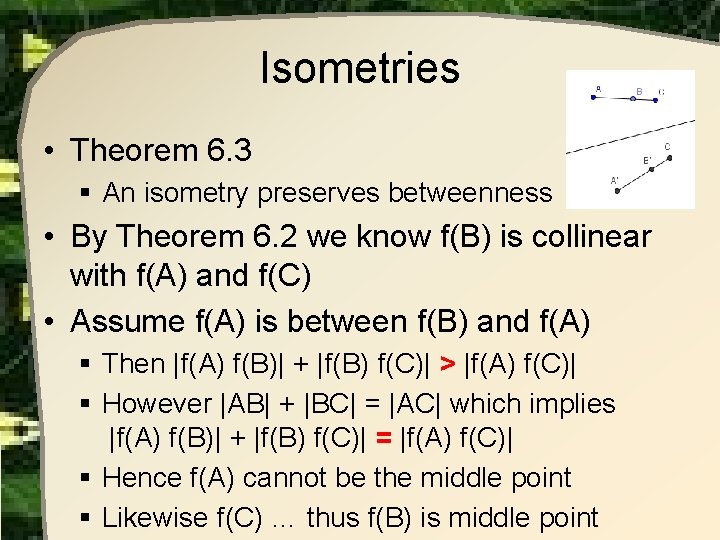
Isometries • Theorem 6. 2 § An isometry preserves collinearity • Use triangle inequality For any 3 points A, B, and C we know |AB| + |BC| |AC| § If collinear, only one order to give equality • Since isometries preserve distance |f(A) f(B)| + |f(B) f(C)| = |f(A) f(C)|
Isometries • Theorem 6. 3 § An isometry preserves betweenness • By Theorem 6. 2 we know f(B) is collinear with f(A) and f(C) • Assume f(A) is between f(B) and f(A) § Then |f(A) f(B)| + |f(B) f(C)| > |f(A) f(C)| § However |AB| + |BC| = |AC| which implies |f(A) f(B)| + |f(B) f(C)| = |f(A) f(C)| § Hence f(A) cannot be the middle point § Likewise f(C) … thus f(B) is middle point
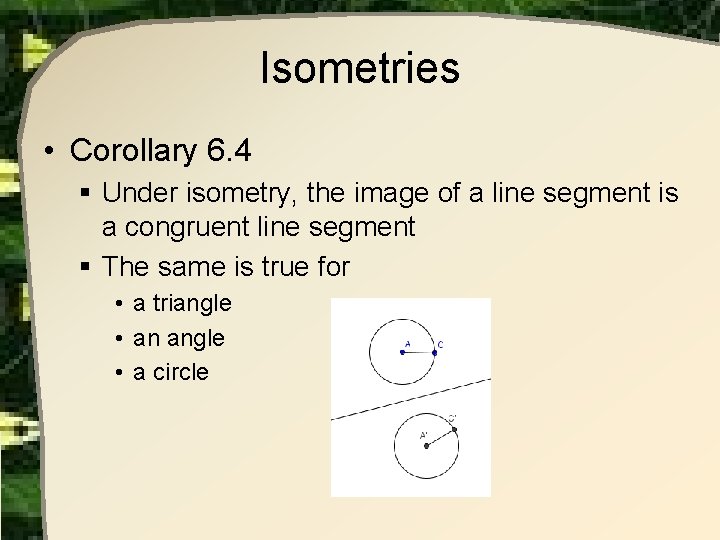
Isometries • Corollary 6. 4 § Under isometry, the image of a line segment is a congruent line segment § The same is true for • a triangle • an angle • a circle
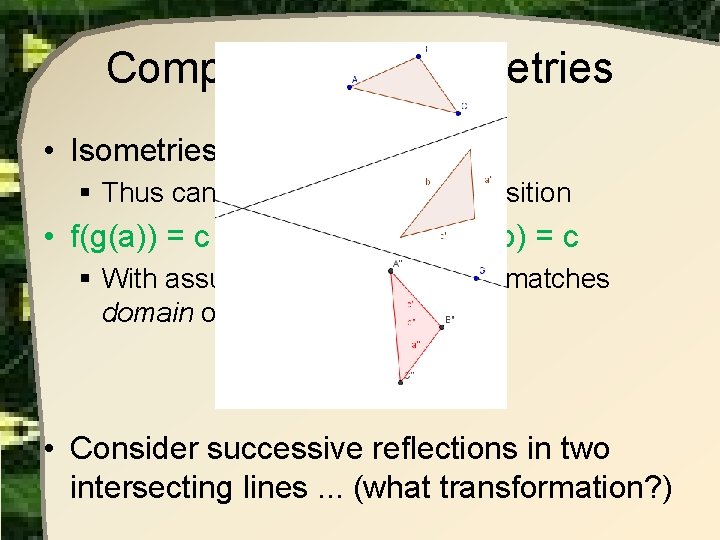
Composition of Isometries • Isometries are functions § Thus can be combined in composition • f(g(a)) = c g(a) = b and f(b) = c § With assumption that range of g matches domain of f • Consider successive reflections in two intersecting lines. . . (what transformation? )
Composition of Isometries • What transformations result from § Successive reflections in two parallel lines? § Two translations in any direction • Theorem 6. 5 § In the Euclidean plane, there are only four types of isometry: • • Translations Rotations Reflections Glide reflections
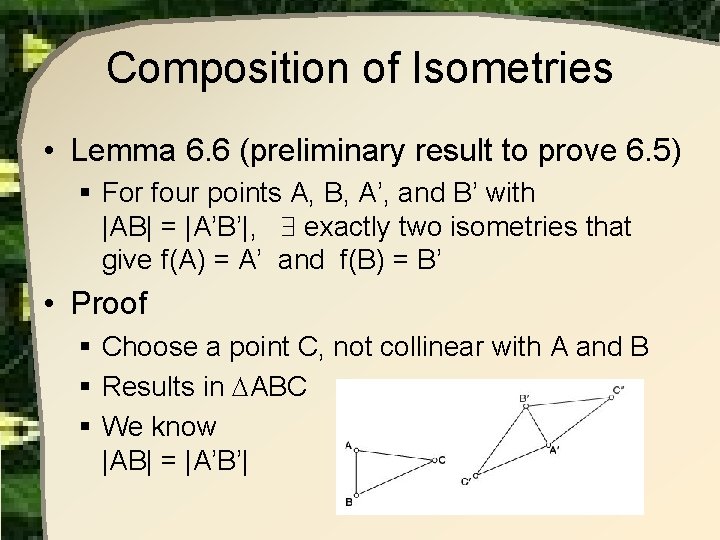
Composition of Isometries • Lemma 6. 6 (preliminary result to prove 6. 5) § For four points A, B, A’, and B’ with |AB| = |A’B’|, exactly two isometries that give f(A) = A’ and f(B) = B’ • Proof § Choose a point C, not collinear with A and B § Results in ABC § We know |AB| = |A’B’|
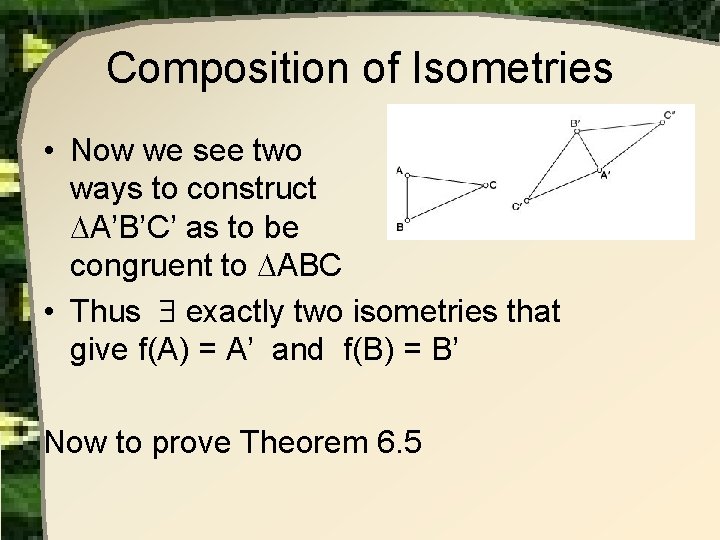
Composition of Isometries • Now we see two ways to construct A’B’C’ as to be congruent to ABC • Thus exactly two isometries that give f(A) = A’ and f(B) = B’ Now to prove Theorem 6. 5
Composition of Isometries Proof of Theorem 6. 5 – examine possibilities • Given f an isometry where f(A) A • If there is no such point A … § Then every point is a fixed point for f § Two possible isometries: • Translation by zero vector • Rotation by zero degrees The trivial case • If there is such a point where f(A) A we need to consider what happens to 3 points
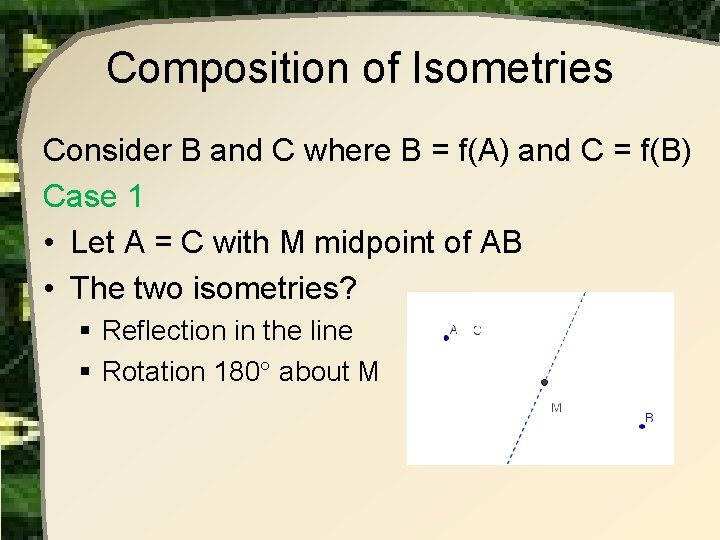
Composition of Isometries Consider B and C where B = f(A) and C = f(B) Case 1 • Let A = C with M midpoint of AB • The two isometries? § Reflection in the line § Rotation 180 about M
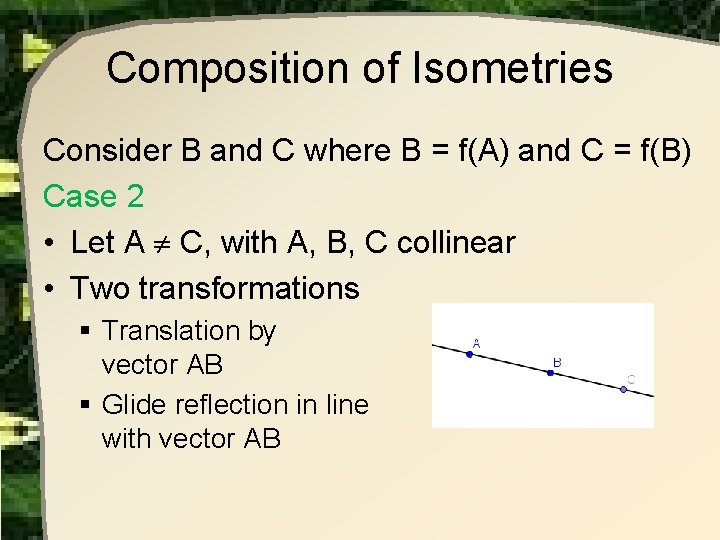
Composition of Isometries Consider B and C where B = f(A) and C = f(B) Case 2 • Let A C, with A, B, C collinear • Two transformations § Translation by vector AB § Glide reflection in line with vector AB
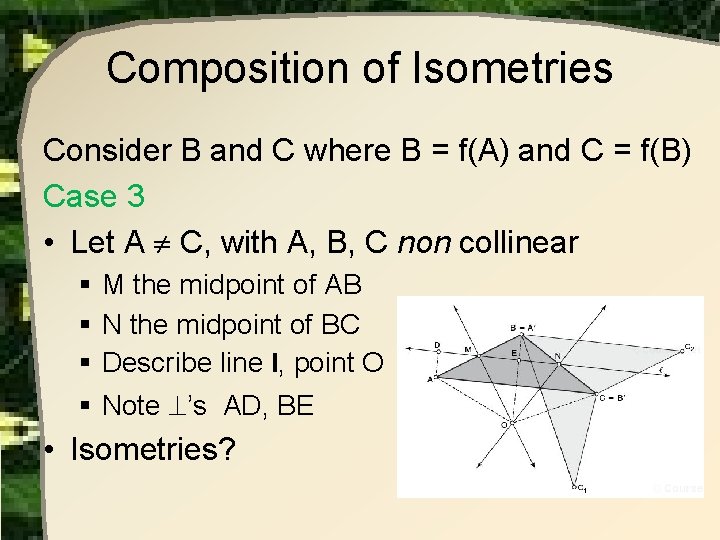
Composition of Isometries Consider B and C where B = f(A) and C = f(B) Case 3 • Let A C, with A, B, C non collinear § M the midpoint of AB § N the midpoint of BC § Describe line l, point O § Note ’s AD, BE • Isometries?
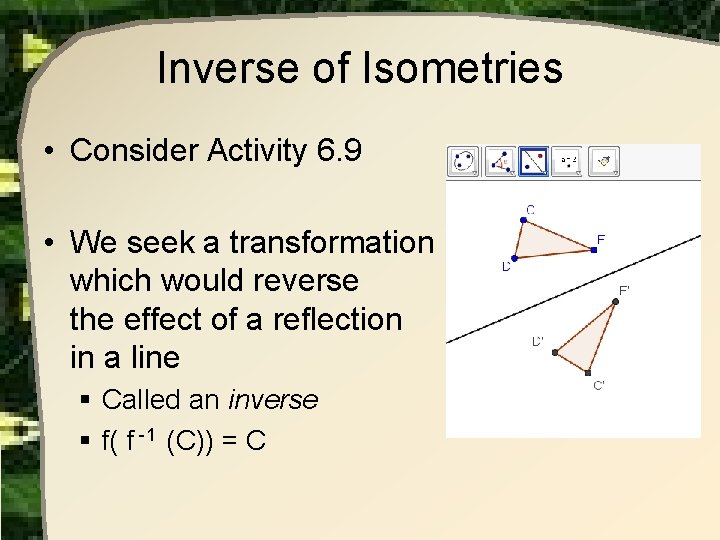
Inverse of Isometries • Consider Activity 6. 9 • We seek a transformation which would reverse the effect of a reflection in a line § Called an inverse § f( f -1 (C)) = C
Inverse of Isometries • Link to abstract algebra: § The set of isometries in the Euclidean plane is an example of a group • Definition: § A group is a set with binary operation that satisfies the properties of • • Closure Associativity Identity Inverses Composition Note: no commutativity
Inverse of Isometries • Lemma 6. 7 § The composition of any two isometries is an isometry (closure property) § Why? § Note again the lack of commutativity • Theorem 6. 8 § The set of all isometries in the plane is a group • Which individual transformations are subgroups?
Using Isometries in Proofs • Recall that isometries preserve congruence § If we can find an isometry between two objects Then we have proved congruence • Also proof by isometry can give new insights
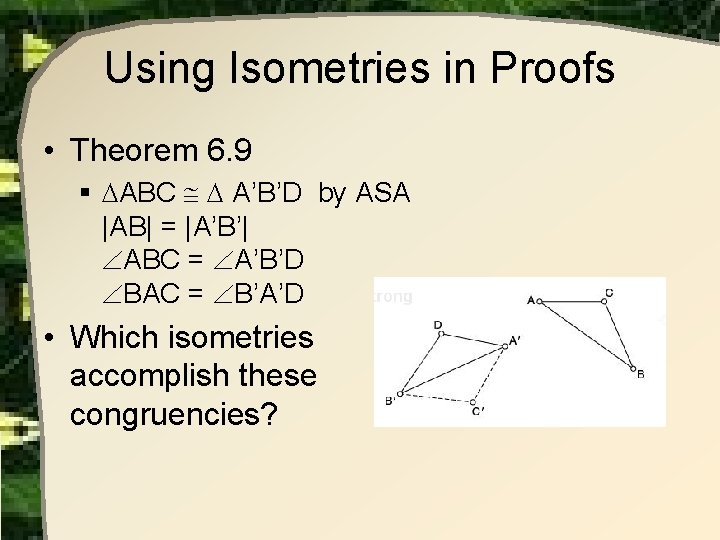
Using Isometries in Proofs • Theorem 6. 9 § ABC A’B’D by ASA |AB| = |A’B’| ABC = A’B’D BAC = B’A’D • Which isometries accomplish these congruencies?
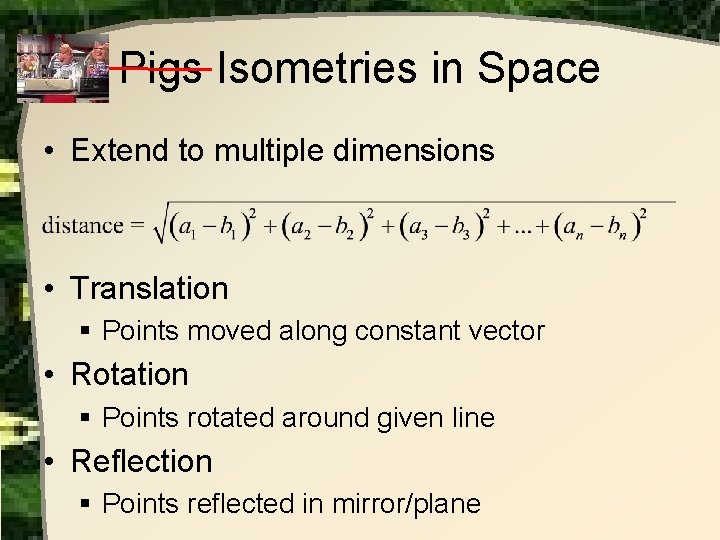
Pigs Isometries in Space • Extend to multiple dimensions • Translation § Points moved along constant vector • Rotation § Points rotated around given line • Reflection § Points reflected in mirror/plane
Isometries in Space • Glide reflection § Points reflected in plane, then translated with vector parallel to plane • Screw or twist § Rotation followed by translation • Rotary reflection § Reflection followed by rotation around axis • Central inversion § Reflection in a point
Transformational Geometry Chapter 6