
TRANSFORMATION OF FUNCTION OF TWO OR MORE RANDOM


- Slides: 18
TRANSFORMATION OF FUNCTION OF TWO OR MORE RANDOM VARIABLES BIVARIATE TRANSFORMATIONS
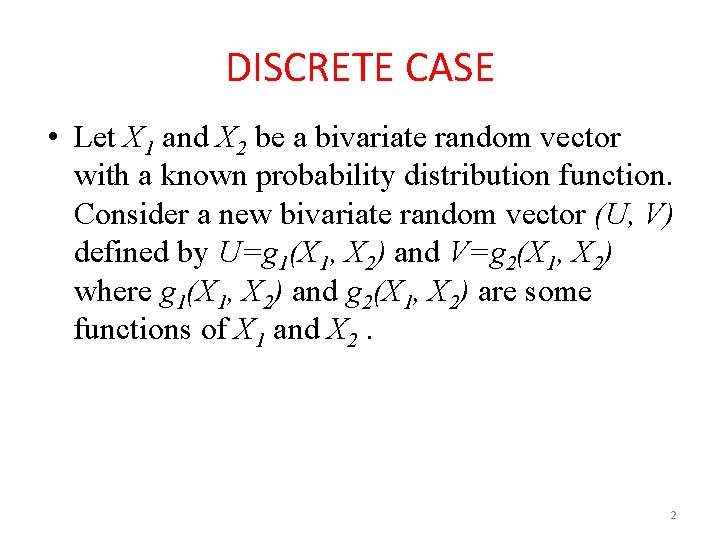
DISCRETE CASE • Let X 1 and X 2 be a bivariate random vector with a known probability distribution function. Consider a new bivariate random vector (U, V) defined by U=g 1(X 1, X 2) and V=g 2(X 1, X 2) where g 1(X 1, X 2) and g 2(X 1, X 2) are some functions of X 1 and X 2. 2
DISCRETE CASE • If B is any subset of 2, then (U, V) B iff (X 1, X 2) A where • Then, Pr(U, V) B=Pr(X 1, X 2) A and probability distribution of (U, V) is completely determined by the probability distribution of (X 1, X 2). Then, the joint pmf of (U, V) is 3
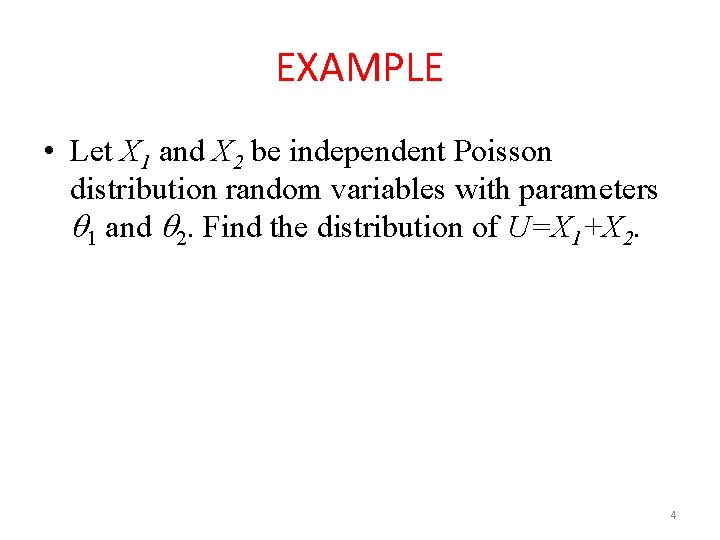
EXAMPLE • Let X 1 and X 2 be independent Poisson distribution random variables with parameters 1 and 2. Find the distribution of U=X 1+X 2. 4
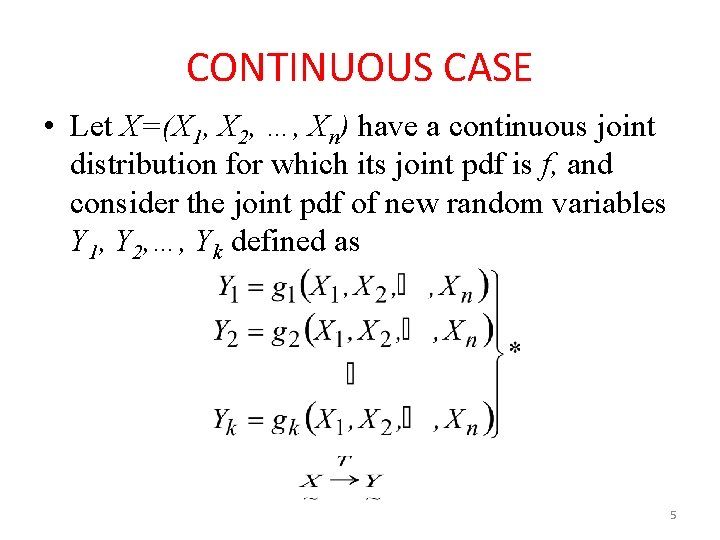
CONTINUOUS CASE • Let X=(X 1, X 2, …, Xn) have a continuous joint distribution for which its joint pdf is f, and consider the joint pdf of new random variables Y 1, Y 2, …, Yk defined as 5
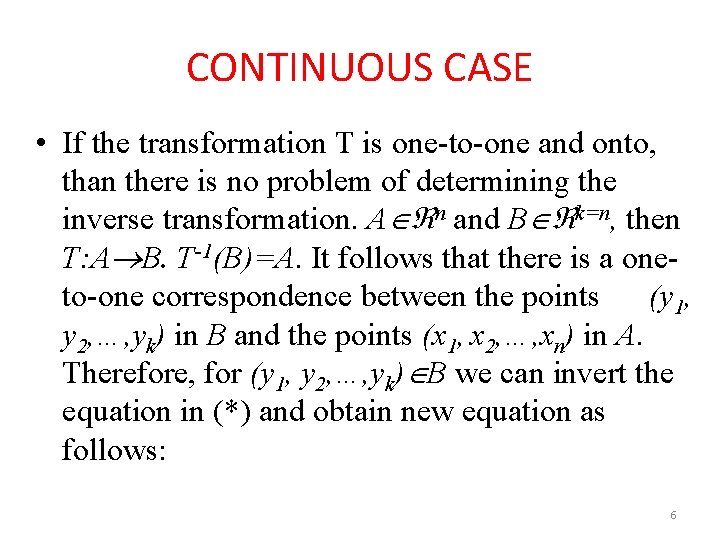
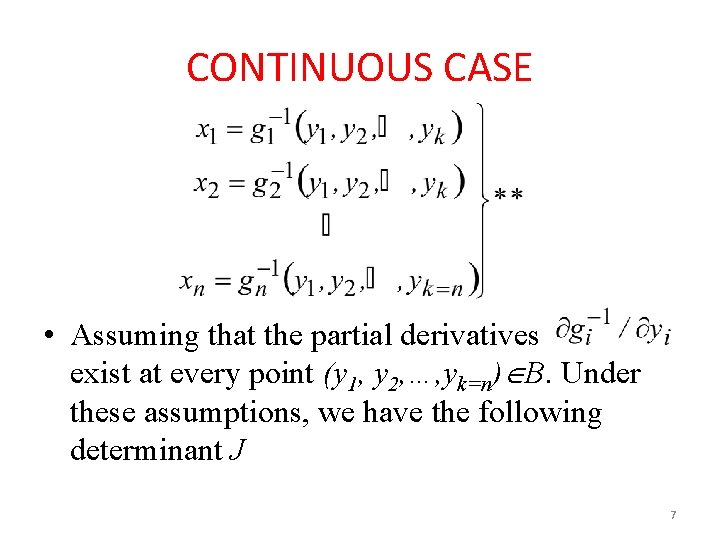
CONTINUOUS CASE • If the transformation T is one-to-one and onto, than there is no problem of determining the inverse transformation. A n and B k=n, then T: A B. T-1(B)=A. It follows that there is a oneto-one correspondence between the points (y 1, y 2, …, yk) in B and the points (x 1, x 2, …, xn) in A. Therefore, for (y 1, y 2, …, yk) B we can invert the equation in (*) and obtain new equation as follows: 6
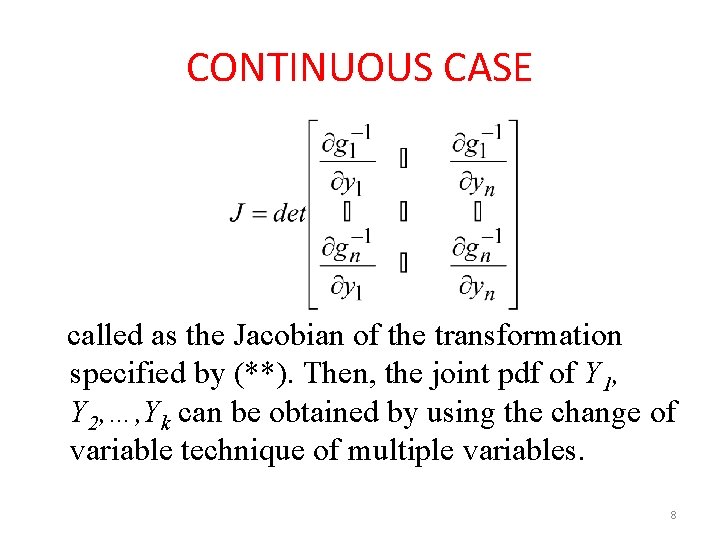
CONTINUOUS CASE • Assuming that the partial derivatives exist at every point (y 1, y 2, …, yk=n) B. Under these assumptions, we have the following determinant J 7
CONTINUOUS CASE called as the Jacobian of the transformation specified by (**). Then, the joint pdf of Y 1, Y 2, …, Yk can be obtained by using the change of variable technique of multiple variables. 8
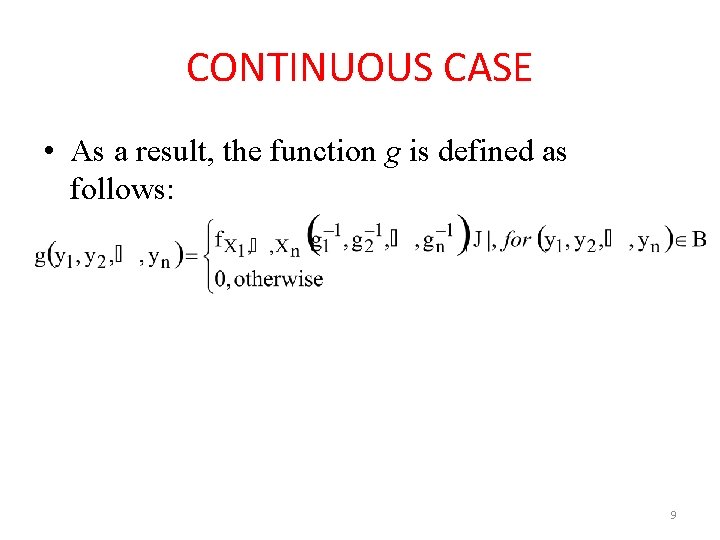
CONTINUOUS CASE • As a result, the function g is defined as follows: 9
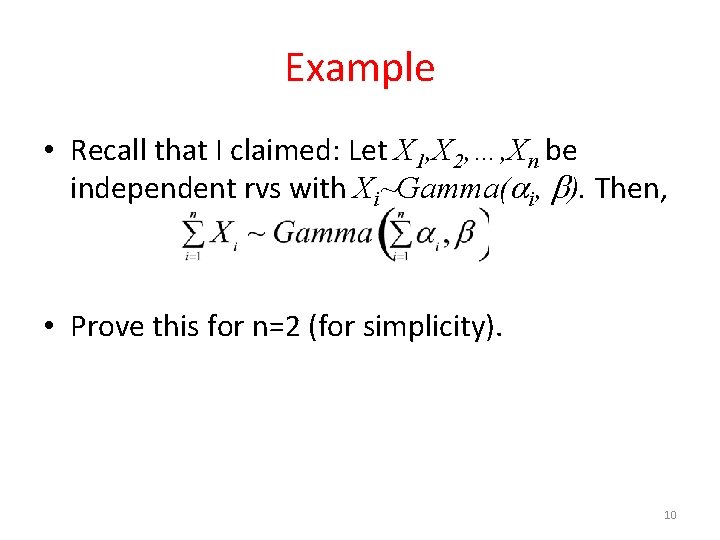
Example • Recall that I claimed: Let X 1, X 2, …, Xn be independent rvs with Xi~Gamma( i, ). Then, • Prove this for n=2 (for simplicity). 10
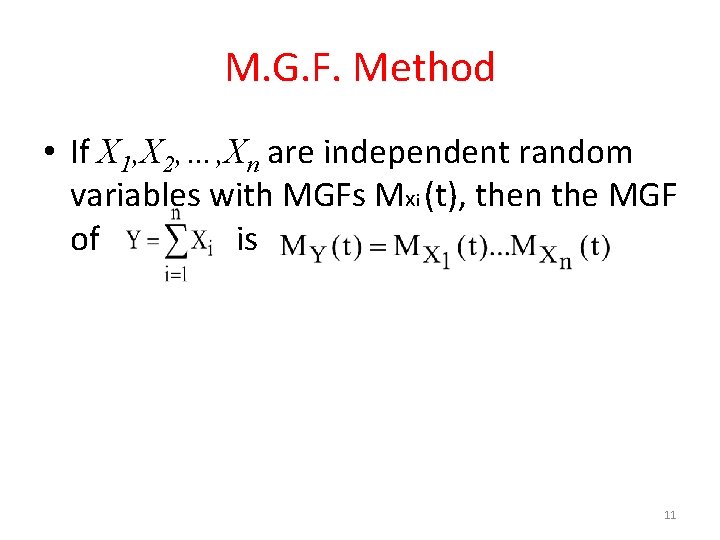
M. G. F. Method • If X 1, X 2, …, Xn are independent random variables with MGFs Mxi (t), then the MGF of is 11
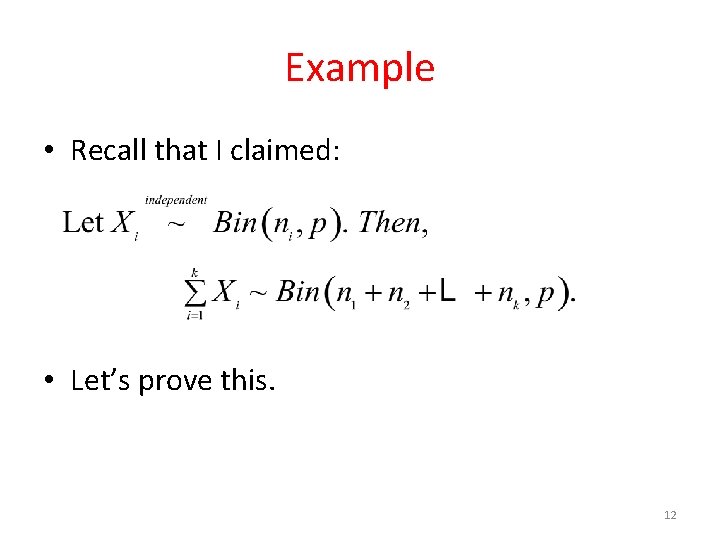
Example • Recall that I claimed: • Let’s prove this. 12
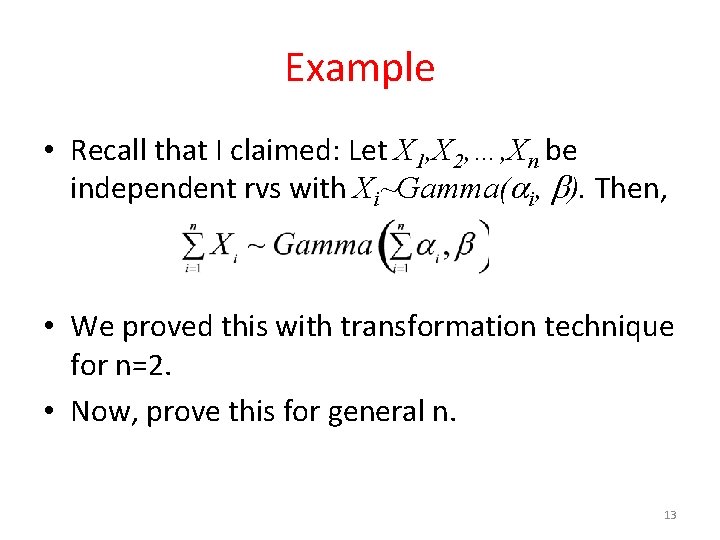
Example • Recall that I claimed: Let X 1, X 2, …, Xn be independent rvs with Xi~Gamma( i, ). Then, • We proved this with transformation technique for n=2. • Now, prove this for general n. 13
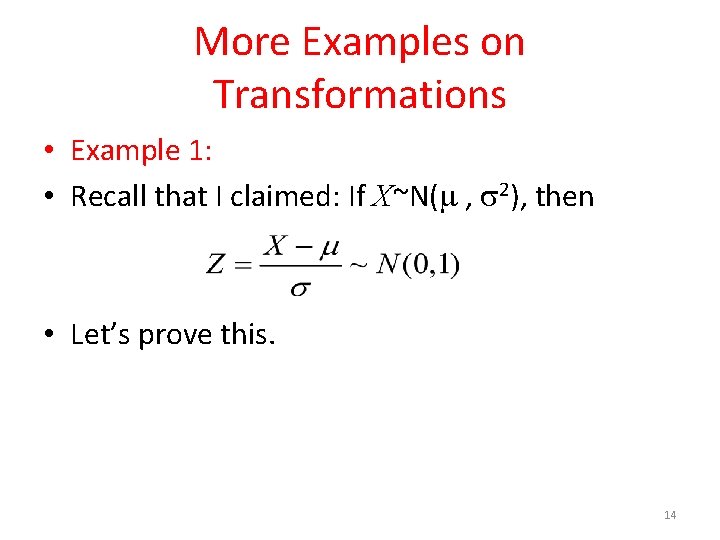
More Examples on Transformations • Example 1: • Recall that I claimed: If X~N( , 2), then • Let’s prove this. 14
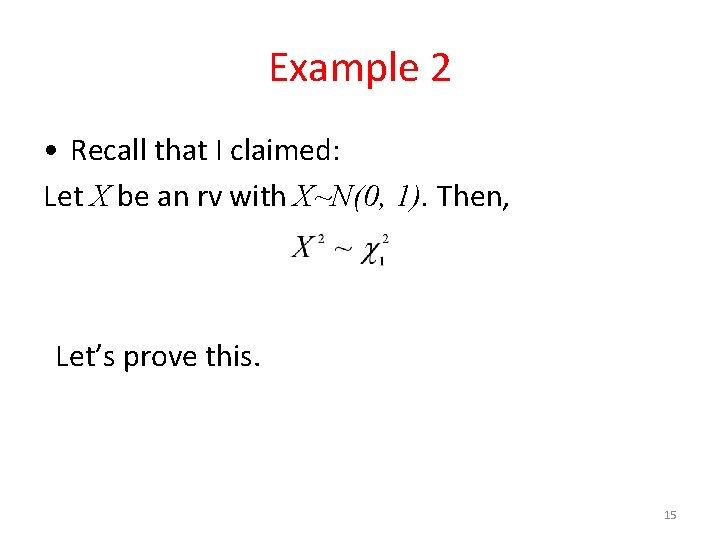
Example 2 • Recall that I claimed: Let X be an rv with X~N(0, 1). Then, Let’s prove this. 15
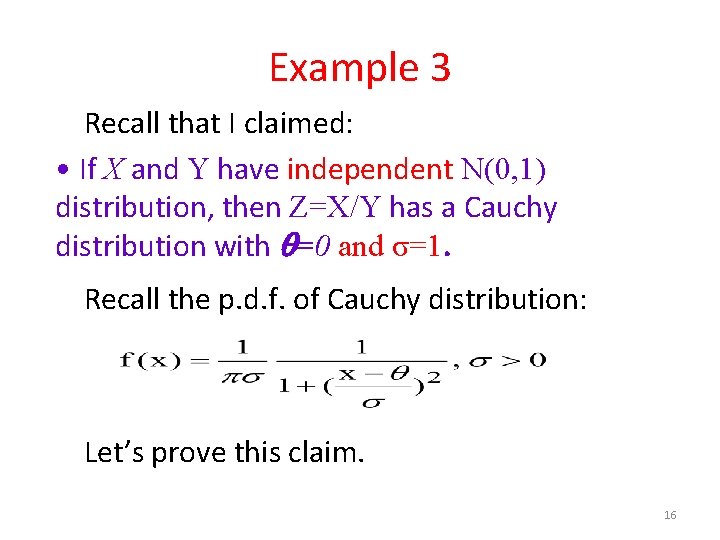
Example 3 Recall that I claimed: • If X and Y have independent N(0, 1) distribution, then Z=X/Y has a Cauchy distribution with =0 and σ=1. Recall the p. d. f. of Cauchy distribution: Let’s prove this claim. 16
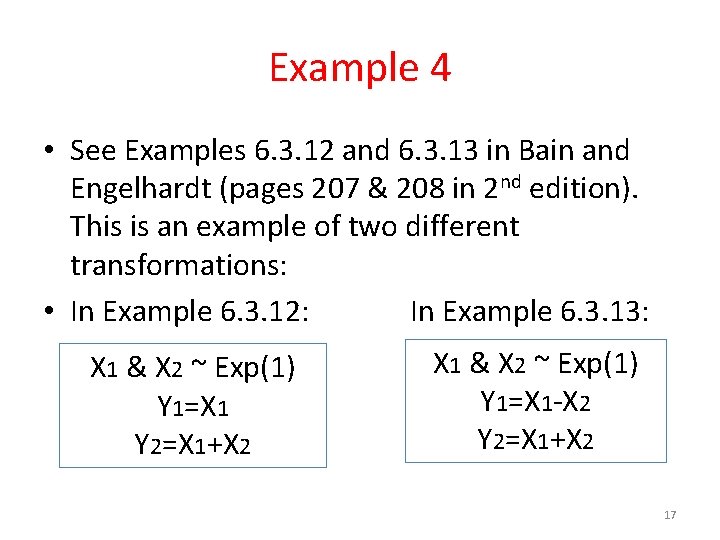
Example 4 • See Examples 6. 3. 12 and 6. 3. 13 in Bain and Engelhardt (pages 207 & 208 in 2 nd edition). This is an example of two different transformations: • In Example 6. 3. 12: In Example 6. 3. 13: X 1 & X 2 ~ Exp(1) Y 1=X 1 Y 2=X 1+X 2 X 1 & X 2 ~ Exp(1) Y 1=X 1 -X 2 Y 2=X 1+X 2 17
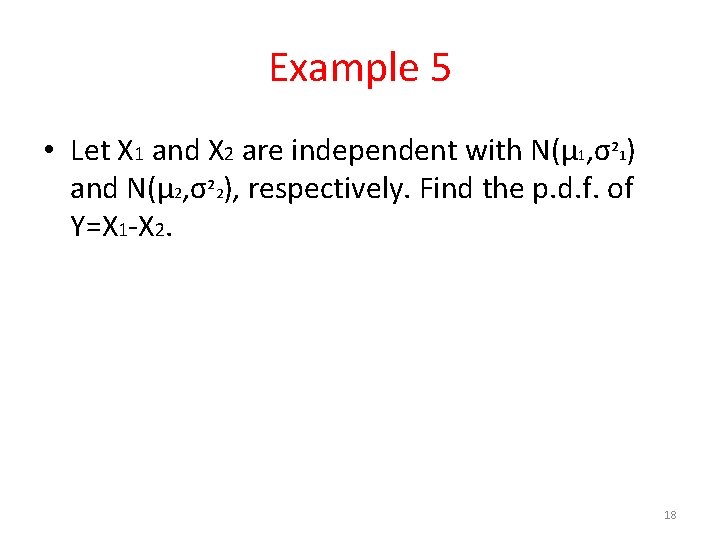
Example 5 • Let X 1 and X 2 are independent with N(μ 1, σ² 1) and N(μ 2, σ² 2), respectively. Find the p. d. f. of Y=X 1 -X 2. 18