
Transformation of Axes Change of origin To change
- Slides: 4
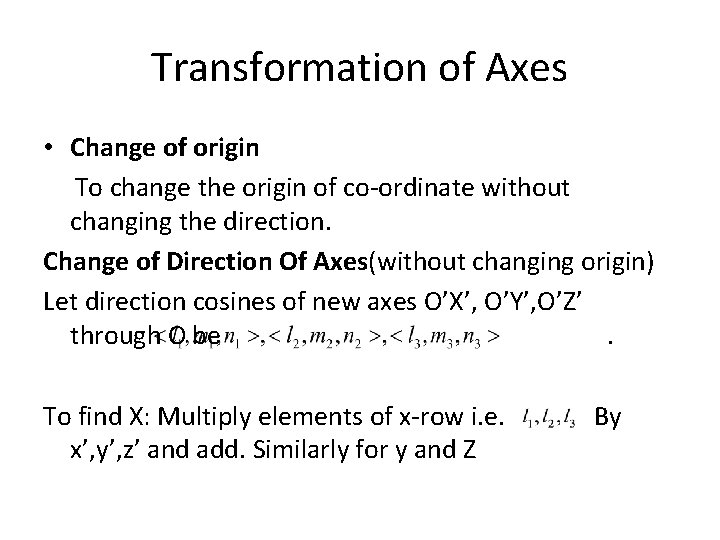
Transformation of Axes • Change of origin To change the origin of co-ordinate without changing the direction. Change of Direction Of Axes(without changing origin) Let direction cosines of new axes O’X’, O’Y’, O’Z’ through O be. To find X: Multiply elements of x-row i. e. x’, y’, z’ and add. Similarly for y and Z By
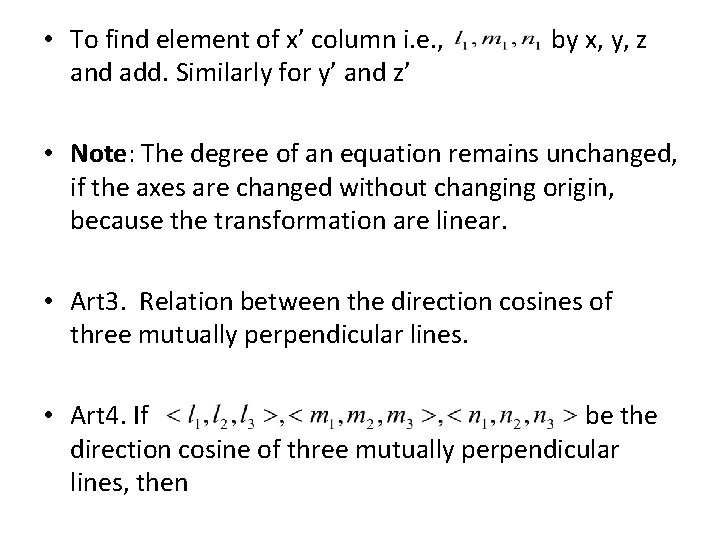
• To find element of x’ column i. e. , and add. Similarly for y’ and z’ by x, y, z • Note: The degree of an equation remains unchanged, if the axes are changed without changing origin, because the transformation are linear. • Art 3. Relation between the direction cosines of three mutually perpendicular lines. • Art 4. If be the direction cosine of three mutually perpendicular lines, then
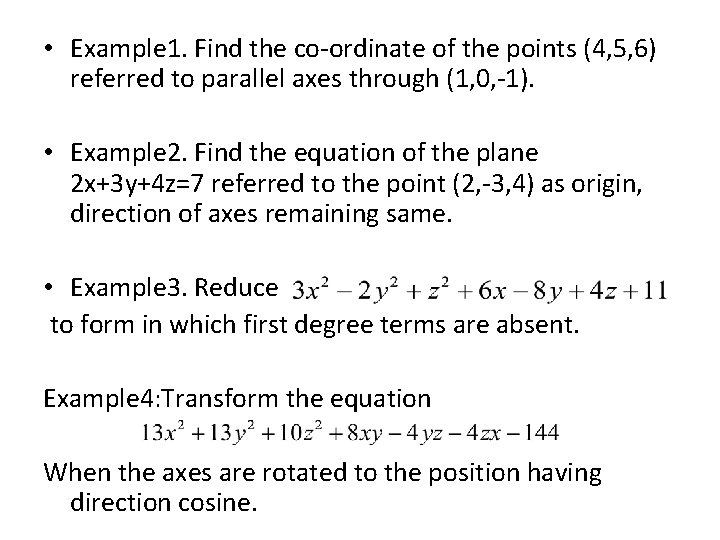
• Example 1. Find the co-ordinate of the points (4, 5, 6) referred to parallel axes through (1, 0, -1). • Example 2. Find the equation of the plane 2 x+3 y+4 z=7 referred to the point (2, -3, 4) as origin, direction of axes remaining same. • Example 3. Reduce to form in which first degree terms are absent. Example 4: Transform the equation When the axes are rotated to the position having direction cosine.
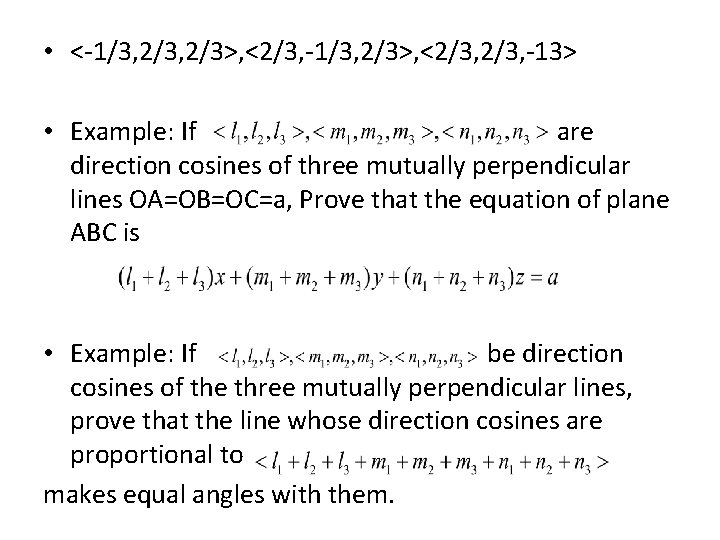
• <-1/3, 2/3>, <2/3, -13> • Example: If are direction cosines of three mutually perpendicular lines OA=OB=OC=a, Prove that the equation of plane ABC is • Example: If be direction cosines of the three mutually perpendicular lines, prove that the line whose direction cosines are proportional to makes equal angles with them.