
Transformation DNA exchange among bacteria DNA can be
Transformation
DNA exchange among bacteria • DNA can be exchanged among bacteria in three ways: 1. Conjugation – a plasmid or other selftransmissible DNA element transfers it self and sometimes other DNA into other bacterial cell. 2. Transduction – a phage carries DNA from one bacterium to another. 3. Transformation – cells take up free DNA directly from their envirnment.
Naturally transformable bacterium • Most types of cells cannot take up DNA efficiently unless they have been exposed to special chemical or electrical treatments to make them more permeable. 1. Naturally transformable bacterium (or naturally competent bacterium) – They can take up DNA from the environment without requiring special treatment. 2. About 40 species have been found to be naturally competent or transformable. 3. Bacillus subtilis, Streptococcus pneumoniae, Haemophilus influenzae, Neisseria gonorrhoeae, Helicobacter pylori, Acinetobacter baylyi, and some species of marine cyanobacteria.
Artificially induced competence • Bacteria can be sometimes be made competent by certain chemical treatments or DNA can be forced into bacteria by a strong electric field in a process called electroporation. 1. Treatment with calcium ions. (1) Chemically induced transformation is usually inefficient, and only a small percentage of the cells are ever trnasformed. (2) Accordingly, the cells must be plated under conditions selective for the transformed cells. (3) Therefore, the DNA used for the transformation should contain a selectable gene such as one encoding resistance to an antibiotic.
Artificially induced competence 2. Electroporation (1) The bacteria are mixed with DNA and briefly exposed to a strong electric field. (2) The bacteria must first be washed extensively in buffer with very low ionic strength such as distilled water. The buffer usually also contains a nonionic solute such as glycerol to prevent osmotic shock. (3) The brief electric field across the cellular membranes might create artificial pore of H 2 O lined by phospholipid head groups. DNA can pass through these temporary hydrophilic pores. (4) Electroporation requires specialized equipment.
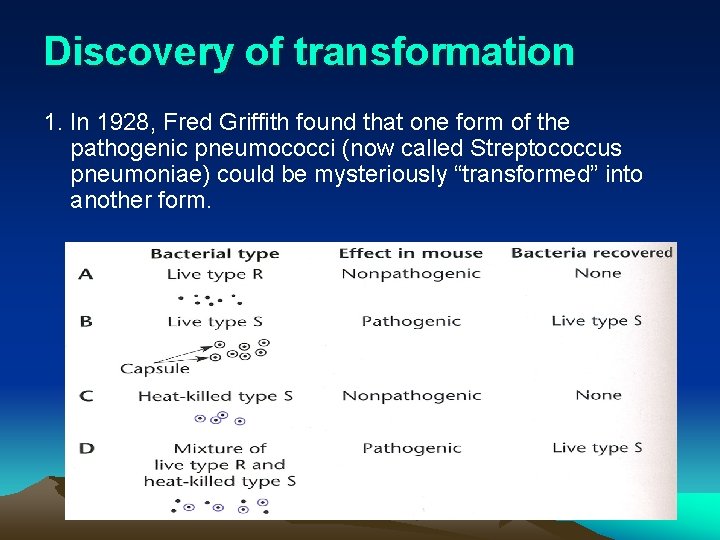
Discovery of transformation 1. In 1928, Fred Griffith found that one form of the pathogenic pneumococci (now called Streptococcus pneumoniae) could be mysteriously “transformed” into another form.
Discovery of transformation 2. Griffith made a conclusion that the dead pathogenic bacteria gave off a “transforming principle” that changed the live nonpathogenic rough-colony-forming bacteria into the pathogenic smooth-colony form. 3. Later, other researchers did an experiment in which they trnasformed rough-colony-forming bacteria into the pathogenic smooth-colony form by mixing the rough forms with extracts of the smooth forms in a test tube. 4. About 16 later after Griffith did his experiment with mice, Oswald Avery and his collaborators purified the “transforming principle” from extracts of smooth-colony formers and showed that it is DNA. Avery and his colleagues were first to demonstrate that DNA, and not protein or other factors in the cell, is the hereditary material.
Competence • The ability of some bacteria to take up naked DNA from their environment. • It is genetically programmed. Generally, more than a dozen genes are involved, encoding both regulatory and structural components. • The general steps that occur in natural transformation differ somewhat in Gram-negative and positive bacteria. • The followings are two examples for G – and G + , respectively.
Competence • The steps for DNA uptake 1. Binding of double-stranded DNA to the outer cell surface of bacterium. 2. Movement of DNA across the cell wall and outer membrane (no outer membrane in G + bacterium). 3. Degradation of one of the DNA strands. 4. Translocation of the remaining single strand of DNA into cytoplasm of the cell across inner membrane. 5. Once in the cell, the single-stranded transforming DNA might synthesize the complementary strand reestablish itself as a plasmid, stably integrate into the chromosome, or degraded.
Competence • While the DNA uptake system of G + and G – bacteria have features in common, they do seem to differ in certain important respects. 1. There are many proteins involved in transformation in bacteria. 2. They are discovered on the basis of isolation of mutants that are completely lacking in the ability to take up DNA. 3. The genes affected in the mutants were named com (for competence defective). (1) The com genes are organized into several operons. (2) The products of these, including the com. A and com. K operons, are involved in regulation of competence. (3) Others, including the products of genes in the com. E, com. F, and com. G operons, become part of the competence machinery in the membrane that takes DNA up into the bacteria. (4) The genes in these operons are given two letters, the first for the operon and the second for the position of gene in the operon, ex. , com. FA is the first gene of the com. F operon.
Steps in natural transformation • Com. EA encoded by the first gene of the com. E operon, binds directly extracellular double-stranded DNA. • The com. F genes encode proteins that translocate the DNA into the cell. Com. FA is an ATPase that may provide the energy for translocation of DNA through the membrane (not shown). • Com. EA, Com. EC, and Com. FA form a sort of ATPDNA into the cell. • The genes in the com. G operon encode proteins that might form a “pseudopilus” which helps move DNA through the Com. EC channel. They might bind to extracellular DNA, perhaps acting through the Com. EA DNA-binding protein, and then retract, drawing the DNA into the cell.
Steps in natural transformation • The com. E, com. F and com. G operons are all under the transcrptional control of Com. K, a transcriptio factor that is itself regulated by Com. A. • Some of genes involved in the transformation process are not designated as com, because such genes were first discovered on the basis of their involvement in other processes. 1. The nuc. A gene product makes double-strand breaks in extracellular DNA. The free DNA ends become the substrates for the competence proteins. 2. Other examples are single-stranded-DNA binding protein (SSB), and Rec. A functions in the recombination of transforming DNA with chromosome DNA.
Steps in natural transformation • The lengths of single-stranded DNA incorporated into the recipient chromosome are about 8. 5 to 12 kbbase on cotransformation of genetic markers, and the incorporation takes only few minutes to be completed. • The proteins in shaded boxes are analogous in G + and G – bacteria. Com. EC of B. subtilis is an ortholog of Com. A protein of Neisseria. • The DNA is shown running through the cell wall alonside the pseudopilus (Com. G in B. subtilis; Pil. E in G – systems that are related to type II protein secretion systems.
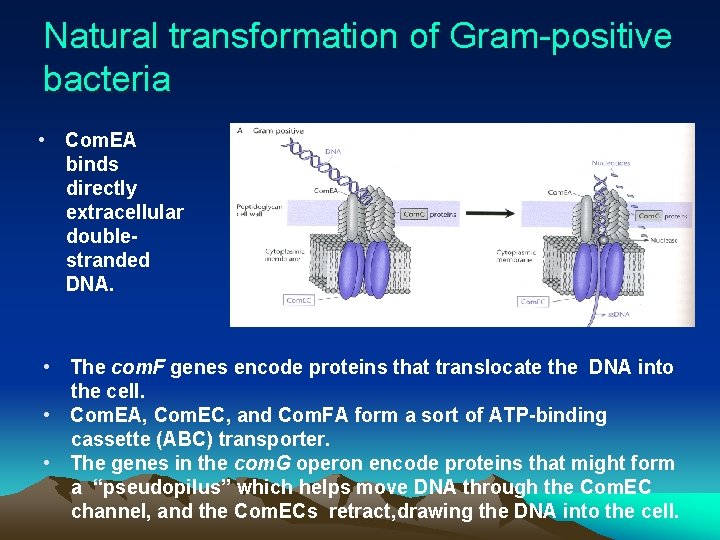
Natural transformation of Gram-positive bacteria • Com. EA binds directly extracellular doublestranded DNA. • The com. F genes encode proteins that translocate the DNA into the cell. • Com. EA, Com. EC, and Com. FA form a sort of ATP-binding cassette (ABC) transporter. • The genes in the com. G operon encode proteins that might form a “pseudopilus” which helps move DNA through the Com. EC channel, and the Com. ECs retract, drawing the DNA into the cell.
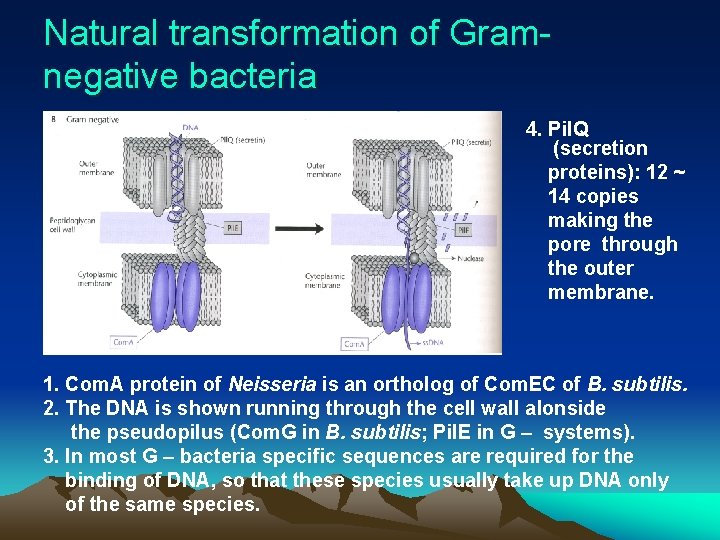
Natural transformation of Gramnegative bacteria 4. Pil. Q (secretion proteins): 12 ~ 14 copies making the pore through the outer membrane. 1. Com. A protein of Neisseria is an ortholog of Com. EC of B. subtilis. 2. The DNA is shown running through the cell wall alonside the pseudopilus (Com. G in B. subtilis; Pil. E in G – systems). 3. In most G – bacteria specific sequences are required for the binding of DNA, so that these species usually take up DNA only of the same species.
Natural transformation of Gramnegative bacteria 1. The competence systems of most G – bacteria are very similar to type II secretion systems that assemble type IV pili on the cell surface. 2. Type IV pili are long, thin hairlike appendages that stick out from the cell and are used to attach cells to solid surface. 3. While competence requires the protein that makes up most of the pilus, i. e. , the major pilin protein (called Pil. E in Neisseria), some other minor pilin proteins are required for competence but not for pilus formation.
Natural transformation of Gramnegative bacteria 4. The competence of Helicobacter pylori, an opportunistic pathogen involved in ulcer, bases on the type IV secretionconjugation systems. (1) The proteins of type IV secretion-conjugation system is similar to Vir conjugation proteins in Agrobacterium tumefaciens. (2) Type IV secretion-conjugation system can function as two way DNA transfer systems, capable of moving DNA both into and out of the cells. (3) However, H. pylori has a bona fide type IV secretion system that secrets proteins directly into eukaryotic cells. These two systems are related, but they function independently of each other and have no proteins in common. ▇ When the secretion systems, transformation systems, and pili were named, no one could have predicted their relationships to each other; this confusion is the result.
Regulation of competence in B. subtilis It is achieved through a two-component regulatory system: a sensor protein (Com. P) and a response regulator (Com. A) protein. 1. When the cell runs out of nutrients and the population reach a high density registered by Com. P. 2. Com. P autophosphorylates itself. 3. Com. P transfer ~P to Com. A. 4. Com. A~P is an active transcriptional activator for several genes, including some required for competence. 5. Eventually, another transcriptional activator, Com. K is made. It is directly responsible for activating the transcription of other com genes, including those that form the transformation machinery.
Regulation of competence in B. subtilis How does the cell know that other B. subtilis cells are nearby and that it should induce competence? 1. High cell density is signaled through small peptides, competence pheromones that are excreted by the bacteria as they multiply. 2. Cells become competent only in the presence of high concentrations of these peptides. 3. This is a phenomenon called quorum sensing. The small molecules are known as including homoserine lactones that signal cell density in some G – bacteria. 4. In B. subtilis, the major competence pheromone peptide is called Com. X and is cut of a longer polypeptide, the product of the com. X gene.
Regulation of competence in B. subtilis How does the cell know that other B. subtilis cells are nearby and that it should induce competence? 5. The product of gene com. Q which is immediately upstream of com. X is a protease that cut the longer polypeptide. 6. Once the peptide has been cut of the longer molecule, it binds to the Com. P protein in the membrane and trigger its autophosphorylation. 7. At best, only about 10% of B. subtilis cells ever become competent, no matter how favorable the conditions or how high the cell density. This has been called a bistable state and seems to be determined somehow by autoregulation of the Com. K activator protein.
Regulation of competence development in B. subtilis by quorum sensing A 1. Com. P in the membrane senses a high concentration of the Com. X peptide, and phosphorylates itself by transferring a phosphate from ATP. 2. The phosphate is then transferred to Com. A. 3. Com. A activates the transcription of many genes including com. K. 4. Com. K is an activator of the com genes. B 1. In another pathway, a peptide sometimes called CSF (competence-stimulating factor) processed from the signal sequence of another protein (Phr. C) is imported into the cell by the Spo. OK oligopeptide permease. 2. CFS indirectly activates Com. A~P by inactivating Rap. C.
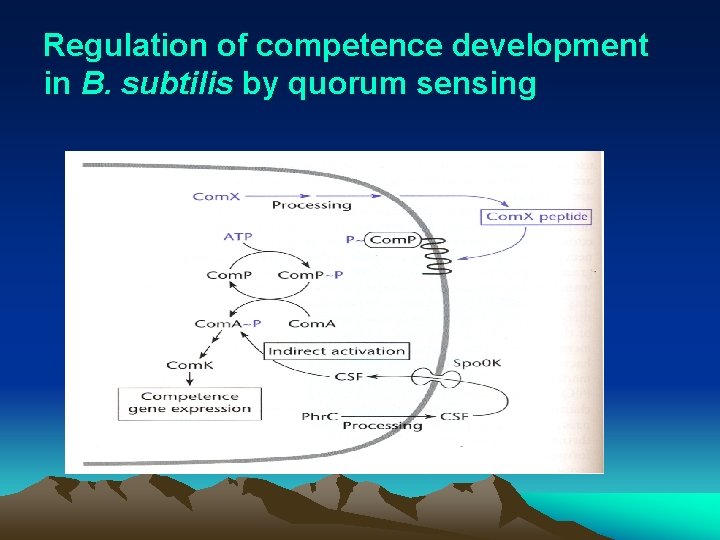
Regulation of competence development in B. subtilis by quorum sensing
Relationship between competence, sporulation, and other cellular states 1. About the same time as B. subtilis reaches the stationary phase, some cells acquire competence and some cells sporulate, forming the endospore. 2. Sporulation allows a bacterium toenter a dormant state and survive adverse conditions, such as starvation, irradiation and heat. 3. To coordinate sporulation and competence, B. subtilis cells may produce other competence peptide. (1) There at least two such peptides that regulate Com. A indirectly by inhibiting proteins, Rap proteins, which bind to the C-terminal DNAbinding domain of Com. A~P and it from binding to DNA and activating transcription.
Relationship between competence, sporulation, and other cellular states (2) These peptides (CSF) are processed from the signal sequences of longer polypeptides, the products of the phr genes, and are transported into cell by the oligopeptide permease, Spo. OK. (3) The spo. OK gene is an example of a regulatory gene that is required for sporulation and also for the development of competence.
Three questions for natural transformation A. How efficient is DNA uptake? - Donor DNA is radioactively labeled by growing the cells in medium containing 32 P. - The radioactive DNA is then extracted and mixed with competent cells. - The mixture is treated with DNase at various times. - Any DNA that is not degraded and survives intact must have been taken up by the cells, where it is protected from the DNase. - Collect cells on filter and count the radioactivity. Degraded DNA will pass through filter. - The radioactivity on the filter is compared with the total radioactivity of the DNA that was added to the cell. - This kind of experiment shows that some competent bacteria take up DNA very efficiently. The % shows some
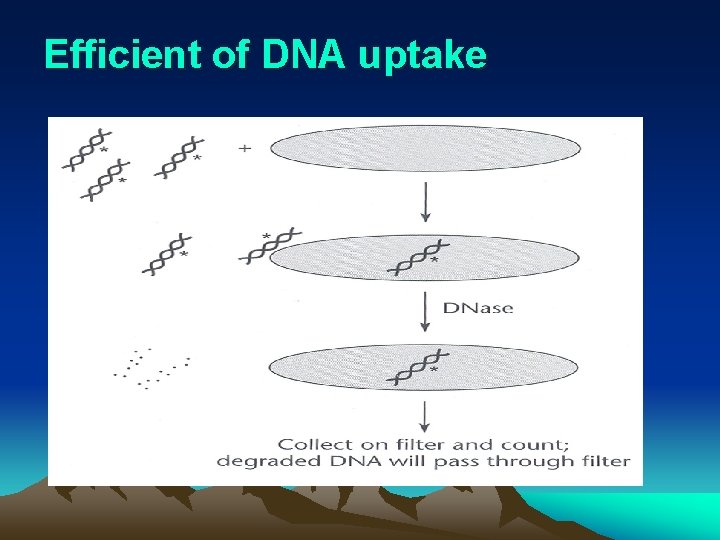
Efficient of DNA uptake
Three questions for natural transformation B. Can only DNA of the same species enter a given cell? - The same experiment demonstrates that some types of bacteria take up DNA from only their own species (ex. , Neisseria gonorrhoeae and Haemophilus influenzae) whereas others (B. subtilis) can take up DNA from any source. - Bacteria that preferentially take up the DNA of their own species do so because their DNA contains specific uptake sequences. -
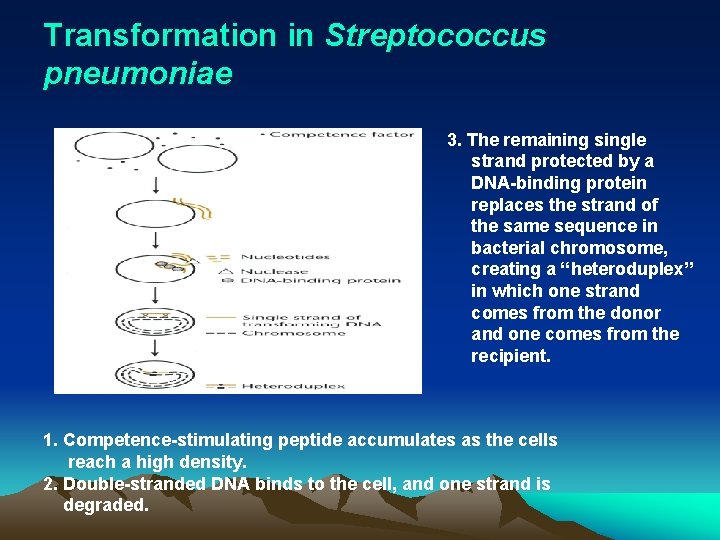
Transformation in Streptococcus pneumoniae 3. The remaining single strand protected by a DNA-binding protein replaces the strand of the same sequence in bacterial chromosome, creating a “heteroduplex” in which one strand comes from the donor and one comes from the recipient. 1. Competence-stimulating peptide accumulates as the cells reach a high density. 2. Double-stranded DNA binds to the cell, and one strand is degraded.
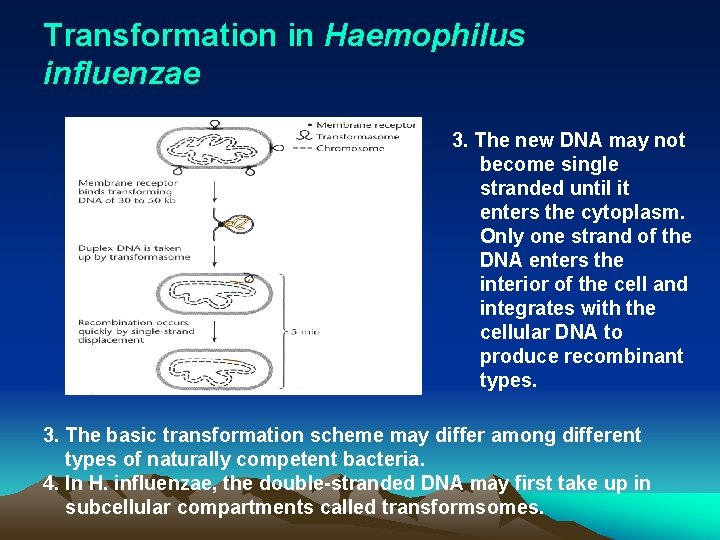
Transformation in Haemophilus influenzae 3. The new DNA may not become single stranded until it enters the cytoplasm. Only one strand of the DNA enters the interior of the cell and integrates with the cellular DNA to produce recombinant types. 3. The basic transformation scheme may differ among different types of naturally competent bacteria. 4. In H. influenzae, the double-stranded DNA may first take up in subcellular compartments called transformsomes.
Three questions for natural transformation C. Are both of the DNA strands taken up and incorporated into the cellular DNA? - Experiments have shown that only doublestranded DNA can bind to specific receptors on the cell surface, i. e. , single-stranded DNA can not transform cells and yield recombinant types. - However, the transforming DNA enters a “eclipse” period for a short time after it is added to competent cells, as expected if it enters the cell in a single-stranded state. - The following is the design for experiment:
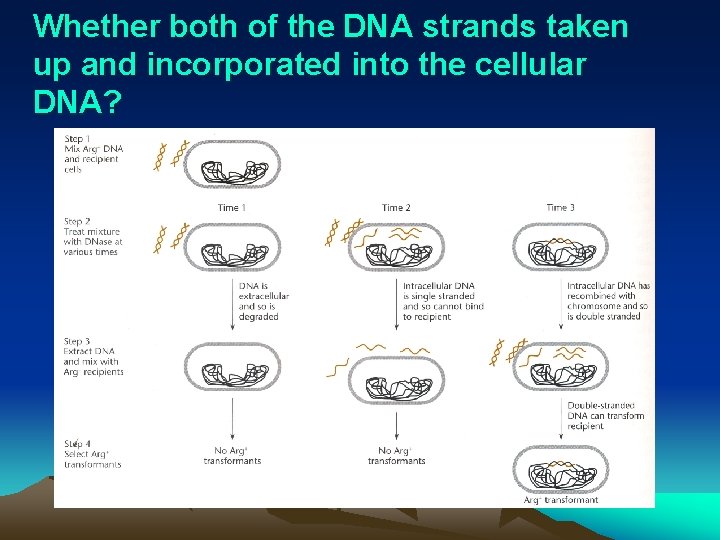
Whether both of the DNA strands taken up and incorporated into the cellular DNA?
Whether both of the DNA strands taken up and incorporated into the cellular DNA? As shown in Fig. 6. 8, transforms were observed depending on the time the DNA was extracted from the cells. 1. Time 1, the DNA is still outside the cells and accessible to the DNase. No Arg+ transformants are observed because the Arg+ donor DNA is all destryed by DNase. 2. Time 2, some of DNA is now inside the cells, where it can not be degraded by the DNase, but this DNA is single-stranded. It has not yet recombined with bacterial chromosomal DNA, and so no Arg+ transformants observed in step 4. 3. Time 3, when some of the DNA has recombined with bacterial chromosomal DNA, and so is again double-stranded, do transformants appear in step 4. ■ Thus, the transformingf DNA enters the eclipse period for a short time after it is added to competent cells, as expected if it enters the cells in a single-stranded state.
Plasmid transformation and phage transfection of naturally competent bacteria Neither plasmids nor phage DNAs can be efficiently introduced into naturally competent cells for two reasons: 1. They must double stranded to replicate. Natural transformation requires breakage of double-stranded DNA and degradation of one of the two strands so that a linear single strand can enter the cells. 2. They must recyclize. However, pieces of plasmid or phage DNA can not recyclize if there are no repeated or complementary sequences at their ends. - To overcome the problem, they are usually dimerized and multimerized into long concatemers. - If a dimerized plasmid or phage DNA is cut only once, it still has complementary sequences at its ends that can recombine to recylize the plasmid.
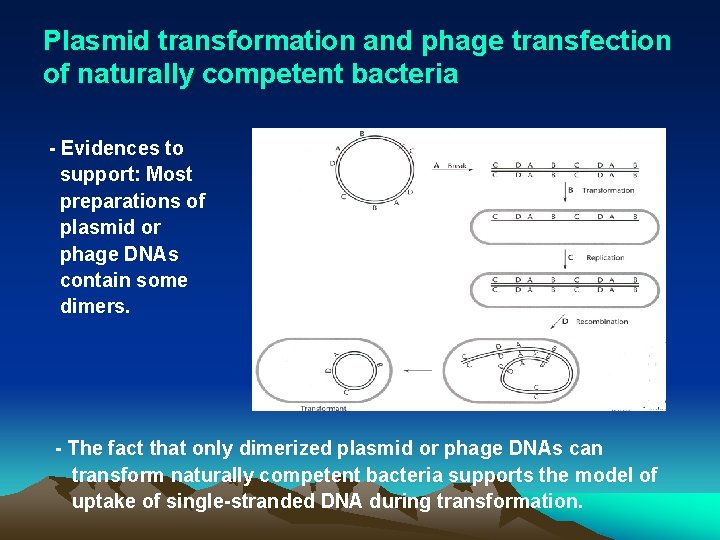
Plasmid transformation and phage transfection of naturally competent bacteria - Evidences to support: Most preparations of plasmid or phage DNAs contain some dimers. - The fact that only dimerized plasmid or phage DNAs can transform naturally competent bacteria supports the model of uptake of single-stranded DNA during transformation.
- Slides: 35