
Transform your teaching through student feedback Patrick Rousseau
Transform your teaching through student feedback Patrick Rousseau SMAT 29 - Sandanona Conference August 10, 2011 1
Contents 1. Literature Review 2. Discussion 3. Hall’s Feedback Frame Work 4. My Context 5. Written/Verbal Feedback Results and Interpretation 6. Conclusion 7. Questions 2
Literature Review • Reasons for Feedback (Hall, 2010) Shows concern Encourages reflect learning Democratization of classroom • Kathleen Graves (2000) Student feedback is an integral part of ongoing needs assessment. • Green et al. (1994) Student feedback can be viewed as “quality indicators”, where students have a say in their education. 3
• Problems with institutionalized feedback mechanisms (Huxham, 2008) (Watson, 2003) 1. Cynicism among students and staff 2. Standardized questionnaires fail to capture the ‘social climate’ in the classroom Wiers. Jenssen (2002, cited in Huxam 2008) 3. Closed questions 4. Lack reflection 5. Feedback loop is open 4
(Tuckman, 1980) Student teachers altered their teaching favorably based on student feedback. Effective Feedback strategy requires: 1. A receptive audience 2. A credible source 3. A non threatening climate 5
Discussion 1. What is your experience with student feedback from both a teacher’s and a student’s perspective? 2. How would you envision student feedback in your context? 3. What problems do you foresee regarding student feedback?
Hall’s Feedback Framework • Four stages of feedback: 1. Planning 2. Presenting 3. Reflection 4. Reporting 7
My Context Konkuk University General English Size: 25 students Age: Undergraduate Students (Freshman to Senior) Gender: Mixed Other Languages: Korean, Chinese Purposes: Academic requirement for graduation Language Level: Predominantly low intermediate with elementary to advanced Total Span: 3 hours a week over 16 weeks (Total of 48 hours) 8
Written Feedback Through Group Reflection 9
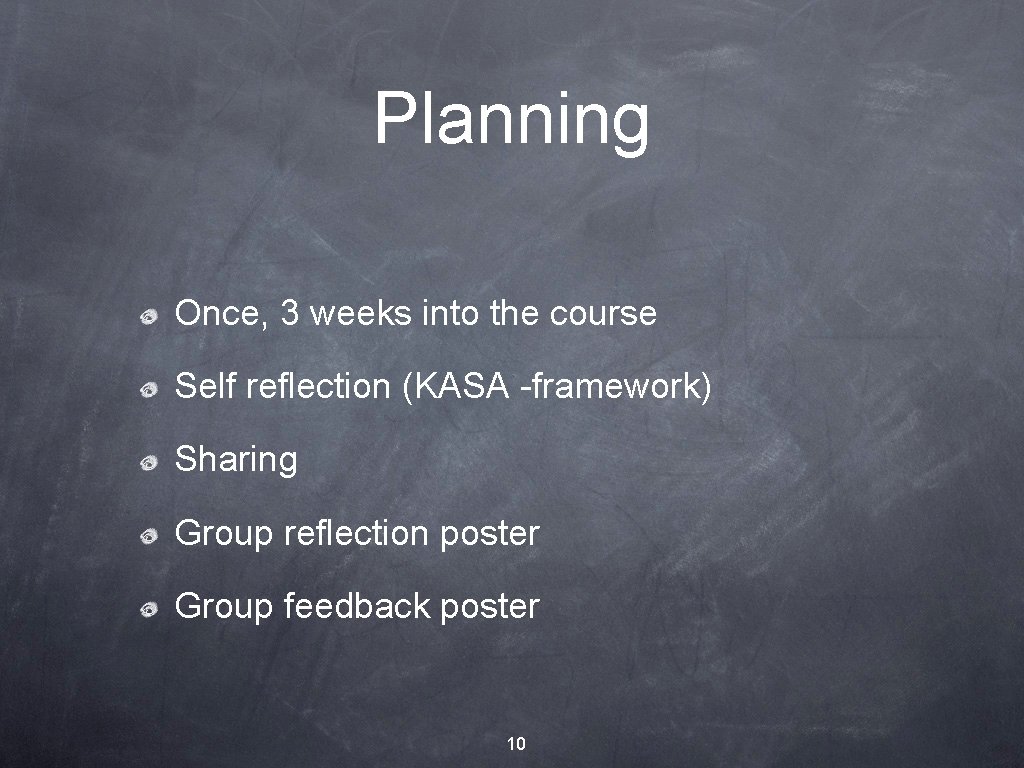
Planning Once, 3 weeks into the course Self reflection (KASA -framework) Sharing Group reflection poster Group feedback poster 10
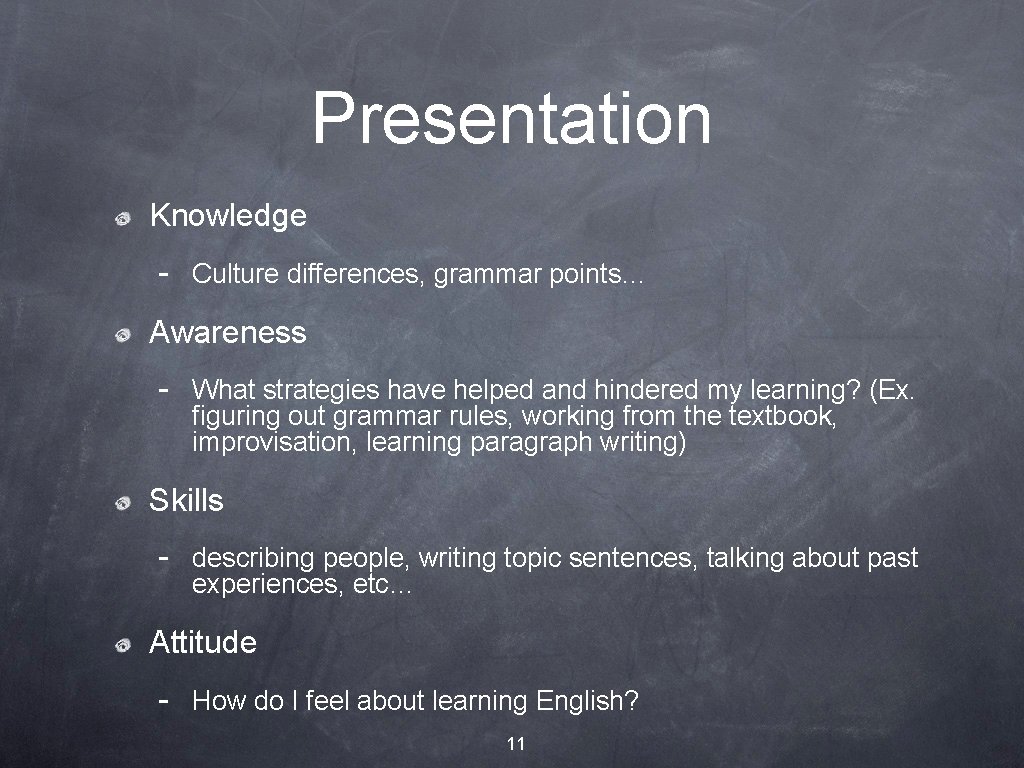
Presentation Knowledge - Culture differences, grammar points… Awareness - What strategies have helped and hindered my learning? (Ex. figuring out grammar rules, working from the textbook, improvisation, learning paragraph writing) Skills - describing people, writing topic sentences, talking about past experiences, etc… Attitude - How do I feel about learning English? 11
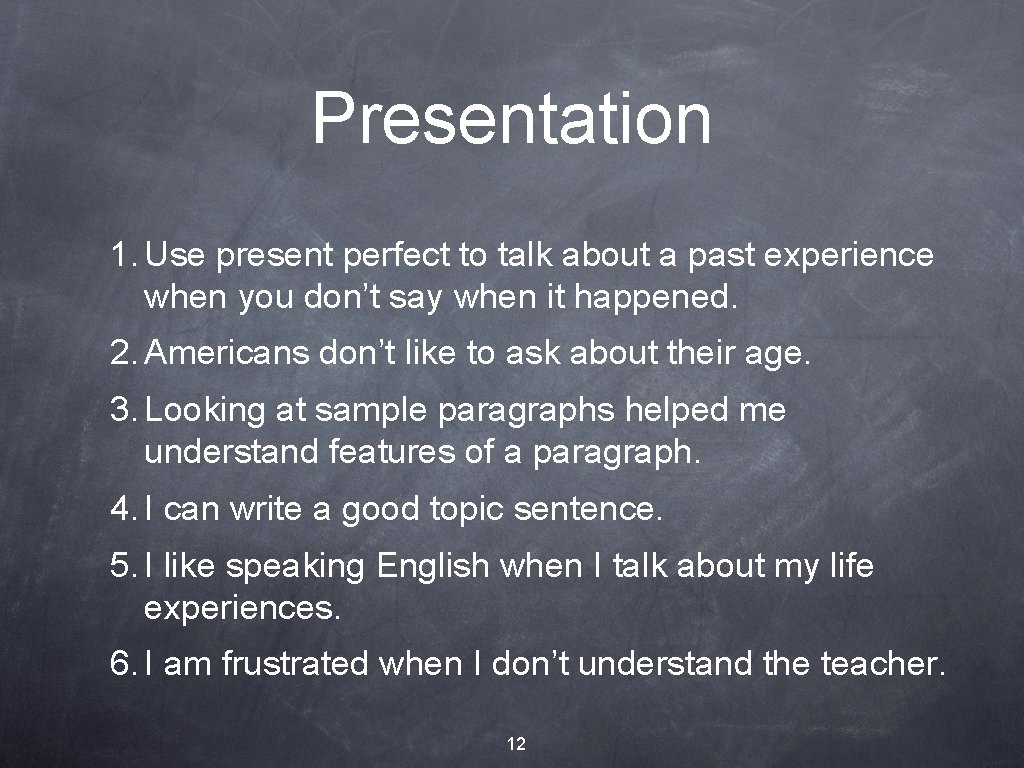
Presentation 1. Use present perfect to talk about a past experience when you don’t say when it happened. 2. Americans don’t like to ask about their age. 3. Looking at sample paragraphs helped me understand features of a paragraph. 4. I can write a good topic sentence. 5. I like speaking English when I talk about my life experiences. 6. I am frustrated when I don’t understand the teacher. 12
Presentation • Examples: Helped - Teacher sharing class objectives. Hindered - “It would help me understand if the teacher talked a little slower” or “It would challenge me more if the teacher spoke faster” 13
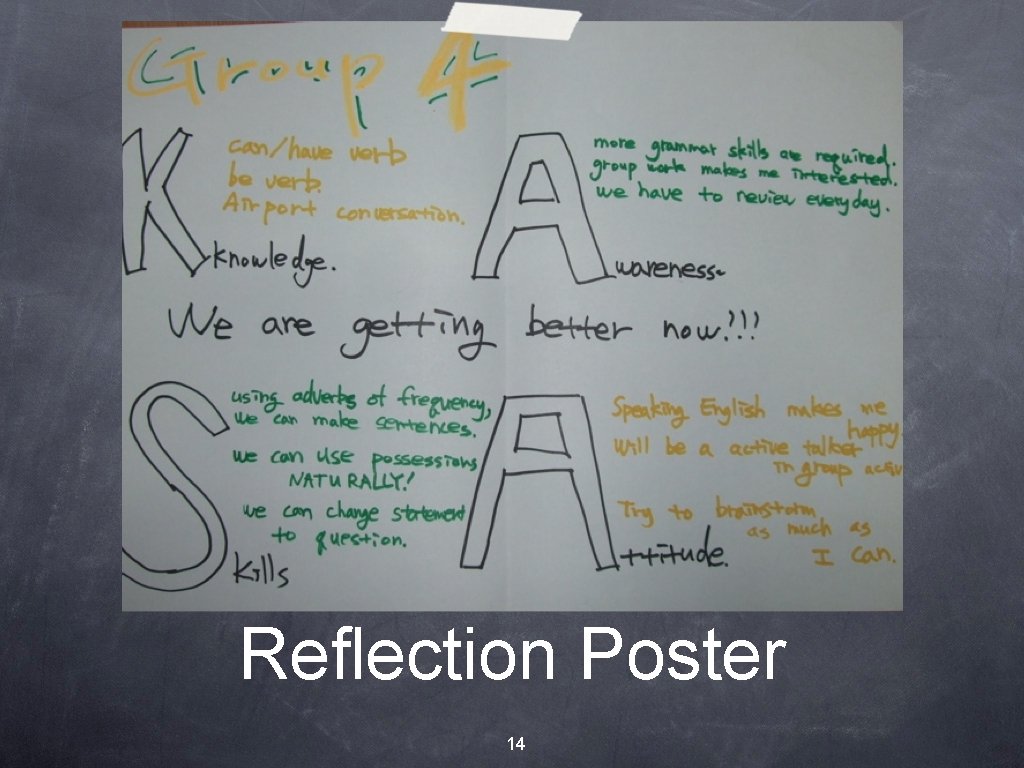
Reflection Poster 14
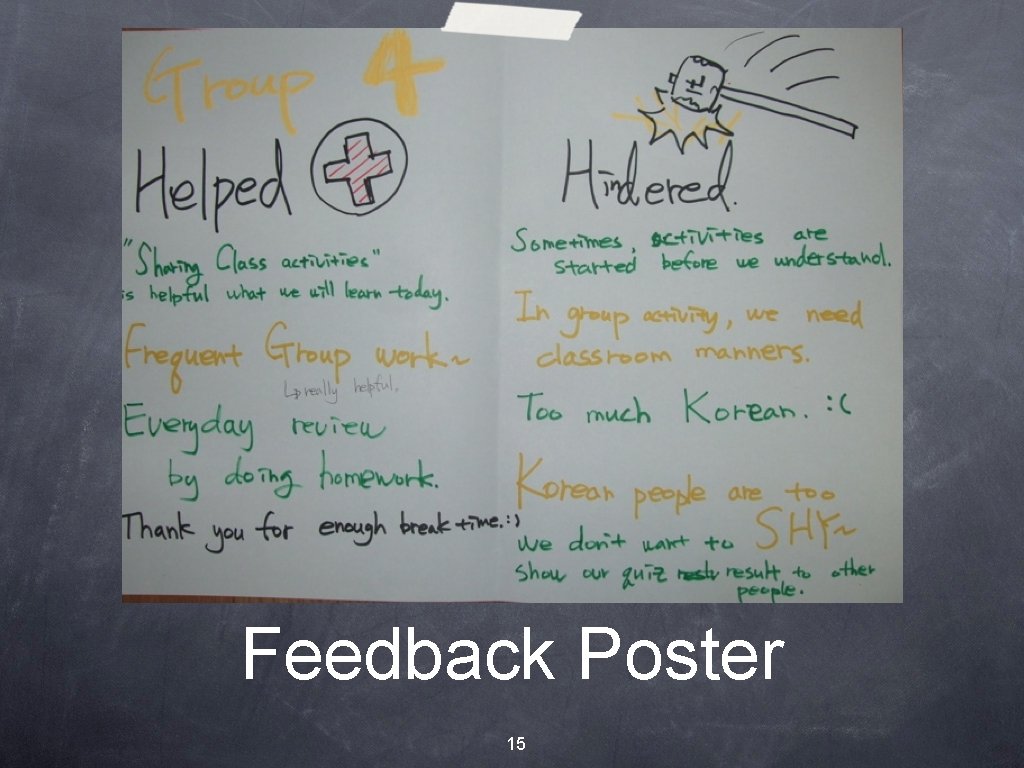
Feedback Poster 15
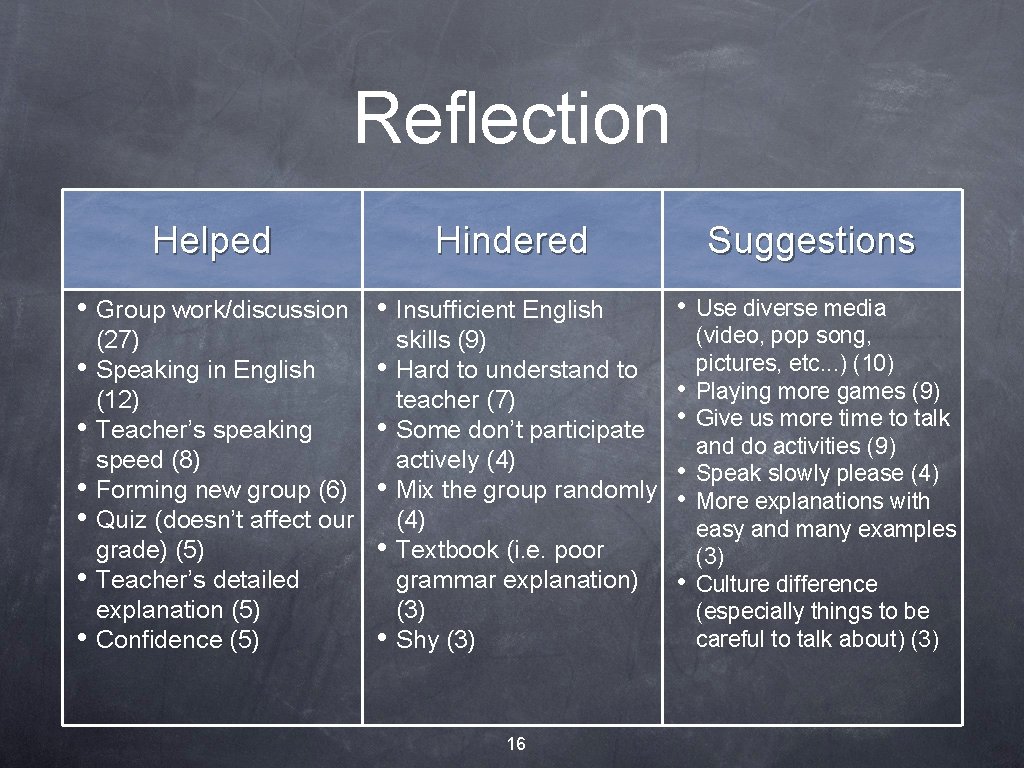
Reflection Helped Hindered • Group work/discussion • Insufficient English • • • (27) Speaking in English (12) Teacher’s speaking speed (8) Forming new group (6) Quiz (doesn’t affect our grade) (5) Teacher’s detailed explanation (5) Confidence (5) • • • skills (9) Hard to understand to teacher (7) Some don’t participate actively (4) Mix the group randomly (4) Textbook (i. e. poor grammar explanation) (3) Shy (3) 16 Suggestions • • • Use diverse media (video, pop song, pictures, etc. . . ) (10) Playing more games (9) Give us more time to talk and do activities (9) Speak slowly please (4) More explanations with easy and many examples (3) Culture difference (especially things to be careful to talk about) (3)
Reflection • (Watson, 2003) When collecting feedback, the emphasis should be on responding to students’ expectations rather than meeting them directly. 17
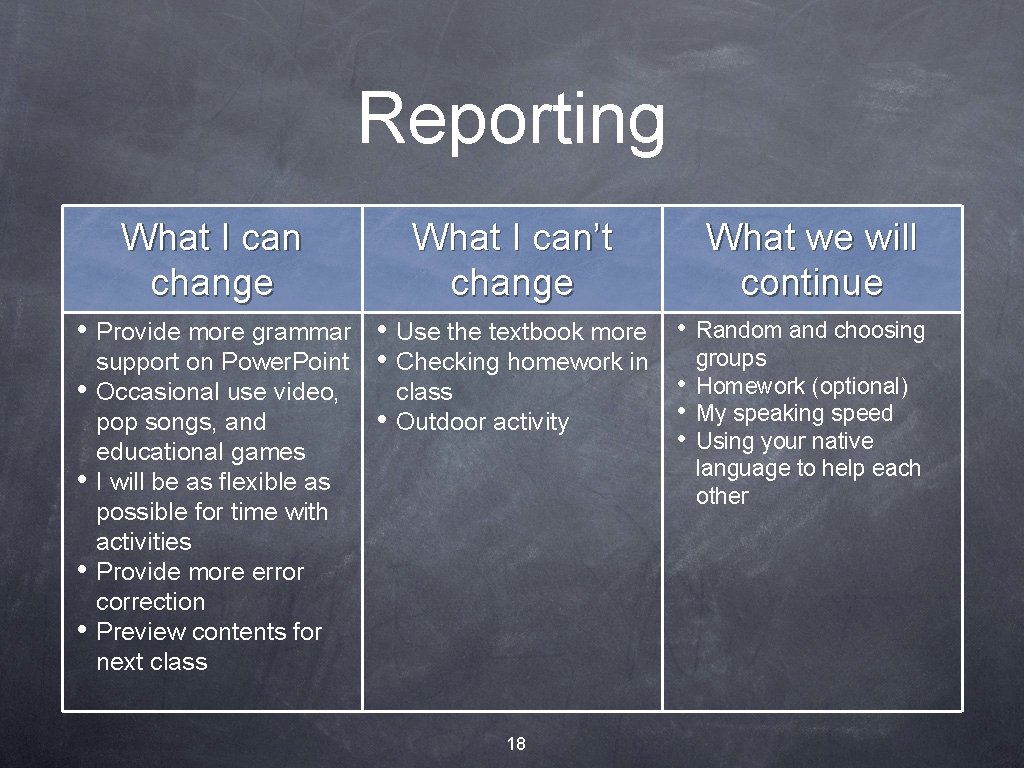
Reporting What I can change What I can’t change What we will continue • Provide more grammar • Use the textbook more • support on Power. Point • Checking homework in • • Occasional use video, class • pop songs, and • Outdoor activity • • educational games I will be as flexible as possible for time with activities Provide more error correction Preview contents for next class 18 Random and choosing groups Homework (optional) My speaking speed Using your native language to help each other
Verbal Feedback Using the Participatory Approach 19
Planning/Presentation Problem posing using code: How do they feel? (Elicit responses from groups) Personalization: What feelings do you usually feel while studying English in this class? (Select the most common ones identified) When do these feeling occur? Strategizing: What strategies have you used in the past to deal with these feelings/situations? What does “Lean into your discomfort” mean to you? 20

Code 21
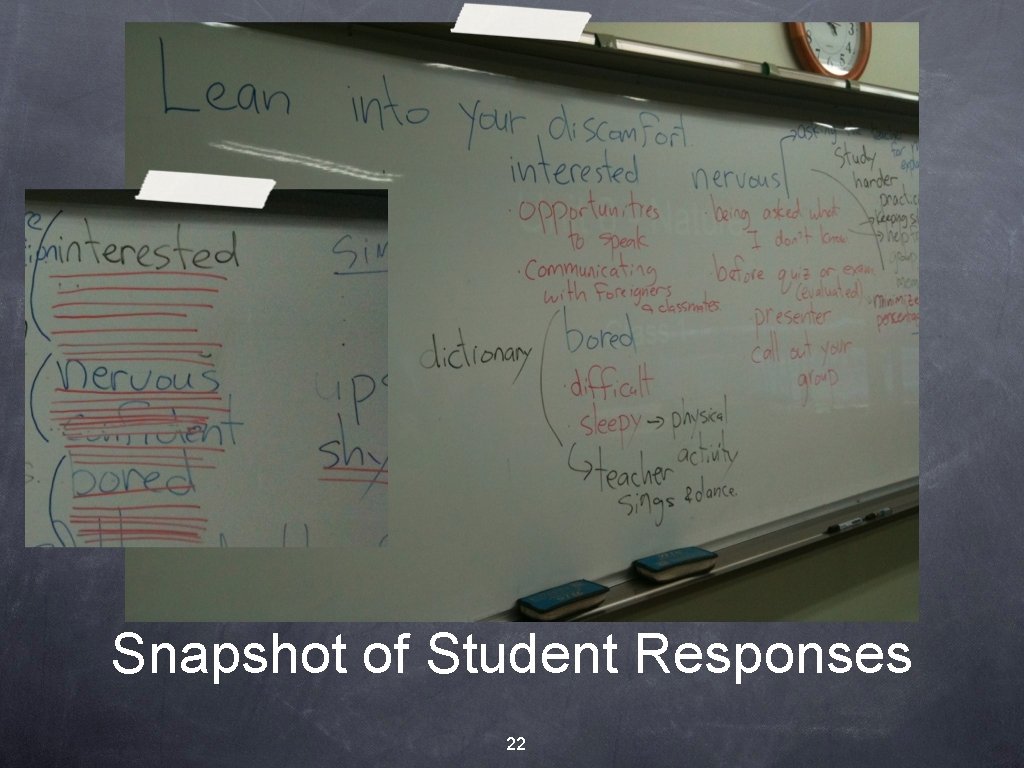
Snapshot of Student Responses 22
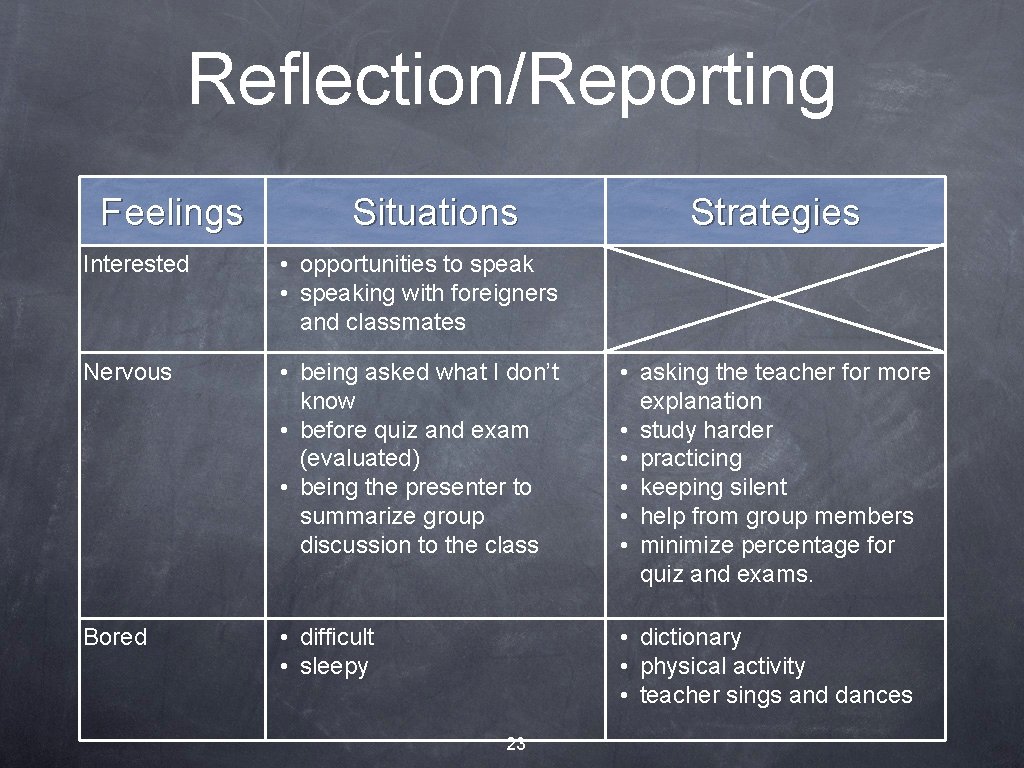
Reflection/Reporting Feelings Situations Strategies Interested • opportunities to speak • speaking with foreigners and classmates Nervous • being asked what I don’t know • before quiz and exam (evaluated) • being the presenter to summarize group discussion to the class • asking the teacher for more explanation • study harder • practicing • keeping silent • help from group members • minimize percentage for quiz and exams. Bored • difficult • sleepy • dictionary • physical activity • teacher sings and dances 23
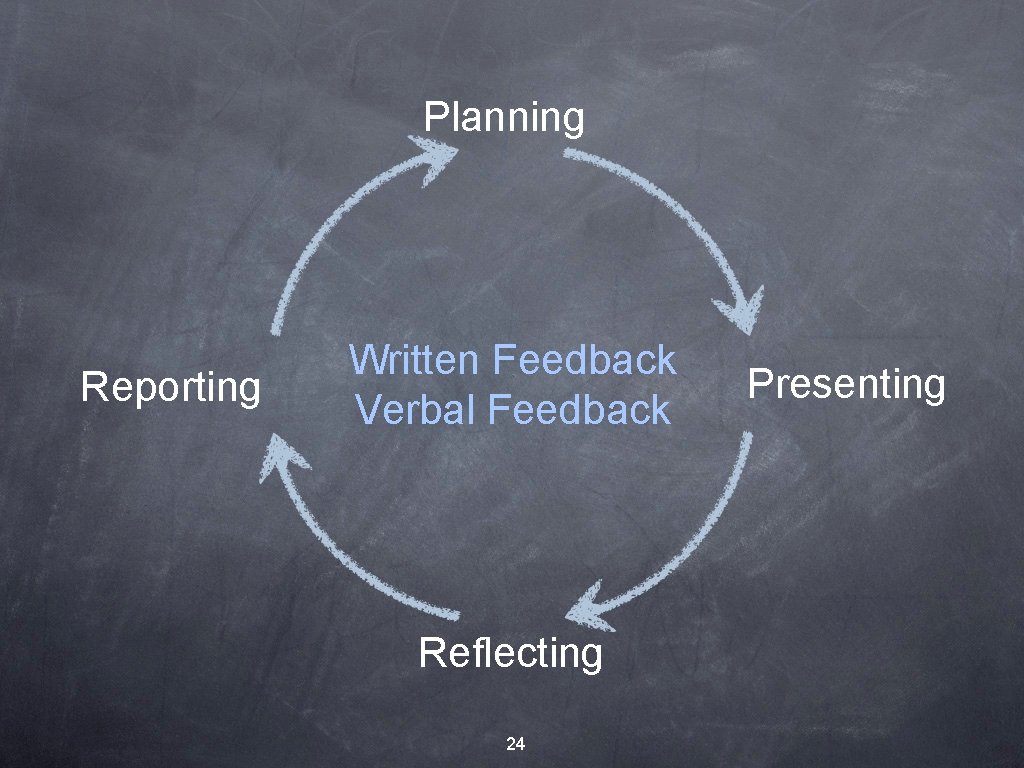
Planning Reporting Written Feedback Verbal Feedback Reflecting 24 Presenting
Students’ Comments He try to figure out exact level of stuent and feedback his course. Sometimes feedback is borthering me, but it looks good. This semester gives me much more satisfaction than fisrt semester. I am really satisfied with your class. And I can see you are trying to help students who cannot speak english very well!!! I think you are very passionate professor !! I was deeply impressed that you took feedback and immediately reflected it. And, you always prepared every ecture well!! I totally thanks for your lectures!! I will take your class next semester, practical english 1. Happy holidays!!! 25
Conclusions Less assumptions Address students expectations View criticism with distance Teacher initiated 26
- Slides: 26