
Transform and Conquer n n n Data structure

![Bottom-up heap construction algorithm(A Recursive version) ALGORITHM Heap. Bottom. Up(H[1. . n]) //Constructs a](https://slidetodoc.com/presentation_image_h/93cb1b5598364297990b63dfa2e53d18/image-10.jpg "Bottom-up heap construction algorithm(A Recursive version) ALGORITHM Heap. Bottom. Up(H[1. . n]) //Constructs a")

- Slides: 29
Transform and Conquer n n n Data structure: Heap Representation change: Heapsort Problem reduction 1
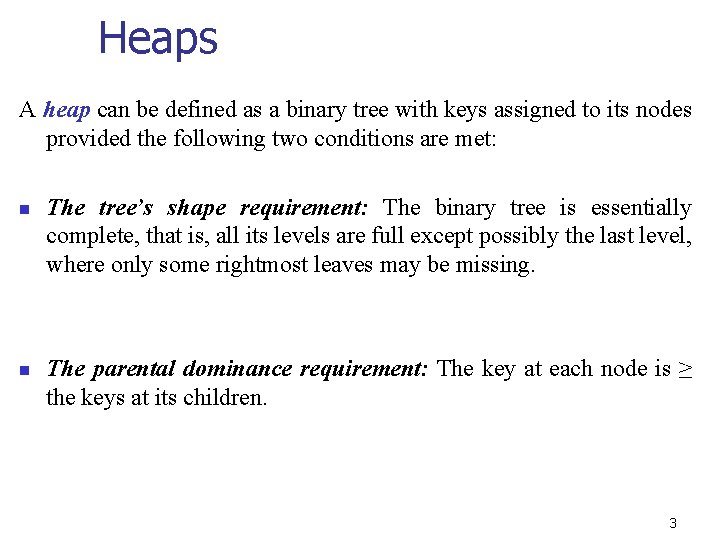
Expected Outcomes n Students should be able to n n n Explain the idea of heapsort Explain the ideas of problem reduction Analyze the time complexity of heapsort 2
Heaps A heap can be defined as a binary tree with keys assigned to its nodes provided the following two conditions are met: n n The tree’s shape requirement: The binary tree is essentially complete, that is, all its levels are full except possibly the last level, where only some rightmost leaves may be missing. The parental dominance requirement: The key at each node is ≥ the keys at its children. 3
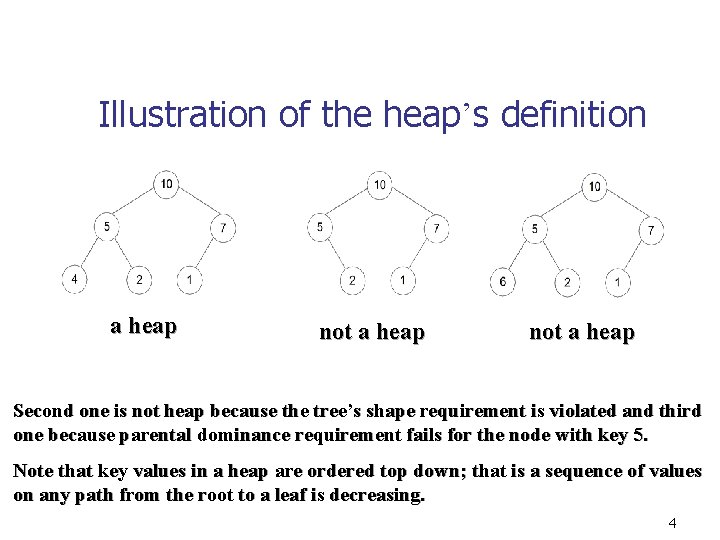
Illustration of the heap’s definition a heap not a heap Second one is not heap because the tree’s shape requirement is violated and third one because parental dominance requirement fails for the node with key 5. Note that key values in a heap are ordered top down; that is a sequence of values on any path from the root to a leaf is decreasing. 4
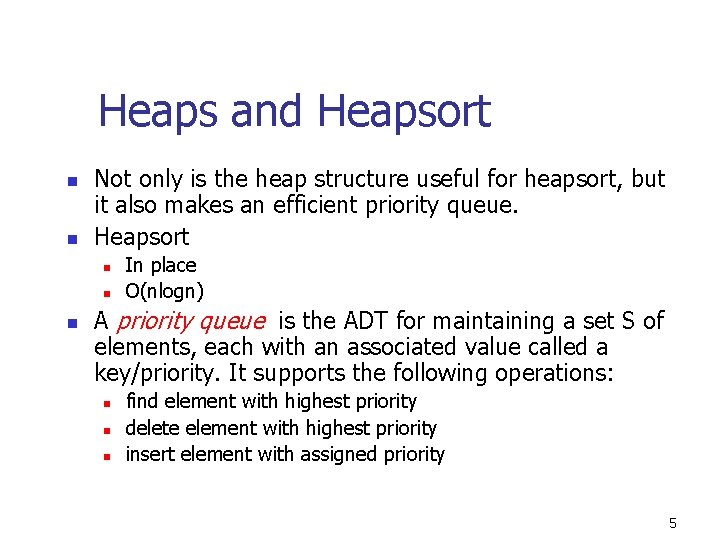
Heaps and Heapsort n n Not only is the heap structure useful for heapsort, but it also makes an efficient priority queue. Heapsort n n n In place O(nlogn) A priority queue is the ADT for maintaining a set S of elements, each with an associated value called a key/priority. It supports the following operations: n n n find element with highest priority delete element with highest priority insert element with assigned priority 5
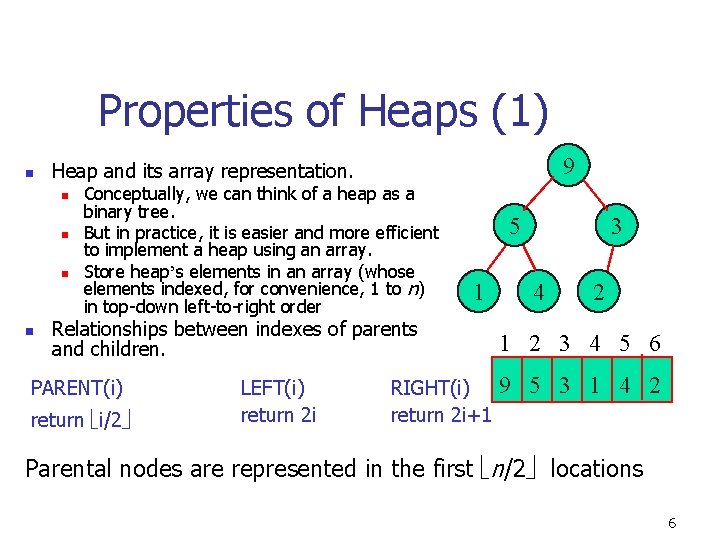
Properties of Heaps (1) n n n 9 Heap and its array representation. Conceptually, we can think of a heap as a binary tree. But in practice, it is easier and more efficient to implement a heap using an array. Store heap’s elements in an array (whose elements indexed, for convenience, 1 to n) in top-down left-to-right order 5 1 Relationships between indexes of parents and children. PARENT(i) return i/2 LEFT(i) return 2 i RIGHT(i) return 2 i+1 3 4 2 1 2 3 4 5 6 9 5 3 1 4 2 Parental nodes are represented in the first n/2 locations 6
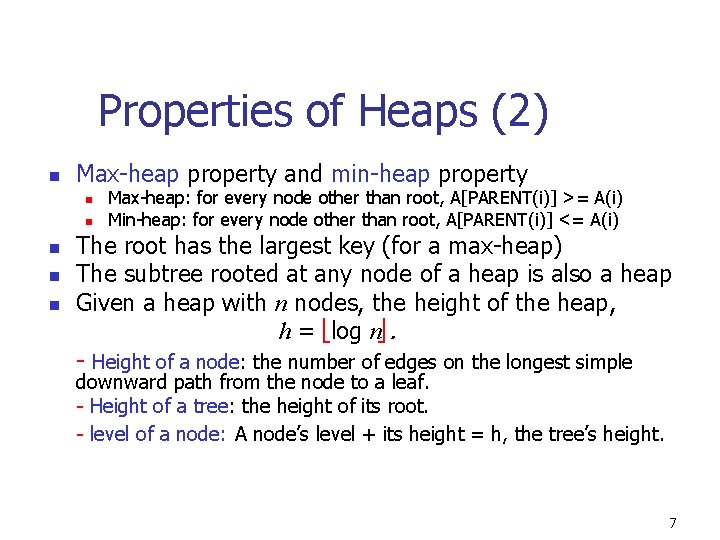
Properties of Heaps (2) n Max-heap property and min-heap property n n n Max-heap: for every node other than root, A[PARENT(i)] >= A(i) Min-heap: for every node other than root, A[PARENT(i)] <= A(i) The root has the largest key (for a max-heap) The subtree rooted at any node of a heap is also a heap Given a heap with n nodes, the height of the heap, h = log n. - Height of a node: the number of edges on the longest simple downward path from the node to a leaf. - Height of a tree: the height of its root. - level of a node: A node’s level + its height = h, the tree’s height. 7
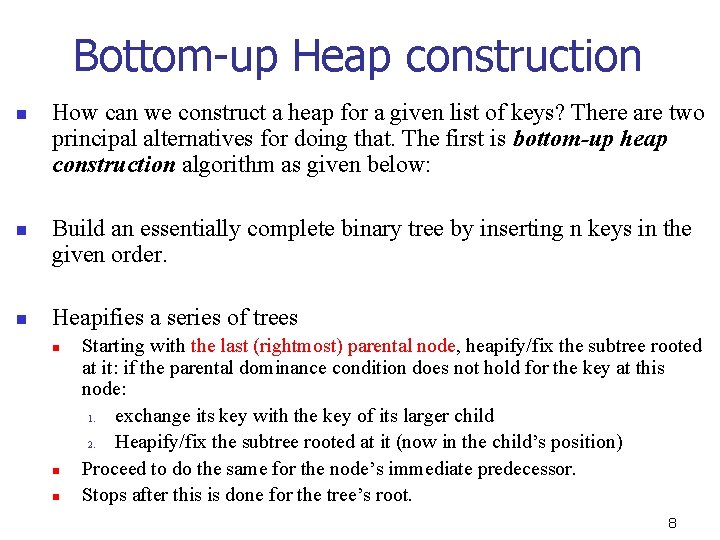
Bottom-up Heap construction n How can we construct a heap for a given list of keys? There are two principal alternatives for doing that. The first is bottom-up heap construction algorithm as given below: Build an essentially complete binary tree by inserting n keys in the given order. Heapifies a series of trees n n n Starting with the last (rightmost) parental node, heapify/fix the subtree rooted at it: if the parental dominance condition does not hold for the key at this node: 1. exchange its key with the key of its larger child 2. Heapify/fix the subtree rooted at it (now in the child’s position) Proceed to do the same for the node’s immediate predecessor. Stops after this is done for the tree’s root. 8
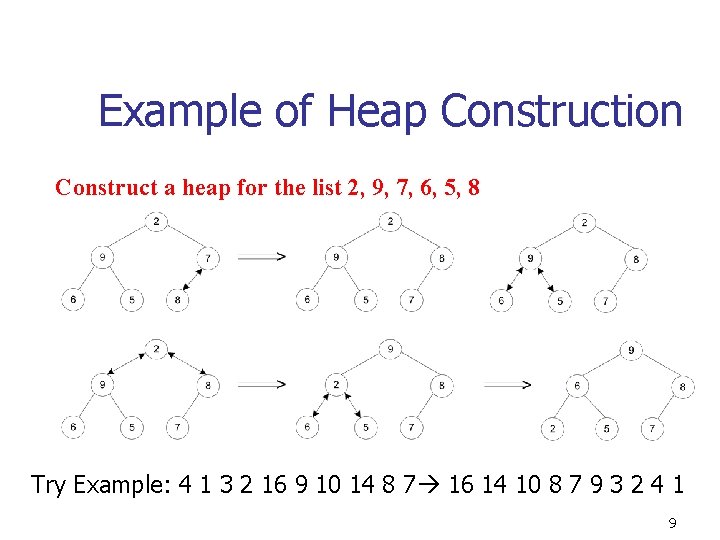
Example of Heap Construction Construct a heap for the list 2, 9, 7, 6, 5, 8 Try Example: 4 1 3 2 16 9 10 14 8 7 16 14 10 8 7 9 3 2 4 1 9
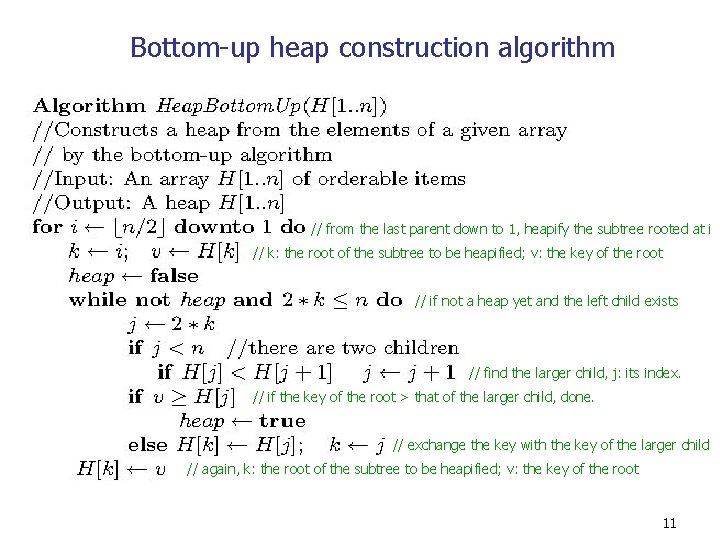
Bottom-up heap construction algorithm(A Recursive version) ALGORITHM Heap. Bottom. Up(H[1. . n]) //Constructs a heap from the elements //of a given array by the bottom-up algorithm //Input: An array H[1. . n] of orderable items //Output: A heap H[1. . n] for i n/2 downto 1 do Max. Heapify(H, i) Given a heap of n nodes, what’s the index of the last parent? n/2 ALGORITHM Max. Heapify(H, i) l LEFT(i) r RIGHT(i) if l <= n and H[l] > H[i] // if left child exists and > H[i] then largest l else largest i if r <= n and H[r] > H[largest] // if R child exists and > H[largest] then largest r if largest i then exchange H[i] H[largest] // heapify the subtree Max. Heapify(H, largest) 10
Bottom-up heap construction algorithm // from the last parent down to 1, heapify the subtree rooted at i // k: the root of the subtree to be heapified; v: the key of the root // if not a heap yet and the left child exists // find the larger child, j: its index. // if the key of the root > that of the larger child, done. // exchange the key with the key of the larger child // again, k: the root of the subtree to be heapified; v: the key of the root 11
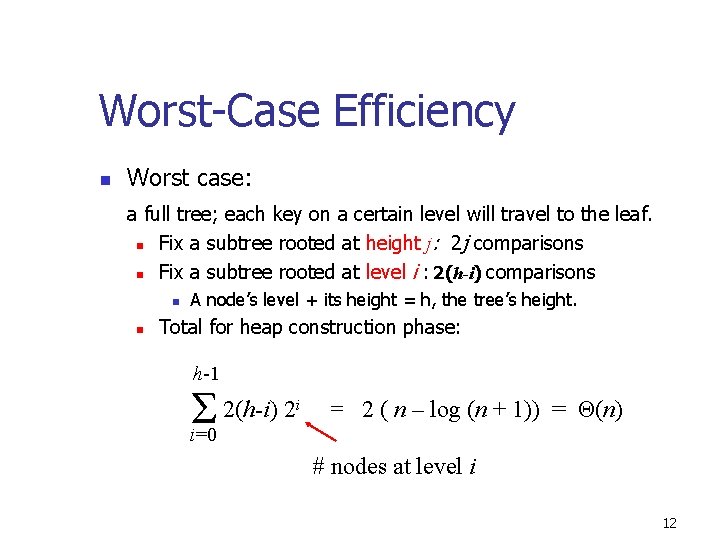
Worst-Case Efficiency n Worst case: a full tree; each key on a certain level will travel to the leaf. n Fix a subtree rooted at height j: 2 j comparisons n Fix a subtree rooted at level i : 2(h-i) comparisons n n A node’s level + its height = h, the tree’s height. Total for heap construction phase: h-1 2(h-i) 2 Σ i=0 i = 2 ( n – log (n + 1)) = Θ(n) # nodes at level i 12
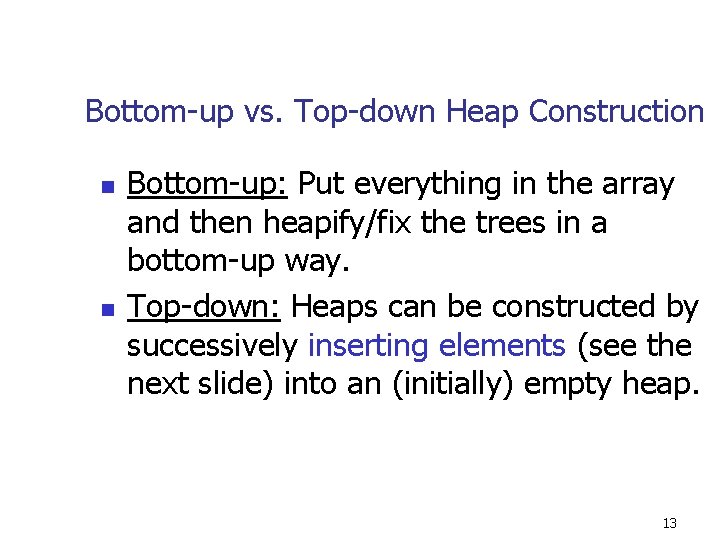
Bottom-up vs. Top-down Heap Construction n n Bottom-up: Put everything in the array and then heapify/fix the trees in a bottom-up way. Top-down: Heaps can be constructed by successively inserting elements (see the next slide) into an (initially) empty heap. 13
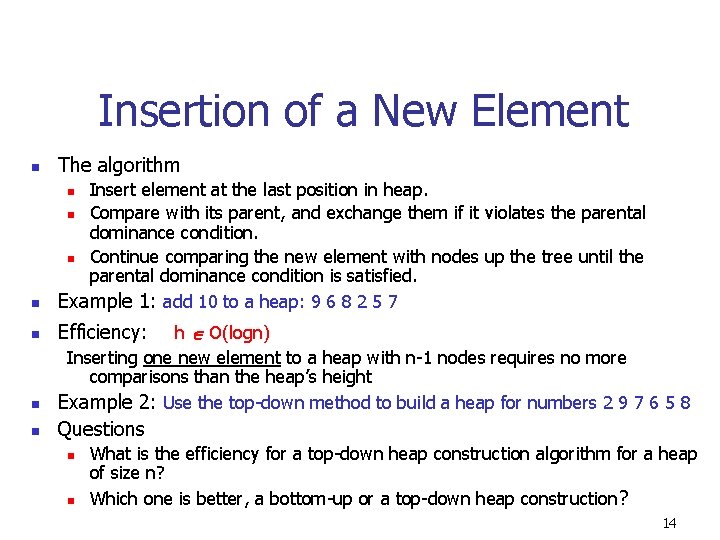
Insertion of a New Element n The algorithm n Insert element at the last position in heap. n Compare with its parent, and exchange them if it violates the parental dominance condition. n Continue comparing the new element with nodes up the tree until the parental dominance condition is satisfied. Example 1: add 10 to a heap: 9 6 8 2 5 7 n Efficiency: n n h O(logn) Inserting one new element to a heap with n-1 nodes requires no more comparisons than the heap’s height Example 2: Use the top-down method to build a heap for numbers 2 9 7 6 5 8 n Questions n n What is the efficiency for a top-down heap construction algorithm for a heap of size n? Which one is better, a bottom-up or a top-down heap construction ? 14
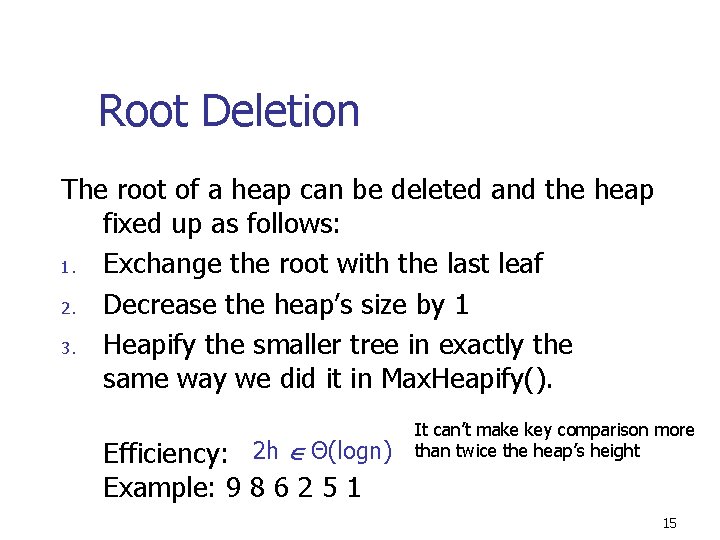
Root Deletion The root of a heap can be deleted and the heap fixed up as follows: 1. Exchange the root with the last leaf 2. Decrease the heap’s size by 1 3. Heapify the smaller tree in exactly the same way we did it in Max. Heapify(). Efficiency: 2 h Θ(logn) Example: 9 8 6 2 5 1 It can’t make key comparison more than twice the heap’s height 15
Update keys n How to do it? 16
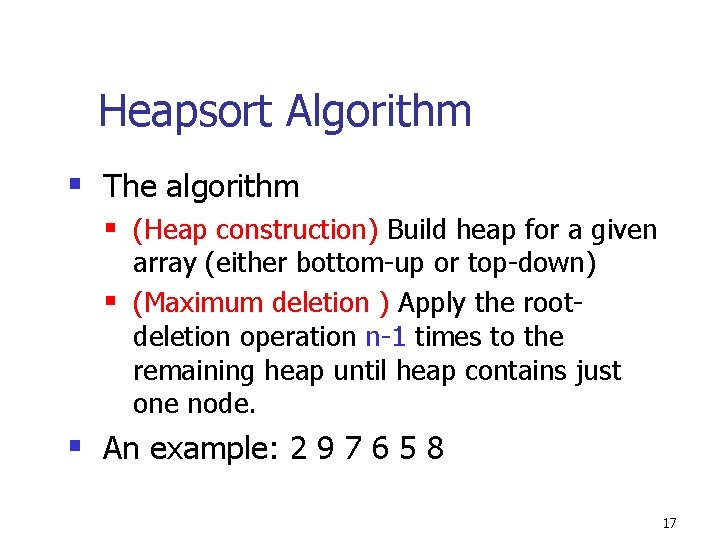
Heapsort Algorithm § The algorithm § (Heap construction) Build heap for a given array (either bottom-up or top-down) § (Maximum deletion ) Apply the rootdeletion operation n-1 times to the remaining heap until heap contains just one node. § An example: 2 9 7 6 5 8 17
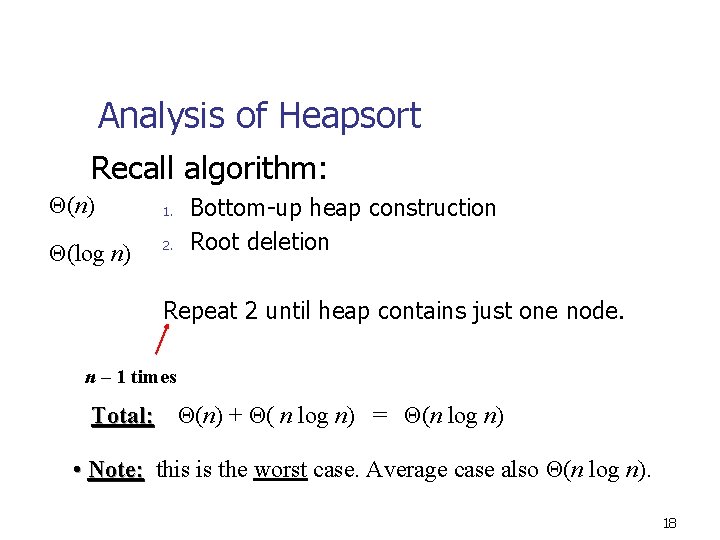
Analysis of Heapsort Recall algorithm: Θ(n) Θ(log n) 1. 2. Bottom-up heap construction Root deletion Repeat 2 until heap contains just one node. n – 1 times Total: Θ(n) + Θ( n log n) = Θ(n log n) • Note: this is the worst case. Average case also Θ(n log n). 18
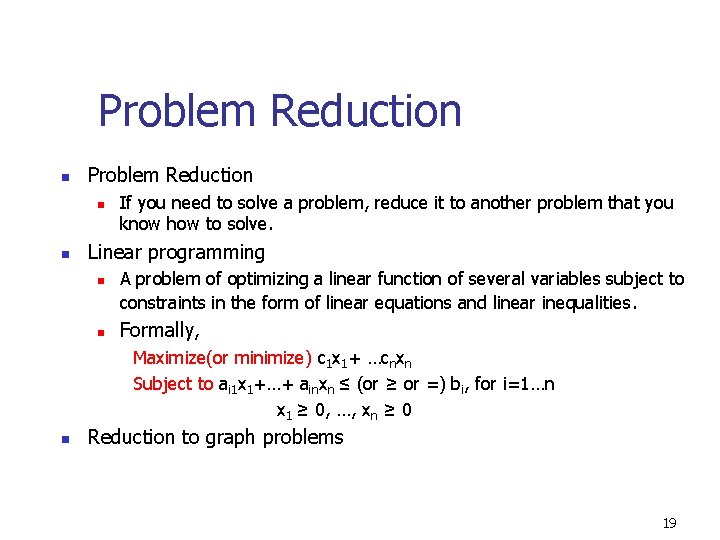
Problem Reduction n n If you need to solve a problem, reduce it to another problem that you know how to solve. Linear programming n n A problem of optimizing a linear function of several variables subject to constraints in the form of linear equations and linear inequalities. Formally, Maximize(or minimize) c 1 x 1+ …cnxn Subject to ai 1 x 1+…+ ainxn ≤ (or ≥ or =) bi, for i=1…n x 1 ≥ 0, …, xn ≥ 0 n Reduction to graph problems 19
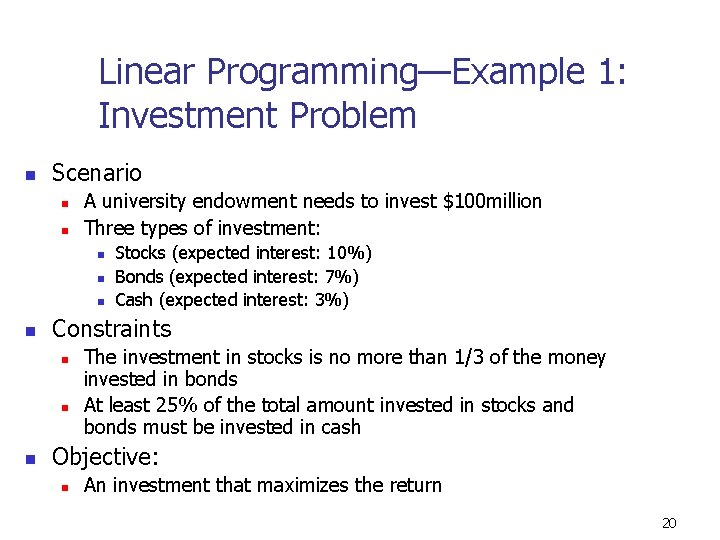
Linear Programming—Example 1: Investment Problem n Scenario n n A university endowment needs to invest $100 million Three types of investment: n n Constraints n n n Stocks (expected interest: 10%) Bonds (expected interest: 7%) Cash (expected interest: 3%) The investment in stocks is no more than 1/3 of the money invested in bonds At least 25% of the total amount invested in stocks and bonds must be invested in cash Objective: n An investment that maximizes the return 20
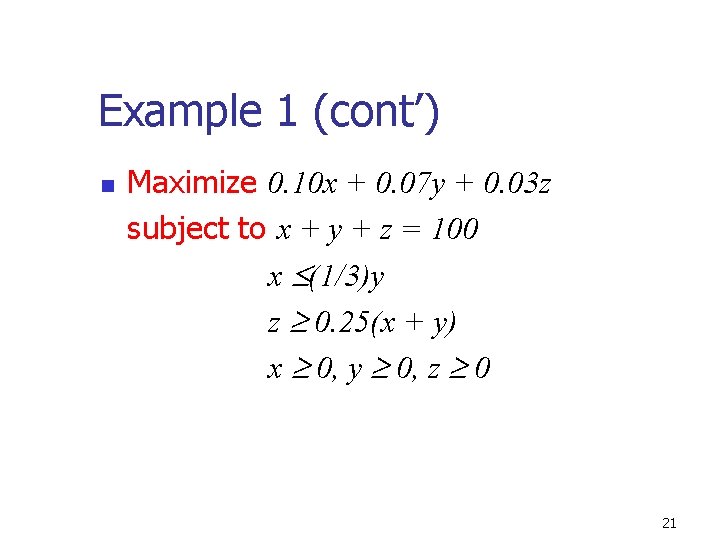
Example 1 (cont’) n Maximize 0. 10 x + 0. 07 y + 0. 03 z subject to x + y + z = 100 x (1/3)y z 0. 25(x + y) x 0, y 0, z 0 21
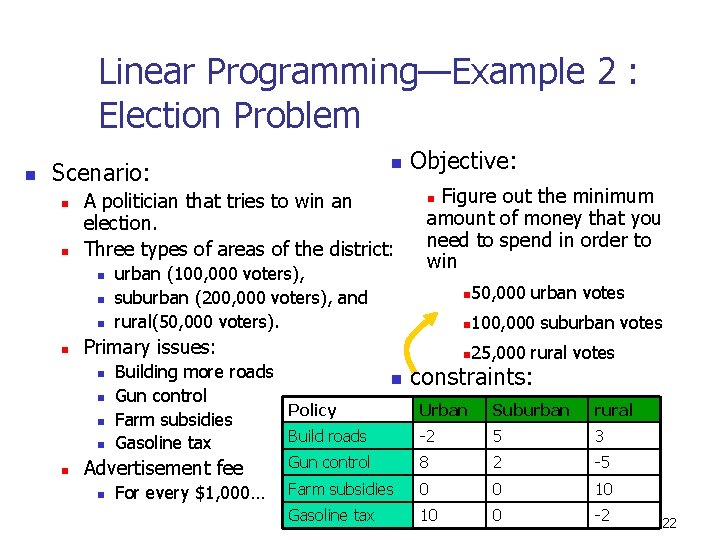
Linear Programming—Example 2 : Election Problem n n Scenario: n n A politician that tries to win an election. Three types of areas of the district: n n Figure out the minimum amount of money that you need to spend in order to win n 50, 000 urban votes n 100, 000 suburban votes n Primary issues: n n n urban (100, 000 voters), suburban (200, 000 voters), and rural(50, 000 voters). Objective: Building more roads Gun control Policy Farm subsidies Build roads Gasoline tax Advertisement fee n For every $1, 000… 25, 000 rural votes n n constraints: Urban Suburban rural -2 5 3 Gun control 8 2 -5 Farm subsidies 0 0 10 Gasoline tax 10 0 -2 22
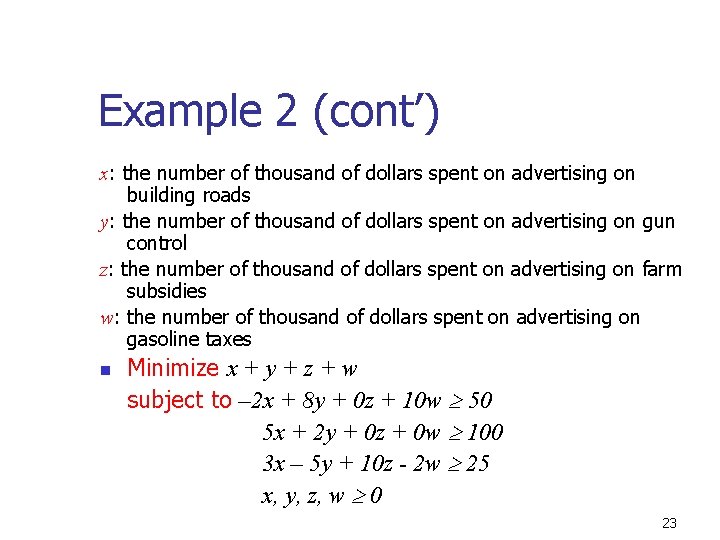
Example 2 (cont’) x: the number of thousand of dollars spent on advertising on building roads y: the number of thousand of dollars spent on advertising on gun control z: the number of thousand of dollars spent on advertising on farm subsidies w: the number of thousand of dollars spent on advertising on gasoline taxes n Minimize x + y + z + w subject to – 2 x + 8 y + 0 z + 10 w 50 5 x + 2 y + 0 z + 0 w 100 3 x – 5 y + 10 z - 2 w 25 x, y, z, w 0 23
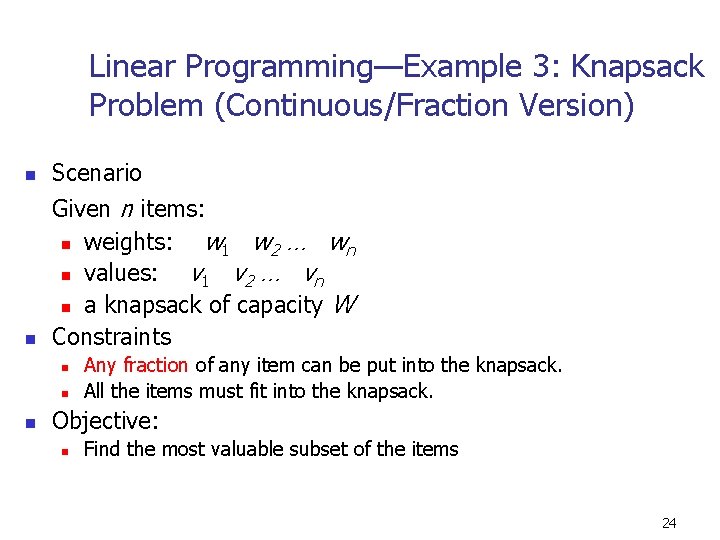
Linear Programming—Example 3: Knapsack Problem (Continuous/Fraction Version) n Scenario n Given n items: n weights: w 1 w 2 … w n n values: v 1 v 2 … v n n a knapsack of capacity W Constraints n n n Any fraction of any item can be put into the knapsack. All the items must fit into the knapsack. Objective: n Find the most valuable subset of the items 24
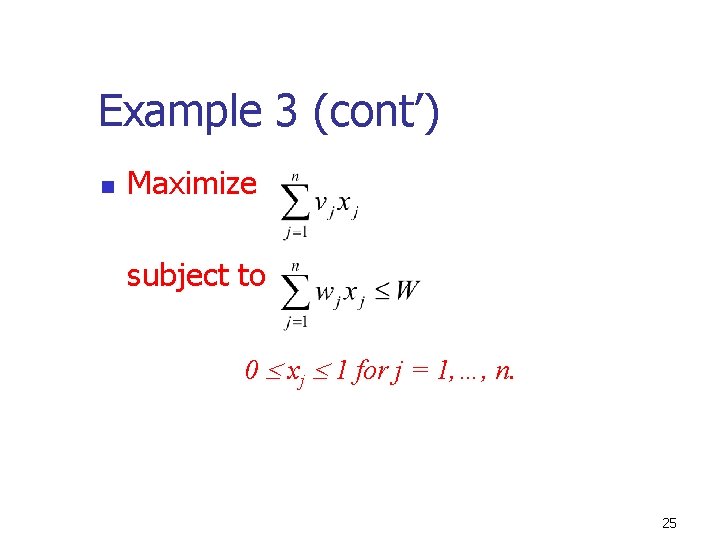
Example 3 (cont’) n Maximize subject to 0 xj 1 for j = 1, …, n. 25
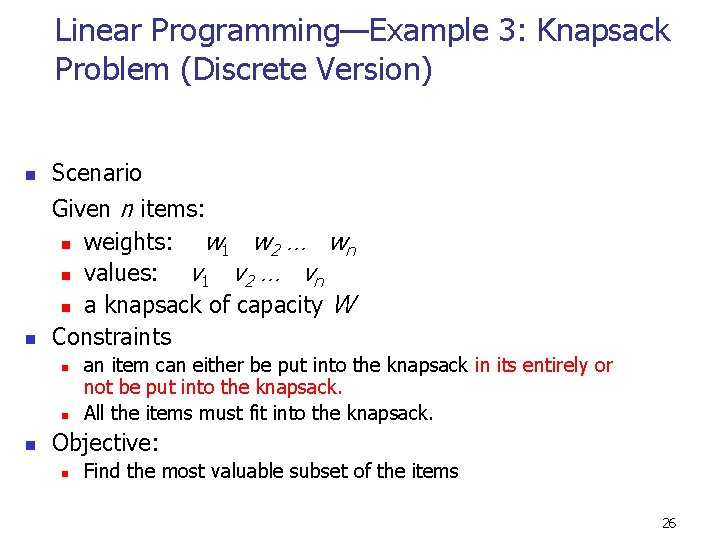
Linear Programming—Example 3: Knapsack Problem (Discrete Version) n Scenario n Given n items: n weights: w 1 w 2 … w n n values: v 1 v 2 … v n n a knapsack of capacity W Constraints n n n an item can either be put into the knapsack in its entirely or not be put into the knapsack. All the items must fit into the knapsack. Objective: n Find the most valuable subset of the items 26
Example 3 (cont’) n Maximize subject to xj {0, 1} for j = 1, …, n. 27
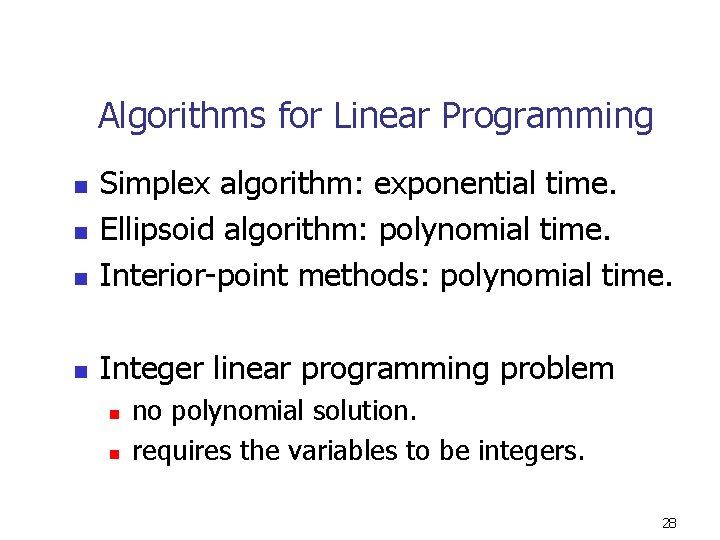
Algorithms for Linear Programming n Simplex algorithm: exponential time. Ellipsoid algorithm: polynomial time. Interior-point methods: polynomial time. n Integer linear programming problem n n no polynomial solution. requires the variables to be integers. 28
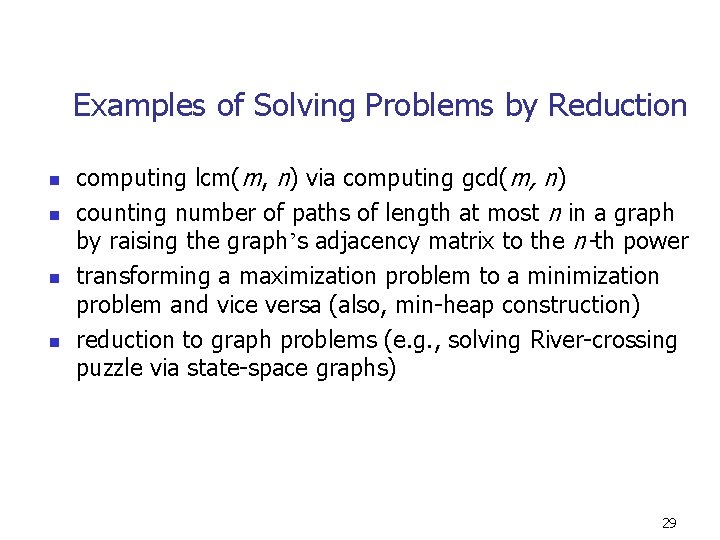
Examples of Solving Problems by Reduction n n computing lcm(m, n) via computing gcd(m, n) counting number of paths of length at most n in a graph by raising the graph’s adjacency matrix to the n-th power transforming a maximization problem to a minimization problem and vice versa (also, min-heap construction) reduction to graph problems (e. g. , solving River-crossing puzzle via state-space graphs) 29