
Transferability of Economic Evaluation Results Between Countries Group

Transferability of Economic Evaluation Results Between Countries Group Three Dorian Herceg Ashley Jenkins Viraj Kasbekar Annie Kirkwood Radhika Kulkarni
Introduction • Transferability factors • Knock-out Criteria • Modeling adjustments • Degree of transferability • Corrections for different currency and purchasing power • Transferability decision chart applied to: • Case 1 - Germany • Case 2 - Netherlands • Case 3 - Denmark • Link to Brown et al. article • Conclusion

Determining Transferability Factors o Definition: The quality of being transferable or exchangeable o Two Approaches • Systematic identification of potential transferability factors • Literature review o Four Characteristics the Potential Factors Had to Possess 1. Influence on outcomes of economic evaluations 2. International variation 3. Measurability 4. Distinguishable from other factors, i. e. they should overlap with other factors as little as possible
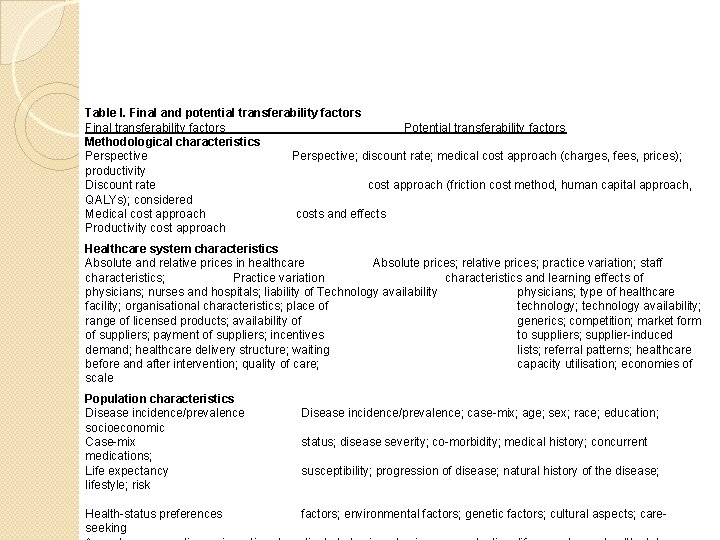
Table I. Final and potential transferability factors Final transferability factors Potential transferability factors Methodological characteristics Perspective; discount rate; medical cost approach (charges, fees, prices); productivity Discount rate cost approach (friction cost method, human capital approach, QALYs); considered Medical cost approach costs and effects Productivity cost approach Healthcare system characteristics Absolute and relative prices in healthcare Absolute prices; relative prices; practice variation; staff characteristics; Practice variation characteristics and learning effects of physicians; nurses and hospitals; liability of Technology availability physicians; type of healthcare facility; organisational characteristics; place of technology; technology availability; range of licensed products; availability of generics; competition; market form of suppliers; payment of suppliers; incentives to suppliers; supplier-induced demand; healthcare delivery structure; waiting lists; referral patterns; healthcare before and after intervention; quality of care; capacity utilisation; economies of scale Population characteristics Disease incidence/prevalence socioeconomic Case-mix medications; Life expectancy lifestyle; risk Health-status preferences seeking Disease incidence/prevalence; case-mix; age; sex; race; education; status; disease severity; co-morbidity; medical history; concurrent susceptibility; progression of disease; natural history of the disease; factors; environmental factors; genetic factors; cultural aspects; care-
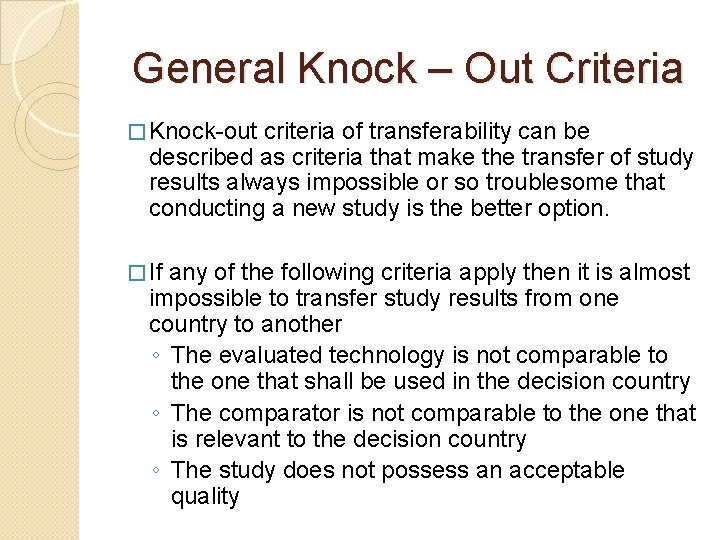
General Knock – Out Criteria � Knock-out criteria of transferability can be described as criteria that make the transfer of study results always impossible or so troublesome that conducting a new study is the better option. � If any of the following criteria apply then it is almost impossible to transfer study results from one country to another ◦ The evaluated technology is not comparable to the one that shall be used in the decision country ◦ The comparator is not comparable to the one that is relevant to the decision country ◦ The study does not possess an acceptable quality
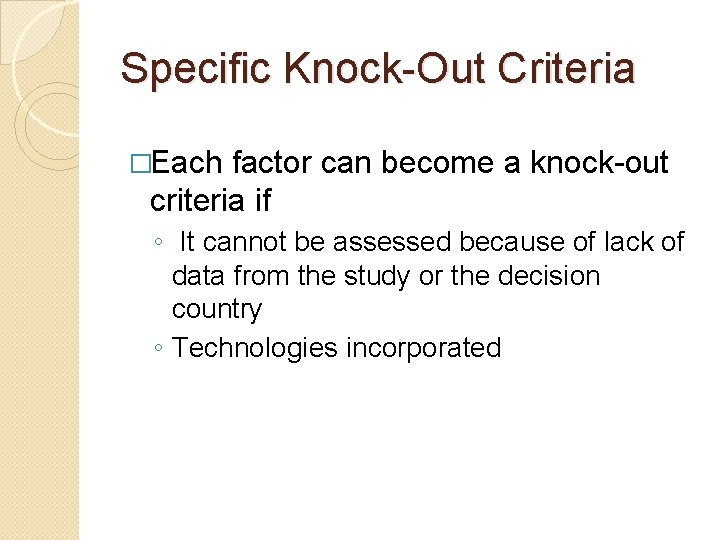
Specific Knock-Out Criteria �Each factor can become a knock-out criteria if ◦ It cannot be assessed because of lack of data from the study or the decision country ◦ Technologies incorporated
Knock –out Criteria Conclusion �If either knock-criteria are present then study results are not transferable �If both criteria are not present then you assess whether modeling adjustments are necessary
Modeling Adjustments �Always necessary when big differences between the study country and decision country are present for ◦ Practice variation ◦ Relative prices or incidence/prevalence of the respective target disease �Also, every other transferability factor can also cause need for remodeling �If necessary, identify if study/data methods complete and then if data is available )new parameter and new CER, and sensitivity analysis) �If not necessary, study results fully transferable or needing higher transferability)
Degree of Transferability �Identify if study/data methods complete �If no, not transferable �If yes, identify if relevant decision country data available ◦ Fully available �Substitute all parameters and calculate new CER ◦ Partially available �Substitute all parameters and calculate new CER �Re-apply checklist or perform sensitivity analysis �Either transferable or not transferable ◦ Not available �Assess variability of parameters and perform sensitivity analysis �Either transferable or not transferable

Correction for Different Currency or Purchasing Power as Well as Inflation � Correction for Different Currency or Purchasing Power ◦ Purchasing power parities (PPPs) � Correction for Inflation ◦ The healthcare-specific price indices ◦ GDP-price index
Application of the Transferability Decision Chart �Case 1 – Germany ◦ Cost effectiveness of stenting technology compared with PTCA for patients with coronary heart disease. �Case 2 – Netherlands ◦ Cost effectiveness of current and future vaccine candidates - National Vaccine Program �Case 3 – Denmark ◦ Cost effectiveness of a systematic chlamydial screening program of asymptomatically infected individuals
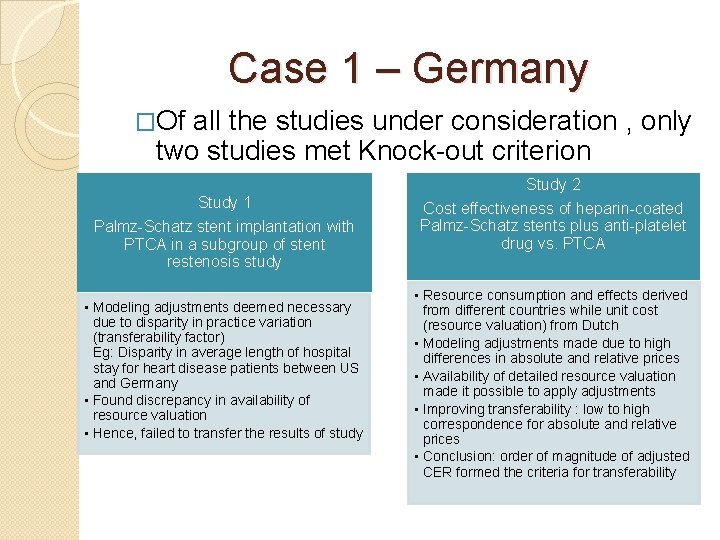
Case 1 – Germany �Of all the studies under consideration , only two studies met Knock-out criterion Study 2 Study 1 Palmz-Schatz stent implantation with PTCA in a subgroup of stent restenosis study • Modeling adjustments deemed necessary due to disparity in practice variation (transferability factor) Eg: Disparity in average length of hospital stay for heart disease patients between US and Germany • Found discrepancy in availability of resource valuation • Hence, failed to transfer the results of study Cost effectiveness of heparin-coated Palmz-Schatz stents plus anti-platelet drug vs. PTCA • Resource consumption and effects derived from different countries while unit cost (resource valuation) from Dutch • Modeling adjustments made due to high differences in absolute and relative prices • Availability of detailed resource valuation made it possible to apply adjustments • Improving transferability : low to high correspondence for absolute and relative prices • Conclusion: order of magnitude of adjusted CER formed the criteria for transferability
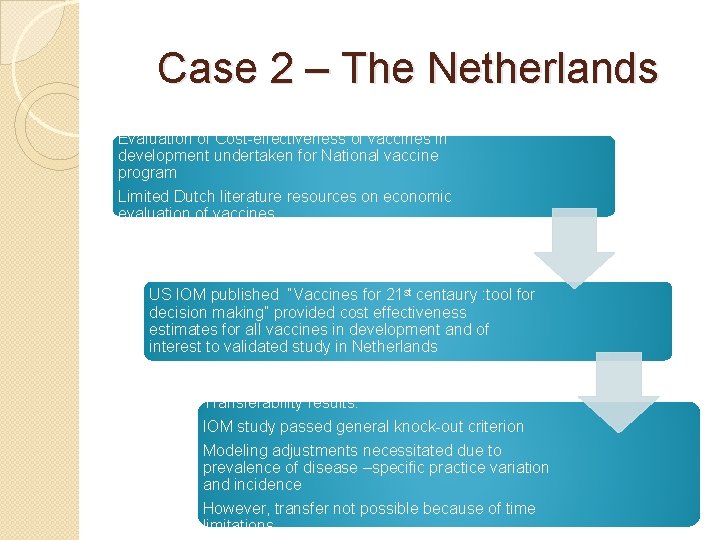
Case 2 – The Netherlands Evaluation of Cost-effectiveness of vaccines in development undertaken for National vaccine program Limited Dutch literature resources on economic evaluation of vaccines US IOM published “Vaccines for 21 st centaury : tool for decision making” provided cost effectiveness estimates for all vaccines in development and of interest to validated study in Netherlands Transferability results: IOM study passed general knock-out criterion Modeling adjustments necessitated due to prevalence of disease –specific practice variation and incidence However, transfer not possible because of time limitations
Case 3 – Denmark Danish researchers intented to transfer Dutch CEA Model to evaluation cost effectiveness of large-scale chlamydial screening programme which would save on time and cost of conducting the evaluation � Constraints in transferability: � – Divergence in two programmes with regards to screening approach, partner tracing programme as well as comparator As a result, transfer of study results not possible. � Assessment of transferability of model: � o Entailed two sub-models: epidemiological and economical o Parameters from eidemiological model like partner mixing, number of partners and nature of infection including the prevalence data seemed transferable without any need for adjustments, whereas only testing probability and contraction needed correction. o To apply the economic model, Danish parameters for utilization and valuation of resources consumption had to be totally replaced , additionally a new model to predict cost of test and partner referral created
Connection to Brown et al. • • • Transferability by Robert Welte article can be applied to Brown article How? Transfer of economic evaluation results Goal – cost effectiveness of ERT compared to radiotherapy alone Funding based on cost-effectiveness This study varied substantially across countries Relevant data was established for each country in order for transferability of information Had to take these changes into consideration (e. g. sensitivity analysis on lifetime cost-utility analysis) Discount rate, Radiotherapy admission costs, Costs of adverse event treatment, Acute health state utilities, etc.

Questions
- Slides: 16