
Transfer reactions Resonant Elastic scattering Inelastic scattering GR
- Slides: 9
Transfer reactions Resonant Elastic scattering Inelastic scattering: GR
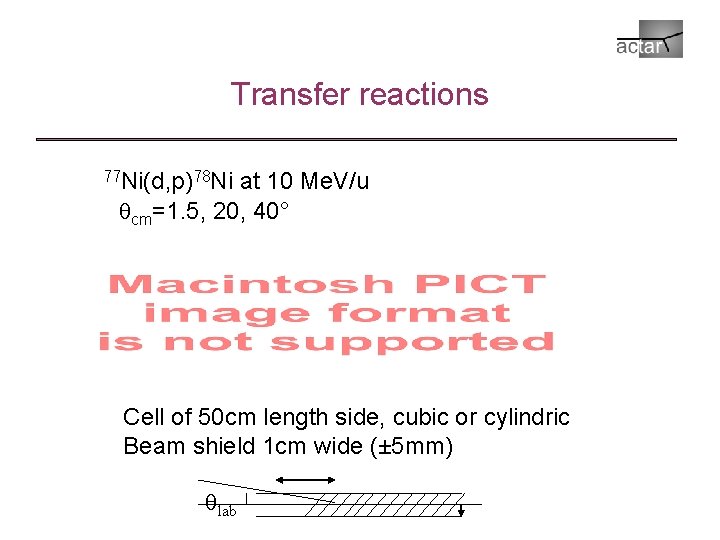
Transfer reactions 77 Ni(d, p)78 Ni at 10 Me. V/u cm=1. 5, 20, 40° Cell of 50 cm length side, cubic or cylindric Beam shield 1 cm wide (± 5 mm) lab
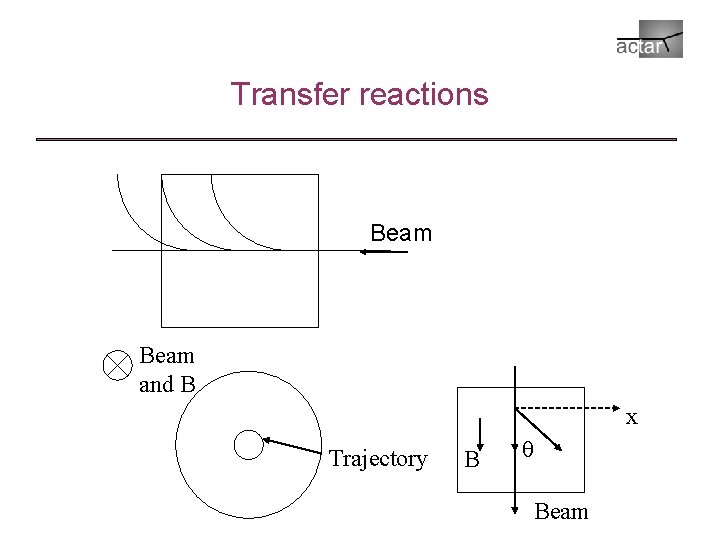
Transfer reactions Beam and B x Trajectory B Beam
Transfer reactions Conclusions -Forward angles most difficult -Better energy resolution obtained with cubic geometry and B But -Deviation of the beam -trajectories crossing the beam Best design: cylindric detector with B parallel to the beam and longitudinal projection
Resonant Elastic scattering Eres=Ecb-Sn+Ex Case 77 Ni: Eres=5 Me. V Typical energy range to cover: 4 to 9 Me. V
Resonant Elastic scattering For angles below 10°, energy resolution dominated by the position resolution at the reaction place MAYA geometry: reaction place determined by projection on anode plane. Limitation to between ± 45°. Loss of solid angle (factor 2 or 4). Cylindric geometry: position determined by time resolution. Problem also at small angles: for 5°, with interstrip=2 mm, resolution ≈ 1 mm. Problem with increase of rise time? ? ?
Inelastic scattering: Giant resonances Very low energy recoil Particles =>no impurities Pure gases H 2, D 2 Track length>5 cm P≈100 mb Charge state fluctuations? ? ?
Inelastic scattering: Giant resonances Plane geometry Cylindric geometry
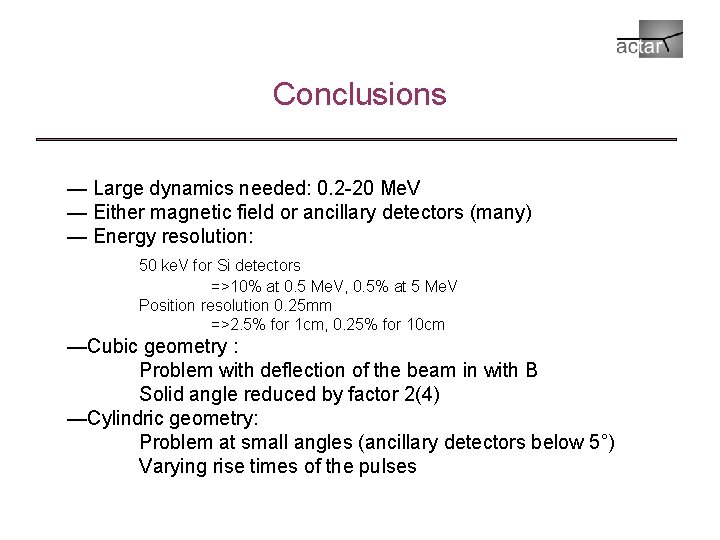
Conclusions — Large dynamics needed: 0. 2 -20 Me. V — Either magnetic field or ancillary detectors (many) — Energy resolution: 50 ke. V for Si detectors =>10% at 0. 5 Me. V, 0. 5% at 5 Me. V Position resolution 0. 25 mm =>2. 5% for 1 cm, 0. 25% for 10 cm —Cubic geometry : Problem with deflection of the beam in with B Solid angle reduced by factor 2(4) —Cylindric geometry: Problem at small angles (ancillary detectors below 5°) Varying rise times of the pulses