
Transfer Pricing Refers to prices related parties charge
- Slides: 14
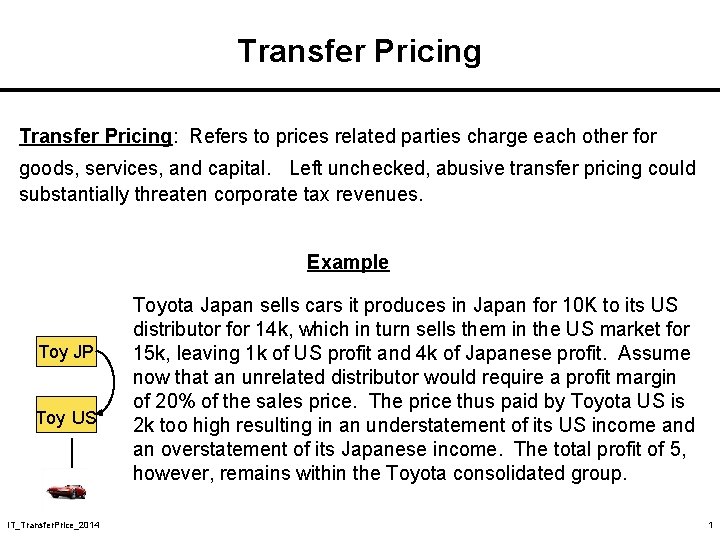
Transfer Pricing: Refers to prices related parties charge each other for goods, services, and capital. Left unchecked, abusive transfer pricing could substantially threaten corporate tax revenues. Example Toy JP Toy US IT_Transfer. Price_2014 Toyota Japan sells cars it produces in Japan for 10 K to its US distributor for 14 k, which in turn sells them in the US market for 15 k, leaving 1 k of US profit and 4 k of Japanese profit. Assume now that an unrelated distributor would require a profit margin of 20% of the sales price. The price thus paid by Toyota US is 2 k too high resulting in an understatement of its US income and an overstatement of its Japanese income. The total profit of 5, however, remains within the Toyota consolidated group. 1
Transfer Pricing: 482 In any case of two or more organizations, trades, or businesses (whether or not incorporated, whether or not organized in the United States, and whether or not affiliated) owned or controlled directly or indirectly by the same interests, the Secretary may distribute, apportion, or allocate gross income, deductions, credits, or allowances between or among such organizations, trades, or businesses, if he determines that such distribution, apportionment, or allocation is necessary in order to prevent evasion of taxes or clearly to reflect the income of any of such organizations, trades, or businesses. In the case of any transfer (or license) of intangible property (within the meaning of section 936(h)(3)(B)), the income with respect to such transfer or license shall be commensurate with the income attributable to the intangible. IT_Transfer. Price_2014 2
Transfer Pricing: 482 Regulations • 1968: Set out arm’s-length standard for loans, services, use and sale of tangible property, and transfer of intangible property • 1986: Added the CWI standard in section 482 for intangibles • 1988: Treasury White Paper • 1994: Final Section 482 Regs • 2005: New Proposed Cost-Sharing Regs • 2006: New Controlled Services Regs • 2008 -9: New Temporary Cost-Sharing Regs • Dec. 16, 2011: Final Cost-Sharing Regs IT_Transfer. Price_2014 3
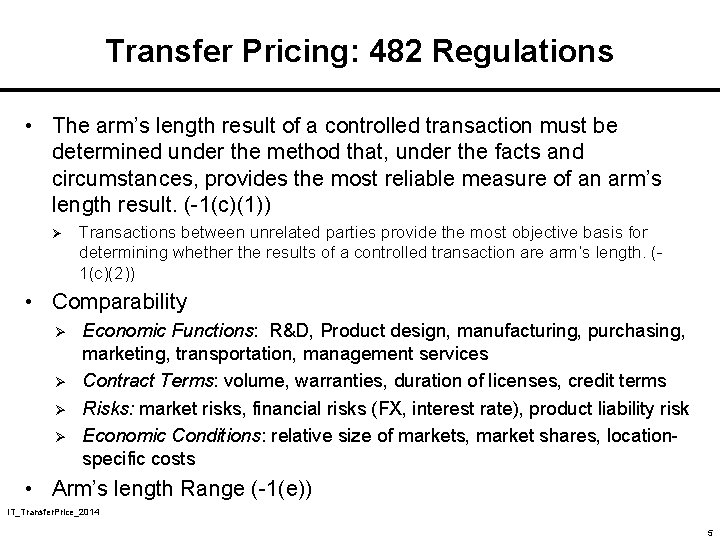
Transfer Pricing: 482 Regulations • In determining the true taxable income of a controlled taxpayer, the standard to be applied in every case is that of a taxpayer dealing at arm’s length with an uncontrolled taxpayer. A controlled transaction meets the arm’s length standard if the results of the transaction are consistent with the results that would have been realized if uncontrolled taxpayers had engaged in the same transaction under the same circumstances (arm’s length result). However, because identical transactions can rarely be located, whether a transaction produces an arm’s length result generally will be determined by reference to the results of comparable transactions under comparable circumstances. (-1(b)(1)) IT_Transfer. Price_2014 4
Transfer Pricing: 482 Regulations • The arm’s length result of a controlled transaction must be determined under the method that, under the facts and circumstances, provides the most reliable measure of an arm’s length result. (-1(c)(1)) Ø Transactions between unrelated parties provide the most objective basis for determining whether the results of a controlled transaction are arm’s length. (1(c)(2)) • Comparability Ø Ø Economic Functions: R&D, Product design, manufacturing, purchasing, marketing, transportation, management services Contract Terms: volume, warranties, duration of licenses, credit terms Risks: market risks, financial risks (FX, interest rate), product liability risk Economic Conditions: relative size of markets, market shares, locationspecific costs • Arm’s length Range (-1(e)) IT_Transfer. Price_2014 5
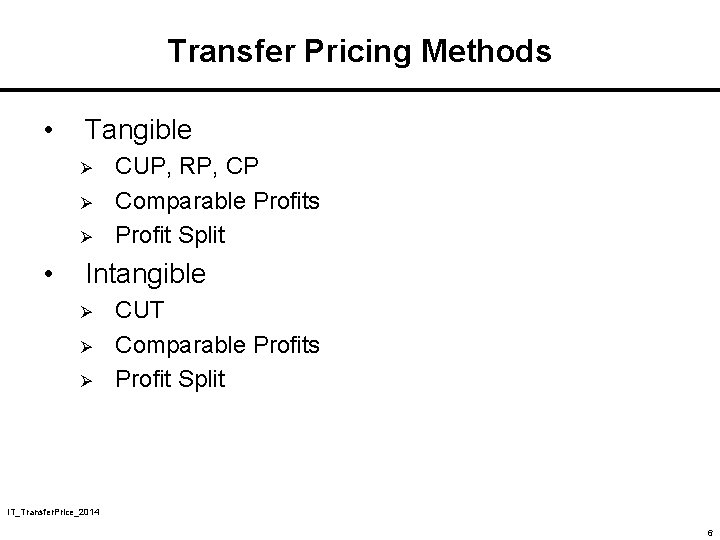
Transfer Pricing Methods • Tangible Ø Ø Ø • CUP, RP, CP Comparable Profits Profit Split Intangible Ø Ø Ø CUT Comparable Profits Profit Split IT_Transfer. Price_2014 6
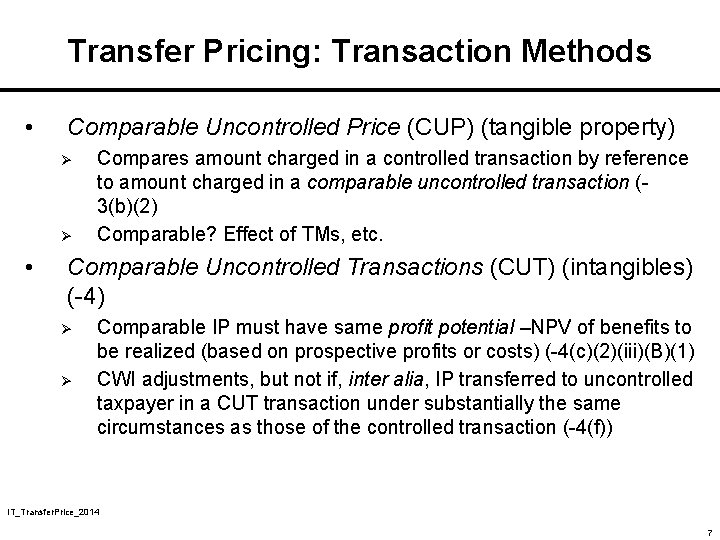
Transfer Pricing: Transaction Methods • Comparable Uncontrolled Price (CUP) (tangible property) Ø Ø • Compares amount charged in a controlled transaction by reference to amount charged in a comparable uncontrolled transaction (3(b)(2) Comparable? Effect of TMs, etc. Comparable Uncontrolled Transactions (CUT) (intangibles) (-4) Ø Ø Comparable IP must have same profit potential –NPV of benefits to be realized (based on prospective profits or costs) (-4(c)(2)(iii)(B)(1) CWI adjustments, but not if, inter alia, IP transferred to uncontrolled taxpayer in a CUT transaction under substantially the same circumstances as those of the controlled transaction (-4(f)) IT_Transfer. Price_2014 7
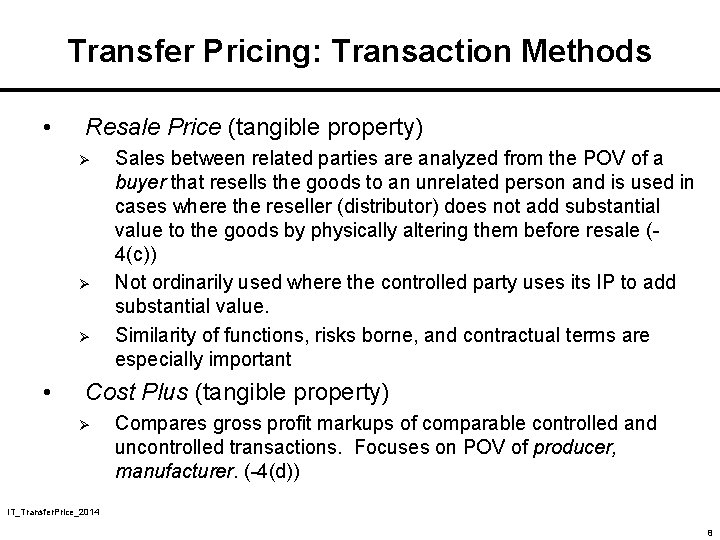
Transfer Pricing: Transaction Methods • Resale Price (tangible property) Ø Ø Ø • Sales between related parties are analyzed from the POV of a buyer that resells the goods to an unrelated person and is used in cases where the reseller (distributor) does not add substantial value to the goods by physically altering them before resale (4(c)) Not ordinarily used where the controlled party uses its IP to add substantial value. Similarity of functions, risks borne, and contractual terms are especially important Cost Plus (tangible property) Ø Compares gross profit markups of comparable controlled and uncontrolled transactions. Focuses on POV of producer, manufacturer. (-4(d)) IT_Transfer. Price_2014 8
Transfer Pricing: Profit-Based Methods • Profit Split Ø Ø Allocate P&L based on relative value of each controlled taxpayer’s contribution to combined P&L based on functions performed, risks assumed, and capital employed by each party. (-6(b)) Comparable Profit Split (-6(c)(2)) » Difficult to find uncontrolled parties dealing at arm’s length in similar transactions and enough information about their combined P&Ls » Examine operating profit margin relative to financial metric Ø Residual Profit Split (-6(c)(3)) » Operating income allocated to each party to provide market return for “routine” contributions to activity—contributions of tangible and IP, services that are generally owned by uncontrolled TP engaged in similar activities. » Residual profit divided among the controlled parties based on relative value of their contributions of IP to the relevant business activity – – – External market benchmarks that reflect the FMV of the IP, Capitalized cost of developing the IP, or The amount of actual expenditures IT_Transfer. Price_2014 9
Cost Sharing Arrangements (-7 T) • • Reasons for CSAs and transfer pricing concerns CSA: arrangement by which controlled participants share the costs and risks of developing cost shared intangibles in proportion to their reasonably anticipated benefits (RAB) shares. Ø • • Xilinx v. CIR, 598 F. 3 d 1191 (9 th Cir. 2010) (stock option expenses) If there is a valid CSA, each participant is considered to be an owner of the IP and therefore no royalty is imputed. Buy-in payments (platform contribution costs) Ø Veritas v. CIR, 133 T. C. 297 (2010) IT_Transfer. Price_2014 10
Transfer Pricing • • BOP: 482 determinations sustained absent showing of abuse of discretion—allocations are arbitrary, capricious, or unreasonable. Enforcement/Penalty Provisions: Ø Ø Ø 1059 A 6038 A; and 6662(e)(B) » » • APAs and Arbitrations Ø • Substantial valuation misstatement: price/value > 200% (or 50% less) than correct amount or net 482 adjustment exceeds the lessor of $5 mm or 10% of gross receipts Gross valuation misstatement: same as above but 400% (or 25%) or net 482 adjustment exceeds the lessor of $20 mm or 20% of gross receipts Uni, Bi, and Multilateral Income Tax Treaties Ø Art. 9(2) IT_Transfer. Price_2014 11
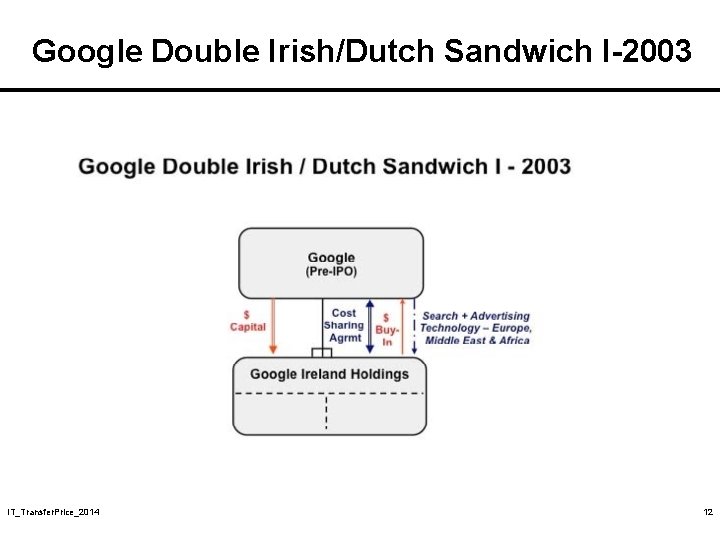
Google Double Irish/Dutch Sandwich I-2003 IT_Transfer. Price_2014 12
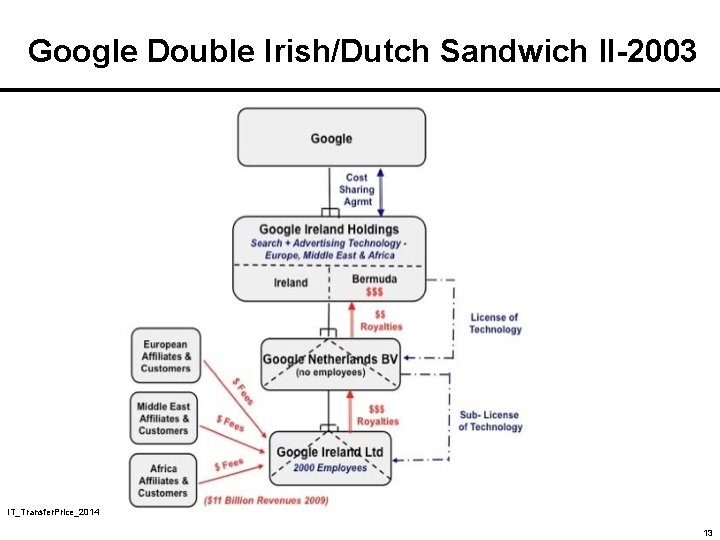
Google Double Irish/Dutch Sandwich II-2003 IT_Transfer. Price_2014 13
OECD: Base Erosion & Profit Shifting (BEPS) • • Addressing Base Erosion & Profit Shifiting Action Plan on Base Erosion & Profit Shifting (7/19/13) Discussion drafts on hybrid mismatch arrangements (3/19/14) Discussion draft on tax challenges of the digital economy (3/24/14) IT_Transfer. Price_2014 14