
TRANSFER PRICING BASICS FOR INSPECTORS In Transfer Pricing
TRANSFER PRICING BASICS FOR INSPECTORS In Transfer Pricing, the role of Inspectors is also significant. They should be aware of not only the principles of TP, but also their role in different circumstances. � � Role of Inspectors in TP Basics of Transfer Pricing

ROLE OF INSPECTORS
ROLES IN DIFFERENT OFFICES � Assessment � CIT’s charges office � Transfer Pricing Office
ROLE OF TRANSFER PRICING OFFICER � � � Under normal circumstances, the Assessing Officer (AO) has the power to determine the taxable income under all heads of income However in cases where International Transactions (IT) or Specified Domestic Transactions (SDT) are involved, AO seeks the assistance of the Transfer Pricing Officer (TPO) by making a reference In such cases, the AO determines the income from all transactions excluding referred transactions In case of referred transactions, the TPO determines the income from referred transactions by passing an order If the order passed by the TPO has the effect of increasing the income or reducing the losses, it is incorporated as such in the assessment order passed by the AO The effect of this arrangement is that the AO and TPO have mutually exclusive jurisdiction (as per the latest Instruction) over the non-TP and TP issues respectively
THE WORK FLOW OF TRANSFER PRICING � � � � � Assessing Officer (AO) decides to make a reference to Transfer Pricing Officer (TPO) Writes to Commissioner seeking approval for reference Commissioner grants approval [Sec 92 CA(1)] Makes a reference to TPO determines the income from referred transactions and passes order [Sec 92 CA(3)] Depending on the nature of order and assessee’s response, AO passes draft order or a final order Draft order goes to Dispute Resolution Panel (DRP) for considering assessee’s objections to the draft order DRP passes order with directions to the AO AO passes final order
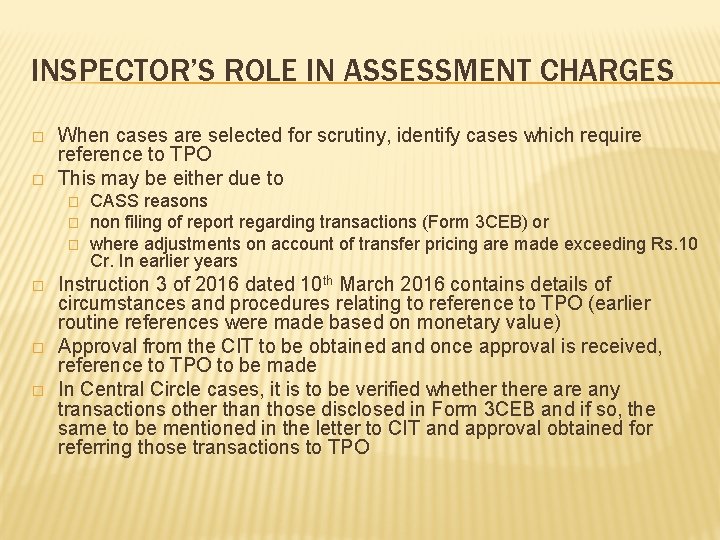
INSPECTOR’S ROLE IN ASSESSMENT CHARGES � � When cases are selected for scrutiny, identify cases which require reference to TPO This may be either due to � � � CASS reasons non filing of report regarding transactions (Form 3 CEB) or where adjustments on account of transfer pricing are made exceeding Rs. 10 Cr. In earlier years Instruction 3 of 2016 dated 10 th March 2016 contains details of circumstances and procedures relating to reference to TPO (earlier routine references were made based on monetary value) Approval from the CIT to be obtained and once approval is received, reference to TPO to be made In Central Circle cases, it is to be verified whethere any transactions other than those disclosed in Form 3 CEB and if so, the same to be mentioned in the letter to CIT and approval obtained for referring those transactions to TPO
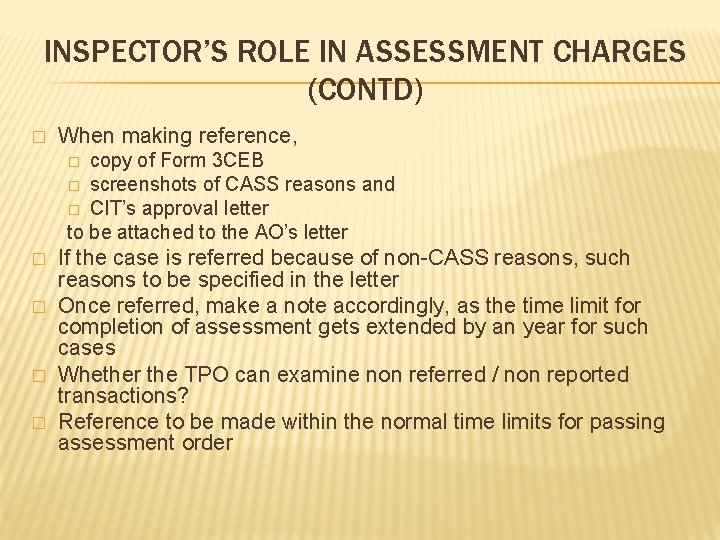
INSPECTOR’S ROLE IN ASSESSMENT CHARGES (CONTD) � When making reference, copy of Form 3 CEB � screenshots of CASS reasons and � CIT’s approval letter to be attached to the AO’s letter � � � If the case is referred because of non-CASS reasons, such reasons to be specified in the letter Once referred, make a note accordingly, as the time limit for completion of assessment gets extended by an year for such cases Whether the TPO can examine non referred / non reported transactions? Reference to be made within the normal time limits for passing assessment order
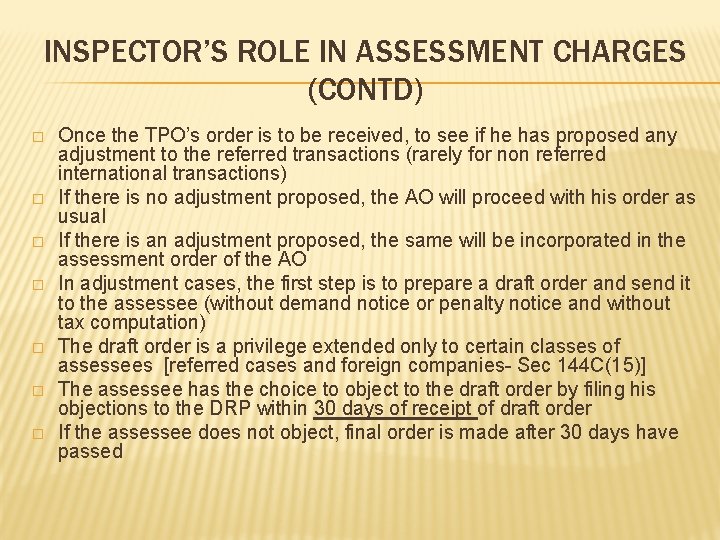
INSPECTOR’S ROLE IN ASSESSMENT CHARGES (CONTD) � � � � Once the TPO’s order is to be received, to see if he has proposed any adjustment to the referred transactions (rarely for non referred international transactions) If there is no adjustment proposed, the AO will proceed with his order as usual If there is an adjustment proposed, the same will be incorporated in the assessment order of the AO In adjustment cases, the first step is to prepare a draft order and send it to the assessee (without demand notice or penalty notice and without tax computation) The draft order is a privilege extended only to certain classes of assessees [referred cases and foreign companies- Sec 144 C(15)] The assessee has the choice to object to the draft order by filing his objections to the DRP within 30 days of receipt of draft order If the assessee does not object, final order is made after 30 days have passed
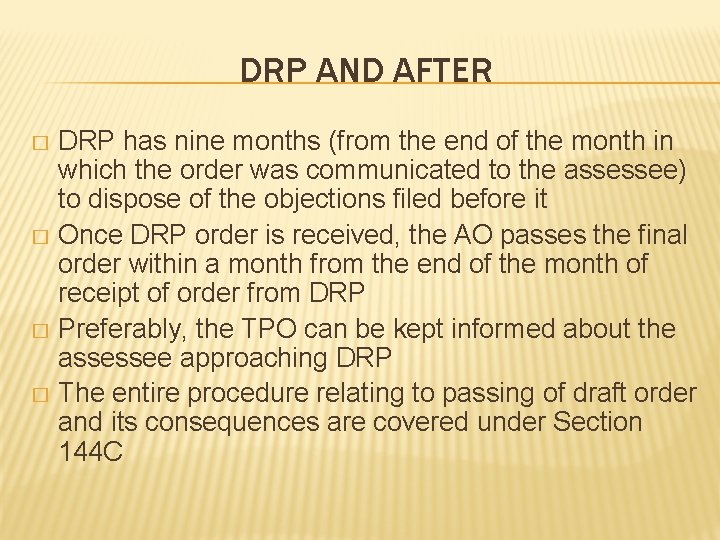
DRP AND AFTER DRP has nine months (from the end of the month in which the order was communicated to the assessee) to dispose of the objections filed before it � Once DRP order is received, the AO passes the final order within a month from the end of the month of receipt of order from DRP � Preferably, the TPO can be kept informed about the assessee approaching DRP � The entire procedure relating to passing of draft order and its consequences are covered under Section 144 C �
IN CIT’S OFFICE � � � If posted in CIT’s Office, to ensure that approval for reference to TPO is properly accorded This is a statutory approval and no reference can be made without CIT’s approval For IT, TPO can look into other non-reported transactions even if not referred, but does not have similar power for SDT Therefore, ensure that transactions which are required to be referred are mentioned in the approval letter (especially relevant for Central Circle cases) Often, Form 3 CEB filed by assessee contains both IT & SDT (first 20 columns pertain to IT and the rest to SDT). The AO may or may not seek approval for both. Therefore, what transactions are approved should be clearly discernible in the approval letter. If both are approved, the letter should be accordingly drafted. Sometimes, only a part of the IT is mentioned in CASS. In such cases, only those transactions will find place in the approval letter and care should be taken to draft letter accordingly
IN TRANSFER PRICING DIRECTORATE � � � Once references are received, notices for assumption of jurisdiction / calling for details [Sec 92 CA(2) & 92 D(3)] are to be issued Assessees file their transfer pricing documentation (called TP Study, which is the basic document for transfer pricing) and other relevant documents / information Assessees can choose one of the six prescribed methods for determining the arm’s length price of their transactions Inspectors access publicly available databases to find similar companies to check whether the prices reported by the assessee are in tune with market trends Currently used databases – Prowess, Ace. TP, Capital. Line
IN TRANSFER PRICING DIRECTORATE (CONTD) � � � Similar to additions to income and disallowance of expenses, the TPOs make upward and downward adjustments In case of adjustments, the quantification of those adjustments are to be carefully done to avoid arithmetical errors TP audit is concluded by passing order under Section 92 CA(3) with or without adjustments TP orders are to be passed 60 days before the AO’s time limit (AO’s time limit till AY 2017 -18 is 31 st December which means that TP order is to be passed by 1 st November – remember, it is 60 days and not two months) This time limit gets extended when reference is made by the TPO to a foreign tax jurisdiction requesting for information relating to transfer pricing audit of any assessee
BASICS OF TRANSFER PRICING
WHAT IS TRANSFER PRICING � In taxation and accounting, transfer pricing refers to the rules and methods for pricing transactions between enterprises under common ownership or control. � TP is the price at which an enterprise transfers physical goods and intangible property and provides services to associated enterprises /related parties
RELEVANCE OF TRANSFER PRICING � � � Business transactions are increasingly becoming global More Indian Companies setting up overseas or owned by Foreign companies Consequently taxpayer tries to manage business affairs – to pay less tax in low tax jurisdictions or no tax in tax free jurisdictions TP gains significance because these can be used by the controlling parties to their advantage, to minimise tax incidence If the transactions are across different tax jurisdictions, where tax rates are different, shifting is beneficial
TRANSFER PRICING LAWS IN INDIA � Introduced in India in 2001 -02 for International Transactions � Transfer Pricing is covered in Chapter-X of the Act � Sections 92 to 92 F � Rules 10 A to 10 THD � Determination of Arm’s Length Price (ALP) governed loosely by OECD Guidelines (revised very recently in 2017) � Transfer Pricing for domestic transactions introduced in 2012 w. e. f. AY 2013 -14 (Sec 92 BA)
TERMINOLOGIES USED IN TRANSFER PRICING � � � � � Adjustment – downward revision of items of expense like purchase of goods, royalty & service charges and upward revision of revenue items by TPO Arm’s Length Price (ALP) – the price which the goods or services would fetch in a normal market scenario Associated Enterprise (AE) – the entities who are governed by common control or ownership Comparable party – the third party/parties with whose prices the comparison of assessee’s prices are being made Controlled transactions – transactions between AEs FAR Analysis – Functions, Assets & Risks analysis Most Appropriate Method (MAM) – the method chosen by the assessee to evaluate his transactions. This can be different for different types of transactions for the same year. TPO can choose to apply a different MAM. Tested Party – generally the assessee whose transactions are being evaluated (sometimes the AE is also taken as the tested party) Uncontrolled transactions – transactions taking place in market driven conditions
APPLICABILITY FOR INTERNATIONAL TRANSACTIONS � Transfer pricing provisions are applicable only if: � There are two or more enterprises (defined in Sec 92 F) � The enterprises are AEs (defined in Sec 92 A) � The enterprises enter into a transaction (defined in Sec 92 F) � The transaction is an International transaction (defined in Sec 92 B) � Consequences of these provisions: � Computation of income/ allowance of expenses having regard to the Arm’s length price [Section 92] � Maintenance of prescribed Documentation (Section 92 D & Rule 10 D) � Obtaining of Accountant’s report (under Form 3 CEB) (Section 92 E) � To ensure compliance with the arm’s length principle, stiff Penalties have been prescribed
APPLICABILITY FOR DOMESTIC TRANSACTIONS � Domestic transfer pricing is in respect of transactions between related parties mentioned in Section 40 A(2) (Expenses) and for those claiming profit linked deductions from their income in Chapters III & VI-A (Sections 10 AA & 80 IA etc) � Specified Domestic Transactions (SDT) are defined in Section 92 BA � Earlier, these transactions were dealt with by AOs � The Finance Act 2017 has amended Sec 92 BA to remove transactions referred in Section 40 A(2) from 92 BA, thereby restoring the powers of AOs to evaluate the transactions (AY 2017 -18 onwards) � With the result, only profit linked deductions referred in Chapters III and VI-A remain within the ambit of SDT from AY 2017 -18 onwards
ACCOUNTANT’S REPORT – FORM 3 CEB (SEC 92 E AND RULE 10 E) � � One of the basic documents for transfer pricing Obtained by every tax payer filing a return in India and having international transaction (and SDT from AY 201314) To be filed by due date for filing return of income Essentially has information on: � � � the transactions entered into during the year (for International Transactions every single transaction is to be reported, whereas for SDT the limit is Rs. 20 Crores [Rs. 5 Crores before AY 2016 -17] whether as per the transfer pricing documentation the prices of international transactions are at arm’s length, and certifies the value of the international transactions as per the books of account and as per the transfer pricing documentation are “true and correct”
WORK FLOW FOR TP AUDIT CYCLE � � � � Receipt of reference from AO Issue of notice u/s 92 CA(2) and 92 D(3) Submission of TP documentation by assessee Evaluate transactions either using same method(s) as assessee or different method(s) If usage of comparable margins is involved, check margins returned by assessee by using margins of similar companies through a search of Prowess, Capital. Line or Ace. TP databases If there are wide variations [exceeding 3%, 1% for wholesale traders] between the uncontrolled mean margins found by TPO and as returned by assessee, adjustment recommended After conclusion of TP Audit, order passed u/s 92 CA(3) and passed on to AO for incorporation in his assessment order u/s 143(3) [draft or final]

IMPORTANT ASPECTS OF TRANSFER PRICING
TRANSACTIONS § § Section 92(1), 92(2) and 92(3) Indian Transfer Pricing provisions provide that � Any income arising from an “International Transaction” � Allowance for any expenses or interest arising from an international transaction � Cost sharing arrangements between "associated enterprises" ("AEs") – � Similar provisions for SDT - 92(2 A) shall be computed or determined having regard to the "arm’s length price“ However, no adjustment is permissible which has the effect of reducing the income or increasing loss
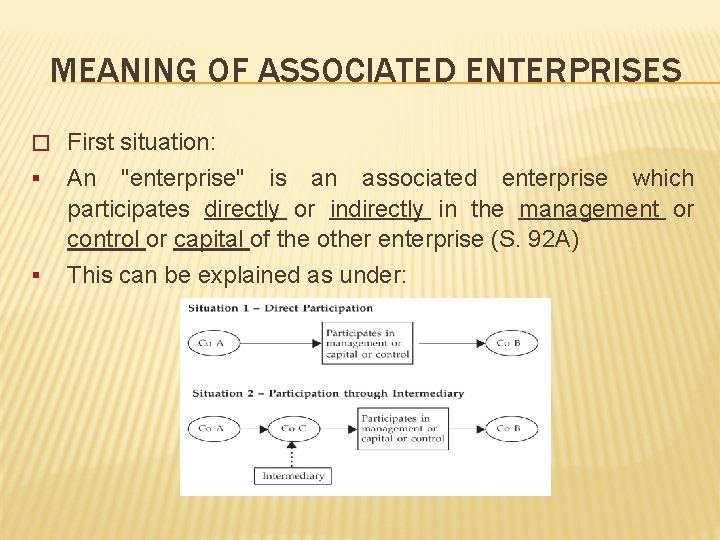
MEANING OF ASSOCIATED ENTERPRISES � First situation: § § An "enterprise" is an associated enterprise which participates directly or indirectly in the management or control or capital of the other enterprise (S. 92 A) This can be explained as under:
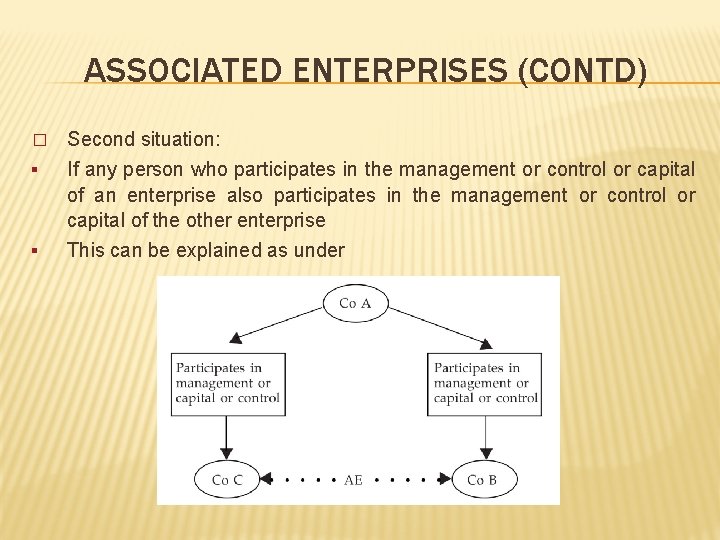
ASSOCIATED ENTERPRISES (CONTD) � § § Second situation: If any person who participates in the management or control or capital of an enterprise also participates in the management or control or capital of the other enterprise This can be explained as under
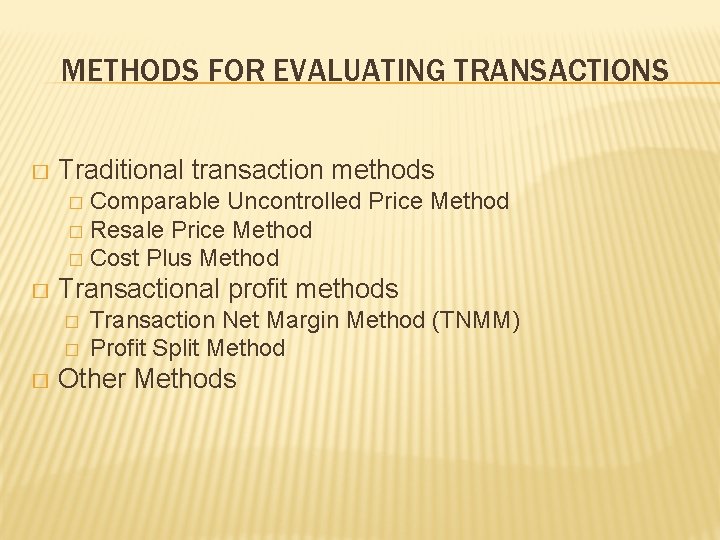
METHODS FOR EVALUATING TRANSACTIONS � Traditional transaction methods Comparable Uncontrolled Price Method � Resale Price Method � Cost Plus Method � � Transactional profit methods � � � Transaction Net Margin Method (TNMM) Profit Split Method Other Methods
COMPARABLE UNCONTROLLED PRICE (CUP) METHOD • CUP method compares the “price” charged in a controlled transaction with that charged in a comparable uncontrolled transaction. • If comparable uncontrolled transactions are available, this method is considered “ most direct and reliable method” • Comparison of prices charged in one transaction with those charged in another transaction is the most direct approach. • Differences in prices can be traced directly to differences in commercial and financial arrangements.
LIMITATIONS OF CUP METHOD � Since it is a direct comparison, strict similarity required for comparison � In practice, difficult to get uncontrolled prices of similar commodities
RESALE PRICE METHOD (RPM) RPM compares a distributor’s / reseller’s gross margin on controlled transactions with the gross margins of comparable independent firms. � Applies to trading / marketing activities, including activities of pure resellers where products are resold without any value addition � Difficult to apply in following cases – � - transaction involving rendering of services - substantial value addition made by the reseller
COST PLUS METHOD (CPM) � CPM uses the costs incurred by the supplier of the property (or services) in a controlled transaction. � Direct and indirect costs of production incurred by the enterprise in respect of the property or service to a related party are determined. � A gross profit mark up in the same or similar comparable uncontrolled transaction by the enterprise or an unrelated enterprise is added. � CPM – applicability • Transfer of semi-finished goods • Inter - unit transfers within an organization • Provision of services
PROFIT SPLIT METHOD (PSM) � � � Profit Split Method (PSM) may be applicable for International Transactions involving transfer of unique intangibles. Multiple International Transactions which are so interrelated that ALP of any one of transaction cannot be evaluated separately PSM first identifies the combined profit of the related parties arising from the transaction in which they are engaged. The relative contribution made by each related party is then evaluated on the basis of the FAR Analysis. The combined profit is then split amongst the parties in proportion to their respective contributions.
TRANSACTIONAL NET MARGIN METHOD (TNMM) × × In TNMM the assessee attempts to establish the ALP of transactions by looking at the profits attained from those transactions and comparing these profits with the profits attained by similar Non AEs having similar transactions One of the most widely used methods – can be used for manufacturing and service sectors
TNMM (CONTD) � The Net Operating Profit Margin on cost or revenue (depending on the transaction) of the assessee is computed � This OPM is compared with the mean margin of the comparable companies � Where there any abnormalities, these are adjusted (may be on account of any extraordinary event of expenses unique to the assessee during the year)
OTHER METHOD � Residual method, notified from AY 2012 -13 (Rule 10 AB) � Used when none of the other five main methods are appropriate � Generally used for transactions like import of capital goods, subscription to share capital, reimbursement or other transactions which are not capable of being evaluated under the main methods
FAR ANALYSIS � � � The first and most important step in determining the ALP is FAR analysis FAR stands for Functions, Assets and Risks The functions performed by the assessee, the assets used in these functions and the risks undertaken are relevant for determining the correct price of goods or services The underlying principle of this analysis is that the profits are determined by the functions performed by the assessee vis-à-vis the AE and the risks undertaken by the assessee in performing those functions and the assets employed to do it General principle – more risk, more profit Sometimes, FAR analysis may result in adoption of different method for determining ALP
ALTERNATE MECHANISMS FOR ASSESSEES TO FIX THEIR PROFIT MARGINS � The Act provides for alternate mechanisms where the assessees can opt for fixed margins � Safe Harbour Rules (SHR) provide for fixed margins subject to conditions prescribed � Advance Pricing Agreement (APA) are agreements signed between the assessee and the CBDT wherein margins are fixed after negotiations
SAFE HARBOUR RULES (SHR) � � � � A ‘Safe Harbour’ can be any statutory provision or regulatory approach directed at simplifying transfer pricing compliance applicable to a specific category of tax payers / transactions. The Central Board of Direct Taxes notified the Safe Harbour Rules on 18 th September, 2013 for International Transactions and on 4 th February 2015 for SDT under Sec 92 CB. These rules are optional in nature and can be opted for by filling Form 3 CEFA or 3 CEFB (for IT & SDT respectively) The assessee can opt for the safe harbour regime for a period of his choice but not exceeding 5 AYs beginning from AY 13 -14 by filing Form 3 CEFA (For SDT no such period, it is an year option). Once the option exercised by the assessee has been held valid it shall remain so for the period opted unless the assessee voluntarily opts out of safe harbour regime by furnishing a statement to this effect. Rules 10 TA to 10 TG deal with SHR for International Transactions and Rules 10 TH to 10 THD with SDT Generally opted for by smaller entities No TP audit is conducted for the period when the assessee opts for SHR
ADVANCE PRICING AGREEMENT (APA) � � � � Advance Pricing Agreements are agreements signed by assessees with the Board where prices of products or services are agreed to in advance Can be unilateral (with the assessee) or bilateral (where the tax authorities of AE are also party) or multilateral (where more than one tax jurisdiction is involved) The margins are fixed after negotiations Five year period Compliance with the agreement is verified by compliance audit conducted by TPO annually during the currency of APA No TP audit is conducted during the currency of the Agreement Section 92 CC and Rules 10 F to 10 T Opted for by large MNCs with presence in different
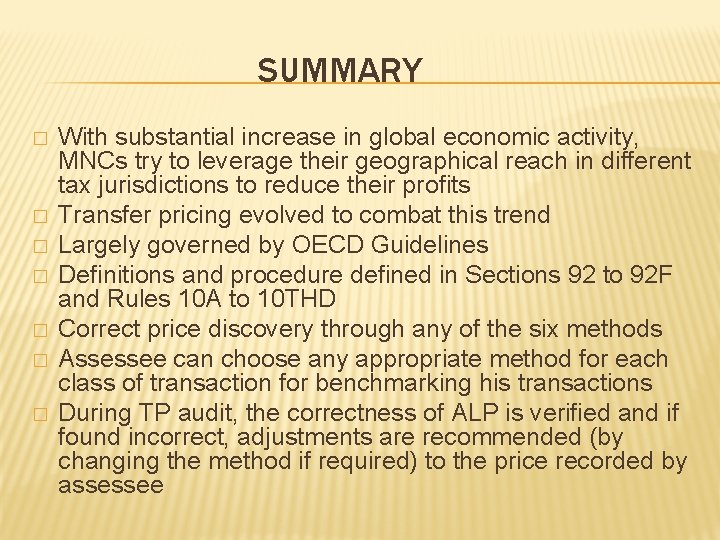
SUMMARY � � � � With substantial increase in global economic activity, MNCs try to leverage their geographical reach in different tax jurisdictions to reduce their profits Transfer pricing evolved to combat this trend Largely governed by OECD Guidelines Definitions and procedure defined in Sections 92 to 92 F and Rules 10 A to 10 THD Correct price discovery through any of the six methods Assessee can choose any appropriate method for each class of transaction for benchmarking his transactions During TP audit, the correctness of ALP is verified and if found incorrect, adjustments are recommended (by changing the method if required) to the price recorded by assessee
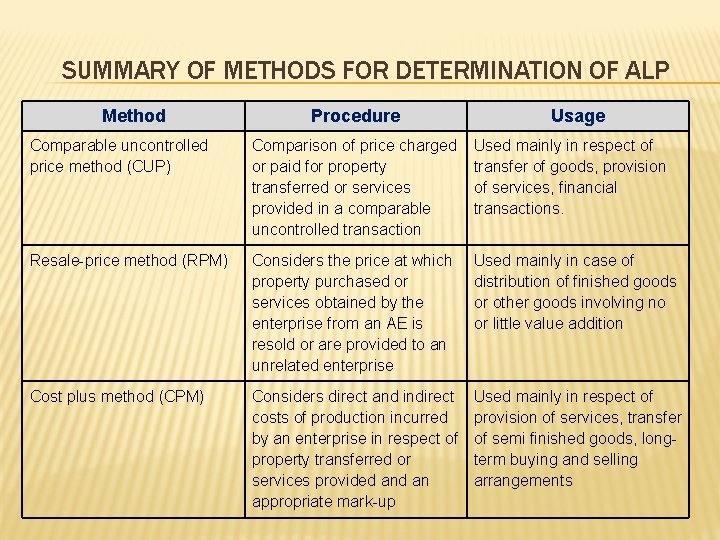
SUMMARY OF METHODS FOR DETERMINATION OF ALP Method Procedure Usage Comparable uncontrolled price method (CUP) Comparison of price charged or paid for property transferred or services provided in a comparable uncontrolled transaction Used mainly in respect of transfer of goods, provision of services, financial transactions. Resale-price method (RPM) Considers the price at which property purchased or services obtained by the enterprise from an AE is resold or are provided to an unrelated enterprise Used mainly in case of distribution of finished goods or other goods involving no or little value addition Cost plus method (CPM) Considers direct and indirect costs of production incurred by an enterprise in respect of property transferred or services provided an appropriate mark-up Used mainly in respect of provision of services, transfer of semi finished goods, longterm buying and selling arrangements
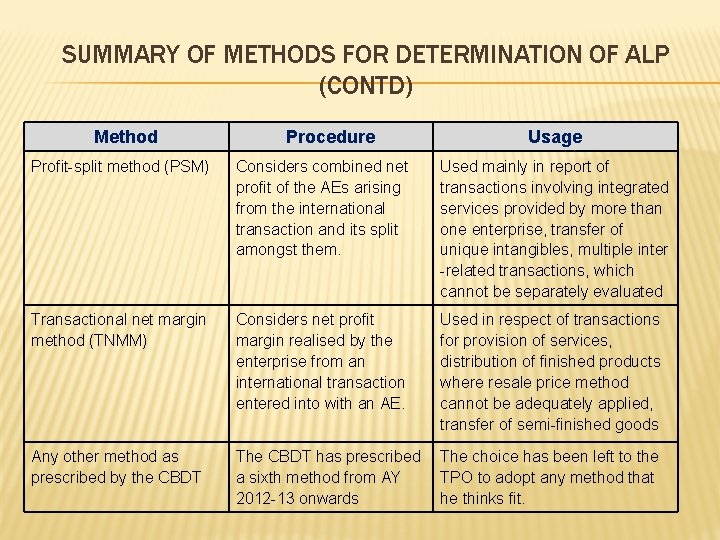
SUMMARY OF METHODS FOR DETERMINATION OF ALP (CONTD) Method Procedure Usage Profit-split method (PSM) Considers combined net profit of the AEs arising from the international transaction and its split amongst them. Used mainly in report of transactions involving integrated services provided by more than one enterprise, transfer of unique intangibles, multiple inter -related transactions, which cannot be separately evaluated Transactional net margin method (TNMM) Considers net profit margin realised by the enterprise from an international transaction entered into with an AE. Used in respect of transactions for provision of services, distribution of finished products where resale price method cannot be adequately applied, transfer of semi-finished goods Any other method as prescribed by the CBDT The CBDT has prescribed a sixth method from AY 2012 -13 onwards The choice has been left to the TPO to adopt any method that he thinks fit.

- Slides: 42