
Transfer of the Trauma Patient to Definitive Care

- Slides: 15
Transfer of the Trauma Patient to Definitive Care Unfolding scenario Reflective self-assessment April 2020 © The Royal College of Surgeons of England 2020. All rights reserved
Transfer Relevance of content • The decision to transfer a patient to another facility depends on the known and suspected injuries as well as the capabilities on hand to quickly diagnose and treat them. This is particularly important for potentially life-threatening injuries.
Transfer Learning Outcomes - by the end of this module, you will be able to: • Identify injured patients who require transfer to a higher level of care. • Discuss optimal preparation for safe patient transfer.
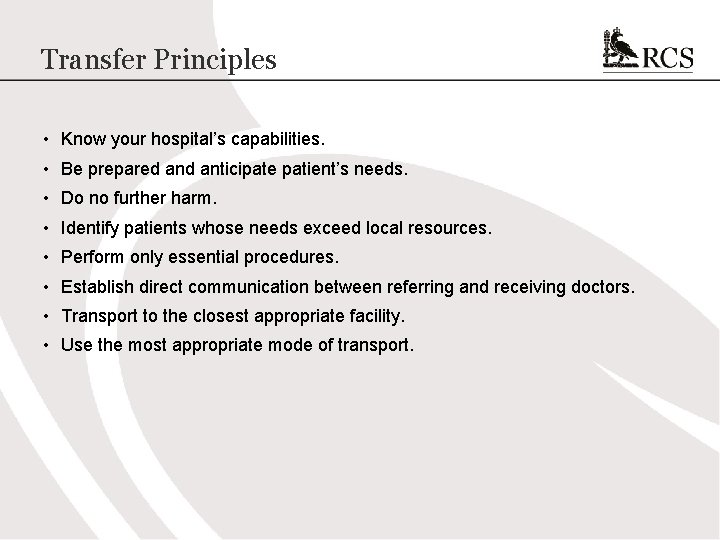
Transfer Principles • Know your hospital’s capabilities. • Be prepared anticipate patient’s needs. • Do no further harm. • Identify patients whose needs exceed local resources. • Perform only essential procedures. • Establish direct communication between referring and receiving doctors. • Transport to the closest appropriate facility. • Use the most appropriate mode of transport.
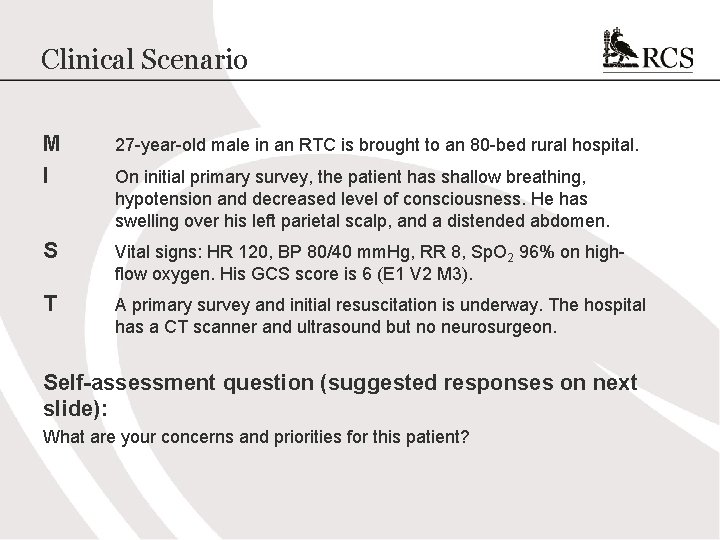
Clinical Scenario M I 27 -year-old male in an RTC is brought to an 80 -bed rural hospital. S Vital signs: HR 120, BP 80/40 mm. Hg, RR 8, Sp. O 2 96% on highflow oxygen. His GCS score is 6 (E 1 V 2 M 3). T A primary survey and initial resuscitation is underway. The hospital has a CT scanner and ultrasound but no neurosurgeon. On initial primary survey, the patient has shallow breathing, hypotension and decreased level of consciousness. He has swelling over his left parietal scalp, and a distended abdomen. Self-assessment question (suggested responses on next slide): What are your concerns and priorities for this patient?
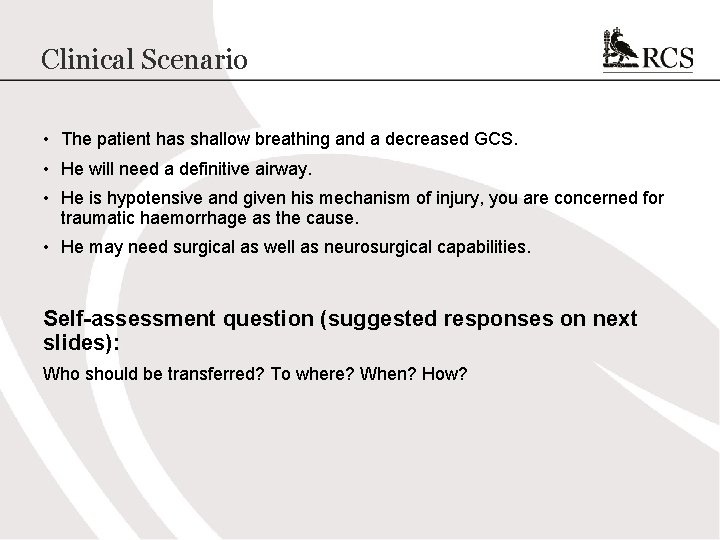
Clinical Scenario • The patient has shallow breathing and a decreased GCS. • He will need a definitive airway. • He is hypotensive and given his mechanism of injury, you are concerned for traumatic haemorrhage as the cause. • He may need surgical as well as neurosurgical capabilities. Self-assessment question (suggested responses on next slides): Who should be transferred? To where? When? How?
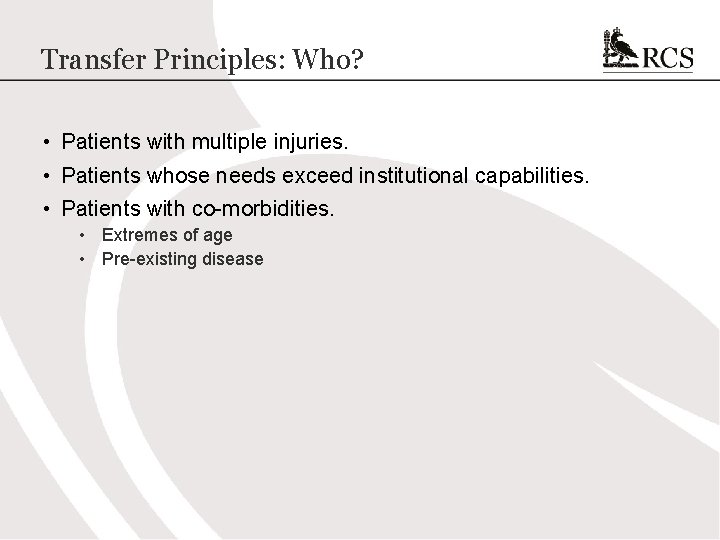
Transfer Principles: Who? • Patients with multiple injuries. • Patients whose needs exceed institutional capabilities. • Patients with co-morbidities. • Extremes of age • Pre-existing disease
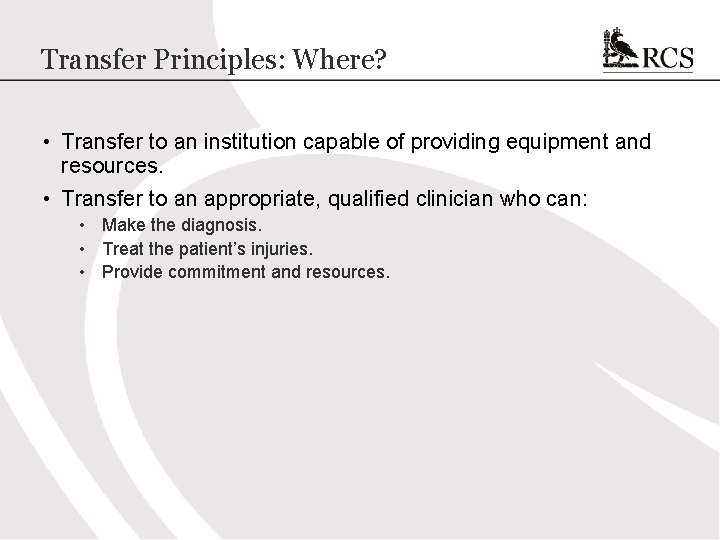
Transfer Principles: Where? • Transfer to an institution capable of providing equipment and resources. • Transfer to an appropriate, qualified clinician who can: • Make the diagnosis. • Treat the patient’s injuries. • Provide commitment and resources.
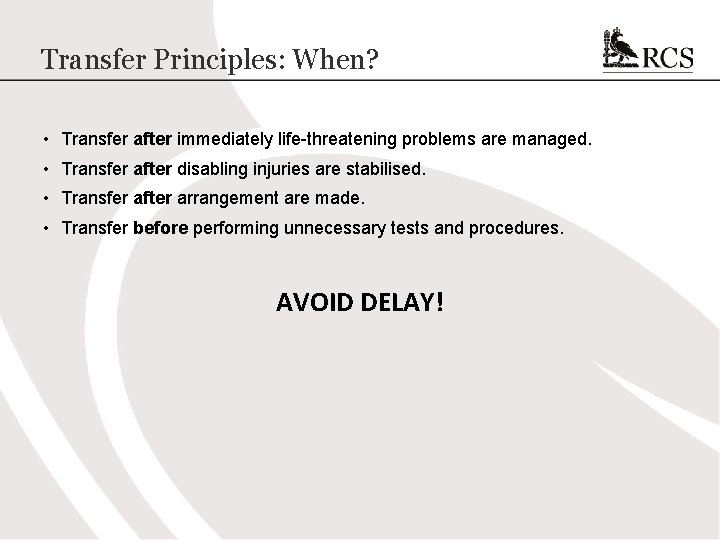
Transfer Principles: When? • Transfer after immediately life-threatening problems are managed. • Transfer after disabling injuries are stabilised. • Transfer after arrangement are made. • Transfer before performing unnecessary tests and procedures. AVOID DELAY!
Transfer Principles: How? The means of transfer is determined by: • • Care required in transit Patient destination Available resources Existing transfer agreements
Clinical Scenario Self-assessment questions (suggested responses on next slide): • • Does the patient in the scenario require transfer? Where should this patient be transferred? When and how? What are the risks of transferring the patient?
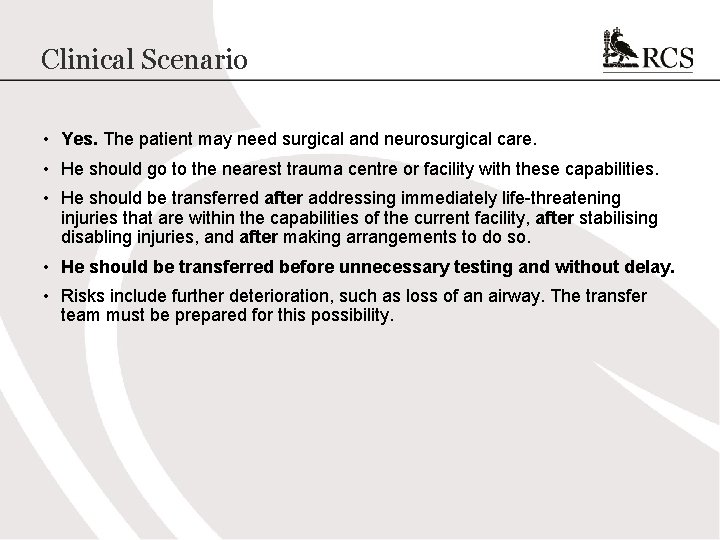
Clinical Scenario • Yes. The patient may need surgical and neurosurgical care. • He should go to the nearest trauma centre or facility with these capabilities. • He should be transferred after addressing immediately life-threatening injuries that are within the capabilities of the current facility, after stabilising disabling injuries, and after making arrangements to do so. • He should be transferred before unnecessary testing and without delay. • Risks include further deterioration, such as loss of an airway. The transfer team must be prepared for this possibility.
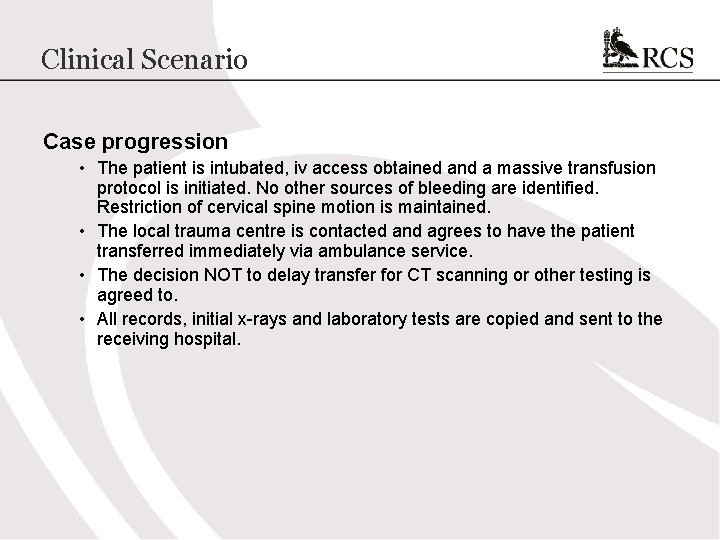
Clinical Scenario Case progression • The patient is intubated, iv access obtained and a massive transfusion protocol is initiated. No other sources of bleeding are identified. Restriction of cervical spine motion is maintained. • The local trauma centre is contacted and agrees to have the patient transferred immediately via ambulance service. • The decision NOT to delay transfer for CT scanning or other testing is agreed to. • All records, initial x-rays and laboratory tests are copied and sent to the receiving hospital.
Transfer You have learned: • How to identify injured patients who require transfer to a higher level of care. • The considerations that must be made to transfer the patient in the safest way possible.
Further Learning When transferring a patient, clear communication between the referring and receiving medical teams must occur. A formal template (such as SBAR) is helpful to ensure key information about the patient is communicated. Transfer teams should be adequately skilled to administer the right level of patient care between facilities.