
Transfer of a pronator teres motor branch to
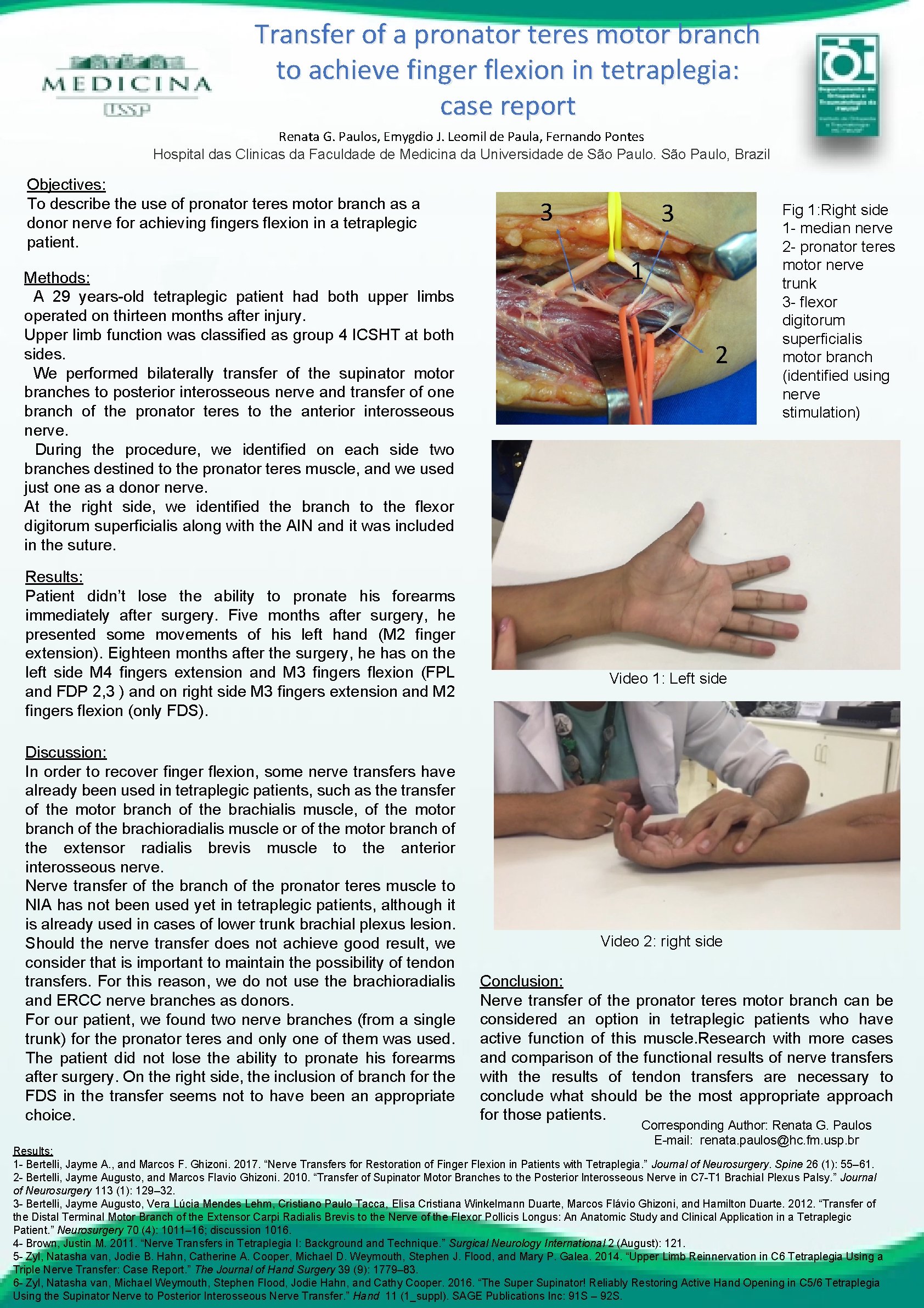
Transfer of a pronator teres motor branch to achieve finger flexion in tetraplegia: case report Renata G. Paulos, Emygdio J. Leomil de Paula, Fernando Pontes Hospital das Clinicas da Faculdade de Medicina da Universidade de São Paulo, Brazil Objectives: To describe the use of pronator teres motor branch as a donor nerve for achieving fingers flexion in a tetraplegic patient. Methods: A 29 years-old tetraplegic patient had both upper limbs operated on thirteen months after injury. Upper limb function was classified as group 4 ICSHT at both sides. We performed bilaterally transfer of the supinator motor branches to posterior interosseous nerve and transfer of one branch of the pronator teres to the anterior interosseous nerve. During the procedure, we identified on each side two branches destined to the pronator teres muscle, and we used just one as a donor nerve. At the right side, we identified the branch to the flexor digitorum superficialis along with the AIN and it was included in the suture. Results: Patient didn’t lose the ability to pronate his forearms immediately after surgery. Five months after surgery, he presented some movements of his left hand (M 2 finger extension). Eighteen months after the surgery, he has on the left side M 4 fingers extension and M 3 fingers flexion (FPL and FDP 2, 3 ) and on right side M 3 fingers extension and M 2 fingers flexion (only FDS). Discussion: In order to recover finger flexion, some nerve transfers have already been used in tetraplegic patients, such as the transfer of the motor branch of the brachialis muscle, of the motor branch of the brachioradialis muscle or of the motor branch of the extensor radialis brevis muscle to the anterior interosseous nerve. Nerve transfer of the branch of the pronator teres muscle to NIA has not been used yet in tetraplegic patients, although it is already used in cases of lower trunk brachial plexus lesion. Should the nerve transfer does not achieve good result, we consider that is important to maintain the possibility of tendon transfers. For this reason, we do not use the brachioradialis and ERCC nerve branches as donors. For our patient, we found two nerve branches (from a single trunk) for the pronator teres and only one of them was used. The patient did not lose the ability to pronate his forearms after surgery. On the right side, the inclusion of branch for the FDS in the transfer seems not to have been an appropriate choice. 3 3 1 2 Fig 1: Right side 1 - median nerve 2 - pronator teres motor nerve trunk 3 - flexor digitorum superficialis motor branch (identified using nerve stimulation) Video 1: Left side Video 2: right side Conclusion: Nerve transfer of the pronator teres motor branch can be considered an option in tetraplegic patients who have active function of this muscle. Research with more cases and comparison of the functional results of nerve transfers with the results of tendon transfers are necessary to conclude what should be the most appropriate approach for those patients. Corresponding Author: Renata G. Paulos E-mail: renata. paulos@hc. fm. usp. br Results: 1 - Bertelli, Jayme A. , and Marcos F. Ghizoni. 2017. “Nerve Transfers for Restoration of Finger Flexion in Patients with Tetraplegia. ” Journal of Neurosurgery. Spine 26 (1): 55– 61. 2 - Bertelli, Jayme Augusto, and Marcos Flavio Ghizoni. 2010. “Transfer of Supinator Motor Branches to the Posterior Interosseous Nerve in C 7 -T 1 Brachial Plexus Palsy. ” Journal of Neurosurgery 113 (1): 129– 32. 3 - Bertelli, Jayme Augusto, Vera Lúcia Mendes Lehm, Cristiano Paulo Tacca, Elisa Cristiana Winkelmann Duarte, Marcos Flávio Ghizoni, and Hamilton Duarte. 2012. “Transfer of the Distal Terminal Motor Branch of the Extensor Carpi Radialis Brevis to the Nerve of the Flexor Pollicis Longus: An Anatomic Study and Clinical Application in a Tetraplegic Patient. ” Neurosurgery 70 (4): 1011– 16; discussion 1016. 4 - Brown, Justin M. 2011. “Nerve Transfers in Tetraplegia I: Background and Technique. ” Surgical Neurology International 2 (August): 121. 5 - Zyl, Natasha van, Jodie B. Hahn, Catherine A. Cooper, Michael D. Weymouth, Stephen J. Flood, and Mary P. Galea. 2014. “Upper Limb Reinnervation in C 6 Tetraplegia Using a Triple Nerve Transfer: Case Report. ” The Journal of Hand Surgery 39 (9): 1779– 83. 6 - Zyl, Natasha van, Michael Weymouth, Stephen Flood, Jodie Hahn, and Cathy Cooper. 2016. “The Super Supinator! Reliably Restoring Active Hand Opening in C 5/6 Tetraplegia Using the Supinator Nerve to Posterior Interosseous Nerve Transfer. ” Hand 11 (1_suppl). SAGE Publications Inc: 91 S – 92 S.
- Slides: 1