
Transfer kinetic energy the energy of motion Reduce



- Slides: 47
• Transfer kinetic energy (the energy of motion) • Reduce the effort needed to move a load • Change the direction or amount of motion • Change the type of motion (rotary to straight line)
• Effort (E) = the input force • Either the user or some type of engine supplies this force. • Load (R) = the output force. • Also known as the force resisting the motion.
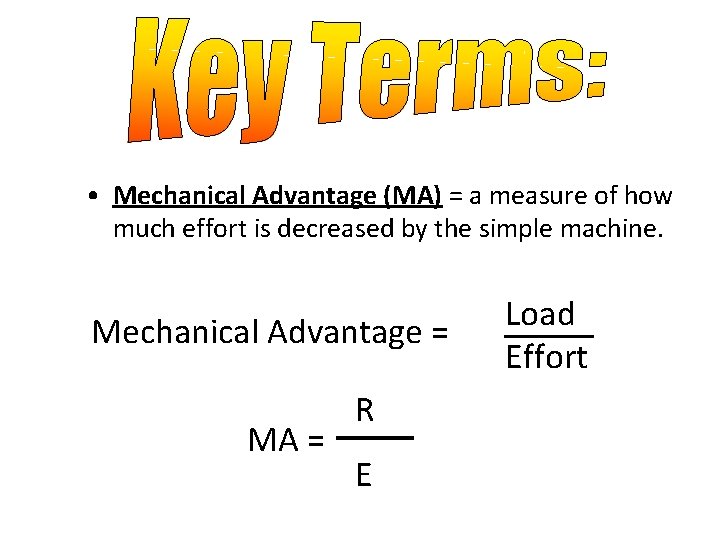
• Mechanical Advantage (MA) = a measure of how much effort is decreased by the simple machine. Mechanical Advantage = MA = R E Load Effort
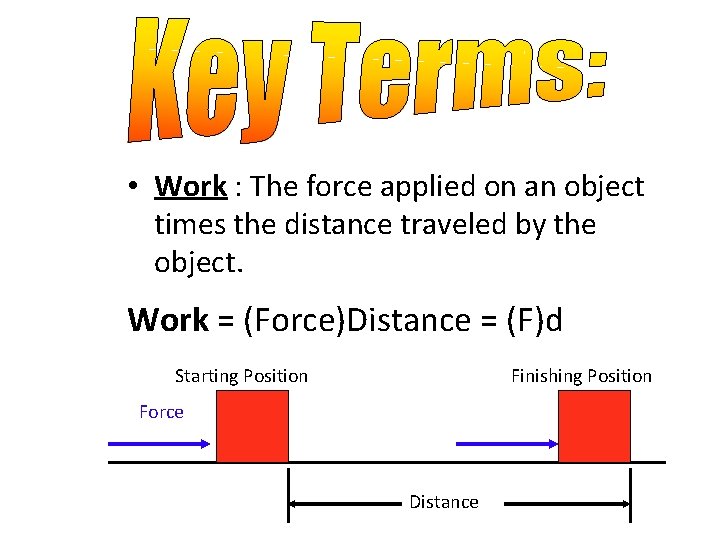
• Work : The force applied on an object times the distance traveled by the object. Work = (Force)Distance = (F)d Starting Position Finishing Position Force Distance
• Friction results from two bodies moving against each other in different directions. – Friction always opposes motion and makes doing work harder. – Lubricants (graphite, oil, grease, silicone) and bearings are used to combat friction. – Sometimes, friction is a good thing! • Efficiency is the ratio of the work that results to the amount of work put into the machine.
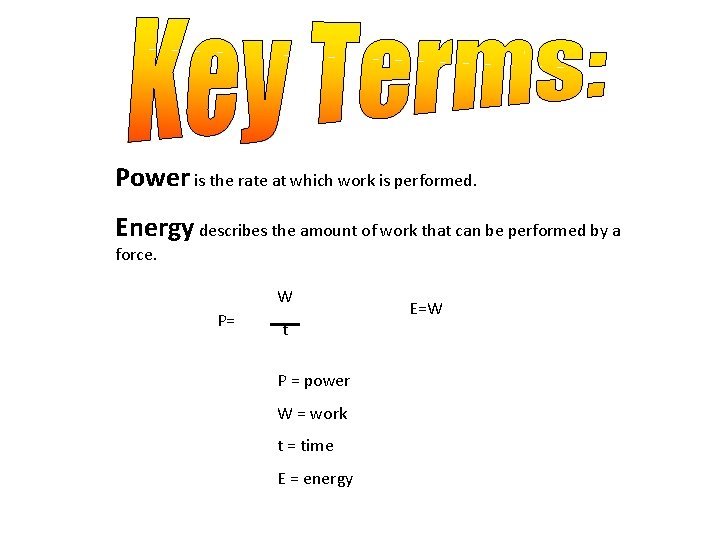
Power is the rate at which work is performed. Energy describes the amount of work that can be performed by a force. W P= t P = power W = work t = time E = energy E=W
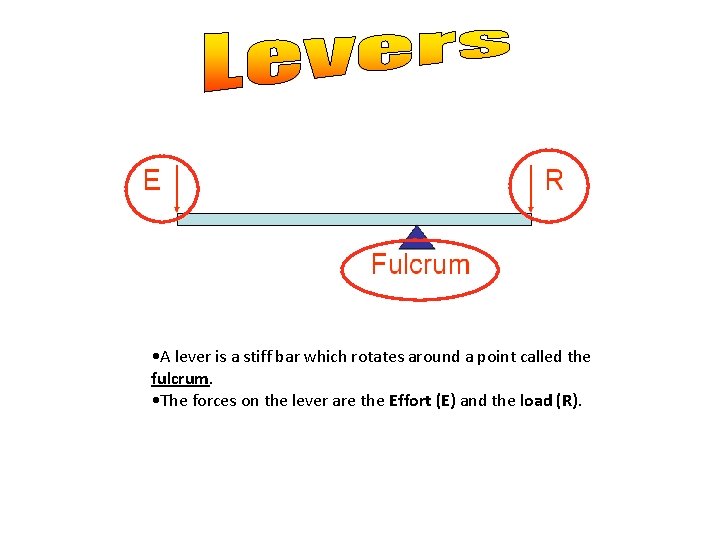
• A lever is a stiff bar which rotates around a point called the fulcrum. • The forces on the lever are the Effort (E) and the load (R).
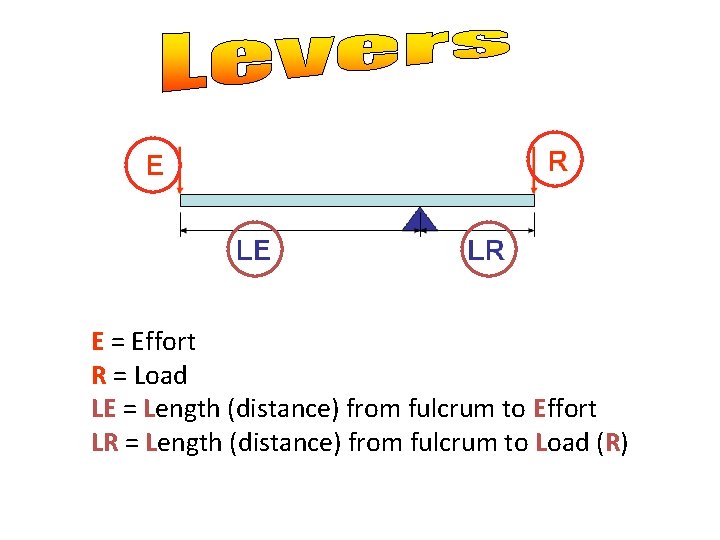
E = Effort R = Load LE = Length (distance) from fulcrum to Effort LR = Length (distance) from fulcrum to Load (R)
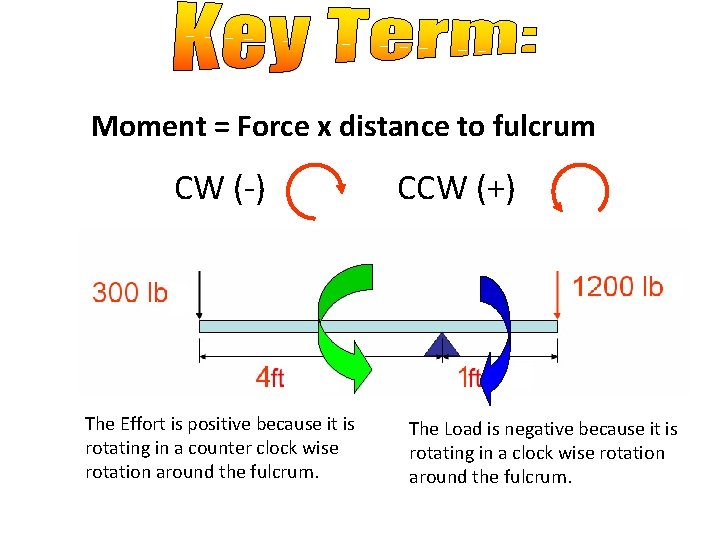
Moment = Force x distance to fulcrum CW (-) The Effort is positive because it is rotating in a counter clock wise rotation around the fulcrum. CCW (+) The Load is negative because it is rotating in a clock wise rotation around the fulcrum.
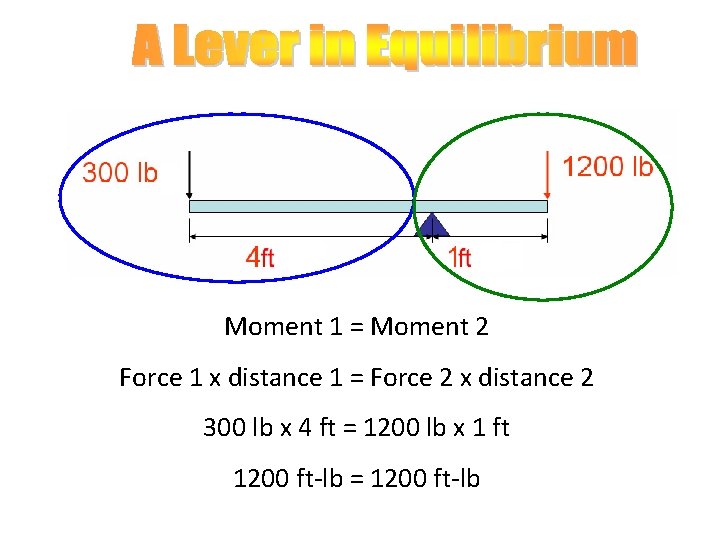
Moment 1 = Moment 2 Force 1 x distance 1 = Force 2 x distance 2 300 lb x 4 ft = 1200 lb x 1 ft 1200 ft-lb = 1200 ft-lb
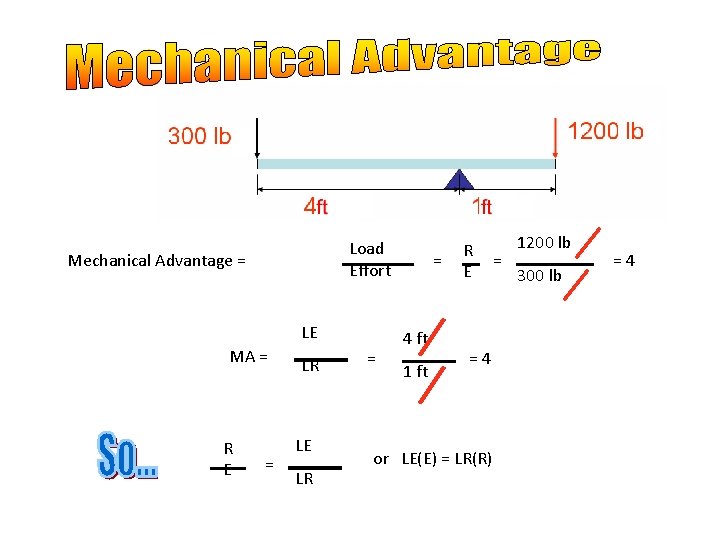
Load Effort Mechanical Advantage = LE MA = R E = LR LE LR = = 4 ft 1 ft R E =4 or LE(E) = LR(R) = 1200 lb 300 lb =4
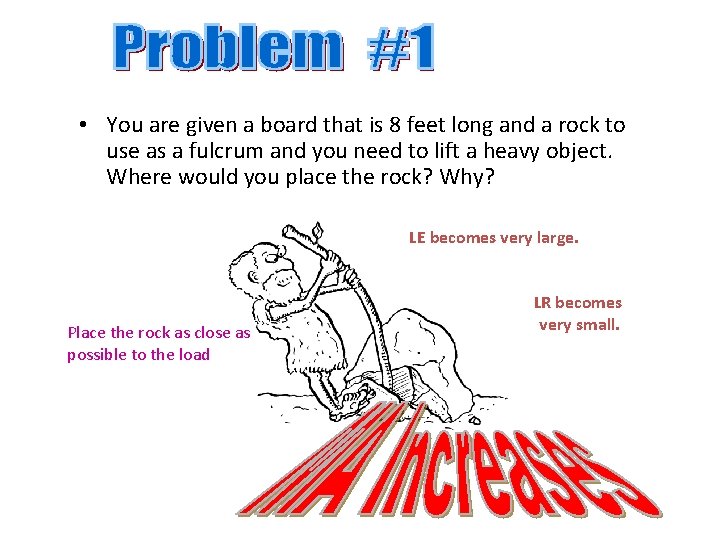
• You are given a board that is 8 feet long and a rock to use as a fulcrum and you need to lift a heavy object. Where would you place the rock? Why? LE becomes very large. Place the rock as close as possible to the load LR becomes very small.
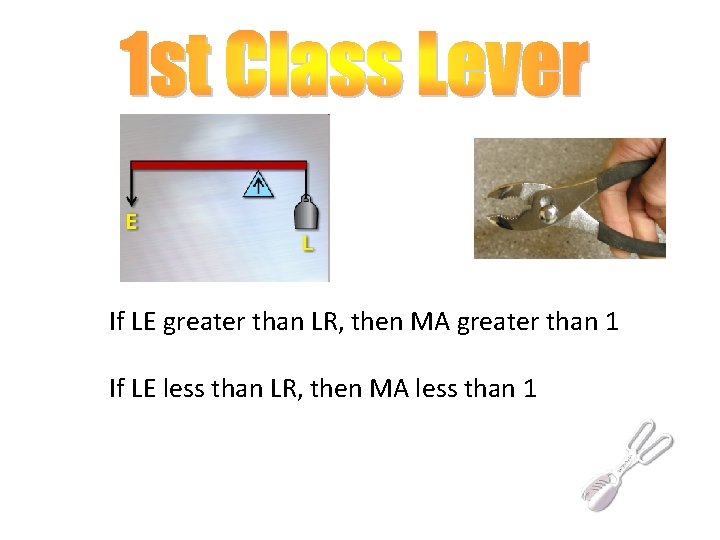
If LE greater than LR, then MA greater than 1 If LE less than LR, then MA less than 1
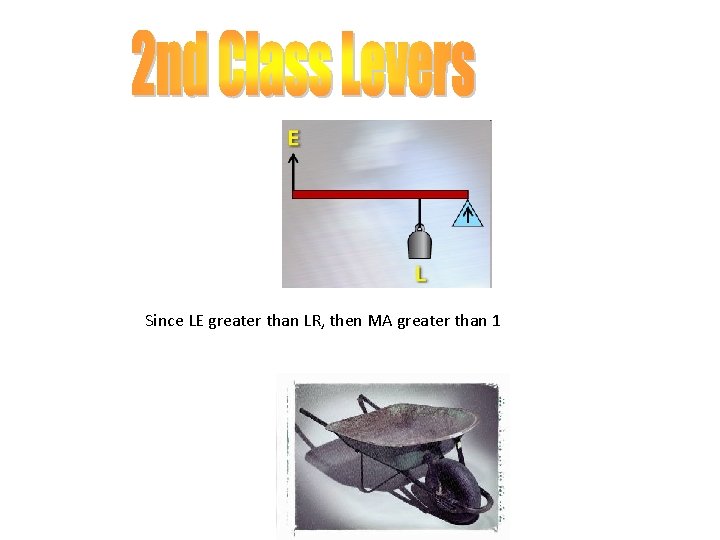
Since LE greater than LR, then MA greater than 1
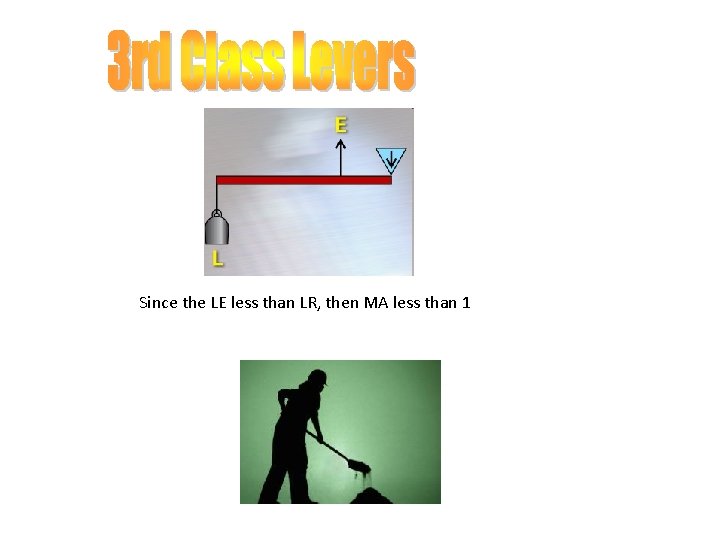
Since the LE less than LR, then MA less than 1
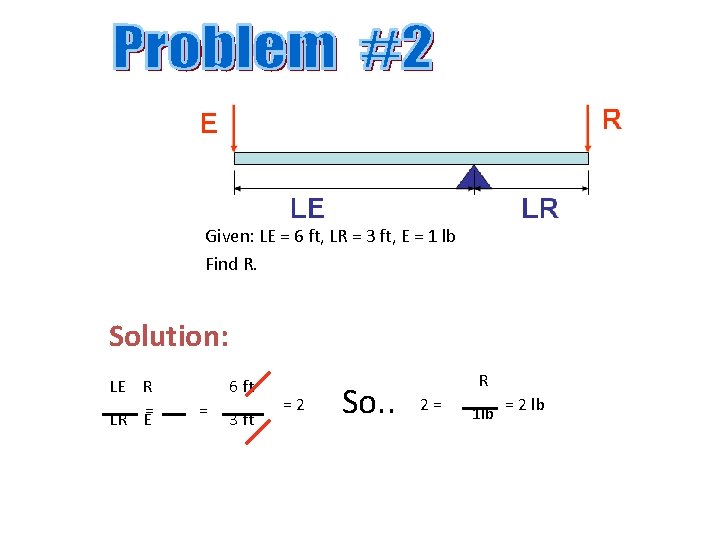
Given: LE = 6 ft, LR = 3 ft, E = 1 lb Find R. Solution: LE R LR E= 6 ft = 3 ft =2 So. . R 2= 1 lb = 2 lb
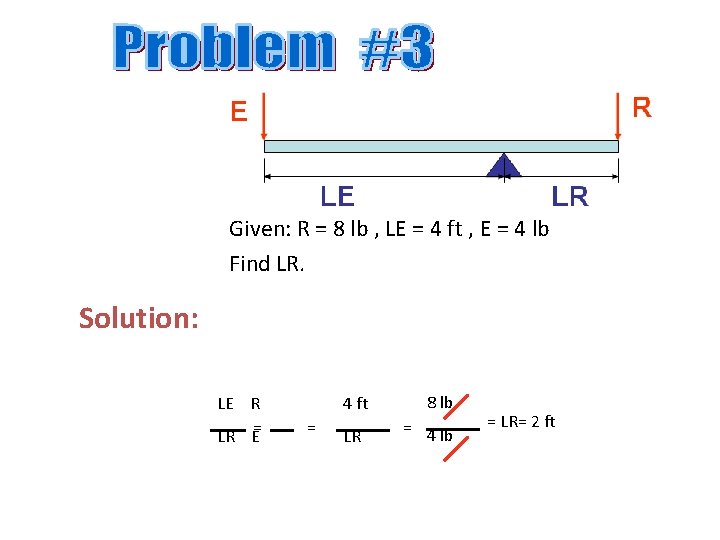
Given: R = 8 lb , LE = 4 ft , E = 4 lb Find LR. Solution: LE R LR E= 4 ft = LR 8 lb = 4 lb = LR= 2 ft
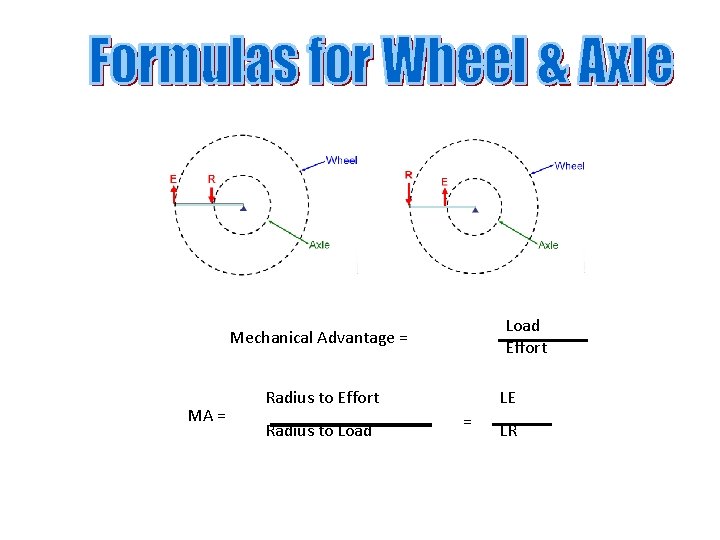
Load Effort Mechanical Advantage = MA = Radius to Effort Radius to Load LE = LR
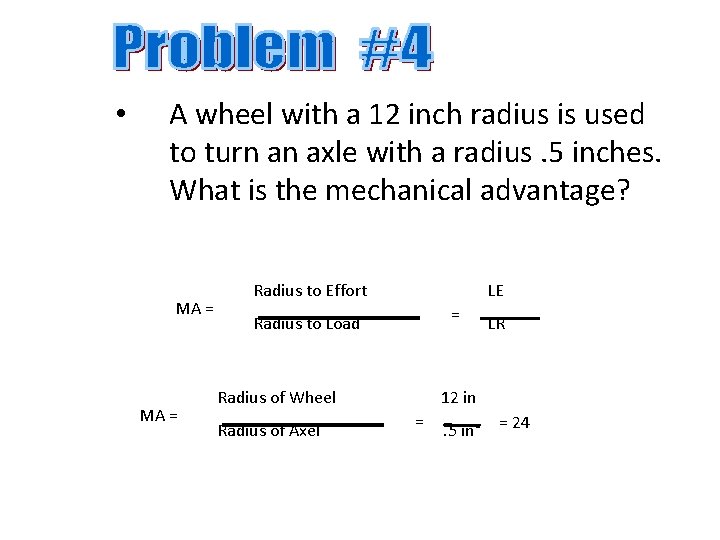
• A wheel with a 12 inch radius is used to turn an axle with a radius. 5 inches. What is the mechanical advantage? MA = Radius to Effort LE = Radius to Load Radius of Wheel Radius of Axel LR 12 in = . 5 in = 24
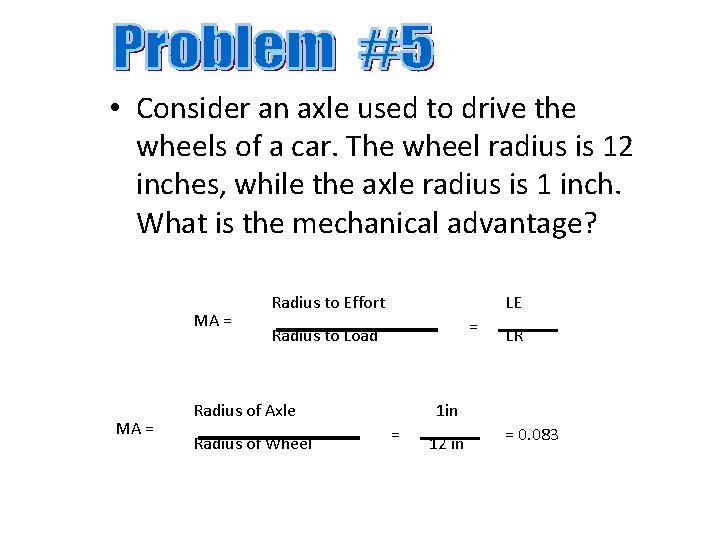
• Consider an axle used to drive the wheels of a car. The wheel radius is 12 inches, while the axle radius is 1 inch. What is the mechanical advantage? MA = Radius to Effort LE = Radius to Load Radius of Axle Radius of Wheel LR 1 in = 12 in = 0. 083
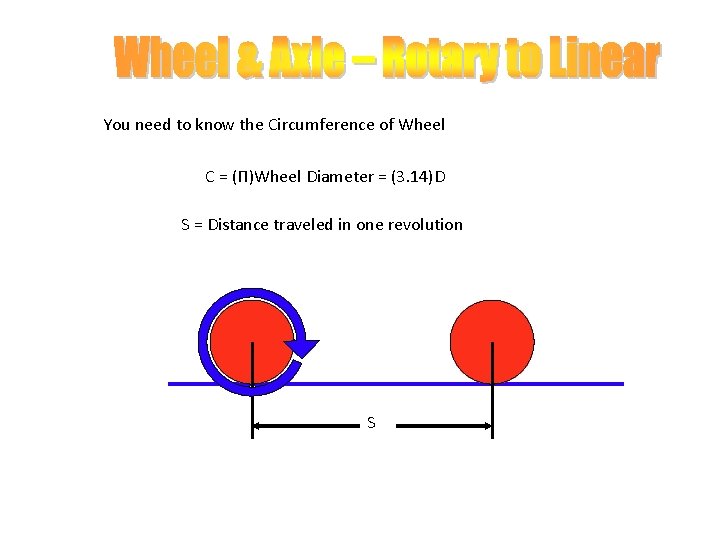
You need to know the Circumference of Wheel C = (Π)Wheel Diameter = (3. 14)D S = Distance traveled in one revolution S
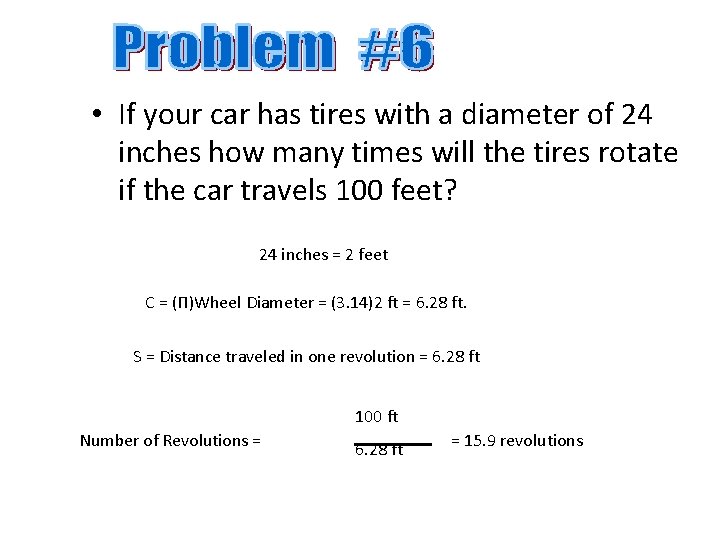
• If your car has tires with a diameter of 24 inches how many times will the tires rotate if the car travels 100 feet? 24 inches = 2 feet C = (Π)Wheel Diameter = (3. 14)2 ft = 6. 28 ft. S = Distance traveled in one revolution = 6. 28 ft 100 ft Number of Revolutions = 6. 28 ft = 15. 9 revolutions
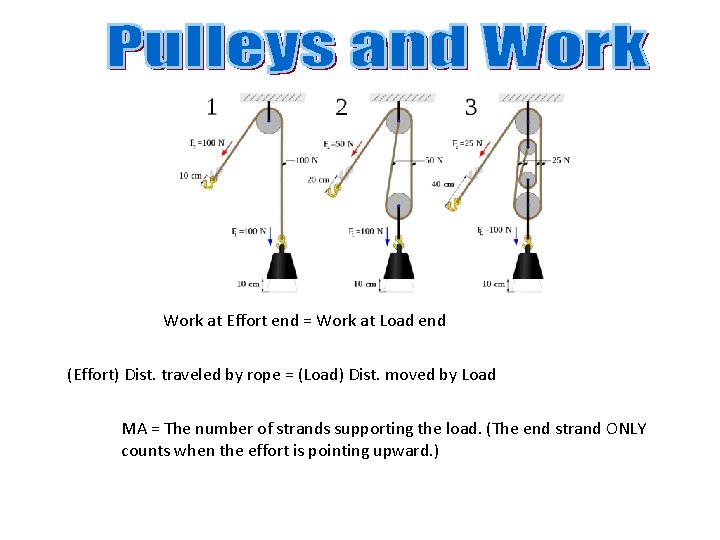
Work at Effort end = Work at Load end (Effort) Dist. traveled by rope = (Load) Dist. moved by Load MA = The number of strands supporting the load. (The end strand ONLY counts when the effort is pointing upward. )
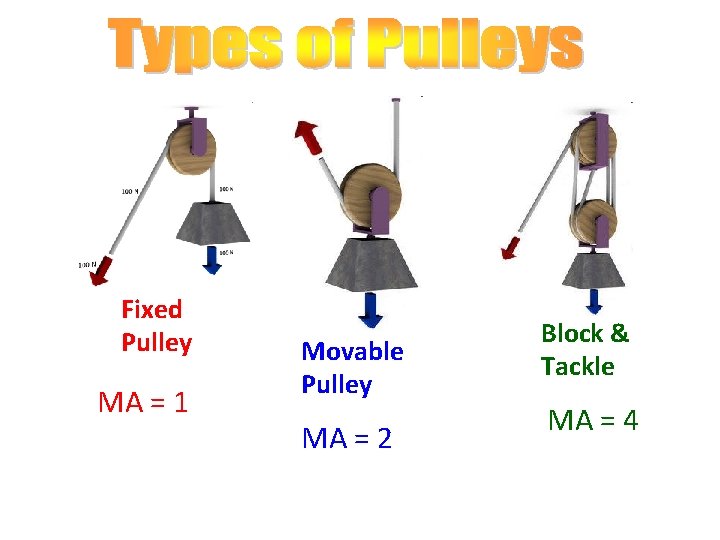
Fixed Pulley MA = 1 Movable Pulley MA = 2 Block & Tackle MA = 4
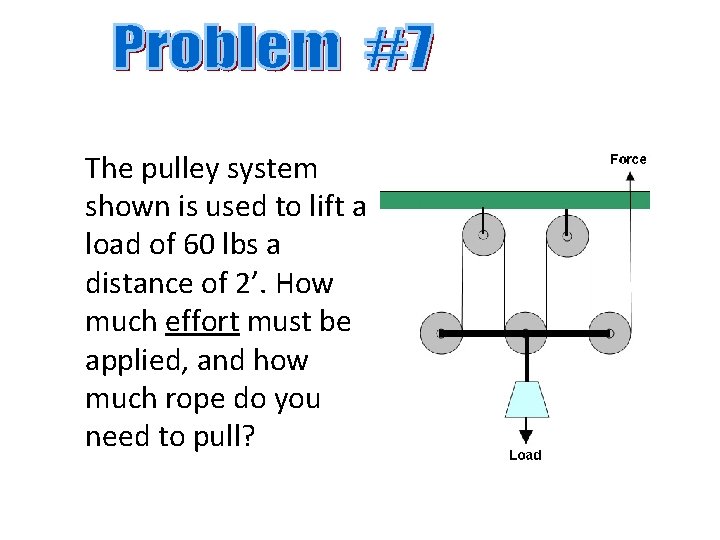
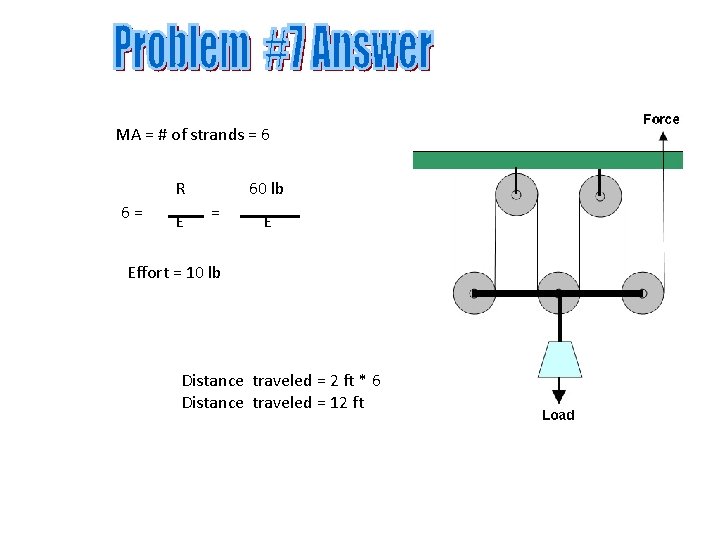
The pulley system shown is used to lift a load of 60 lbs a distance of 2’. How much effort must be applied, and how much rope do you need to pull?
MA = # of strands = 6 R 6= E 60 lb = E Effort = 10 lb Distance traveled = 2 ft * 6 Distance traveled = 12 ft
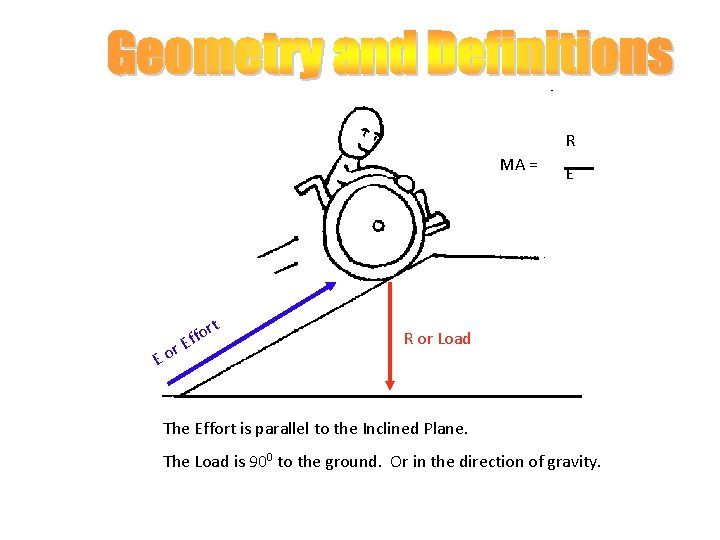
R MA = t r Eo or f f E E R or Load The Effort is parallel to the Inclined Plane. The Load is 900 to the ground. Or in the direction of gravity.
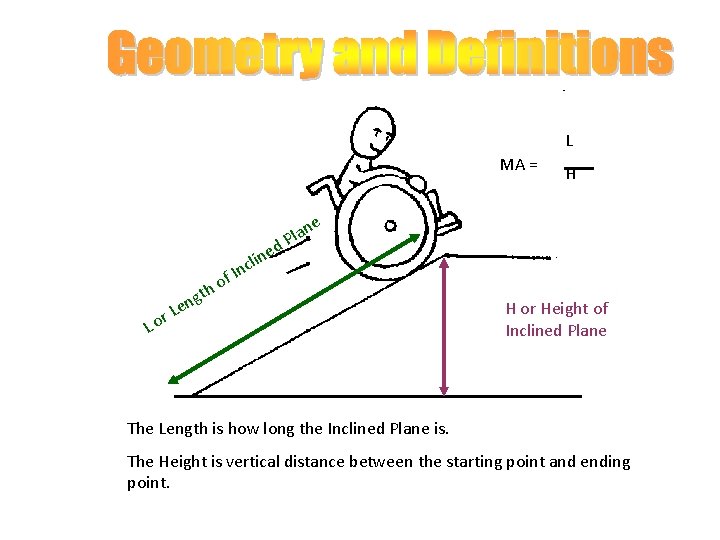
L MA = r Lo gt n Le f ho ed In clin H ne a l P H or Height of Inclined Plane The Length is how long the Inclined Plane is. The Height is vertical distance between the starting point and ending point.
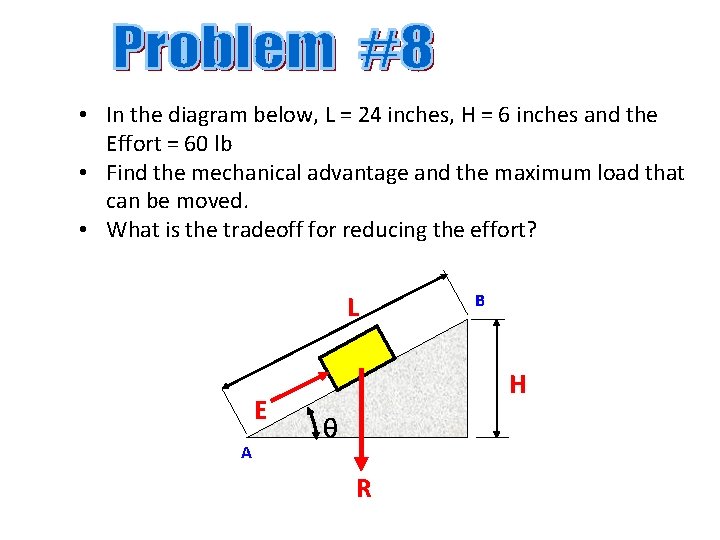
• In the diagram below, L = 24 inches, H = 6 inches and the Effort = 60 lb • Find the mechanical advantage and the maximum load that can be moved. • What is the tradeoff for reducing the effort? L E A B H R
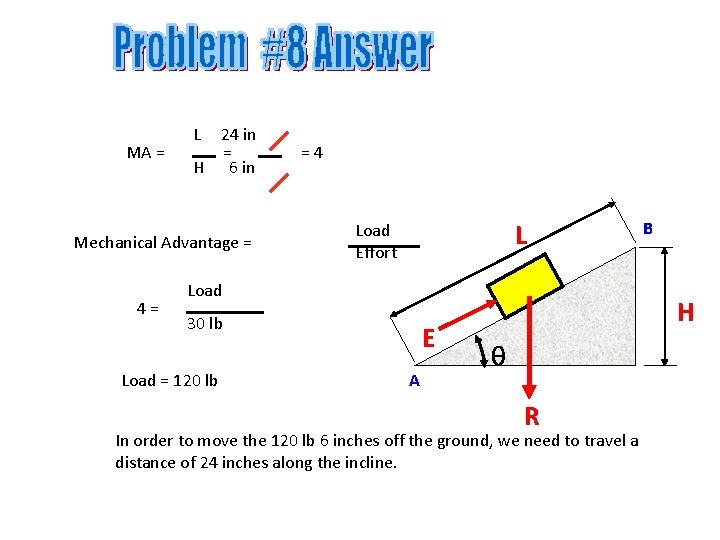
MA = L 24 in = H 6 in Mechanical Advantage = 4= =4 L Load Effort Load 30 lb Load = 120 lb E A B H R In order to move the 120 lb 6 inches off the ground, we need to travel a distance of 24 inches along the incline.
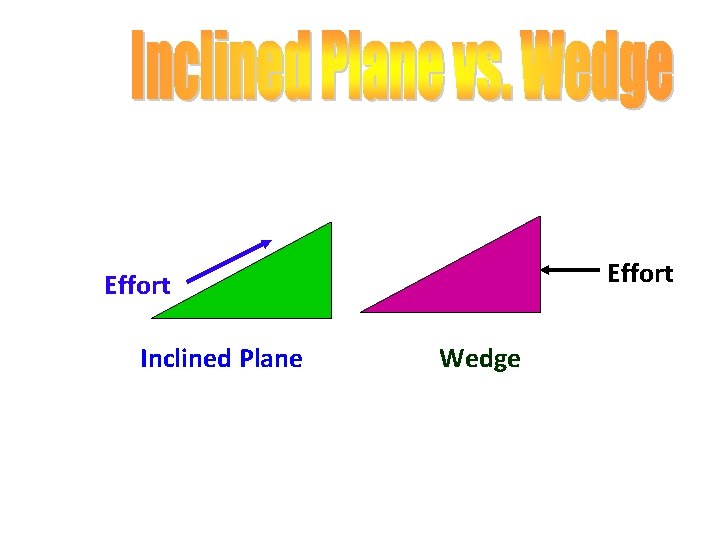
Effort Inclined Plane Wedge
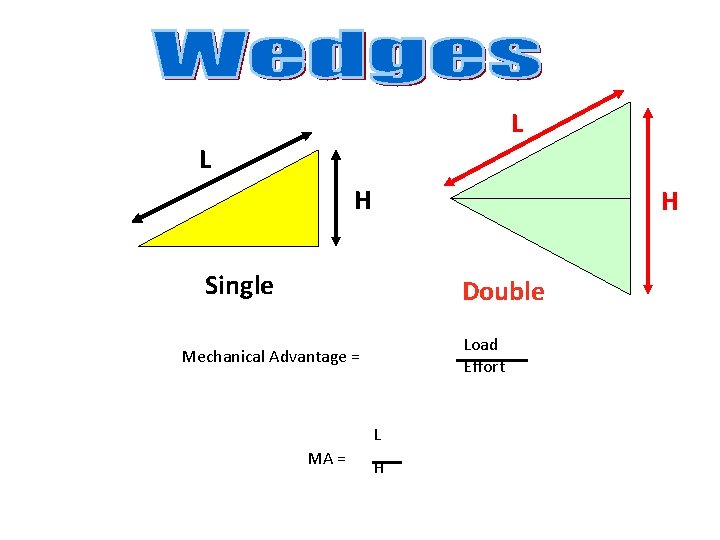
L L H H Single Double Load Effort Mechanical Advantage = L MA = H
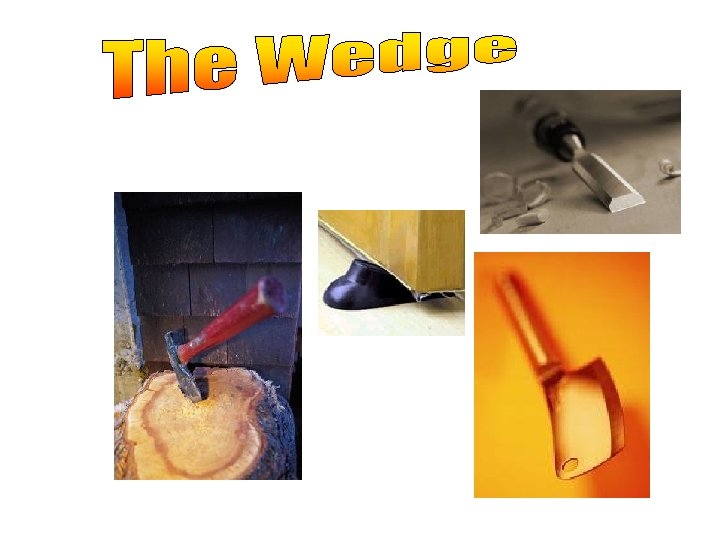
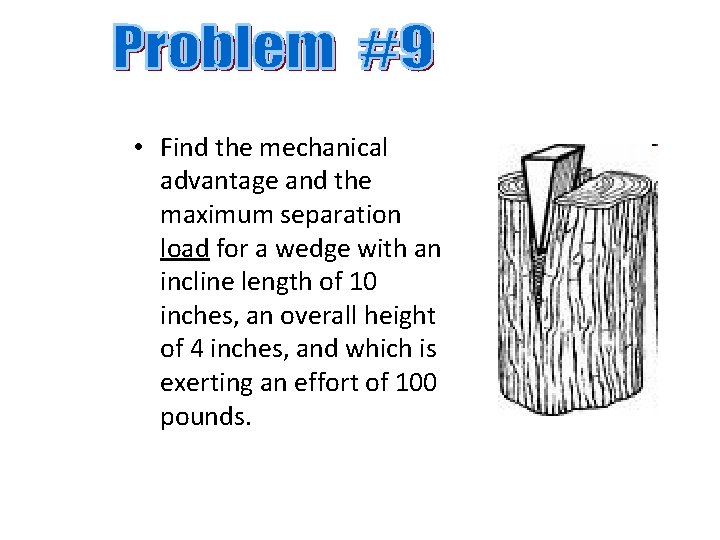
• Find the mechanical advantage and the maximum separation load for a wedge with an incline length of 10 inches, an overall height of 4 inches, and which is exerting an effort of 100 pounds.
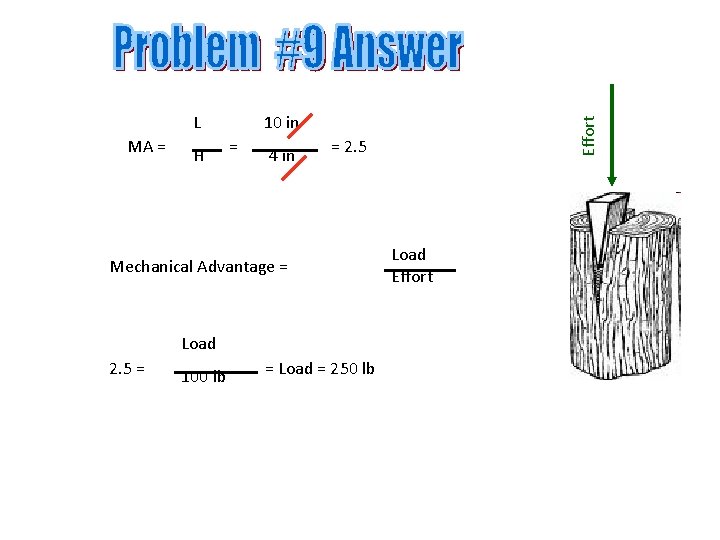
MA = H 10 in = 4 in = 2. 5 Mechanical Advantage = Load 2. 5 = 100 lb Effort L = Load = 250 lb Load Effort
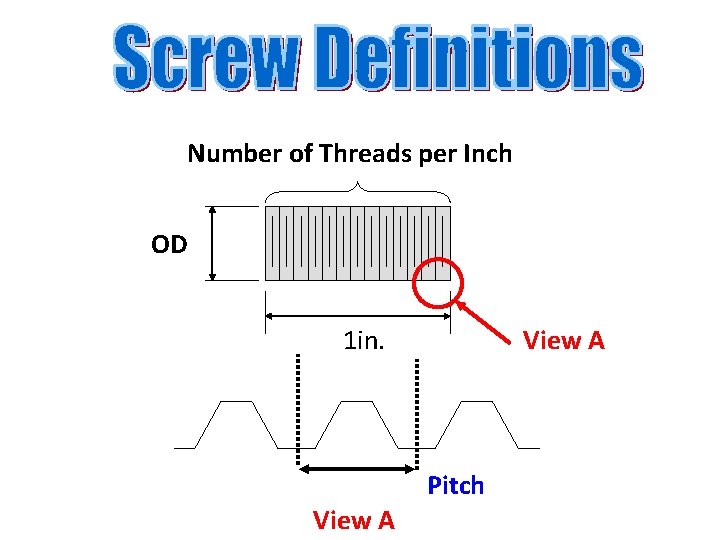
• 1/4 - 20 UNC 1/4 = the outer diameter of the threads. 20 = the number of threads per inch of screw length. UNC refers to Unified National Coarse thread.
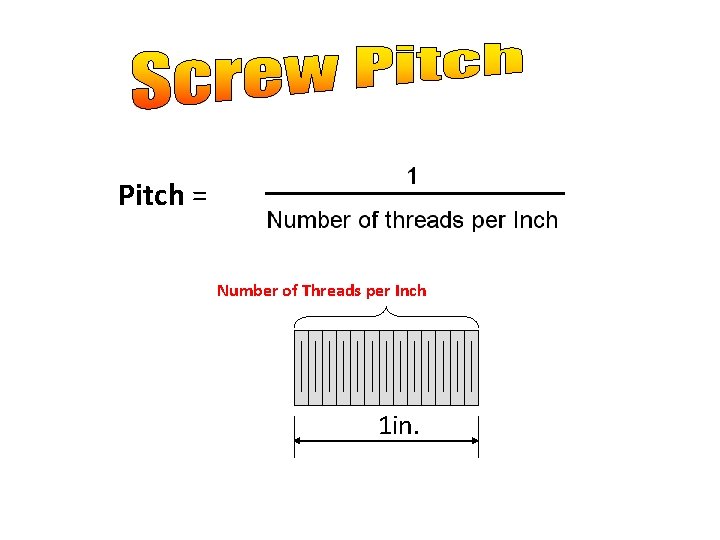
Number of Threads per Inch OD 1 in. View A Pitch View A
Pitch = Number of Threads per Inch 1 in.
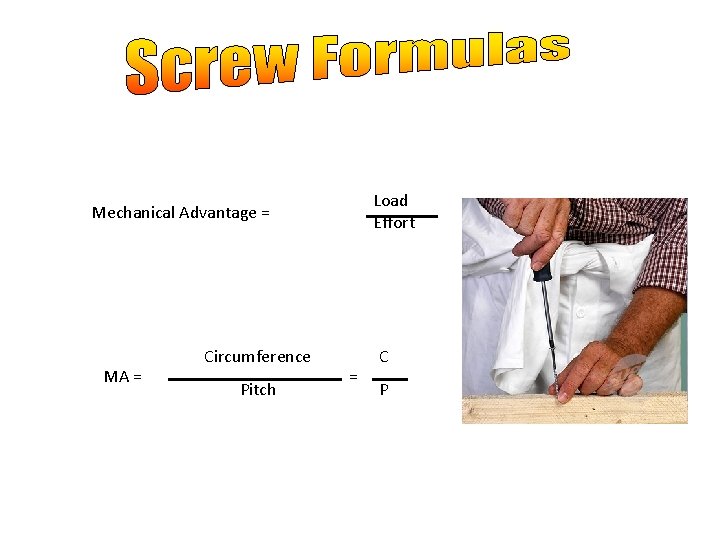
Load Effort Mechanical Advantage = MA = Circumference Pitch = C P
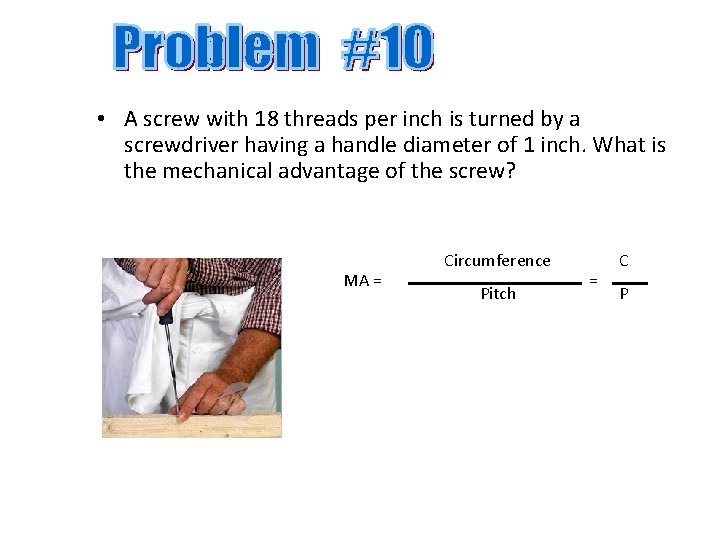
• A screw with 18 threads per inch is turned by a screwdriver having a handle diameter of 1 inch. What is the mechanical advantage of the screw? MA = Circumference Pitch = C P
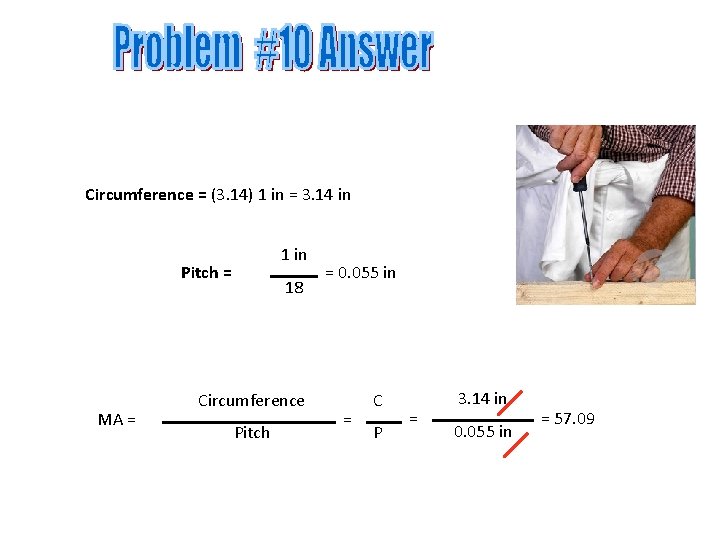
Circumference = (3. 14) 1 in = 3. 14 in 1 in Pitch = MA = 18 Circumference Pitch = 0. 055 in = C P = 3. 14 in 0. 055 in = 57. 09